ISSN: 1809-4430 (on-line)
_________________________
1Engenheiro A grônomo, Doutorando, Departamento de Engenharia de Biossistemas, USP/Piracicaba – SP, Fone: (19) 3447-8576,
2 Engenheiro A grônomo, Prof. Titular, Departamento de Engenharia de Biossistemas, USP/Piracicaba – SP, [email protected] 3 Engenheiro A grônomo, Doutor, Instituto Nacional de Ciência e Tecnologia – Engenharia da Irrigação, USP/Piracicaba – SP,
4 Engenheiro A grícola, Prof. Adjunto, Departamento de Engenharia, UFRRJ/Seropédica – RJ, [email protected]
MODELLING HEAD LOSS ALONG EMITTING PIPES USING DIMENSIONAL ANALYSIS
Doi:http://dx.doi.org/10.1590/1809-4430-Eng.Agric.v35n3p 442-457/2015
ACÁCIO PERBONI1, JOSE A. FRIZZONE2, ANTONIO P. DE CAMARGO3,
MARINALDO F. PINTO4
ABSTRACT: Local head losses must be considered in estimating properly the maximum length of
drip irrigation laterals. The aim of this work was to develop a model based on dimensional analysis for calculating head loss along laterals accounting for in-line drippers. Several measurements were performed with 12 models of emitters to obtain the experimental data required for developing and assessing the model. Based on the Camargo & Sentelhas coefficient, the model presented an excellent result in terms of precision and accuracy on estimating head loss. The deviation between estimated and observed values of head loss increased according to the head loss and the maximum deviation reached 0.17 m. The maximum relative error was 33.75% and only 15% of the data set presented relative errors higher than 20%. Neglecting local head losses incurred a higher than estimated maximum lateral length of 19.48% for pressure-compensating drippers and 16.48% for non pressure-compensating drippers.
KEYWORDS: microirrigation, lateral line, maximum length.
MODELAGEM DA PERDA DE CARGA EM TUBOS EMISSORES USANDO ANÁLISE DIMENSIONAL
RESUMO: As perdas localizadas de carga nos emissores devem ser consideradas para cálculo
preciso do comprimento máximo de linhas laterais de irrigação por gotejamento. O objetivo deste trabalho foi desenvolver um modelo utilizando análise dimensional para calcular perda de carga ao longo de linhas laterais de irrigação, constituídas por gotejadores in-line. Várias medições foram realizadas com 12 modelos de emissores a fim de obter dados experimentais requeridos para o ajuste e avaliação do modelo matemático. O modelo proposto foi classificado como excelente, de acordo com o coeficiente de Camargo & Sentelhas. Ocorreu aumento no desvio entre valores observados e estimados com o aumento da perda de carga, sendo que o desvio máximo foi de 0,17 m. O erro relativo máximo foi 33,73%, sendo que 15% dos dados ensaiados apresentaram erro relativo maior que 20%. A desconsideração da perda de carga localizada ocasionou superestimava do comprimento máximo da linha lateral de até 16,48%, para os tubos emissores não regulados, e de até 19,48%, para os tubos com emissores regulados.
PALAVRAS-CHAVE: microirrigação, linha lateral, comprimento máximo.
INTRODUCTION
manufacturing process; emitter clogging (TARCHITZKY et al., 2013; ZHOU et al., 2013) and pressure variations caused by slope (ZHU et al., 2010) and friction losses (RETTORE NETO et al., 2009; GOMES et al., 2010; VEKARIYA et al., 2011).
Total energy loss along laterals can be divided into two parts: major and minor losses. Major losses are associated with energy loss along the pipe due to frictional effects, which depend on fluid viscosity, wall roughness, internal diameter of the pipe, pipe length, and flow velocity. Although many equations are available for determining friction losses along laterals, the Darcy-Weisbach equation seems to be the most accepted for small diameter polyethylene pipes (YILDIRIM, 2009).
The introduction of the Blasius friction factor (equation 1) into the Darcy–Weisbach equation provides an accurate estimate of the frictional losses produced by turbulent flow inside uniform
pipes with low wall roughness and when the Reynolds number (R) falls within the range 3,000-105 (CARRIÓN et al., 2013).
(1)
For laminar flow regime ( ), the friction factor is given by [eq. (2)].
(2) Low-density polyethylene is usually used in the manufacture of micro irrigation laterals. The internal diameter of polyethylene pipes is affected by operating pressure (JUANA et al., 2002), which can change the hydraulic conditions of an irrigation system.
RETTORE NETO (2011) presented a model for determining continuous head loss that considers the modulus of elasticity of material, wall thickness of pipe, pressure inside the pipe, and consequently internal diameter variation due to pressure effects (equation 3). According to the author, the equation was an improvement on the Darcy-Weisbach formula and presented excellent results in estimating continuous head loss of polyethylene pipes.
(3) in which,
= head loss (m); = Pipe length (m);
= internal diameter of the pipe (m);
= mean water velocity at uniform pipe sections (m s-1); = gravitational acceleration (m s-2);
= pressure inside the pipe (Pa); = wall thickness of pipe (m),
= modulus of elasticity of material (Pa).
The insertion of emitters along a lateral line modifies the flow streamlines inducing additional pressure losses, which must be taken into consideration in order to accurately evaluate total energy losses along laterals (YILDIRIM, 2009).
(4) in which,
= local head loss (m);
= water velocity at the section of flow contraction (m s-1); = cross-sectional area of flow where an emitter is located (m2),
= cross-sectional area of the pipe (m2).
DEMIR et al. (2007) presented a model based on dimensional analysis to calculate the friction head loss in drip irrigation laterals equipped with in-line emitters (equation 5), which is valid for the following conditions: 0.2 ≤ ≤ 1 m; 0.01253 ≤ ≤ 0.01377 m; 0.01133 ≤ ≤ 0.01205 m;
0.03153 ≤ ≤ 0.06868 m; 3591 ≤ R ≤ 23688.
(5) in which,
= friction head loss between two consecutive emitters (m);
= emitter spacing (m);
= kinematic viscosity of water (m2 s-1); = emitter inside diameter (m),
= emitter length (m).
Dimensional analysis is a simple, clear and intuitive method for determining the functional dependence of physical quantities that influence a process (VEKARIYA et al., 2011). The aim of this work was to develop a model based on dimensional analysis for calculating head loss along laterals accounting for in-line drippers.
MATERIAL AND METHODS Model development
Dimensional analysis is a useful tool for developing predictive equations, which reduces the physical quantities to dimensionless groups called Π terms (VEKARIYA et al., 2011). The Π
theorem enables the organisation of experimental runs and the analysis of measurements by dimensionless groups. Using dimensionless groups permits a reduction in the number of runs and the testing of the global effects of the variables that occur in each group rather than the effect o f each singular variable (FERRO, 2010).
cross-sectional area of flow where an emitter is located ( ).
(6)
Equation (7) resulted from [eq. (6)] and it presents a theoretical model for estimating total head loss between two consecutive emitters, which considers the friction coefficient given by the Blasius equation (equation 1)] and the change in internal diameter due to elasticity and pressure inside the pipe (equation 3).
(7)
The following relationship can therefore be defined:
(8) in which,
is a functional symbol.
Table 1 presents [eq. (8)] rewritten as a dimensional matrix.
TABLE 1. Dimensional matrix.
M 0 0 0 0 0 1 0 1 0 0 0
L 1 1 1 2 1 1 -1 -1 1 2 2
T 0 -1 0 -1 0 -2 0 -2 -2 0 0
Table 1 shows eleven variables, where is the dependent variable and the remainder are
independent variables ( ). The physical process involves three
TABLE 2. Dimensionless terms. Dimensionless
term Meaning
Π term Function
Relationship between head loss and pipe diameter
Inverse of Reynolds number
Relationship between distance of emitters and pipe diameter
Inverse of Froude number
Relationship between cross-sectional area of the pipe and the square of the pipe diameter
Relationship between mean cross-sectional area of flow where an emitter is located and the square of the pipe diameter
Relationship between wall thickness and pipe diameter
Relationship between modulus of elasticity and pressure inside the pipe
The first dimensionless term was obtained by combining with the three basic variables (equation 9).
(9)
Rewriting [eq. (9)] as a dimensional equation:
(10)
The exponents of each dimension in [eq. (10)] are: , , , and
consequently the first Π term (equation 11) was obtained by substituting these values into [eq. (9)]. (11)
The second Π term was determined by combining with the basic variables and the other dimensionless terms were also obtained by a similar process.
Equation (12) was determined considering . The terms
(12)
Since Π terms were defined, 816 measurements were performed with 12 models of cylindrical in-line drippers to obtain the experimental data required for developing and assessing the model. Seventy percent of the collected data was applied to model developing and 30% was applied to model assessment and validation.
Model assessment and validation
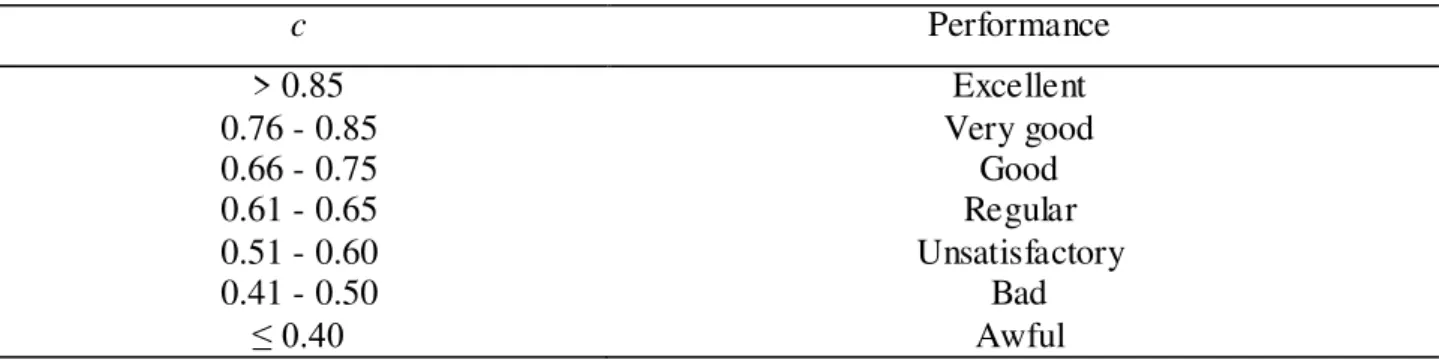
The Camargo & Sentelhas coefficient (CAMARGO & SENTELHAS, 1997) was used to indicate the model performance at estimating head loss. This coefficient combines the accuracy and precision of a model in a single value (equation 15) that can be interpreted based on Table 3. The Camargo & Sentelhas coefficient is the product of Pearson's correlation coefficient (equation 13) and Willmott's index of agreement (equation 14).
(13)
(14)
(15) in which,
= observed values;
= estimated values;
= Pearson's correlation coefficient; = Willmott's index of agreement, = the Camargo & Sentelhas coefficient.
TABLE 3. Criteria for interpreting model performance based on the Camargo & Sentelhas coefficient (CAMARGO & SENTELHAS, 1997).
c Performance
> 0.85 Excellent
0.76 - 0.85 Very good
0.66 - 0.75 Good
0.61 - 0.65 Regular
0.51 - 0.60 Unsatisfactory
0.41 - 0.50 Bad
≤ 0.40 Awful
Testing conditions
The differential manometer was used to determine total head loss along the lateral. Emitting pipes/emitters were totally plugged before carrying out the experiments and four repetitions were performed on each model. The pressure at the lateral inlet during all the tests was 196 kPa (±0.98 kPa) and the flow rate ranged from 160 to 1420 Lh-1 in increments of 80 Lh-1.
FIGURE 1. Diagram of the facility used to perform the tests.
For each emitting pipe model, the internal diameter ( ) and wall thickness ( ) of eight samples were measured using a horizontal benchtop optical comparator Starret HB400. The cross-sectional area of the pipe ( ) and the flow velocity at the pipe section ( ) were determined based on measured values of .
A digital thermometer (resolution 0.01ºC) was used to measure water temperature during the tests in order to estimate the kinematic viscosity and density of the water.
Following the procedure described by RETTORE NETO (2011), a tensile test machine (FIGURE 2) was used to perform uniaxial tensile tests in order to determine the modulus of elasticity of the pipes. Three repetitions were performed for each model of emitting pipe. The tested samples were 25-cm lengths and the machine was configured to apply tension at a speed of 10 mm/minute.
Methodology for determining the cross-sectional area of flow where an e mitter is located
The mean cross-sectional area of flow where an emitter is located ( ) was determined indirectly based on the volume of distilled water required to fill up a cylinder of pipe in which the emitter was assembled. Eight samples (cylinders) were extracted from each model of emitting pipe.
The length of each sample was exactly the length occupied by an emitter inside the pipe. The samples were sealed at one side so that they could be filled with water. Empty and water-filled samples were weighed using a digital balance (resolution 0.01 g). The value of each sample was obtained by dividing the water volume inside each cylinder by its length. A digital caliper (resolution 0.01 mm) was used to measure the cylinder length.
RESULTS AND DISCUSSION Model input data
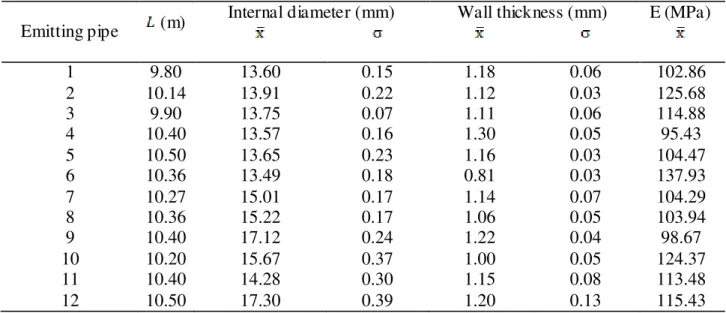
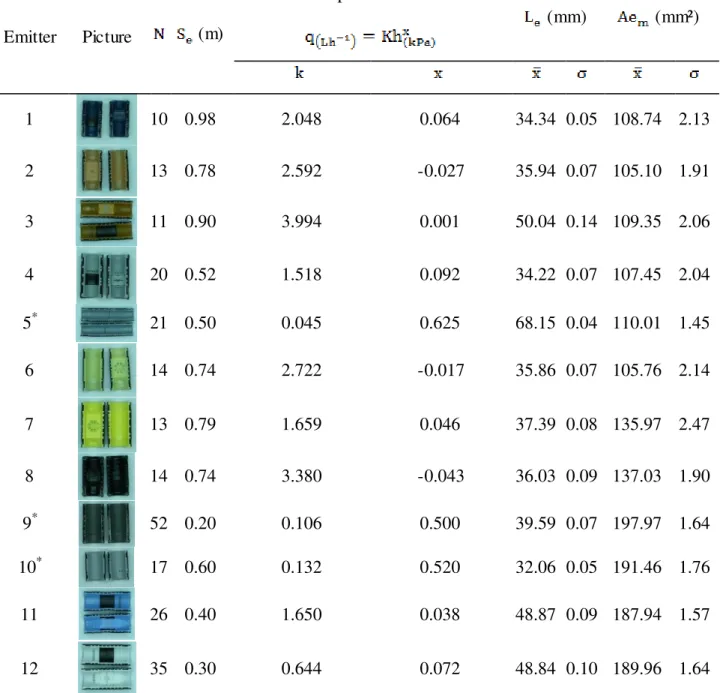
Table 4 and 5 describe the geometric properties of the pipes and emitters evaluated during the experiments.
TABLE 4. Properties of the pipes evaluated during the experiments.
Emitting pipe (m) Internal diameter (mm) Wall thickness (mm) E (MPa)
1 9.80 13.60 0.15 1.18 0.06 102.86
2 10.14 13.91 0.22 1.12 0.03 125.68
3 9.90 13.75 0.07 1.11 0.06 114.88
4 10.40 13.57 0.16 1.30 0.05 95.43
5 10.50 13.65 0.23 1.16 0.03 104.47
6 10.36 13.49 0.18 0.81 0.03 137.93
7 10.27 15.01 0.17 1.14 0.07 104.29
8 10.36 15.22 0.17 1.06 0.05 103.94
9 10.40 17.12 0.24 1.22 0.04 98.67
10 10.20 15.67 0.37 1.00 0.05 124.37
11 10.40 14.28 0.30 1.15 0.08 113.48
12 10.50 17.30 0.39 1.20 0.13 115.43
= average; = standard deviation;
TABLE 5. Properties of the emitters evaluated during the experiments.
Emitter Picture (m)
Relation pressure-flow rate
(mm) (mm²)
1 10 0.98 2.048 0.064 34.34 0.05 108.74 2.13
2 13 0.78 2.592 -0.027 35.94 0.07 105.10 1.91
3 11 0.90 3.994 0.001 50.04 0.14 109.35 2.06
4 20 0.52 1.518 0.092 34.22 0.07 107.45 2.04
5* 21 0.50 0.045 0.625 68.15 0.04 110.01 1.45
6 14 0.74 2.722 -0.017 35.86 0.07 105.76 2.14
7 13 0.79 1.659 0.046 37.39 0.08 135.97 2.47
8 14 0.74 3.380 -0.043 36.03 0.09 137.03 1.90
9* 52 0.20 0.106 0.500 39.59 0.07 197.97 1.64
10* 17 0.60 0.132 0.520 32.06 0.05 191.46 1.76
11 26 0.40 1.650 0.038 48.87 0.09 187.94 1.57
12 35 0.30 0.644 0.072 48.84 0.10 189.96 1.64
= Number of emitters along the lateral; and = coefficients of the pressure-flow rate function; * = non pressure-compensating drippers.
Validation and assessment of the model
TABLE 6. Statistical analysis.
Statistical parameter
R multiple adjusted Standard error Number of measurements
0.9951 0.9901
0.0629
571
ANOVA Source of
variation DF SQ QM F Ftab(1%) Fsig
Regression 4 225.484 56.371 14256.808 3.05 0
Error 566 2.238 0.004
Total 570 227.722
DF = degrees of freedom; SQ = Sum of squares; QM = Mean of squares; F = Calculated value of F-Test statistic; Ftab = Critical value of the F distribution at α = 0.01; Fsig = Significance level of acceptance of the null hypothesis.
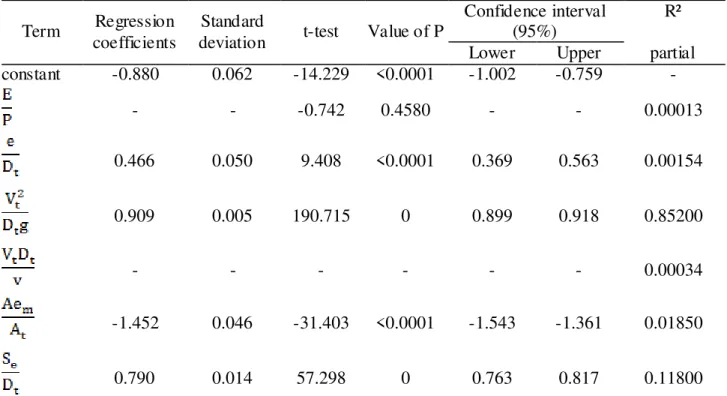
The calculated value of F was higher than the critical value and therefore the hypothesis of regression existence was accepted. The adjusted coefficients were evaluated by t-test and all of them differed from zero considering a significance level of 1% (Table 7).
TABLE 7 - Regression coefficients.
Term Regression
coefficients
Standard
deviation t-test Value of P
Confidence interval
(95%) R²
partial
Lower Upper
constant -0.880 0.062 -14.229 <0.0001 -1.002 -0.759 -
- - -0.742 0.4580 - - 0.00013
0.466 0.050 9.408 <0.0001 0.369 0.563 0.00154
0.909 0.005 190.715 0 0.899 0.918 0.85200
- - - 0.00034
-1.452 0.046 -31.403 <0.0001 -1.543 -1.361 0.01850
0.790 0.014 57.298 0 0.763 0.817 0.11800
ttab (1%) = 2.58; Value of P = Significance level of acceptance of the hypothesis that the regression exponent is equal to zero.
significance level. Nevertheless, both removed terms presented low values of partial R2 and have practically no effect on the model (Table 7).
[eq. (16)] was determined by substituting the regression coefficients from Table 7 into [eq. (12)] and applying the anti-logarithm.
(16)
Finally, after replacing with , assuming g is equal to 9.81 m s-2, and rearranging the terms, the proposed model is given by [eq. (17)].
(17) The model is valid for emitting pipes considering the following attributes and thresholds: 0.2
≤ ≤ 0.98 m; 0.01349 ≤ ≤ 0.01730 m; 0.18 ≤ ≤ 2.8 m s-1; 0.105x10⁻³≤ ≤ 0.198 x10⁻³ m2.
The proposed model can be classified as excellent, based on the obtained value of the Camargo & Sentelhas coefficient equal to 0.9925 (CAMARGO & SENTELHAS, 1997).
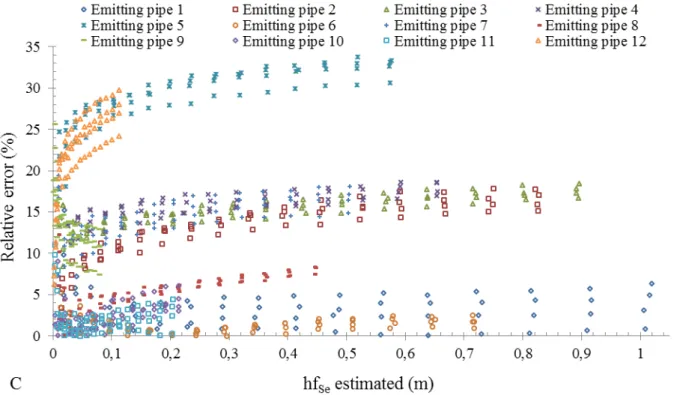
FIGURE 3. A) Estimated versus observed values of head loss; B) Cumulative frequency versus
relative error on estimating head loss ( ); C) Relative
error versus hfSe estimated for individual emitting pipes.
Comparison between the proposed model and the model presented by DEMIR et al. (2007)
The model presented by DEMIR et al. (2007) can be applied to estimating the head loss of just 5 of the 12 emitting pipes studied in this research (emitting pipes 1, 3, 4, 5, and 6). Figure 4 groups charts presenting observed hfSe, estimated hfSe by the proposed model and estimated hfSe
FIGURE 4. Observed hfSe(∆), estimated hfSe by the proposed model (
○
), and estimated hfSe usingthe model presented by DEMIR et al. (2007) (□).
Applying the developed model on designing late rals
An example of how to apply the developed model on designing the maximum length of laterals is presented and it assumes the following criteria: a) the maximum flow velocity along the lateral is 1.5 m s-1; b) the allowable variation in emitters' flow rate along the lateral is 5% and c) pressure at the lateral inlet is 120 and 200 kPa for non compensating (NPC) and pressure-compensating (PC) emitters, respectively.
TABLE 8. Maximum length of laterals placed on a level ground.
Emitting pipe (m)
A B 100 (A-B)/A
(m) (m) (%)
1 10.2 208 180 13.46
2 10.2 211 175 17.06
3 10.2 158 136 13.92
4 10.2 154 124 19.48
5* 0.92 122 105 13.93
6 10.2 183 164 10.38
7 10.2 260 226 13.08
8 10.2 212 183 13.68
9* 1.14 91 76 16.48
10* 1.1 128 130 -1.56
11 10.2 159 162 -1.89
12 10.2 303 248 18.15
= maximu m lateral length (m); = allowable head loss (m); A = results neglecting local head loss effects; B = results provided by the developed model; = difference in maximu m lateral length between A and B; * = non pressure-compensating drippers.
Comparing results from both methods, gave a value of 19.48%, which seems to represent a significant difference caused by neglecting local head loss effects. Depending on the type of dripper, GOMES et al. (2010) reported that maximum lateral length could be overestimated by around 25.7% (NPC drippers) and 9.5% (PC drippers) when local head losses were neglected. Based on the results shown in Table 8, the maximum lateral length was overestimated by around 19.48% (emitting pipe 4 - PC dripper) and 16.48% (emitting pipe 9 - NPC dripper) when local head losses were neglected.
CONCLUSIONS
The model developed for estimating total head loss along drip irrigation laterals requires only the following parameters: distance between emitters ( ); internal diameter ( ) and wall thickness ( ) of the pipe; flow velocity ( ) and mean cross-sectional area of flow where an emitter is located ( ). Although the final parameter ( ) is not available in the manufacturer's catalogue, the methodology presented in this work enables easy and rapid determination of and requires no sophisticated equipment.
Based on the Camargo & Sentelhas coefficient, the model for estimating head loss was classified as excellent and can be applied to the design of laterals accounting for in-line cylindrical emitters. Only 15% of the data set presented relative errors higher than 20%, whereas the maximum value was 33.73%. Since a single equation was used to estimate head losses, relative errors varied between emitting pipes due to their inherent peculiarities. Relative errors increased according to head loss for most of the emitting pipes.
The maximum lateral length was overestimated by around 19.48% for PC drippers and 16.48% for NPC drippers when local head losses were neglected.
ACKNOWLEDGEMENTS
Development Council (CNPq); the Sao Paulo State Scientific Foundation (FAPESP) and the National Institute of Science and Technology in Irrigation Engineering (INCTEI).
REFERENCES
BAGARELLO, V.; FERRO, V.; PROVENZANO, G.; PUMO, D. Evaluating pressure losses in drip--irrigation lines. Journal of Irrigation and Drainage Engineering, New York, v. 123, n. 1, p. 1-7, 1997.
BORSSOI, A. L.; VILAS BOAS, M. A.; REISDÖRFER, M.; HERNÁNDEZ, R.; FOLLADOR, F. A. C. Water application uniformity and fertigation in a dripping irrigation set. Engenharia
Agrícola, Jaboticabal, v. 32, n.4, p. 718-726, 2012.
CAMARGO, A. P; SENTELHAS, P. C. Avaliação do desempenho de diferentes métodos de estimativa da evapotranspiração potencial no estado de São Paulo, Brasil. Revista Brasileira de
Agrometeorologia, Santa Maria, v. 5, n. 1, p. 89-97, 1997.
CARRIÓN, F.; TARJUELO, D.; HERNÁNDEZ, D.; MORENO, M. A. Design of microirrigation subunit of minimum cost with proper operation. Irrigation Science, New York, p. 1-9, 2013. doi: http://dx.doi.org/10.1007/s00271-013-0399-8.
DEMIR, V.; YURDEM, H.; DEGIRMENCIOGLU, A. Development of prediction models for friction losses in drip irrigation laterals equipped with integrated in-line and on-line emitters using dimensional analysis. Biosystems Engineering, Silsoe, v. 96, n. 4, p. 617-631, 2007.
DOGAN, E.; KIRNAK, H. Water temperature and system pressure effect on drip lateral properties.
Irrigation Science, New York, v. 28, n. 5, p. 407-419, jun. 2010.
FERRO, V. Deducing the USLE mathematical structure by dimensional analysis and self-similarity theory. Biosystems Engineering, Silsoe, v. 106, n. 2 , p. 216-220, 2010.
GOMES, A. W. A.; FRIZZONE, J. A.; RETTORE NETO, O.; MIRANDA, J. H. Perda de carga localizada em gotejadores integrados em tubos de polietileno. Engenharia Agrícola, Jaboticabal, v. 30, n.3, p. 435-446, 2010.
JUANA, L.; RODRÍGUES-SINOBAS, L.; LOSADA, A. Determining minor head losses in drip irrigation laterals: I - Methology. Journal of Irrigation and Drainage Engineering, New York, v. 128, n. 6, p. 376-384, 2002.
PROVENZANO, G.; PUMO, D. Experimental analysis of local pressure losses for microirrigation laterals. Journal of Irrigation and Drainage Engineering, New York, v. 130, n. 4, p. 318-324, 2004.
RETTORE NETO, O. Modelo para determinação da perda de carga e m tubos elásticos.2011.
95 f. Tese (Doutorado em Irrigação e Drenagem) –Escola Superior de Agricultura “Luiz de
Queiroz”, Universidade de São Paulo, Piracicaba, 2011.
RETTORE NETO, O.; FRIZZONE, J. A.; MIRANDA, J. H; BOTREL, T. A. Perda de carga localizada em emissores não coaxiais integrados a tubos de polietileno. Engenharia Agrícola, Jaboticabal, v. 29, n.1, p. 28-39, 2009.
TARCHITZKY, J.; RIMON, A.; KENIG, E.; DOSORETZ, C. G.; CHEN, Y. Biological and chemical fouling in drip irrigation systems utilizing treated wastewater. Irrigation Science, New York, v. 31, n. 6, p. 1277-1288, 2013.
VEKARIYA, P. B.; SUBBAIAH, R.; MASHRU, H. H. Hydraulics of microtube emitters: a dimensional analysis approach. Irrigation Science, New York, v. 29, n. 4, p. 341-350, 2011. YILDIRIM, G. Simplified procedure for hydraulic design of small-diameter plastic pipes.
ZHOU, B.; L, Y.; PEI, Y.; LIU, Y.; ZHANG, Z.; JIANG. Y. Quantitative relationship between
biofilms components and emitter clogging under reclaimed water drip irrigation. Irrigation
Science, New York, p. 1-13, 2013. doi: http://dx.doi.org/ 10.1007/s00271-013-0402-4.
![Table 1 presents [eq. (8)] rewritten as a dimensional matrix.](https://thumb-eu.123doks.com/thumbv2/123dok_br/15932991.677440/4.893.86.808.597.715/table-presents-eq-rewritten-as-a-dimensional-matrix.webp)