Designing a Microstructural Array Associated with Hardness of Dual-phase Cu-Zn Alloy
Using Investment Casting
Gabriel Iecksa, Luiz Michel Aram Maiolob, Ausdinir Danilo Bortolozob, Wislei Riuper Osórioa,b*
Received: December 04, 2017; Revised: February 14, 2018; Accepted: March 19, 2018
A comparative investigation on the microstructural morphologies and hardness values of Cu-35 wt.% Zn and Cu-30 wt.% Zn with 1.5 wt.% Al content is provided. Distinctive specimens by using traditional investment casting were produced. Specimens withdrawn from distinct locations along the castings were thermally and microstructural analyzed. Thermally and chemically induced microstructural modifications affecting the microstructure and hardness are discussed. It is found that components (specimens) located at different positions along of the pattern tree casting have distinctive hardness values. This is associated with Cu segregation and cooling rate. It is also found that solidified piece under a cooling rate ~0.12 K/s has hardness 20% higher than the specimen solidified under 0.07 K/s. Duplex brass with Widmanstätten structure constitutes the resulting microstructure array. This seems to be associated with Al content, while both Zn and Al contents are associated with cooling rate as responsible parameter to induce Widmanstätten structure formation.
Keywords: Cu-Zn alloys, investment casting, microstructure, solidification, hardness.
* e-mail: [email protected]
1. Introduction
In order to design the performance of manufactured component as a function of the processing variables, a combination of determined hall of properties is very important. An alternative way to affect the resulting performance of a component is controlling of the resulting microstructural morphology by manipulating the processing variables. Some investigations have been developed, demonstrating the correlation between resulting microstructure array and properties1-10. Based on this, in this present study,
corroborations with some guidelines in order to preprogram a desired property intimately associated with microstructural array concerning to brass alloys applied in jewelry sector are carried out.
In the 1980's a number of investigations concerning to brass, jewelry, gold jewelry and investment casting have contributed with both technical and scientific aspect. Ott and collaborators11-13 and Nielsen14 have demonstrated factors
affecting the quality surface of castings and nucleation characterization inferring into the liquid and final surface of the castings. Zinc content effect12 and gas pressure in mold
during casting, which also affect the quality of the casting produced have also been reported by Ott et al.12,13. A number
of other important contributions concerning to Cu alloys (in particular brasses) involving thermodynamic aspects and some properties has been reported5-8,13-18,22,23. Recently, it has
been published a paper18 discussing a new shell casting for
investment casting for distinctive materials and applications. However, it is perceived that since the 80's decade there exists a lack of a contribution mixture between technical and scientific aspects directly focused on the jewelry industry. This contribution should indicate a range of operational parameters such as melting temperature correlated with piece volume and dimension, the corresponding position of the piece inside the casting, which affects significantly the resulting macrosegregation, cooling rate, visual/surface quality, mechanical properties and gold-plating quality. In this sense, this proposed investigation reasonably corroborates in this direction based on their obtained experimental results. Since their operational parameters are discussed and possibly controlled, a certain cost and desired performance (e.g. hardness and surface polishing) correlated with cooling rate can be attained.
The combination of workability, thermal and electrical conductivity, good wear and mechanical behavior, associated with reasonable corrosion resistance and low relative cost5,6,
a number of brasses in distinctive industrial applications (e.g. automobile, electronic, energy, etc.) are widely manufactured1-3,5,6. It is worthy noted that during the last
30 years the tribological behavior of these brasses has also been reported5,7,8. From the brass alloys required to bearing
application, both Cu content (> than 60 wt. %) and partial Pb content (of about 3%) are considered. This induces to a reasonable formability in a cold working and facilitated machining6.
aFaculdade de Ciências Aplicadas - FCA, Centro de Pesquisa de Materiais Avançados - CPMMA,
Universidade Estadual de Campinas - UNICAMP, 1300, Limeira, SP, Brasil
Cu-Zn is an important and well-known binary alloy system and at Cu-rich side has widely been investigated9.
Considering the group of non-ferrous metals, Cu-Zn alloys constitute a group of alloys in industrial application widely used10. Brasses are commonly produced in various domains
into the foundry industry in order to manufacture some distinctive components used e.g. in: civil engineering, aircraft industry, and machine buildings. The jewelry industry also constitutes an industrial sector, which has widely used these brasses to produce distinct components. Although the manufacturing of the brasses in jewelry parts has been carried for a long time, it is considered reasonably new the trade-off between performance and cost associated with environmentally-friendly aspect.
From the metallurgical point of view, both the alpha and alpha + beta (called as dual-phase) brasses are commonly used. It is known that the investment casting was established over 5500 years ago19. This process is the
proven technology to economically produce metal forms with complex geometries, narrow tolerances, great mechanical properties and superior surface finish. As aforementioned, there are various components manufactured using this process (e.g. turbine blades, dental crowns and fixtures, gears, jewelry, etc.)19,20. Prototypes are rapidly produced
from a customer furnished computer-aided design solid model. These associated with investment casting can be a powerful tool to casting industry with near-net shape, environmental-friendly, relative low cost and preprograming resulting properties.
Since the brasses offer a friendly-environmental aspect, in order to improve the resulting performance based on the applied process variables the jewelry sector has been taken attention. In this sense, a group of small business companies from the gold-plating sector and their association (i.e. Association of Gold-plated Jewelry from Limeira city, the Associação Limeirense de Joias - ALJ 21) have induced
reinforcements to improve the sector. Although the gold-plating jewelry industry is worldwide recognized, Limeira city (São Paulo state, Brazil) is renowned as the gold-plating capital city in Brazil21. Approximately 500 companies of semi
jewelry production are located at Limeira city. It has been stated21 that their monthly production attains of about 50 ton.
Based on the friendly-environmental aspect and compatible relative cost associated with reasonable performance (i.e. unsoundness, strength, hardness, ductility, workability and corrosion/oxidation behavior), the thermal and compositional aspects and operational parameters can be used to control of the resulting microstructural array of these semi jewelry pieces. As a direct consequence, the desired performance can also appropriately be attained.
From the metallurgical point of view, an investigation concerning to thermally and chemically induced microstructural modifications, which affect the hardness of a brass (Cu-Zn based) alloy seems to corroborate with up-dating knowledge.
This is scarce in literature, in particular considering duplex brasses applied to jewelry and semi-jewelry industries. Although this study is majority focused on jewelry industry, it is well known that bearing, medical and a number of other industries can be benefited. The novelty concerns to the fact of the chemical and thermal aspects are intimately associated with the resulting hardness and workability of the proposed components and investment casting parameters (i.e. location at pattern tree, molten temperature and cooling rate). A comparison between two distinctive Zn contents (i.e. 30 and 35 wt. %) and two different component shapes of a Cu-Zn-1.5Al alloy is carried out.
2. Experimental Procedure
2.1 Materials and samples preparations
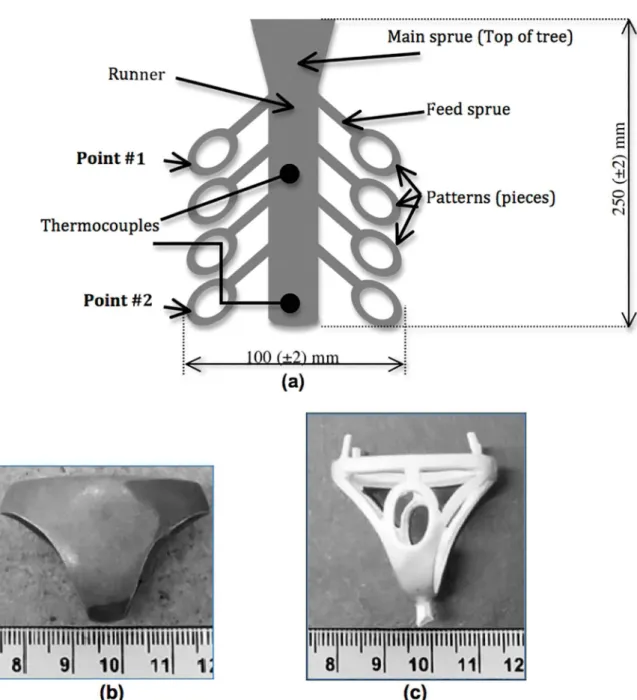
Commercial pure Cu (99.991 wt. %), Zn (99.993 wt. %), and Al (99.97 wt. %) are used. Two distinctive brasses with 1.5 wt.% Al content are produced: i) Cu-30 wt. % Zn (C30ZA) and ii) Cu-35 wt. % Zn (C35ZA). An inductive furnace is utilized to prepare the examined alloys samples. X-ray fluorescence (XRF) and EDS (energy dispersive spectroscopy) techniques are used to confirm the alloys compositions. Table 1 shows the chemical compositions of each examined brasses samples constituting the semi jewelry (ring) pieces. In the shell-building, gypsum to constitute the ceramic shell is used. The brass components with shaped-ring are called as "Model" 1, 1B, 2 and 3. Model 1 and 2 have designated composition as C35ZA since their chemical compositions and shapes are similar (i.e. ~35 wt.% Zn and 1.5 wt.% Al). They were obtained (withdrawn) from distinct locations at the pattern tree (casting). The component Model 1B has a same shaped-ring of Models 1 and 2 containing 30 wt. % Zn content (designated as C30ZA). Model 3 has a different shaped-ring, but it has a similar chemical composition when compared with Models 1 and 2. Models 1 and 2 are located approximately of 40 and 95 (±3) mm from the intersection between "main sprue" and "runner" of the proposed tree casting considering their corresponding "feed sprue", as schematically shown in Fig. 1(a).
Fig. 1(b) and 1(c) shows the corresponding shape-ring of the proposed brass samples, i.e. called as Model 1 and Model 3. At the top of the steel flask (tubes) containing the pattern tree are located the thermocouples, as also shown in Fig. 1. Thermocouples (Type K) strategically located at "main sprue" are used to recorded the cooling curves of each examined Model 1 at points #1 and #2, as show in Fig. 1(a). The cooling rates were determined based on the transformations detected in the experimental temperature
vs. time curves considering those specific thermocouple locations (points #1 and #2), as shown in Fig. 1(a).
Table 1. Chemical compositions of produced Models and its corresponding pure materials.
Chemical Composition (wt. %)
Cu Zn Al Si Sn Pb Fe
Model 1 balance 34.5 1.48 <0.02 <0.02 <0.01 0.032
Model 1B balance 30.2 1.66 <0.03 <0.03 <0.01 0.028
Model 2 balance 33.7 1.51 <0.02 <0.03 <0.02 0.030
Model 3 balance 34.2 1.49 <0.03 <0.03 <0.01 0.033
Al ingot <0.001 N/A balance 0.02 N/A <0.02 0.03
Cu ingot balance <0.001 <0.001 N/A N/A <0.001 <0.001
Zn ingot <0.002 balance <0.002 <0.001 <0.001 <0.001 <0.002
N/A = not available.
solidification, the casting trees were knocked out for remove the involving capsules of gypsum and brass samples (patterns) were cut-off and metallographically prepared.
2.2 Microstructural observation and hardness
The brass samples were mounted into molding epoxy and sequentially were ground using grit silicon carbide papers (up to 1200 mesh), washed into deionized water, degreased with acetone and dried by forced natural airflow. A 0.3 µm alumina paste/suspension for polishing was used. In order to reveal the resulting microstructure array for all examined brasses, a solution constituted of 10 % (vol.) ammonium persulfate during 2 and 4 s was used. Although there are other etchants to reveal the brass microstructure (i.e. FeCl3 into HCl solution5,10,22, and a HNO3 solution
23), the ammonium
persulfate has produced satisfactory micrographs. The grain sizes (GS) and the average lengths of needle-like or plate-like Widmanstätten were determined when were depicted. From each selected position lengthwise of each casting piece of about 10~20 values were measured. The averages and its corresponding error ranges were also determined.
Brinell hardness tests were carried out using a 5 mm diameter steel ball and a 62.5 kgf load (HBS 5/62.5, ASTM E10). The averages of HBS values were determined considering of about 15 measurements for each examined sample. Vickers microhardness were also performed indenting predominantly α phase and β phase using loading of 25 and 50gf (ASTM E384). For microhardness measurements, at least 5 points for each one of the examined samples were tested, and arithmetical mean values were determined.
3. Results and Discussion
3.1 Resulting microstructure array: distinctive
positions at casting
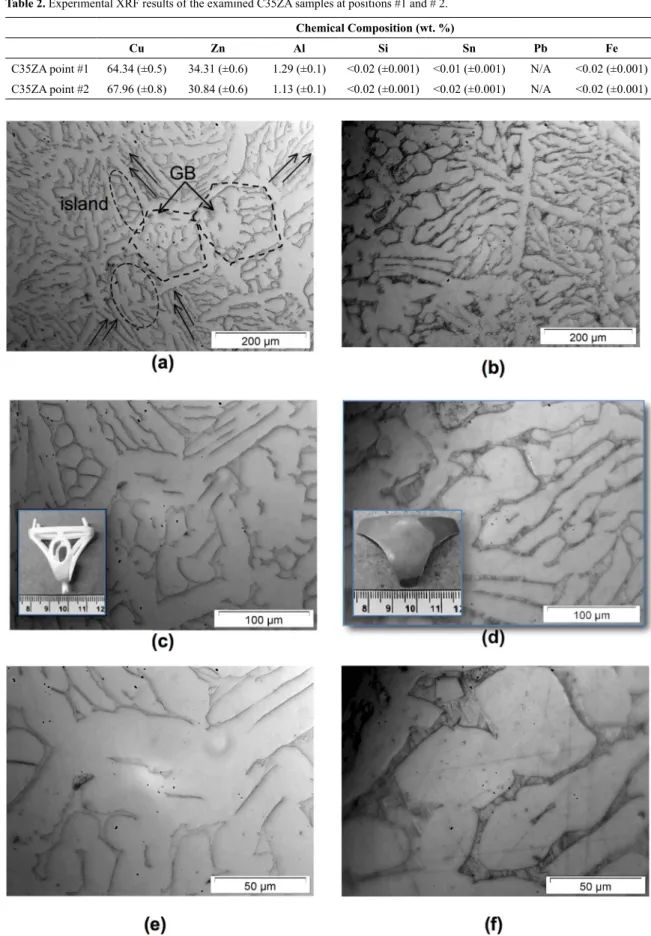
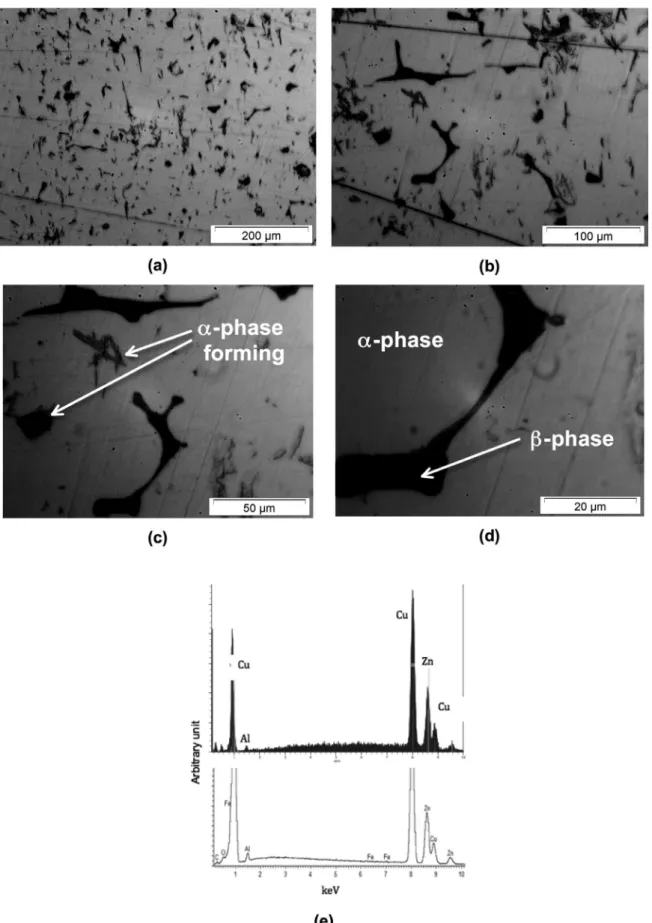
A comparison between the resulting microstructural array of similar shape and chemical composition of the pieces (Model 1, as shown in Fig. 1b) varying their corresponding positions along the casting (pattern tree) was provided. Typical micrographs of the as-cast brass C35ZA samples are depicted in Fig. 2.
Fig. 2 (a) and (c) corresponds to that of the resulting microstructure at point # 1, which is located at the top of the casting. On the other hand, the obtained microstructural array of the C35ZA alloy is correlated with the bottom of the casting (pattern tree), as shown in Fig. 2(b) and (d). Based on these microstructural observations, it can be seen that the classic Widmanstätten structures22-24 are formed.
The α phase (needle-like) Widmanstätten are predominantly formed, as depicted in Fig. 2 (a) and (c). The plate-like Widmanstätten structures are predominantly shown in Fig. 2(b) and (d). The resulting microstructures clearly reveal
that duplex phase (α plus β) are constituted. The phase α and β phases are represented by light (needles or plates) and dark regions, respectively. The α phase (light region) represents a solid solution of Zn in Cu (Zn-rich phase) and CuZn intermetallic (dark region, Cu-rich phase)5,22,23. A Cu-Zn
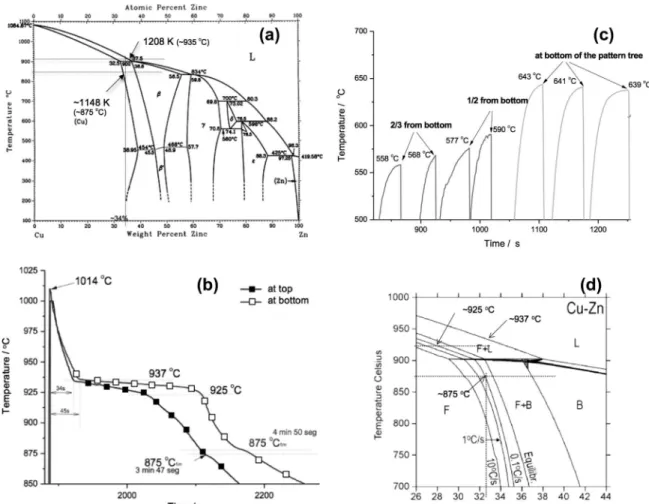
binary alloy phase diagram is shown in Fig. 3(a)6,9,24. Fig.
3(b) shows the experimental cooling curves at points #1 (top of the casting) and #2 (at bottom). It is worth noting that all steps (procedures) applied in the investment casting were very similar in order to obtain the examined samples. The Zn content and shaped-ring of Models 1B and 3 are different. It can clearly be observed that Widmanstätten (alpha-phase) structures are parallel to the β (110) plane and it precipitates at the grain boundary (GB) of the β phase, as well known in previous studies23,25-27.
A schematic representation to explain the precipitation and mechanism of formation for Widmanstätten structure has been recently reported23. When a Widmanstätten structure is
precipitated, a tile angle is formed and this phase growths toward to Y direction, as shown in Fig. 2(a). It is known that the island structure is parallel to the acicular structure and the island transfers into the acicular structure for another section23,26.
A mixture between needle-like Widmanstätten morphology and an island structure are observed in Fig. 2(a) and (c). The GB size is ranged between 195 (±15) µm and the average of the width for the alpha-phase (needle-like) Widmanstätten is of about 32 (±12) µm, while their corresponding average of the length is of about 85 (±8) µm. The characterization of coarser islands is clearly observed in Fig. 2(c) and (d). It can also be said that both the average of the length and width of the microstructure shown in Fig. 2(c) and (d) are higher than other ones. Hsieh et al.23 have reported that finer
(shorter) plate and acicular morphologies constitute slower mobile regions of the GB than the coarser morphology.
As aforementioned, two typical cooling curves corresponding with those thermocouples located at points # 1 (at top of the casting) and # 2 (at bottom), are shown in Fig. 3(b). It is remarkable that the flask is displaced inside a rotate furnace under a 0.5 rpm and temperature setting is at 913 K during 8 h before the pouring brass molten casting. The flasks (steel carbon) were displaced with its top at bottom of the rotate base of the furnace in order to dewaxing be provided. The dewaxing is facilitated with this displacement and at point #2 a higher temperature (~ 913 K, i.e. ~ 640 oC) than the
point # 1 is registered (~ 853 K, i.e. ~ 580 oC).
Fig. 3(c) depicts distinctive experimented temperatures in order to evidence the thermal behavior at bottom, 1/2 and 2/3 from the bottom of the flask (at pattern tree). From the cooling curves, it can be observed that at bottom of the casting a temperature of about 1287 K (~ 1014 oC) is
Figure 2. Typical microstructure arrays in different magnifications for brass C35ZA alloy located at: (a) and (c) point #1 (top of the casting) and (b) and (d) point #2 (bottom of the casting).
K (~1000 oC). It was taken of about 45 s and 34 s to initiate
the solidification at positions #2 (bottom) and #1 (top), respectively. It is perceived that the bottom of the casting (point #2) solidifies after the point #1. This initiates at 1210 K (937 oC) up to 1198 K (925 oC) under cooling rates of
0.12 (±0.011) K/s and 0.07 (± 0.008) K/s at position #2 (bottom) and #1 (top), respectively. These cooling rates are typically observed when a ceramic (gypsum) shell mold in the investment casting is used.
Based on these aforementioned experimental results, it is corroborated with the jewelry manufacturers that commonly not check, inspect and controlling the eminent molten before pouring in chamber or mold. As will forwardly be discussed, these operational procedures have an important roles on the resulting microstructure arrays and consequently on their corresponding results of the mechanical behavior.
It is well known that in an equilibrium solidification condition, a peritectic temperature at 1175 K (902 oC) will
occur, as shown in Cu-Zn phase diagram28-31. The liquidus
temperature seems to be at 1210 K (937 oC) and the beta-phase
transformation seems to be consolidated at 1148 K (902 oC),
as observed in Cu-Zn phase diagram. At temperature ~ 1198 K (~ 925 oC) a slight variation in cooling curve is observed. This
seems to be correlated with a modified peritectic transformation due to a non-equilibrium solidification condition. Some investigations have shown that the peritectic temperature in a non-equilibrium can slightly be varied28-31. It is remarkable
that solidification in a non-equilibrium condition is typically applied in jewelry sector, which indicates that preprograming of the operational parameters have important roles onto the resulting mechanical behavior.
Investigation developed by Miettinen31 considering Cu-Zn
alloys system has demonstrated that the solidus temperature and α → α+β transformation field are significantly modified when cooling rate is increased (i.e. displaced to left side ortowards to lower Zn content direction). Miettinen31 has
demonstrated a partial Cu-Zn phase diagram with four variations of solvus line as a function of different cooling rates (i.e., under equilibrium, 0.1, 1, and 10 oC/s). Considering
Figure 3. (a) Cu-Zn phase diagram; (b) Experimental cooling curves at points #1 (top of the casting) and #2 (at bottom); (c) recorded temperature in three distinct positions inside the pattern tree before the casting (i.e. at bottom, 1/2 and 2/3 from the bottom of the flask); and (d) a partial Cu-Zn phase diagram adapted from Miettinen31 evidencing the effect of cooling rate on transformation temperatures for brasses.
observed thermal transformations seem to be similar with prescribed in phase diagram, as shown in Fig. 3(d) (adapted from31).
Another important observation that should also be taken in account is the fact that the piece located at bottom of the pattern casting tends to be a slightly higher Cu content than the sample observed at top of the casting. This is intimately associated with Cu segregation. It is known that Cu density is of about 25% (~ 8.9 g cm-3) higher than Zn (~ 7.14 g
cm-3), which under a slow solidification a Cu segregation
is provided. Table 2 shows the XRF results (average from duplicate analysis) for the examined C35ZA samples at positions #1 and # 2 evidencing that Cu segregation has occurred. Several manufacturers reasonably neglect these thermo and physical phenomena. Consequently a rather and poorly homogenization of the melting is provided and a deleterious effect provoked by a Cu macrosegregation is attained. It is mentioned deleterious effect due to the difference in the Cu-to-Zn mass ratio, the resulting mechanical behavior is significantly affected. With this, the hardness is decreased while the ductility is increased and a definitive plastic deformation on the surface of the pieces when polishing can
easily occur. This means that a complementary treatment to correction at the surface will be demanded. Finally, the manufacturing costs can significantly be modified.
3.2 Resulting microstructure array: distinctive
Models
Table 2. Experimental XRF results of the examined C35ZA samples at positions #1 and # 2.
Chemical Composition (wt. %)
Cu Zn Al Si Sn Pb Fe
C35ZA point #1 64.34 (±0.5) 34.31 (±0.6) 1.29 (±0.1) <0.02 (±0.001) <0.01 (±0.001) N/A <0.02 (±0.001)
C35ZA point #2 67.96 (±0.8) 30.84 (±0.6) 1.13 (±0.1) <0.02 (±0.001) <0.02 (±0.001) N/A <0.02 (±0.001)
It is also clearly observed the typical Widmanstätten structures for both the Models 1 and 3 (thinner) are formed. The former microstructural array (Fig. 6 b, d and f) is coarser than the latter (Fig. 6 a, c, and e). With this comparison, it can be induced that the thinner Model has a finer needle-like α phase, finer grain size and islands than ones.
Fig. 2(a) and (c) corresponds to the solidified microstructural array at point #1, which is located at the top of the casting. On the other hand, the resulting microstructure of the C35ZA alloy is correlated with the bottom of the casting (pattern tree), as shown in Fig. 2(b) and (d). Based on these microstructural observations, it can be seen that a typical and traditional Widmanstätten structure is formed. The needle-like α-phase Widmanstäetten for the Model 3 (thinner) attains a width between 12 and 50 µm while the Model 1 has attained between 25 and 80 µm, as shown in Figs. 4 (e) and (f). It is important to remember that a Widmanstätten structure is constituted from the precipitation of a new solid phase at high temperature decomposing into two solid phases at a lower temperature32. This precipitation usually occurs at
the grain boundaries of the initial crystals within the grains themselves (needle- or plate-like phase), which have particular orientations depending on the crystallographic structures of the original crystals32.
It is known that a β-phase (Zn-rich region, dark region) has a body centered cubic (BCC) lattice32-34, which is harder
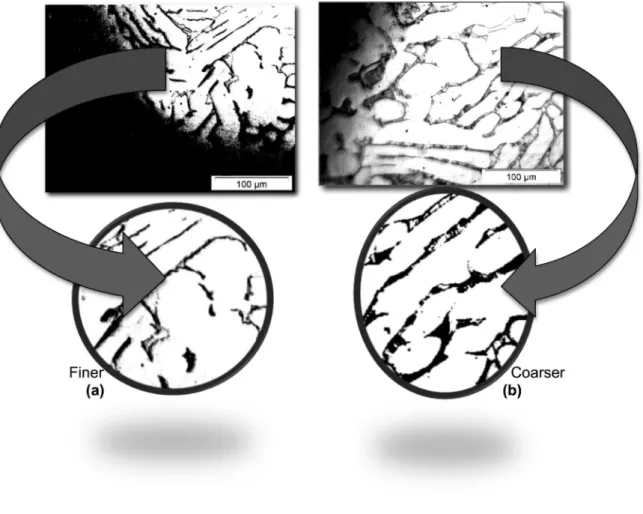
than the α-phase. Cu has a face-centered cubic (FCC), while a hexagonal close-packed lattice (HPC) is constituted by Zn. After a peritectic reaction, the Zn-rich phase (β-phase) is consolidated. These phases are constituted by dark regions, as shown in Figs. 2 and 4. For this reason, a high cooling rate induces to a finer microstructural array. This provides a finely and homogeneously distributed β-phase, which provides for the Model 3 a microstructure of about 3 x finer then other examined samples. This also suggests that the mechanical behavior is improved. When the ductility is predominantly desired in a component produced under this condition, the thermal condition should be revised in order to preprogram another more adequate. Although very similar Cu and Zn contents, the finer microstructure (Model 3) has ~ 5 % of the average of the black area percentage corresponding with β-phase, while ~ 17 % corresponding with coarser microstructure is attained, as shown in Fig. 5.
Fig. 5(a) and (b) demonstrates typical binary images of those micrographs shown in Fig. 4. Image intensity threshold was applied in order to become binary images using sections of 300 per 300 pixels (at least 100,000 µm2).
Fig. 5(c) shows the average of the β-phase determined from the obtained binary images. It is known that the β-phase is primarily solidified, and this confirms that a high cooling rate provides finely and homogeneously distributed black regions. On the other hand, a more slowly cooled microstructure is constituted by a coarser β-phase and needle to plate-like α-phase (Widmanstätten structure). It is also worth noting
that the jewelry manufacturers immerse the brass casting into water container intending to reduce the producing cycle. Consequently, distinct microstructural array from that initially planned are established. Instead a reduction of the production time be attained, the complementary procedures will be required, and consequently the final cost will be increased.
3.3 Resulting microstructure array: two
distinctive Zn contents
In order to evaluate the effect of the chemical modification on the resulting microstructure array of the examined brasses, the Model 1 was selected. However, Zn content was reduced to ~ 30 wt. % and ~1.6% (wt. %) and Al content was remained. This sample was called as Cu-30 wt. % Zn alloy with ~ 1.6 wt. % Al (C30ZA) considering the Model 1B, as shown in Fig. 1(b).
Fig. 6 shows the distinct optical magnifications for a typical microstructure of a C30ZA. A duplex α/β phase formation is clearly observed. For this brass composition, the Widmanstätten morphology was not characterized. The α-phase (light region) is predominantly formed, while the β phase (dark region) seems to be occupied into pseudo-interdendritic arms. Experimental Investigations22,23 have
shown similar microstructures when Zn content attains between 30 and 40 wt. %. It is important to remember that this microstructure shown in Fig. 6 was manufactured by using the same Model 1 shown in Fig. 1(b). Based on literature, it is presumed23,26-31 that a Widmanstätten array
in a brass has a critical chemical composition (~30 wt. % Zn) to be formed. Depending of the applied cooling rate, the composition vs. temperature for α+β phase and Widmanstätten formation can be significantly modified31. This seems to help
to explain the reason for a sample C30ZA be constituted by a duplex structure formation. In the investigation developed by Pantazopoulos and Vazdirvanidis22, it was found that the
brass phases formation are intimately associated with both the casting and thermo-mechanical conditions (e.g. cooling rate and extrusion temperature, respectively).
Although Widmanstätten structure is not predominantly characterized, it seems that both Zn content and cooling rate have corroborated to initiate this formation, as depicted in Fig. 6. Although the cooling rate was no specifically determined for this samples, it will define both the alpha and α and β phase morphologies and sizes. Wood and Hellawell26
is relative higher than a certain adequate temperature and both Zn and Al contents can be "missed". This is strongly affected when the cooling rate and/or Zn content (or Cu-to-Zn ratio) are modified. Besides, Al addition seems to provide a deleterious effect in the gold plating, which delaminates the Au-plated coating. Besides, dirt into galvanic bath can also be incorporated and the efficiency of the gold-plating and its cycling life-time are considerably be reduced.
From the metallurgical point of view, thermally and chemically induced modifications have affected the resulting microstructure of the examined brasses. Different hardness measures have been obtained due to these distinct microstructural morphologies. In order to correlate the experimental hardness results with their corresponding microstructure array some comparisons were made.
3.4 Hardness, microstructure array and cooling
rate correlations
It was previously mentioned that HPC and FCC lattices are corresponding with Zn and Cu, while a BCC lattice characterizes the β- Zn rich phase32-34. Haque and Khan35 have
reported that a Cu-Zn casting alloy has both its hardness and tensile strength varying with the imposed casting condition. It was reported that the sand casting samples attain hardness values ~ 45 HV, while the chilled casting samples have achieved of about 60 HV. The former alloy sample evidences a tensile strength ~ 150 MPa, while the latter has exhibited approximately 200 MPa. It is important to remember that the resulting microstructure characterized in this mentioned investigation has no demonstrated a Widmanstätten formation. This seems to be intimately correlated with their chemical composition, i.e. ~ 69 wt. % Cu, 30 % wt. Zn, 1.2 wt. % Sn and 0.11 wt. % Pb35.
In order to compare the hardness of the examined brasses in this present investigation and to correlate with their resulting microstructures, the hardness measurements of commercial brasses are also discussed. Based on the mechanical behavior results obtained from the Copper Development Association36,37,
two casting brasses commercially recognized into Unified Numbering System were analyzed, i.e. (UNS) C85500 (casting) and C85450. Since these mentioned UNS brasses have similar chemical compositions with those examined in this present study (i.e. Zn content, low or free-Pb and Sn, and low Fe and Al contents), they were selected in order to comparison be provided. In this sense, the mechanical strengths of both commercial and examined brasses are shown in Table 3. Although the corresponding cooling rates for commercial brasses are not indicated (no described in literature), it is induced that the C85500 produced using a permanent mold surely has a higher cooling rate than the C85500 produced by using a sand-cast condition. This significantly affects their hardness (in HRB or H Brinell) and tensile strength, as demonstrated in Table 3.
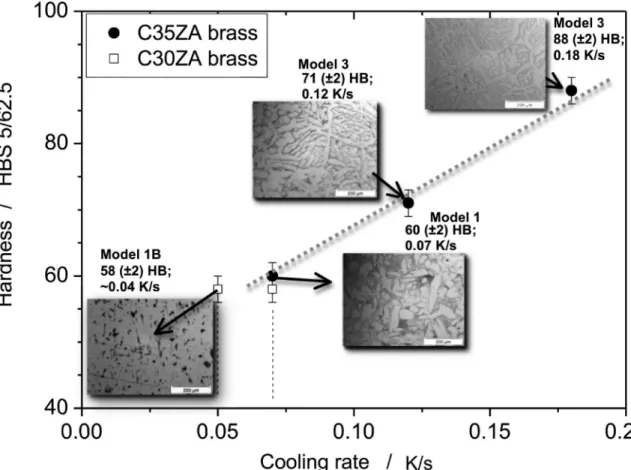
Based on the experimental hardness results and compared with the aforementioned commercial brasses, it is hardly induced that the increase of the hardness of a duplex brass component produced by investment casting is obtained when the cooling rate receives a certain preprograming and controlling. A C35ZA brass sample constituting the Model 3 (Fig. 1c) produced under a cooling rate ~0.18 K/s generates a finely and homogeneously Widmanstätten microstructure array. Their obtained hardness result (~ 88 HB) is similar to those obtained for commercial casting brasses (~ 85 HB)36,37.
Based on these hardness measures and the obtained microstructural arrays, it can also be concluded that the highest Brinell hardness is that of the sample with ~ 35 wt. % Zn and 1.5 (±0.1) wt. % Al contents, which has been produced under a 0.18 K/s. The intermediate HB hardness is that of similar chemical composition under 0.12 K/s. The lowest HB hardness values are those of the C35ZA and C30ZA brasses samples.
Although the experimental cooling rate was not determined for the C30ZA sample, it is speculated that their corresponding cooling rate is similar to C35ZA (i.e. ~0.07 K/s) due to their shape is also very similar. It is expected that this similarity in hardness is associated with duplex structure formation. It is clearly also observed that HV microhardness measurements have also accompanied the general HB hardness, i.e. HV microhardness decreases with decreasing the cooling rate.
A number of experimental investigations38-44 considering
distinctive materials and alloys has reported that the increase of the imposed cooling rate generates an increase in the mechanical behavior. Based on the experimental results and comparing with commercial brasses, evaluations between examined brasses and those commercial brasses can be carried out. The effect of the cooling rate on the resulting microstructure array is summarized in Table 3. Since the main core of this proposed investigation is to demonstrate the effect cooling rate upon the microstructure and consequently on the attained hardness, when comparing the values shown in Table this correlation can be understood. It is also worth noting that a duplex brass has both the alpha and betha phases. These phases have their individual contribution in order compose the general hardness of the solidified brass. As also can be observed in Table 3, the α-phase has a lower hardness (designated in HV hardness) than the β-phase. It is confirmed that β-phase is hardener than α-phase, as also shown in Table 3. This helps to explain the fact when a fine and homogenously β-phase distributed induces to a positive strengthening effect.
Table 3. Mechanical properties* of both the commercial and examined Cu-Zn brasses.
Casting
Condition Designation
Cooling
rate Hardness Tensile Strength Microstructure
Commercial
Permanent mold C85500** N/A 55HRB (~85 HB) 60 ksi (~420 MPa) N/A
Sand cast C85500** N/A 53 HRB (~82 HB)*** 54 ksi (~370 MPa) N/A
N/A (rod & bar) C85450 N/A 80 HRB (~120 HB)*** 55 ksi (~375 MPa) N/A
Examined Investment casting
C35ZA
(Model 1) 0.12 K/s
71 (±2) HB
115 (±8) HV at β phase; 60 (±4) HV at α phase
N/A
α + β phases
(needle-like Widmanstätten)
C35ZA
(Model 2) 0.07 K/s
60 (±2) HB
90 (±10) HV at β phase; 60 (±5) HV at α phase
α + β phases
(coarser Widmanstätten)
C35ZA
(Model 3) 0.18 K/s
88 (±2) HB
124 (±4) HV at β phase; 70 (±5) HV at α phase
α + β phases (finer Widmanstätten)
C30ZA
(Model 1B) N/A 58 (±2) HB α + β phases
*Measurements determined at environmental temperature. ** Obtained from References35-37. *** approximately converted values (ASTM
E140). N/A is not available.
Figure 7. Correlation between experimental hardness (HB) with cooling rate for the C35ZA and C30ZA brasses.
behavior (i.e. ~ 60 HB). On the other hand, considering a same Zn content, an increase of the hardness (~ 90 HB) is attained when a cooling rate from ~ 0.12 K/s to ~ 0.2 K/s is increased. It is remembered that the increase of about 2 times of the applied cooling rate seems to be cheaper than the increase of Zn content or other strengthening element
From the aforementioned discussion concerning to the microstructural array, chemical composition and hardness measurements, it is induced that from those examined duplex brasses samples, the β phase seems to be precipitated with Al content, as also verified in previous investigations5,6,22,23,26-28.
The Widmanstätten formation seems to be associated with both Zn and Al contents (or their Zn to Al mass ratio) and the imposed (experimentally practicable) cooling rate. For instance, the C30ZA brass sample has Al content and Widmanstätten has no occurred or no predominantly formed, as shown in Fig. 6.
Among the examined duplex brass structures, independently of their chemical composition, the hardness has increased with increasing the resulting cooling rate. This seems to be intimately associated with fineness of the resulting Widmanstätten array. This evidences that thermally and chemically induced microstructural modification affects substantially the resulting hardness. In this sense, it is hardly indicated to the jewelry's manufacturers that independently of the selected manufacturing route, the imposed cooling rate should meticulously be preprogrammed, controlled and analyzed.
In the investment casting commonly used in jewelry sector, the position (location) of the piece in the pattern tree (along the casting) should be carefully designed (planned) intending that a certain and adequate cooling rate condition be provided. This will surely originates in a microstructural array with a slightly increase in the desired mechanical behavior. For instance, if there is a design for a thinner piece to be produced (inside casting mold), a low hardness will be attained when this piece at the bottom of the casting is located (positioned). On the other hand, if an increase in the hardness is desired for this mentioned piece, it seems that the increase of the Zn content limiting up to 45 wt. % is a reasonable mechanical solution. When complementary working is required (e.g. drilling, ground, polishing, etc.), it is suggested that a lower hardness be obtained. In this sense, it seems that an argon injection and/or an overheating provide a resulting ductility compatible with proposed future working. It is worth noting that the flask temperature has also an important role on the resulting microstructural array and due to, it should also be associated with the pouring temperature in order to determine the cooling rate of the examined brasses.
Based on the aforementioned experimental results associated with the fact that examined brasses have friendly-environmentally aspect, low relative cost associated with controllable performance (e.g. hardness, ductility, and castability), this experimental study corroborates with both jewelry and other industries in order to improve the technical and operational understanding of the effects correlated with thermal and compositional aspects and operational parameters controlling the microstructure formed. As a direct consequence, each distinctive component accordingly with
their different desired performance can be appropriately preprogramed. With this, both the chemical composition (Zn and Cu contents) and applied cooling rates before neglected by jewelry manufacturers when planning a component will be more adequately analyzed.
4. Conclusions
1. Based on the experimental results is revealed both thermal and chemical effects on induced microstructural modification and, consequently on the mechanical behavior. The following conclusions can be drawn. 2. Considering an investment casting proceeding
and inside a same pattern tree, it is found that the manufactured components located at distinctive positions along the casting containing very similar Zn and Al contents have their values of hardness differently ranged. It is found Cu segregation at the bottom of the examined casting. A finer microstructure array is formed and a hardness ~20% higher (~70 HB) than the located at the bottom of the casting is provided.
3. It is also found that a thinner piece exhibits a more finely and homogeneously distributed β phase with finer Widmanstätten structure than the piece solidified under low cooling rate. This also evidences the important role of the thermal effect on the microstructural morphology and hardness. 4. A duplex brass seems to be intimately associated
with Al content, which induces to a strengthening effect. The hardness is increased with the increase of the cooling rate, which seems to be associated with fineness of the Widmanstätten array.
5. Acknowledgements
The authors acknowledge financial support provided by FAEPEX-UNICAMP (#2335/17), and CNPq (The Brazilian Research Council, Grants #304950/2017-3 and #446797/2014-6).
6. References
1. Heidarzadeh A, Saeid T. A comparative study of microstructure and mechanical properties between friction stir welded single and double phase brass alloys. Materials Science and Engineering:
A. 2016;649:349-358.
2. Dasharath SM, Mula S. Mechanical properties and fracture
mechanisms of ultrafine grained Cu-9.6% Zn alloy processed
by multiaxial cryoforging. Materials Science and Engineering:
A. 2016;675:403-414.
3. Leinenbach C, Transchel R, Gorgievski K, Kuster F, Elsener
HR, Wegener K. Microstructure and Mechanical Performance of
Nano-Sized TiC Particles. Journal of Materials Engineering and Performance. 2015;24(5):2042-2050.
4. Zuo X, Zhu J, An B, Han K, Li R, Wang E. Influence of Fe
addition on microstructure and properties of Cu-Ag composite.
Metals and Materials International. 2017;23(5):974-983.
5. Panagopoulos CN, Georgiou EP, Simeonidis K. Lubricated wear behavior of leaded α + β brass. Tribology International. 2012;50:1-5.
6. García P, Rivera S, Palacios M, Belzunce J. Comparative study
of the parameters influencing the machinability of leaded brasses.
Engineering Failure Analysis. 2010;17(4):771-776.
7. Sundberg M, Sundberg R, Hogmark S, Otterberg R, Lehtinen B, Hörnström SE, et al. Metallographic aspects on wear of
special brass. Wear. 1987;115(1-2):151-165.
8. Mindivan H, Çimenoglu H, Kayali ES. Microstructures and
wear properties of brass synchroniser rings. Wear. 2003;254(5-6):532-537.
9. Gierlotka W, Chen S. Thermodynamic descriptions of the Cu-Zn system. Journal of Materials Research. 2008;23(1):258-263.
10. Ozgowicz W, Kalinowska-Ozgowicz E, Grzegorczyk B. The
microstructure and mechanical properties of the alloy CuZn30 after recrystallizion annealing. Journal of Achievements in
Materials and Manufactoring Engineering. 2010;40(1):15-24.
11. Ott D, Raub CJ. Investment casting of gold jewellery. The surface properties of castings: Effects of casting atmospheres
and other factors. Gold Bulletin. 1985;18(4):140-143.
12. Raub CJ, Ott D. Gold casting alloys. The effect of zinc additions
on their behaviour. Gold Bulletin. 1983;16(2):46-51.
13. Ott D, Raub CJ. Investment casting of gold jewellery. Factors affecting the filling of moulds. Gold Bulletin. 1986;19(2):34-39.
14. Nielsen JP. Solidification fundamentals of jewelry and dental casting. In: Proceedings of the Sixth International Precious Metals Institute Conference; 1982 Jun 7-11; Newport Beach, CA, USA.
15. Ingo GM, Chiozzini G, Faccenda V, Bemporad E, Riccucci C. Thermal and microchemical characterisations of CaSO4-SiO2
investment materials for casting jewellery alloys. Thermochimica
Acta. 1998;321(1-2):175-183.
16. Sbornicchia P, Montesperelli G, Ingo GM, Gusmano G. Advances
in jewellery microcasting. Thermochimica Acta. 2004;419(1-2):195-204.
17. Pattnaik S, Karunakar DB, Jha PK. Developments in investment casting process - A review. Journal of Materials Processing
Technology. 2012;212(11):2332-2348.
18. Jiang W, Fan Z, Liao D, Dong X, Zhao Z. A new shell casting process based on expendable pattern with vacuum and low-pressure casting for aluminum and magnesium alloys. The
International Journal of Advanced Manufacturing Technology.
2010;51(1-4):25-34.
19. Beeley PR, Smart RF, eds. Investment Casting. 1st ed. Cambridge:
The University Press; 1995.
20. Liu Q, Leu MC. Fabrication of dental crowns by investment casting with rapid freeze prototyping generated ice patterns.
In: Medical Device Materials: Proceeding of the Materials &
Processes for Medical Devices Conference; 2003 Sep 8-11;
Anaheim, CA, USA. p. 438-443. DOI: 10.1361/cp2003mpmd438.
21. ALJ - Associação Limeirense de Joias. Limeira - A Capital
da Joia Folheada. Available from: <http://www.alj.org.br>.
Access in: 02/09/2015.
22. Pantazopoulos G, Vazdirvanidis A. Characterization of the
microstructural aspects of machinable α-β phase brass. Microscopy and Analysis. 2008;22:13-16.
23. Hsieh CC, Wang JS, Wu PTY, Wu W. Microstructural development of brass alloys with various Bi and Pb additions. Metals and Materials International. 2013;19(6):1173-1179.
24. Baker H, ed. ASM Metals Handbook, Alloy Phase Diagrams.
Volume 3. Metals Park: ASM International; 1992.
25. heARTJOIA. Tutoriais e manuais de joalharia. Available from: <http://www.heartjoia.com/4485-fundicao-cera-perdida-microfundicao-ouro-prata>. Access in: 02/09/2015.
26. Wood MS, Hellawell A. Grain boundary precipitation in αβ
brass. Acta Metallurgica. 1961;9(5):428-433.
27. Simonen EP, Trivedi R. Edgewise growth of Widmanstätten
alpha precipitates in brass. Acta Metallurgica. 1977;25(8):945-950.
28. Korojy B, Fredriksson H. On solidification and shrinkage of
brass alloys. International Journal of Cast Metals Research. 2009;22(1-4):183-186.
29. Boettinger WJ. The structure of directional solidified
two-phase Sn-Cd peritectic alloys. Metallurgical Transactions. 1974;5(9):2023-2031.
30. Zhou X, Hsu TY. Thermodynamics of the ɑ and β phases equilibria and ordering in Cu-Zn system. Acta Metallurgica. 1989;37(11):3085-3090.
31. Miettinen J. Thermodynamic-kinetic model for the simulation
of solidification in binary copper alloys and calculation of
thermophysical properties. Computational Materials Science. 2006;36(4):367-380.
32. Scott DA. Metallography and microstructure of ancient and
historic metals. 1st ed. Los Angeles: The Getty Conservation
Institute; 1991.
33. Konečá R, Fintová S. Copper and Copper Alloys: Casting, Classification and Characteristic Microstructures. In: Collini
L, ed. Copper Alloys - Early Applications and Current
Performance - Enhancing Processes. Rijeka: InTech; 2012.
Available from: <http://www.intechopen.com/books/copper-
alloys-early-applications-and-current-performance-enhancing-
processes/copper-and-copper-alloys-casting-classification-and-characteristics>. Access in: 11/04/2018.
34. Smallman RE, Ngan AHW. Physical Metallurgy and Advanced Materials. 7th ed. Oxford: Butterworth-Heinemann; 2011.
35. Haque MM, Khan AA. Investigation on Structure and Properties
of Brass Casting. Journal of Materials Science & Technology. 2008;24(3):299-301.
36. Cooper Development Association. Free-Cutting Brass (UNS
C36000) for Automatic Screw Machine Products; 2015. Available
37. Cooper Development Association. Properties of wrought
and cast copper alloys; 2018. Available from: <https://www. copper.org/resources/properties/db/basic-search.php>. Access in: 17/04/2018.
38. Petch NJ. The cleavage strength of polycrystals. Journal of the
Iron and Steel Institute. 1953;174:25-28.
39. Donelan P. Modelling microstructural and mechanical properties of ferritic ductile cast iron. Materials Science and Technology. 2000;16(3):261-269.
40. Ochoa F, Williams JJ, Chawla N. Effects of cooling rate on the
microstructure and tensile behavior of a Sn-3.5wt.%Ag solder.
Journal of Electronic Materials. 2003;32(12):1414-1420.
41. Osório WR, Goulart PR, Garcia A, Santos GA, Moura Neto C. Effect of dendritic arm spacing on mechanical properties and
corrosion resistance of Al 9 wt% Si and Zn 27 wt% Al alloys.
Metallurgical and Materials Transactions A. 2006;37(8):2525-2538.
42. Garcia LR, Osório WR, Garcia A. The effect of cooling rate on
the dendritic spacing and morphology of Ag3Sn intermetallic particles of a SnAg solder alloy. Materials & Design. 2011;32(5):3008-3012.
43. Osório WR, Peixoto LC, Garcia LR, Mangelinck-Noël N,
Garcia A. Microstructure and mechanical properties of Sn-Bi, Sn-Ag and Sn-Zn lead-free solder alloys. Journal of Alloys and Compounds. 2013;572:97-106.
44. Satizabal LM, Costa D, Hainick GO, Moura DR, Bortolozo AD, Osório WR. Microstructural and Hardness Evaluations of