ABSTRACT:Objective: This study aims at working on a systematic review of articles published on social determinants associated with the elderly mortality. Methods: We searched articles published in Portuguese, English and Spanish language periodicals from January 1st 2007 to December 31st 2009, by means of Lilacs and Pubmed databases. Twenty cohort studies were identiied, having most of them been developed in European, North-American and Asian countries. Results: The articles analysed provided determinant social factors signiicantly associated with the elderly mortality: urban/rural and intercontinental variation, be part of ethnic minorities, inancial stress, living conditions, schooling, social participation, gender and race discrimination, smoking, alcoholism, physical activities, instrumental activities of daily living, leisure, marital status, equality and healthy lifestyle. Conclusion: Mortality amongst the elderly is inluenced by social determinants in many levels of reach, from determinants linked to lifestyle to socioeconomic macro-determinants. The actions on these determinants must be guided by the intersectorial perspective and regarded as a priority in the health sector, seeking to provide extended longevity with good quality of life for the population.
Keywords: Aged. Mortality. Socioeconomic factors. Social conditions. Social determinants of health. Review.
Social determinants of death among the
elderly: a systematic literature review
Determinantes sociais da mortalidade do idoso: uma revisão
sistemática da literatura
Vanessa de Lima SilvaI, Eduarda Ângela Pessoa CesseI, Maria de Fátima Pessoa Militão de AlbuquerqueI
ICentro de Pesquisas Aggeu MagalhãesFundação Oswaldo Cruz – Recife (PE), Brazil.
Corresponding author: Vanessa de Lima Silva. Avenida Moraes Rego, s/n, Cidade Universitária , CEP: 50670-420, Recife, PE, Brasil. E-mail: [email protected]
Conlict of interests: nothing to declare – Financing source: none.
INTRODUCTION
In recent decades, both in the national and international literature, there is an important advance in the study of the relationship between the way a particular society and the health status of its population organizes and develops. This advance is particularly striking in the study of health inequities1.
The theory of social determination of the health-disease process is one of the theories that seek to provide input to the understanding of the health and disease production process and its effects on the distribution of the population’s health status. This theory analyzes the establishment of the capitalist system of production and its particular forms of expression in different societies, giving greater emphasis to the mechanisms of capital accumulation and distribution of power, prestige and possessions that arise from them. The class position and social reproduction come to be seen as the main determinants of the health and illness profile2.
According to Breilh3, the notion of determination presupposes a dialectical
relationship between two phenomena equally not reproducible in different conditions. The determination includes the cause and works with the dialectic of internality and externality of the phenomena. It presupposes the reality in a movement that is subject to laws, establishing a relationship between the general, the particular and singular.
Among the existing models of social determination of health, the one proposed by Dahlgren and Whitehead4 allows the identification of points for policy interventions,
RESUMO:Objetivo: O presente estudo objetivou realizar uma revisão sistemática de artigos publicados sobre os determinantes sociais associados à mortalidade do idoso. Métodos: Foram pesquisados artigos publicados entre 1 de janeiro de 2007 e 31 de dezembro de 2009 em periódicos nos idiomas português, inglês e espanhol nas bases de dados Lilacs e Pubmed. Foram identiicados 20 estudos do tipo coorte, sendo a maioria desenvolvida em países europeus, norte-americanos e asiáticos. Resultados: Do total de artigos analisados, foram identiicados como fatores determinantes sociais signiicativamente associados à mortalidade do idoso: variação urbano/rural e intercontinental, pertencer a etnias minoritárias, estresse inanceiro, habitação, escolaridade, participação e engajamento social, discriminação percebida de raça e gênero, tabagismo, alcoolismo, atividade física, atividade instrumental de vida diária, lazer, estado civil, paridade e comportamento saudável de vida. Conclusão: A mortalidade do idoso é inluenciada por determinantes sociais nos diversos níveis de abrangência, desde determinantes ligados ao estilo de vida dos indivíduos até macrodeterminantes socioeconômicos. As ações sobre tais determinantes devem ser direcionadas à perspectiva intersetorial e tratadas como prioridade pelo setor saúde, objetivando proporcionar maior longevidade com qualidade de vida à população.
to minimize the differences in Social Determinants of Health originated by the social position of individuals and groups5. This model includes the social determinants of
health arranged in different “layers”, according to their level of coverage, and that represent the levels of reality where the phenomena occur, from a level closer to the individual determinants to a distal level, where the social macrodeterminants are6.
This conception of structuring reality in levels of complexity was developed by Castellanos7. For the author, the explanation in epidemiology must come from how the
concrete phenomena of health and disease are determined by natural laws and general and universal biological and social principles through specific social reproduction mediating processes.
In the literature, there is a growing body of evidence of the continuity of inequalities in health in the elderly population, regardless of socioeconomic measure or circumstance. Other studies show little consistency of their findings in relation to individuals of working age, particularly in studies that analyze class of occupation and social position. These differences may be the result of selective mortality, premature death of socially disadvantaged segments8,9.
Huisman et al.10 identified the persistence of socioeconomic inequalities in mortality
among elderly of 11 populations in northern, southern and central European countries, through a comparative study of mortality among elderly and young adults. According to the authors, the large number of additional deaths in the lower socioeconomic groups is undoubtedly an important public health problem.
Socioeconomic status plays a central role in determining the mortality of individuals and populations, but the existence of this influence in the older age groups is controversial. Thus, the need to identify the social determinants that influence mortality in the elderly population, with a view to the necessary changes, should be emphasized.
This study aimed to perform a systematic review of articles published on the social determinants associated with mortality in the elderly.
METHOD
A systematic literature review was conducted, guided by the following question: “What are the social determinants related to the general socioeconomic, cultural and environmental conditions, living and working conditions, social and community networks and lifestyle factors associated with mortality in elderly, present in the literature in analytical epidemiological studies?”
The bibliographic search used the descriptor “mortality” referring to the mortality of the elderly, whose limits were “humans, elderly”. For the identification of descriptors related to social determinants of mortality in the elderly to be used in the systematic review, the model of social determinants of health, proposed by Dahlgren and Whitehead4
For the bibliographic research, the LILACS and Pubmed databases were used. For the search in LILACS, the terms in the model were found in the list of Health Sciences Descriptors, available on the Virtual Health Library website (http://decs.bvs.br). The search expression used was: mortalidade [Subject descriptor] and “Renda” or “Fatores socioeconômicos” or “Acesso à informação” or “Cultura” or “Ambiente” or “Habitação” or “Saneamento” or “Trabalho” or “Desemprego” or “Participação comunitária” or “Educação” or “Assistência à saúde” or “Estilo de vida” or “Atividade motora” or “Lazer” or “Tabagismo”
or “Alcoolismo” or “Dieta” [Subject descriptor] and “HUMANOS, IDOSO” [Limits].
For the search in the Pubmed database, the descriptors were identified in Medical Subject Headings - Mesh, available at the U.S. National Library of Medicine (http://www. nlm.nih.gov/mesh/). The search expression used was: “Mortality”[Mesh] AND (“Life Style”[MeSH Terms] OR “Motor Activity”[MeSH Terms] OR “Leisure Activities”[MeSH Terms] OR “Smoking”[MeSH Terms] OR “Alcoholism”[MeSH Terms] OR “Consumer Participation”[MeSH Terms] OR “Education”[MeSH Terms] OR “Dietetics”[MeSH Terms] OR “Housing”[MeSH Terms] OR “Sanitation”[MeSH Terms] OR “Work”[MeSH Terms] OR “Employment”[MeSH Terms] OR “Unemployment”[MeSH Terms] OR “Delivery of Health Care”[MeSH Terms] OR “Access to Information”[MeSH Terms] OR “Income”[MeSH Terms] OR “Socioeconomic Factors”[MeSH Terms] OR “Culture”[MeSH Terms] OR “Environment”[MeSH Terms]) - Limits Activated: Humans, English, Spanish, Portuguese, Aged: 65+ years, Publication Date from 2007/01/01 to 2009/12/31.
Articles published from January 1, 2007 to December 31, 2009, issued in journals in Portuguese, English and Spanish, were surveyed. The choice of 2007 for the beginning of the bibliographic search was due to it being the first year after the creation of the National Commission on Social Determinants of Health in Brazil. We started from questioning whether the commission’s work would have had an impact on searches conducted on elderly mortality in the country; however, the selection of articles was not restricted to Brazilian studies, thereby seeking to compare possibilities in the use of the theoretical framework used by the authors, as well as the expansion of the conceptual framework.
Based on the descriptors, the search in the selected databases led to the identification of 1,207 potential titles for inclusion in the systematic review, then the selection began. The second stage consisted of the reading of 1,207 abstracts, conducted by two researchers, authors of this study (VL Silva and EAP Cesse), independently, based on inclusion and exclusion criteria that were pre-defined in the study protocol.
Inclusion criteria were: type of exposure (related to social determinants present in the matrix by Dahlgren and Whitehead4), the outcome of interest (mortality in
After reading the abstracts, the Kappa index was applied for analysis of concordance between the two professionals and validation of selection criteria on the protocol. Kappa = 0.70 was found, representing substantial concordance.
Of the 1,207 abstracts read, there was concordance of 24 abstracts for inclusion in the systematic review and of 1,083 abstracts for deletion. There was divergence for 100 abstracts. Abstracts for which there was disagreement were read by a third reader, the author of this study (MFPM Albuquerque), and a consensus was reached by the three readers, whose goal was to improve the understanding of pre-defined criteria. After the meeting, there was consensus for the inclusion of 29 abstracts and the exclusion of 71 abstracts. At the end, 53 abstracts were included in the third stage of selection, that is, in the reading of the entire articles.
Like with the abstracts, the full articles were read by two independent readers, authors of this study (VL Silva and MFPM Albuquerque). During the reading, the criteria for inclusion and exclusion were confirmed. There was 100% concordance among the readers for the inclusion of 20 articles and the exclusion of 33 articles.
After selecting the 20 studies in the systematic review, data extraction was initiated using a protocol developed by the researchers, from the theoretical model of social determination and an organized pilot study with a sample of ten selected articles.
After the data extraction, the quality analysis of the articles was performed through The Newcastle-Ottawa Scale (NOS)11. The NOS scale assesses the quality of scientific
articles regarding selection, comparability and outcome. Stars are assigned for each category, generating a final score ranging from 0 to 9 (http://www.ohri.ca/programs/ clinical_epidemiology/oxford.asp).
Data from 20 articles, resulting from the selection of this systematic review, were expressed in tables. A schematic model of the social determinants of mortality in the elderly was prepared through an adaptation of the model by Dahlgren and Whitehead4.
This study was approved by the Research Ethics Committee of Centro de Pesquisas
Aggeu Magalhães (CPqAM-FIOCRUZ), under protocol number 35/2010.
RESULTS
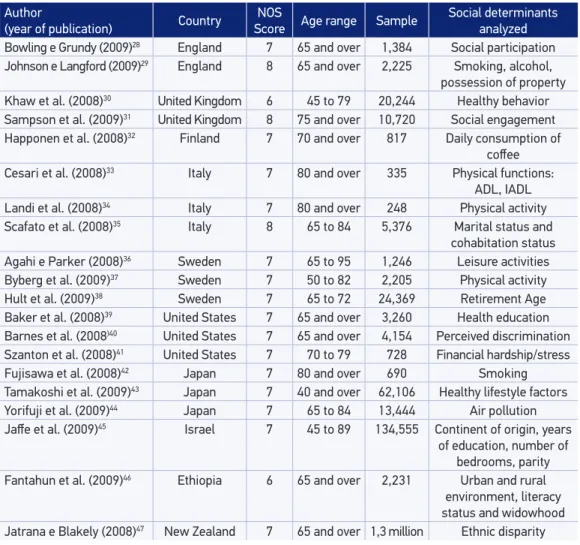
During the systematic review, 20 cohort studies were identified which analyzed the association between social determinants and mortality in the elderly population (60 years or more). Most studies were carried out in European countries, the United States and Japan, and published in 2008. No articles were published in 2007. Studies developed in Latin America were not found. As for the quality of the studies, the majority had a score of 7 in the NOS scale (Table 1).
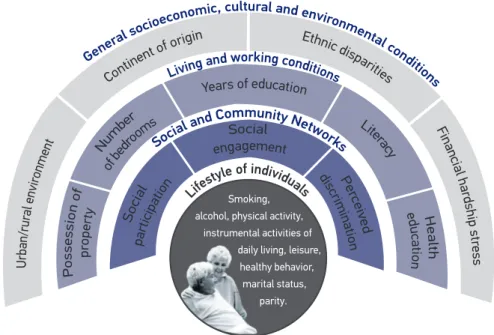
Dahlgren and Whitehead4, confirming the model of social determination of mortality
in the elderly (Figure 1).
Five articles addressed the first determination level (general socioeconomic, cultural and environmental conditions), of which four identified social factors significantly associated with mortality in the elderly. These were: living in a rural area compared to the urban, residing in the African continent compared to the European, belonging to minority ethnic groups and going through stress or financial hardship (Table 2).
In reference to the second level of determination, composed of social determinants on the living and working conditions, the following risk factors were identified: living
Table 1. Studies included in the systematic review according to the country of study, NOS Score for quality of analysis, age range studied (in years), number of people examined and social determinants analyzed.
Author
(year of publication) Country ScoreNOS Age range Sample Social determinants analyzed Bowling e Grundy (2009)28 England 7 65 and over 1,384 Social participation Johnson e Langford (2009)29 England 8 65 and over 2,225 Smoking, alcohol, possession of property Khaw et al. (2008)30 United Kingdom 6 45 to 79 20,244 Healthy behavior Sampson et al. (2009)31 United Kingdom 8 75 and over 10,720 Social engagement Happonen et al. (2008)32 Finland 7 70 and over 817 Daily consumption of
cofee Cesari et al. (2008)33 Italy 7 80 and over 335 Physical functions:
ADL, IADL Landi et al. (2008)34 Italy 7 80 and over 248 Physical activity Scafato et al. (2008)35 Italy 8 65 to 84 5,376 Marital status and
cohabitation status Agahi e Parker (2008)36 Sweden 7 65 to 95 1,246 Leisure activities Byberg et al. (2009)37 Sweden 7 50 to 82 2,205 Physical activity Hult et al. (2009)38 Sweden 7 65 to 72 24,369 Retirement Age Baker et al. (2008)39 United States 7 65 and over 3,260 Health education Barnes et al. (2008)40 United States 7 65 and over 4,154 Perceived discrimination Szanton et al. (2008)41 United States 7 70 to 79 728 Financial hardship/stress Fujisawa et al. (2008)42 Japan 7 80 and over 690 Smoking Tamakoshi et al. (2009)43 Japan 7 40 and over 62,106 Healthy lifestyle factors Yorifuji et al. (2009)44 Japan 7 65 to 84 13,444 Air pollution Jafe et al. (2009)45 Israel 7 45 to 89 134,555 Continent of origin, years
of education, number of bedrooms, parity Fantahun et al. (2009)46 Ethiopia 6 65 and over 2,231 Urban and rural
Smoking, alcohol, physical activity, instrumental activities of daily living, leisure,
healthy behavior, marital status,
parity.
Ge
neral
socioe
conomic, cultural and environme ntal con
dition s
L
iving and working conditions
Socia
l and Community Netw orks
Life
style of individuals
*Adapted from Dahlgren and Whitehead4
Figure 1. Model of social determinants of mortality in the elderly.
Table 2. Distribution of studies according to social determinants related to “general socioeconomic, cultural and environmental conditions”.
Study Social determinant Category RR/HR (CI)
Yorifuji et al. (2009) Air pollution: level of NO 2
Increase of 10 mg/m3 in the NO2 level
HR = 1.02 (0.96 – 1.08)
Fantahun et al. (2009) Urban and rural environment
Urban environment HR = 1
Rural environment HR = 1.52 (1.41 – 1.64) Rural environment - Men HR = 1.21 (1.07 – 1.37) Rural environment - Woman HR = 1.68 (1.55 – 1.83)
Jafe et al. (2009) Continent of origin
Europe HR = 1
African - Men HR = 1.20 (1.11 – 1.28) African - Women HR = 1.10 (0.98 – 1.24) Asian - Men HR = 0.94 (0.88 – 1.00) Asian - Women HR = 0.87 (0.78 – 0.96)
Jatrana, Blakely (2008) Ethnic disparity
Non-Maori, non-Paciic and
non-Asian RR = 1
Maori - men RR = 1.51 (1.40 – 1.63) Maori - women RR = 1.78 (1.64 – 1.93) Paciic - men RR = 1.41 (1.24 – 1.60) Paciic - women RR =1.37 (1.20 – 1.57) Asian - men RR = 0.60 (0.52 – 0.70) Asian - Women RR = 0.76 (0.66 – 0.88) Szanton et al. (2008) Financial hardship/stress For each unit of increase in
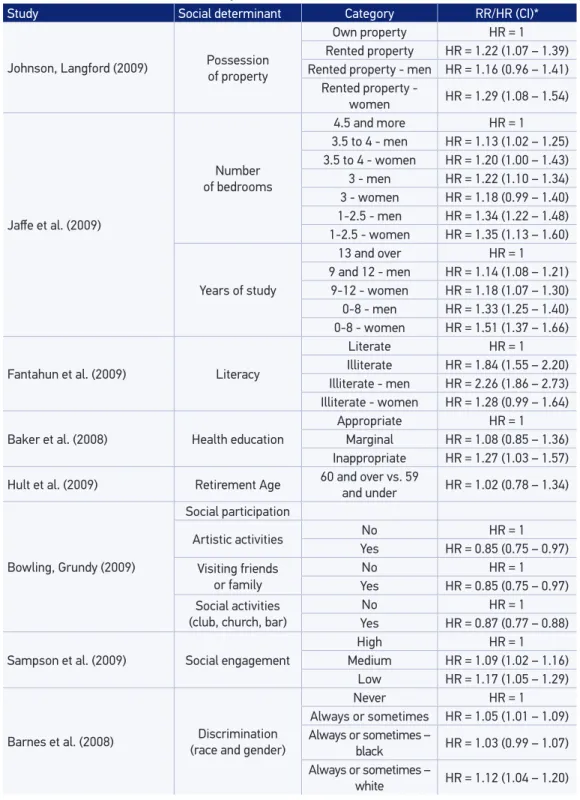
in rented accommodation compared to own property, residing in property with less than 4.5 rooms, having less than 13 years of education, being illiterate and having inappropriate level of education in health. Among these determinants, there is illiteracy, presenting the greatest measures of association (HR = 1.84 for men and women and HR = 2.26 for men) (Table 3).
Three of the articles selected addressed factors related to the third level of the Dahlgren and Whitehead model4, “social and community networks.” These factors
found social determinants associated with mortality in the elderly regarding social participation (not doing artistic activities regularly, not visiting friends or family, not participating in social activities, such as clubs, churches or bars), social engagement (medium or low score) and perceived discrimination by race and gender (Table 3).
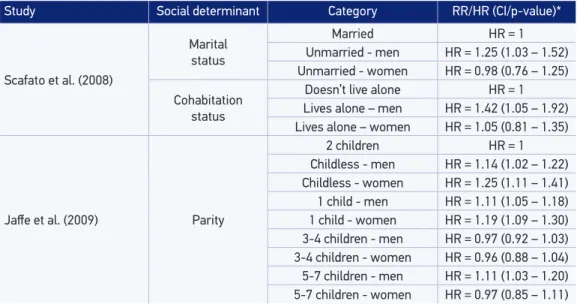
The social determinants related to the lifestyle of individuals, the fourth level of determination, represented the largest number of articles identified in the systematic review. A total of 11 studies were identified, which presented 10 social determinants significantly associated with mortality in the elderly (Table 4).
As for risks for mortality in the elderly, the following factors were found: being current smokers, being sedentary or performing average physical activity, being dependent in relation to instrumental activities of daily living, or performing less than four hours of leisure activities, being widowed, being a man and not being married, being a man and living alone and having only one child or not having children. In this group, we can highlight the determinants leisure and smoking among women as the ones with the highest measures of association.
Protective factors for mortality in the elderly were consuming alcohol moderately, and having combined factors of a healthy lifestyle, such as not smoking, moderate alcohol consumption, being physically active, daily intake of fruits and green leaves and sleeping more than 6.5 hours per night.
DISCUSSION
The world population is aging rapidly. Forecasts indicate that the percentage of people aged 60 years or more will increase from 11% in 2006 to 22% in 205012. In low
and middle income countries, the proportion of elderly people is growing even more rapidly than in high-income countries. The aging of the global population makes meeting social security needs an increasingly important challenge13.
Inequalities in mortality related to socioeconomic status among the elderly have been less discussed, compared to younger age groups. However, the literature on the topic is growing, and there has been a rise in the number of researchers interested in studying the subject10. Marmot14 reports that the social determinants of health of the
Table 3. Distribution of studies according to social determinants related to “living and working conditions” and “social and community networks”.
Study Social determinant Category RR/HR (CI)*
Johnson, Langford (2009) Possession of property
Own property HR = 1 Rented property HR = 1.22 (1.07 – 1.39) Rented property - men HR = 1.16 (0.96 – 1.41)
Rented property -
women HR = 1.29 (1.08 – 1.54)
Jafe et al. (2009)
Number of bedrooms
4.5 and more HR = 1 3.5 to 4 - men HR = 1.13 (1.02 – 1.25) 3.5 to 4 - women HR = 1.20 (1.00 – 1.43) 3 - men HR = 1.22 (1.10 – 1.34) 3 - women HR = 1.18 (0.99 – 1.40) 1-2.5 - men HR = 1.34 (1.22 – 1.48) 1-2.5 - women HR = 1.35 (1.13 – 1.60)
Years of study
13 and over HR = 1
9 and 12 - men HR = 1.14 (1.08 – 1.21) 9-12 - women HR = 1.18 (1.07 – 1.30) 0-8 - men HR = 1.33 (1.25 – 1.40) 0-8 - women HR = 1.51 (1.37 – 1.66)
Fantahun et al. (2009) Literacy
Literate HR = 1
Illiterate HR = 1.84 (1.55 – 2.20) Illiterate - men HR = 2.26 (1.86 – 2.73) Illiterate - women HR = 1.28 (0.99 – 1.64)
Baker et al. (2008) Health education
Appropriate HR = 1
Marginal HR = 1.08 (0.85 – 1.36) Inappropriate HR = 1.27 (1.03 – 1.57)
Hult et al. (2009) Retirement Age 60 and over vs. 59 and under HR = 1.02 (0.78 – 1.34)
Bowling, Grundy (2009)
Social participation
Artistic activities No HR = 1
Yes HR = 0.85 (0.75 – 0.97) Visiting friends
or family
No HR = 1
Yes HR = 0.85 (0.75 – 0.97) Social activities
(club, church, bar)
No HR = 1
Yes HR = 0.87 (0.77 – 0.88)
Sampson et al. (2009) Social engagement
High HR = 1
Medium HR = 1.09 (1.02 – 1.16) Low HR = 1.17 (1.05 – 1.29)
Barnes et al. (2008) (race and gender)Discrimination
Never HR = 1
Always or sometimes HR = 1.05 (1.01 – 1.09) Always or sometimes –
black HR = 1.03 (0.99 – 1.07) Always or sometimes –
Table 4. Distribution of studies according to social determinants related to “individual lifestyle factors”.
Study Social determinant Category RR/HR (CI/p-value)*
Fujisawa et al. (2008) Smoking
Non-smoker HR = 1
Current smoker – men HR = 2.3 (1.0 – 5.2) Current smoker – women HR = 4.2 (1.9 – 9.5)
Johnson, Langford (2009)
Smoking
Non-smoker HR = 1
Frequent smoker – men HR = 1.64 (1.30 – 2.06) Frequent smoker – women HR = 1.98 (1.07 – 1.13)
Alcohol
Insigniicant consumption HR = 1 Moderate consumption – men HR = 0.80 (0.66 – 0.98)
Moderate consumption - women
HR = 0.74 (0.61 – 0.98)
Heavy consumption – men HR = 1.00 (0.77 – 1.32) Heavy consumption – women HR = 0.55 (0.35 – 0.87)
Landi et al. (2008) Physical activity Sedentary HR = 1 Active HR = 0.36 (0.12 – 0.98)
Byberg et al. (2009) Physical activity
High HR = 1
Medium HR = 1.14 (1.01 – 1.28) Low HR = 1.13 (0.96 – 1.33)
Cesari et al. (2008) Physical function: IADL ** Totally dependent HR = 1 Totally independent HR = 0.70 (0.50 – 0.99)
Agahi, Parker (2008) Leisure activities
6 activities or more HR = 1 1 activity HR = 2.2 (p < 0.001) 2 activities HR = 1.8 (p < 0.001) 3 activities HR = 1.5 (p < 0.01) 4 activities HR = 1.4 (p < 0.05) 5 activities HR = 1.3
Tamakoshi et al. (2009) 6 healthy life factors
0 to 2 factors HR = 1 3 factors – men HR = 0.79 (0.73 – 0.85) 3 factors – women HR = 0.83 (0.73 – 0.95) 4 factors – men HR = 0.71 (0.65 – 0.77) 4 factors – women HR = 0.74 (0.65 – 0.84) 5 factors – men HR = 0.56 (0.49 – 0.63) 5 factors – women HR = 0.59 (0.51 – 0.68) 6 factors – men HR = 0.40 (0.28 – 0.55) 6 factors – women HR = 0.52 (0.40 – 0.67)
Khaw et al. (2008) Healthy behavior
4 behaviors HR = 1
3 behaviors HR = 1.51 (1.29 – 1.77) 2 behaviors HR = 2.06 (1.75 – 2.41) 1 behavior HR = 2.68 (2.22 – 3.23) No behavior HR = 3.58 (2.51 – 5.11)
Fantahun et al. (2009) Widowhood
Not a widower HR = 1
Despite the inconsistencies reported in the literature8,9,10,15, in relation to continuity
of health inequalities in elderly populations, the present study identified researches that report in total, 24 social determinants significantly associated with mortality in the elderly.
In the first level of determination, referring to general socioeconomic, cultural and environmental conditions, are included, for example, political, fiscal and commercial strategies and environmental agreements between countries4. Intercontinental differences
in housing and financial stress or hardship were identified as social determinants of mortality in the elderly.
There are health inequalities between countries. Life expectancy at birth ranges from 34 years in Sierra Leone to 81.9 years in Japan14. Global trends show a widening
inequality in education in South Asia and deep inequality in health in Africa. Latin America remains the most unequal region in income, but not in health and education16.
Inequalities in health arise because of inequalities in society, and its magnitude is a good marker of progress in creating a more just society17. Health equity will be achieved
through a series of governmental tools, supported by an environment of international policies that enhance both social development as a whole and economic growth13.
Other social determinants of mortality in the elderly found in this group were the urban-rural variation and belonging to ethnic minorities. Policy and investment patterns, which reflect the paradigm of the urban base growth, reverberated in rural communities around the world, including indigenous peoples. Such communities have suffered a progressive disinvestment in infrastructure and services, with disproportionate
Study Social determinant Category RR/HR (CI/p-value)*
Scafato et al. (2008)
Marital status
Married HR = 1
Unmarried - men HR = 1.25 (1.03 – 1.52) Unmarried - women HR = 0.98 (0.76 – 1.25)
Cohabitation status
Doesn’t live alone HR = 1 Lives alone – men HR = 1.42 (1.05 – 1.92) Lives alone – women HR = 1.05 (0.81 – 1.35)
Jafe et al. (2009) Parity
2 children HR = 1
Childless - men HR = 1.14 (1.02 – 1.22) Childless - women HR = 1.25 (1.11 – 1.41) 1 child - men HR = 1.11 (1.05 – 1.18) 1 child - women HR = 1.19 (1.09 – 1.30) 3-4 children - men HR = 0.97 (0.92 – 1.03) 3-4 children - women HR = 0.96 (0.88 – 1.04) 5-7 children - men HR = 1.11 (1.03 – 1.20) 5-7 children - women HR = 0.97 (0.85 – 1.11) RR/HR (CI/P): Relative Risk/Harzard Ratio (Conidence Interval, p value).
levels of poverty and low living conditions. This inequality, with prejudice to the conditions of rural life, contributed to inequalities in health between urban and rural dwellers in many low-income countries13.
In reference to the social determinants of mortality in the elderly identified in this systematic review, regarding living and working conditions, we find low education levels and poor housing. In this level of determination of health are included social benefits through the social security, health, food and nutrition, agriculture and labor sectors. These sectors should focus on improving the social and material conditions of the population through public policies and decisions of companies and trade unions, as well as voluntary work4.
Education is an indicator that remains stable over the course of life, is closely related to age, has greater validity and is easily obtained compared to other socioeconomic variables9. However, Hoffmann18 reports that, compared to education, low income was
a more powerful risk factor for mortality in elderly Danes and Americans.
In a multicenter study of elderly Americans and Germans, Knesebeck et al.19
reported disparities in health status regarding socioeconomic status, represented by educational level, income and occupation. Næss, Hernes and Blane20 reported that
elderly in a disadvantaged socioeconomic status in life, according to occupation and monthly income, show high mortality after retirement.
Huisman et. al.21 demonstrated differences in mortality among the elderly in Western
Europe according to educational level. Social stratification and differences in access to resources such as wealth and prestige produce inequalities in chances of the population’s life, regardless of their risk to health and epidemiological characteristics.
People’s place of residence affects health and their chances to enjoy prosperous lives. Communities that ensure access to basic goods become socially cohesive, promote physical and psychological well-being and protect their natural environment, which are essential elements for health equity13.
Among the social determinants of mortality in the elderly related to social and community networks, we highlight the social participation and perceived discrimination by race and gender. This group of determinants is focused on how the population can come together in mutual support, and thereby strengthen protection against health risks4.
The influence of social networks on the health of populations can be explained by the theory of stress. Social processes act as specific stressors, increasing the susceptibility of certain bodies against a direct noxious stimulation through changes in their neuroendocrine system. Stress dampers or mediators reduce its harmful effects by acting on the vulnerability of the subjects. Social support, primarily in the form of support groups and social networking, is an important damper22.
respect and self-esteem. Social participation, in turn, influences social inclusion and access to information12.
Another determinant identified at this level is perceived discrimination. Prejudice based on factors such as gender, ethnicity or disability is considered one of the most important social determinants, for generating social stratification and inequities relating to economic power23.
The circumstances of everyday life also directly influence the health of populations, such as different exposures to disease-causing influences in early life, the social and physical environments and work, associated with social stratification13. Among the
determinants identified in this systematic review, concerning the lifestyle of individuals, are: smoking, alcohol, physical activity, dependence on instrumental activities of daily living, leisure, marital and cohabitation status, parity and combined factors of a healthy lifestyle.
Shankar, McMunn and Steptoe24, in a study on health behavior in older adults
and elderly English, report evidence of aggregation of health risk behaviors in this population and suggest targeted interventions to mitigate multiple risk factors in less advantaged groups.
In a cohort study conducted with elderly people in Spain, the following factors were identified as predictors of risk of death: visiting friends or relatives less than once a week, smoking, alcohol consumption, physical activity, frequency of consumption of vegetables, fruits, fish and olive oil25. In a Brazilian study cohort, the absence of
spouse and disability in daily living activities were identified as factors independently associated with mortality in the elderly26.
The focus of action in this group of determinants includes health education and support to groups with less healthy lifestyles4. However, a wide range of epidemiological
and sociological evidence suggests the persistence of inequalities in health, even with the equalization of lifestyle factors. Policies to modify health behaviors should address a wide range of social determinants of health. Interventions focusing on the individual will not, by itself, reduce health inequalities. The responsibility should be shared between society and the individual17.
The heterogeneity of the studies analyzed in terms of population, theoretical model used and construction of the study variables can be highlighted as one limitation of this study, making it impossible to perform quantitative analysis and calculation of summarized measures. However, it is understood that this characteristic is inherent in the object of study - social determinants of health.
Research on health and living conditions should be seen as a process of successive approximations. The construction of a general theory on this subject configures a long process, necessarily fed by numerous partial inputs, plus numerous difficulties27.
CONCLUSION
This study allowed the construction of a model of social determination of the elderly population’s mortality by identifying 24 social determinants significantly associated with mortality in this population.
The mortality of the elderly is influenced by social determinants at different levels of coverage, from determinants related to lifestyle to socioeconomic macrodeterminants. The actions on these determinants should be directed to the intersectoral perspective and should be treated as a priority by the health sector, seeking to provide greater longevity with quality of life for the population.
1. Almeida-Filho N, Kawachi I, Filho AP, Dachs JN. Research on health inequalities in Latin America and the Caribbean: bibliometric analysis (1971-2000) and descriptive content analysis (1971-1995). Am J Public Health 2003; 93(12): 2037-43.
2. Barata RB. Como e por que as desigualdades sociais fazem mal à saúde. Rio de Janeiro: Fiocruz; 2009. 3. Breilh J. Epidemiologia: economia, política e saúde.
São Paulo: Unifesp/Hucitec; 1991.
4. Dahlgren G, Whitehead M. Policies and strategies to promote social equity in health. Stockholm: Institute for Future Studies; 1991.
5. Buss PM, Pelleg rini Filho A. A saúde e seus determinantes sociais. Physis 2007; 17(1): 77-93. 6. Comissão Nacional de Determinantes Sociais da Saúde.
As causas sociais das iniquidades em saúde no Brasil. Rio de Janeiro: Fiocruz; 2008.
7. Castellanos PL. Sobre el concepto de salud-enfermedad. Descripción y explicación de la situación de salud. Epidemiol Bull 1990; 10(4): 1-7.
8. McMunn A, Breeze E, Goodman A, Nazroo J, Oldf ield Z. Social deter minants of health in older age. In: Marmot M, Wilkinson RG. Social determinants of health. New York: Oxford University Press; 2006. p. 267-96.
9. Barros MBA, Francisco PMSB, Lima MG, César CLG. Social inequalities in health among the elderly. Cad Saúde Pública 2011; 27(S2): S198-S208.
10. Huisman M, Kunst AE, Andersen O, Bopp M, Borgan JK, Borrell C. Socioeconomic inequalities in mortality among elderly people in 11 European populations. J Epidemiol Community Health 2004; 58(6): 468-75. 11. The Newcastle-Ottawa Scale. Disponível em: http://
www.ohri.ca/programs/clinical_epidemiology/oxford. asp. (acessado em 20 de agosto de 2011).
12. World Health Organization. Global age-friendly cities: a guide. 2007.
13. Organização Mundial de Saúde. Redução das desigualdades no período de uma geração. Igualdade na saúde através da ação sobre os seus determinantes sociais.Relatório inal da comissão para os determinantes sociais da saúde. Lisboa: Organização Mundial da Saúde; 2010. 14. Marmot M. Social determinants of health inequalities.
Lancet 2005; 365(9464): 1099-104.
15. Guillet E, Bopp M, Faeh D, Paccaud F. Socioeconomic gradients in mortality in the oldest old: A review. Arch Gerontol Geriatr 2010; 51(3): e37-e40.
16. Programa das Nações Unidas para o Desenvolvimento. Relatório do desenvolvimento humano de 2011 – Sustentabilidade e equidade: um futuro melhor para todos. PNUD; 2011.
17. Marmot M, Bell R. Fair society, healthy lives: strategic review of health inequalities in England, post-2010, the marmot Review. Public Health. 2012; 126 Suppl 1: S4-10. doi: 10.1016/j.puhe.2012.05.014. Epub 2012 Jul 10.
18. Hofmann R. Socioeconomic inequalities in old-age mortality: A comparison of Denmark and the USA. Soc Sci Med 2011; 72(2): 1986-92.
19. von dem Knesebeck O, Lüschen G, Cockerham WC, Siegrist J. Socioeconomic status and health among the aged in the United States and Germany: a comparative cross-sectional study. Soc Sci Med 2003; 57(9): 1643-52.
20. Næss Ø,Hernes FH, Blane D. Life-course inluences on mortality at older ages: evidence from the Oslo Mortality Study. Soc Sci Med 2006; 62(2): 329-36. 21. Huisman M, Kunst AE, Bopp M, Borgan J, Borrell C,
Costa G, et al. Educational inequalities in cause-speciic mortality in middle-aged and older men and women in eight western European populations. Lancet 2005; 365(9458): 493-500.
22. Bar ata RB, Almeida Filho N, Bar reto MG. Epidemiologia social. In: Almeida Filho N, Barreto MG. Epidemiolog ia & Saúde. Rio de Janeiro: Guanabara Koogan, 2011.
23. Organização Mundial da Saúde. Diminuindo diferenças: a prática das políticas sobre determinantes sociais da saúde: documento de discussão. Rio de Janeiro, OMS; 2011.
24. Shank ar A, McMunn A, Steptoe A. Health-related behaviors in older adults relationships with socioeconomic status. Am J Prev Med 2010; 38(1): 39-46.
25. Reg idor E, Kunst AE, Rodriguez-Artalejo F, Mackenbach JP. Small socio-economic differences in mortality in Spanish older people. Eur J Public Health 2012; 22(1): 80-5.
26. Lima-Costa MF, Peixoto SV, Matos DL, Firmo JOA, Uchôa E. Predictors of 10-year mortality in a population of community-dwelling Brazilian elderly: the Bambuí Cohort Study of Aging. Cad Saúde Pública 2011; 27 (S3): S360-S69.
27. Castellanos PL. Perfis de mortalidade, nível de desenvolvimento e iniquidades sociais na região da Américas. In: Barata RB (Org.), Equidade e saúde: contribuições da epidemiologia. Rio de Janeiro: Fiocruz/Abrasco; 1997.
28. Bowling A, Grundy E. Differentials in mortality up to 20 years after baseline interview among older people in East London and Essex. Age Ageing 2009; 38(1): 51-5.
29. Johnson B, Langford A. Health Stat Q. Demographic, behavioural and socio-economic inluences on the survival of retired people-evidence from a ten year follow up study of the general household survey, 1994. Health Stat Q 2009; 44: 27-34.
30. Khaw KT, Wareham N, Bingham S, Welch A, Luben R, Day N. Combined impact of health behaviours and mortality in men and women: the EPIC-Norfolk prospective population study. PLoS Med 2008; 5(1): e12. 31. Sampson EL, Bulpitt CJ, Fletcher AE. Survival of
community-dwelling older people: the effect of cognitive impairment and social engagement. J Am Geriatr Soc 2009; 57(6): 985-91.
32. Happonen P, Läärä E, Hiltunen L, Luukinen H. Cofee consumption and mortality in a 14-year follow-up of an elderly northern Finnish population. Br J Nutr 2008; 99(6): 1354-61.
33. Cesari M, Onder G, Zamboni V, Manini T, Shorr RI, Russo A, et al. Physical function and self-rated health status as predictors of mortality: results from longitudinal analysis in the ilSIRENTE study. BMC Geriatr 2008; 8: 34.
34. Landi F, Russo A, Cesari M, Pahor M, Liperoti R, Danese P, et al. Walking one hour or more per day prevented mortality among older persons: results from ilSIRENTE study. Prev Med 2008; 47(4): 422-6. 35. Scafato E, Galluzzo L, Gandin C, Ghirini S, Baldereschi
M, Capurso A, et al for the Ilsa Working Group. Marital and cohabitation status as predictors of mortality: a 10-year follow-up of an Italian elderly cohort. Soc Sci Med 2008; 67(9): 1456-64.
36. Agahi N, Parker MG. Leisure activities and mortality: does gender matter? J Aging Health 2008; 20(7): 855-71. 37. Byberg L, Melhus H, Gedeborg R, Sundström J,
Ahlbom A, Zethelius B, et al. Total mortality after changes in leisure time physical activity in 50 year old men: 35 year follow-up of population based cohort. BMJ 2009; 338: b688.
38. Hult C, Stattin M, Janlert U, Järvholm B. Timing of retirement and mortality-a cohort study of Swedish construction workers. Soc Sci Med 2010; 70(10): 1480-6. 39. Baker DW, Wolf MS, Feinglass J, Thompson JA. Health literacy, cognitive abilities, and mortality among elderly persons. J Gen Intern Med 2008; 23(6): 723-6. 40. Barnes LL, de Leon CF, Lewis TT, Bienias JL, Wilson
RS, Evans DA. Perceived discrimination and mortality in a population-based study of older adults. Am J Public Health 2008; 98(7): 1241-7.
41. Szanton SL, Allen JK, Thorpe RJ Jr, Seeman T, Bandeen-Roche K, Fried LP. Efect of inancial strain on mortality in community-dwelling older women. J Gerontol B Psychol Sci Soc Sci 2008; 63(6): S369-74.
43. Tamakoshi A, Tamakoshi K, Lin Y, Yag yu K, Kikuchi S; JACC Study Group. Healthy lifestyle and preventable death: findings from the Japan Collaborative Cohort ( JACC) Study. Prev Med 2009; 48(5): 486-92.
44. Yorifuji T, Kashima S, Tsuda T, Takao S, Suzuki E, Doi H, et al. Long-term exposure to traic-related air pollution and mortality in Shizuoka Japan. Occup Environ Med 2010; 67(2): 111-7.
45. Jaffe DH, Neumark YD, Eisenbach Z, Manor O. Parity-related mortality: shape of association among
middle-aged and elderly men and women. Eur J Epidemiol 2009; 24(1): 9-16.
46. Fantahun M, Berhane Y, Högberg U, Wall S, Byass P. Ageing of a rural Ethiopian population: who are the survivors? Public Health 2009; 123(4): 326-30. 47. Jatrana S, Blakely T. Ethnic inequalities in mortality
among the elderly in New Zealand. Aust N Z J Public Health 2008; 32(5): 437-43.
Received on: 05/09/2012