TYMPANIC AND TEMPORAL THERMOMETRY IN HYPOTHERMIA
ASSESSMENT FOR ADULT IN INTRAOPERATIVE ABDOMINAL SURGERY
1Rutes de Fatima Terres Danczuk2, Eliane Regina Pereira do Nascimento3, Patrícia Madalena Vieira Hermida4, Luciana Bihain Hagemann5, Katia Cilene Godinho Bertoncello6, Walnice Jung7
1 Text extracted from the thesis - Unplanned hypothermia evaluation during abdominal elective surgeries, presented to Programa de Pós-Graduação em Enfermagem (PEN), Universidade Federal de Santa Catarina (UFSC), 2014.
2 M.Sc. in Nursing. University Hospital Polydoro Ernani de São Thiago (HU), PEN/UFSC. Florianópolis, Santa Catarina, Brazil. E-mail: [email protected]
3 Ph.D. in Nursing. Professor, Nursing Department, PEN/UFSC. Florianópolis, Santa Catarina, Brazil. E-mail: eliane.nascimento@ ufsc.br
4 Ph.D. student, PEN/UFSC. CAPES scholarship. Florianópolis, Santa Catarina, Brazil. E-mail: [email protected] 5 M.S.c. in Health. Nurse at HU/UFSC. Florianópolis, Santa Catarina, Brazil. E-mail: [email protected]
6 Ph.D. in Nursing Fundamentals. Professor of the Nursing Department, UFSC. Florianópolis, Santa Catarina, Brazil. E-mail: katia. [email protected]
7 Master’s student, PEN/UFSC. Florianópolis, Santa Catarina, Brazil. E-mail: [email protected]
ABSTRACT
Objective: to analyze the association between sociodemographic, clinical, operative and environmental characteristics with hypothermia events, measured intraoperatively by tympanic and temporal thermometers in adult patients undergoing elective abdominal surgery with visceral exposure.
Method: prospective quantitative, correlational, observational study. Data were collected by means of structured instrument containing the variables: age, Body Mass Index; American Society of Anesthesiologists class; type of anesthesia; time of surgery; tympanic and temporal temperature; temperature and relative humidity of the surgical room. Temperatures were assessed by methods of tympanic and temporal measurement in 63 patients. The data analysis sought an association between hypothermia and patient characteristics, type of anesthesia, surgical environment, according to the method of measurement and surgical time.
Results: Among the 63 patients, 15 (23.8%) had hypothermia. Of the total (n=15; 100%) number of hypothermic patients, 13 (80%) had mild
hypothermia. Moderate hypothermia was identiied only by temporal thermometry in three (20%) patients. Severe hypothermia was not identiied, and in two (13.3%) patients the hypothermia was identiied only by temporal thermometry. Hypothermia had a statistically signiicant association only with age (p=0.0027) and sex (p=0.015), when measuring tympanic temperature.
Conclusion: Only sex and age showed correlation with hypothermia during surgery measured by tympanic thermometry; no variable
inluenced hypothermia measured by temporal thermometry.
DESCRIPTORS: Hypothermia. Intraoperative period. Perioperative nursing. Elective surgical procedures. Body temperature. Thermometry. Anesthesia.
TERMOMETRIA TIMPÂNICA E TEMPORAL NA AVALIAÇÃO DA HIPOTERMIA
NO INTRAOPERATÓRIO DE CIRURGIA ABDOMINAL EM ADULTOS
RESUMO
Objetivo: analisar a associação entre características sociodemográicas, clínicas, operatórias e ambientais com a ocorrência de hipotermia medida por meio de termômetros timpânico e temporal, em pacientes adultos, no intraoperatório, submetidos à cirurgias abdominais eletivas com exposição visceral.
Método: estudo observacional prospectivo, quantitativo, correlacional. Os dados foram coletados mediante instrumento estruturado
contendo as variáveis: idade; índice de massa corporal; classiicação da American Society of Anesthesiologists; tipo de anestesia; tempo da cirurgia; temperatura timpânica e temporal; temperatura e umidade relativa da sala cirúrgica. Foram mensuradas as temperaturas pelos métodos de aferição timpânico e temporal em 63 pacientes. Na análise dos dados buscou-se associação da hipotermia com as características dos pacientes, do tipo de anestesia, do ambiente cirúrgico segundo o método de aferição e do tempo cirúrgico.
Resultados: dos 63 pacientes, 15 (23,8%) apresentaram hipotermia. Do total (n=15; 100%) de pacientes hipotérmicos, 13 (80%) tiveram
hipotermia leve. A hipotermia moderada foi identiicada apenas pela termometria temporal, em três (20%) pacientes. Não houve
hipotermia grave e em dois (13,3%) pacientes a hipotermia ocorreu apenas na medida da termometria temporal. Na relação das variáveis,
identiicou-se que a hipotermia teve associação estatisticamente signiicante somente com a idade (p=0,0027) e o sexo (p=0,015), na aferição
da temperatura timpânica.
Conclusão: apenas o sexo e a idade interferiram na hipotermia no intraoperatório pela termometria timpânica e nenhuma variável inluenciou na hipotermia pela termometria temporal.
DESCRITORES: Hipotermia. Período intraoperatório. Enfermagem perioperatória. Procedimentos cirúrgicos eletivos. Temperatura corporal. Termometria. Anestesia.
TERMOMETRÍA TIMPÁNICA Y TEMPORAL EN LA EVALUACIÓN DE
HIPOTERMIA EN EL TRANS-OPERATORIO DE CIRUGÍA ABDOMINAL
RESUMEN
Objetivo: analizar la asociación entre las características sociodemográicas, clínicas, operatorias y ambientales con la ocurrencia de hipotermia medida por medio de termómetros timpánicos y temporales, en pacientes adultos en el trans-operatorio sometidos a cirugías abdominales electivas con exposición visceral.
Métodos: estudio observacional, prospectivo, cuantitativo, correlacional. Los datos fueron recolectados mediante instrumento estructurado
conteniendo las variables: edad; índice de massa corporal; classiicación American Society of Anesthesiologists; tipo de anestesia; tiempo de la cirugía; temperatura timpánica y temporal; temperatura y humedad relativa a la sala quirúrgica. Fueron medidas las temperaturas por los métodos de afección timpánico y temporal en 63 pacientes. En el análisis de los datos se buscó la asociación de la hipotermia con las características de los pacientes, del tipo de anestesia, del ambiente quirúrgico segundo el método de afección y del tiempo quirúrgico. Resultado: de los 63 pacientes, 15 (23,8%) presentaron hipotermia. Del total (n=15; 100%) de pacientes hipotérmicos, 13 (80%) presentaron
hipotermia leve. La hipotermia moderada fue identiicada apenas por la termometría temporal, en tres (20%) pacientes. No hubo hipotermia
grave y en dos (13,3%) pacientes a la hipotermia ocurrió apenas en la medida de la termometría temporal. En la relación de las variables,
identiicación que la hipotermia tuvo asociación estadísticamente signiicante solamente con la edad (p=0,0027) y el sexo (p=0,015), en la
afección de la temperatura timpánica.
Conclusión: apenas el sexo y la edad interirieron en la hipotermia en el trans-operatorio por la termometría timpánica y ninguna variable
inluenció por la termometría temporal.
DESCRIPTORES: Hiportemia. Periodo intraoperatorio. Enfermería perioperatoria. Procedimientos quirúrgicos electivos. Temperatura corporal. La Termometría. Anestesia.
INTRODUCTION
Hypothermia is deined as a body temperature below 36oC, and when this occurs during surgery or in the immediate postoperative period, it is called perioperative hypothermia. This is a common prob-lem and usually under diagnosed, as temperature monitoring remains an underused practice.1
The patient undergoing surgery is at risk of de-veloping hypothermia in the intraoperative period, as the result of factors such as extremes of age, an-esthetic agents, room temperature, time of exposure to the low temperature environment, cold venous infusions, metabolic diseases, among others.2
However, heat loss may occur in patients un-dergoing surgery with greater exposure of cavities and central organs,3 such as abdominal surgery with visceral exposure, which is studied in this research. In this type of surgery, which is usually extended, lasting more than 30 minutes, there is a greater possibility of decreasing temperature at the end of the procedure.4 The concern with the development of intraoperative hypothermia exists especially in patients undergoing major surgery, which require long periods of anesthesia.5
Complications of hypothermia in the intraop-erative period that are highlighted by the literature include: coagulopathy and increased need for blood transfusion, morbid coronary events such as heart attack, tachycardia and hypertension, surgical site infection, thermal discomfort, tremors, decreased drug metabolism, and prolonged recovery. Due to the serious consequences associated with hypo-thermia, the standard of care is to monitor the body
temperature during the anesthesia, and maintain a stable temperature.6
Although central thermometry via pulmonary artery is the best indicator, and the gold standard for evaluating the patient’s thermal state, the invasive measurement is inconvenient.4 When invasive ther-mometry methods are not available, non-invasive techniques are used (oral, axillary, tympanic or temporal artery).7
In this study, tympanic (TT) and temporal (TTE) thermometry were used because TT is considered the most trustworthy in terms of the thermoregulatory center temperature in the hypo-thalamus;8 TTE was introduced in the 1990s as a measure that records temperatures comparable with the core temperature, and since then, studies have been conducted to test its accuracy and reliability.9
One study on the accuracy of TT found that it is a method that can be used in clinical practice due to its safety, ease of use and the rapid speed of temperature reading. However, the research did not include patients with hypothermia, and recom-mended further studies with this group to support the wider use of tympanic thermometers.10
Research that analyzed the relationship between the measurement of temporal, oral and axillary temperatures supports the use of TTE in surgical normothermic adult patients, who do not require invasive monitoring. However, the authors indicate that the performance of TTE under hypo-thermic conditions remains a research question.9
measurement method, the use of TT and TTE were options to be analyzed to due to their accuracy. It is believed that the comparison of these two methods during intraoperative surgery with visceral expo-sure can support the choice of one of them by the institution.
Given the above, and considering the rel-evance of the theme for intraoperative patient care, the question is: what is the association between sociodemographic, clinical, operative and environ-mental characteristics with hypothermia events measured by tympanic and temporal thermometers in intraoperative adult patients undergoing elective abdominal surgery with visceral exposure?
In order to answer to this question this study aimed to analyze the association between sociode-mographic, clinical, operative and environmental characteristics with hypothermia measured by tympanic and temporal thermometers, in adult intraoperative patients undergoing elective abdomi-nal surgery with visceral exposure.
It is believed that the contribution of this re-search for nursing is that the evidence found could aid in choosing the most suitable non-invasive method for assessing the temperature of patients in similar conditions as those in this research.
METHOD
Quantitative, prospective, correlational, obser-vational study, conducted in the operating room of a public hospital, a reference site for medium and ex-tensive surgeries, in the state of Santa Catarina, Brazil. The hospital has 270 beds, including clinical, surgical, pediatric, gynecological, emergency, and maternity (neonatology and rooming-in), intensive care unit services, dialysis, general and specialized outpatient, radiology, hemodynamic, and a surgi-cal center. The surgisurgi-cal center has ive operating rooms, one room for procedures with local anesthe-sia, four for small, medium and extensive surgery procedures that require general anesthesia and a post-anesthesia care unit (PACU). All operating rooms have similar characteristics regarding size, air conditioner, as well as the provision of surgical equipment.
Among the types of surgeries performed at the hospital are: digestive tract, reproductive, uri-nary, musculoskeletal, circulatory, corrective and transplant surgeries. We chose to study the patients having abdominal surgery with visceral exposure, as these are more likely to result in hypothermia due to the time of organ exposure.
Data collection occurred between August and November of 2013. The study population was 263 patients who underwent elective surgery of the abdominal cavity with visceral exposure, which was the amount of surgeries performed in the data collection period. Non probabilistic, sequential sampling was used, and the sample consisted of 63 patients who met the inclusion criteria, namely: age between 18-59 years; both sexes; minimum operat-ing time of 120 minutes; body mass index (BMI) equal to or less than 35 kg/m2; and American Society of Anesthesiologists (ASA) class I, II, and III.
Recruitment of subjects was performed by one of the researchers, and occurred in two stages: one before surgery and another intraoperatively. In the irst stage, after consulting the surgical map of surgeries to be performed on the following day, the potential patients for inclusion were identiied, by the type of surgery. A visit was conducted prior to the surgery with the patient, to present the ob-jectives of the study, and to collect information on comorbidities. Then, the Free and Informed Consent Term was signed, and some procedures such as anthropometric measures, and excessive earwax assessment were recorded on the instrument itself. In the second stage of recruitment, data regarding age, BMI and ASA were extracted from the patient record and recorded, as well as, the observation of the time of surgery, as only those with a minimum of 120 minutes were included.
For calculation of BMI, the World Health Organization (WHO) classiication was used,11 i.e.: normal (18.50 to 24.99 kg/m2); overweight (25 to 29.99 kg/m2); obesity I (30 to 34.99 kg/m2); and for hypothermia, the classiication adopted was: mild (temperature 35.1 to 35.9°C); moderate (below 35°C); and severe (≤33.9°C).2
The same researcher performed data collec-tion during surgery by means of observacollec-tion and recording on a structured instrument, which in-cluded information regarding age, BMI, ASA, type of anesthesia, surgery time, tympanic and temporal temperature, as well as temperature and relative humidity of the surgical room. Three experts (one nurse, one anesthesiologist, and one surgeon) vali-dated this instrument for face (clarity/comprehen-sion) and content (relevance) validity. A pre-test with ive patients was performed, and adjustments to the instrument were not necessary.
second hour, respectively. With the same frequency, the temperature and humidity of the operating room were checked. The surgeries were performed in four operating rooms for small, medium and extensive procedures, all of them with similar characteristics. The thermometry was performed with the tympanic thermometer Adtemp®TM421, and the temporal with the Beurer Stirnthermoeter® FT60, measured simultaneously. All patients were evaluated with the same tympanic and temporal apparatus. The thermohygrometer, More Fitness®, was used to verify the temperature and humidity of the operat-ing room, which was positioned against the wall, with an approximate distance of 130cm from the patient.
The data collected were organized in spread-sheets in Microsoft Ofice Excel, version 15.0.44 (2013). For data analysis, descriptive statistics were used, and the Kolmogorov-Smirnov, Kruskal-Wallis and Mann Whitney tests, with a signiicance level of α = 0.05, using the SestatNet software.12 The cal-culation of mean temperatures was performed in accordance with the measurement method (TT or TE), and thereafter, the statistical tests were per-formed. In all calculations, all the 63 patients who constituted the sample were included.
The TTs and the TTE had values ranging from zero to seven, which quantiied the prevalence of hypothermia. The value of zero indicates that no intraoperative hypothermia occurred; seven indi-cates that the patient was in a hypothermic state for all measurements.
The research project was approved by the Research Ethics Committee of the Universidade Federal de Santa Catarina, N. 374659/2013, CAAE 14708013.9.0000.0121, and according to Resolution N. 466/12 of the National Health Council.
RESULTS
From the sample of 63 patients, the female gen-der predominated (n=44; 69.8%) and the mean age was 45.4 years (21-59). With regard to categorization of BMI, 44 (69.8%) patients were classiied in a range lower than 30 kg/m2, and 19 (30.2%) had a degree of obesity I (30 to 34.9 kg/m2). Six (9.5%) patients had ASA I, 45 (71.4%) ASA II, and 12 (19.1%) ASA III. General anesthesia associated with epidural was the prevalent type of anesthesia in 38 (60.3%) patients, followed by general anesthesia in 16 (25.4%) and spinal anesthesia in nine (14.3%) interventions.
The temperature of the operating room during the study ranged from 22.2oC to 23.1oC (mean of 22.6oC). The humidity of the operating room ranged from 42% to 76%, with a mean of 59%.
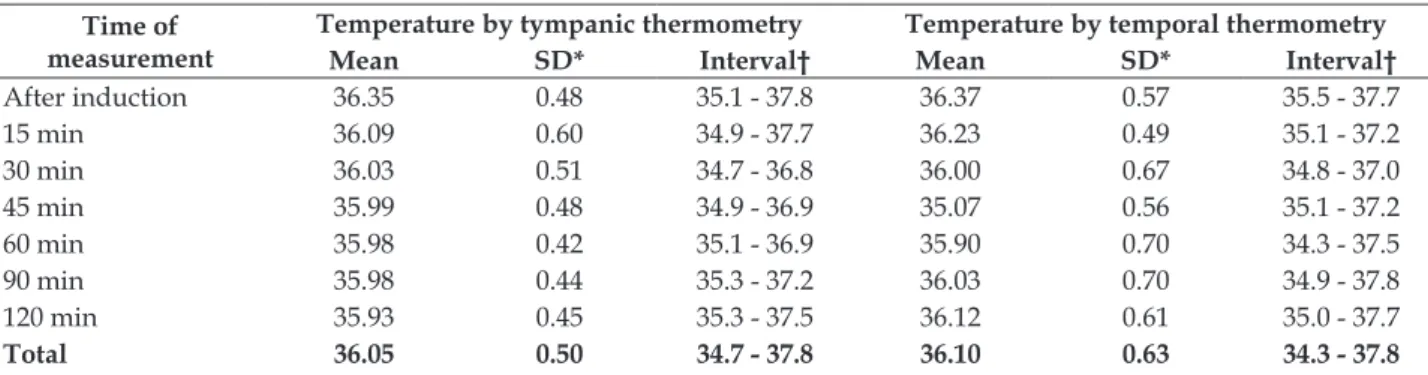
The patient temperature during the surgical procedure varied according to the two methods of measurement used, with different means and stan-dard deviations (SD). The larger SD (0.7) was found at two surgical times, at 60 and 90 minutes, when measuring the TTE; while in the TT measurement, the larger SD (0.6) was identiied after 15 minutes. In the TT, the mean temperature was 36.05oC (SD 0.50), while in the TTE the mean was 36.1oC (SD 0.63). Measurement with TT demonstrated more accurate results, i.e., less variation around the mean temperature (Table 1).
However, data analysis did not demonstrate statistically signiicant differences between the TTE and TT at 15, 30, 45, 60, 90 and 120 minutes. The TTE was not signiicantly higher than the TT, and both were able to detect the occurrence of hypothermia at different intraoperative times, which means that the two techniques of body temperature veriication had similar results.
Table 1 – Temperature measured by tympanic and temporal thermometry of intraoperative patients during elective abdominal surgery with visceral exposure. Florianópolis, SC, Brazil, 2013. (n=63)
Time of measurement
Temperature by tympanic thermometry Temperature by temporal thermometry
Mean SD* Interval† Mean SD* Interval†
After induction 36.35 0.48 35.1 - 37.8 36.37 0.57 35.5 - 37.7
15 min 36.09 0.60 34.9 - 37.7 36.23 0.49 35.1 - 37.2
30 min 36.03 0.51 34.7 - 36.8 36.00 0.67 34.8 - 37.0
45 min 35.99 0.48 34.9 - 36.9 35.07 0.56 35.1 - 37.2
60 min 35.98 0.42 35.1 - 36.9 35.90 0.70 34.3 - 37.5
90 min 35.98 0.44 35.3 - 37.2 36.03 0.70 34.9 - 37.8
120 min 35.93 0.45 35.3 - 37.5 36.12 0.61 35.0 - 37.7
Total 36.05 0.50 34.7 - 37.8 36.10 0.63 34.3 - 37.8
Among the 63 (100%) patients studied, 15 (23.8%) presented hypothermia; from this total (n = 15, 100%), 13 (80%) had mild hypothermia, and only three (20%) experienced moderate hypothermia, which was identiied by the TTE. Severe hypother -mia did not occur, and in two (13.3%) patients, the hypothermia was observed only in the TTE mea-surement (Table 2).
Although hypothermic patients are identi-ied in all age groups, the age ratio analysis with hypothermia, veriied by TT and TTE, a statistically signiicant association was obtained between these variables only using the tympanic thermometry (p=0.0027).
Hypothermia predominated in female patients (n=9; 60%), which also showed the lowest tempera-ture (34.5oC) in two patients (13.3%) by means of TTE, after 60 minutes of surgery. According to the TT, the frequency of hypothermia (n= 6; 40%) was similar in both sexes, registered post-induction, at 60 and 120 minutes (Table 2). The ratio of the variable, sex, with hypothermia identiied by TT showed a statistically signiicant association between these variables (p=0.015), as with this method of measure-ment, hypothermia was not expressed similarly in female and male patients; this was unlike what happened using the TTE method (p=0.0873).
Regarding the BMI, the indings cannot con -irm that the patient with obesity I will present with hypothermia, because among the hypothermic patients, eight (53.3%) presented with this index (30 to 34.99 kg/m2), four (26.7%) with normal BMI,
and three (20%) were overweight. The BMI relation-ship with hypothermia measured by tympanic and temporal methods obtained, respectively, p=0.4176 and p=0.4785, and did not show association between these variables. Hypothermia identiied by these two methods was expressed similarly in normal, overweight and obesity I patients.
All hypothermic patients exhibited ASA II or III. Although the frequency of hypothermia was higher (n=12; 80%) in patients classiied as ASA II, those with ASA III (n=2; 13.3%) presented hypothermia with greater intensity (34.5ºC), when assessed by TTE (Table 2). However, there was no association between ASA with hypothermia veriied by tympanic (p=0.4322) and temporal (p=0.4245) thermometry.
All hypothermic patients (n=15,100%) received general anesthesia (n=4, 26.7%) or combined, i.e. general anesthesia associated with peridural (n=11; 73.3%). The type of anesthesia also did not show association with hypothermia by TT (p=0.8187) or TTE (p=0.6035).
The longer the operating time, the higher the frequency of hypothermia by TT, which is inversely proportional to the TTE, whose frequency of hy-pothermia was higher after anesthesia induction, showing it to be more sensitive to these medications. According to the data, TT is more accurate in as-sessing the patient in the intraoperative abdominal surgery throughout the surgical procedure, main-taining a more stable temperature measurement when compared to TTE.
Table 2 - Hypothermia by tympanic and temporal thermometry according to age, body mass index, American Society of Anesthesiologists and anesthesia. Florianópolis, SC, Brazil, 2013. (n=15)
Age (years)
Sex* BMI†
Kg/m2
ASA‡
Anes-thesia§
Hypothermia by temporal ther-mometry (°C)
Hypothermia by tympanic thermometry (°C)
Post-in-duction 60” 120”
Post-
in-duction 60” 120”
59 M 23.7 2 G & P 35.5 35.7 35.4 35.8 35.8 35. 9
58 M 28.3 2 G & P 35.8 35.3 36.5 36.0 35.1 35.7
55 F 31.4 3 G & P 35.5 36.0 36.5 36.6 35.8 35.5
53 F 25.0 2 G & P 35.7 35.8 36.0 36.0 35.1 35. 5
53 F 32.4 3 G & P 35.6 34.5 35. 5 35.1 36.0 35.4
53 F 32.4 3 G & P 35.6 34.5 35.5 35.1 36.0 35.6
52 M 21.6 2 G & P 35.6 34.7 36.4 36.6 35.4 35.5
49 M 25.8 2 G & P 35.8 35.5 35.7 35.4 35.5 35.5
48 F 30.4 2 G 35.7 35.1 36.0 36.5 36.1 35.9
48 F 30.4 2 G 35.7 35.1 35.5 36.5 36.1 36.0
46 F 30.0 2 G & P 35.6 35.2 36.0 36.0 36.5 35.8
Age (years)
Sex* BMI†
Kg/m2
ASA‡
Anes-thesia§
Hypothermia by temporal ther-mometry (°C)
Hypothermia by tympanic thermometry (°C)
Post-in-duction 60” 120”
Post-
in-duction 60” 120”
44 M 23.6 2 G 35.9 36.9 36.8 36.0 35.9 35.4
36 F 34.5 2 G & P 35.8 36.8 37.2 36.7 36.4 36.6
26 M 19.6 2 G 35.8 35.5 35.8 36.5 35.3 35.3
*M: male, F: female; † body mass index;‡American Society of Anesthesiologists; §G: general; G & P: general and peridural.
The mean temperature of the operating room, from patient arrival up to 45 minutes into surgery, was 21.7oC (SD 1.9) to 22.3oC (SD 1.3), and thereafter, it decreased at a slow pace until 90 minutes into surgery, when it then remained stable (Table 3). The observed temperature difference was statistically signiicant. As all measurement conditions were similar, the temperature of the operating room was not a factor that interfered with hypothermia of the patient.
The humidity of the operating room air was analyzed to identify whether it was a causal factor for hypothermia. This moisture had its highest level
in the post-anesthetic induction time, with a mean value of 58.3% (SD 6.0) of moisture and, thereafter, decreased to 54.7% (SD 4.5) after 90 minutes of sur-gery. The variance of air humidity was also slightly higher at the beginning of surgery.
Therefore, not all of the air humidity measure-ments were equal (p=0.000004), since there was at least one condition that differed from the others. Statistically signiicant differences was obtained between the condition of arrival, 90 and 120 minutes, and the post-induction condition at 45, 60, 90 and 120 minutes.
Table 3 - Temperature and air humidity in the operating room from patient arrival until 120 minutes intraoperatively. Florianópolis, SC, Brazil, 2013. (n=15)
Measurement time Room temperature (°C) Air humidity (%)
Mean SD* Interval† Mean SD Interval
Arrival 21.7 1.9 17.5-24.5 57.7 6.0 48-68
Post-induction 21.9 1.8 18.2-24.5 58.3 6.0 44-68
15 min 22.0 1.6 18.2-24.3 57.8 6.7 48-68
30 min 21.7 1.3 18.6-23.6 56.6 6.4 49-68
45 min 22.3 1.3 18.6-23.6 55.5 6.4 45-68
60 min 20.9 1.1 18.7-22.9 55.5 5.7 49-68
90 min 20.8 1.1 18.9-23.4 54.7 4.5 48-61
120 min 20.8 1.0 18.9-22.7 55.5 4.2 48-61
Total 21.4 0.5 17.5-24.5 56.5 1.4 44-68
*SD: Standard deviation; †Interval: minimum-maximum temperatures
DISCUSSION
The results of body temperature identiied by the TT and the TTE were similar with the two assess-ment methods; the limitations of each site should be considered when the professional is performing thermometry. These limitations are presented in studies7,13 involving this subject.
Patient age did not inluence the occurrence of hypothermia in this study, but it was manifested differently according to age when measured by TT, while this was not the case with TTE. Other research performed intraoperatively in another large hospital
identiied similar results.14 Although the evidence is weak, extremes of age are considered risk factors for perioperative hypothermia, as shown by some studies;13,15-16 this population was not included in this survey, as only patients from 18 to 59 years was involved.
male and female patients, different from that identi-ied by TT, which proved to be different.
Although women experience lower heat loss than men during surgery, due to their higher per-centage of adipose tissue that acts as a protective layer, their smaller amount of muscle and increased body surface ratio mass can make them more sus-ceptible to heat loss to the environment.3 However, the American Society of PeriAnesthesia Nurses (ASPAN) classiies the evidence on the female sex factor as weak for the onset of perioperative hypo-thermia.15
This study demonstrated that BMI did not in-terfere with hypothermia. The statistical analysis to suggest that hypothermia veriied by tympanic and temporal thermometry are similar between normal, overweight and obesity I patients. According to the ASPAN, normal and below normal BMI are risk factors with insuficient evidence for perioperative hypothermia.15
However, the relationship of BMI with peri-operative hypothermia was reported in a national survey with obese and non-obese women undergo-ing elective open abdominal surgery. By usundergo-ing mea-sures of oral and esophageal temperatures, different thermometry than that used in this study, obese women were shown to have a higher perioperative temperature and a lower incidence of hypothermia when compared to non-obese women.17 In the USA, one study comparing oral, temporal and bladder thermometry supported a BMI below 30 kg/m2 as a risk factor for hypothermia.13
In the present study, hypothermia was identi-ied in patients with ASA II and III, that is, those with comorbidities. However, statistically, no association was identiied between ASA classiication and hypo -thermia, with either the tympanic or the temporal thermometry. National studies2,18-19 on hypothermia include ASA in the proile description of surgical patients, but not as a factor that interferes with the occurrence of hypothermia. In one of those studies, most patients were classiied as ASA I, followed by ASA II, and no patients with ASA III,2 distinct from the results of this research. In other investigations, the highest incidence was ASA II.18-19 Research that speciically analyzed the factors related to the loss of body heat in the intraoperative period did not include the ASA as a variable in the study.8
In a study in Spain with adults undergoing some kind of elective surgery, the association be-tween ASA classiication and hypothermia was also rejected.16 However, the National Institute for Health and Care Evidence (NICE) considers patients
to be at high risk of perioperative hypothermia when they have two or more of the following risk factors: ASA greater than I, preoperative temperature below 36°C, combined and regional anesthesia, medium and extensive surgery, and patients with cardiovas-cular history.20
Regarding the type of anesthesia, a study that used axillary thermometry in the perioperative pe-riod showed a higher frequency of mild and mod-erate hypothermia in patients undergoing general anesthesia, followed by combined,21 which differs from the indings of the present research, which had the largest amount of hypothermic patients among those undergoing combined anesthesia.
In the list of variables, the results of this re-search conirm that anesthesia did not inluence the loss of body heat of patients in the intraoperative period,8 however, the literature indicates that com-bined anesthesia presents a situation of increased risk of intraoperative hypothermia.22 Research with patients in the intraoperative period of abdominal surgery, which used TT, found that combined an-esthesia was a statistically signiicant variable to predict hypotermia.14 A study conducted in China suggested that this type of anesthesia increased the risk of hypothermia, although the results did not reach statistical signiicance.5
The possibility of the patient developing hypothermia who received combined anesthesia increases mainly due to inhibition of the thermo-regulatory center, combined with the impaired ability to maintain compensatory mechanisms, such as: tremors, piloerection, peripheral vasoconstric-tion induced by cold, thus contributing to lower temperatures.6,23
Exposure to the cold environment of the operating room, usually combined with the inhibi-tion of thermoregulainhibi-tion induced by anesthetics, produces hypothermia.6 Heat loss occurs through four mechanisms: radiation, conduction, evapora-tion, and convection.3
Regarding the temperature of the operating rooms, the parameters remained close to the limits recommended by the Association of Perioperative Registered Nurses (AORN), which recommends between 20 and 23°C.24
Research corroborates the findings of this study in which the temperature of the operating room did not inluence the loss of body heat of patients in the intraoperative period, although this result was evident in elderly patients.8
tem-perature of the operating room were not followed in other studies.2-3,13 A study conducted in Fortaleza-CE (Brazil), showed that in 120 surgical procedures, the room temperatures were not in accordance with the recommendations, achieving a minimum of 18.1oC.3
In another study in the municipality of Santos-SP (Brazil), the room temperature the was even lower (15 and 16.9oC) than the recommendation in 43.3% of the cases, an aspect that may have contrib-uted to the development of hypothermia.2
In a study in Belo Horizonte-MG (Brazil), the temperature of the operating room was was controlled within the recommended range. Room temperature signiicantly inluences the occurrence of hypothermia and should be controlled, because every 1°C increase in room temperature lowers the chance of hypotermia.18 In the international scenario, a mean temperature of 20°C in the operating room was identiied, with a minimum of 18.3oC and a maximum of 23.3oC. Based on the indings, it is stated that the ambient temperature below 20°C constitutes a risk factor for hypothermia.13
The air humidity did not always follow the ref-erence of values between 30 and 60%.24 Nevertheless it was found that this variable was not statistically associated with hypothermia. Further investigations corroborated that room humidity did not interfere with hypothermia.8,18
A study evaluating the variations of tempera-ture and humidity of the operating room showed a statistically signiicant association between both. Thus, the lower the temperature of the room, the lower the humidity.25
This highlights the importance of constant evaluation of temperature and humidity of the operating room environment, in order to promote safe patient care.25 Patient safety is the focus of the Brazilian Network of Nursing and Patient Safety (Rede Brasileira de Enfermagem e Segurança do Paciente -REBRAENSP ) which has as one of its strategies to promote discussion and dissemination of protocols released by the Ministry of Health, among which is “safe surgery”.26
CONCLUSION
Among the variables (sex, age, BMI, ASA, type of anesthesia, temperature and humidity of the op-erating room environment) only sex and patient age demonstrated inluence on hypothermia, measured by tympanic thermometry, in the intraoperative period. No variable showed an inluence on hypo -thermia when temporal thermometry was used.
This research did not show that the occur-rence that hypothermia in the intraoperative period is more related to the extremes of age, due to age group of patients included in this study, but dem-onstrated the importance of thermometry, especially in patients at high surgical risk, as hypothermia was present in those patients with ASA II and III.
The study revealed that the two temperature assessment methods used were effective in detecting hypothermia at different times in the intraopera-tive period, however, the tympanic thermometry showed greater stability with less variation around the mean temperature, which indicates its applica-tion. However, as the values for the temperature veriied by the temporal method were also within the acceptable range as deined by experts, the results suggest that both methods of thermometry used have potential for use in the context of elective abdominal surgery with visceral exposure, as non-invasive devices for measurements of body tem-perature. It is expected that these results will make the surgical team, especially the nursing team, more aware of the need to use one of these temperature veriication methods.
With regard to study limitations, the sample size requires caution with generalizing the results. On the other hand, given the lack of studies on the subject, especially on the national scene, the results may support the development of research with more representative samples and of an experimental type, using tympanic and temporal thermometry as well as other non-invasive methods of temperature measurement. It should be noted that the patients in this study were not undergoing therapeutic hy-pothermia, thus the results cannot be extrapolated to this condition.
REFERENCES
1. Reales-Osorio RJ, Palomino-Romero R, Ramos-Clason EC, Pulgarín-Díaz JI, Guette-Viana A. Prevención de hipotermia perioperatoria utilizando bolsas plásticas de polietileno, em pacientes sometidos a cirugía bajo
anestesia general. Rev Ciênc Bioméd [Internet]. 2014
Jan-Jun [cited 2015 Nov 30]; 5(1):23-8. Available from: http://revistas.unicartagena.edu.co/index.php/ cienciasbiomedicas/article/view/1197/1107 2. Mattia AL, Barbosa MH, Rocha AM, Farias HL, Santos
CA, Santos DM. Hypothermia in patients during the perioperative period. Rev Esc Enferm USP [Internet]. 2012 Feb [cited 2015 Nov 28]; 46(1):60-6. Available from: http://www.scielo.br/scielo.php?pid=S0080-62342012000100008&script=sci_arttext&tlng=en 3. Muniz GS, Teles NSB, Leitão IMTA, Almeida PC,
os cuidados de enfermagem no transoperatório. Rev SOBECC [Internet]. 2014 Jan-Mar [cited 2015 Nov 30]; 19(1):79-86. Available from: http://itarget.com.br/ newclients/sobecc.org.br/2015/pdfs/site_sobecc_ v19n2/04_sobecc_v19n2.pdf
4. Kasai T, Hirose M, Yaegashi K, Matsukawa T, Takamata A, Tanala Y. Preoperative risk factors of intraoperative hypothermia in major surgery under general anesthesia. Anesth Analg [Internet]. 2002 Nov [cited 2016 Jul 28]; 95 (5):1381-3. Available from: http://journals.lww.com/anesthesia-analgesia/ Fulltext/2002/11000/Preoperative_Risk_Factors_of_ Intraoperative.51.aspx
5. Yi J, Xiang Z, Deng X, Fan T, Fu R, Geng W, et al. Incidence of inadvertent intraoperative hypothermia and its risk factors in patients undergoing general anesthesia in Beijing: a prospective regional survey. PLoS ONE [Internet]. 2015 Sep [cited 2016 Jul 29]; 10(9):e0136136. Available from: http://www.ncbi. nlm.nih.gov/pmc/articles/PMC4567074/pdf/ pone.0136136.pdf
6. Sessler DI. Temperature monitoring: the consequences and prevention of mild perioperative hypothermia. South Afr J Anaesth Analg [Internet]. 2014 May [cited 2015 Nov 30]; 20(1):25-31. Available from: http:// www.tandfonline.com/doi/pdf/10.1080/22201173. 2014.10844560
7. Counts D, Acosta M, Holbrook H, Foos E, Hays-Ponder K, Macairan O. Evaluation of temporal artery and disposable digital oral thermometers in acutely
ill patients. Medsurg Nurs [Internet]. 2014 Jul-Aug
[cited 2015 Nov 30]; 23(4):239-44. Available from: http://web.a.ebscohost.com/ehost/pdfviewer/ pdfviewer?sid=324c0450-ba19-45b0-99bf-d9c1a7393 3e4%40sessionmgr4007&vid=5&hid=4209
8. Tramontini CC, Graziano KU. Fatores relacionados à perda de calor corporal no intra-operatório: análise de duas intervenções de enfermagem. Ciênc Cuid Saúde [Internet]. 2012 [cited 2015 Nov 15]; 11(supl.):220-5. Available from: http://www.periodicos.uem.br/ojs/ index.php/CiencCuidSaude/article/view/17079/pdf 9. Barringer LB, Evans CW, Ingram LL, Tisdale PP,
Watson SP, Janken JK. Agreement between temporal artery, oral, and axillary temperature measurements in the perioperative period. J Perianesth Nurs [Internet]. 2011 Jun [cited 2015 Nov 15]; 26(3):143-50. Available from: http://www.jopan.org/article/ S1089-9472(11)00158-4/pdf
10. Gasim GI, Musa IR, Abdien MT, Adam I. Accuracy of tympanic temperature measurement using an infrared tympanic membrane thermometer. BMC Res Notes [Internet]. 2013 May [cited 2015 Nov 15]; 6:194. Available from: http://www.ncbi.nlm.nih.gov/pmc/ articles/PMC3658932/pdf/1756-0500-6-194.pdf 11. World Health Organization. The problem of
overweight and obesity. In: Obesity: preventing and managing the global epidemic. Report of a World Health Organization consultation [Internet]. Geneva:
World Health Organization; 2000 [cited 2015 Nov 15]. p. 5-37. WHO Obesity Technical Report Series, n. 284. Available from: http://www.who.int/nutrition/ publications/obesity/WHO_TRS_894/en/
12. Nassar SM, Wronscki VR, Ohira M. SEstatNet - Sistema Especialista para o Ensino de Estatística na Web [Internet]. Florianópolis (SC): 1999-2014. [cited 2015 Jun 18]. Available from: http://www.sestatnet. ufsc.br/sestatnet.php
13. Winslow EH, Cooper SK, Haws DM, Balluck JP, Jones CM, Morse EC, et al. Unplanned perioperative hypothermia and agreement between oral, temporal artery, and bladder temperatures in adult major surgery patients. J Perianesth Nurs [Internet]. 2012 Jun [cited 2015 Nov 15]; 27(3):165-80. Available from: http://ac.els-cdn.com/S108994721200072X/1- s2.0-S108994721200072X-main.pdf?_tid=d14a9812-55dd-11e6-a046-00000aab0f6c&acdnat=1469832366_ c38b50c8ea029db3d1db04f97b4f74dd
14. Prado CBC, Barichello E, Pires PS, Haas VJ, Barbosa MH. Occurrence and factors associated with hypothermia during elective abdominal surgery. Acta Paul Enferm [Internet]. 2015 Jul-Aug [cited 2015 Dec 02]; 28(5):475-81. Available from: http://www.scielo. br/pdf/ape/v28n5/en_1982-0194-ape-28-05-0475.pdf 15. Hooper VD, Chard R, Clifford T, Fetzer S, Fossum
S, Godden B, et al. ASPAN’s evidence-based clinical practice guideline for the promotion of perioperative normothermia: second edition. J Perianesth Nurs [Internet]. 2010 Dec [cited 2015 Nov 30]; 25(6):346– 65. Available from: http://ac-els-cdn-com.ez46. periodicos.capes.gov.br/S1089947210004120/1- s2.0-S1089947210004120-main.pdf?_tid=2deaf04e-55e3-11e6-9db9-00000aab0f27&acdnat=1469834669_ a0dda6376d5f7482a4e9332c5ec52563
16. Monzón CGC, Aranaa CAC, Valzb HAM, Rodrígueza FA, Mejíac JJB, Gómeza JAA. Temperature management during the perioperative period and frequency of inadvertent hypothermia in a general hospital. Rev Colomb Anestesiol [Internet]. 2013 Apr-Jun [cited 2015 Nov 15]; 41(2):97–103. Available from: http://ac.els-cdn.com/S2256208713000126/1- s2.0-S2256208713000126-main.pdf?_tid=6c2fb95c-55e3-11e6-ba4d-00000aab0f27&acdnat=1469834774_ c214f38fadfdf21ccfb1a50094f5feb9
17. Fernandes LA, Braz LG, Koga FA, Kakuda CM, Módo-lo NSP, Carvalho LR, et al. Comparison of peri-opera-tive core temperature in obese and non-obese patients. Anaesthesia [Internet]. 2012 Dec [cited 2015 Dec 30]; 67(12):1364–9. Available from: http://onlinelibrary. wiley.com/doi/10.1111/anae.12002.x/epdf
19. Mattia AL, Barbosa MH, Rocha AM, Pereira NHC. Hipotermia em pacientes na recuperação pós-anestésica: análise da intervenção de infusão venosa aquecida. Rev Eletr Enferm [Internet]. 2014 Out-Dez [cited 2015 May 17]; 16(4):787-94. Available from: https://www.fen.ufg.br/fen_revista/v16/n4/pdf/ v16n4a11.pdf
20. National Institute for Health and Care Evidence. Clinical practice guidelines: the management of inadvertent perioperative hypothermia in adults [Internet]. Emergency Nurses Association; 2011 Dec [cited 2015 Jul 18]. Available from: www.nice.org.uk/ CG65
21. Amante LN, Slomochenski LA, Teixeira MGPN, Bertoncello KCG. Ocorrência de hipotermia não planejada em sala de recuperação anestésica. UNOPAR Cient, Ciênc Biol Saúde [Internet]. 2012 Out [cited 2015 May 17]; 14(4):211-5. Available from: http://pgsskroton.com.br/seer/index.php/ JHealthSci/article/view/828/793
22. Biazzotto CB, Brudniewski M, Schmidt AP, Auler Júnior JOC. Perioperative hypothermia. Rev Bras Anestesiol [Internet]. 2006 Jan-Fev [cited 2016 Jul 29]; 56(1):89-106. Available from: http://www.
scielo.br/scielo.php?script=sci_arttext&pid=S0034-70942006000100012&lng=en&nrm=iso&tlng=en 23. Hart SR, Bordes B, Hart J, Corsino D, Harmon D.
Unintended perioperative hypothermia. Ochsner J [Internet]. 2011 [cited 2016 Jul 29]; 11:259–270. Available from: http://www.ncbi.nlm.nih.gov/pmc/ articles/PMC3179201/
24. Association of periOperative Registered Nurses. Recommended practices for sterilization. In: Association of periOperative Registered Nurses - AORN. Perioperative standards and recommended practices. Denver: AORN; 2013. p. 513-4.
25. Poveda VB, Santos B, Galvão CM. Análise entre o tempo cirúrgico e as variações da temperatura e da umidade em sala de operação. Rev SOBECC [Internet]. 2014 Abr-Jun [cited 2015 Dec 02]; 19(2):61-6. Available from: http://itarget.com.br/newclients/sobecc.org. br/2015/pdfs/site_sobecc_v19n2/01_sobecc_v19n2. pdf
26. Caldana G, Guirardello EB, Urbanetto JS, Peterlini MAS, Gabriel CS. Brazilian Network for Nursing and Patient Safety: challenges and perspectives. Texto Contexto Enferm [Internet]. 2015 Jul-Sep [cited 2015 Dec 02]; 24(3):906-11. Available from: http://www. scielo.br/pdf/tce/v24n3/0104-0707-tce-24-03-00906. pdf
Correspondence: Patrícia Madalena Vieira Hermida Servidão Romeu Joaquim Antunes, no 173
88065-260– Campeche, Florianópolis, SC, Brazil E-mail: [email protected]