Identification of sugarcane cDNAs encoding components of the cell cycle machinery
Mírian Helene Andrietta
1, Núbia Barbosa Eloy
1, Adriana Silva Hemerly and Paulo C.G. Ferreira*
Abstract
Data on cell cycle research in plants indicate that the majority of the fundamental regulators are conserved with other eukaryotes, but the controlling mechanisms imposed on them, and their integration into growth and development is unique to plants. To date, most studies on cell division have been conducted in dicot plants. However, monocot plants have distinct developmental strategies that will affect the regulation of cell division at the meristems. In order to advance our understanding how cell division is integrated with the basic mechanisms controlling cell growth and development in monocots, we took advantage of the sugarcane EST Project (Sucest) to carry an exhaustive data mining to identify components of the cell cycle machinery. Results obtained include the description of distinct classes of cyclin-dependent kinases (CDKs); A, B, D, and H-type cyclins; CDK-interacting proteins, CDK-inhibitory and activating kinases, pRB and E2F transcription factors. Most sugarcane cell cycle genes seem to be member of multigene families. Like in dicot plants, CDKa transcription is not restricted to tissues with elevated meristematic activity, but the vast majority of CDKb-related ESTs are found in regions of high proliferation rates. Expression of CKI genes is far more abundant in regions of less cell division, notably in lateral buds. Shared expression patterns for a group of clusters was unraveled by transcriptional profiling, and we suggest that similar approaches could be used to identify genes that are part of the same regulatory network.
INTRODUCTION
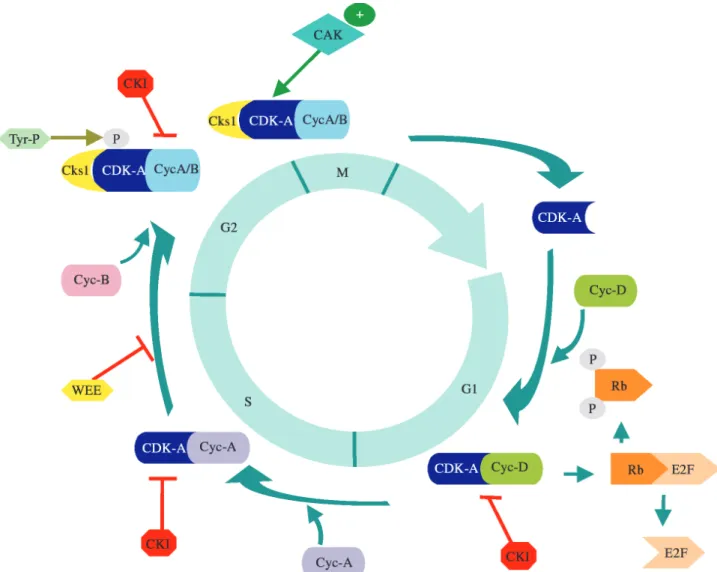
The fundamental controls that coordinate the cell cy-cle, ensuring that Mitosis does not proceed until DNA is completely duplicated seem to be conserved in all euka-ryotes and such controls depend on cyclin-dependent kina-se (CDK) complexes that regulate key transitions at the entry into S phase and Mitosis. A universal model for the control of progression through the mitotic cycle has been proposed and it involves the formation, activation and sub-sequent deactivation of these protein complexes. CDK complexes consist of a catalytic CDK subunit (a member of the CDC2-related family), and a regulatory cyclin subunit (Nurse, 1990). CDKs bind sequentially to a series of cyclins that are responsible for differential activation of the kinase during cell cycle progression. According to the phase of the cycle in which the cyclins are functional they can be classified as G1, S and G2-phase cyclins. In addi-tion, CDK activity is also regulated by postranslational modifications and by association with interacting proteins (Figure 1). Studies on the characterization of plant genes in-volved in controlling cell division strongly suggest that the cell cycle machinery is also conserved in plants (reviewed in Mironovet al., 1999).
Cell division plays a key role in plant development by giving rise to the cells that will expand and differentiate in various cell types, finally forming the plant body. These processes require essential co-ordination of cell division and developmental signals to drive plant growth. Cell
divi-sions should be differentially activated and repressed to al-low the formation of multicellular tissues. Therefore, throughout plant life, developmental controls must be per-fectly integrated with the mechanisms regulating mitotic activity in the meristems to construct highly ordered struc-tures. In addition, clearly discernible developmental strate-gies can be recognized between the two angiosperm classes. While in monocot plants secondary growth does not occur, in dicot plants, cell division in the vascular cam-bium provides new cells for the stem secondary growth. Another important difference between the two classes oc-curs during leaf development. In grasses there is clear
sepa-ration among the regions of cell division and
differentiation. Divisions occur mainly at the meristematic regions at the base of the leaf, and differentiation takes place along the leaf. Regions of cell proliferation and cellu-lar proliferation are not be so obviously defined in dicot plants. In addition, in grasses the cells of the mature leaves are terminally differentiated, while in many dicot plants many cells retain the competence to restart cell division (Hemerlyet al., 1993). Although substantial progress has been made in the understanding the mechanisms control-ling cell division in plants several most research has been conducted in dicot systems, and very little is known of the mechanisms regulating the cell cycle in grasses.
As a first step to study cell division in sugarcane, data mining in the SUCEST (sugarcane EST project) data set was conducted to identify genes involved in cell cycle
con-1Both these authors contributed equally to the article.
trol. Sequencing of randomly selected cDNAs is an effec-tive approach to discover new genes and inspect their expression in a broad diversity of tissues and/or treatments. Our results show that a complete set of sugarcane genes en-coding components of the cell cycle machinery is present in the SUCEST data base. Moreover, more than one cluster was retrieved for most genes, indicating that they are en-coded by multigene families. Sequence comparisons of the CDC2-related proteins revealed the existence of a new member of the family. Transcriptional profiles obtained for each gene revealed the existence of subsets of clusters with common expression patterns and this finding could be used to design strategies to identify novel genes that may partici-pate in the same regulatory network.
MATERIAL AND METHODS
The overall goal of this study was to retrieve from the SUCEST data set, sugarcane homologues to all genes de-scribed in Figure 1. In order to achieve this, data mining in the SUCEST database was carried using a combination of Blastx analyses using plant genes as baits, and keyword searches in the SUCEST home page (http://sucest.lbi.dcc. unicamp.br/cgi-bin/prod/blast/form_maker.pl or http:// sucest.lbi.dcc.unicamp.br/cgi-bin/prod/blastkwsearch/blas tkwsearch.pl, respectively). Each cluster from the first col-lection of genes retrieved was compared again with the SUCEST data set using the Blastn program in order to ex-tend the number of candidate genes. Then, both nucleotide and deduced amino acid sequences were used to compare all the clusters inside a gene family in order to confirm the number of candidate clusters.
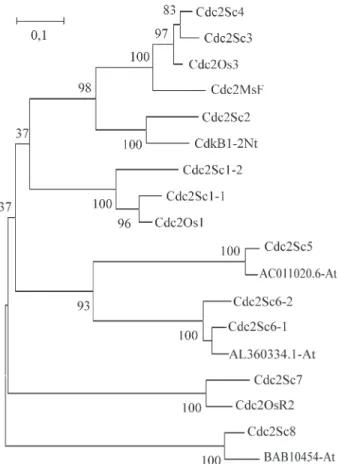
Alignment of partial amino acid sequences from CDC2 related sequences was made using CLUSTALW (http://biomaster.uio.no/clustalw.html). The closest plant homologue to each sugarcane gene was included in the comparison. The resulting alignment was used to obtain a phylogenetic tree using the Mega2b3 program (Kumaret al., 1993). An unrooted phylogenetic tree was constructed using the “Neighbor Joining” method. Confidence in the re-sulting tree was evaluated running a bootstrap test with 500 repetitions.
Transcriptional profiles were obtained by calculating the percentage of abundance from all reads of a given clus-ter in each cDNA library. Only cDNA libraries with more than 4500 reads were generally used. Exceptionally, when three or more reads of one cluster was found in cDNA li-braries with smaller number of the reads than 4500, these reads were considered in the final calculation. Percentage abundance was obtained by first calculating a normaliza-tion factor for each gene was obtained by dividing the total number of reads of in the cluster by the total number of reads of all cDNA libraries were the particular gene was
ex-pressed. Next, a normalized value for individual cDNA li-braries was calculated by multiplying the normalization factor by the number of reads in the particular cDNA li-brary. Finally, percentage abundance was calculated by di-viding the normalized value by the sum of all normalized values, and multiplying the result by 100.
RESULTS AND DISCUSSION
Cyclin-depedent kinases
Cyclin-dependent kinases (CDKs) play a pivotal part in the control cell cycle progression in eukaryotes. They are specific serine/threonine kinases that are activated at de-fined cell cycle phases. Various homologous of CDKs have been isolated from different plant species (reviewed in Hemerly et al., 1999). The CDKs can be separated into three main classes. The group containing the PSTAIRE se-quence, with the perfectly conserved 16 amino acid cyclin interacting motif forms the a-type class. A second class, the b-type, contains the PPTALRE or the PPTTLRE motifs at the equivalent position. The c-type class is formed by a group of homologues with divergent motifs that do not fit into either of the other classes.
A phylogenetic tree was constructed with the cDNA
sequences from the members of the sugarcane
CDC2-related family available in the SUCEST data set. Because not all clusters contained full-length clones, the alignment was constructed with amino acid sequences ran-ging from the conserved kinase catalytic domains I to VI (Hankset al., 1988). Data mining in the SUCEST data set allowed the identification of 2 CDK-a homologous clus-ters. Interestingly, the rice Cdc2Os1 gene (the rice CDC2 functional homologue) shares more similarities with the Cdc2Sc1-1 cluster (Figure 2), indicating that a gene dupli-cation occurred in theSaccharumprogenitor species after the event that generated the Oryza sativa/Saccharum sp separation. Because commercial sugarcane varieties are hybrids ofSaccharum officinarumandSaccharum sponta-neousspecies it would be interesting to verify if each gene is originated from the individual parental species. Expres-sion profile shows that the Cdc2Sc1-2 transcript is less abundant (5 out 25 total reads came from this gene, data not shown). Interestingly, all transcripts from this gene came from tissues with less meristematic activity, and one hy-pothesis is that this gene may have evolved to perform cell division in more restricted situations, while the other gene is responsible for cell divisions in regions of intense cell proliferation.
The CDK-related proteins are separated in six dis-crete families with a clear correlation with their function (Figure 2). The CDK-b1 class was represented in the EST bank by one cluster with the characteristic PPTALRE motif (Cdc2Sc2, Table I). Its close homologue is the tobacco CdkB1-2. An interesting situation emerges in the CDK-b2 Figure 2- Phylogenetic analysis of CDC2-related proteins from
family. One cluster with the typical PPTTLRE family motif was identified (Cdc2Sc3). In addition, another SUCEST cluster, with a PPTAMRE motif (Cdc2Sc4) was found in the CDK-b2 branch of the tree. Data base searches have not identified any CDK homologue in other eukaryotes with this motif. Because the bootstrap value separating these 2 clusters was quite high, the PPTAMRE containing protein may represent a new gene. On the other hand, both clusters are together in a branch of the tree that includes typical CDC-b2 genes such as the alfalfa Cdc2MsF and the rice Cdc2Os3 and this observation could suggest that CdcSc3 and CdcSc4 are alleles. The determination of the complete sequence of the cDNAs should solve this question.
Clusters homologous to CDK-activating kinase (CAK), to CDK8 kinase, to PITSLRE the family of human protein kinases and a cluster with a PITAIRE motif are split from the CDK-a and CDK-b classes. Although the phylo-genetic tree was constructed with partial amino acid se-quences, the results reinforce previous suggestions that the CDK-b branch may have evolved from a CDK-a containing
phylum (Lessard et al., 1999). Furthermore, it also indicates that an earlier duplication in the family of CDC2-related kinases separated the members of the family in-volved in the control of cell division from another group of proteins that evolved to assume more specialized functions.
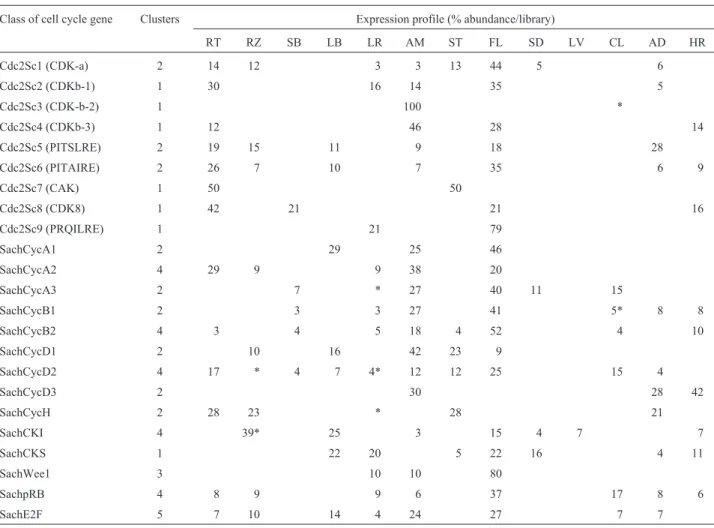
An important step in CDK activation is phospho-rylation of a conserved threonine residue by CAK (Miro-novet al., 1999). While in some organisms like mammals, CAKs can not only activate CDKs, but also phosphorylates the carboxy-terminal domain (CTD) of RNA-Polymerase II, in yeast these activities are carried out by two separated kinases. It has been proposed that in plants that both situa-tions may exist. In rice, a CAK homologue (Cdc2OsR2) can carry the two biochemical activities (Yamaguchiet al., 1998), but anArabidopsisCAK homologue (Cak1At) can only phosphorylate cyclin-dependent kinases (Umeda et al., 1998). A sugarcane CAK homologous gene was identi-fied (Cdc2Sc7) in the SUCEST database, and its closest match is the rice Cdc2OsR2 gene. Surprisingly, the best hit Table I- Sugarcane ESTs encoding regulators of the plant cell cycle
Class of cell cycle gene Clusters Expression profile (% abundance/library)
RT RZ SB LB LR AM ST FL SD LV CL AD HR
Cdc2Sc1 (CDK-a) 2 14 12 3 3 13 44 5 6
Cdc2Sc2 (CDKb-1) 1 30 16 14 35 5
Cdc2Sc3 (CDK-b-2) 1 100 *
Cdc2Sc4 (CDKb-3) 1 12 46 28 14
Cdc2Sc5 (PITSLRE) 2 19 15 11 9 18 28
Cdc2Sc6 (PITAIRE) 2 26 7 10 7 35 6 9
Cdc2Sc7 (CAK) 1 50 50
Cdc2Sc8 (CDK8) 1 42 21 21 16
Cdc2Sc9 (PRQILRE) 1 21 79
SachCycA1 2 29 25 46
SachCycA2 4 29 9 9 38 20
SachCycA3 2 7 * 27 40 11 15
SachCycB1 2 3 3 27 41 5* 8 8
SachCycB2 4 3 4 5 18 4 52 4 10
SachCycD1 2 10 16 42 23 9
SachCycD2 4 17 * 4 7 4* 12 12 25 15 4
SachCycD3 2 30 28 42
SachCycH 2 28 23 * 28 21
SachCKI 4 39* 25 3 15 4 7 7
SachCKS 1 22 20 5 22 16 4 11
SachWee1 3 10 10 80
SachpRB 4 8 9 9 6 37 17 8 6
SachE2F 5 7 10 14 4 24 27 7 7
in theArabidopsis genome (74% of homology) was not Cak1At but a putative CDC2-related protein.
The closest homologue to the sugarcane Cdc2Sc5 cluster was a putative CDC2-related kinase from Arabi-dopsis (Figure 2), and the best hits with proteins with known function was with the family of human PITSLRE protein kinases that are targets to caspases during apoptosis (Tanget al., 1998). Two clusters with the PITAIRE motif were identified in the sugarcane family of CDC2 related proteins (Cdc2Sc6). Animal and plant proteins with very similar sequences are found in databases, but a biochemical function has not been proposed yet. A sugarcane cluster with a novel PRQILRE motif (Cdc2Sc9) is highly homolo-gous to the Cdc2Sc6 clusters in the conserved kinase cata-lytic domains, but quite divergent in less conserved regions. Further characterization of this cluster may reveal that this is a new member of the CDK family not described yet in eukaryotes. The Cdc2Sc8 cluster encodes a homo-logue to the human CDK8 gene that interacts with Cyclin C and is involved in transcription (Tassanet al., 1995).
Cyclins
It has been demonstrated that the triggering of the events that control cell cycle progression depends on the accumulation of the cyclin proteins. Cyclin binding to CDKs regulates not only kinase activity, but also deter-mines the substrate specificity and subcellular localization of the kinase. Plant cyclins are classified as A, B or D-types (CycA, CycB and CycD), depending on their sequence homology to their animal counterparts. According to their sequence homology plant cyclin were separated in classes. While expression of CycA and CycB genes is cell cycle regulated, CycD mRNA levels do not fluctuate in actively dividing cells. There is a growing amount of evidence that CycDs are involved in mediating the response of plant cells to stimuli that control re-initiation of cell division (re-viewed in Huntley and Murray, 1999).
Sugarcane cyclins identified in this study could be classified in subgroups, using the categorization scheme proposed by Renaudin and coworkers (1996). Clusters en-coding CycA1, CycA2, CycA3, CycB1, CycB2, CycD1, CycD2, and CycD3-related genes were encountered by us in the SUCEST database with varying numbers in each class (Table I). Interestingly, in the CycD2 class, one clus-ter displays slightly more similarity with theArabidopsis CYCD4;1 gene, than with CYCD2;1 gene. Whether sugar-cane encodes also a D4-type cyclin will only be confirmed by the determination of the full sequences of the clusters, but two observations suggest that this indeed be the case. First, there was no nucleotide homology among of this clus-ter and the other D2-type cyclins, despite the fact it is long cDNA. The other observation is that the homology between the putative D4 cluster and the other D2 sugarcane cyclins was approximately the same it is found among the
Arabi-dopsiscycD2 and cycD4 proteins. Our data mining in the SUCEST data set indicated the presence of two sugarcane clusters encoding cyclinH proteins, the regulatory subunit of the CAK kinase.
Other genes involved in the regulation of CDK activity
Besides cyclins, other proteins have been isolated based on their ability to bind to CDKs, among them the an-choring protein CKS or Suc1, which can bind both negative and positive regulators of CDKs (Mironovet al., 1999). In plants, it has been shown that theArabidopsisCKS homo-logue, CKS1At is capable of binding both Cdc2aAt and Cdc2bAt (Jacqmardet al., 1999). Sugarcane clusters with homology to CKS were identified in the SUCEST database. Their deduced amino acid sequences have only thee con-served substitutions compared with theArabidopsisgene. Both at the amino acid and at the nucleotide levels the cod-ing regions of the sugarcane genes were 100% identical. However, at the 5’ UTR and 3’ UTR of the sugarcane clus-ters there were minor differences that suggested that they were indeed different genes. Another group of proteins, called CDK inhibitors (CKIs), interact with CDK and in-hibit cell cycle progression. Although several CKIs have been identified in the genome ofArabidopsis, the sequence of only two of these genes has been reported (Wanget al., 1998; Luiet al., 2000). Our results indicate that sugarcane encodes at least four CKI genes. Sequence comparisons in-dicated that their homology was restricted to the carbo-xy-terminal domain, and similar observation was made before, regarding the homology among ArabidopsisCKI genes (Luiet al., 2000).
Modulation of CDK activity can also be accom-plished by reversible phosphorylation in conserved tyro-sine and threonine residues located in the catalytic subdomain I. Inhibitory phosphorylation is carried out by a dual specificity kinase, Wee1. Three sugarcane clusters ho-mologous to the maize Wee1 gene (Sunet al., 1999) are present in the SUCEST bank. In higher animals and in the fission yeast, dephosphorylation in the above-mentioned residues is a key step in activating CDKs and it is carried by a protein phosphatase called Cdc25. There are genetic and biochemical evidence that tyrosine dephosphorylation on CDKs may be essential for cell cycle progression in plants (John, 1998; McKibbinet al., 1998). However, no CDC25 homologue has been identified in plants, despite the avail-ability of large cDNA collections, such as the SUCEST data set, and the completion of the sequence of the Arabi-dopsisgenome.
that in maize leaves, levels of the retinoblastoma protein are inversely correlated with Cdc2-related protein accumula-tion detected with an anti-PSTAIR antibody (Huntleyet al., 1998). Furthermore, as in higher eukaryotes, plant cyclin D proteins may act as sensors of external mitogenic stimuli (Riou-Khamlichiet al., 1999). In sugarcane, we identified in the Sucest data set seven retinoblastoma-related clusters. However, they may indeed represent only four genes, be-cause the best homology of four of these clusters was the maize RRB1 gene (Achet al., 1997). Another cluster was highly homologous to the maize RRB2 gene, and two fur-ther clusters were identified for the first time in grasses, and they share highest similarities with homologous genes in pea and poplar respectively. Out of 5 sugarcane E2F-re-lated clusters, three have highest homologies with the only wheat E2F published sequence (Ramirez-Parra et al., 1999), the other two clusters being homologous to different ArabidopsisE2F- related sequences.
Expression analysis based on relative abundance of EST/CDNA library
Large sets of ESTs from redundant non-normalized cDNA libraries can be used to detect evidence of differen-tial expression of individual genes in distinct tissues and/or treatments. An estimation of the abundance of a given mRNA can be obtained by the frequency of the ESTs corre-sponding to this mRNA, divided by the total number of ESTs in the data set. Not only can the expression of individ-ual genes can be compared in several situations, but it is possible to compare the mRNA expression of different genes. This is the concept of “digital Northern blot” or “transcriptional profile” (for a discussion of the advantages and limitations of this approach see Audic and Claverie, 1997 and Ohlorogge and Benning, 2000). One assumption of this strategy is that groups of genes with similar trans-criptional profiles could be part of a common regulatory network.
We calculated the relative abundance of ESTs in each cDNA library and a transcriptional profile of the sugarcane components of the cell cycle machinery was obtained (Ta-ble I). Previous analysis using promoter marker fusions and in situhybridization in dicot plants have shown that CDK-a expression is not restricted to dividing cells, its abundance being correlated with the tissue competence to proliferate (Hemerlyet al., 1993). In contrast, CDK-b is preferentially expressed in dividing cells (Fobertet al., 1996). Our trans-criptional profile of these genes in the SUCEST data set in-dicated that a similar pattern exists in monocot plants. While, CDC2Sc1 transcripts were observed not only in ac-tively dividing tissues (39% abundance in cDNA libraries other than the RT, AM and FL), Cdc2Sc2, Cdc2Sc3 and Cdc2Sc4 mRNA levels are much reduced or even absent in tissues with less meristematic activity (79, 100 and 86%, respectively in the RT, AM and FL libraries).
Cdc2Sc5 and Cdc2Sc6 shared approximately 60% of homology at the amino acid level, and they are closer to each other than to any other member of the CDC2-related family (Figure 2, and other data not shown). Although no biological function has been proposed for PITAIRE CDKs, because of the sequence homology between Cdc2Sc4 and Cdc2Sc5, and their strikingly similar transcriptional pro-files (Table I), it is tempting to speculate that the PITAIRE CDKs could also be involved in apoptosis.
A, and B-type sugarcane cyclins were preferentially expressed tissues with more meristematic activity, espe-cially in apical meristems and flowers. In the A and B classes, CycA2 and CycB2 were the only sugarcane genes present in roots. Surprisingly, the transcriptional profile of the sugarcane CycD-type genes showed a much less posi-tive correlation with meristematic activity. Only approxi-mately 50% of the CycD1 and CycD2 were found in the RT, AM and FL cDNA libraries. CycD3 transcripts were absent of flowers and roots, but present in apical meristems. These observations are not easy to reconcile with data from animals and dicot plants which shows that cyclin D genes are absent from non-dividing tissues, their expression being induced by mitogenic stimuli (Huntley and Murray, 1999). The enrichment of cyclin D transcripts in tissues with low meristematic activity could indicate that sugarcane adopted a particular developmental strategy in answer to external stimuli. Alternatively, the distinctive transcriptional pro-files of cyclin D genes may reflect the restricted meris-tematic activity or competence to divide in a subset of the cells inside each tissue. This later hypothesis is strength-ened by the pattern of expression of the sugarcane retino-blastoma and E2F genes. Only 51 of the retinoretino-blastoma, and 58% of the E2F total ESTs were restricted to the RT, AM and FL cDNA libraries. However, there was a strong correlation among presence and abundance of transcripts from both genes and the family of sugarcane cyclin D genes in the other cDNA libraries. In animal systems, phospho-rylation of pRB by cyclin D kinases results in E2F release leading to the G1 to S transition, and the same could be hap-pening in sugarcane cells. More careful studies of cyclin D expression in specific tissues may help to answer this ques-tion.
al., 1999). Therefore, it is suggestive that in the sugarcane tissues showing the highest level of CKI transcripts, only A and D-type cyclin ESTs are present.
The results described here represent a first step to-wards understanding the regulation of cell division regula-tion in sugarcane. Sugarcane homologous clusters to all known components of the cell cycle controlling machinery in plants were identified. In addition, transcriptional pro-files obtained allowed the identification of subsets of clus-ters showing similar expression patterns. In future studies, the integration of more traditional approaches of investigat-ing gene expression with new strategies to retrieve relevant information from the SUCEST data set should advance re-search and render a wealth of new perspectives from which to investigate questions not only in sugarcane, but in plants in general.
RESUMO
Resultados recentes da pesquisa sobre divisão celular em plantas sugerem que a maioria dos reguladores funda-mentais do ciclo celular são conservados em relação aos outros organismos eucariotos, mas que os mecanismos de controle superimpostos à maquinária básica, e a sua inte-gração com o crescimento e desenvolvimento são proces-sos característicos das plantas. Até agora, a maioria dos estudos de divisão celular em plantas tem sido conduzido em dicotiledôneas. Entretanto, as plantas monocotiledô-neas tem estratégias de desenvolvimento próprias, que irão afetar a regulação da divisão nos meristemas. Objetivando avançar o conhecimento de como a divisão celular é inte-grada com os mecanismos básicos que controlam a pro-gressão do ciclo celular em monocotiledôneas, uma busca exaustiva por genes de cana de açúcar envolvidos em divi-são celular foi feita no banco de dados do SUCEST (sugar-cane EST project). Os resultados obtidos incluem a descrição de várias classes de quinases dependentes de ciclinas (CDKs), de ciclinas do tipo A, B, C, D, e H; de proteínas que interagem com CDK; de quinases que ativam e inibem a atividade de CDKs, de proteínas homólogas ao gene retinoblastoma, e de fatores de expressão da família E2F. Grande parte dos genes do ciclo celular de cana de açúcar parecem ser codificados por famílias multigênicas. Assim como em plantas dicotiledôneas a transcrição do CDK-a não é restrita a celulas em divisão, mas a grande maioria dos ESTs de CDK-b são encontrados em regiões de alta proliferação. A expressão dos genes que codificam CKI é bem mais forte em regiões de pouca divisão celular, notadamente em gemas laterais. Padrões de expressão compartilhados de grupos de genes foi revelado por “Northern blot” digital, sugerindo que uma abordagem semelhante pode ser usada para identificar genes que participam da mesma via regulatória.
ACKNOWLEDGMENTS
The research was supported by FAPERJ, CNPq and CAPES.
REFERENCES
Ach, R.A., Durfee, T., Miller, A.B., Taranto, P., Hanley-Bow-doin, L., Zambryski, P.C. and Gruissem, W. (1997). RRB1 and RRB2 encode maize retinoblastoma-related pro-teins that interact with a plant D-type cyclin and geminivirus replication protein.Mol. Cell. Biol. 17: 5077-5086.
Audic, S.andClaverie, J.M.(1997). The significance of digital gene expression profiles.Genome Res. 7:986-995.
De Veylder, Engler, J.D., Burssens, S., Manevski, A., Lescure, B., Van Montagu, M., Engler, G.andInzé, D. (1999). A new D-type cyclin ofArabidopsis thalianaexpressed during lateral root primordia formation.Planta 208: 453-462.
Hemerly, A.S., Ferreira, P.C.G., Engler, J.A., Van Montagu, M., Engler, G.andInzé, D.(1993). Cdc2a expression in
Arabidopsis is linked with competence for cell division.
Plant Cell 5:1711-1723.
Hemerly, A.S., Ferreira, P.C.G., Van Montagu, M.andInzé, D. (1999). Cell cycle control and plant morphogenesis: is there an essential link?BioEssays 21:29-37.
Fobert, P.R., Gaudin, V., Lunness, P., Coen, E.S.andDoonan, J.H.(1996). Distinct classes of cdc2-related genes are dif-ferentially expressed during the cell division cycle in plants.
Plant Cell 8:1465-1476.
Hanks, S.K.; Quinn, T. and Hunter, T.(1988). The protein kinase family: conserved features and deduced phylogeny of the catalytic domains. Science 241:42-51.
Jacqmard, A., De Veylder, L., Segers, G., de Almeida Engler, J., Bernier, G., Van Montagu, M. andInzé, D. (1999).
CKSAtexpression inArabidopsis thalianasuggests a role for the protein in both the mitotic and endoreduplication cy-cle.Planta 207:496-504.
John, P.C.L.(1998). Cytokinin stimulation of cell division: es-sential signal transduction via Cdc25 phosphatase.J. Exp. Botany 49:91.
Kumar, S., Takamura, K.andNei, M.(1993). Molecular evolu-tionary genetics analysis version 2.0.beta (Build 4). The Pennsylvania State University, University Park, PA 16802.
Lui, H., Wang, H., DeLong, C., Fowke, L.C., Crosby, W.L.and
Fobert, P.R. (2000). The Arabidopsis Cdc2a-interacting protein ICK2 is structurally related to ICK1 and is a potent inhibitor of cyclin-dependent kinase in vitro. Plant J. 21:
379-385.
McKibbin, R.S., Halford, N.G.andFrancis, D.(1998). Expres-sion of fisExpres-sion yeast cdc25 alters the frequency of lateral root formation in transgenic tobacco. Plant Mol. Biol. 36:
601-602.
O’Farrel, P.H.(1992). Cell cycle control: many ways to skin a cat.Trends Cell Biol. 2: 159-163.
Ohlrogge, J.andBenning, C.(2000). Unraveling plant metabo-lism by EST analysis. Current Opinion in Plant Biol. 3:
224-228.
Mironov, V., De Veylder, L., Van Montagu, M.andInzé, D.
(1999). Cyclin-dependent kinases and cell division in plants - the nexus.Plant Cell 11:509-521.
Ramirez-Parra, E., Xie, Q., Boniotti, M.B.andGutierrez, C.
protein, reveals unique and conserved features with animal G1/S regulators.Nucleic Acids Res. 27: 3527-3533.
Renaudin, J.P., Doonan, J.H., Freeman, D., Hashimoto, J., Hirt, H., Inzé, D., Jacobs, T., Kouchi, H., Rouzé, P., Savoure, A., Sorrell, D.A., Sundaresan, V.andMurray, J.A.H.(1996). Plant cyclins: an unified nomenclature for plant A-, B-, and D-type cyclins based on sequence organi-zation.Plant Mol. Biol. 32:1003-1018.
Sun, Y., Dilkes, B.P., Zhang, C., Dante, R.A., Carneiro, N.P., Lowke, K.S, Jung, R., Gordon-Kamm, W.J.andLarkins, B.A.(1999). Characterization of maize (Zea mays L.) Wee1 and its activity in developing endosperm.P.N.A.S. USA 30:
4180-4185.
Tang, D.M., Gururajan, R.andKidd, V.J. (1998). Phosphoryl-ation of PITSLRE p110 isoforms accompanies their
pro-cessing by caspases during Fas-mediated cell death. J. Biol. Chem. 273:16601-16607.
Tassan, J.P., Jacquenoud, M., Leopold, P., Schultz, S.J.and
Nigg, E.A.1995. Identification of human cyclin-dependent kinase 8, a putative partner for Cyclin C.P.N.A.S., USA 92:
8871-8875.
Umeda, M., Bhalerao, R.P., Schell J., Uchimiya, H.andKoncz, C.(1998). A distinct cyclin-dependent kinase-activating ki-nase ofArabidopsis thaliana.P.N.A.S., USA 95:5021-5026.
Yamaguchi M., Umeda, M.andUchimiya, H.(1998). A rice homolog of CDK7/MO15 phosphorylates both cyclin-de-pendent kinases and the carboxy-terminal domain of RNA Polymerase II.Plant J. 16:613-619.
Wang H., Qi, Q.G., Schorr P., Cutler A.J., Crosby W.L.,and