Article
J. Braz. Chem. Soc., Vol. 26, No. 2, 247-254, 2015. Printed in Brazil - ©2015 Sociedade Brasileira de Química 0103 - 5053 $6.00+0.00
A
*e-mail: [email protected]
Improving Yield of 1,3-Diglyceride by Whole-Cell Lipase from
A. Niger
GZUF36
Catalyzed
Glycerolysis via Medium Optimization
Cuiqin Li,a Lanxiang Li,b,c Huanjing Zhou,b,c Chaoshuang Xiab,d and Laping He*,b,c,d
aSchool of Chemistry and Chemical Engineering; bDepartment of Food Science, College of Liquor
and Food Engineering; cGuizhou Province Key Laboratory of Fermentation Engineering and
Biopharmacy and dKey Laboratory of Agricultural and Animal Products Store & Processing of Guizhou Province, Guizhou University, 550025 Guiyang, China
1,3-Diglyceride (1,3-DG) has attracted considerable attention as a healthful food oil component. In this study, we reported a novel method to synthesis of 1,3-DG via glycerolysis of triglyceride (TG) catalyzed by whole-cell lipase from a new isolated strain, Aspergillus niger GZUF36. The
glycerolysis products include major diglyceride and minor monoglyceride. To improve yield of 1,3-DG, the optimized medium for the strain was obtained by combination of single-factor experiments, Plackett-Burman (PB), the steepest ascent and Box-Behnken design (BBD). Using the optimized medium, yield of 1,3-DG synthesized by the whole-cell lipase was 26.90 mol% and 1.42-fold yield was improved. The optimized medium lays the foundation for further studies of the reaction system for synthesis of 1,3-DG. The whole-cell catalyzed-glycerolysis process represents a significant advance toward achieving economical production of 1,3-DG at industrial scale.
Keywords: 1,3-diglyceride, screening, Aspergillus niger GZUF36, medium optimization,
whole-cell lipase
Introduction
1,3-Diglyceride (1,3-DG) is a healthy natural lipid, which is extensively used in food processing and utilized
as pharmaceutical intermediate.1-3 1,3-DG has numerous
advantages, due to low concentration in grease, so preparation of 1,3-DG is preferred. Enzymatic approaches to prepare 1,3-DG have been attached importance to by academics owing to their mild conditions, regioselectivity,
safety, and environmental friendliness.4,5
Enzymatic method commonly obtains 1,3-DG through
ester synthesis4 or glycerolysis.5 Compared with ester
synthesis, glycerolysis has advantages of cheaper raw materials and no need to removal of water during reaction process. So, the glycerolysis of triglyceride (TG) is a promising method for 1,3-DG preparation. To date, the used enzymes for preparation of 1,3-DG are mainly commercial
lipases4,5 and not whole-cell biocatalysts. Commercial
enzymes tend to be high in cost due to purification
procedures, making the process uneconomical.6 An
alternative to purified lipase enzyme is to use the organisms that produce the enzyme. In essence, intracellular enzymes
expressed on the cell wall or membrane are used as whole-cell catalysts instead of extrawhole-cellular enzymes that require extraction and purification from the culture medium. So, whole-cell lipases can decrease the purification cost and simplifying the process. Considering these advantages, considerable attention has been focused on the direct use of intracellular lipase as a whole-cell biocatalyst to synthesize
valuable compounds.7-9 Currently, no research is available
on the preparation of 1,3-DG using whole-cell lipase in non-aqueous medium.
Based on their advantages, whole-cell lipase was used to synthesize 1,3-DG by glycerolysis in this study.
To this end, intracellular lipase-producing microbes with highly selective synthesis of 1,3-DG were screened. The medium for the microbes was optimized to improve lipase activity because the enzymatic activity of a wild-type strain is generally low. The enzymatic activity of every unit mass of lipase can be expressed as the amount of 1,3-DG synthesized through enzyme-catalyzed glycerolysis.
experiments, and Box-Behnken design (BBD).10 In lipase
production, carbon source, nitrogen resource, and inorganic salts are first selected using single-factor experiments.
Important factors are then chosen by PB design.11 The ranges
of the optimization values are defined by the steepest-ascent
procedure,12 and then the optimized concentrations of the
main factors are determined by BBD.13,14
Therefore, in this study, intracellular lipase-producing microbes with highly selective synthesis of 1,3-DG were screened. The combination of the four designs was used to optimize the medium for the screened microbes to improve the yield of 1,3-DG by lipase-catalyzed glycerolysis of triolein. Before preparation of 1,3-DG, suitable method to analysis of TG, DG need to be chosen. To date, they can
be analyzed by a single marker,15 by NMR and GC,16,17
or by high-performance liquid cromatography (HPLC).4
Considering the specific conditions of the laboratory, HPLC was used to determine TG and DG in this work.
Materials and Methods
Materials and medium
Soil samples for the separation of lipase-producing microbes were obtained from lipid-rich soil. Monoolein, 1,3-diolein, 1,2-diolein, and triolein (purity > 99%) as standards were purchased from Sigma. Acetonitrile and hexane were chromatographically pure. All other chemicals used in this experiment were of analytical grade and commercially available. Rhodamine B-olive oil agar plate medium was prepared according to the method described
by Kouker and Jaeger.18 Seed medium contained 5 g L−1
peptone, 5 g L−1 glucose, 3 g L−1 beef extract and 5 g L−1
NaCl. The pH was adjusted to 7.0. Basal medium (or
rescreening fermentation medium) contained 20 g L−1
soybean, 20 g L−1 corn syrup, 5 g L−1 K
2HPO4 and 5 g L−1
NaNO3. The pH was adjusted to 7.0.
Screening and identification
Primary screening was performed using rhodamine
B-olive oil agar plate method.17 Rescreening was performed
based on HPLC analysis of glycerolysis products of TG catalyzed by whole-cell lipase.
The screened strain with highly selective synthesis of 1,3-DG was identified by the China Center for Type Culture Collection (CCTCC) based on its morphological characteristics and 18S rDNA sequence analysis. A phylogenetic tree was constructed by neighbor-joining algorithm using the maximum composite likelihood method in MEGA 5.0.
Preparation of whole-cell lipase
The two-ring spores of strain from slant tubes were collected by inoculation, and then transferred into 250 mL Erlenmeyer flasks containing 50 mL of seed medium. The seed culture in shake flasks was carried out at 30 °C for 24 h at 180 rpm. Subsequently, 2% (v/v) seed culture was transferred into 250-mL Erlenmeyer flasks containing 50 mL of basal medium (or other medium below). The fermentation culture in flasks was carried out at 30 °C for 48 h at 180 rpm. The harvested cells were freeze-dried, ground into powder using liquid nitrogen, and used as whole-cell lipase.
Single-factor experiments
Different carbon resources, nitrogen resources, and inorganic salts in the basal medium were determined by one-factor-at-a-time experiments.
PB design
Variables that significantly influenced 1,3-DG production were screened using a fractional factorial
PB design.11 According to the results of single-factor
experiment, glucose, soybean, K2HPO4, Na2HPO4, ZnSO4,
CaCl2, and NaCl had distinct positive effects on the yield of
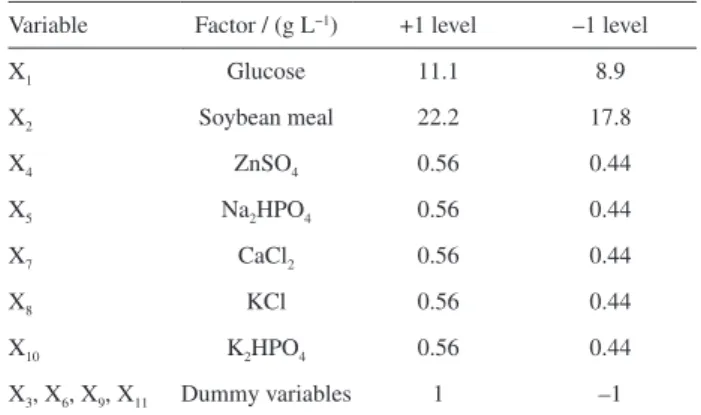
1,3-DG, and thus were selected for PB design. The seven independent and four dummy variables were evaluated at two levels (high and low) designated as level +1 and level –1, respectively (Table 1). PB design was conducted using Design-Expert software 8.06 (Stat-Ease, Inc., Minneapolis, USA).
Steepest-ascent design
The steepest-ascent design12 was used to find the
optimal regions of the significant factors determined by PB experiments.
Table 1. Minimum and maximum range of the parameters selected in the PB design
Variable Factor / (g L−1) +1 level –1 level
X1 Glucose 11.1 8.9
X2 Soybean meal 22.2 17.8
X4 ZnSO4 0.56 0.44
X5 Na2HPO4 0.56 0.44
X7 CaCl2 0.56 0.44
X8 KCl 0.56 0.44
X10 K2HPO4 0.56 0.44
BBD
BBD was performed to optimize the levels of the
influential significant variables.12-14 Each significant factor
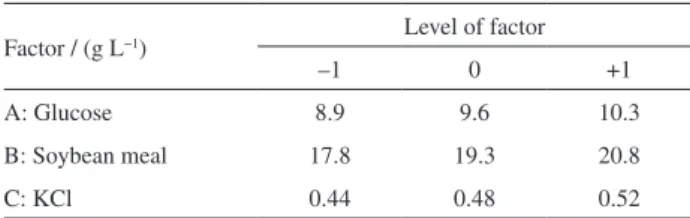
was coded by three levels: low (–1), medium (0), and high (+1). The code conversion equation is: xi= Xi – Xo/∆i, where
xi is the dimensionless value of an independent variable, Xi
is the real value of an independent variable, X0is the value
of Xi at the average point, and ∆i is the steep change. The
coded and actual values of the variables in the BBD are shown in Table 2.
Validation of the cubic model
To validate the optimization of the medium compositions, fermentation was performed using the optimal medium at 30 °C for 48 h at 180 rpm.
Glycerolysis reaction
All glycerolysis reactions in the experiment were performed in a sealed 50-mL flask containing 25 µmol (2.3 mg) glycerol, 50 µmol (44.28 mg) triolein, 0.2 g of dry whole-cell lipase (7.6% water content), 4.9 mL of
dry hexane, and 0.1 mL of dry t-butanol at 40 °C for 12 h
at 200 rpm. Hexane and t-butanol were dehydrated by
incubation with 10% (m/v) 4 Å activated molecular sieves for three days prior to addition to the reaction system. In addition, a blank for glycerolysis reactions in the absence of whole-cell lipase was carried out. While studying the time course of the whole-cell lipase-catalyzed reaction system, the enzyme was obtained from the optimized medium.
HPLC analysis
After the glycerolysis reaction, the organic phase was filtered with a 0.45 µm micro-porous membrane. The filtered samples were analyzed by HPLC (Agilent technologies 1260 infinity) with a Nova-Pak column (3.9 mm × 150 mm, Waters, USA) and a diode array detector. Initially, the mobile phase, acetonitrile, and isopropanol (v/v, 60:40) was held for 27 min. The volume ratio of acetonitrile and isopropanol was adjusted to 80:20, and then maintained for 3 min.
Other conditions were flow rate at 0.6 mL min−1, column
temperature at 30 °C, and detection wave at 210 nm. The
concentration (mol L−1) of TG, 1,3-DG and 1,2-DG were
calculated from their peak areas. Yield of DG and selectivity of lipase on 1,3-DG were respectively calculated by the following equations 1 and 2.
(
)
initial
DG Yield mol % of DG 100%
TG
= × (1)
1,3-DG
Selectivity of lipase on 1,3 - DG 100% 1,3-DG+1,2-DG
= × (2)
where the values of DG, 1,3-DG, 1,2-DG are all calculated
by subtracting their corresponding blank value, mol L−1;
TGinitial means the concentration of TG at the beginning of
the reaction, mol L−1.
Statistical analysis
All experiments were performed in triplicates. Data were presented as the mean of three determinations and their relative standard deviations were all below 5%. Data from PB test and BBD were analyzed using Design-Expert version 8.06. Other data were analyzed by SPSS version 16.0 (SPSS, Chicago, IL, USA). Differences were considered significant at p < 0.05.
Results and Discussion
Screening and identification
More than 70 lipase-producing strains were chosen in the rhodamine B-olive oil agar plates for the lipase-producing microbes. Results from the rescreening indicate that GZUF36 is an excellent intracellular lipase-producing strain showing high selectivity (72.54%) on synthesis of 1,3-DG by glycerolysis. Intracellular enzymes are essentially expressed on the cell wall or membrane. So, the membrane or cell wall of the host is altered to change the enzyme properties including selectivity and activity. This may give further interest to the use of whole-cell lipase. In micromorphological studies, the sequencing of 18S rDNA and phylogenetic analysis (Figure 1) suggest that GZUF36
strain is Aspergillus niger. This strain was registered in
CCTCC under CCTCC No. M2012538.
In the glycerolysis reaction catalyzed by whole-cell lipase from GZUF36 in mixed media of hexane and tert-butanol (49:1, v/v), the products were major DG and minor monoglyceride (MG). The content of 1,3-DG is 72.54 mol% in the total DGs, and its yield by the whole-cell lipase of GZUF36 using basal medium (or rescreening fermentation medium) is 11.12 mol%. Byproduct MG is also a kind of valuable compounds, which may be used as
Table 2. Coded and real values of variables in the BBD
Factor / (g L−1) Level of factor
–1 0 +1
A: Glucose 8.9 9.6 10.3
B: Soybean meal 17.8 19.3 20.8
an emulsifier. Regarding synthesis of MG by the whole-cell lipase, it will be discussed in detail in another article.
Effect of carbon sources on synthesis of 1,3-DG
Based on the basal medium, several inexpensive and easily obtainable carbon sources were selected. These sources were glucose, soluble starch, sucrose, corn syrup, olive oil, and maltose, which are also commonly used in the industry.
Figure 2 shows the effects of carbon sources on the synthesis of 1,3-DG catalyzed by whole-cell lipase. Result suggests that selectivity of lipase is lowest using maltose as sole carbon source. By contrast, the selectivity of lipase is highest using glucose. In addition, the effects of soluble starch, sucrose, olive oil, and corn syrup on
the selectivity of lipase were almost the same (p > 0.05).
The phenomenon may be attributed to the carbon source affecting the conformation of the whole-cell lipase by changing ingredient composition of the cell. Result also shows that the lowest yield of 1,3-DG was observed when soluble starch or olive oil was used as sole carbon source, whereas the highest yield was obtained when glucose was
used. A similar study was performed in Bacillus pumilus
SG2 because glucose is the best carbon source for lipase
production.19 The reason is that glucose induces lipase
production.20 Therefore, glucose was selected as the sole
carbon source for further experiments.
Effect of nitrogen sources on synthesis of 1,3-DG
Based on the basal medium, several nitrogen sources were available, such as soybean meal, peptone, beef extract, yeast extract, sodium nitrate, and ammonium sulfate. These nitrogen sources are also commonly used in the industry.
(HM347449.1)
Aspergillus niger
HKS11 (JX112703.1)
Aspergillus niger
sp. LQ21 (HM536999.1)
Aspergillus
IG4(JQ012802.1)
Aspergillus terreus
(HQ397705.1)
Aspergillus niger
IG3 (JQ012801.1)
Aspergillus awamori
strain IG1 (JQ012799.1)
Aspergillus niger
strain ETYB-13 (GQ903338.1)
Aspergillus niger KY (EU184861.1) Aspergillus niger contig An03c0100(AM270051.1) Aspergillus niger GZUF36 contig An03c0110(AM270052.1) Aspergillus niger
Aspergillus nigerMZM 89-a2 (FR774047.1 )
100
100 56
0.1
Figure 1. Neighbor joining phylogenetic tree derived from partial 18S rDNA sequences. The numbers at the nodes represent percentage bootstrap values based on 1000 replicates. The horizontal scale bar indicates a distance of 0.1.
glucose maltose soluble
starch
olive oil corn syruo surcose
0 5 10 15 20
25 Yield of diglyceride / mol%
Selectivity of lipase on 1,3-diglyceride
Carbon source
A
B B B
C D a b b b c c 10 20 30 40 50 60 70 80 90
Selectivity of lipase on 1,3-diglyceride /
%
Y
ield of diglyceride / mol%
Figure 2. Effect of carbon sources on the synthesis of 1,3-diglyceride
catalyzed by whole-cell lipase. Means with different lower case letters on the bars are significantly different (p < 0.05); means with different uppercase letters are also significantly different (p < 0.05), the same below Figures 3 and 4.
soybean meal yeast extract beef extract
peptone NaNO3 (NH ) SO4 2 4
0 10 20 30 Nitrogen source Y
ield of diglyceride / mol%
A A A B B C a b c Yield of diglyceride / mol%
Selectivity of lipase on 1,3-diglyceride
10 20 30 40 50 60 70 80 90
Selectivity of lipase on 1,3-diglyceride /
%
d
e e
Figure 3. Effect of nitrogen sources on the synthesis of 1,3-diglyceride
The effect of different nitrogen sources on the selectivity of the whole-cell lipase from the highest to lowest is soybean meal, peptone, beef extract > yeast extract, ammonium sulfate > sodium nitrate (Figure 3). The foregoing can be attributed to the nitrogen source that affects the cell structure, thereby influencing the spatial structure and selectivity of the lipase. The effect of the nitrogen source on the yield of 1,3-DG demonstrates another phenomenon, in which the highest yield is 18.11 mol% from soybean meal and the lowest yield is from yeast extract or beef extract. This finding can be explained by nitrogen, which
affects lipase production,21 thereby influencing the yield
of 1,3-DG. Soybean also contains vegetable oil that can
induce the production of lipase.22 So, soybean was used as
the sole nitrogen source for further experiments.
Effect of inorganic salts on synthesis of 1,3-DG
Based on the basal medium with glucose and soybean meal as the sole carbon and nitrogen source, respectively, the selection of inorganic salts was based on some reports
on the fermentative production of lipase.23,24
Lipase activity and selectivity are significantly
influenced (p < 0.05) by inorganic salts. Magnesium sulfate
can inhibit the production of DG, whereas KCl, K2HPO4,
or ZnSO4 can facilitate it (Figure 4). In addition,
whole-cell lipase shows high selectivity on 1,3-DG with KCl,
Na2HPO4, or ZnSO4, whereas low selectivity is observed
with MgSO4. The explanation can be attributed to inorganic
salt, which affects enzymatic activity by influencing enzyme production or conformation. Thus, inorganic salt can change the selectivity by altering the conformation of the enzyme via binding to the enzyme.
Figure 4 illustrates the yield and selectivity of
whole-cell lipase that are suppressed by MgSO4. Haider and
Pakshirajan observed the same phenomenon, in which
MgSO4 exerts a negative effect on the lipolytic activity.25
Thus, MgSO4 was not added in the succeeding experiments.
Figure 4 also suggests that suitable inorganic salt should
be selected from KCl, Na2HPO4, or ZnSO4.
PB test
The medium components were evaluated by PB statistical design. This design is a fraction of a two-level
factorial design, and allows the investigation of ‘n–1’
variables with a minimum of ‘n’ experiments.11 Thus, PB
design can determine important factors through statistical analysis.
Results of PB design (Table 3) were subjected to analysis of variance using Design-Expert software, which
Table 3. PB design with coded values along with the observed results
No. X1 X2 X3 X4 X5 X6 X7 X8 X9 X10 X11 Yielda / mol% Selectivityb / %
1 –1 1 –1 1 1 –1 1 1 1 –1 –1 15.21 86.49
2 –1 1 1 1 –1 –1 –1 1 –1 1 1 13.67 85.51
3 1 1 1 –1 –1 –1 1 –1 1 1 –1 15.39 85.03
4 1 –1 –1 –1 1 –1 1 1 –1 1 1 16.69 86.66
5 –1 1 1 –1 1 1 1 –1 –1 –1 1 16.92 87.94
6 1 –1 1 1 –1 1 1 1 –1 –1 –1 12.81 88.25
7 1 –1 1 1 1 –1 –1 –1 1 –1 1 16.61 87.90
8 –1 –1 1 –1 1 1 –1 1 1 1 –1 18.29 87.96
9 –1 –1 –1 1 –1 1 1 –1 1 1 1 23.57 87.48
10 1 1 –1 1 1 1 –1 –1 –1 1 –1 13.83 87.94
11 1 1 –1 –1 –1 1 –1 1 1 –1 1 10.92 87.83
12 –1 –1 –1 –1 –1 –1 –1 –1 –1 –1 –1 18.50 88.62
aYield means yield of 1,3-DG; bselectivity means selectivity of lipase on 1,3-DG.
KCl Na HPO2 4 MgSO4 CaCl2 K HPO2 4 ZnSO4
0 5 10 15 20 25 30 35 40
Inorganic salts
A A
B B
b
a a
50 60 70 80 90 Yield of diglyceride / mol%
Selectivity of lipase on 1,3-diglyceride A
a
c C
d
Y
ield of diglyceride / mol%
Selectivity of lipase on 1,3-diglyceride /
%
Figure 4. Effect of inorganic salts on the synthesis of 1,3-diglyceride
showed that glucose (X1), soybean meal (X2), and KCl (X8)
have significant effects on the yield of 1,3-DG (p < 0.05).
Other factors have no significant effect. The insignificant
terms were neglected (p > 0.05), and a modified first-order
equation was employed to describe the yield of 1,3-DG in terms of coded factors as follows:
Y = 16.03428 – 1.66049X1 – 1.70994X2 – 1.43461X8 (1)
Equation 1 indicates that X1, X2, and X8 have adverse
effects on the yield of 1,3-DG in their given ranges of concentration (code values: –1 to +1). According to the results of PB experiment, the optimum medium
compositions are 8.9 g L-1 glucose, 17.8 g L-1 soybean meal,
0.44 g L-1 ZnSO
4, 0.44 g L-1 Na2HPO4, 0.44 g L-1 CaCl2,
0.44 g L-1 K
2HPO4, and 0.44 g L-1 KCl.
The concentrations of the three key factors (glucose, soybean meal, and KCl) were further optimized. Considering that selectivity of lipase on 1,3-DG is within the range of 85% to 89% and is almost kept stable, the yield of 1,3-DG was only measured in the following experiments for simplification.
Steepest-ascent experiments
PB design is a valuable tool for screening the significant variables that affect the enzyme activity, but it is unable to
predict the optimum levels of the compositions.26 However,
the path of the steepest ascent can be used to determine the changing direction of the factors, and thus obtain the optimum region. The path of the steepest ascent and the results are shown in Table 4. Based on the findings, run 4 is the closest to the optimal region. Thus, run 4 was chosen for the extended optimization by BBD.
BBD
After the ranges of the principal factors were selected by PB and steepest-ascent experiment, BBD was used to
obtain a polynomial model.12,13
The highest yield of 1,3-DG observed is 25.19 mol% in run 5 (Table 5). After analysis of variance for data from Table 5 and the neglect of insignificant variables
(p > 0.05), a modified cubic-order model was fitted to the
yield of 1,3-DG, which resulted in the following regression equation 2 in terms of coded factors:
Y = 20.15 + 1.56A – 1.37B + 0.34C + 1.45AB +
2.62AC – 1.72BC + 1.57B2 – 1.22AB2 (2)
The regression equation with R-squared 0.9962
ensures satisfactory adjustment of the cubic model to the experimental data. This model can be used to navigate the design space.
The 2D contour plots (Figure 5a-c) for the effect of the interaction variables on the yield of 1,3-DG were generated to determine the interaction among these two factors and their optimum concentration values. In this plot, responses were examined by taking two variables at a time while
keeping the other one at the ‘0’ level.27 Result suggests
that strong interactions between two factors of glucose, soybean, and KCl exist, and these factors have significant effects on the yield of 1,3-DG. The point prediction feature was applied, and the optimum concentrations were
determined to be 10.3 g L-1 glucose, 17.8 g L-1 soybean, and
0.52 g L-1 KCl. The predicted maximum yield of 1,3-DG
is 26.65 mol% at this optimum condition.
Table 4. The steepest ascent experiments and results
Trial Glucose / (g L-1) Soybean meal / (g L-1) (g LKCl / -1) Yield of 1,3-DG / mol%
1 11.7 23.7 0.6 10.96
2 11.1 22.2 0.56 11.93
3 10.3 20.8 0.52 17.62
4 9.6 19.3 0.48 24.18
5 8.9 17.8 0.44 21.25
6 8.2 16.3 0.4 11.02
Table 5. Results of BBD for 1,3-DG
Trial Glucose (A)
Soybean meal (B)
KCl (C)
Yield of 1,3-DG / mol%
1 –1 –1 0 24.17
2 0 0 0 20.39
3 –1 0 –1 20.72
4 0 1 1 18.93
5 0 –1 1 25.19
6 1 0 1 24.50
7 1 –1 0 21.94
8 1 1 0 22.19
9 0 0 0 20.26
10 0 1 –1 21.66
11 0 0 0 20.05
12 0 0 0 20.50
13 –1 1 0 18.61
14 0 0 0 20.19
15 1 0 –1 18.60
16 –1 0 1 16.14
Based on all test results, the final optimization of the
medium is 10.3 g L-1 glucose, 17.8 g L-1 soybean, 0.52 g L-1
KCl, 0.44 g L-1 ZnSO
4, 0.44 g L-1 Na2HPO4, 0.44 g L-1
CaCl2, and 0.44 g L-1 K2HPO4.
Validation of the optimized condition
To confirm the optimized results, the culture of GZUF36 was examined using the optimal medium. Results show
that the yield of 1,3-DG is 26.90 mol% ± 1.10 mol%
by whole-cell lipase from A. niger GZUF36 using the
optimized medium. The maximum yield is almost equal to the predicted value (26.65 mol%). Thus, the optimized medium is propitious for the production of whole-cell lipase from GZUF36 for the synthesis of 1,3-DG.
Based on optimizing the medium composition for the production of whole-cell lipase from GZUF36, the yield of 1,3-DG catalyzed by the lipase is improved from 11.12 mol% to 26.90 mol%, in which a 1.42-fold increase is observed.
Time course of the reaction system using the optimized medium
The time course is a good indicator of enzyme performance and reaction progress. It can pinpoint the shortest or adequate time necessary to obtain a good yield and minimize the process cost. Figure 6 shows the time course of the glycerolysis of TG to DG catalyzed by
whole-cell lipase from A. niger GZUF36. The yield of 1,3-DG had
a linear increase until 6 h; thereafter, the increase slowed down. From 12 to 16 h, the yield (25.69%) of 1,3-DG was held constant on the whole. The time course also indicted that the reaction rate was faster in initial 6 h, and then lowered. The selectivity also remained fixed (about 85%) throughout the course of the reaction. So, the suitable time was 12 h.
Conclusions
In this research, we isolated a new strain, A. niger
GZUF36, that can produce intracellular lipase with selective synthesis of 1,3-DG. To simplify the process, we directly used the lipase as whole-cell enzyme to
Figure 5. Contours of mutual-influences (a) between glucose concentration
and soybean concentration; (b) between glucose concentration and KCl concentration; and (c) between soybean meal concentration and KCl concentration with targets of maximizing yield of 1,3-DG.
1 2 3 4 5 6 7 8 9 10 11 12 13 14 15 16 17
5 10 15 20 25 30
Reaction time / h
0 10 20 30 40 50 60 70 80 90
Selectivity of lipase on 1,3-diglyceride /
%
Y
ield of diglyceride / mol%
Figure 6. Time course of the reaction system using the optimized medium.
The symbol means yield of 1,3-DG (%), selectivity of lipase on
synthesize 1,3-DG through glycerolysis. Yield of 1,3-DG was improved from 11.12 mol% to 26.90 mol% through
optimization of the medium for A. niger GZUF36 via
single-factor experiments, PB design, steepest-ascent experiments, and BBD. The suitable reaction time was 12 h. The optimized medium provides the basis for further studies of the reaction system for synthesis of 1,3-DG by whole-cell lipase.
Supplementary Information
Supplementary data of variance analysis with reduced cubic model for BBD are available free of charge at http://jbcs.sbq.org.br, as PDF file.
Acknowledgments
This work was financially supported by the Special Fund of the Governor of Guizhou Province for Excellent Scientific, Technological and Educational Talents, No. (2010)10 and the National Natural Science Foundation of China (NSFC, 21062004 and NSFC, 31160002).
References
1. El Kihel, L.; Bourass, J.; Richomme, P.; Petit, J. Y.; Letourneux, Y.; Drug Res. 1996, 16, 1040.
2. Maurelli, S.; Blasi, F.; Cossignani, L.; Bosi, A.; Simonetti, M. S.; Damiani, P.; J. Am. Oil. Chem. Soc.2009, 86, 127. 3. Doucet, J. I. M;US pat. 59,098,655 1999.
4. Duan, Z. Q.; Du, W.; Liu, D. H.; J. Biotechnol. 2012, 159, 44. 5. Yamane, T.; Kang, S. T.; Kawahara, K.; Koizumi, Y.; J. Am. Oil
Chem. Soc.1994, 71, 339.
6. Noureddini, H.; Gao, X.; Philkana, R. S.; Bioresource Technol.
2005, 96, 769.
7. Liu, W.; Jia, B.; Zhao, H.; Xu, L.; Yan, Y.; J. Agric. Food Chem.
2010, 58, 10426.
8. Iftikhar, T.; Niaz, M.; Afzal, M.; Haq, I. U.; Rajoka, M. I.; Food Technol. Biotechnol.2008, 46, 402.
9. He, Q.; Xu, Y.; Teng, Y.; Wang, D.; Chin. J. Catal. 2008, 29, 41.
10. Zhang, H.; Sang, Q.; Zhang, W.; Ann. Microbiol.2012, 62, 629. 11. Plackett, R. L.; Burman, J. P.; Biometrika1946, 33, 305. 12. Guo, L.; Luo, Y.; Fan, D.; Xu, R.; Hui, J.; Ma, X.; Zhu, C.;
Afr. J. Microbiol. Res.2012, 6, 3856.
13. Wang, Z. W.; Liu, X. L.; Bioresource Technol.2008, 99, 8245. 14. Ottoni, C. A.; Cuervo-Fernández, R.; Piccoli, R. M.;
Moreira, R.; Guilarte-Maresma, B.; Silva, E.; Sabino, D.; Rodrigues, M. F. A.; Maiorano, A. E.; Braz. J. Chem. Eng.
2012, 29, 49.
15. Tan, T.; Lai C.-J.-S.; Zeng, S.-L.; Liu E-H.; Li, P.; Anal. Bioanal. Chem.2014, 406, 4921.
16. Rosset, I. G.; Tavares, M. C. H.; Assaf, E. M.; Porto, A. L. M.; Appl. Catal. A2011, 392, 136.
17. Rosset, I. G.; Assaf, E. M.; Porto, A. L. M.; Curr. Catal.2013,
2, 53.
18. Kouker, G.; Jaeger, K.-E.; Appl. Environ. Microbiol.1987, 53, 211.
19. Sangeetha, R.; Geetha, A.; Arulpandi, I.; Int. J. Microbiol. 2008,
5, 1937.
20. Lin, E. S.; Ko, H. C.; Enzyme Microb. Tech.2005, 37, 261. 21. Thanagrit, B.; Thidarat, P.; Ratanaporn, L.; J. Life Sci. Technol.
2013, 1, 176.
22. Pogori, N.; Cheikhyoussef, A.; Xu, Y.; Wang, D.; Biotechnology
2008, 7, 710.
23. Kathiravan1, T.; Marykala, J.; Sundaramanickam, A.; Kumaresan, S.; Balasubramanian, T.; Adv. Appl. Sci. Res. 2012,
3, 591.
24. Iftikhar, T.; Haq, I. U.; Javed, M. M.; Pakistan J. Bot.2003, 35, 519.
25. Haider, M. A.; Pakshirajan, K.; Appl. Biochem. Biotechnol.
2007, 141, 377.
26. Chen, X. C.; Bai, J. X.; Cao, J. M.; Li, Z. J.; Xiong, J.; Zhang, L.; Hong, Y.; Ying, H. J.; Bioresource Technol.2009, 100, 919. 27. Zhang, B.; Zhang, J.; Yang, Q.; Feng, C.; Zhu, Y.; Ye, Z.; Ni, J.;
Bioresource Technol.2012, 124, 1.
Submitted on: August 21, 2014