Article
J. Braz. Chem. Soc., Vol. 22, No. 4, 767-771, 2011. Printed in Brazil - ©2011 Sociedade Brasileira de Química
0103 - 5053 $6.00+0.00
A
*e-mail: [email protected]
Electrochemical Behavior and Determination of Fluconazole
Éric de S. Gil,*,a Diogo D. Cordeiro,a Ana E. B. Matiasa and Sílvia H. P. Serranob
aFaculdade de Farmácia, Universidade Federal de Goiás, Av. Universitária com 1º Avenida s/n,
Setor Universitário, 74605-220 Goiânia-GO, Brazil
bInstituto de Química, Departamento de Química Fundamental, Universidade de São Paulo,
Avenida Prof. Lineu Prestes, 748, Bloco 2 superior, 05508-900 São Paulo-SP, Brazil
O comportamento eletroquímico do luconazol demonstrou oxidação irreversível com mecanismos eletroquímicos-químicos dependentes do material eletródico. Em eletrodos de Pt observou-se adsorção do reagente sob a aplicação de potenciais positivos, enquanto adsorção preferencial dos produtos foi observada em eletrodo de carbono vítreo. Em valores de pH inferiores a 7,0, a corrente do processo anódico é intensamente diminuída. Em eletrodo de pasta de carbono e tampão fosfato, pH 8,0, a corrente de oxidação variou linearmente com a concentração de luconazol em solução, Ipa = 5,7×10⁻⁵ (mA) × 0,052 [Fluconazol] (µg mL-1), no intervalo de 48,0 a 250,0 µg mL-1. O limite de detecção obtido foi 6,3 µg mL-1.
The electrochemical behavior of luconazole showed an irreversible oxidation process, with the electrochemical - chemical mechanism being highly dependent on the electrode material. Adsorption of reagent at positive applied potential was observed at Pt electrode while preferential adsorption of the oxidation products was observed at Glassy Carbon surfaces. In pH below 7.0, the anodic current process was intensively decreased. At carbon paste electrode, the luconazole oxidation current, recorded in phosphate buffer solution (pH 8.0), changed linearly with the luconazole concentration, Ipa = 5.7×10⁻⁵ (mA) × 0.052 [Fluconazol] (µg mL-1), in the range of 48.0 to 250.0 µg mL-1. The detection limit obtained was 6.3 µg mL-1.
Keywords: luconazole, electrochemical behavior, voltammetry, electrodic material
Introduction
Fluconazole is a luorine-substituted bis-triazole which is commonly used as an anti-fungal drug to treat supericial and systemic mycoses,1 whose structure is depicted in Figure 1.
Various analytical methods have been developed for the determination of luconazole, most of them including
spectrometric2,3 and chromatographic methods.4-6 The presence of electroactive groups in luconazole molecule makes it an interesting candidate for electroanalytical methods. Furthermore, while there are already some publications of imidazole analogues in the electrochemical area,7-10 there is no electrochemical studies extended to luconazole and other triazoles antifungals available in the literature.
Electrochemistry has many advantages which turns it a good option for pharmaceutical and bioanalysis applications. These techniques offer a wide dynamic range and require only small sample volumes, often in the microliter range, that coupled with the low detection limits, allows analysis on subpicogram amounts of analyte. Also, the selectivity of electrochemical detection in complex samples is excellent, because fewer electroactive interferents are often encountered than spectroscopic interferents.11 Considering the levels of luconazole in many clinical samples (e.g. urine, blood, faeces, breast milk,
N N N
N N N OH
F F
saliva, cerebrospinal luid and ocular luids), as well the fact of 90% is excreted unchanged in the urine and 10% in the faeces,1,12 the higher sensitivity can be useful to detect the unchanged form of luconazole in these matrices.
The aim of the present work is to study the redox behaviour of luconazole in aqueous solutions at platinum (Pt) and carbon (glassy carbon and carbon paste) electrodes, using several voltammetric techniques and, also, develop sensitive electroanalytical procedures for the direct determination of luconazole.
Experimental
Apparatus
All voltammetric curves were obtained using a µAutolab type III potentiostat from Eco Chemie (Utrecht, Netherlands) and GPES software (Eco Chemie). The voltammetric system was composed by a 10 mL electrolytic cell linked by a three electrode system. A calomelane (SCE) was used as reference electrode and a platinum wire was used as auxiliary electrode, while the work electrodes were of platinum (Pt, Ø 0.2 mm); glassy carbon (GC, Ø 2 mm) or carbon paste electrode (CP, Ø 2 mm).
Chemicals, solutions and sample preparation
All solutions were prepared from analytical grade chemicals with de-ionized water from Milli Q system (Millipore, Bedford, mA, USA). Phosphate buffer (0.1 mol L-1, pH 4.0-8.5) and 0.1 mol L-1 KCl pH 8,0 were used as supporting electrolyte. The pH was adjusted with 0.1 mol L-1 NaOH or HCl solutions.
The standard solution was prepared by dissolving luconazole in NaOH 0.1 mol L-1 in order to reach the inal luconazole concentration of 0.2%. The working solution was prepared by suitable dilution in de-ionized water in order to reach 0.02% solution. The standard of luconazole was purchased from Brazilian Pharmacopoeia.
The standard addition method was then applied, adding successive aliquots of 50 µL of the 0.02% solution in the 10 mL cell.
Results and Discussion
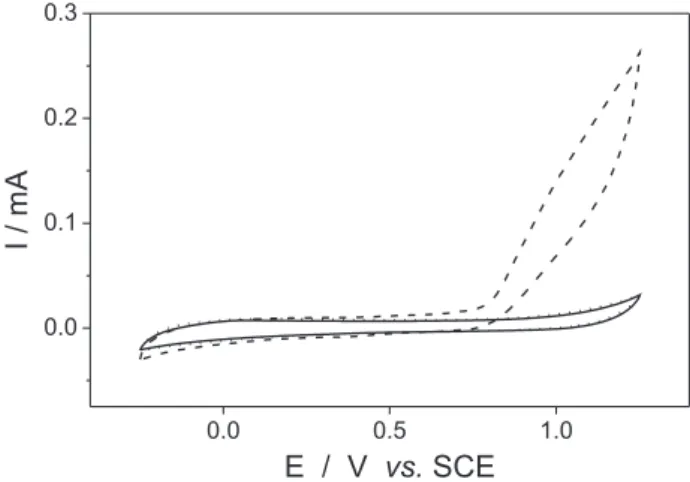
Fluconazole exhibits a clearly pH dependent oxidation process, which is entirely suppressed at pH 4.0 (Figure 2). At a glassy carbon electrode, the anodic process began at 0.8 V and extend to higher potentials (above 1.1 V), probably involving the oxidation of the N- in the azo groups. This supposition is supported by the fact that
triazoles can undergo oxidation through the loss of an electron of triazolic ring, producing a radical-cation, which suffer further dimerization step to form a bis-compound.13
The inluence of pH on luconazole oxidation showed to be very similar to some thiotriazoles. Previous report,14 using DPV, showed that peak potential for the anodic process (Ep,a) of thiotriazoles shift to less positive value with increasing pH and is pH independent above of pH 8.0, while the peak current (Ip,a) increases from pH 8.0. Similar effect was also observed with luconazole, when the pH was changed from 8.0 to 8.5, Figure 3.
The electrodic material has great inluence over the oxidation process, being more intense for larger supericial area. The Figure 4 shows the voltammograms obtained at the same conditions with three different electrodes.
Figure 2. Cyclic voltammograms obtained at carbon paste electrode in 0.1 mol L-1 phosphate buffer solution, pH 8.0 (––––); phosphate buffer
pH 4.0 (……) and pH 8.0 (– – – –) containing 5.0 × 10⁻⁴ % luconazole.
Experimental conditions: −0.25 V ≤ Eappl ≤ 1.25 V at v = 100 mV s-1.
Figure 3. DPV obtained at carbon paste electrode in 0.1 mol L-1 KCl,
pH 8.0 blank (……); 0.1 mol L-1 KCl pH 8.0 (– – – –) and pH 8.5 (––––)
containing 5.0 × 10⁻⁴ % luconazole. Experimental conditions: E initial =
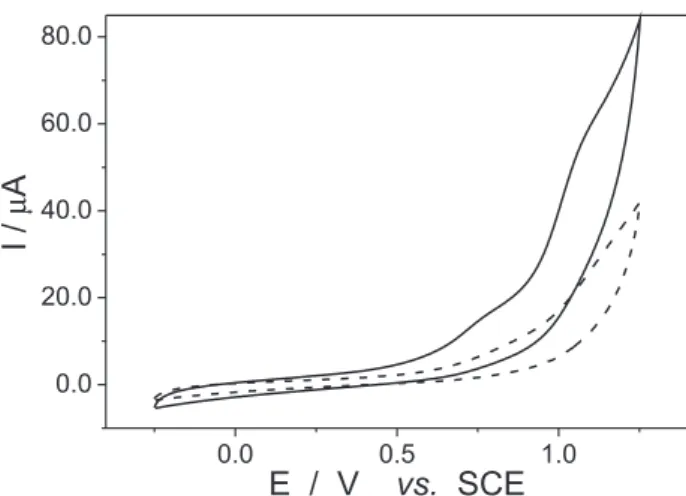
It was also observed for glassy carbon (GC) electrode by cyclic voltammetry that after successive cycles, the luconazole is accumulated over the surface increasing the current levels, which stabilize at the saturation point, which occurs only after 15 cycles (Figure 5). This fact was conirmed after cleaning the electrode surface and registered of 15 consecutive voltammograms in phosphate buffer, pH 8.0, without luconazole. As can been seen, the electrode surface is not modiied by cycling on the supporting electrolyte.
This adsorptive behavior is consistent with the pre pre-concentration of ketoconazole at a mercury electrode on a open circuit,7 but in our experimental conditions, no adsorption, on a open circuit, was observed at glassy carbon electrode and, it was very slight at platinum electrode, even after 5 min of immersion in 0.2% luconazole solution.15
It is an indicative that the adsorption could be attributed to the adsorption of the luconazole oxidation products rather than luconazole, since that the electrode surface is not modiied by action of the supporting electrode at higher applied potentials.
The stabilization of current levels improves a lot, when the experiments are carried on carbon paste (CP) electrode. Indeed, even after successive experiments, the voltammograms proile remains stable (Figure 6).
When the experiments were carried on platinum (Pt) work electrode, a great shift to lower potential was observed for the anodic peak, but just for the irst scan (Figure 7).
Furthermore, the decreasing of the current level is continuous even after 10 or more cycles and, after cleaning procedure the electrode surface (mechanical polishing and use of ultrasound for 5 min in water), the current level obtained in the irst scan of Figure 7 cannot be reproduced, Figure 8.
Figure 4. Cyclic voltammograms obtained in phosphate buffer solution, pH 8.0 containing 5.0 × 10⁻⁴ % fluconazole at carbon
paste, ∅ = 2 mm (––––); Pt, ∅ = 0,2 mm (……) and glassy carbon,
∅ = 2 mm (– – – –). Experimental conditions: − 0.25 V ≤ Eappl≤ 1.25 V at v = 100 mV s-1.
Figure 5a. Cyclic voltammograms obtained at glassy carbon electrode in 0.1 mol L-1 phosphate buffer solution, pH 8.0 containing 5.0 × 10⁻⁴ %
luconazole: 1st (––––); 10th (– – – –) and 15th cycles (……). Inset: Cyclic
voltammograms obtained at glassy carbon electrode in 0.1 mol L-1
phosphate buffer solution pH 8.0, blank (1st; 10th; 15th cycles).
Figure 5b. Last scan before cleaning the electrode surface (––––); and 15th cycle after cleaning the electrode surface (– – – –). Experimental
conditions: − 0.25 V ≤ Eappl≤ 1.25 V and v = 100 mV s-1.
Figure 6. Cyclic voltammograms (1st, 3rd, 5th, 10th) obtained at carbon
paste electrode in 0.1 mol L-1 phophate buffer solution, pH 8.0 containing
5.0 × 10⁻⁴ % luconazole (successive scans). Experimental conditions:
These experimental results can be explained taking in account the adsorption of the luconazole reaction products and the ability of the “semilexible” organic ligand combine to metal centre by one or two of its 1,2,4-triazole groups resulting in a passivation of the electrode surface.16 The same behavior can be checked in other triazoles, since studies suggest that these molecules could complex with metals (like copper and gold) in electrodes surface.13,17 Indeed, much attention have been given to the use of azoles to prevent the corrosion process, by surface protection (adsorption and ilm formation).17-19
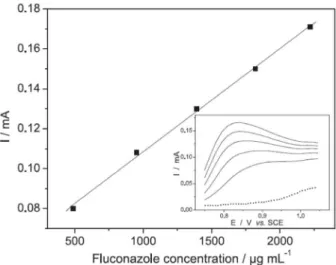
The ability of luconazole to adsorb strongly on the electrode surface may compromise some analytical parameters such as sensitivity, linearity and reproducibility in na electroanalytical methodology. Therefore, to obtain a calibration curve for analytical purposes, the utilization of platinum or a glassy carbon working electrodes require constant supericial regeneration, which can be eliminated by using carbon paste modiied electrodes. At this material no adsorption effects were observed and, this different behavior is probably associated with the adsorption mode of the oxidation product, which depends of the electrode material, principally in the case of lexible molecules such as luconazole. The calibration curve, obtained using carbon paste modiied electrode and DPV, is presented on Figure 9.
When the fluconazole adsorption on the electrode surface is controlled, the electroanalytical method showed to be a possible alternative in the determination of this drug, since it was observed a low detection limit (estimated as 6.3 µg mL-1), good linearity (R = 0.9989) in the range from 48.0 to 250.0 µg mL-1 and relative standard deviation
Figure 7. Cyclic voltammograms obtained at Pt electrode, ∅ = 0.2 mm, in 0.1 mol L-1 phophate buffer solution, pH 8.0 containing 5.0 × 10⁻⁴ %
luconazole: irst (––––) and second (– – – –) scans. Experimental conditions: − 0.25 V ≤ Eappl≤ 1.25 V and v = 100 mV s-1.
Figure 9. Analytical curve obtained at carbon paste electrode in 0.1 mol L-1
phosphate buffer, pH 8.0 containing increasing concentrations of luconazole. Inset: DPV obtained after successive additions of luconazole solution. Experimental conditions: Einitial = +0.75 V; Einal = + 1.05 V; v = 30 mV s-1 and pulse amplitude = 50 mV.
Figure 8. a) Cyclic voltammograms obtained at Pt electrode, ∅ = 0.2 mm, in 0.1 mol L-1 phosphate buffer solution, pH 8.0 containing 5.0 × 10⁻⁴ %
luconazole: (a) irst (––––); ifth (– – – –) and tenth (……) scans. Inset: irst (––––); ifth (– – – –) and tenth (……) scans in phosphate buffer solution without luconazole after cleaning the electrode surface. b) irst cycle before cleaning the electrode surface (– – – –) and isrt cicle after cleaning the electrode surface (––––); b) Experimental conditions:
(RSD) of 3.1% (n = 3). The regression equation was Ipa = 5.7×10⁻⁵ (mA) × 0.052 [Fluconazol] (µg mL-1). The luconazole determination were carried in pharmaceutical capsules, obtained a recovery of 98% (RSD 5.8%).
However, the reproducibility of the proposed method was slight lower as compared with the spectrophotometric (RSD < 3%),20-22 while the sensitivity was similar to those reported for chromatographic methods,5,6,23 which is in the order of µg mL-1. No more comparison of results is possible since that there is no electroanalytical method described for luconazole determination and, therefore the simplicity, rapidity and low cost of the proposed method should be taking in account.
Conclusions
Fluconazole showed electrochemical behavior consistent with other triazoles related in the literature, with the oxidation process being pH dependent and more effective in alkaline medium. Adsorption of the luconazole oxidation products were observed at glassy carbon and platinum electrodes. In the last case, adsorption of the reagent cannot be discarded since that, as a lexible ligand, luconazole is a good metal complexing agent and can promote decreasing of current levels at platinum working electrode. Poisoning of the electrode surface was not observed at carbon paste surfaces, which shows the importance of the electrode material in the global process. The linear response range at carbon paste electrode was from 48.0 to 250.0 µg mL-1, with a detection limit of 6.3 µg mL-1.
References
1. Hardman, J. G.; Gilman, A. G.; Limbird, L. E., eds.; Goodman and Gilman’s The Pharmacological Basis of Therapeutics, 10th
ed., Mc-Graw Hill: New York, NY, 2005. 2. Otay, O.; Selçk, F.; Anal. Lett. 1996, 29, 2163.
3. Göger, N. G.; Abou-Enein, H. Y.; Anal. Lett. 2001, 34, 2089. 4. Beijnen, J. H.; Meenhorst, P. L.; Gijn, R.; Hazelager, W. A.;
Koks, C. H. W.; Underberg, W. J. M.; J. Pharm. Biomed. Anal.
1991, 9, 1173.
5. Kim, S. S.; Im, H. T.; Kang, I. M.; Lee, H. S.; Lee, H. W.; Cho, S. H.; Kim, J. B.; Lee, K. T.; J. Chromatogr., B. 2007, 852, 174. 6. Wattananat, T.; Akarawut, W.; Biomed. Chromatogr. 2006, 20, 1. 7. Peng, T-Z.; Qiong, Q.; Yang; C. F.; Fresenius J. Anal. Chem.
2001, 370, 1082.
8. Shamsipur M.; Farhadi K.; Electroanalysis2000, 12, 429. 9. Pereira, F. C.; Stradiotto, N. R.; Zanoni, M. V. B.; An. Acad.
Bras. Cienc. 2002, 74, 425.
10. Pereira, F. C.; Stradiotto, N. R.; Zanoni, M. V. B.; J. Braz. Chem. Soc. 2001, 12, 202.
11. Lunte, C. E.; Osbourn, D. In Electrochemical Detection for Pharmaceutical Analysis inEncyclopedia of Pharmaceutical
Technology; Swarbrick, J.; Boylan, J. C., eds.; Informa
Healthcare: New York, 2007.
12. Rang, H. P.; Dale, M. M.; Ritter, J. M.; Flower, R. J.;
Pharmacology, 6th ed., Churchill Livingstone, Elsevier:
London, 2008.
13. Abou-Elenien, G. M.; El Maghrdy, A. A.; Abdel-Twab, H. R.;
Electroanalysis 2001, 13, 587.
14. Fotouhi, L.; Hajilari, F.; Heravi, M. M.; Electroanalysis2002,
14, 1728.
15. Oguzie, E.E.; Corros. Sci. 2007, 49,1527.
16. Gong, Y.; Hu, C. W.; Xia, Z. N.; J. Mol. Struct. 2007, 837, 48. 17. Lalitha, A.; Ramesh, S.; Rajeswari, S.; Electrochim. Acta2005,
51, 47.
18. Antonijevic, M. M.; Milic, S. M.; Petrovic, M. B.; Corros. Sci. 2009, 51, 1228.
19. Subramanian, R.; Lakshminarayanan, V.; Corros. Sci. 2002, 44, 535.
20. Coelho, H.; Matinatti, A. F.; Benjamim de Araujo, M.; Bergold, A.M.; Bueno, F.; Rev. Bras. Cienc. Farm. 2004, 40, 235. 21. Aboul-Enein, H. Y.; Goger, N. G.; Turkalp, A.; Anal. Lett. 2002,
35, 1193.
22. Atay, O.; Selcuk, F.; Anal. Lett. 1996, 29, 2163.
23. Hurtado, F. K.; Souza, M. J.; de Melo, J.; Rolim, C. M. B.; Lat. Am. J. Pharm. 2008, 27, 224.
Submitted: June 18, 2010
Published online: January 25, 2011