Printed in Brazil - ©2007 Sociedade Brasileira de Química 0103 - 5053 $6.00+0.00
A
rt
ic
le
A
rt
ic
le
A
rt
ic
le
A
rt
ic
le
A
rt
ic
le
*e-mail: [email protected]
C
60-based Ebselen Derivative: Synthesis by Bingel Cyclopropanation and
Enhanced Antioxidative and Neuroprotective Activity
Xufeng Liu,a,b Wenchao Guan*,a and Wengshan Kec
a
Ministry of Education Key Laboratory for the Synthesis and Application of Organic Functional Molecules, Hubei University, Wuhan 430062, P. R. China
b
Department of Chemistry, HuaZhong University of Science and Technology, Wuhan 430074, P. R. China
c
College of Life Science, Hubei University, Wuhan 430062, P. R. China
Um derivado de ebselen baseado em C60, 3, foi sintetizado pela reação de ciclopropanação de Bingel envolvendo C60 e manolato de ebselen, 2. O produto foi sintetizado em três etapas,
partindo de cloreto de 2-cloro-selenobenzoila e 2-(2-aminoetoxietanol), com rendimento de 42% (baseado no consumo de C60). O composto 3 foi caracterizado estruturalmente por análises espectroscópicas de RMN de 1H e de 13C, IV, UV e FAB-MS. Com o objetivo de verificar um
possível aumento na atividade antioxidante e neuroprotetora do derivado 3, um derivado de C60 (4), um derivado de ebselen (2) e sua mistura (4 + 2 em razão equimolar) foram selecionados
para o tratamento de células neurais pelo mesmo procedimento adotado para 3 e na mesma concentração final (30 µmol L-1). As viabilidades celulares dos quatro grupos de tratamento
foram estimadas por ensaios de LDH (desidrogenase láctica) e MTT (brometo de 3-[4,5-dimetil-tiazol-2-il]-2,5-difenil-tetrazólio). Os resultados mostraram que a atividade antioxidante e neuroprotetora de 3 frente à lesão neural mediada por H2O2 (MTT(OD) 0,364
± 0,028; LDH liberado (UL-1) 4,66 ± 0,28) foi significativamente mais alta que a do derivado
de C604 (MTT(OD) 0,324 ± 0,025; LDH liberado (UL-1) 5,39 ± 0,17), do derivado de ebselen
2 (MTT(OD) 0,294 ± 0,021; LDH liberado (UL-1) 5,71 ± 0,27), e da sua mistura (4 + 2)
(MTT(OD) 0,310 ± 0,018; LDH liberado (UL-1) 5,54 ± 0,39). Esses resultados mostram que
a combinação de dois componentes moleculares com atividades biológicas similares (C60 e
ebselen) pode ser uma forma desejável de preparação de novos compostos biologicamente efetivos derivados de C60.
C60-based ebselen derivative 3 was synthesized through Bingel cyclopropanation of C60 with the ebselen malonate 2. Compound 3 was obtained in 42% yield (based on consumed C60)
in a three-step synthesis starting from 2-(chloroseleno)benzoyl chloride and 2-(2-aminoethoxy)ethanol. Its structure was confirmed by 1H NMR, 13C NMR, IR, UV and FAB-MS
spectroscopy analyses. In order to verify the enhanced antioxidative and neuroprotective activity of 3, a C60 derivative(4), an ebselen derivative (2), and their mixture (4 plus 2 in equimolar ratio) were employed to treat cortical neuronal cells, following the same procedure used with 3
and at the same final concentration (30 µmol L-1). Cell viabilities of the four treated groups
were estimated by LDH (lactic dehydrogenase) leakage and MTT (3-(4, 5-dimethylthiazol-2-yl)-2,5-diphenyl-tetrazolium bromide) assays. Results showed that the antioxidative and protective activities of C60-based ebselen derivative 3 against H2O2-mediated neuronal injury (MTT(OD) 0.364 ± 0.028; LDH release (UL-1) 4.66 ± 0.28) were significantly higher than those
of C60 derivative 4 (MTT(OD) 0.324 ± 0.025; LDH release (UL
-1) 5.39 ± 0.17), ebselen derivative
2 (MTT(OD) 0.294 ± 0.021; LDH release (UL-1) 5.71 ± 0.27), and the mixture of 4 and 2
(MTT(OD) 0.310 ± 0.018; LDH release (UL-1) 5.54 ± 0.39). These findings demonstrated that
the combination of two molecular units with similar biological activities (C60 and ebselen) may be a desirable way of obtaining new and more biologically effective C60-based compounds.
Keywords: fullerene, ebselen derivative, Bingel cyclopropanation, neuroprotective activity,
Introduction
The investigation of modern medical sciences has suggested that free radicals are associated with a number of neurodegenerative diseases,1 such as Parkinson and
Huntington’s diseases and Alzheimer’s dementia. Some reactive oxygen species (ROS), including superoxide (O2–•) and hydroxyl (•OH) radicals, and the H
2O2 molecule,
are believed to be major contributors to oxidative damage in neurodegenerative diseases. Reactive oxygen species, produced during oxidative stress, may cause different kinds of biological damage, such as lipid peroxidation, protein oxidation and protein cross-linking, and lead to neuronal cell death.2 In the search for a link between active
oxygen species and neurodegenerative conditions, the development of chemopreventive agents with antioxidative activities could help preventing neurological injury caused by the ROS.
C60-fullerenes, owing to their electronic structure as electron-poor polyolefines, are highly reactive towards various organic radicals3 and have drawn considerable
attention in the area of antioxidant research. An electron paramagnetic resonance analysis has shown that C60 derivatives, such as carboxyfullerene, fullerenol and hexa(sulfobutyl)fullerene, have excellent capabilities to scavenge deleterious reactive oxygen species.4 In addition,
neuroprotective effects of some water-soluble C60 derivatives on oxidative injuries have also been extensively studied in several cell cultures and animal models of CNS (central nervous system) damage. For example, carboxyfullerenes prevent apoptotic injury of cultured cortical neurons evoked by N-methyl-D-aspartate and β-amyloid peptide,5 and
inhibit iron-induced oxidative stress in rat brain.6 The same
carboxyfullerenes were also reportedly able to inhibit cerebellar granule cell apoptosis, possibly by reducing the generation of ROS.7 Other fullerene derivatives,
such as fullerenol, hexasulfobutylated C60 (FC4S) and C60(glucosamine)6, also showed neuroprotective activity related to their antioxidative property. Fullerenol demonstrated to be a powerful scavenger for the free radicals induced by I/R (ischemia/reperfusion) injury of the small intestine.8 Hexasulfobutylated C
60 (FC4S) can be employed
as a free radical remover in the biological system.9 Recently,
C60(glucosamine)6 has been found to prevent renal I/R-induced apoptosis formation and superoxide generation.10
All these results reveal that fullerene and its derivatives possess antioxidative activity and may be useful as neuroprotective agents in several acute or chronic neurodegenerative diseases.
On the other hand, ebselen and its analogues seem to possess glutathione (GSH) peroxidase-like activity, and
may act as antioxidants and free radical scavengers.11
Recently, ebselen and its analogues were reported to have neuroprotective effect against brain ischemic insults and the glutamate-induced neurotoxicity.12 More recently,
ebselen and its derivatives also confirmed to have neuroprotective effects on experimental rat spinal cord injury.13 All these biological effects shown by ebselen and
its analogues are obviously related to their antioxidative properties and free radical scavenge activities.
In view of the above mentioned antioxidative and neuroprotective properties of both C60 and ebselen derivatives, it is expected that the covalent attachment of the biologically active ebselen moiety to C60-fullerene may lead to the formation of a new C60-based ebselen derivative, which could present better antioxidative and neuroprotective properties than the parent C60 or ebselen molecules. In this article we report the synthesis of the new C60-based ebselen derivative 3,which contains a solubilizing ethyleneglycol chain, by Bingel cyclopropanation involving C60 and ebselen malonate. We also report the neuroprotective activity of 3
against hydrogen peroxide-induced neuronal insults in cortical cell cultures.
Experimental
Reagents and instruments
C60 (99% purity) was prepared by the Institute of Fullerenes of Wuhan University. 2-(Chloroseleno)benzoyl chloride was prepared according to the literature.14 All
solvents and reagents were dried prior to use by standard procedures and other commercially available compounds were used as received. Melting points were determined with a Digital Melting Point Apparatus (WRS-IB). Column chromatography was performed on silica Gel (200-300 mesh). IR spectra (KBr pellets) were obtained on a Spectrum One Perkin Elmer spectrometer. UV spectra were recorded on a Perkin-Elmer λ-17 instrument. NMR data were recorded in CDCl3 at room temperature on a Varian INOVA 600 NMR instrument operating at 14.09 T, observing 1H and 13C at 599.94 and 150.86 MHz,
respectively. 1H and 13C NMR chemical shifts are given
in ppm relative to TMS as internal standard at 0.00 ppm. Mass spectra were recorded on a JMS AXS05H instrument using 3-nitrobenzyl alcohol (m-NBA) as a matrix.
hydrochloride were from Tianjin Biochemical Factory (China). Poly-L-lysine, DMSO, MTT (3-(4,5-dimethylthiazol-2-yl)-2,5-diphenyltetrazolium bromide) were obtained from Sigma Chemical Co. (USA). C60 derivative 4 (Figure 1) was prepared according to the literature.15 LDH (lactic dehydrogenase) assay kit was
obtained from Beijing Chemical Kit Company (China). The optical density of each well was measured at 550 nm on a BIO-RAD550 (USA) enzyme-linked analyzer.
Synthesis of 2-(2-(2-hydroxyethoxy)ethyl)benzo[d][1,2] selenazol-3(2H)-one (1)
Details of the procedure are described in reference 16. Reaction of diethylene glycolamine (1.456 g, 13.86 mmol) with 2-(chloroseleno)benzoyl chloride gave ebselen derivative 1 (2.5 g, 63%). White needles, mp 116.7~117.5 °C; IR νmax/cm-1: 3630 (O-H), 3048 (C-H
Ar),
1610, 1573 (amide C=O), 1283 (amide C-N), 1170 (C-O-C); 1H NMR (CDCl
3, 600 MHz) δ 8.00 (dd, J 7.6, 1.5 Hz,
1 H, ArH), 7.86 (dd, J 7.1, 1.4 Hz, 1 H, ArH), 7.63 (ddd,
J 7.3, 7.3, 1.7 Hz, 1 H, ArH), 7.43 (ddd, J 7.3, 7.3, 1.7 Hz,1 H, ArH), 4.92 (br, s, 1 H, OH), 4.10 (t, J 6.2 Hz, 2 H, NCH2), 3.76 (t, J 6.0 Hz, 2 H, ethylene glycol aliphatic hydrogens), 3.65 (t, J 6.0 Hz, 2 H, ethylene glycol aliphatic hydrogens), 3.54 (t, J 6.2Hz, 2 H, ethylene glycol aliphatic hydrogens); 13C NMR (CDCl
3, 150MHz) δ 166.55 (amide
C=O), 134.33, 132.54, 132.08, 129.20, 127.85, 127.00 (aromatic C), 72.26 (OCH2CH2OH), 69.23 (NCH2CH2O), 61.52 (OCH2CH2OH), 39.20 (NCH2CH2O).
Preparation of ebselen malonate 2
A solution of malonyl dichloride (0.37 mL, 3.87 mmol) in dry CHCl3 (50 mL) was added dropwise to a stirred solution ofebselen derivative 1 (2.44 g, 8.51 mmol) and pyridine (0.84 mL, 10.2 mmol) at 0 °C in dry CHCl3 (150 mL) and the resulting mixture was allowed to warm slowly to room temperature. After stirring overnight, the mixture was washed with aqueous NaHCO3 (5%), dried over MgSO4 and evaporated in vacuum. The residue was chromatographed on silica gel, and elution with ethyl acetate/petroleum ether (3:1) gave ebselen malonate 2
(183.5 mg, 74%) as a pale yellow oil. TLC Rf = 0.48 (ethyl acetate/petroleum ether 4:1); IR νmax/cm-1: 3045 (C-H
Ar),
1750, 1735 (ester C=O), 1613, 1568 (amide C=O), 1330, 1276 (amide C-N), 1160, 1170 (C-O-C); 1H NMR (CDCl
3,
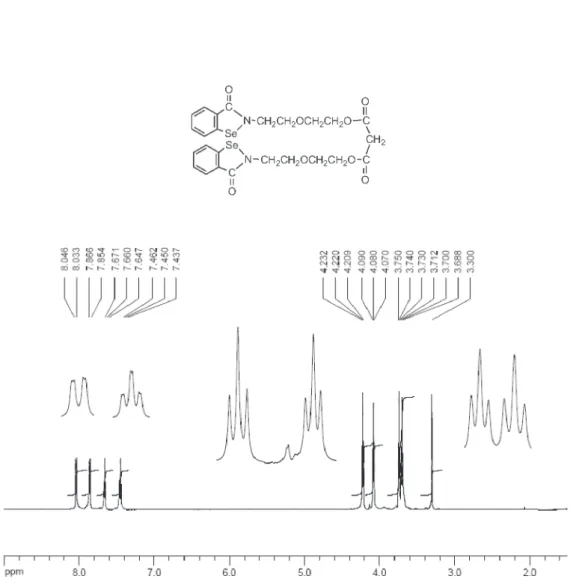
600 MHz) δ8.04 (dd, J 7.8, 1.5 Hz, 2 H, ArH), 7.86 (dd,
J 7.2, 1.5 Hz, 2 H, ArH), 7.66 (ddd, J 7.3, 7.3, 1.8 Hz, 2 H, ArH), 7.45 (ddd, J 7.5, 7.5, 1.8 Hz, 2 H, ArH), 4.22 (t,
J 7.0 Hz, 4 H, COOCH2), 4.08 (t, J 6.0 Hz, 4 H, NCH2),
3.74 (t, J 6.0 Hz, 4 H, ethylene glycol aliphatic hydrogens), 3.70 (t, J 7.2 Hz, 4 H, ethylene glycol aliphatic hydrogens), 3.30 (s, malonic CH2); 13C NMR (CDCl
3, 150 MHz)
δ 168.32 (ester C=O), 167.85 (amide C=O), 134.85, 132.43, 132.12, 129.16, 127.70, 127.02 (aromatic C), 70.73 (OCH2CH2O), 69.46 (NCH2CH2O), 65.32 (OCH2CH2O), 41.27 (malonic CH2), 39.53 (NCH2CH2O).
Bingel cyclopropanation of C60 with ebselen malonate 2 to give 3
To a solution of C60 (150 mg, 0.208 mmol), CBr4 (103.5 mg, 0.312 mmol), and ebselen malonate 2 (159.5 mg, 0.249 mmol) in 200 mL of toluene, 63.33 mg of DBU (0.416 mmol) was added. The reaction mixture was stirred under N2 at room temperature for 10 h. The solvent was distilled, and the residue was chromatographed on silica gel, and eluting first with toluene (to remove unreacted C60), then with toluene/CHCl3 (8:1) provided the fullerene-ebselen mono-adduct 3 (95.23 mg, 42%, based on consumed C60) as a dark brown solid. TLC Rf = 0.51 toluene/chloroform 8:1); UV-Vis λmax/nm (CHCl3) 433, 332, 228.5; IR νmax/cm-1: 3052 (C-H
Ar), 1756, 1740 (ester
C=O), 1610, 1570 (amide C=O), 1433 (C60), 1334, 1272 (amide C-N), 1185 (C60), 1158, 1174 (C-O-C), 528 (C60);
1H NMR (CDCl
3, 600MHz) δ8.06 (dd, J 7.8, 1.5 Hz, 2
H, ArH), 7.88 (dd, J 7.1, 1.5 Hz, 2 H, ArH), 7.65 (ddd, J
7.3, 7.3, 1.8 Hz, 2 H, ArH), 7.46 (ddd, J 7.5, 7.5, 1.8 Hz, 2 H, ArH), 4.35 (t, J 6.6 Hz, 4 H, COOCH2), 4.17 (t, J 6.3 Hz, 4 H, NCH2), 3.80 (t, J 7.5 Hz, 4 H, ethylene glycol aliphatic hydrogens), 3.76 (t, J 7.8 Hz, 4 H, ethylene glycol aliphatic hydrogens); 13C NMR (CDCl
3, 150 MHz)
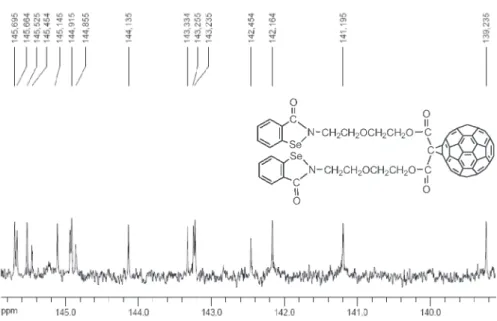
δ 168.80 (ester C=O), 167.88 (amide C=O), 145.70, 145.66, 145.53, 145.46, 145.16, 144.92, 144.86, 144.14, 143.34, 143.26, 143.24, 142.46, 142.17, 141.20, 139.24 (15 C60-sp2-carbons), 134.87 (aromatic C), 132.44, 132.14,
129.13, 127.73, 127.11 (aromatic C), 72.37 (C60-sp3
-carbons), 70.80 (OCH2CH2O), 69.80 (NCH2CH2O), 65.71 (OCH2CH2O), 52.51 (malono bridge), 39.61 (NCH2CH2O); FAB-MS [(+), m-NBA] m/z 1361 [(M+H)+,
13%], 720 [(M+H-ebselen malonate)+, 100].
Primary cortical neuronal cultures
Primary cultures of rat cortical neurons were established using a modification of previous methods17 which is briefly
through a 200-order stainless steel sieve. After centrifugation at 4000 g for 10 min, the cells were gently resuspended in DMEM / 10% FCS and vaccinated to poly-L-lysine (0.01%) coated 96-well plates at the density of 1 × 10⁵ cells per well.
All cells were incubated in DMEM culture medium containing 10% fetal calf serum (FCS), penicillin (100 U mL-1) and streptomycin (100 µg mL-1) at 37 °C in a 95%
air / 5% CO2 humidified culture box. On the third day of vaccination, cytarabine (final concentration 10 µmol L-1)
was added to the culture medium to prevent proliferation of non-neuronal cells.
On the 10th day of culture, the neural cells were divided
at random into a control group, an H2O2-injured group, and a compound-treated group. The compound-treated group was divided into 4 subgroups according to the different chemicals employed (C60 derivative 4, ebselen derivative 2, mixture of 4 and 2 (equimolar ratio) and C60-based ebselen derivative 3) (Figure 1).
Culture treatments
Stock solutions (10 mmol L-1) of compounds 4, 2,
mixture(4 + 2)and 3 prepared in DMSO and diluted with sterile water were kept at 4 °C. At the time of medium change, stock solutions were further diluted and applied to the cultures.
Oxidative injury was induced by adding H2O2 (final concentration 150 µmol L-1) to the serum-free DMEM
culture medium containing 0.2% DMSO and incubating at 37 °C for 2 h.18 After that treatment, the culture medium
was replaced with fresh serum-free DMEM and the cells were incubated for 24 h in culture box. For the four compound-treated groups, cortical neuronal cultures were pretreated with compound 4, 2, mixture(4 + 2),or 3 (final concentration: 30 µmol L-1) for 2 h and then exposed to
150 µmol L-1 H
2O2 for other 2 h. Afterwards, the cell
cultures received the same treatment as the H2O2-injured group. Control cells were not exposed to H2O2 nor to the various compounds, but cultured in serum-free DMEM medium supplemented with 0.2% DMSO for 24 h.
Measurement of cell viability19
Cell viability was determined by measuring the mitochondrial dehydrogenase activity (MDHA) through the reduction of MTT. After the above described procedure, an MTT solution (final concentration 0.5 mg mL-1) was added to each well, and the cells were incubated
at 37 °C for 4 h. After removal of the medium, formazan crystals, produced by MDHA in viable cells, were dissolved in dimethyl sulfoxide (200 µL). The optical
density of each well was measured at 550 nm using an enzyme-linked analyzer.
Determination of LDH release20
Cell damage was evaluated by measuring the release of lactate dehydrogenase (LDH) into the culture medium. LDH contents in the extracellular medium were determined using the LDH assay kit according to the kit instructions.
Results and Discussion
Synthesis and spectroscopic properties of C60-based Ebselen derivative 3
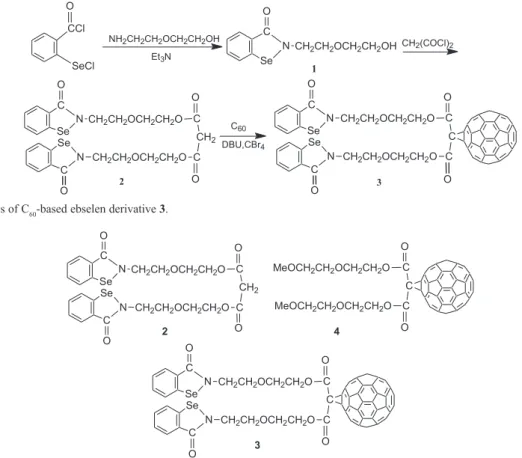
The synthesis of 3 is achieved after a three-step process as outlined in Scheme 1. Reaction of 2-(chloroseleno)benzoyl chloride with slight excess 2-(2-aminoethoxy)ethanol (1.1 equiv.) in dry CH3CN afforded ebselen derivative 1, which is N-substituted with an ethylene glycol chain, in 63% yield. The ebselen derivative 1 was esterified with malonyl dichloride in 2.2:1 molar ratio in dry CHCl3 in the presence of pyridine (1.2 equiv. to 1). After purification by flash chromatography (silica gel, eluent: ethyl acetate/petroleum ether 3:1), ebselen malonate 2 was obtained in 74% yield. Finally, Bingel cyclopropanation21 of C
60 (toluene, room
temperature, 10 h) with the ebselen malonate 2 (1.2 equiv. to C60) in the presence of 1,8-diaza-bicyclo[5.4.0]undec-7-ene (DBU, 2.0 equiv. to C60) and CBr4 (1.5 equiv. to C60) gave rise to the fullerene-ebselen mono-adduct 3 in a 42% yield (based on consumed C60). Mono-adduct 3 was isolated by column chromatography on silica-gel, eluted with pure toluene, followed by toluene/CHCl3 (8:1, v/v).
The structure of 3 was confirmed by standard spectroscopic methods. Its 13C NMR spectrum (150MHz,
CDCl3) displays 15 peaks between δ139.24 and δ 145.70 owing to the sp2-fullerene C-atoms, indicating that
compound 3 has C2v symmetry with a [6,6]-closed structure.22 The signal at 72.37 ppm was assigned to the
sp3-fullerene C-atoms. The six carbons of the phenyl ring
in the ebselen moiety give rise to 6 peaks between δ127.11 and δ 134.87. The carbon of the bridge is observed at 52.51 ppm. The remaining 4 signals in the δ39.61 ~ δ
70.80 region are assignable to the aliphatic carbons of the ethyleneglycol chain. The carbons of the carboxylate and amide groups are detected at 168.80 and 167.88 ppm, respectively. The 1H NMR spectrum (600 MHz, CDCl
3)
ethyleneglycol chain give rise to two triplets (δ4.35, J 6.6 Hz; δ 4.17, J 6.3 Hz ) and two doublets betweenδ3.76 and δ3.80. The FTIR spectrum of compound 3 shows strong carbonyl absorptions at 1756, 1740 cm-1 (ester) and
1610, 1570 cm-1 (imide), and three characteristic
absorptions of the C60 skeleton at 1433, 1185, and 528 cm-1. The FAB-MS analysis of compound 3 gives the
molecular ion peak at m/z 1361 (M+H)+ and a relevant
fragment at m/z 720 (M+H-ebselen malonate)+. The
UV-Vis spectrum of compound 3 contains a typical medium intensity absorption band at around 430 nm, which is characteristic of most dihydrofullerenes23 and further
proves that compound 3 is a [6,6]-closed methano-fullerene.
Effects of C60 derivative 4, ebselen derivative 2, mixture (4 + 2), and C60-based ebselen derivative 3 on cell viability and LDH release
In order to verify the enhanced neuroprotective activity of C60-based ebselen derivative 3, related compounds (the C60 derivative 4, the ebselen derivative 2, and a mixture of 4
and 2) were also used to treat cortical neuronal cells according to the same procedures employed for 3 (Figure 1).
Cell viability and cell damage were estimated by MTT and LDH leakage assays, respectively. Results of LDH
Figure 1. C60 derivative 4, ebselen derivative 2 and C60-based ebselen derivative 3 used in this study. N CH2CH2OCH2CH2O
Se
N CH2CH2OCH2CH2O CH2 Se C O C O C O C O
N CH2CH2OCH2CH2O
Se
N CH2CH2OCH2CH2O C Se C O C O C O C O
MeOCH2CH2OCH2CH2O
MeOCH2CH2OCH2CH2O C C O C O 2 3 4
Scheme 1. Synthesis of C60-based ebselen derivative 3.
N CH2CH2OCH2CH2OH Se C O N CH2CH2OCH2CH2O Se
N CH2CH2OCH2CH2O CH2 Se C O C O C O C O C60 DBU,CBr4 NH2CH2CH2OCH2CH2OH
Et3N
CH2(COCl)2
N CH2CH2OCH2CH2O
Se
N CH2CH2OCH2CH2O C Se C O C O C O C O SeCl CCl O 2 3 1
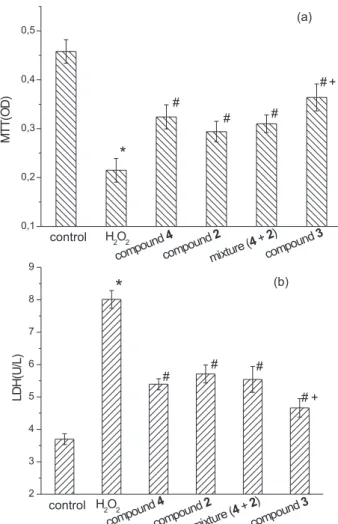
release and MTT(OD) measurements are shown in Figure 2. Compared with the control group, treatment of cortical culture with 150 µmol L-1 H
2O2 for 2 h caused a decrease
of MTT(OD) from 0.458 ± 0.024 to 0.215 ± 0.024 (P < 0.01) and an increase of LDH content in the extra-cellular media from 3.69 ± 0.17 to 8.02 ± 0.27 (P < 0.01), indicating H2O2-induced neuronal injury. Cytotoxicity tests demonstrated that compounds 4, 2 and 3,as well as the mixture 4 + 2, at a concentration up to 30 µmol L-1,
have no toxic effect on cortical neurons. Therefore, 30
µmol L-1 was selected to detect their protective effects on
H2O2-mediated neuronal injury. As expected, they were effectively able to attenuate the H2O2-mediated increase of LDH release and decrease of MTT(OD) value (Figure 2). MTT(OD) was elevated from 0.215 ± 0.024 (H2O2 alone) to 0.324 ± 0.025 (4), 0.294 ± 0.021 (2), 0.310 ± 0.018 (4 + 2), 0.364 ± 0.028 (3) (P < 0.01) (Figure 2a), and LDH release was reduced from 8.02 ± 0.27 (H2O2 alone) to 5.39 ± 0.17 (4), 5.71 ± 0.27 (2), 5.54 ± 0.39 (4 + 2) and 4.66 ± 0.28 (3) (P < 0.01) (Figure 2b).
+ 2) (5.54 ± 0.39). These results indicated that the antioxidative and protective activities of C60-based ebselen derivative 3 against H2O2-mediated neuronal injury are significantly higher than those shown by C60 derivative 4, ebselen derivative 2, and their mixture (4 + 2). Hence, the covalent incorporation of fullerene and ebselen units into a new molecule is of significance for enhancing antioxidative activity.
C60-fullerene is a redox-active compound, since it has low LUMO and high HOMO levels. Okuda et al.24 have
observed that a water-soluble fullerene derivative (C60 -dimalonic acid, C62(COOH)4) has cytochrome c
peroxidase-like activity. They confirmed that C62(COOH)4 was essential for the oxidation of reduced cytochrome c
in the presence of H2O2. Hence, C60-fullerene should also display glutathione peroxidase-like (Gpx) activity. Besides, C60-fullerene possesses an excellent antioxidative property derived from its polyolefine bonds, which are
highly reactive towards deleterious reactive oxygen species. On the other hand, ebselen has excellent Gpx activites and limited radical scavenging ability. Therefore, we think that the enhanced neuroprotective activity of C60-based ebselen derivative 3 can reasonably be attributed to the improvement of both its free radical scavenging and Gpx-like activities.
Conclusions
The present work describes the synthesis of a C60-based ebselen derivative (3), which contains an ethyleneglycol chain between the fullerene and the biologically active ebselen moiety. The C60-based ebselen derivative was characterized by NMR, MS, IR and UV spectroscopy analyses. In addition, it showed stronger antioxidative and neuroprotective activities than parent C60 derivative 4, ebselen derivative 2, and a mixture of 4 and 2. From this encouraging result, it can be concluded that the selection and incorporation of appropriate antioxidant components into C60-fullerene molecules can give rise to new C60-based derivatives with better antioxidative ability, and this is also an effective strategy for designing and synthesizing C60-based antioxidants.
Acknowledgment
This work was supported by the National Science Foundation of China (No. 20474020)
Supplementary Information
Relevant spectral data, including NMR and mass spectra, are available free of charge at http:// jbcs.sbq.org.br, as a PDF file.
References
1. Beyer, C. E.; Steketee, J. D.; Saphire, D.; Biochem. Pharmacol. 1998, 56, 1265.
2. Stadtman, E. R.; Berlett, B. S.; Chem. Res. Toxicol.1997, 10, 485; Moore, T. M.; Khimenko, P. L.; Taylor, A. E.; Chin. J. Physiol.1996,9, 65.
3. Krusic, P. J.; Wasserman, E.; Ketzer, P. N.; Morton, J. R.; Preston, K. F.; Science1991, 254, 1183.
4. Cheng, F.; Yang, X.; Zhu, H.; Sun, J.; Liu, Y.; J. Phys. Chem. Solids2000, 61, 1145; Zhu, Y. S.; Sun, D. Y.; Liu, G. Z.; Chem. J. Chin. Univ.1996, 17, 1127; Chiang, L. Y.; Lu, F. J.; Lin, J. T.; J.Chem. Soc., Chem. Commun.1995, 1283; Chueh, S. C.; Lai, M.K.; Lee, M. S.; Chiang, L. Y.; Ho, T. I.; Chen, S. C.;
Transplant. Proceed.1999, 31, 1976. 0,1 0,2 0,3 0,4 0,5 + # # # # * (a) mixture (4+2)
compound 3 compound 2 compound 4
H2O2 control MT T (OD ) 2 3 4 5 6 7 8 9 mixture (4+2)
# (b) + # # #
*
compound 3 compound 2 compound 4H2O2 control L D H( U/ L )
Figure 2. (a) MTT(OD) values and (b) LDH release, both caused by H2O2 in cortical neurons, aftertreatment with compounds 4, 2,mixture(4 + 2) and 3. Values are mean ± SD of 8 experiments. Statistical comparisons were made using one way ANOVA followed by Newman-keuls test as a post-hoc analysis. Differences were accepted as significant at p < 0.05 and p < 0.01. *p < 0.01 vs. control, #p < 0.01 vs. H
2O2 group,
5. Dugan, L. L.; Turetsky, D. M.; Du, C.; Lobner, D.; Wheeler, M.; Almli, C. R.; Shen, C. K.-F.; Luh, T.-Y.; Choi, D. W.; Lin, T. S.; Proc. Natl. Acad. Sci. USA1997, 94, 9434; Dugan, L. L.; Gabrielsen, J. K.; Yu, S. P.; Lin, T-S.; Choi, D. W.; Neurobiol. Disease 1996, 3, 129.
6. Lin, A. M. Y.; Chyi, B. Y.; Wang, S. D.; Yu, H. H.; Kanakamma, P. P.; Luh, T. Y.; Chou, C. K.; Ho, L. T.; J. Neurochem.1999,
72, 1634.
7. Bisaglia, M.; Natalini, B.; Pellicciari, R.; Straface, E.; Malorni, W.; Monti, D.; Franceschi, C.; Schettini, G.; J. Neurochem. 2000, 74, 1197.
8. Lai, H-Sh.; Chen, W-J.; Chiang, L-Y.; World J. Surg.2000, 24, 450.
9. Lee, Y. T.; Chiang, L. Y.; Chen, W. J.; Hsu, H. C.; PSEBM 2000,
224, 69; Huang, S. S.; Tsai, Sh. K.; Chin, Ch. L.; Chiang, L. Y.; Hsieh, H. M.; Teng, C. M.; Free Radic. Biol. Med.2001, 30, 643. 10. Chien, Ch. T.; Chen, Ch-F.; Hsu, Su-M.; Chiang, L. Y.; Lai,
M-K; Fullerene Science and Technology 2001, 9, 77.
11. Muller, A.; Cadenas, E.; Graf, P.; Sies, H.; Biochem. Pharmacol.
1984, 33, 3235; Ren, X. J.; Yang, L.; Liu, J.; Su, D.; You, D.; Liu, Ch.; Zhang, K.; Luo, G.; Arch. Biochem. Biophys. 2001, 387, 250. 12. Porciuncula, L. O.; Rocha, J. B. T.; Boeck, C. R.; Vendite, D.; Souza, D. O.; Neurosci. Lett. 2001, 299, 217; Graham, I. H.; Masayasu, D. I.; Macrae, H.; Free Radic. Biol. Med.2003, 34, 56. 13. Kalayci, M.; Coskun, O.; Cagavi, F.; Kanter, M.; Armutcu, F.;
Gul, S.; Neurochem. Res.2005, 30, 403.
14. Schewe, T.; Gen. Pharmac. 1995, 26, 1153.
15. Guldi, D. M.; Tian, Y.; Fendler, J. H.; Hungerbuehler, H.; Asmus, K-D.; J. Phys. Chem.1995, 99, 17673.
16. Osajda, M.; Mlochowski, J.; Tetrahedron 2002, 58, 7531. 17. Choi, D. W.; Mauluccigedde, M.; Kriegstein, A. R.; J.
Neurosci.1987, 7, 357; Schena, M.; Shalon, D.; Dais, R. W.;
Science1995, 270, 467.
18. Hansen, M. B.; Nielsen, S. E.; Berg, K.; J. Immunol. Methods 1989, 119, 203; Yoshizumi, M.; Kogame, T.; Suzaki, Y., Fuijita, Y.; Br. J. Pharmacol.2002, 136, 1023.
19. Mosmann, T.; J. Immunol. Methods1983, 65, 55; Behl, C.; Davis, J. B.; Lesley, R.; Schubert, D.; Cell 1994, 77, 817. 20. Koh, J. Y.; Choi, D. W.; J. Neurosci. Methods1987, 20, 83;
Hartnett, K. A.; Stout, A. K.; Rajdev, S.; Rosenberg, P. A.; Reynolds, I. J.; Aizenman, E.; J. Neurochem.1997, 68, 1836. 21. Camps, X.; Hirsch, A.; J. Chem. Soc., Perkin Trans. 11997,
1595.
22. Diederich, F.; Isaacs, L.; Philp, D.; Chem. Soc. Rev. 1994, 243. 23. Isaacs, L.; Wehrsig, A.; Diederich, F.; Helv. Chim. Acta1993,
76, 1231.
24. Okuda, K.; Mashino, T.; Hirobe, M.; Bioorg. Med. Chem. Lett. 1996, 5, 539.
Printed in Brazil - ©2007 Sociedade Brasileira de Química 0103 - 5053 $6.00+0.00
S
u
p
p
le
m
e
n
ta
ry
I
n
fo
rm
a
ti
o
n
S
u
p
p
le
m
e
n
ta
ry
I
n
fo
rm
a
ti
o
n
S
u
p
p
le
m
e
n
ta
ry
I
n
fo
rm
a
ti
o
n
S
u
p
p
le
m
e
n
ta
ry
I
n
fo
rm
a
ti
o
n
S
u
p
p
le
m
e
n
ta
ry
I
n
fo
rm
a
ti
o
n
*e-mail: [email protected]
C
60-based Ebselen Derivative: Synthesis by Bingel Cyclopropanation and
Enhanced Antioxidative and Neuroprotective Activity
Xufeng Liu,a,b Wenchao Guan*,a and Wengshan Kec
a
Ministry of Education Key Laboratory for the Synthesis and Application of Organic Functional Molecules, Hubei University, Wuhan 430062, P. R. China
b
Department of Chemistry, HuaZhong University of Science and Technology, Wuhan 430074, P. R. China
c
College of Life Science, Hubei University, Wuhan 430062, P. R. China
Figure S2. 13C{1H} NMR spectrum of compound 2 at room temperature (150 MHz, CDCl
3). The peak noted with * is due to solvent (ethyl acetate).
Figure S3. 1H NMR spectrum of compound 3 at room temperature (600 MHz, CDCl
Figure S4.13C{1H} NMR spectrum of compound 3 at room temperature [150 MHz, CDCl
3]. The peak noted with * is due to solvent (ethyl acetate).