Brazilian Journal of Physics, vol. 39, no. 4, December, 2009 663
Pairing gap energy correction in Shell model for the neutron-rich tin isotopes
L. Aissaoui,∗ F. Benrachi,† and D. Boumala
Mathematic and Subatomic Physics Laboratory, Physics Department, Mentouri-Constantine University, Algeria. (Received on 27 June, 2008)
The region in the vicinity of132Sn, gathering numerous isotopes of important masses, shows lots of
inter-ests for explaining the most interesting phenomena. It offers among others the possibility to extract theN−N empirical interactions so as to test theoretical shell model description of nuclear structure in this region. The researches on the neutron-rich tin isotopes present the anomalies in a systematic variation on various spectro-scopic data such as the first 2+ excited state and reduced probabilitiesB(E2; 2+→0+). In order to improve the OXBASH interactions which are based on the shell model calculations, we have modified some neutron-neutron and proton-proton tow body matrix elements of CW5082 interaction of132Snregion by adding to them the pairing gap energy. The calculations turn out a new interaction so called CWD5082, allowing to determine the excited energies and the reduced probabilitiesB(E2)ofSnandTeisotopes forA=134 and 136 masses. The obtained results display a remarkable enhancement in the predictive power of experimental values.
Keywords:132Snregion; Oxbash code; Effective interaction
1. INTRODUCTION
As experience has progressed toward the nuclear drip line, it becomes possible to examine the systematic properties of nuclear isotopic chains composed of nuclei with greatNand Znumbers. That offers new opportunities to evaluate the de-veloped theoretical models for the grandest exotic phenom-ena, and therefore imply the development of the applicable effective interaction for these channels. One of the regions in which recent experimental progress has been made is the neutron-rich tin isotopes132Sn. This region shows a closure shells (Z=50) for protons and (N=82) for neutrons with the nuclei that can provide direct information on the nucleon-nucleon effective interaction, the effective charges values, and particles or holes energies [1]. In addition, the experi-mental and/or theoretical study of neutron-rich nuclei in the
132Snregion is very important for modeling the r-process
as-trophysics nucleosynthesis.
The structure of the pairing correlations and the strength of the pairing interaction as we move towards the neutron drip-line in the neutron-rich132Snregion, are a great interest
sub-ject in experimental and theoretical nuclear physics [2][3]. Since the pairing plays an important role in exotic nuclei, weakly bound nuclei with a magnitude of chemical potential close to that of the pairing gap [4].
In this article we are interested studying and understanding the role of the pairing effect on the shell model calculations for the neutron-rich tin isotopes, by modifying the CW5082 interaction of Chou and Warburton [5] in the OXBASH code [6]. In these modifications, we have considered the pairing gap energy. In addition, the obtained results are confronted to the experimental values, the values obtained by the CW5082 original interaction and those of S. Saha et al. [7].
∗Electronic address:[email protected]
†Electronic address:[email protected]
2. PAIRING GAP ENERGY AND SHELL MODEL
The shell model calculations of the neutron-rich tin iso-topes have been developed using the OXBASH code [6]. The space model is composed of an inert core132Snand all the
orbitals between132Snand208Pb: 1g
9/2, 2d5/2, 2d3/2, 3s1/2
and 1h11/2for protons with the energies:−9.6629,−8.7005, −7.2233,−6.9657 and−6.8714 [8] respectively, expressed in MeV, and 1h9/2, 2f7/2, 2f5/2, 3p3/2, 3p1/2and 1i13/2for neutrons with the energies: −0.8944, −2.4553, −0.4507, −1.6016,−0.7996 and+0.2397 [8] respectively, expressed in MeV. These single energies are taken from experimental values, except that of the single state 3s1/2 which was
de-rived from a local system [9]. While the energy of the state 1i13/2was taken from the reference [10].
The CW5082 interaction is construct from the Kuo-Herling interaction so-called KH5082 [5], by replacing the tow body matrix elements (TBME) of protons in the sub-shellN=4 using the effective interaction Kruse and Wilden-thal [5] from the derivation of a least squares fit of binding energies with the surface delta interaction (SDI) as a starting point.
The binding energies of neutron orbitals have been re-duced by 100 keV and the proton-neutron TBME are modi-fied to reproduce the levels of spinJ=0 and 1 of the134Sb
nucleus.
All two body matrix elements of KH5082 interaction (Kuo-Herling bare + partcule-hole “or” bare G matrix + core polarization”) of the208Pbregion have been multiplied by the mass factor(132/208)1/3. Moreover, the six
neutron-neutron diagonal elements of the spin J p=0+ which are more attractive and produce a deficit in the binding energies of the states of the Kuo-Herling interaction, were then re-duced by a factor of 0.6 [ 11].
To obtain the binding energy of−6.365 MeV the ground state of134Snnucleus, we have multiplied the six neutron-neutron diagonal elements of the spin.Jπ=
0+by the factor 0.48 [5]. Then, calculate the quantity:
2∆n−E(
CW5082)(2+) (1)
where 2∆ncorresponds to the energy needed to break a pair
664 L. Aissaoui et al.
superior orbital.
∆n = (−1)
A−Z+1
4 [−M(Z,N+1) +3M(Z,N)
− M(Z,N−1) +M(Z,N−2)] (2)
After that, we subtract the latter part of the neutron-neutron matrix elements, corresponding to three excited states 2+, 4+ and 6+of134Snof the multiple configurations (ν2f
7/2)2and
a matrix element of the configuration (ν1h
9/2ν2f7/2)2of the
excited state 8+ of the original interaction CW5082. Finally, we have multiplied these obtained elements by a factor of 0.6 that is proposed by Terasaki [13] in order to renormalize for the reduction of the neutrons pairing gap aboveN=82.
According to the modification steps outlined above, we have also changed the proton-proton matrix elements for
134Te nucleus of the multiple configurations from the
mul-tiplet (π2g7/2)2of the spinJ=0+, 2+, 4+and 6+. We
de-termine also the quantity:
2∆p−E(
CW5082)(2+) (3)
as to calculate the elements:
hV12iCW5082− 2∆p−ECW5082(2+) (4)
With∆pis expressed by the following formula:
∆p = (−1)
A−Z+1
4 [−M(Z+1,N) +3M(Z,N)
− M(Z−1,N) +M(Z−2,N)] (5)
2∆pcorresponds to the energy needed to break a pair of
pro-tons, allowing the jump of a proton to the superior orbital. These elements are multiplied by a factor of renormaliza-tion proton value 0.9 [13]. The same reducrenormaliza-tion was made for these matrix elements. Finally, by the modification of 16 ma-trix elements of CW5082 interaction, we have reproduced a new interaction named by CW∆5082.
3. RESULTS, COMPARISON, AND DISCUSSION
This work is divided into two parts: the first is devoted to calculate the low spin spectra energy of the even-even
134,136Sn, 134,136Te and136X e isotopes. While the second
part concerns the calculation of the electric transition re-duced probabilities B (E2 : 0+→2+) for some of these nu-clei. These calculations are performed by using the effective interaction CW∆5082 in the framework the OXBASH code.
The calculations with the original CW5082 interaction have also been included.
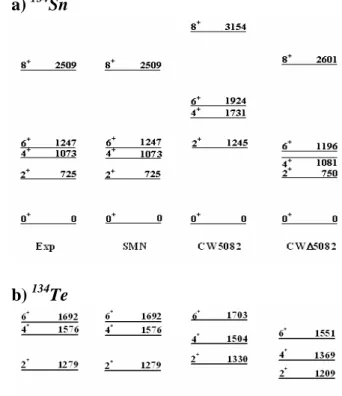
The two figures (1) and (2) illustrate the results of the ob-tained energy spectra. These are compared with experimen-tal data and spectra calculated by S. Saha et al., [5] [14].
On the figures (1.a) and (2.a) showing the interaction be-tween the valence neutrons in the isotopes134,136Sn, we see clearly that the obtained results by CW∆5082 for134Snare
very close to those of experience and of SMN, although the agreement is better for the first three excited states 2+, 4+ and 6+. On the figure (2.a) there is no experimental data of
a)
134Sn
b)
134Te
FIG. 1: Comparison of calculated spectra with experimental ones for isobars: (a)134Snand (b)134Te.
136Snnucleus that we allow comparing with the experience,
but we put in this figure our results with those calculated by CW5082 interaction and those of SMN. We note that the dif-ferent between the CW∆5082 and SMN for the excited 2+,
4+and 6+levels is less than 80keV.
The (1b) and (2.c) figures exhibit the energy spectra of
134Teand136X eisotones, respectively, where there is a
sig-nificant gap between the excited states energies obtained by CW∆5082 and those of the experiment. Moreover, this gap
grows with increasing number of valence protons. One has
∆E (134Te)=100 keV from the state 4+and∆E(136X e)=300
keV. While this difference is not observed between the exper-imental spectra energy and those of the CW∆5082
interac-tion for136Tenucleus as is revealed in the figure (2.b). These results reflect the interaction between the valence neutrons ofN=82−126 shells and valence protons ofZ=50−82 shells.
In general, we find that both SMN interactions and SMPN of S. Saha give the closest results to the experimental ones in the both figures (1) and (2)
On the basis of these results, we can show two very im-portant points:
•The first point exposes the effect of the pairing energy gap on the neutron-neutron and proton-proton interaction in the shell model calculations. You can also see that the 2∆n
effect is more interesting than the 2∆p one. The original
CW5082 interaction represents the proton-proton interaction better than the modified CW∆5082 interaction, as the case of
134Teand136X enuclei.
Brazilian Journal of Physics, vol. 39, no. 4, December, 2009 665
a) 136Sn
b) 136Te
c) 136Xe
FIG. 2: Comparison of calculated spectra with experimental ones for isobars: (a)136Sn, (b)136Teand (c)136X e.
of the nuclei with valence protons i.e. the effect of the inter-action of neutrons located in theN=50−82 shells on the valence protons in theZ=50−82 shells.
In the second part of this work, we have calculated the reduced probabilitiesB(E2)of the electric transition of the ground state to first excited state 0+→2+ (absorption) for
134,136Snand134,136Teisotopes. The table below shows the
results. The actual charges used correspond to a proton effec-tive charge of 1.47e and a neutron effeceffec-tive charge of 0.72e.
The comparison between the available experimental values ofB(E2)with those of CW∆5082 and SMN, demonstrates
a very good agreement between the calculated results and those of experience for the134Tenucleus. By against, we can not find this agreement for136Tenucleus.
The study of the behavior of the transition probability B(E2 : 0+→2+)↑ contributes in the classification of the energy of the first excited 2+level (E2+) according to the re-lation of Grodzins [13] where we find that B(E2)↑increases with decreasing of E2+(table (1)).
TABLE 1: Comparison between the values ofB(E2)calculated with the experimental (ine2f m4) using the ofep=1.47eand
en=0.72eeffective charges
Isotopes π π
f
i I
I → Exp SMN CW5082 CW∆5082
134 Sn
136Sn
134Te
136Te
0+ 2+
0+ 2+
0+ 2+
0+ 2+ 290.0
-
960.0
1030.0 366.0
-
869.8
2165.0
413.9
858.4
857.9
2989.0
369.5
561.5
824.9
1794.0
4. CONCLUSION
The adding of the pairing gap∆nand∆pin the
modifica-tions of the CW5082 interaction produced a new interaction called CW∆5082. The application of the latter interaction
in the shell model calculations produced the good results for the134,136Sn,134,136Teand136X eeven-even nuclei compared to those of the original interaction CW5082. Despite this, the CW∆5082 interaction does not describe the effect of the
modifications in proton-proton matrix elements for the en-ergy spectra calculations of 134Te and136X e isotones, be-cause of the addition of the pairing gap in the proton-proton matrix elements of the original CW5082 interaction. The calculated values of reduced probabilities of electric dipole transitionB(E2)using the effective charges 1.47eand 0.72e of proton and neutron, respectively, are in good agreement with the experiment for134Snand134Tenuclei.
5. ACKNOWLEDGMENTS
Special thanks are due to the Profs. S. Sarkar and S.M. Sarkar for their modification of the CW5082 interaction and also due to the Prof. B.A. Brown for his help in providing us his OXBASH code.
[1] A. Gargano, European Physics Journal A20, 103 (2004) [2] M. P. Kartamyshev, T. Engeland, M. Jorth-Jensen, and E.
Os-nes, Physical Review C76, 024313 (2007)
[3] L.S. Geng, H. Toki, and J. Meng WSPC/INSTRUCTION FILE 2006
[4] M.V. Stoitsov, J. Dobaczewski, R. Kirchner, W. Nazarewicz, and J. Terasaki, Physical Review C76, 014308 (2007) [5] W. T Chou and E. K. Warburton, Physical Review C45, 1720
(1992)
666 L. Aissaoui et al.
(1984)
[7] S. Saha and M. S. Sarkar, Europen Physics Journal A 21, 61-66 (2004)
[8] Data extracted using the NNDC on line Data Service from ENSDF and XUNDL data bases, file revised as of 22 Novem-ber (2002)
[9] B. Fogelberg, K.A. Mezilev, V.I. Isakov, and J. Slivov, Physi-cal Review Lett 82, 1823 (1999)
[10] W. Urban, W. Kurcewicz, A. Nawok, T. Rzaca-Urban, J.L. Durell, M.J. Leddy, M.A. Jones, W.R. Philips, A.G. Smith, B.J. Varley, M. Bentaleb, E. Lubkiewicz, N. Schulz, J.
Blomqyist, P.J. Daly, P. Bhattacharyya, C.T. Ahang, I. Ahmad, and L.R. Morss, European Physics Journal A5, 239 (1999) [11] E. K. Warburton and B. A. Brown, Physical Review C43, 602
(1991)
[12] G. Audi, A.H. Wapstra, and C. Thibault, Nuclear Physics A729, 337 (2003)
[13] J. Terasaki, J. Engel, W. Nazarewicz, and M. Stoitsov, Physical Review C66, 054313 (2002)