PREVALENCE OF TEACHER’S VOICE SYMPTOMS IN
MUNICIPAL NETWORK EDUCATION IN CAMPO GRANDE - MS
Prevalência de sintomas vocais em professores na rede municipal
de ensino em Campo Grande – MS
Elisangela Giroto Carelli Hermes (1), Paulo Roberto Haidamus de Oliveira Bastos (1)
(1) Universidade Federal do Mato Grosso do Sul, Campo
Grande, MS, Brasil. Support source: CAPES
Conlict of interest: non-existent
The beginning of the symptoms is usually
insidious, becoming more predominant in the end
of the working day and decreasing after a night rest or on weekends. As time goes by, the symptoms become constant regardless of the prolonged use of the voice, and there is no improvement even after
vocal rest 6-8.
Work-related dysphonia may also be related to symptoms of mental sufering due to demands of the work organization. The need to meet such demands, the fear of unemployment, lack of information and other contingencies of the modern working world force the worker to endure these symptoms and keep working until there is an escalation in their clinical condition which would demand more complex
therapeutic interventions. It is important to mention
the existence of laws concerning the teacher’s vocal
health program at both state (Mato Grosso do Sul
State) and municipal levels since 2007, which deal with this issue, however in an incipient manner9,10.
Being temporarily hoarse, due to work routine : the acceptance of this fact as something natural shows the lack of information about how teachers’ voices are afected and how problems could be reduced or even avoided if these professionals
INTRODUCTION
The need to use the voice as work tool has grown in the last decades. Estimates show that between 20% and 30% of the world labor force have activities in which there is signiicant vocal demand. Singers,
actors, voice-over actors, teachers and telephone operators are among these estimates, being called
voice professionals 1,2.
Among the professionals who use their voice as main work tool, teachers are the main research subjects accounting for approximately 2 million workers at basic level education in Brazil 3.
The combination of the voice prolonged use and environmental risk factors (physical, chemical and ergonomic), as well as the work organization inluence the rise of prevalence of vocal complaints leading to work leaves and inability to perform functions, which generate inancial and social costs to both institutions and the society 4,5.
ABSTRACT
Purpose: to describe the epidemiological overview of the teacher’s voice at Municipal Network Teaching
in Campo Grande / MS, checking the prevalence of voice problems in this population. Methods: this is
a cross-sectional, descriptive and quantitative study. Among the 4.957 registered teachers in Semed / 2013, 394 participated. All seven urban areas of the municipality (Prosa, Bandeira, Anhanduizinho, Lagoa, Segredo, Centro, Imbirussu) were sampled. To collect the data we used the protocol Ferreira et al., adapted, using as the measuring method the Likert scale. Results: high prevalence of vocal
symptoms. Teachers had multiple symptoms related to the use of voice at work and realized the adverse efects on their professional performance. Conclusion: the seriousness of the teacher’s
voice problems experienced in daily speech therapy services and the Municipal Education Network was revealed in signiicant numbers in this research.
possible losses or refusals, there was an addition of
10% (50 teachers).
For the schools to authorize the execution of the study, it was necessary to adapt the data collection so as not to afect the participants’ work routine. For this reason, the measurement of the vocal symptoms through an otorhinolaryngological evalu
-ation or voice recording for an auditory-perceptive analysis couldn’t be made. Therefore, the presence of one or more self-referred vocal symptoms was measured daily or weekly.
The inclusion criteria in the sample were grouping and selecting the teachers who had been working for at least 6 months on a labor contract and under labor laws in their work activity. As for their exclusion criteria all the professionals whose function was diferent from teaching, and cases of work leave, license and/or function relocation were
discarded.
The instrument of research was an adapted and self-applicable questionnaire, whose measurement unit refers to the Likert Scale model, based on the instrument elaborated by Ferreira et al. (2007)11. The
same instrument has even been used as diagnosis
and awareness element by a Program developed by the São Paulo City Council. It is easy to understand and ill in, besides the fact that it can be used as a whole or in parts, according to the researcher’s
interest in evaluating demographic, occupational,
family or environmental issues. In order to meet the goals of the project, the questions concerning psychology and violence at school were taken out, and emphasis was given to questions about general health, work environment, vocal behavior or living
habits.
Firstly a pre-test was carried on, which was made up of:
a) questionnaire application through interview with 10 individuals from the group of Master’s
Degree in Health and Development at the
Center-West Region of UFMS (Federal University of Mato Grosso do Sul), in order to evaluate the adequacy of terms and unders
-tanding of the instrument.
b) revision of misunderstood questions by the
respondents;
c) application of reformulated questionnaire in the self-applicable format. It was noticed that most of the surveyed individuals at the pre-test had clarity and assertiveness concerning the answers, except for the open-ended ones. The average durability time to answer the test was 25 minutes and the researcher was present to help with possible questions. Questionnaire easiness: predominance of
closed ended questions; accessible language; had access to preventive polices either at public
or private employment levels. Reality shows that there is much to be done as far as teachers’ voice care is concerned. Studies with scientiic grounding for the development of projects and programs to provide guidance and therapy when necessary are an example. There are many initiatives to reach this aim such as The National Voice Campaign, but for deeper and lasting improvements it is necessary to move further. Do the teachers from the Municipal Network Education of the city of Campo Grande really sufer with voice problems? In order to build solutions which ensure the teachers’ public health, answers to such question is a must.
The aim of this study was to outline the epidemi
-ological scenario on teachers’ voice in the Municipal Network Education of the city of Campo Grande-MS, verifying the prevalence of vocal symptoms self-referred by this population.
METHODS
This study was forwarded to the Ethics Committee in Research of the Federal University of Mato Grosso do Sul – CEP/UFMS for analysis, being approved by the opinion number 320.349/2013. All the participants signed the Term of Free and clariied consent – TFCC following the Resolution MS/CNS/ CNEP number 466/14.
It is an epidemiological, transversal, descriptive
and quantitative study whose study factor was the presence of vocal symptoms.
The inclusion criteria were grouping the teachers who had been working for at least 6 months on employment contracts – under federal labor laws (CLT) and with an oicial employment relationship. Professionals whose functions were other teaching and cases of work leave, license and/or function relocation, were excluded from the study.
The research was conducted at schools belonging to the Municipal Network Education encompassing elementary school teaching (1st to 9th
Figures 1 and 2 show the most often cited symptoms and sensations among teachers in
general.
Table 3 shows deleterious vocal habits self-referred by symptomatic vocal teachers.
Table 4 shows healthy living habits self-referred by the teachers
Table 5 shows what the teachers claimed to be predictors of their vocal problem.
topic-separated subjects. Diiculties found in this instrument: very long; ive choices of answers per item; some semi open-ended
questions.
The following variables were analyzed – I. Teachers’ proiles: sex, age, marital status, education and functional situation; II. Relation between the symptomatic vocal group and health
problems: digestive, hormonal, spine, dental,
circulatory, emotional, respiratory and auditory; III. Relation between vocal symptomatic and living habits(daily water consumption, smoking,
alcoholism, sleeping, leisure activities); IV. Relation
between vocal symptomatic and vocal aspects (sensation of discomfort while speaking, voice nuances throughout the day, listeners’ reaction); V. Relation between the vocal symptomatic and work: (absenteeism, vocal satisfaction, vocal care
guidance).
The sample characteristics were described on tables and igures. In order to compare categorical variables, the Chi-square test was used, and for continuous variables and variables with normal distribution Student t test was used. Values p<0.05 were considered signiicant. Odds ratio (OR) was used to verify independent associations.
RESULTS
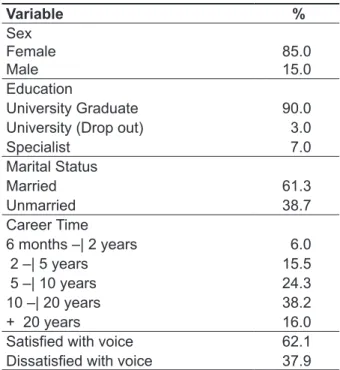
The teachers’ proile, demonstrated on Table 1 is predominantly: female, average age: 39 years old, education: university graduate; marital status: married; career time: between 10 and 20 years; vocal asymptomatic; satisied with her voice.
Table 1 – General Population proile
Variable %
Sex
Female Male
85.0 15.0 Education
University Graduate 90.0
University (Drop out) 3.0
Specialist 7.0
Marital Status
Married 61.3
Unmarried 38.7
Career Time
6 months –| 2 years 6.0
2 –| 5 years 15.5
5 –| 10 years 24.3
10 –| 20 years 38.2
+ 20 years 16.0
Satisied with voice 62.1
Dissatisied with voice 37.9
Hoarseness Voice loss Voice failure Rough/thin voice Weak voice
Hem Dry cough Dry throat Tiredness when Efort when speaking speaking
Figure 2 – Sensations in the Throat
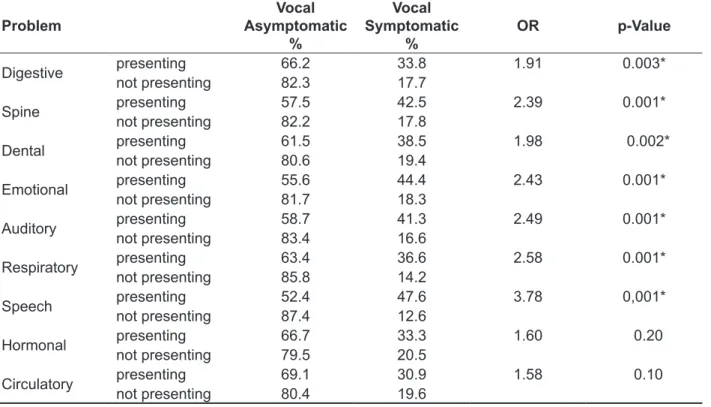
Table 2 – General Health Problems
Problem
Vocal Asymptomatic
%
Vocal Symptomatic
%
OR p-Value
Digestive presenting 66.2 33.8 1.91 0.003*
not presenting 82.3 17.7
Spine presenting 57.5 42.5 2.39 0.001*
not presenting 82.2 17.8
Dental presenting 61.5 38.5 1.98 0.002*
not presenting 80.6 19.4
Emotional presenting 55.6 44.4 2.43 0.001*
not presenting 81.7 18.3
Auditory presenting 58.7 41.3 2.49 0.001*
not presenting 83.4 16.6
Respiratory presenting 63.4 36.6 2.58 0.001*
not presenting 85.8 14.2
Speech presenting 52.4 47.6 3.78 0,001*
not presenting 87.4 12.6
Hormonal presenting 66.7 33.3 1.60 0.20
not presenting 79.5 20.5
Circulatory presenting 69.1 30.9 1.58 0.10
not presenting 80.4 19.6
*p- Value <0.05.
Student t test, signiicant values p<0.05.
Odds ratio (OR) was used to verify independent associations.
Table 3 – Deleterious living habits
Habit Frequency
Vocal Asymptomatic
%
Vocal Symptomatic
%
OD p- Value
Smoking presenting 88.2 11.8 0.55 0.22
not presenting 78.6 21.4
Acoholism presenting 71.4 28.6 1.37 0.68
not presenting 78.6 21.4
Student t test, signiicant values p<0.05.
of students (26.4%), singing in church (18.5%),
choir singing, giving private lessons (4%),sales
work (3.4%), among others. It is important to stress the occupational nature of vocal problems among teachers. The diferences at the school environment, students’ age group and stocking, as well as the kind of discipline applied can predispose to dysphonia in
a shorter time.
Prevalence of vocal symptoms
According to Figures 1 and 2, the prevalence
of vocal symptoms referred by teachers from the Municipal Network Education of Campo Grande-MS for the year 2013 is deined at 21.5% in a population of 4,957 active teachers. That is, respecting the conidence interval, this sample projected number for the general population of the “MNE” means in absolute value – 1,066 teachers with vocal symptoms indicating disease in the larynx and who are daily exposed to the escalation of the condition.
DISCUSSION
Population Proile
According to Table 1, the composition of the teachers’ group in this study is similar to those in the research papers developed in this area: mostly females, exclusively dedicated to teaching and having working hours longer than 20 hours a week
12,13.
Considering the average working years between
10 and 20, it can be admitted there is no relationship
concerning the vocal adjustments of the early career phase. The onset of a permanent dysphonia along the career shows the chronicity of this alteration due to voice ill-use or vocal abuse and not simply to a
current transient occurrence 14.
The teachers associated all vocal symptoms to the use of voice in the classroom. The association to the use of voice outside the classroom happened to a minority of teachers as in cases of: taking care
Table 4 – Healthy living habits
asymptomatic %
symptomatic
% OD p-Value
Water
Sleep
Leisure
Drink Drink little Sleep well Sleep badly
Yes
No
77.7 73.2 81.3 70.8 77.1 81.0
22.3 26.8 18.8 29.2 22.9 19.0
0.83
0.64
1.21
0.53
0.10
0.38
Student t test, signiicant values p<0.05.
Odds ratio (OR) was used to verify independent associations.
Table 5 – Teachers indicate as predictors to their vocal problems Asymptomatic
%
Symptomatic
% OR p-Value
Respiratory* Referred 72.7 27.3 1.39 0.12
Not Referred 80.4 19.6
Cold Referred 79.2 20.8 0.93 0.79
Not Referred 77.4 22.6
Stress Referred 70.4 29.6 1.50 0.07
Not Referred 80.3 19.7
Intense use of
the voice
Referred 68.9 31.1
3.14 0.001*
Not Referred 90.8 9.2
Noise Referred 66.7 33.3 1.66 0.04*
Not Referred 79.9 20.1
*p-value <0.05.
the balance of two systems: masticatory (articu
-lation) and respiratory (forces: aerodynamic and myoelastic). When the teacher does not breathe properly, the phonation time is compromised and this causes speaking tiredness. Voice projection or resonance also sufer loss of quality and throughout the working day, the professional overloads the whole vocal tract 29,30.
As far as speech problems are concerned, the need of being understood forces the teachers who have diiculty in expressing themselves well to constantly repeat what they say and this also overloads the phonologic work. Speech sound
distortions can also be associated to alterations to dental structures and malocclusion 31, since these
are reported as etiological factors of phonologic distortions, and the most afected phonemes are the
linguodental, alveolar and labiodental.
Living Habits
Table 3 shows the presence of deleterious living habits among the vocal symptomatic teachers – smoking (11.8%) and alcoholism (28.6%) and it was observed that there was no signiicant statistic diference. The indings of this research are in accordance with the data from the World Health Organization (WHO), where it is estimated that 15% of the world population presents smoking or drinking habits. The low reference to deleterious habits positively relects the teachers’ voice and life quality and can be justiied as a response to the national anti-smoking and anti-drinking campaigns as well as the increase in the reinforcement of laws
restricting their consumption 32,33.
Concerning Table 4, which shows the presence of healthy living habits among the vocal symptomatic teachers, it was observed: daily water intake close to
2 liters (22.3%), sleeping period lasting 6 to 8 hours
a day (18.8%) and leisure activities (22.9%). It is noticed that there was no statistic diference among the vocal symptomatic. It means that the variables: water and leisure were not determinant of the vocal problems in this study. This relects positively on the teachers’ vocal health.
It is necessary to report that although 81.5% of the sample teachers claim to sleep an average of 6 to 8 hours a day, 69% declare not to wake up feeling relaxed. That is, the habit of physiologic rest exists, but its quality is compromised. Physical tiredness inhibits body movements. As far as the voice is concerned, it is observed little mouth opening, low projection, articulatory inaccuracy and reduction of phonation maximum time. The variation of this percentage may be explained by countless factors, either economic, social, family-related or private to
each individual 34,35.
This number does not include the state network or the private education sector of the city: The national
literature average 15-18 is ratiied, which varies
between 20% and 30%. In the international literature
the percentage varies at a greater coverage 19-22,
but the presence of vocal symptoms appears unanimously among this class of workers.
The reciprocity between the number of referred symptoms (21.5%) and the number of sensations in the throat (26.3%) means that the teacher is aware of his/her voice and can detect signs and symptoms of vocal problems.
The results for the teachers of the Municipal Education Network point out the following as the main causes related to voice sufering: intense use of voice; bad sleeping quality; respiratory (allergies) and auditory problems, which will be further
discussed in more detail.
Predictor Factors to Vocal Problems
Analyzing the data on Table 2, digestive problems may be associated to the voice due to alterations that gastroesophageal relux and heartburn can
cause to the vocal tract mucosa. The gastric juice
causes edemas and lesions to cells when in contact with the larynx’s higher portion, compromising the vocal production. The relationship between the gastroeshophageal relux – (GER) and dysphonia in teachers has been studied in recent years 23,24.
Spine deviations, having either skeletal or postural origin, as well as cervical pressures or
cervicalgias generate tension points at the glottal
area, which favor muscle and postural unbalance between the phono-articulatory structures. This contributes negatively to the voice use, leading to a tense, compressed voice quality 25,26.
The emotional aspect predisposes to psycho
-genic or hyperfunctional dysphonia, which are relected alterations of psychological stress. In the classroom, due to conlict with students or with the board of directors, the condition may start with hoarseness, phonation instability or conversion aphony, which usually strikes abruptly. It is reversible, but requires specialized assistance from speech therapists and psychologists 27,28.
In order to justify the auditory problem it is necessary to investigate the auditory symptomatic teachers clinically to diagnose the kind and degree of the hypoacusia. A hypothesis which would justify such condition could be the presence of environmental noise in the classroom, which causes auditory discomfort. This issue will be better
discussed later on.
the average values of environmental noise inside the classrooms ranged from 56 dB (A) to 94.1 dB
(A) 39,40.
Vocal treatment Question
Among the teachers who declared sufering from vocal problems, 71% haven’t undergone
treatment, 26% have undergone treatment and 3%
are currently under treatment. These data ratify the need to increase the attention given to the teachers’ health, since even being aware of having vocal problems, most of these professionals have never tried to any kind of treatment. Other factors are also probably involved such as: diiculty in having
immediate access to health services and the need
to continue their professional activities even having
evident voice problems.
At the question about kinds of vocal treatment from the teachers who tried to ind them, it was evident that: 48.9% had speech therapy; 52.3% used medication; 4.5% underwent surgery and 5.7% tried to ind palliative methods to solve the vocal problem. The use of medication for voice treatment
is still predominant.
Severity of vocal problem Question
As to the severity of the vocal problem, it was found that: 39.1% discreet; 35.7% moderate; 12.3% severe; 12.3% could not say. That implies that
adding the moderate percentage to the severe one,
the proportion is higher than the other ones, which indicates a condition of important repercussion in vocal function. In this case, besides the fact that the
teacher notices the vocal problem, people around
him/her also notice that and it may bring restrictions
to the communicative process.
Absenteeism at work Question
Among the sampled teachers, 18.6% declared
to have missed work due to voice alterations. Relecting upon public health, the burden of workers
developing their activities considering the vocal
factor represents a worrying scenario, either from an economic, professional or social-educational
perspective.
Vocal care guidance Question
As to the guidance questions about voice care,
44.3% of the sampled teachers reported not having received any kind of instruction on the subject; and 55.4% airmed having received such guidance.
The lack of uniformity in the answers relects the fact that the teachers are inserted in diferent labor contexts. The prophylaxis of dysphonia starts with the teachers’ knowledge about vocal hygiene. Sleeping disorders are common in modern life
and have been related to stress among teachers.
A PhD study in the Social Psychology area by the São Paulo University – USP in 2011 surveyed 165 teachers from the town of Poços de Caldas to evaluate the impact of stress in their health and sleep quality. Data revealed that 59% of the teachers presented stress, most of whom in the resistance phase (39%) with prevalence of psycho
-logical stress. Moreover, they indicated that 46.7% of the teachers are poor sleepers, evidencing the association between physical and psychological factors for stress and sleep disorders. The USP study revealed the importance to investigate stress and sleep for the prevention of teachers’ mental
health problems and their social consequences at
work and life quality 28.
Relection upon the hydration habit : this is one of the main promoters of vocal quality, as well as
rest and anti-stress activities (leisure). It is correct
to say that this habit may not be the only reason for euphony, but it contributes potentially for its promotion and maintenance. The luid oral intake, as well as environmental humidity and medication action inluence the quality of secretions. In addition to that, hydration increases the diference in the reduction of the phonation initial pressure – PIP – of high pitch, making phonation easier36,37.
Vocal Aspects
Table 5 shows that the teachers understand that the origin of their vocal problem (either past or present) is statistically associated to factors such as: exposure to noise (33.3%) and intense vocal use (31.1%). The study could conclude that the teachers indicate multiple predictors of vocal problems both in
the present and in the past and relate their problem
predominantly to the intense use of their voice at work. Moreover, they realize that environmental noise in the classroom afects their eiciency in
communicating.
Concerning classroom noise, it was observed
that the classroom acoustics is compromised since
there is no standardization at structural level either in sound projection or noise muling. In addition to this, the exceeding number of students in the rooms
increases the acoustic problem. The acceptable
noise level for classrooms varies between 40 and
50 dB (A), and values over this level are considered
harmful to health 38. Intense noises make verbal
communication diicult, leading to an increase of psychological tension and reduction of the attention
level. The higher the noise level, the higher the
vocal intensity applied to try to compensate it. The
voice should be at least 10 dB (A) louder than the
demonstrated to be poor sleepers qualitatively, which may contribute negatively to their life and voice quality.
The teachers are partially aware of the origin of
their vocal problem.
The satisfaction with their own voice varies from acceptance in the asymptomatic teachers to rejection in the symptomatic ones.
There is a relation between vocal self-image and vocal quality.
There is the real need to implement the program
on teachers’ vocal health at Municipal Network
Education in Campo Grande, MS.
CONCLUSION
There is a relevant percentage of vocal symptoms teachers in the Municipal Network Education in Campo Grande, MS, Brazil. The most expressive vocal symptoms predictors were: speech problems, respiratory and auditory problems, indicating that the teachers’ communicative system is altered
and deserves special attention concerning the
prophylaxis, diagnosis and vocal rehabilitation
process.
Although the healthy habit – sleep – was presented with high percentage, the teachers
REFERENCES
1. Sociedade Brasileira de Fonoaudiologia.
Departamento de voz. Seção: Mal pode virar doença ocupacional. 2013 [acesso em 2013 set 22]. Disponível em: http://www.sbfa.org.br/portal/depto_ titulo.php?id=3&ttpg_comissao=VOZ&ttpg=Mal pode virar uma doença ocupacional&tpc=cinza 2. Academia Brasileira de Laringologia e Voz. Campanha da Voz 2014. [acesso em 2014 abr 16]. Disponível em: http://www.ablv.com.br
3. Instituto Nacional de Estudos e Pesquisas Educacionais Anísio Teixeira. Censo 2012. [acesso em 2012 out 10]. Disponível em: http://portal.inep.
gov.br/basica-censo
4. Ferreira LP. Condições de produção vocal de professores da rede do município de São Paulo.
Rev Distúrb Comum. 2003;14(1):275-308.
5. Giannini SPP. Distúrbio de voz relacionado ao
trabalho docente: um estudo caso-controle. CoDAS. 2013;25(6):566-76.
6. Dragone MLS, Ferreira LP, Giannini SPP, Simões-Zenari M, Vieira VP, Behlau M. Voz do professor: uma revisão de 15 anos de contribuição fonoaudiológica.
Rev Soc Bras Fonoaudiol. 2010;15(3):289-96.
7. Costa HO. Distúrbios da voz relacionados ao
trabalho. In: Mendes R (org.) Patologia do trabalho. São Paulo: Atheneu; 2003.
8. Araújo TM, Carvalho, FM. Condições de trabalho docente e saúde na Bahia: estudos epidemiológicos.
Educ. Soc. 2009;30(107):427-49.
9. Campo Grande. LEI no. 4.479, de 15 de julho
de 2007. Criação Programa Municipal Saúde Vocal.
Câmara Municipal de Campo Grande-MS. Diário
Oicial do Estado de Mato Grosso do Sul. [acesso em 2012 ago 28]. Disponível em: http://www. camara.ms.gov.br/?secao=noticia&id=164189
RESUMO
Objetivo: delinear o panorama epidemiológico sobre a voz do professor na Rede Municipal de Ensino
de Campo Grande/MS, veriicando a prevalência de sintomas vocais autorreferidos nessa popula
-ção. Métodos: trata-se de um estudo epidemiológico, transversal, descritivo, quantitativo. Dentre os
4.957 professores cadastrados na Semed/2013, 394 participaram da pesquisa. Todas as sete regiões urbanas do município (Prosa, Bandeira, Anhanduizinho, Lagoa, Segredo, Centro, Imbirussu) foram amostradas. Para a coleta de dados utilizou-se o protocolo de Ferreira e cols., adaptado, utilizando-se como método de mensuração a escala Likert. Resultados: constatou-se alta prevalência de sintomas
vocais autorreferidos. Os professores apresentaram múltiplos sintomas relacionados ao uso da voz no trabalho e perceberam os efeitos adversos em seu desempenho proissional. Conclusão: a
serie-dade dos problemas de voz do professor, vivenciados diariamente nos serviços de atendimento fono
-audiológico e na Rede Municipal de Ensino foi revelada em números expressivos nessa pesquisa.
complaints, treatment-seeking behavior, knowledge of vocal care, and voice-related absenteeism. Department of Otolaryngology and Head and Neck Surgery, University Hospital Ghent, Belgium. J
Voice. 2011; 25(5):570-5.
21. Simberg S, Laine A, Sala E, Ronnema AM.
Prevalence of voice disorders among future teachers. J Voice. 2000;14(2):231-5.
22. Masuda T. Analysis of vocal abuse: luctuations in phonation time and intensity in 4 groups of speakers. Acta Otolaryngol (Stockh). 1993;113(4):547-52. 23. Burati DAC, Eckley C, Costa H. Doença do Reluxo Gastroesofágico: análise de 157 pacientes.
Rev Bras Otorrinolaringol. 2003;69(4):458-62.
24. Bruneto B, Oyárzun R, Mella L, Avila S. Mitos Y realidades de La disfonia proissional. Rev Otorrinolaringol Cir Cabeza Cuello. 1986;46:115-20. 25. Hermes EGC, Nakao M. Educação vocal na formação do docente. Fonoaudiol Bras.
2003;2(3):48-59.
26. Pinho MSR. Fundamentos em laringologia e
voz. Rio de Janeiro: Guanabara Koogan; 2003. 27. Rechenberg L, Goulart BNG, Roithmann R.
Impacto da atividade laboral de teleatendimento em
sintomas e queixas vocais – estudo analítico. J Soc
Bras Fonoaudiol. 2011;23(4):301-7.
28. Valle LELR, Malvezzi S. Estresse e distúrbio do sono no desempenho de professores: saúde mental no trabalho. [Tese]. São Paulo (SP): Universidade
de São Paulo, Faculdade de Psicologia, Doutorado em Psicologia Social; 2011.
29. Mestre L, Merlin E. Adoecimento vocal em
professores. Anais do XVI Encontro de iniciação Cientiica da PUC. Setembro 2009;29-30,
Campinas.
30. Vilkman E. Voice Problems at Work: a Challenge for Occupational Safety and Health Arrangement.
Folia Phoniatr Logop. 2000;52(1-3):120-5.
31. CarellI EG, Sá MOSM. Análise fonética em portadores de alterações dentárias. Rev Fono Atual.
2001;4(15):39-42.
32. Vilkman E. Occupational safety and health aspectos of voice and speech professions. Folia
Phoniatr Logop. 2004;56(4):220-53.
33. Williams NR. Occupational groupos at risk of voice disorders: a review of the literature. Rev
Occupational Medicine. 2003;53(7):456-60.
34. Yiu EML. Impact and prevention of voice problems in the teaching profession: embracing the consumer´s view. J Voice. 2002;16(2):215-29. 35. Colton RH, Casper JK. Compreendendo os problemas de voz: uma perspectiva isiológica ao diagnóstico e ao tratamento. Porto Alegre: Artes
Médicas; 1996.
36. Satalof RT. World Voice Day 2012. [Editorial] Ear, Nose and Throat Journal. 2012;91(2):52.
10. Mato Grosso do Sul. LEI no. 2.198, de 20 de
dezembro de 2000, Promulgada em 2007. Diário Oicial do Estado de Mato Grosso do Sul. Criação Programa Estadual Saúde Vocal. [acesso em 2012 jul 02]. Disponível em: http://www.sbfa.org.br/portal/ voz_proissional/leis.pdf
11. Ferreira LP, Giannini SPP, Latorre MRDO, Zenari MS. Distúrbio da voz relacionado ao trabalho: proposta de um instrumento para avaliação de professores. Rev Dist Comun. 2007;19(1):127-37.
12. Hermes EGC, Alves MP, Meireles A, Araújo C, Federici M, Boemer B.; Pereira, T. Qualidade vocal
da população atendida na Campanha Nacional da Voz 2011- MT. In: 8º. Congresso Internacional de
Fonoaudiologia. 2011. Anais eletrônicos. p. 103.
[acesso em 2011 abr 9]. Disponível em: www.sbfa. org.br/portal/suplementorsbfa
13. Lima MFEM. Condições de trabalho e saúde do professor universitário. Centro de Ciências Humanas e Sociais/UFMS. Rev Ciências & Cognição. 2009;14(3):62-82.
14. Behlau MS, Zambon F, Guerrieri AC, Roy N. Panorama epidemiológico sobre a voz do professor no Brasil. Anais do 17º Congresso Brasileiro de Fonoaudiologia. 1º Congresso
Íbero-Americano de Fonoaudiologia. Rev Soc
Bras Fonoaudiol [Internet]. Suplemento 2009: 1511. [citado 2009 Dez 1]. Disponível em:http:// www.sbfa.org.br/portal/anais2009/anais_select. php?op=PR&cid=1511&tid=1
15. Lima-Silva MFB, Ferreira LP, Silva MAA,
Ghirardi ACAM. Distúrbio de voz em professores: autorreferência, avaliação perceptiva da voz e
das pregas vocais. Rev Soc Bras Fonoaudiol. 2012;17(4):391-7.
16. Giannini SPP, Latorre MRDO, Ferreira LP.
Voice disorders (Dysphonia) in public school female teachers working in Belo Horizonte: prevalence and associated factors. J Voice. 2010;15(3):475-9. 17. Provenzano LCFA, Sampaio TMM. Prevalence of vocal dysfunction in teachers from the state education-licensed from classroom. Rev CEFAC.
2010;12(1):97-108.
18. Bacha SMC, Camargo AFFP, Brasil MLR.
Incidência de Disfonia em professores de
pré-escola do ensino regular da rede particular
de Campo Grande/MS. Pró-Fono R Atual Cient.
1999;11(2):8-14.
19. Preciado-López J, Pérez-Férnandez CP, Preciado-Ruiz P. Epidemiological study of voice disorders among teaching professionals of La Rioja, Spain. Department of Otorhinolaryngology, Hospital San Millán, San Pedro y de La Rioja, Logroño, Spain. J Voice. 2008;22(4):489-508.
saúde vocal: proposta de melhoria do peril vocal de professores. Pró-Fono R Atual. Cient.
2008;20(3):177-82.
40. Ijuim JMO, Lacerda CBF. A presença de ruído ambiental e a qualidade da voz do professor em uma escola cenecista. 2006. [Dissertação]. Piracicaba
(SP): Universidade Metodista de Piracicaba,
Mestrado em Educação; 2006. 37. Thompson AR. Pharmacological agents with
efects on voice. Am J Otolaryngol. 2005;16(1):12-8. 38. Associação Brasileira de Normas e Técnicas. NBR 10152: Níveis de ruído para conforto acústico. [acesso em 2014 out 03]. Disponível em: http:// www.abntcatalogo.com.br/norma.aspx?ID=4564 39. Silvério KCA, Gonçalves CGO, Penteado RZ, Vieira TPG, Libardi A, Rossi D. Ações em
Received on: January 26, 2015 Accepted on: May 27, 2015
Mailing address:
Elisangela Giroto Carelli Hermes Av. Senador Filinto Muller, s/n
Cidade Universitária - Universidade Federal do Mato Grosso do Sul
Campo Grande – MS – Brasil CEP: 79000-100
APPENDIX – ADAPTED QUESTIONNAIRE MODEL – BASTOS, HERMES (2013) I – Questionnaire Identiication
1 Interviewee code (do not ill in)
2 School
3 Date / /
II – Interviewee Identiication
4 Name
5 Date of Birth / /
6 Sex 0. ( ) female 1. ( ) male
7 Marital status
1. ( ) single 3. ( ) separated or divorced
2. ( ) married or in any form or union 4. ( ) widow
8 Education
1. ( ) university graduate; course:
2. ( ) undergraduate; course:
3. ( ) university drop out
4. ( ) high school 5. ( ) high school drop out
6. ( ) elementary school 7. ( ) elementary school drop out
8. ( ) other
III – Functional situation
9 How long have you been a teacher?
10 At how many schools have you worked throughout you career? 11 At how many schools do you work nowadays?
12 Besides schools, do you work at any other place? 0. ( ) No 1. ( ) Yes 12.1 Is yes, where do you work and what do you do?
13. How long have you worked at this school?
14. This institution is a/an
1. ( ) kindergarten 2. ( ) elementary school
3. ( ) high school
4. ( ) university
15. What is your employment post? 1. ( ) efective teacher
2. ( ) substitute teacher
3. ( ) temporary readapted teacher 4. ( ) deinitely readapted teacher 4.1 If readapted, for which reason? 4.2 If readapted, for how long?
5. ( ) Coordinator
6. ( ) Board of Director’s Assistant
7. ( ) Principal
8. ( ) Other. What? _________________________ 16. What is / are your current activity / activities at the school?
1. ( ) teaching
2. ( ) administrative work 3. ( ) break / entrance supervision
4. ( ) assistance to the public 5. ( ) pedagogic planning
6. ( ) library administration 7. ( ) other. What ?
17. How many hours a week do you spend with the students?
1. ( ) less than 10 hours
2. ( ) from 10 to 20 hours 3. ( ) from 20 to 30 hours 4. ( ) from 30 to 40 hours
5. ( ) more than 40 hours
6. ( ) I do not spend time with students 18. Is your work environment calm?
19. Do you have a good relationship with:
1. your colleagues 0.( )never 1.( )rarely 2.( )sometimes 3.( )always 4.( )I don’t know 2. the board of directors 0.( )never 1.( )rarely 2.( )sometimes 3.( )always 4.( )I don’t know 3 . the students 0.( )never 1.( )rarely 2.( )sometimes 3.( )always 4.( )I don’t know 4. the students’ parents 0.( )never 1.( )rarely 2.( )sometimes 3.( )always 4.( )I don’t know 20. Are you free to plan and develop your activities?
0. ( ) never 1. ( ) rarely 2. ( ) sometimes 3. ( ) always 4. ( ) I don’t know 21. Is there constant supervision?
0. ( ) never 1. ( ) rarely 2. ( ) sometimes 3. ( ) always 4. ( ) I don’t know 22. Is the working rhythm stressing?
0. ( ) never 1. ( ) rarely 2. ( ) sometimes 3. ( ) always 4. ( ) I don’t know 23. Do you have time to develop all the activities at the school?
0. ( ) never 1. ( ) rarely 2. ( ) sometimes 3. ( ) always 4. ( ) I don’t know 24. Do you ever take work home?
0. ( ) never 1. ( ) rarely 2. ( ) sometimes 3. ( ) always 4. ( ) I don’t know 25. Is there a suitable resting place for teachers at the school? 0. ( ) No 1. ( ) Yes
26. If necessary, is it easy for you to leave your classroom?
0. ( ) never 1. ( ) rarely 2. ( ) sometimes 3. ( ) always 4. ( ) I don’t know
IV – General Health Aspects
56 – Concerning your general health condition do you ever have:
1. Digestive problems:
1.1 heartburn 0.( )never 1.( )rarely 2.( )sometimes 3.( )always 4.( )I don’t know 1.2 relux 0.( )never 1.( )rarely 2.( )sometimes 3.( )always 4.( )I don’t know 1.3 gastritis 0.( )never 1.( )rarely 2.( )sometimes 3.( )always 4.( )I don’t know 1.4 Other 0.( )never 1.( )rarely 2.( )sometimes 3.( )always 4.( )I don’t know
2. Hormonal problems
0.( )never 1.( )rarely 2.( )sometimes 3.( )always 4.( )I don’t know If yes, which one / (ones)?
3. Spine problems
0.( )never 1.( )rarely 2.( )sometimes 3.( )always 4.( )I don’t know If yes, which one / (ones)?
4. Dental problems
0.( )never 1.( )rarely 2.( )sometimes 3.( )always 4.( )I don’t know If yes, which one / (ones)?
5. Circulatory problems
0.( )never 1.( )rarely 2.( )sometimes 3.( )always 4.( )I don’t know If yes, which one / (ones)?
6. Emotional problems
0.( )never 1.( )rarely 2.( )sometimes 3.( )always 4.( )I don’t know If yes, which one / (ones)?
If yes, are you undergoing any treatment?
0. ( ) No 1. ( ) Yes, psychiatric 2. Yes, psychotherapeutic 3. ( ) other 7. Respiratory problems
7.1 rhinitis 0.( )never 1.( )rarely 2.( )sometimes 3.( )always 4.( )I don’t know 7.2 sinusitis 0.( )never 1.( )rarely 2.( )sometimes 3.( )always 4.( )I don’t know 7.3 tonsillitis 0.( )never 1.( )rarely 2.( )sometimes 3.( )always 4.( )I don’t know 7.4 pharyngitis 0.( )never 1.( )rarely 2.( )sometimes 3.( )always 4.( )I don’t know 7.5 laryngitis 0.( )never 1.( )rarely 2.( )sometimes 3.( )always 4.( )I don’t know 7.6 bronchitis 0.( )never 1.( )rarely 2.( )sometimes 3.( )always 4.( )I don’t know 7.7 asthma 0.( )never 1.( )rarely 2.( )sometimes 3.( )always 4.( )I don’t know 7.8 colds 0.( )never 1.( )rarely 2.( )sometimes 3.( )always 4.( )I don’t know 7.9 other 0.( )never 1.( )rarely 2.( )sometimes 3.( )always 4.( )I don’t know If yes, which one / (ones)?
8. Auditory problems
8.1diiculty in hearing 0.( )never 1.( )rarely 2.( )sometimes 3.( )always 4.( )I don’t know 8.2 earache 0.( )never 1.( )rarely 2.( )sometimes 3.( )always 4.( )I don’t know 8.3 discomfort with sounds and noise
0.( )never 1.( )rarely 2.( )sometimes 3.( )always 4.( )I don’t know 8.4 buzzing noise 0.( )never 1.( )rarely 2.( )sometimes 3.( )always 4.( )I don’t know 8.5 dizziness/vertigo 0.( )never 1.( )rarely 2.( )sometimes 3.( )always 4.( )I don’t know
9. Other health problem
0.( )never 1.( )rarely 2.( )sometimes 3.( )always 4.( )I don’t know If yes, which one / (ones)?
0.( )never 1. ( )rarely 2.( )sometimes 3.( )always 4.( )I don’t know 57 – Do you have speech problems? 0. ( ) No 1. ( ) Yes
58 – As to menstruation
1. Do you sufer from pre-menstrual syndrome?
0.( )never 1.( )rarely 2.( )sometimes 3.( )always 4.( )I don’t know 2. The menstrual cycle is regular
0.( )never 1.( )rarely 2.( )sometimes 3.( )always 4.( )I don’t know 3. You are in menopause 0.( ) No 1.( ) Yes 2.( ) I do not menstruate for other reasons 4. Do you have hormone replacement therapy? 0. ( ) No 1. ( ) Yes
59 – Do you use medication?
0.( )never 1.( )rarely 2.( )sometimes 3.( )always 4.( )I don’t know
If you marked “always” for the former question, please inform which medication you take and what you take it for. 60 – Do you smoke? 0. ( ) No 1. ( ) Yes
If yes,1. How many cigarettes on average, do you smoke a day? 2. How long have you had this habit?
61 – Have you ever smoked? 0. ( ) NO 1. ( ) Yes If yes,1. How many cigarettes did you use to smoke a day? 2. How long ago did you stop smoking?
62 – Do you consume alcoholic drinks?
0.( )never 1.( )rarely 2.( )sometimes 3.( )always 4.( )I don’t know If yes, 1. What kind of drinks?
2. How much on average, do you consume per week?
63 – Do you usually drink water during the day? 0. ( ) No 1. ( ) Yes
1. Apart from water, do you ever drink other liquids (cofee, tea, juice, soft drinks, etc.) during the day? 0.( )never 1.( )rarely 2.( )sometimes 3.( )always 4.( )I don’t know 2. How many glasses of water or other liquids on average, do drink a day?
64 – As to your eating habits:
1. How many meals do you have a day? 2. Do you eat at regular times?
0.( )never 1.( )rarely 2.( )sometimes 3.( )always 4.( )I don’t know 3. Do you avoid any kind of food?
0.( )never 1.( )rarely 2.( )sometimes 3.( )always 4.( )I don’t know If yes, which from the food listed below do you usually avoid?
3.1. ( ) solid food (e.g. beef, raw carrots) 3.2. ( ) fatty food
3.3. ( ) spicy food 3.4. ( ) dairy products 3.5. ( ) other, which one/ones?
4. When opening your mouth or chewing, do you notice:
4.1. clicking noises 0.( )never 1.( )rarely 2.( )sometimes 3.( )always 4.( )I don’t know 4.2. sand sensation 0.( )never 1.( )rarely 2.( )sometimes 3.( )always 4.( )I don’t know 4.3. chin deviation 0.( )never 1.( )rarely 2.( )sometimes 3.( )always 4.( )I don’t know 4.4. diiculty in opening you mouth or biting food
0.( )never 1.( )rarely 2.( )sometimes 3.( )always 4.( )I don’t know 65 – As to your sleep
1. How many hours on average do you sleep every day? 2. Do you ever wake up during the night?
0.( )never 1.( )rarely 2.( )sometimes 3.( )always 4.( )I don’t know 3. Do you wake up feeling relaxed?
0.( )never 1.( )rarely 2.( )sometimes 3.( )always 4.( )I don’t know 66 – As to your leisure activities, tick how often you go to the places below:
1. club 0.( )never 1.( )rarely 2.( )sometimes 3.( )always 4.( )I don’t know 2. friends’ house 0.( )never 1.( )rarely 2.( )sometimes 3.( )always 4.( )I don’t know 3. shopping center 0.( )never 1.( )rarely 2.( )sometimes 3.( )always 4.( )I don’t know 4. church 0.( )never 1.( )rarely 2.( )sometimes 3.( )always 4.( )I don’t know 5. parks 0.( )never 1.( )rarely 2.( )sometimes 3.( )always 4.( )I don’t know 6. movies or theater 0.( )never 1.( )rarely 2.( )sometimes 3.( )always 4.( )I don’t know 7. bars 0.( )never 1.( )rarely 2.( )sometimes 3.( )always 4.( )I don’t know 8. dancing clubs 0.( )never 1.( )rarely 2.( )sometimes 3.( )always 4.( )I don’t know 9. gym 0.( )never 1.( )rarely 2.( )sometimes 3.( )always 4.( )I don’t know 10. beach / ranch 0.( )never 1.( )rarely 2.( )sometimes 3.( )always 4.( )I don’t know 11. other 0.( )never 1.( )rarely 2.( )sometimes 3.( )always 4.( )I don’t know
V – Vocal Aspects
68 – If you have a voice alteration, how long have you had it?
1. ( ) 0 to 5 months 2. ( ) 6 months to 11 months 3. 1 to 2 years 4. ( ) 3 to 4 years 5. ( ) more than 4 years
69 – If you had / have a voice alteration, in your opinion, what has caused it? 1. ( ) use of the voice instrument
2. ( ) respiratory infection 3. ( ) allergy
4. ( ) stress 5. ( ) constant colds
6. ( ) exposition to cold 7. ( ) exposition to noise
8. ( ) there was no apparent cause 9. ( ) I do not know
10. ( ) Other, what?
70 – Is you had / have a voice alteration, did you have or do you have any specialized treatment for this problem? 0. ( ) No 1. ( ) Yes, I did 2. ( ) Yes, I do
If yes, what kind of treatment was / is it? 1. ( ) speech therapy
2. ( ) use of medication If yes, which one / ones? 3. ( ) surgery
4. ( ) other, which one / ones?
71 – If you had / have a voice alteration, the onset of the problem was: 1. ( ) sudden 2. ( ) progressive 3. ( ) on and of 72 – If you had / have a voice alteration, the condition has:
1. ( ) remained the same 2. ( ) improved 3. ( ) worsened 73 – If you had / have a voice alteration; how would you deine it?
1. ( ) discreet alteration 2. ( ) moderate alteration 3. ( ) severe alteration 4. ( ) I do not know 74 – Along the day you voice is:
1. ( ) hoarse in the morning and improving later
2. ( ) better in the morning and worsening later
3. ( ) the voice does not come out in the morning
4. ( ) hoarse in the morning, improving later and worsening again in the evening
5. ( ) the voice does not come out in the evening
6. ( ) without alterations
75 – How do people react when they listen to you? 1. ( ) refer to constant voice alteration
2. ( ) are surprised at your voice 3. ( ) do not understand what you say 4. ( ) mistake your sex when listening to you 5. ( ) mistake your age when listening to you 6. ( ) ask what the problem is
7. ( ) have no reaction
8. ( ) other, what?
76 – Which vocal symptoms do you have nowadays?
1. hoarseness 0.( )never 1.( )rarely 2.( )sometimes 3.( )always 4.( )I don’t know 2. voice loss 0.( )never 1.( )rarely 2.( )sometimes 3.( )always 4.( )I don’t know 3. voice failure 0.( )never 1.( )rarely 2.( )sometimes 3.( )always 4.( )I don’t know 4. breathlessness 0.( )never 1.( )rarely 2.( )sometimes 3.( )always 4.( )I don’t know 5. thin voice 0.( )never 1.( )rarely 2.( )sometimes 3.( )always 4.( )I don’t know 6. rough voice 0.( )never 1.( )rarely 2.( )sometimes 3.( )always 4.( )I don’t know 7. varying voice (rough/thin)
0.( )never 1.( )rarely 2.( )sometimes 3.( )always 4.( )I don’t know 8. weak voice 0.( )never 1.( )rarely 2.( )sometimes 3.( )always 4.( )I don’t know 9. other, what? 0.( )never 1.( )rarely 2.( )sometimes 3.( )always 4.( )I don’t know 77 – Which sensations related to the throat and to the voice do you have nowadays?
11. secretion / phlegm in the throat
0.( )never 1.( )rarely 2.( )sometimes 3.( )always 4.( )I don’t know 12. dry throat 0.( )never 1.( )rarely 2.( )sometimes 3.( )always 4.( )I don’t know 13. tiredness when speaking
0.( )never 1.( )rarely 2.( )sometimes 3.( )always 4.( )I don’t know 14. efort to speak 0.( )never 1.( )rarely 2.( )sometimes 3.( )always 4.( )I don’t know 15. other, what? 0.( )never 1.( )rarely 2.( )sometimes 3.( )always 4.( )I don’t know 78 – have you ever missed work due to voice alterations?
0. ( ) No 1. ( ) Yes If yes, how many times? How many days, on average, were you absent?
79. Are you happy with your voice?
0. ( ) No 1. ( ) Yes If you are not happy with your voice, what would you change?
80 – Have you ever received any guidance on how to take care of you voice? 0. ( ) No 1. ( ) Yes
81 – What do you usually do when your voice is altered? 82 – As to vocal habits at work do you usually:
1. save your voice when you are not with the students.
0.( )never 1.( )rarely 2.( )sometimes 3.( )always 4.( )I don’t know 2. shout 0.( )never 1.( )rarely 2.( )sometimes 3.( )always 4.( )I don’t know 3. speak a lot 0.( )never 1.( )rarely 2.( )sometimes 3.( )always 4.( )I don’t know 4. speak outdoors 0.( )never 1.( )rarely 2.( )sometimes 3.( )always 4.( )I don’t know 5. speak while doing physical activity
0.( )never 1.( )rarely 2.( )sometimes 3.( )always 4.( )I don’t know 6. speak while carrying weight
0.( )never 1.( )rarely 2.( )sometimes 3.( )always 4.( )I don’t know 7. drink water while using your voice
0.( )never 1.( )rarely 2.( )sometimes 3.( )always 4.( )I don’t know 83 – Outside work – Do you do other activities which demand the use of the voice?
1. choir singing 0.( )never 1.( )rarely 2.( )sometimes 3.( )always 4.( )I don’t know 2. professional singing
0.( )never 1.( )rarely 2.( )sometimes 3.( )always 4.( )I don’t know 3. church singing 0.( )never 1.( )rarely 2.( )sometimes 3.( )always 4.( )I don’t know 4. public reading 0.( )never 1.( )rarely 2.( )sometimes 3.( )always 4.( )I don’t know
5. participating debates
0.( )never 1.( )rarely 2.( )sometimes 3.( )always 4.( )I don’t know 6. tutoring students 0.( )never 1.( )rarely 2.( )sometimes 3.( )always 4.( )I don’t know 7. sales work
0.( )never 1.( )rarely 2.( )sometimes 3.( )always 4.( )I don’t know 8. voice recording work
0.( )never 1.( )rarely 2.( )sometimes 3.( )always 4.( )I don’t know
9. private lessons teaching
0.( )never 1.( )rarely 2.( )sometimes 3.( )always 4.( )I don’t know 10. speaking on the phone
0.( )never 1.( )rarely 2.( )sometimes 3.( )always 4.( )I don’t know
11. other
0.( )never 1.( )rarely 2.( )sometimes 3.( )always 4.( )I don’t know 84 – Are there cases of voice alteration in your family?
0. ( ) No 1. ( ) Yes 1. If yes, who had / has it?
2. If yes, what was / is the problem? 3. If yes, did they have any surgery?