THE GENERALIZATION THROUGH THE TREATMENT
WITH FRICATIVES: FAVORABLE ENVIRONMENTS
VERSUS UNFAVORABLE AND NEUTRAL ENVIRONMENTS
A generalização a partir do tratamento com fricativas: ambientes
favoráveis versus ambientes pouco favoráveis e neutros
Fernanda Maraiga Wiethan(1), Helena Bolli Mota(2)
(1) Speech Therapist; PhD student in Human Communication Disorders – Universidade Federal de Santa Maria – RS – Brazil.
(2) Speech Therapist; Professor of the Speech and Hearing Therapy graduation and Post-graduate in Human Commu-nication Disorders of Universidade Federal de Santa Maria – RS – Brazil; PhD in Applied Linguistics – Pontifícia Uni-versidade Católica do Rio Grande do Sul – Brazil. Founding source: CAPES
Conlict of interest: non existent
Modiied Cycles Model1 due to its easy
implemen-tation. This model has the elimination of phono-logical processes present in the child’s speech as a basic principle. The elimination occurs from the awareness of the characteristics of the substituted sound, starting from the stimulation and production1.
In order to improve the therapy results, one of the aspects addressed in the current Brazilian researches is the target words using the favorable environments to the production of certain target
sound. The favorable environments are contexts
that facilitate the production and acquisition of the treated sound2. These contexts have been
widely researched to the liquid consonants of Brazilian Portuguese, aiming to verify if the determi-nation of target words with its target sounds located
in favorable environments would be more beneicial
INTRODUCTION
Many researches about speech disorder (SD) and its therapy are observed in literature.
Regarding to the therapeutic strategies, the therapy models with phonological basis are very much used. One of the most used models is the
ABSTRACT
The aim of this study was to analyze and compare the occurrence and the types of generalization
observed through the treatment of the fricatives /z/, /ʃ/ and /ʒ/in two groups of children, one using
words with favorable phonological contexts and another with unfavorable and neutral contexts. Six
children with phonological disorder between 4:7 and 7:8 year-old participated in the study, with their parents’ authorization. There were speech-language and complementary evaluations to diagnose the phonological disorder. The subjects were matched according to the severity of the phonological
disorder, sex, age and aspects of the phonological system in relation to the altered phonemes. Half the children were treated with words in which the phonemes /z/, /ʃ/ and /ʒ/ were in favorable phonological
environments and the other half with unfavorable and neutral environments. There were eight sessions and, after them, a new speech evaluation was performed in order to verify the types of generalization that were obtained. The generalization percentages were compared between the groups by statistical test Mann-Whitney (p<0.05). At the end of therapy, it was observed an increasing in generalization percentage for all the subjects. In the comparison between the groups, no statistical difference was found to the analyzed generalizations. However, there was an advantage to for the favorable group regarding to the generalizations “to another position in the word” and “inside a sound class”. The obtained results can be related to the small number of subjects or to other factors mentioned in the article.
CASE REPORT
This study consists in case reports of six children,
who gave verbal consent for their participation in the study and whose parents have previously signed the Term of Free Informed Consent to participate in the research. The following criteria were adopted to subjects’ inclusion: present alterations only in the phonological level of language; at least two of the
fricative sounds /z/, /ʃ/ and /ʒ/ with percentage equal
to or less than 40% in the phonogical system6 in the
initial and/or medial position; being aged between 4:0 and 8:0; not having undergone speech therapy before.
Description of pre treatment evaluation performed
To stablish the PD diagnosis, the following assessments were performed: interview with the parents and/or the guardians, phonological evalu-ation, evaluation of the stomatognathic system, of language, of vocabulary, of phonological awareness skills and of auditory processing. Moreover, the subjects were forwarded to audiological and otorhi-nolaryngologic assessment to dismiss organic factors that could determine the PD. The interview aimed to eliminate cognitive and/or neurological factors, which might interfere in the phonological development.
The interview aimed at hearing children’s history through the questions to parents about the pregnancy, childbirth, psychomotor and language development, feeding habits, physiopathology background and information about the subjects’ school life.
In the evaluation of stomatognathic system, an assessment protocol based on Marchesan7 was
used and the aspects observed are: appearance, posture, tonus and mobility of the articulators (tongue, lips, cheeks, soft palate, hard palate and teeth), as well as its functions (breathing, chewing and swallowing).
The language evaluation was held by sponta-neous situations, like free dialogues or games with
the child. Skills of understanding and expressing
oral language were observed.
The phonological awareness abilities were evaluated by “Protocolo de Tarefas de Consciência Fonológica”8, which evaluates the child’s
compe-tence in thinking about the language sounds and its organization in word formation.
The auditory processing was evaluated by “Avaliação Simpliicada do Processamento
Auditivo”9. This evaluation aims at verifying if the
children perform cognitive analysis of sonorant events.
to the correct production2,4. However, the research of
favorable environments to the other sound classes
is still little explored.
One of the most recent studies about the theme addressed the favorable environments to the fricative phonemes production3. In the author’s
research, eight children had their therapeutic processes analyzed, and the ABAB withdrawal and multiple probes model was used. The aim of the research was verifying the value of favoring which target-words have in the therapeutic success, involving fricative phonemes. The value of favoring is caused by stress, number of syllables, word position, preceding and following phonological
context. The author concluded that although the
favoring environments have a role as a facilitator, they are not crucial for the production of the fricative phonemes3.
The comparison of two subjects’ groups during the speech therapy, that will be showed in the present
article, is unprecedented to the sounds /z/, /ʃ/ and /ʒ/, since the mentioned author3 used data basis, in
which the same subject was treated with favorable, neutral and little favorable words simultaneously.
Furthermore, the study results about favorable environments were inconclusive2-4, being necessary
the realization of more researches about the theme, using other sounds and/or other therapeutic models,
specially controlling the phonological context of
target words.
To determine if the favorable environments are or not favorable to the treatment, some criteria, that need to be well determined, are necessary. The generalization analysis obtained is a good way to investigate this aspect. The generalization consists
in the extension of right production of target sounds
treated to others that were not stimulated. The generalization is the main contribution of phono-logical models, since it can help the therapist in the choice of the best model and target sounds to be stimulated5.
The phonological change promoted by the therapy can be of two types: structural, on the
identi-ication of structural properties of generalization or
circumstances in which it occurs; or functional, that
examines the functional properties of generalization
or how it’s used by a child to modify his/her phono-logical system, analyzing the intrasubject variables5.
Thus, the purpose of this study was to analyze and compare the occurrence and the types of generalization observed through the treatment of
the fricatives /z/, /ʃ/ and /ʒ/in three pairs of children, one using words with favorable phonological
Therapeutic Procedures
After the inal of the assessments, the members
of each children pair, which would receive the
treatment with phonological favorable contexts,
were randomly selected. The remaining children were treated with the target-words, whose
phono-logical contexts were little favorable or neutral. We
emphasize that the use of words with phonological environments little favorable and neutral couldn’t impair the children’s treatment, since all children would be treated. In addition, until then the therapy researches did not consider the phonological
contexts in the treatment of PD.
The treatment was performed through the
Modiied Cycles Model1, that was adapted to the
research needs. In the choice of phonological processes to be treated, there were selected only one or two, and two target sounds due to the methodological demand of being used the sounds
/z/, /ʃ/ and /ʒ/. The sessions lasted 50 minutes and
were carried out twice a week. Two cycles were performed with each child, being one of them in isolated word level and the other in the sentence level. However, when the children did not reach the percentage of hits equal to or greater than 50% to certain target-sound, the sound was repeated in isolated word level in the second cycle. Each target-sound was stimulated during two sessions per cycle,
totalizing eight sessions for each client in the inal of
data collection.
In the inal of each cycle a follow-up to verify the
treated sounds production in different words was performed. In the beginning and at the end of each session, the auditory bombardment was realized. This measurement consisted in the reading of words with the selected target-sound for the child. The parents were active agents in the therapeutic process, helping at home with the target-words activities and reading of auditory bombardment for the child.
To select target-words of the therapy, their phonological weight was calculated according to an author3 assumptions. The author assigned weights
to the favoring absolute values. The weight varied from 0 to 3, according to the phoneme position in
the word, stress, preceding and succeeding context
and number of syllables of the word. It needs to add
the weight of each context. The result of the addition
indicates whether the word is very favorable (weight 15), favorable (weight from 14 to 10), neutral (weight 9), little favorable (weight from 8 to 3) or unfavorable (weight equal to or less than 2).
Half of the children were treated with favorable words and the other half were treated with little favorable and/or neutral words. We emphasize that the chosen target-sounds were the same to each The vocabulary evaluation was held through
ABFW – part B (Vocabulary)10. The test evaluates
nine semantic ields: clothing, animals, food, means
of transportation, furniture and utensils, occupations, places, shapes and colors, toys and musical instru-ments. The child had to denominate the drawings of
box test spontaneously.
The hearing and otorhinolaryngologic
evalu-ations were held by experienced professionals
in these areas. The methods were chosen by the professionals.
The collection of speech data was held through “Avaliação Fonológica da Criança” (AFC)11.
The speech data were recorded and phoneti-cally transcribed, initially by the main investigator and after by two judges. At least two of the three transcriptions should be coincidental. When there
was no agreement, the word was excluded from
the sample. Based on those data, the contrastive analysis was held to determine the phonetic and phonological inventory of the children, using the following criteria6. occurrence from 0 to 39% - absent
or not acquired sound (NA); occurrence from 40% to 79% - partially acquired sound; occurrence equal to or greater than 80% - acquired sound.
After, the PD’s severity was calculated from the Percentage of Correct Consonants (PCC-R)12.
Pairing of subjects according to the assessment results
The selected subjects were paired according to the PD severity; gender; age and phonological system characteristics regarding to the changed
sounds, specially the fricatives /z/, /ʃ/ and /ʒ/, in
which the distinctive features should be the same and the percentage production similar. The subjects S1 and S2, both male, presented PCC-R of 73,1% and 78,3% (mild-moderate disorder - MMD) and age of 7:8 and 7:6, respectively, both presented changes
of the feature [+voice] to the fricatives /z/ and /ʒ/ and of the feature [-anterior] to the fricatives /ʃ/ and /ʒ/. The subjects S3, S4, S5 and S6 were female
and presented the feature [-anterior] altered to the
production of /ʃ/ and /ʒ/. S3 and S4 had PCC-R of
73,6% and 78,4% (MMD) and age of 5:5 and 4:7, respectively. As S5 and S6 presented PCC-R of 87,6% and 87,5% (mild disorder - MD) and ages of 6:6 and 6:5, respectively.
Besides, the subjects’ pairs presented the same education. S1 and S2 frequented the 2nd grade,
S3 and S4 the kindergarten and S5 and S6 the 1st grade. All children studied in public school and
so high (15) and so low (2 or less) scores, respec-tively, weren’t found.
The target sounds and the target words were determined according to Picture 1.
pair members. The only difference between the
children was the context in that the target-sound
was inserted. The environments very favorable and unfavorable were disregarded, because words with
Description of post-treatment analyses
After inishing two cycles, new AFC was
performed to verify the changes occurred in the phonological systems of the children and the types of generalization obtained.
This study is part of a research project linked to a higher education institution and approved by the Ethics and Research Committee under number 052/04.
The therapy results were analyzed through descriptive and statistical analysis of structural generalizations obtained with the phonological treatment. The percentages between the initial
and inal assessments and between the groups
of children treated with favorable environments versus little favorable and neutral environments. The Mann-Whitney statistical test was used, due
to its small sample size, and the signiicance level
adopted was 5% (p<0.05).
The following types of generalization were considered for analysis5:
1. To lexical items that were not used in the
treatment (other words): The percentages of correct production of the sounds stimulated in words which were different from the ones used in the therapy were analyzed.
2. To another position in the word: the percentages of correct production of the target-sounds in different position from the ones stimulated in therapy were analyzed.
3. Inside a sound class: the percentages of correct production of the fricatives that weren’t stimulated in therapy were analyzed.
4. To other sound classes: the percentages of correct production of the plosives, liquids, nasals and affricates were analyzed.
Subject environmentLinguistic soundsTarget- Target-words
S1 Favorable /z/ - OM
/ʃ/ - OM
Azedo, azeite, azul, asa, doze, casinha.
Bicho, cachorro, peixe, caixa, roxo, abacaxi.
S2 Little favorable and neutral
/z/ - OM
/ʃ/ - OI
Casamento, Monza, casa, mesa, onze, pesadelo.
Chocalho, charuto, chaminé, chocolate, chinês, xampu.
S3 Favorable /ʃ/ - OM
/ʒ/ - OM
Bicho, cachorro, peixe, caixa, roxo, abacaxi.
Beijo, queijo, anjo, canja, laranja, pijama
S4 Little favorable and neutral
/ʃ/ - OI /ʒ/ - OM
Chaminé, chocolate, chinês, xampu, chapéu, chocalho.
Abajur, caju, anjinho, injeção, ajuda, agenda.
S5 Favorable /ʃ/ - OM
/ʒ/ - OM
Bicho, cachorro, peixe, caixa, roxo, abacaxi.
Anjo, loja, queijo, canja, pijama, beijo.
S6 Little favorable and neutral
/ʃ/ - OI /ʒ/ - OM
Chocalho, charuto, chaminé, chocolate, chinês, xadrez.
Abajur, caju, ajuda, agenda, anjinho, injeção.
Legenda: OI= Onset inicial; OM=Onset medial.
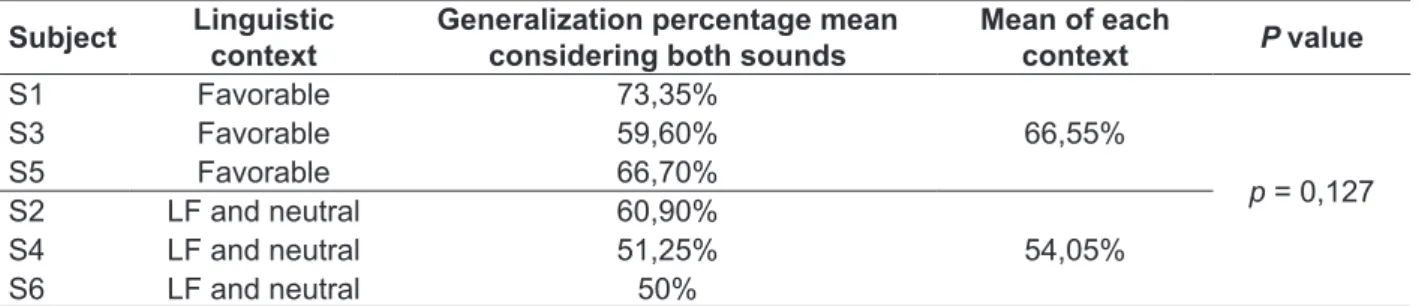
In Table 1 the generalization to lexical items that
were not used in the treatment is showed.
Increase in the percentages of correct production to all subjects in all targets stimulated was observed. In the comparison between the groups, the favorable one had higher percentages. However no statistical
signiicance was observed.
RESULTS
All types of possible generalization were
observed: to lexical items that were not used in the
treatment, to another position in the word, inside a sound class and to other sound classes.
Table 1 – Generalization to lexical items that were not used in the treatment (other words) in the subjects
Subject Linguistic context Generalization percentage mean considering both sounds Mean of each context P value
S1 Favorable 73,35%
66,55%
p = 0,127
S3 Favorable 59,60%
S5 Favorable 66,70%
S2 LF and neutral 60,90%
54,05%
S4 LF and neutral 51,25%
S6 LF and neutral 50%
Legend: LF = little favorable
Statistic test that was adopted:Mann-Whitney test, Signiicance level: 5% (p< 0,05).
Table 2 shows the percentages of general-ization to another position in the word. In this respect, increase of percentages of all subjects was observed. One more time, in the comparison
between the groups, the favorable one had higher
percentages. However, no statistical signiicance
was observed.
Table 2 – Generalization to another position in the word in the subjects
Subject Linguistic context – both sounds in the two positions Mean of generalization percentage that they can occur
Mean of each
context p value
S1 Favorable 100%
75%
p = 0,275
S3 Favorable 55,70%
S5 Favorable 70%
S2 LF and neutral 92,85%
62,90%
S4 LF and neutral 52,50%
S6 LF and neutral 43,35%
Legend: LF = little favorable
Statistic test that was adopted:Mann-Whitney test, Signiicance level: 5% (p< 0,05).
The other subjects couldn’t have presented this type of generalization, because the only changed
fricatives in the phonological systems were /ʃ/ and /ʒ/, that were the targets of the treatment. Increase
of consonants correct percentage to the sounds /v/
and /ʒ/ to the subjects S1 and S2 was observed.
/s/ in the production of coda also improved to s4. In the comparison between S1 and S2, both presented similar percentages.
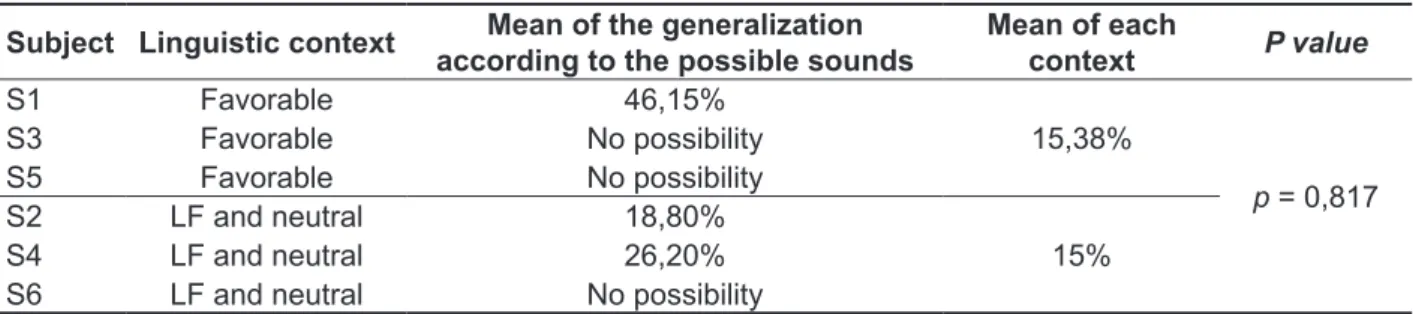
The percentages of generalization inside a sound class are listed in Table 3. This type of gener-alization could be observed only in subjects S1 and
S2, that didn’t present /v/ and /ʒ/ in their phono -logical systems, in addition to the fricatives treated
/z/ and /ʃ/. This generalization was observed in S4
Table 3 – Generalization inside a sound class in the subjects
Subject Linguistic context according to the possible soundsMean of the generalization Mean of each context P value
S1 Favorable 46,15%
15,38%
p = 0,817
S3 Favorable No possibility
S5 Favorable No possibility
S2 LF and neutral 18,80%
15%
S4 LF and neutral 26,20%
S6 LF and neutral No possibility
Legend: LF = little favorable
Statistic test that was adopted:Mann-Whitney test, Signiicance level: 5% (p< 0,05).
Table 4 – Generalization to other sound classes in the subject
Subject Linguistic context Non stimulated class generalization in Mean of the each class
Means of the
subjetcs P value
S1 Favorable
Plosives
34,50%
11,50%
p = 0,796
S3 Favorable No possibility
S5 Favorable No possibility
S2 LF and neutral 37%
12,33%
S4 LF and neutral No possibility
S6 LF and neutral No possibility
S1 Favorable
Affricates
3,30%
1,10%
p= 0, 317
S3 Favorable No possibility
S5 Favorable No possibility
S2 LF and neutral 0%
0%
S4 LF and neutral No possibility
S6 LF and neutral No possibility
S1 Favorable
Liquids
0%
19,86%
p = 0, 513
S3 Favorable 22,82%
S5 Favorable 36,75%
S2 LF and neutral 24%
36,68%
S4 LF and neutral 13,40%
S6 LF and neutral 72,65%
Legend: LF = little favorable
Statistic test that was adopted:Mann-Whitney test, Signiicance level: 5% (p< 0,05).
Table 4 shows the generalization to other sound classes. Generally, the subjects increased their correct production percentages. Only S1 and S2 could present generalizations to the plosives and affricates, because presented changes in the voiced sounds of those classes.
The other subjects presented those classes stabilized in their phonological systems. To this type of generalization, the percentages were
similar between the groups, except to the liquids in
which the group little favorable and neutral showed advantage over the favorable, but without statistical
To S4, there was a slight increase of the percentage of productions of /s/ in coda, different from a child cited in the previous study3, also treated
with /ʒ/ in little favorable and neutral environments,
who obtained 55,76% of generalization to /s/. But, the subject treated with more favorable words, obtained percentage of generalization similar to S43. We couldn’t compare S4 with S3 from this
variable, since the generalization inside a sound class couldn’t occur to the second child mentioned.
The generalization to other sound classes (Table 4) occurred to: plosives, affricates and liquids. To the plosives, the percentages were similar between S1 and S2. In the thesis that has been commented, this type of generalization could occur only for one subject, nevertheless, even being treated with four favorable words, he/she reduced the correct production of changed plosives /b/, /d/ and /g/3.
The generalization to the allophone [dʒ] for S1
and S2 did not occur, and neither for subject 1 described by Blanco-Dutra3. However, two other
subjects, one treated with /z/ and other treated with
/ʒ/ had generalization to the voiced affricate.
To the liquids, the percentages of generalization were higher to the group little favorable and neutral. In other research, no difference was observed among the subjects3 regarding to this variable. Yet
other research about the acquisition of /r/, showed higher occurrence of generalization to other sound classes in the subject treated with favorable environments4.
The percentages of generalization to other
sound classes could be higher if the more complex
sounds, like the liquids, were chosen as targets for
treatment, since the more complex the sound, the
higher the number of sounds generalized13,17,18.
Generally, high rates of generalizations were observed to all children. We can imply that fact is due to the severity of the disorders presented (MMD and MD). Children with lighter disorders could show better therapeutic evolution, because they have a few issues to be adequate and because they presents some organization of phonological system, when compared to children with more severe disorders.
As already mentioned, we assumed that the percentage of generalization would be higher if
the treated targets were more complex like the
liquids19, except for S1 and S2, who were treated
with the non-acquired sounds more complex in their
phonological systems. Furthermore, a therapeutic
approach that involved the complexity of features
and didn’t involve the occurrence of phonological processes could also show a better outcome, since
what is expected of phonological treatment is that treating more complex targets, the child acquire
DISCUSSION
Once all types of possible structural
general-ization could be observed, we can verify the eficacy
of the therapeutic approach, since the main purpose of phonological therapy is promoting the highest structural change in the phonological system
and the maximum of generalization as possible,
adapting the child’s speech to the adult’s target system13. The generalization is a essential criterion
to evaluate the quality of approach, because the greater the number of sounds generalized by the
child, the higher the therapeutic eficacy13.
Regarding to the generalization to lexical items
that were not used in the treatment (Table 1), we observed advantage of the subjects treated with the targets in favorable environments, however without
statistical signiicance. The children of this group
had higher percentages of generalization than the ones treated with little favorable and neutral environments. The same was found in another research about the favorable environments to the fricative production3. It is important to highlight that
all subjects had high percentages of this type of generalization, similar to other researches14,15.
The generalization to another position in the word (Table 2) also occurred to all subjects16, being
higher to the ones treated with words in favorable environments.
In a study that compared the phonological acqui-sition between two subjects treated with the sound /r/, one with favorable environments and other with little favorable environments, the authors observed this generalization with higher percentages to the subject treated with favorable environments, supporting this research4.
We observed that the generalizations that
occurred with higher percentages were to lexical
items that were not used in the treatment and to other position in the word, which supports one of the principles proposed in a research paper: “during the training of a process, the greatest gains are obtained with the sounds directly treated”17. Thus,
the children should apply the same phonological rules to the production of the tested sounds, even needing to deal with a different syllabic position than those ones treated in the second type. That
assumption could explain the success in the two
types of generalization mentioned.
CONCLUSION
We observed that all types of possible general-ization occurred, being the higher percentages to
“lexical items that were not used in the treatment”
and “to another position in the word”. The general-izations “inside a sound class” and “to other sound classes” occurred with lower percentages. In the comparison between the groups, no statistical
signiicance was observed. However, the favorable group had higher percentages in the two irst types
of generalization mentioned.
We highlight that this study results can’t be generalized because we described case reports,
with only six subjects. It needs more researches
about this topic. In addition, we suggest the imple-mentation of other studies involving the favorable environments to the fricative production through other phonological therapy models.
the less complex ones related to the former without
direct intervention13,18.
The fact that there hasn’t been found any difference between the treatment with favorable environments versus little favorable and neutral can be assigned to the small number of treated children. Even though, other factors can’t be discharged, because it is possible that the choice of therapeutic model or the way the sounds, are stimulated are
more relevant than the contexts in which the
target-sounds are inserted in the words20. Furthermore, the
frequency in which the words appear in the language can be a possible factor to determine either better or worse therapeutic results. Considering what was mentioned, it’s important that new researches be conducted to prove or to question the hypotheses made here.
RESUMO
O objetivo deste estudo foi analisar e comparar a ocorrência e os tipos de generalização observados
a partir do tratamento das fricativas /z/, /ʃ/ e /ʒ/ em dois grupos de crianças, um utilizando palavras
com contextos fonológicos favoráveis e outro os contextos pouco favoráveis e neutros. Seis crianças
com desvio fonológico e idades entre 4:7 e 7:8 participaram do estudo com a autorização dos
respon-sáveis. Realizaram-se avaliações fonoaudiológicas e complementares para o diagnóstico do desvio fonológico. Os sujeitos foram pareados de acordo com a gravidade do desvio, sexo, faixa etária e
aspectos do sistema fonológico em relação aos fonemas alterados. Metade das crianças foi tratada
com palavras em que os fonemas /z/, /ʃ/ e /ʒ/ encontravam-se em ambientes fonológicos favoráveis e a outra metade com ambientes pouco favoráveis e neutros. Foram realizadas oito sessões e, após estas, nova avaliação de fala foi realizada para veriicar os tipos de generalização obtidos. Os per
-centuais de generalizações foram comparados entre os grupos por meio do teste estatístico de Mann-Whitney (p<0.05). Ao término da terapia, observou-se aumento dos percentuais de generalização
para todos os sujeitos. Na comparação entre os grupos não foi veriicada diferença estatística para as generalizações analisadas. Entretanto, houve vantagem do grupo favorável em relação às gene
-ralizações “para outra posição na palavra” e “dentro de uma classe de sons”. Os resultados obtidos
podem estar relacionados ao pequeno número de sujeitos ou a outros fatores mencionados no artigo.
DESCRITORES: Criança;Distúrbios da Fala; Fonoterapia; Generalização (Psicologia); Fala
REFERENCES
1. Tyler A, Edwards ML, Saxman J. Clinical application of two phonologically based treatment procedures. J Speech Hear Disord. 1987;52:393-409.
2. Keske-Soares M, Mota HB, Pagliarin KC,
Ceron MI. Estudo sobre os ambientes favoráveis à produção da líquida não-lateral /r/ no
tratamento do desvio fonológico. Rev Soc Bras Fonoaudiol. 2007;12(1):48-54.
3. Blanco-Dutra, AP. A aquisição das fricativas
/f/, /v/, /ʃ/ e /ʒ/ por crianças com desvio fonológico
[Tese]. Porto Alegre (RS): Pontifícia Universidade Católica do Rio Grande do Sul; 2009.
4. Keske-Soares M, Pagliarin KC, Ceron MI. Terapia
fonológica considerando as variáveis linguísticas.
13. Gierut JA. Treatment eficacy: functional phonological disorders in children. J Speech, Lang Hear Res. 1998;41:85-100.
14. Ceron MI, Keske-Soares M. Terapia fonológica: a generalização a itens não utilizados no tratamento (outras palavras). Rev. CEFAC. 2007;9(4):453-60. 15. Keske-Soares M, Donicht G, Checalin MA, Ghisleni MRL. Generalização por ‘reforço’ ou ‘contraste’ no tratamento do desvio fonológico. Rev Soc Bras Fonoaudiol. 2008;13(4):391-7.
16. Ceron MI, Keske-Soares M. Terapia fonológica: a generalização para outra posição na palavra. Rev. CEFAC. 2009;11(2):199-206.
17. Rodriguez VMA, León SL. Contributions to the problems of generalization in the phonological intervention: a clinical approach. Rev CEFAC. 2007;9(1):21-31.
18. Morrisette ML, Farris AW, Gierut JA. Applications of learnability theory to clinical phonology. Adv Speech Lang Path. 2006;8(3):207-19.
19. Lamprecht RR. A aquisição da fonologia do
português na faixa etária dos 2:9 - 5:5. Letras de
Hoje. 1993;28(2):99-106.
20. Hodson BW. Identifying phonological patterns
and projecting remediation cycles: Expediting
intelligibility gains of a 7 year old Australian child. Adv Speech Lang Path. 2006;8(3):257-64.
5. Elbert M, Gierut JA. Handbook of clinical phonology. London: Taylor & Francis; 1986.
6. Bernhardt B. The application of nonlinear phonological theory to intervention with one phonologically disorders child. Clin Linguist Phon. 1992;6:23-45.
7. Marchesan I. Motricidade oral: visão clínica do trabalho fonoaudiológico integrado com outras especialidades. São Paulo: Pancast, 1999.
8. Cielo C A. Habilidades em consciência fonológica em crianças de 4 a 8 anos de idade[Tese]. Porto Alegre-RS: Pontifícia Universidade Católica do Rio Grande do Sul; 2001.
9. Pereira LD. Processamento Auditivo. Temas sobre desenvolvimento. 1993;11(7):7-14.
10. Bei-Lopes DM. Vocabulário (Parte B). In:
Andrade CRF, Bei-Lopes DM, Fernandes FDM,
Wertzner HF. ABFW: teste de linguagem infantil
nas áreas de fonologia, vocabulário, luência e pragmática. Carapicuíba: Pró-Fono; 2000. p. 41-59.
11. Yavas M, Hernandorena CLM, Lamprecht RR. Avaliação fonológica da criança: reeducação e terapia. Porto Alegre: Artes Médicas; 1991.
12. Shriberg L, Austin D, Lewis B, McSweeny J, Wilson D. The percentage of consonants correct
(PCC) metric: extensions and reliability data. J
Speech Lang Hear Res. 1997;40:708-22.
Received on: 2011/10/27 Accepted on: 2012/03/27
Mailing Address:
Fernanda Maraiga Wiethan
Rua Júlio Nogueira, 130 - Bairro Uglione Santa Maria - RS
CEP: 97070-510
E-mail: [email protected]