Case Report
Relato de Caso
Aspects of oral communication in patients
with Parkinson’s disease submitted to Deep
Brain Stimulation
Aspectos de comunicação oral em pacientes
com doença de Parkinson submetidos à
Estimulação Cerebral Profunda
Aline Nunes da Cruz1
Bárbara Costa Beber1
Maira Rozenfeld Olchik1
Márcia Lorena Fagundes Chaves2
Carlos Roberto de Mello Rieder2
Sílvia Dornelles1
Keywords
Cognition Language Speech Voice Parkinson’s Disease Deep Brain Stimulation
Descritores
Cognição Linguagem Fala Voz Doença de Parkinson Estimulação Cerebral Profunda
Correspondence address:
Aline Nunes da Cruz
Universidade Federal do Rio Grande do Sul
Rua Ramiro Barcelos, 2350, 2º andar, Porto Alegre (RS), Brazil,
CEP: 90035-903.
E-mail: [email protected]
Received: June 18, 2015
Study carried out at Hospital das Clínicas de Porto Alegre - Porto Alegre (RS), Brazil.
1 Universidade Federal do Rio Grande do Sul – UFRGS - Porto Alegre (RS), Brazil. 2 Hospital de Clínicas de Porto Alegre - Porto Alegre (RS), Brazil.
Financial support: Fundo de Incentivo à Pesquisa e Eventos do Hospital de Clínicas de Porto Alegre (FIPE-HCPA).
Conlict of interests: nothing to declare.
ABSTRACT
Introduction: Deep Brain Stimulation (DBS) has been satisfactorily used to control the cardinal motor symptoms of Parkinson’s disease (PD), but little is known about its impact on communication. Purpose:This study aimed to characterize the aspects of cognition, language, speech, voice, and self-perception in two patients with PD, pre- and post- DBS implant surgery. Methods: The patients were assessed using a cognitive screening test, a brief language evaluation, a self-declared protocol, and an analysis of the aspects of voice and speech, which was conducted by a specialized Speech-language Therapist who was blinded for the study. Results: At the pre-surgery assessment, Case I showed impairment regarding the aspects of cognition, language and voice, whereas Case II showed impairment only with respect to the voice aspect. The post-surgery evaluation of the cases showed an opposite pattern of the effect of DBS after analysis of the communication data: Case I, who presented greater impairment before the surgery, showed improvement in some aspects; Case II, who presented lower communicative impairment before the surgery, showed worsening in other aspects. Conclusion: This
study shows that DBS may inluence different communication aspects both positively and negatively. Factors
associated with the different effects caused by DBS on the communication of patients with PD need to be further investigated.
RESUMO
Introdução: A Estimulação Cerebral Profunda tem sido considerada uma intervenção satisfatória para os sintomas motores cardinais da doença de Parkinson, porém ainda há poucas evidências sobre seu impacto na comunicação. Objetivo: Esse trabalho teve como objetivo caracterizar os seguintes aspectos da comunicação: cognição, linguagem, fala, voz, e autopercepção de dois pacientes com doença de Parkinson em situação pré e pós a cirurgia de implantação da Estimulação Cerebral Profunda. Método: Os pacientes foram avaliados através de: um teste de rastreio cognitivo; uma avaliação breve da linguagem; um protocolo autodeclarado e aspectos da voz e da fala, que foram avaliados por um fonoaudiólogo expert na área e cegado para o estudo. Resultado:
Observou-se no momento pré-cirurgia que o Caso I apresentava comprometimento nos aspectos cognitivo, da linguagem e voz, enquanto que o Caso II apresentava alteração apenas na voz. A avaliação pós-cirúrgica dos casos mostrou um padrão oposto de efeito da Estimulação Cerebral Profunda, quando analisados os dados pós-cirúrgicos, referente à comunicação. O Caso I, que era considerado com o maior prejuízo no período anterior à cirurgia, apresentou melhora em alguns aspectos, enquanto o Caso II, que era observado com menos prejuízo comunicativo previamente à cirurgia, apresentou piora em outros aspectos. Conclusão: Este estudo demonstrou
que a Estimulação Cerebral Profunda pode inluenciar diferentes aspectos da comunicação, tanto de modo
INTRODUCTION
Parkinson’s disease (PD) is a neurological, chronic, progressive condition which affects the brain circuits responsible for the motor control of human movement. It results from the degeneration of nerve cells in the substantia nigra responsible for producing dopamine(1). PD shows characteristic motor signs such as resting
tremor, muscle rigidity, postural instability, and slowness in the execution of movements, also called bradykinesia. In addition,
patients with PD may present dificulty in oral communication,
which depends on the functioning of the aspects of breathing, phonation (voice), articulation (speech), language, and cognition(2-4).
The most frequent vocal characteristics in PD patients described in the literature are vocal tremor, frequency monotony, reduced loudness, and hoarse, rough and breathy voice quality(2,3).
The vocal alterations presented by patients with PD, when associated with changes in breathing, articulation, resonance,
prosody and/or luency, are characteristic of dysarthria. Dysarthria
is a neurological disorder which affects oral communication due
to deicits in the control of speech muscles. Dysarthria present in PD is classiied as hypokinetic, because it presents imprecision
in the articulation of consonants, hypernasal resonance, changes
in luency, and variable speech rate(4).
There are treatments available to minimize its symptoms and improve the patients’ quality of life; the most commonly applied methods are medical, psychotherapeutic, and surgical(1,2,5).
Among the most current resources, Deep Brain Stimulation (DBS) has shown satisfactory results for motor cardinal symptoms;
however, indings on its impact on the oral communication of
implanted subjects are limited.
DBS consists of the unilateral or bilateral surgical implantation of three components: quadripolar brain electrode, subcutaneous extension cable (lead), and internal pulse generator. After implantation of the brain electrode, the pulse generator is placed in the subclavian region, and the leads are subcutaneously tunneled, connecting the electrodes to the generator(2,5). The surgery is
indicated for patients who did not achieve adequate control of motor symptoms with drug therapy. It is known that the use of L-Dopa is the most effective treatment in the control of physical alterations and that this medication is indicated since the initial stage of the disease(2,5).
DBS is expected to bring the following results: reduction in
the ‘off’ periods (motor function luctuation periods in which the
motor state is usually low), increase in the ‘on’ periods (motor
function luctuation periods in which the motor state is usually
good or better), reduced dyskinesia, suppression of medically refractory tremor, better performance in daily life activities and consequent increased quality of life(5). Reducing changes in
communication is not the main objective of DBS implantation; in addition, little is known about its effect on this aspect.
More studies are needed to verify the impact of DBS on the communication of patients with PD; however, the study of individual cases can help identify potential questions to guide future research.
The present survey aimed to compare two case studies on DBS surgical implantation and verify whether the patients presented similar patterns of DBS interference in different aspects of oral communication. To this end, the overall aspects of cognition, speech, voice, and self-perception were evaluated in the pre- and post-DBS surgery situations. This is an innovative study of paramount importance for the research in Parkinson’s disease and Speech-language Pathology considering that the effects of DBS in implanted subjects are inconclusive and little explored
in the speciic literature. In addition, this can be classiied as a
pilot study that could guide future investigations.
METHODS
Information on the clinical cases presented in this article corresponds to the preliminary data of a research project approved by the Research Ethics Committee of the aforementioned institution under number 15-0080.
The present study was conducted in a local reference university hospital. This surgical procedure is performed on a limited basis; therefore, only two individuals, one male and one female, participated in the survey. The inclusion and exclusion criteria were the same used by the Brazilian Academy of Neurology for DBS surgery(5). The participants signed an Informed Consent
Form prior to completion of the study in which they agreed with the disclosure of its results.
The evaluations were conducted with the patients in the ‘on’ state of medication. Pre-DBS assessments were performed the week before the surgery, whereas post-DBS evaluations were performed between 6 and 9 months following the implant with the stimulator turned on.
Cognition and language evaluation
The cognitive screening test Montreal Cognitive Assessment (MoCA)(6) was used to evaluate cognition in the two cases
herein reported. MoCA is suggested by the literature as the most sensitive screening test to detect cognitive changes in PD, because it assesses the executive functions that are predominantly affected by PD(7-8). We also conducted a brief
language evaluation using semantic(9), phonemic(10) and action
(verbs)(11) verbal luency, as well as an oral naming of action
igures and objects using 60 images from the An Object and
Action Naming Battery (OANB)(12,13).
The igures used in the naming test were marked for the
following psycholinguistic features: word frequency, size (number of letters and syllables), visual complexity, familiarity, and imageability. Answers were audio recorded using an ICD-P210 Sony digital recorder.
Speech and voice evaluation
Recordings collected during the naming test were edited and standardized separately during the pre- and post-surgery states of each patient; they were then stored in a shared folder with
numerical identiication. Such voice samples were evaluated
as for voice and speech aspects by a speech pathology referee with a doctoral degree in the area, who was blinded for the evaluation and for the objectives of the study.
The voice aspects evaluated during the pre- and post-DBS moments were voice quality, pitch, loudness, and resonance. Speech was evaluated during the pre- and post-DBS moments
for intelligibility, rate, luency, and articulation.
Self-perception evaluation
A self-declared protocol, speciically prepared for this study,
was applied aiming to verify the patients’ self-perception of the effects that the DBS caused in the oral communication aspects. Therefore, the protocol was applied only at the post-DBS situation.
Case reports
Case I
Male, 45 years old, retired, 14 years of education, diagnosed with PD in 2003. The disease symptoms started with bradykinesia and rigidity in the right arm. The participant was under dopaminergic medication since diagnosis and duration of drug effect was unsatisfactory. In 2010, he began outpatient treatment
showing marked bradykinesia bilaterally, postural instability, rigidity, and resting tremor - worse in the right limbs. DBS was indicated in March 2012 and performed in December the same year. Electrodes were surgically implanted bilaterally in the subthalamic nucleus. The implant occurred nine years after the PD symptoms started.
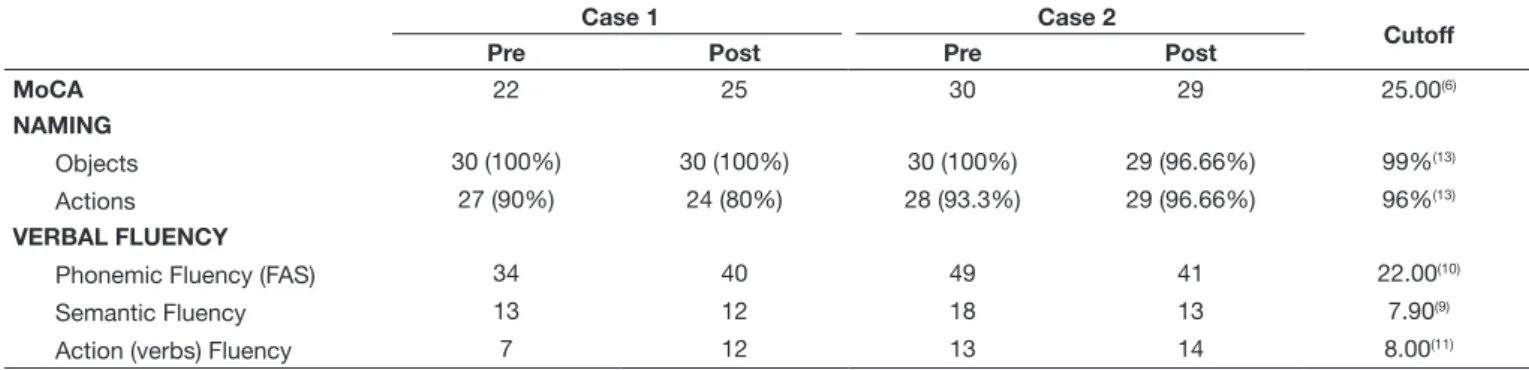
At pre-DBS situation, Case I presented cognitive change according to the results of the screening performed by MoCA, for which he presented score below the cut-off point. His performance
at semantic and phonemic verbal luency was similar to that of healthy subjects, except for action (verbs) luency, which was
slightly below the normal score. As for the naming test used, the patient did not make errors with the naming of objects; however, he presented performance below the cutoff for the naming of actions (Table 1). Regarding the voice aspects assessed in the pre-DBS period, alterations were found in voice quality (roughness); pitch and loudness were inadequate; and resonance was balanced. Speech was considered adequate in all aspects (Table 2).
At post-DBS, Case I presented important improvement of motor symptoms as well as reduction of the dopaminergic medication dose. Regarding the cognitive aspects evaluated in this study, improvements of the cognitive screening (MoCA)
and in phonemic and action verbal luency were observed.
In the naming of actions (verbs), the patient remained below the cutoff, with performance inferior to that of the pre-DBS
period. The object naming and semantic luency did not change
remarkably after the DBS implant (Table 1). Voice quality
Table 1. Description of pre- and post-surgery cognition, naming and verbal fluency data
Case 1 Case 2
Cutoff
Pre Post Pre Post
MoCA 22 25 30 29 25.00(6)
NAMING
Objects 30 (100%) 30 (100%) 30 (100%) 29 (96.66%) 99%(13)
Actions 27 (90%) 24 (80%) 28 (93.3%) 29 (96.66%) 96%(13)
VERBAL FLUENCY
Phonemic Fluency (FAS) 34 40 49 41 22.00(10)
Semantic Fluency 13 12 18 13 7.90(9)
Action (verbs) Fluency 7 12 13 14 8.00(11)
Table 2. Description of voice and speech evaluation
Case 1 Case 2
Pre Post Pre Post
Voice
Voice Quality Roughness Breathiness Tension Roughness and tension
Pitch Inadequate Adequate Adequate Adequate
Loudness Inadequate Inadequate Adequate Adequate
Resonance Balanced Mild hyponasal Balanced Adequate
Speech
Intelligibility Intelligible Intelligible Intelligible Intelligible
Rate Adequate Reduced Adequate Adequate
Fluency Adequate Inadequate Adequate Adequate
remained altered (breathiness), pitch was evaluated as adequate, loudness remained inadequate, and resonance was considered as mild hyponasal. Speech remained intelligible, but with altered
rate, luency, and articulation (Table 2).
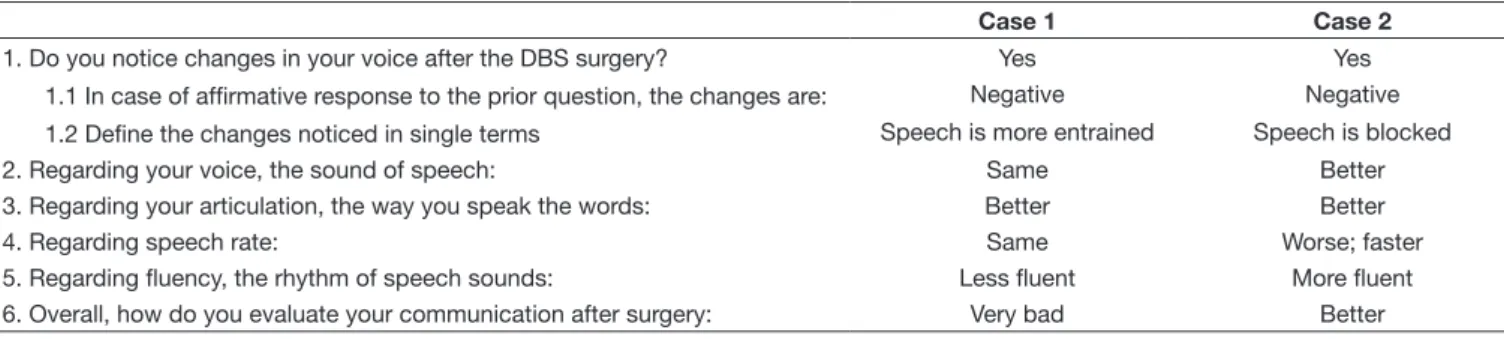
In the self-perception assessment, Case I noticed negative
changes in speech, considering it more entrained and less luent.
In contrast, he reported better articulation. The patient did not notice changes in his voice and speech rate. Overall, he evaluated the post-DBS communication as very bad (Table 3).
Case II
Female, 47 years old, ofice assistant, 12 years of education,
diagnosed with PD in 2006. Symptoms initiated with decrease of the right hand movements, followed by progressive bradykinesia in the four limbs, and loss of balance. She initiated the dopaminergic medication in the same year of diagnosis, with good response for the motor symptoms. Later, she presented rigidity and bradykinesia - worse in the right limbs. The patient was referred to DBS implant in 2010, which was performed in May 2013. The implant was performed bilaterally in the subthalamic nucleus and it occurred seven years after the PD symptoms started.
Before DBS implantation, the patient presented cognitive and language performance similar to that described in studies with healthy subjects (Table 1), except for action naming, which was slightly below the cutoff. Regarding the voice and speech aspects evaluated in the pre-DBS period, only voice quality (tension) was considered altered (Table 2).
After DBS implantation, Case II presented important improvement of motor symptoms and reduction of the dopaminergic medication dose. There was a reduction at the phonemic and semantic verbal
luency performance. There was a reduction in object and action naming. Action (verbs) luency and the MoCA test were slightly
affected by the DBS implant in this Case (Table 1). Voice quality remained altered (with roughness and tension), whereas other voice features were not altered, nor speech aspects.
In the self-perception evaluation, Case II noticed negative changes in speech, describing it as more blocked. She believes
that her voice, articulation, and luency have improved. She reports
that the speech rate is worse (faster). Overall, Case II evaluated her post-DBS communication as better (Table 3).
DISCUSSION
The present article aimed to characterize the aspects of communication, cognition, language, voice, speech, and self-perception of two patients with PD at pre- and post-DBS
implant situations. The two study cases are young patients with higher education who were submitted to the same surgical treatment for PD. Both cases presented improvement of the cardinal symptoms of disease and reduction of dopaminergic demand, reaching the main goals of this study. However,
distinct proiles were observed between them regarding the
communication aspects evaluated.
Before DBS implantation, Case I presented impairment in the cognitive screening (MoCA) regarding language and voice, whereas Case II presented changes only in voice quality. However, an opposite pattern of the effect of DBS was found when analyzing post-surgical data regarding communication: Case I, who was considered the most affected in the pre-surgery period, improved in some aspects; whereas Case II, who was observed with little communicative impairment prior to the surgery, presented worsening of the aspects.
The different communicative patterns presented by each case before surgery, as well as the DBS effects may be discussed in light of the different PD clinical conditions presented by each subject. Case I, who was more compromised in the pre-DBS
period, but seemed to beneit more with the procedure, presented
all PD motor symptoms in the beginning as well as during the disease progression. Nevertheless, Case I presented an increased time of disease when he was implanted, which may explain the worse performance in the communication evaluation.
Among the cognition and language evaluations that seem to be more affected by PD and DBS, the following are worth mentioning: MoCA, action naming, and phonemic and action (verbs)
luency. All these tests evaluate functions that are predominantly
executive and, consequently, predominantly dependent on the frontal areas and frontosubcortical connections(6,10,11,14). There
are reports of deterioration of the executive functions in PD after DBS surgery; however, it was suggested that this deleterious effect may be transitory(15).
The dopamine depletion that occurs in PD leads to a dysfunction of the frontostriatal pathway(1). When DBS is implanted in
the subthalamic nucleus, it causes a neuromodulation of this pathway(5). Therefore, from the pathophysiological point of
view, it is justiiable that cognition in PD have the execution
impairment as its main cognitive feature, and also that DBS interfere in this domain. However, it is still unclear whether the neuromodulation of DBS has positive or negative effects on these cognition aspects.
Table 3. Answers of the self-declared protocol
Case 1 Case 2
1. Do you notice changes in your voice after the DBS surgery? Yes Yes
1.1 In case of affirmative response to the prior question, the changes are: Negative Negative
1.2 Define the changes noticed in single terms Speech is more entrained Speech is blocked
2. Regarding your voice, the sound of speech: Same Better
3. Regarding your articulation, the way you speak the words: Better Better
4. Regarding speech rate: Same Worse; faster
MoCA is a cognitive screening test largely used in PD patients due to its sensitivity to detect cognitive impairment predominantly in the executive functions. Case I presented improvement in the MoCA performance during the post-DBS
period; in contrast, he did not show signiicant difference in
the MoCA score between the two moments evaluated. A study comparing non-motor aspects of PD during the pre- and post-DBS periods reported no difference in the MoCA performance(16).
PD patients present dificulty performing tasks that require verb production, such as action naming and verb luency(17). It is
believed that the processing of verbs depends predominantly on the frontal brain regions and frontal-subcortical circuits, whereas the processing of nouns depends on circuits more posterior in the brain. Considering that PD patients present frontostriatal changes, it is expected that they show a higher impairment in tasks with verbs than with nouns. Nevertheless, there is a lack of studies aiming to verify the effects of DBS on the production of verbs. One study evaluated action and object naming in the ‘on’ and ‘off’ DBS situations; the patients were slower and less accurate in action naming than their healthy controls. When comparing the ‘on’ and ‘off’ conditions, it was observed that the stimulation improved verb and noun naming, with greater improvement for verbs(18).
As for verbal luency, studies show that it is possible to observe a reduction of verbal luency following the DBS
surgery(19). Phonemic verbal luency improved in Case I and
worsened in Case II, whereas semantic verbal luency remained
the same in Case I and worsened in Case II. Action (verbs)
luency improved in Case I and remained the same in Case II. Variation in the luency results was observed, but not a global decline in luency in both cases, maybe due to the short time
window after the surgery.
Regarding speech and voice, Case I showed more changes; the only aspect that remained altered in both cases was voice quality. Case I showed roughness in the pre-surgery period and breathiness in the post-surgery period. In Case II, voice was considered tense before DBS and rough and breathy following
the surgery. Speciic voice aspects such as pitch, loudness, and
resonance were observed in this study; Case I showed changes in all of them. Pitch and loudness were evaluated as inadequate in the pre-assessment and only pitch improved after surgery. Resonance, in Case I, ranged from balanced to mild hyponasal. There are no studies conducted with our population reporting the evaluation of these aspects comparing the pre- and post-DBS periods, but the clinical practice shows that the stimulator
coniguration can greatly affect the voice of these patients. Speech rate, luency, and articulation worsened after DBS in Case I. Regarding luency, a study of two cases evaluated the speech luency in the DBS at the ‘on’ and ‘off’ moments and concluded that the speech luency improved in both patients
when the stimulator was turned off, suggesting that DBS may
negatively affect speech luency(20). Articulation is directly
affected by the PD motor symptoms and, therefore, a post-DBS improvement is expected, even though other variables may
interfere in these results, such as disease progression and use of dopaminergic medication.
In the self-perception evaluation, the only speech aspect considered as improved by the patients after the surgery was articulation. Under a wide aspect, both reported negative speech changes after DBS implantation. As for voice perception, Case I did not notice voice change and Case II declared improvement, suggesting that voice in the pre-DBS period could be more affected by the PD symptoms than after surgery.
The overall communication in these patients was modiied after
the DBS surgery. Case I evaluated that his communication after the surgery is very bad, whereas Case II evaluated improvement in her communication after the DBS surgery. A previous study showed changes caused by DBS in PD patients in different aspects of communication. However, patients of a different study
reported the overall beneits of the surgery regarding increased
mobility due to improvement of motor aspects. Despite the different side effects, they still considered that the results of the surgery were positive(21).
FINAL COMMENTS
This study shows that PD patients submitted to DBS may be positively or negatively affected regarding communication aspects. The case study evidences variability in the DBS effects and the need to investigate factors associated with the different effects caused by DBS on the PD patients’ communication. Therefore, it is important to study all the cognition, language, speech, and voice aspects in researches with an increased number of subjects and controlled conditions for other variables such
as region of electrode implant, stimulator coniguration, use of
medication, test application in the pre- and post-DBS periods, and comparison with control individuals.
REFERENCES
1. Kalia LV, Lang AE. Parkinson’s disease. Lancet. 2015;386(9996):896-912. http://dx.doi.org/10.1016/S0140-6736(14)61393-3. PMid:25904081.
2. Romann AJ. Padrão sequencial de modificações acústicas da voz, fala, fluência verbal e sintomatologia motora após interrupção da estimulação cerebral profunda do núcleo subtalâmico [dissertação]. Porto Alegre: Universidade Federal do Rio Grande do Sul, Faculdade de Medicina; 2012.
3. Ferreira FV, Cielo CA, Trevisan ME. Medidas vocais acústicas na doença de Parkinson: estudo de casos. Rev. CEFAC. 2010;12(5):889-98. http:// dx.doi.org/10.1590/S1516-18462010005000020.
4. Ortiz KZ. Disartria. In: Ortiz KZ. Distúrbios neurológicos adquiridos: fala e deglutição. Barueri: Manole; 2006. p. 54-71.
5. Rieder CRM, Silva DJ. Indicações de tratamento cirúrgico na doença de Parkinson. In: Academia Brasileira de Neurologia. Doença de Parkinson: recomendações. São Paulo: Omnifarma; 2010. p. 128-40.
7. Chou KL, Lenhart A, Koeppe RA, Bohnen NI. Abnormal MoCA and normal range MMSE scores in Parkinson disease without dementia: cognitive and neurochemical correlates. Parkinsonism Relat Disord. 2014;20(10):1076-80. http://dx.doi.org/10.1016/j.parkreldis.2014.07.008. PMid:25085750.
8. Lessig S, Nie D, Xu R, Corey-Bloom J. Changes on brief cognitive instruments over time in Parkinson’s disease. Mov Disord. 2012;27(9):1125-8. http:// dx.doi.org/10.1002/mds.25070. PMid:22692724.
9. Brucki S, Rocha M. Category fluency test: effects of age, gender and education on total scores, clustering and switching in Brazilian Portuguese-speaking subjects. Braz J Med Biol Res. 2004;37(12):1771-7. http://dx.doi. org/10.1590/S0100-879X2004001200002. PMid:15558183.
10. Machado TH, Fichman HC, Santos EL, Carvalho VA, Fialho PP, Koenig AM, et al. Normative data for healthy elderly on the phonemic verbal fluency task – FAS. Dement Neuropsychol. 2009;3(1):55-60.
11. Beber BC. Estudo da natureza do prejuízo na fluência e nomeação de verbos na doença de Alzheimer e na afasia progressiva primária não-fluente [tese]. Porto Alegre: Universidade Federal do Rio Grande do Sul, Faculdade de Medicina; 2014.
12. Druks J, Masterson J. An object and action naming battery. Hove: Psychology Press; 2000.
13. Spezzano LC, Mansur LL, Radanovic M. Applicability of the “An Object and Action Naming Battery” in Brazilian Portuguese. CoDAS. 2013;25(5):437-43. http://dx.doi.org/10.1590/S2317-17822013000500007. PMid:24408547.
14. Piatt AL, Fields JA, Paolo AM, Tröster AI. Action (verb naming) fluency as an executive function measure: convergent and divergent evidence of validity. Neuropsychologia. 1999;37(13):1499-503. http://dx.doi.org/10.1016/ S0028-3932(99)00066-4. PMid:10617270.
15. Zangaglia R, Pacchetti C, Pasotti C, Mancini F, Servello D, Sinforiani E, et al. Deep brain stimulation and cognitive functions in Parkinson’s disease: a three-year controlled study. Mov Disord. 2009;24(11):1621-8. http://dx.doi.org/10.1002/mds.22603. PMid:19514093.
16. Chou KL, Taylor JL, Patil PG. The MDS−UPDRS tracks motor and non-motor improvement due to subthalamic nucleus deep brain stimulation in Parkinson disease. Parkinsonism Relat Disord. 2013;19(11):966-9. http:// dx.doi.org/10.1016/j.parkreldis.2013.06.010. PMid:23849499.
17. Beber BC, Chaves MLF. The basis and applications of the action fluency and action naming tasks. Dement Neuropsychol. 2014;8(1):47-57. http:// dx.doi.org/10.1590/S1980-57642014DN81000008.
18. Silveri MC, Ciccarelli N, Baldonero E, Piano C, Zinno M, Soleti F, et al. Effects of stimulation of the subthalamic nucleus on naming and reading nouns and verbs in Parkinson’s disease. Neuropsychologia. 2012;50(8):1980-9. http://dx.doi.org/10.1016/j.neuropsychologia.2012.04.023. PMid:22575085.
19. Le Goff F, Derrey S, Lefaucheur R, Borden A, Fetter D, Jan M, et al. Decline in verbal fluency after subthalamic nucleus deep brain stimulation in Parkinson’s disease: a microlesion effect of the electrode trajectory? J Parkinsons Dis. 2015;5(1):95-104. PMid:25374271.
20. Toft M, Dietrichs E. Aggravated stuttering following subthalamic deep brain stimulation in Parkinson’s disease: two cases. BMC Neurol. 2011;11(1):44. http://dx.doi.org/10.1186/1471-2377-11-44. PMid:21477305.
21. Tripoliti E, Limousin P, Foltynie T, Candelario J, Aviles-Olmos I, Hariz MI, et al. Predictive factors of speech intelligibility following subthalamic nucleus stimulation in consecutive patients with Parkinson’s disease. Mov Disord. 2014;29(4):532-8. http://dx.doi.org/10.1002/mds.25816. PMid:24532491.
Author contributions