How to cite this section: Frazier-Bowers S. An interview with Sylvia Frazier-Bowers. Dental Press J Orthod. 2015 Mar-Apr;20(2):22-8. DOI: http://dx.doi. org/10.1590/2176-9451.20.2.022-028.int
Submitted: January 12, 2015 - Revised and accepted: January 19, 2015
Sylvia
Frazier-Bowers
Dr. Frazier-Bowers is an associate professor at the University of North Carolina, Chapel Hill (UNC-CH), in the Depart-ment of Orthodontics. She received a BA from the University of Illinois, Urbana-Champaign, and a DDS from the Univer-sity of Illinois, Chicago. Ater completing the NIH Dentist-Scientist Program at UNC-CH in Orthodontics (Certiicate, 97’) and Genetics and Molecular Biology (PhD, 99’), she completed a post-doctoral fellowship at the University of Texas Health Science Center, Houston (UTHSC), in the Department of Orthodontics. Leadership positions include president of local NC-AADR (North Carolina (2005-2006); director of the AADR Craniofacial Biology group (CBG) 2004-2007; IADR/AADR councilor for NC-AADR (2007, 2008, 2012) and for the CBG (2012-2015); member of Southern Associa-tion of Orthodontists Scientiic Afairs Committee (2005-2013) and the American AssociaAssocia-tion of Orthodontists Council on Scientiic Afairs (2014 – Present). Dr. Frazier-Bowers also serves various editorial boards including the Journal of Dental Research and the Scientiic Advisory board for the Consortium on Orthodontic Advances in Science and Technology. Her current role as faculty at UNC-CH includes conducting human genetic studies to determine the etiology of inherited tooth disorders, mentoring students at all levels, teaching graduate and pre-doctoral level Growth and Development courses and treating patients in the UNC School of Dentistry faculty practice in Orthodontics.
» Associate professor, University of North Carolina, Chapel Hill, North Carolina, USA.
» Postdoc, University of Texas Health Science Center, Houston, USA.
DOI: http://dx.doi.org/10.1590/2176-9451.20.2.022-028.int
An interview with
Class III is one of the most challenging malocclu-sions to manage. Speciically, the development of an optimal diagnosis and treatment plan is dif-icult. Early orthopedic interventions have been advocated for skeletal Class III patients. However, many patients that are treated successfully at an early age experience relapse during subsequent growth. The prognosis of such patients can be greatly enhanced if accurate predictors of growth pattern and ultimate growth potential are identi-ied and clinically applidenti-ied. Moreover, a complete characterization of skeletal Class III individuals and future correlation with speciic genetic fac-tors holds great promise for the orthodontic spe-cialty. In your opinion, is it clear that there are dis-tinct types of Class III? And how this classiication
may help solve these cases? (Gustavo Zanardi)
A simple answer to this question is that most or-thodontists are aware that there are many subtypes of Class III malocclusion, but the agreement on what these subtypes are and how we can diagnose them is less clear. Several studies have explored the existence of diferent types of Class III versus a simplistic view of the malocclusion as originally deined by Angle.
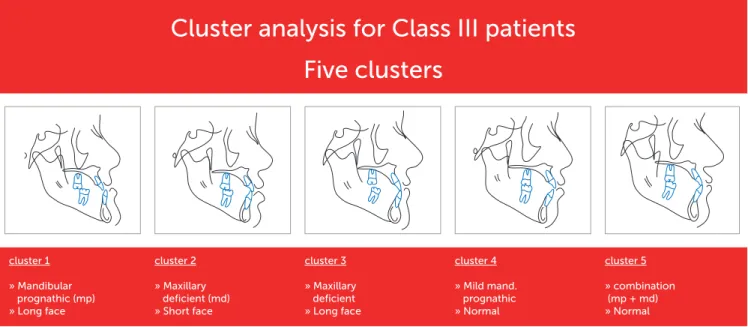
In our study2 we found ive main subtypes that were
highly relevant based on a cluster analysis of a large cohort followed by principal components analysis (Fig 1). Of the many subtypes that have been de-scribed, the two main types are maxillary deiciency
Figure 1 - A cluster analysis of 309 individuals with Class III malocclusion revealed that five subtypes were predominant. A representative cephalometric image accompanies each subtype.
and mandibular prognathism. The simple classiica-tion of these types correlates with treatment regime, that is, either you surgically move the maxilla forward (or modify growth of the maxilla) or surgically set the mandible back. The combination of these two surgi-cal movements is also a possibility. The nuance, how-ever, exists in the many permutations of the dentofa-cial relationships that can lead to a speciic treatment regime. This begs the question as to whether to at-tempt treatment with growth modiication (i.e., when and how to treat). This is due in part to a more general problem in Clinical Orthodontics; speciically that much of the diagnostic process that based on cephalo-metric analysis is quite controversial. To address some of these challenges in understanding, one attractive proposal would be to develop a system whereby an ob-jective and detailed characterization of malocclusion into speciic subtypes (beyond Angle’s classiication) could be correlated with speciic haplotypes. Using Class III malocclusion as a model for this exercise, the range of the Class III phenotype should be carefully characterized irst delineating, for example, between individuals with a Class III relationship, as measured by some antero-posterior (AP) determinants, such as
ANB and overjet, versus those with a vertical
compo-nent, such as downward and backward rotation of the mandible masking the AP problem. The ultimate ac-complishment would be to determine the growth po-tential of each of these subtypes.
Cluster analysis for Class III patients
cluster 2
» Maxillary deficient (md) » Short face
cluster 3
» Maxillary deficient » Long face
cluster 4
» Mild mand. prognathic » Normal
cluster 5
» combination (mp + md) » Normal cluster 1
» Mandibular prognathic (mp) » Long face
Dr. Frazier-Bowers, you are part of a select group of researchers who have studied the genetics of Class III malocclusion. Since there are relatively few groups studying this subject in the world, we can conclude that diiculties are immense. To what reasons do you attribute these diiculties: lack of a better characterization of samples due to the large phenotypic heterogeneity of Class III, or to limitations in laboratory technique of
investiga-tive genetics? (Ricardo Machado Cruz)
Actually there have been recent advances in the study of Class III malocclusion so the prospect of advanc-ing the ield of Class III treatment is very optimistic. Our understanding of growth and development of the dentofacial complex continues to evolve with the contribution of 3-D imaging and genetic advances. The diiculty; however, still lies in the fact that the Class III dentofacial phenotype is poorly understood. While studies in my laboratory have examined the Class III phenotype from the genetic and phenotypic
perspective,2,5 we may actually lag behind in our
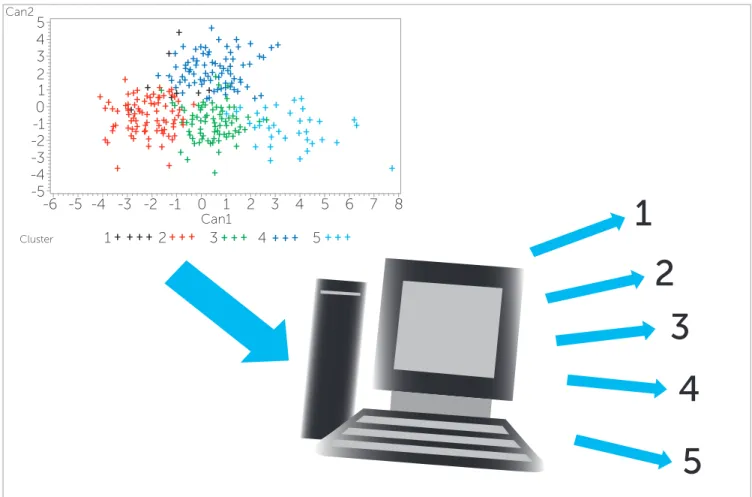
ad-vances in phenotypic characterization. A continuous literature review reveals that the gene discovery has progressed at a relatively impressive rate, hence, this is not where the challenge lies. Conversely, although it has been a gradual progression, the deinitive char-acterization of the phenotypic variation remains elu-sive. Many studies in fact classify types as mandibular prognathic or maxillary deicient with no particular distinction of the vertical dimension. The diiculty in accomplishing the necessary phenotypic characteriza-tion is due, but not limited to two things: 1) the two dimensional tools to study dentofacial proportions is limited by its lack of depth, and 2) the availability of three-dimensional imaging is still in the nascent stages of standardization. Designing an analytic tool with the capability to provide reined and discriminatory phe-notypic detail will remain a challenge in the coming years, but will be the key to maximizing our knowl-edge of the genetic discovery that has occurred (Fig 2).
Figure 2 - Can we use subtype classification to predict success of Class III treatment? In this schematic the clusters shown on the plot diagram are used to cre-ate a mathematical equation that can calculcre-ate the subtype of a prospective individual patient (including subtypes 1-5). A future application of these calculations may be used to predict patient success.
1
8 7 6 5
5 5
4
4 4
3
3 3
2
2 2
1
Can1
Can2
1 1
0 0
-1 -1
-2 -2
-3 -3
-4 -4
-5 -5
-6
2
3
4
5
Would it be possible, in the near future, to create a growth prediction system based on genetic stud-ies for individuals with Class III malocclusion?
(Rhita Almeida)
It is certainly possible for this to occur in the future. We already know certain genes that are associated with Class III growth. If a comprehensive genotype pheno-type correlation were completed, we could attribute certain growth patterns to certain genetic backgrounds. Accordingly, this would allow for a prediction system based on these genotype: phenotype pairs. This futur-istic prediction system would require that a lot more progress be made in this area irst and may realistically be a little more distant than near. A good start would be to use the information that we already have on genes that inluence craniofacial growth and carefully dissect the phenotype of Class III individuals who also have ge-netic information available.
Previous studies show that Class III malocclusion presents multifactorial features with probably more than one involved gene, a signiicant en-vironmental interaction and a high genetic het-erogeneity, since identiication of candidate loci could not be repeated in genetically distinct pop-ulations. Do you believe that chromosomal identi-ication of the cause of Class III can be achieved in the future? And will we have the possibility of pro-ducing genetic tests that can beneit our patients?
(Ricardo Machado Cruz)
There has already been signiicant progress in this area. Ten loci have been associated with Class III mal-occlusion (mostly mandibular prognathism) and, to date, at least ive genes are associated with Class III malocclusion: growth hormone receptor gene (GHR), erythrocyte membrane protein band 4.1 (EPB41), my-osin 1H (Myo1H), matrillin 1 (MATN1) and dual-speciicity phosphatase 6 (DUSP6). This does not im-mediately translate into a genetic test that will be avail-able right away for routine use. The standard of care for genetic testing in the USA requires that it is carried out by a certiied testing laboratory (i.e., with Clinical Lab-oratory Improvement Amendments [CLIA] certiica-tion). Currently, testing of orthodontic problems, such as Class III malocclusion or PFE, is not ofered in cer-tiied laboratories. However, through research studies, such as that in my laboratory at the University of North
Carolina, Chapel Hill, patients can be evaluated as part of the research protocol for certain problems. This is not meant to serve as an oicial test, but the results of our research evaluation of PTH1R and other candidate genes can be made available to the participant (and to the orthodontist at the request of the participant). In the future, the cost of genetic testing (i.e., of one gene) will be likely comparable to several of the other tests that or-thodontists routinely call for in practice (i.e., CBCT or 3DMD). As more candidate genes are identiied relat-ing to various dentofacial characteristics, we might soon witness a change in our orthodontic diagnostic regi-men. It is quite possible that in the not-so-distant future the orthodontist will collect a saliva or cheek sample for genetic tests for conditions such as PFE, root resorption or Class III malocclusion.
Scientists are rapidly developing and employing diagnostic tests in medical diagnosis based on genomic, proteomics and metabolomics, to bet-ter predict the patients’ responses to targeted therapy. This ield termed “personalized medicine” combines human genome, information technolo-gy and biotechnolotechnolo-gy with nanotechnolotechnolo-gy so as to provide treatment based on individual variation versus population trends. In your opinion, how will
personalized Medicine afect Dentistry and
par-ticularly orthodontic treatment? (Gustavo Zanardi)
We are quickly approaching a time when personal-ized Medicine will be a part of our diagnostic regime in Dentistry as it is with Medicine.12 The American Society
of Human Genetics (ASHG) has in fact recommended that taking a family history represents the gold standard in the diagnosis and management of medical (and by ex-tension) dental disorders. As we enter the post-genomic era in Molecular Biology, it is the judicious combina-tion of clinical, biological, and genetic factors that will lead to successful diagnosis and treatment of nearly all clinical disorders. Knowledge of a family history is the irst step, but it is likely in the future that a saliva sample will be taken as part of the initial records routinely col-lected at the initial visit.
As these translational studies continue to produce novel information, we will see a gradual evolution of health-care in general, but certainly of the practice of Dentistry and Orthodontics. In fact, personalized Orthodontics has been the topic featured at meetings including the Consortium on Orthodontic Advances in Science and Technology and the upcoming College of Diplomates of the American Board of Orthodontics in 2015.
What is the prevalence of primary failure of erup-tion (PFE) in the North American populaerup-tion? What is its prognosis? And what is the role of Orthodon-tics and other dental specialties in its treatment?
(José Augusto M. Miguel / Rhita Almeida)
Primary failure of eruption is deined by a non-syndromic eruption failure of teeth in the absence of me-chanical obstruction. Although descriptions of this condi-tion have existed for more than 40 years, the exact mecha-nism of eruption failure, in terms of clinical and molecular parameters, is ill-deined. In recent years, there has been an increase in publications that explore the genetic etiology
of PFE with most of these reports associating mutations in the parathyroid hormone receptor 1 (PTH1R) gene with PFE.3,6,7,10 However, very few have been truly
epide-miologic in nature and therefore the actual prevalence of PFE is speculative. Several reports have estimated the oc-currence of PFE to be around 1% of those who seek orth-odontic treatment. Nonetheless, there have been very few studies that have accurately assessed the outcomes of PFE treatment approaches. In our studies, we determined that the best approach is to diagnose the condition in a system-atic way that is deinitive and evidence-based (Fig 3). While this does not solve all of our treatment mysteries, it im-proves the prognosis of clinical outcomes by avoiding intru-sion of an entire arch that includes an afected molar tooth. It is likely that the orthodontist and possibly the pediatric dentist are those who will encounter the patient with PFE irst. But the oral and maxillofacial surgeon and prosth-odontist will very possibly be involved in the treatment of PFE. For instance, in cases in which the PFE condition is so severe and extraction of afected teeth and eventual drit-ing of teeth distal to the irst molar (as in Type II PFE cases)
Figure 3 - The results of our phenotype: genotype studies of a cohort with eruption disorders yielded a decision tree that serves as diagnostic criteria for eruption disorders. This rubric does not always imply a definitive treatment decision but avoids a poor treatment decision.
Infraocclusion of ≥ 1 tooth
Answer the question: “Is the eruption pathway cleared (i.e., Alveolar bone, etc.)?”
Physical barrier to eruption (i.e., lateral tongue thrust, arch
length deficiency, pathology)
Mechanical obstruction or
MFE
Family Hx?
If YES PFE
Confirmed mutation in PTH1R
If NO, PFE, IFE or Ankylosis
No history of physical barrier
to eruption
Affected permanent 1st molar
Yes or No
Ankylosis Yes
Y e s
No
are required, one approach may be to perform single tooth osteotomies or corticotomies to help improve the position of teeth. If the condition has a more mild manifestation, a prosthodontic approach is to treat with crowns that help camoulage the eruption problem.
What is the diferential diagnosis between primary failure of eruption, tooth ankylosis and tooth im-paction? (Rhita Almeida)
We completed a study that compared PFE, mechanical failure of eruption and ankylosis, and determined that the hallmark feature of PFE is 1) at least one infraoccluded irst molar; 2) a supracrestal presentation of afected teeth and, most importantly; 3) an eruption pathway that is cleared of any obstruction or alveolar bone. There is an important diagnostic distinction between isolated ankylosis, and PFE (Fig 3). If teeth distal to the more commonly unerupted irst molar are normal, it might more likely be ankylosis. If they are also afected, it is likely to be PFE. If the de-termination is made that the diagnosis is PFE based on a familial inheritance or positive identiication of a muta-tion in PTH1R (and likely addimuta-tional genes in the not-so-distant future), then it is certain that afected teeth would be abnormal and unresponsive to orthodontic treatment. However, if it is determined that ankylosis is the correct diagnosis, the remaining teeth will be responsive to orth-odontic treatment ater extraction of the ankylosed tooth.
How can genetic analysis be associated with clini-cal information to improve management of pri-mary failure of eruption? What would be the best clinical decision to treat a patient with a severe manifestation of PFE afecting several quadrants and several teeth? There is evidence of the asso-ciation between PFE and osteoarthritis?
(José Augusto M. Miguel / Rhita Almeida)
The key to genetic analysis in general lies in the in-formation that it provides about the expected biological behavior of the tissue involved. For instance, if we know that a mutation in a given gene gives rise to a speciic biological reaction to orthodontic force, then we can manage that particular patient accordingly. In the case of PFE, this information will provide us with the fol-lowing rubric: if a irst molar is afected that with a clear bony pathway and it cannot be linked to a physical or mechanical cause, but a genetic etiology is discovered, then PFE is the likely culprit.
PFE can occur in mild or severe forms and diagnostic distinction has been made further to include types of PFE. Previous indings in our laboratory have noted a large variability in the clinical presentation of PFE. When we evaluated a large cohort with PFE, we found that there are two distinguishable types of PFE.4
The irst (type I) is marked by a progressive open bite from anterior to posterior of dental arches. For type I, the teeth distal to the irst afected molar tooth appear to be infraoccluded to a greater extent. The second type (type II) also presents as a progressive open bite from anterior to posterior; however, there is also a more var-ied expression of eruption failure and greater, although inadequate, eruption of the second molar. The impor-tance of this distinction is also the therapeutic approach that is optimal for each type. The more severe form of PFE tends to be the type I PFE that typically cre-ates a signiicant posterior lateral open bite. Given the paucity of clinical studies of this malocclusion, it is not clear what the best approach is, but we know that teeth afected by PFE do not respond to orthodontic forces. There have been more anecdotal reports of osteotomies or a regional acceleratory phenomenon whereby corti-cotomies or microperforations are used in conjunction with orthodontic force. Other therapeutic modalities include distraction osteogenesis, which are also more rarely employed, but more importantly, the clinical outcomes have not been evaluated. The bottom line is that PFE-afected teeth do not respond to orthodontic forces alone and the determination of whether a com-bined surgical and orthodontic approach is highly suc-cessful simply has not been possible to make due to lack of studies in this area.
It is quite interesting to ind that of those individuals afected with PFE, an association with osteoarthritis has also been observed co-segregating with PFE in some families. This does not point to a direct association be-tween PFE and osteoarthritis, but a further exploration of this is clearly warranted. We already know that recent evidence conirms the association of osteoarthritis and
a decrease in PTH1R expression in rat chondrocytes.1
1. Becher C, Szuwart T, Ronstedt P, Ostermeier S, Skwara A, Fuchs-Winkelmann S, et al. Decrease in the expression of the type 1 PTH/ PTHrP receptor (PTH1R) on chondrocytes in animals with osteoarthritis. J Orthop Surg Res. 2010 Apr 26;5:28.
2. Bui C, King T, Proffit WR, Frazier-Bowers SA. Phenotypic characterization of Class III patients: a necessary background for genetic analysis. Angle Orthod. 2006;76(4):564-9.
3. Decker E, Stellzig-Eisenhauer A, Fiebig BS, Rau C, Kress W, Saar K, et al. PTHR1 loss-of-function mutations in familial, nonsyndromic primary failure of tooth eruption. Am J Hum Genet. 2008;83(6):781-6. 4. Frazier-Bowers SA, Koehler, K, Ackerman, J, Proffit, W. Primary failure
of eruption: Further characterization of a rare eruption disorder. Am J Orthod Dentofacial Orthop. 2007;131(5):578.e1-11.
5. Frazier-Bowers SA, Rincon Rodriguez R, Zhou J, Alexander K, Lange E. Evidence of linkage in a hispanic cohort with a Class III dentofacial phenotype. J Dent Res. 2009;88(1):56-60.
6. Frazier-Bowers SA, Simmons D, Wright JT, Proffit WR, Ackerman JL. Primary eruption failure and PTH1R: The importance of a genetic diagnosis for orthodontic treatment planning. Am J Orthod Dentofacial Orthop. 2010;137(2):160.e1-7.
7. Frazier-Bowers SA, Hendricks HM, Wright JT, Lee J, Long K, Dibble CF, et al. Novel mutations in PTH1R associated with primary failure of eruption and osteoarthritis. J Dent Res. 2014;93(2):134-9.
8. Jang JY1, Park EK, Ryoo HM, Shin HI, Kim TH, Jang JS, Park HS, Choi JY, Kwon TG. Polymorphisms in the Matrilin-1 gene and risk of mandibular prognathism in Koreans. J Dent Res. 2010;89(11):1203-7.
9. Nikopensius T1, Saag M, Jagomägi T, Annilo T, Kals M, Kivistik PA, et al. A missense mutation in DUSP6 is associated with Class III malocclusion. J Dent Res. 2013;92(10):893-8.
10. Rhoads SG, Hendricks HM and Frazier-Bowers SA. Establishing the Diagnostic Criteria for Eruption Disorders Based on Genetic and Clinical Data. Am J Orthod Dentofacial Orthop. 2013;144(2):194-202.
11. Tassopoulou-Fishella, M, Deeleyb, K, Harvey K, Vieirie A. Genetic variation in Myosin 1H contributes to mandibular prognathism. Am J Orthod Dentofacial Orthop. 2012:141(1):51-9.
12. Zanardi G, Proffit WR, Frazier-Bowers SA. The future of dentistry: How will personalized medicine affect orthodontic treatment? Dental Press J Orthod. 2012;17(3):3-6.
REFERENCES Gustavo Zanardi
» Specialist in Orthodontics, Universidade Estadual do Rio de Janeiro (UERJ).
» MSc in Orthodontics (UERJ / University of North Carolina - UNC).
» Fellow Researcher and Collaborator at University of North Carolina, Chapel Hill, NC.
» Professor, Brazilian Dental Association of Florianópolis, Postgraduate program in Orthodontics.
José Augusto Mendes Miguel
» Specialist in Orthodontics, Universidade Estadual do Rio de Janeiro (UERJ).
» PhD in Dentistry, Universidade Estadual do Rio de Janeiro (UERJ).
» Associate professor of Orthodontics, Universidade Estadual do Rio de Janeiro (UERJ).
Rhita Almeida
» Specialist in Orthodontics, Universidade Estadual do Rio de Janeiro (UERJ).
» MSc in Orthodontics (UERJ / University of North Carolina - UNC).
» PhD in Orthodontics, Universidade Estadual do Rio de Janeiro (UERJ) and Instituto Forsyth.
» Visiting Professor of Orthodontics, Universidade Estadual do Rio de Janeiro (UERJ).
Ricardo Machado Cruz
» MSc in Orthodontics, Universidade Estadual do Rio de Janeiro (UERJ).
» PhD in Animal Biology – Genetics, Universidade de Brasília (UnB).
» Certified by the Brazilian Board of Orthodontics and Dentofacial Orthopedics (BBO).