Mechanical properties of NiTi and CuNiTi wires used in orthodontic treatment.
Part 2: Microscopic surface appraisal and metallurgical characteristics
Marco Abdo Gravina1, Cristiane Canavarro2, Carlos Nelson Elias3, Maria das Graças Afonso Miranda Chaves4, Ione Helena Vieira Portella Brunharo5, Cátia Cardoso Abdo Quintão6
How to cite this article: Gravina MA, Canavarro C, Elias CN, Chaves MGAM, Brunharo IHVP, Quintão CCA. Mechanical properties of NiTi and CuNiTi wires used in orthodontic treatment. Part 2: Microscopic surface appraisal and metallurgical characteristics. Dental Press J Orthod. 2014 Jan-Feb;19(1):69-76. doi: http://dx.doi.org/10.1590/2176-9451.19.1.069-076.oar
Submitted: August 11, 2009 - Revised and accepted: August 09, 2010
Contact address: Marco Abdo Gravina
Av. Barão do Rio Branco, 2595 – Sl. 1204 – Juiz de Fora/MG – Brazil CEP: 36.010-011
E-mail: [email protected]
1 Adjunct professor, Department of Orthodontics, UFJF. 2 Assistant professor, Department of Orthodontics, FOUERJ. 3 Assistant professor, Military Institute of Engineering (IME). 4 Adjunct professor, Department of Pathology, UFJF. 5 Assistant professor, Department of Orthodontics, FOUERJ. 6 Adjunct professor, Department of Orthodontics, FOUERJ.
» The authors report no commercial, proprietary or financial interest in the products or companies described in this article.
Objective:This research aimed at comparing the qualitative chemical compositions and the surface morphology of frac-ture regions of eight types of Nickel (Ni) Titanium (Ti) conventional wires, superelastic and heat-activated (GAC, TP, Ormco, Masel, Morelli and Unitek), to the wires with addition of copper (CuNiTi 27oC and 35oC, Ormco) after traction test. Methods: The analyses were performed in a scanning electronic microscope (JEOL, model JSM-5800 LV) with EDS system of microanalysis (energy dispersive spectroscopy). Results: The results showed that NiTi wires presented Ni and Ti as the main elements of the alloy with minimum differences in their composition. The CuNiTi wires, however, presented Ni and Ti with a significant percentage of copper (Cu). As for surface morphology, the wires that presented the lowest wire-surface roughness were the superelastic ones by Masel and Morelli, while those that presented the greatest wire-surface roughness were the CuNiTi 27oC and 35oC ones by Ormco, due to presence of microcavity formed as a result of pulling out some particles, possibly of NiTi.4 The fracture surfaces presented characteristics of ductile fracture, with presence of microcavities. The superelastic wires by GAC and the CuNiTi 27oC and the heat-activated ones by Unitek presented the smallest microcavities and the lowest wire-surface roughness with regard to fracture, while the CuNiTi 35oC wires pre-sented inadequate wire-surface roughness in the fracture region. Conclusion: CuNiTi 35oC wires did not present better morphologic characteristics in comparison to the other wires with regard to surfaces and fracture region.
Keywords:Physical properties. Orthodontic wires. Scanning electron microscopy. Nickel. Titanium. Copper.
Objetivo:objetivou-se nessa pesquisa comparar as composições químicas qualitativas e as morfologias das superfícies e das regiões de fratura, após ensaios de tração, de oito tipos de fios de NiTi superelásticos e termoativados convencionais (GAC, TP, Ormco, Masel, Morelli e Unitek) aos fios com adição de cobre (CuNiTi 27°C e 35°C, da Ormco). Métodos: as análises foram realizadas em microscópio eletrônico de varredura (JEOL, modelo JSM-5800 LV) com sistema de microanálise EDS (energy dispersive
spectroscopy). Resultados: os resultados mostraram que os fios de NiTi ensaiados apresentaram Ni e Ti como os principais
elementos da liga, com diferenças mínimas em suas composições. Os fios de CuNiTi, por sua vez, apresentaram Ni e Ti, com percentual significativo de cobre (Cu). Em relação às morfologias das superfícies, os fios que apresentaram os melhores acabamentos foram os superelásticos da Masel e Morelli, e os que apresentaram os piores acabamentos foram os de CuNiTi 27°C e 35°C, da Ormco, graças à presença de microcavidades formadas devido ao arrancamento de partículas, possivelmente de NiTi4. As superfícies de fratura apresentaram características de fratura dúctil, com a presença de microcavidades. Os fios superelásticos da GAC e de CuNiTi 27°C, bem como os termoativados da Unitek, apresentaram as menores microcavidades e os melhores acabamentos à fratura, enquanto os fios de CuNiTi 35° apresentaram acabamentos inadequados das regiões de fratura. Conclusão: os fios de CuNiTi 35°C não apresentaram características morfológicas mais adequadas das superfícies e das regiões de fratura em relação aos demais fios.
INTRODUCTION
Since NiTi wires were irst supplied in the orth-odontic market, over thirty years ago, improvements have been obtained in order to enhance its perfor-mance in dental leveling and alignment. In 1963, the NiTi alloys were developed at the Naval Ordinance Laboratory of Silver Springs, Maryland, USA. In orth-odontic practice, Andreasen et al1,2 were attracted by the unique properties inherent to these alloys, such as high elastic limit, high resilience and low module of elasticity and rigidity. For this reason, they developed the irst commercial NiTi alloys aimed at orthodon-tic purposes.1 Subsequently, Unitek Corporation pro-duced the stabilized NiTi alloy for clinical use under the trade name Nitinol (Nickel Titanium Naval Or-dinance Laboratory). It was developed on the weight percentage of 55% of nickel and 45% of titanium, and clinically used for the irst time in 1972. Despite its excellent property of elastic recovery, Nitinol did not have, by that time, shape memory or superelasticity.
Superelastic NiTi alloys (SE NiTi) were initially produced in 1978 by Furukawa Eletric Co. (Japan). Thereafter, several studies were carried out in the at-tempt to produce wires with similar properties for orthodontic purposes, which was achieved in 1986, with the development of the Japanese NiTi wire. Concomitantly to this discovery, another NiTi alloy with similar characteristics was developed specially for orthodontic purposes by Tien Hua Cheng at the General Research Institute for Non-Ferrous Met-als (Beijing, China).6 These alloys, named Chinese NiTi, had unique characteristics of constant mainte-nance of forces during activation and deactivation.6,12 The austenitic crystal structure obtained during the manufacturing process significantly differs them from stabilized NiTi wires.6
Heat-activated NiTi alloys emerged, for commer-cial purposes, in the 90’s. In addition to the property of maintaining the constant load of superelastic wires, thermodynamic NiTi wires had the additional char-acteristic of being thermally activatable, a property that is responsible for shape memory.12 Since 1963, Buehler4 has observed the shape memory effect15, asserting that, in low temperatures, the NiTi alloys were easily deformed and, when heating them above their transition temperatures, their original configu-rations were re-established. However, the complexity
of the thermic treatment of NiTi alloys made it im-possible, at that time, to manufacture heat-activated wires.8,17 NiTi wires with copper (CuNiTi) emerged, commercially, in the mid 90’s and were manufactured in three transition temperatures, one of which was superelastic (CuNiTi 27oC) and two heat-activated (CuNiTi 35oC and CuNiTi 40oC). Due to having copper (efficient heat conductor) added to nickel and titanium, these wires present better defined transition temperatures, which not only ensures the generation of more homogeneous loadings from arch to arch and from end to end, but also increases the effectiveness of tooth movement.16
Fischer-Brandies et al10 compared the chemical composition and the supericial topography of ive trade brands of rectangular superelastic NiTi wires (Dentau-rum, Forestadent and Lancer) and heat-activated wires (GAC and CuNiTi 35oC). The results showed that all tested wires presented minimum diferences in their chemical composition, with nearly 58% of nickel and 42% of titanium, except for the CuNiTi wire which, besides nickel (50.7%) and titanium (42.4%), present-ed 6.9% of copper in its composition. With regard to supericial topography, all wires presented inclusion and manufacturing residue (particles of Si and Al), chemical immunogeneicities and supericial slots. Su-perelastic wires presented smoother surfaces in com-parison to the heat-activated ones. Such characteristics are important because they are associated with the in-tensity of bracket-wire attrition, biocompatibility and resistance to corrosion, given that the release of ions and the fractures caused by fatigue start on the spot of inclusion and corrosion.10
Damon7 stated that the speciic use of CuNiTi 35oC orthodontic wires associated with self-bonding brackets (Damon system) would signiicantly reduce the coeicient of attrition generated in conventional mechanics, which is the key to an eicient treatment. As a result, there would be signiicant reduction in the mean period of chair time, the number of visits paid to the orthodontist and in patient’s degree of discomfort.
and (2) analyzing and comparing by means of SEM and the technique of secondary electrons analysis, the surface finishing as well as the fracture region of these wires, given that such characteristics could affect the clinical performance of these alloys and, more specifi-cally, the coefficient of attrition, the biocompatibility and the adequate resistance to corrosion and to frac-ture under orthodontic forces.3,5,11,13
MATERIAL AND METHODS
Twenty orthodontic 0.018” gauge precontoured wires were used, all of which had the same arch shape and were commercialized by six diferent companies. The wires were divided into two groups (superelastic and heat-activated) according to their mechanical properties which were informed by the manufacturers. Groups and subgroups of the analyzed samples are shown in Table 1. The wires were subjected to traction tests of which re-sults are presented in part 1 of this work.18
The semiquantitative chemical composition was determined by the same methodology used by Fischer-Brandies et al.10 Surface morphology and fracture re-gions of the wires were analyzed by scanning electron
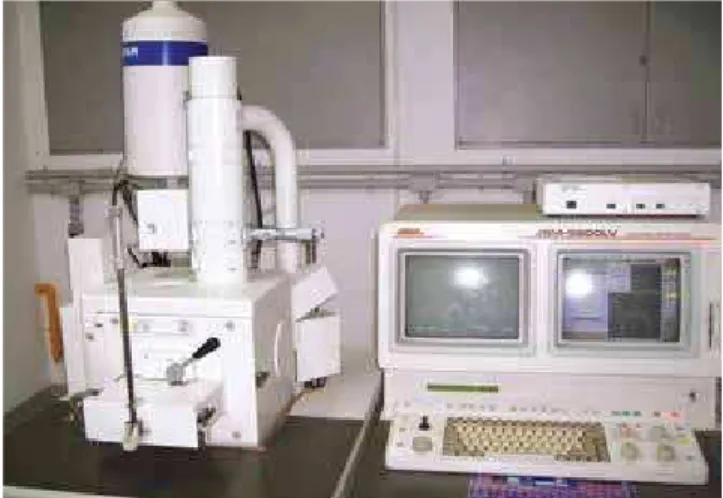
microscopy (JEOL, model JSM-5800 LV with EDS system of microanalysis) (Fig 1). To analyze the surface morphology of the fracture region and wire-surface roughness of the wires, the technique of secondary elec-trons analysis was used, by means of which the images of inclusions, manufacturing residue and supericial heterogeneity were obtained. To carry out these tests, two samples of each wire subgroup were used.
Figure 1 - Scanning electronic microscope used with EDS system of micro-analysis.
SUPERELASTIC GROUP (12 archwires) HEAT-ACTIVATED GROUP (08 archwires)
GAC 2 NiTi SE (REF. 03-018-53T) GAC Sentalloy 2 NiTi Heat (REF. 02-511-132) TP Relex 2 NiTi SE (REF. 381-264) TP HA 2 NiTi Heat (REF. 381-825) Ormco Ni-Ti 2 NiTi SE (REF. 219-3204) Ormco 35OC 2 CuNiTi Heat (REF. 219-4204)
Ormco 27°C 2 CuNiTi SE (REF. 205-0048) Unitek Nitinol HA 2 NiTi Heat (REF. 4286-981)
Masel Elastinol 2 NiTi SE (REF. 4828-018) -
-Morelli 2 NiTi SE (REF. 50.70.014) -
-Table 1 - Orthodontic wires used in this study: GAC (GAC Int. Inc. New York, USA); TP (TP Orthodontics, La Porte, USA); Ormco (Ormco Corp. Glendora, USA); 3M Unitek (Unitek Corporation, Monrovia, USA); Masel (Masel, Bristol, USA); Morelli (Dental Morelli, São Paulo, Brazil).
Table 2 - Chemical composition of tested NiTi and CuNiTi wires (EDS).
Chemical composition % Nickel (Ni) NiO
Titanium (Ti) TiO2
Copper (Cu) CuO
Aluminium (Al) Al2O3
Calcium (Ca) CaO
Bromine (Br) Br
Silicon (Si) SiO2
NiTi SUPER GAC 53.33% 43.52% – 0.19% – – –
NiTi SUPER TP 52.50% 45.44% – 1.61% 0.16% – 0.20%
CuNiTi 27oC Ormco 46.87% 43.70% 6.72% 2.31% – – –
NiTi SUPER Ormco 50.99% 42.27% – – 3.50% 0.54% 1.98%
NiTi SUPER Masel 49.22% 39.40% – 5.08% 0.27% 4.26% 1.42%
NiTi SUPER Morelli 53.84% 42.96% – 2.11% – – 0.58%
NiTi Heat GAC 52.84% 41.61% – 1.13% 0.27% – 1.59%
NiTi Heat TP 53.48% 43.26% – 0.86% – – –
CuNiTi 35oC Ormco 43.82% 45.79% 5.09% 2.40% 0.99% – 0.69%
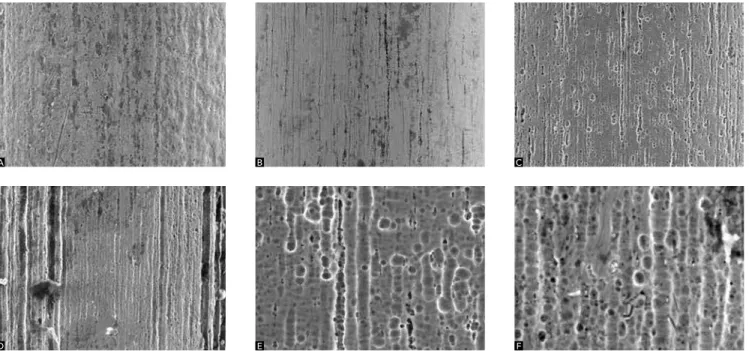
Figure 3 - Surface morphologies of heat-activated NiTi and CuNiTi wires: A) heat-activated NiTi by GAC; B) heat-activated NiTi by TP; C) CuNiTi 35oC by Ormco; D) heat-activated NiTi by Unitek (X500); E) CuNiTi 35oC by Ormco; F) heat-activated NiTi by Unitek (X 2000).
A
D
B
E
C
F
Figure 2 - Surface morphologies of superelastic NiTi and CuNiTi wires: A) superelastic NiTi by GAC; B) superelastic NiTi by TP; C) superelastic NiTi by Ormco;
D) CuNiTi 27oC by Ormco; E) superelastic NiTi by Masel; F) superelastic NiTi by Morelli (X 500).
A
D
B
E
C
F RESULTS
Semiquantitative chemical composition
Chemical analyses revealed that all samples basically have Ni and Ti with minor diferences in percentage. CuNiTi wires presented signiicant percentage of cop-per in addition to Ni and Ti in their composition. Mi-croanalyses results shown in Table 2 indicate the ox-ides present on the surface of the analyzed wires.
Wire-surface roughness
Figure 5 - Surface morphology of fracture of superelastic NiTi and CuNiTi wires: A) NiTi superelastic by GAC; B) NiTi superelastic by TP; C) NiTi superelastic by Ormco; D) CuNiTi 27oC by Ormco; E) NiTi superelastic by Masel; F) NiTi superelastic by Morelli (X 2000).
A
D
B
E
C
F
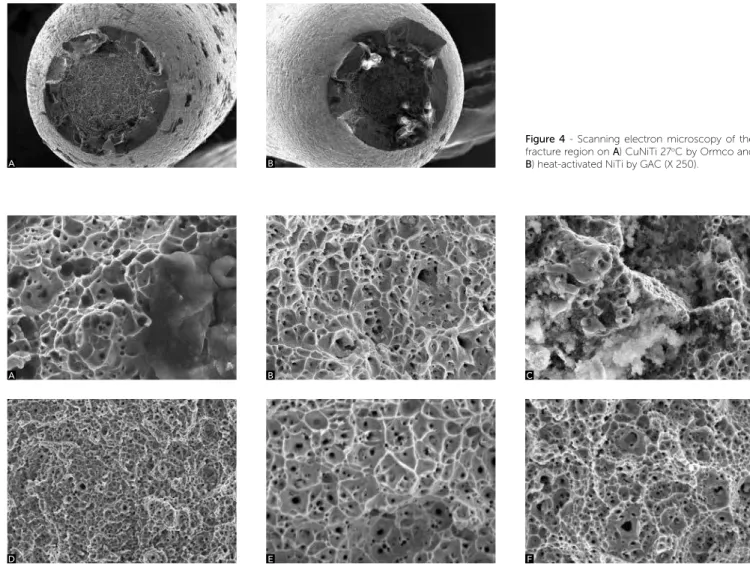
Figure 4 - Scanning electron microscopy of the fracture region on A) CuNiTi 27oC by Ormco and B) heat-activated NiTi by GAC (X 250).
A B
Figure 6 - Surface morphology of fracture of heat-activated NiTi and CuNiTi wires: A) heat-activated NiTi by GAC; B) heat-activated NiTi by TP; C) CuNiTi 35oC by Ormco; D) heat-activated
NiTi by Unitek (X 2000).
A
C
B
As for the surface morphology of wires, the manu-facturing process is carried out by drawing. Drawing is the process in which wires with larger cross-sections (wire rod) pass through tools (spinnerets) to have their dimensions reduced, thus, being transformed into an-other wire with adequate diameter and which can be used for several purposes, for instance, as round, square and rectangle orthodontic wires. The presence and in-tensity of drawing marks on the surface of the wires depend on the period of use and on the spinneret in-ishing, on the alloy composition and on the thermo-dynamic state of the wire rod. Thus, the longer the period of use of the spinneret, the greater the chance of it making slots and imperfections on the surface of the wires during the process. The following is among the consequences of drawing marks: greater concentration of tension on the wires, reduction in the material ca-pacity of being longitudinally deformed, reduction in the limit of traction resistance, increase in the coef-icient of attrition and increase in bioilm adhesion.8
In the present work, superelastic wires presented smoother surfaces in relation to the heat-activated ones, as reported by Fischer-Brandies et al.10 Among the su-perelastic wires, those by Masel and Morelli (Figs 2E and 2F) presented the lowest wire-surface roughness, with evidence of polishment ater the drawing process. TP and GAC wires (Figs 2A and 2B) presented inter-mediate wire-surface roughness. Superelastic NiTi and CuNiTi 27oC wires by Ormco (Figs 2C and 2D) presented the greatest wire-surface roughness, with deep spinneret marks, which led us to believe that they had not been subjected to any chemical or mechanical treatment ater drawing.
Among the heat-activated wires (Fig 3), those by GAC, TP and Unitek as well as the CuNiTi 35oC by Ormco presented inadequate characteristics regard-ing wire-surface roughness, with very visible drawregard-ing marks and slots seen at any degree of magniication. Such marks were more evident and deeper in wires by Unitek and in the CuNiTi 35oC by Ormco (Figs 3C and 3D). When those wires were evaluated under magniication of 2000x (Figs 3E and 3F), they pre-sented, in addition to drawing marks and slots, micro-cavities formed due to pullout of particles, possibly of NiTi,4 which was also observed in superelastic NiTi and CuNiTi 27oC wires by Ormco. NiTi4 precipita-tion depends on the amount of Ni in solid soluprecipita-tion,
Surface morphology of wire fracture
Figures 4 to 6 show the surface morphology of frac-tured NiTi and CuNiTi wires subjected to traction tests. The wires presented macroscopic plastic deforma-tion with signiicant reducdeforma-tion in diameter. The frac-ture was cup-cone type, which is typical of high-duc-tility materials. This occurred to all subgroups of wires, implying that they underwent permanent deformations before fracturing, since they were subjected to tension and traction that were greater than their respective yield value. The analyses of fractured surfaces with greater increase (Figs 5 and 6)demonstrate the presence of mi-crocavities, proving that the fracture is of ductile type.
DISCUSSION
With regard to the chemical composition of the tested wires, we observed that, generally, the tested NiTi wires presented Ni and Ti as the main elements of the alloy with minor diferences in their composi-tion. We also observed the presence of other chemical elements, especially Al, Si and Ca. Superelastic wires (Masel) presented a slightly lower percentage of Ni and Ti associated with a signiicative percentage of alumi-num oxide. Superelastic wires (Ormco) presented a slightly lower percentage of Ni with higher percent-age of calcium. Fischer-Brandies et al10 suggested that all wires present inclusions, chemical immunogenic-ity and manufacturing residue, such as silicon oxide (SiO2) and aluminum oxide (Al2O3), which was also observed in the present work.
time, in the number of visits paid to the orthodontist and in patient’s degree of discomfort.
Nevertheless, a new research should be carried out in order to evaluate the attrition of such wires in rela-tion to other superelastic and heat-activated NiTi and CuNiTi wires, given that through scanning electron microscopy, the present work, in agreement to results obtained by Fischer-Brandies et al,10 proved that Cu-NiTi 35oC wires by Ormco presented not only very visible drawing marks and slots seen under any degree of magniication, but also microcavities formed due to pullout of particles of NiTi4, which could generate a higher coeicient of attrition.
CONCLUSION
1. With regard to chemical composition, the tested NiTi wires presented predominance of Ni and Ti with a small percentage of Al, Ca, and Si. CuNiTi wires presented a significant percent-age of copper in addition to Ni and Ti in their compositions.
2. With regard to surface morphology, the super-elastic NiTi wires by Masel and Morelli present-ed the lowest wire-surface roughness, while the superelastic and heat-activated NiTi and CuNiTi wires by Ormco presented the greatest wire-sur-face roughness.
3. With regard to the morphology of fracture re-gions, CuNiTi 27oC wires by Ormco and the heat-activated wires by GAC and Unitek pre-sented the smallest microcavities, while CuNiTi 35oC by Ormco presented the largest.
4. All wires presented fractured surfaces under duc-tile traction.
5. CuNiTi 35oC wires did not present better mor-phologic characteristics on surfaces and fracture regions in comparison to the other wires.
since it could have been altered by the presence of cop-per in the composition of CuNiTi wires. Variations in 0.1% of Ni would already be signiicant to induce the formation and precipitation of NiTi4. As for the superelastic NiTi wires by Ormco, they presented a slightly lower percentage of Ni in comparison to the other tested NiTi wires (Table 2), which could have induced the formation of a higher percentage of pre-cipitation and pullout of particles of NiTi4.
With regard to the morphology of the fracture region of superelastic and heat-activated wires seen under magnification of 2000x (Figs 5 and 6), we observed the presence of microcavities which are a characteristic of ductile fractures, with the largest microcavities being formed by pullout of particles, possibly of NiTi4. Additionally, we observed that, in general, the size of the microcavities found for su-perelastic NiTi wires was larger than that found for heat-activated NiTi wires. Among the superelastic NiTi wires, those that presented the smallest micro-cavities were the CuNiTi 27oC ones (Fig 5D). Wires by GAC, TP, Masel and Morelli (Figs 5A, 5B, 5E and 5F) presented microcavities of similar sizes. Among the heat-activated wires, those by GAC and Unitek (Figs 6E and 6H) presented smaller microcavities in comparison to wires of other samples.
1. Andreasen GF, Hilleman TB. An evaluation of 55 cobalt substituted nitinol wire for use in orthodontics. J Am Dent Assoc. 1971;82(6):1373-5. 2. Andreasen GF, Hilleman TB. An evaluation of 55 cobalt substituted Nitinol
wire for use in orthodontics. J Am Dent Assoc. 1971;82(6):1373-5. Igual a referencia acima
3. Andreasen GF, Morrow RE. Laboratory and clinical analysis of Nitinol wire. Am J Orthod. 1978;73(2):142-51.
4. Buehler WJ. Proceedings of the 7th Navy Symposium ONR-16 Oice of
Technical Services. 1963. Washington, DC; 1963. v. 1, p. 1-30.
5. Burstone CJ, Goldberg AJ. Beta Titanium: a new orthodontic alloy. Am J
Orthod. 1980;77(2):121-32.
6. Burstone CJ, Qin B, Morton JY. Chinese NiTi wire: a new orthodontic
alloy. Am J Orthod. 1985;87(6):445-52.
7. Damon DH. The Damon low-friction bracket: a biologically compatible
straight-wire system. J Clin Orthod. 1998;32(11):670-80.
8. Elias CN, Lopes HP. Materiais dentários: ensaios mecânicos. São Paulo:
Ed. Santos; 2007.
9. Evans TJW, Durning P. Orthodontic products update. Aligning archwires,
the shape of things to come? A forth and ifth phase of force delivery. Brit J Orthod. 1996;23(3):269-75.
10. Fischer-Brandies H, Es-Souni M, Kock N, Raetzke K, Bock O. Transformation behavior, chemical composition, surface topography and bending properties of ive selected 0.016” X 0.022” NiTi archwires. J Orofac Orthop. 2003;64(2):88-99.
REFERENCES
11. Kapila S, Sachdeva R. Mechanical properties and clinical applications of orthodontic wires. Am J Orthod Dentofacial Orthop. 1989;96(2):100-9. 12. Miura F, Mogi M, Ohura Y, Hamanaka H. The super-elastic property
of the Japanese NiTi alloy wire for use in orthodontics. Am J Orthod Dentofacial Orthop. 1986;90(1):1-10.
13. Mohlin B, Müller H, Odman J, Thilander B. Examination of chinese Ni-Ti wire by a combined clinical and laboratory approach. Eur J Orthod. 1991;13(5):386-91.
14. Parvizi F, Rock WP. The load/delection characteristics of thermally activated orthodontic archwires. Eur J Orthod. 2003;25(4):417-21. 15. Perkins J, Hodgson D. The two-way shape memory efect. London: Jef
Perkings Plenum Press; 1975.
16. Sachdeva RC. Sure-Smile: technology: driven solution for orthodontics. Texas Dent J. 2002;119(7):608-15.
17. West AE. A clinical comparison of two initial aligning archwires [thesis]. Cardif (UK): University of Wales; 1992.