Planning ability impairments in probable
Alzheimer’s disease patients
Evidence from the Tower of London test
Corina Satler1, Luiza Guimarães2, Carlos Tomaz2,3
ABSTRACT. Alzheimer’s disease (AD) is associated with progressive impairment of higher-level cognitive abilities. Previous research suggests that early impairment of executive functions occurs during the course of the disease, but few studies have specifically investigated planning ability in an AD population. Objective: The purpose of the current study was to examine whether AD patients retain the ability to plan ahead, by analyzing specificities of their behavior in successfully achieving a pre-established goal. Methods: Twenty-one AD patients and thirty-three elderly controls underwent a problem-solving assessment using the Tower of London (TOL) test. Results: AD patients were less accurate and less efficient than controls. AD patients also committed more mistakes. This indicates a decline in working memory and inhibitory deficits, resulting in impulsive and inappropriate behaviors. Conclusion: These results are in agreement with previous studies, showing executive function problems in patients with AD. Specifically, this study demonstrates the presence of planning ability deficits in AD, considering both qualitative and quantitative approaches. The wide range of analysis presented in this study can aid clinicians in identifying the nature of the poor performance of AD patients during a planning task.
Key words: cognition, dementia, elderly, executive function, neuropsychology.
ALTERAÇÕES NA HABILIDADE DE PLANEJAMENTO EM PACIENTES COM PROVÁVEL DOENÇA DE ALZHEIMER: EVIDÊNCIAS DO TESTE TORRE DE LONDRES
RESUMO. A doença de Alzheimer (DA) é associada a um comprometimento progressivo das habilidades cognitivas superiores. Pesquisas anteriores sugerem que o comprometimento precoce das funções executivas ocorre durante o curso da doença, mas poucos estudos têm investigado especificamente a capacidade de planejamento em uma população com DA. Objetivo: O objetivo do presente estudo foi analisar se os pacientes com DA mantêm a capacidade de planejar antecipadamente, analisando as especificidades de seu comportamento para alcançar com êxito uma meta pré-estabelecida. Métodos: Vinte e um pacientes com DA e trinta e três controles idosos foram submetidos a uma avaliação de resolução de problemas utilizando o teste de Torre de Londres (TOL). Resultados: Os pacientes com DA foram menos precisos e menos eficientes do que os controles. Os pacientes com DA também cometeram mais erros. Isso indica um declínio na memória operacional e déficits inibitórios, resultando em comportamentos impulsivos e inadequados. Conclusão: Estes resultados estão de acordo com estudos anteriores, mostrando problemas de função executiva em pacientes com DA. Especificamente, este estudo demonstra a presença de déficits de capacidade de planejamento na DA, considerando abordagens qualitativas e quantitativas. A ampla gama de análises apresentadas neste estudo poderá auxiliar aos profissionais da área da saúde na identificação da natureza do baixo desempenho dos pacientes com DA durante uma tarefa de planejamento.
Palavras-chave: cognição, demência, idoso, função executiva, neuropsicologia.
INTRODUCTION
A
lzheimer’s disease (AD) is the mostcom-mon cause of dementia acom-mong adults
aged over 65 years. AD is a slowly progres-sive neurodegenerative process, with typi-cally insidious onset, characterized by
neuro-This study was conducted at the University of Brasilia, Brasilia, DF, Brazil.
1PhD, Adjunct Professor, Faculty of Ceilandia, UnB, University of Brasilia, Brasilia, DF, Brazil. 2Undergraduate Student, Laboratory of Neurosciences and Behavior,
Department of Physiological Sciences, University of Brasilia, Brasilia, DF, Brazil. 3PhD, Full Professor, Neuroscience Research Program, University CEUMA, São Luis,
MA, Brazil.
Corina Satler. Faculty of Ceilandia, University of Brasilia, Campus UnB Ceilandia – 72220-140 Brasilia DF – Brazil. E-mail: [email protected] Disclosure: The authors report no conflicts of interest.
Received March 17, 2017. Accepted in final form April 26, 2017.
nal atrophy, synapse loss, and abnormal deposition of B-amyloid protein plaques and neuroibrillary tangles
within speciic regions of the brain.1 According to the
pattern of neuropathological changes associated with progression to AD, the earliest changes occur in medial temporal lobe limbic structures. his process gradually
spreads to afect temporal, frontal and parietal lobes.2,3
Consistent with these alterations, higher-level cog-nitive abilities are afected early in the course of AD. Episodic memory impairment is usually the earliest and most salient aspect of the AD dementia syndrome. Additionally, deicits in attention, language and visuo-spatial abilities, processing speed, and executive func-tions (EF) may be present from the beginning of the
ill-ness.1,4,5 Given this proile, executive dysfunction can be
considered a common manifestation during the course of AD, occurring at all stages of the disease.1,6-9
he term “executive functions” refers to various complex cognitive processes and sub-processes that are thought to control or guide behaviors in a top-down manner. here is general agreement that EF encompass three main components: inhibition, working memory, and cognitive lexibility. From these, a set of higher order cognitive processes are built, such as reasoning,
problem solving, and planning.10 hese processes enable
us to formulate goals and plans; remember these goals over time; choose and initiate actions to help us achieve these goals; and monitor and adjust our behavior, as
necessary, until we complete or fail at them.11
Evidence from neuropsychological studies shows that the prefrontal cortex plays an important role in EF. As early as 1868, J. M. Harlow airmed that frontal-lobe
lesions in humans result in a loss of “planning skills”.12
Several decades later, Bianchi (1922) described how monkeys with large frontal lesions were unable to
coor-dinate diferent elements of a complex activity.12
Planning and future-directed behavior involve a vari-ety of aspects of EF, including plan formulation, moni-toring and regulation of the responses intended to carry out the plan, the capacity to maintain goal representa-tions in working memory, inhibition of attention to dis-tracting stimuli, and sustained suppression of impulsive response.12,13
Neuropsychological tests based on tower paradigms have been used as a reliable measure of planning and problem solving abilities. he Tower of London (TOL)
test was developed by Shallice and McCarthy14 as an
alternative to the classic Tower of Hanoi test.
he TOL test is considered a complex planning task that relies on multiple executive operations including inhibitory control, set maintenance, cognitive lexibility,
self-monitoring, working memory, and attention alloca-tion.12,13 It is assumed that the solution of the test is best accomplished by the use of strategy and by planning a sequence of moves without breaking the predeined rules.15
Given the TOL test’s widespread use in clinical and research settings, there are several versions that difer with regard to whether they are computerized or stan-dard, the number of attempts, and scoring criteria. he test has been suggested as a useful tool for neuropsy-chological examination of healthy and clinical popula-tions. Planning impairments on the TOL test have been
observed among both acute16,17 and chronic neurological
disorders,18-20 as well as in psychiatric conditions.21,22 Additionally, TOL performance has been associated
with instrumental activities of daily living.23,24
Plan-ning ability is thought to be important to “real world”
activities,25 so an executive dysfunction may hinder the
performance of simple everyday tasks, such as brushing
teeth, cooking, or shopping.26
Everyday action errors are frequent in various clini-cal groups and may impair performance in achievement
of the task goal.27,28 Progressive inability to perform
activities of daily living is one of the diagnostic
crite-ria for AD,29 and leads to a loss of independence, afects
the patient´s quality of life, and increases the burden of caregivers by shifting many daily responsibilities to
them.30 his feature of the disease is closely associated
with the above-mentioned cognitive decline.1,4,5
he prediction that AD patients will show poor per-formance during EF tests is supported by an abundance
of neuropsychological test indings.1,4,8,31
Substantial progress has been made in determin-ing the extent of planndetermin-ing deicits in AD. Neverthe-less, unlike the numerous studies focusing on the TOL scoring system for AD diagnosis and use of the tool for neuropsychological examinations of patients with mild cognitive impairment,20,32-35 only a few studies35,36 have included a qualitative description based on observation of AD patient performance in their investigation of TOL performance.
inhibitory control, and working memory. Additionally,
we expected the presence of perseverations and
closing-in behavior” (CB) for AD patients, considering that CB is the expression of a default sensorimotor organization
normally inhibited by executive control,37 and that this
inhibition can break down under conditions of reduced executive resources, as is the case with AD.
METHODS
he study included 21 patients with a diagnosis of prob-able AD and 33 healthy elderly adults (EC).
All AD patients met the AD criteria described in the DMS-IV (ed.4), published by the American Psychiat-ric Association in 1994, and deined by the NINCDS-ADRDA. A clinical diagnosis of probable AD was deter-mined for each patient at an interdisciplinary team meeting (including a social worker, a neuropsychologist, and a geriatrician). he severity of AD ranged from mild to moderate according to the Clinical Dementia Rating
Scale (CDR).38 Patients exhibited a history of
progres-sive cognitive impairment, which was conirmed by their caregiver using the Informant Questionnaire on
Cognitive Decline in the Elderly (IQCODE).39 All subjects
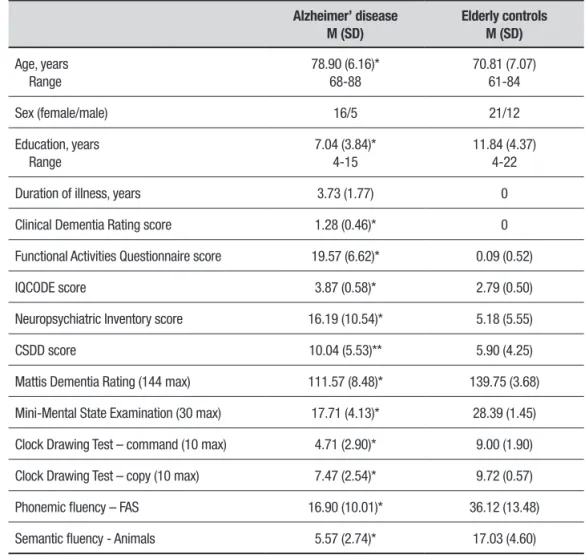
underwent a neuropsychological evaluation (Table 1). his study was approved by the Human Subject Com-mittee of the Faculty of Medicine (FM-UnB).
Procedure. Subjects were tested individually in a room with normal interior lighting at the Geriatric Medical Center at the University Hospital of Brasilia, Brasilia.
he Krikorian version of the TOL test15 was used in
this study, because of its suitability for use with
demen-tia patients.20 Subjects were instructed to transform the
start coniguration into the target coniguration while following three rules: (1) they had to reproduce the examiner’s model in a minimum number of moves; (2) only one ball may be moved at a time; (3) a ball may not be placed on the table or held in the hand while another
Table 1. Demographic and neuropsychological data for Alzheimer’ disease patients and elderly controls.
Alzheimer’ disease M (SD)
Elderly controls M (SD)
Age, years Range
78.90 (6.16)* 68-88
70.81 (7.07) 61-84
Sex (female/male) 16/5 21/12
Education, years Range
7.04 (3.84)* 4-15
11.84 (4.37) 4-22
Duration of illness, years 3.73 (1.77) 0
Clinical Dementia Rating score 1.28 (0.46)* 0
Functional Activities Questionnaire score 19.57 (6.62)* 0.09 (0.52)
IQCODE score 3.87 (0.58)* 2.79 (0.50)
Neuropsychiatric Inventory score 16.19 (10.54)* 5.18 (5.55)
CSDD score 10.04 (5.53)** 5.90 (4.25)
Mattis Dementia Rating (144 max) 111.57 (8.48)* 139.75 (3.68)
Mini-Mental State Examination (30 max) 17.71 (4.13)* 28.39 (1.45)
Clock Drawing Test – command (10 max) 4.71 (2.90)* 9.00 (1.90)
Clock Drawing Test – copy (10 max) 7.47 (2.54)* 9.72 (0.57)
Phonemic fluency – FAS 16.90 (10.01)* 36.12 (13.48)
Semantic fluency - Animals 5.57 (2.74)* 17.03 (4.60)
ball was being moved. We also simpliied the rule con-cerning placement of the balls in relation to the length of the pegs.36
When rules were broken, subjects were asked to restart the problem. Subjects were also asked to restart the problem if a wrong inal coniguration was presented.
he stopwatch was started when the two conigu-rations were revealed to the subject and started again when the subject made the irst move.
Scoring. Accuracy of the problem solution was analyzed based on the number of attempts needed to achieve the correct inal coniguration for each problem, taking into consideration the prescribed minimum number
of moves (raw score of 0 to 36 or 0 to 100 percent).15
he terms “accuracy” and “success” are henceforth used interchangeably.
Two time measures were utilized to analyze each
problem: “initiation time” (IT), the time from the
pre-sentation of a test problem by the examiner to the ini-tiation of the irst problem-solving move by the
sub-ject, and “execution time” (ET), the time from initiation
of the irst move to completion or discontinuation of problem-solving.
In accordance with Rainville et al.,36 we
ana-lyzed three diferent types of errors: (1) “wrong inal
coniguration”-WFC; (2) “rule breaking”-RuleB; and (3) “excess movements”-EM.
We analyzed ive complementary behaviors: (1) “interrupted move”-IM is when the subject started the action and then stopped, such as when they plainly lifted the ball from the peg and then held it in the
air; (2) “hesitation behavior”-HB refers to the action of
touching or almost touching the ball, without
remov-ing it completely from the peg; (3) “regret behavior”-RB
occurs when the subject moved a ball from a peg, and then placed it back on the same peg that it had been on
before starting the move; (4) “perseverative behavior”-PB
refers to inappropriate maintenance of a sequence of movements in an efort to solve the problem; and (5) “closing-in behavior”-CB refers to the action of trying to move a ball from the examiner’s tower, instead of the subject’s own tower.
Statistical methods. Descriptive and inferential statis-tical analyses were performed to characterize the sample. We compared the AD and EC groups with regard to their problem-solving accuracy for the entire set of problems, their time performance, errors, and complementary behaviors. A multivariate analysis of
covariance (MANCOVA) was performed with the group as the independent factor, and age and education as covariates. We also conducted an ANOVA of repeated-measures, with group as the independent factor, and age and education as covariates in order to compare the accuracy of the solutions to the problems across the four levels of the test and ive moves. We then conducted a new t-test for independent samples, this time for each problem individually.
Partial correlations (pr), maintaining both age and
education constants, were used to assess the rela-tionship between the TOL measures for AD patients.
We also conducted a pr to examine a possible
associa-tion between the presence of closing-in behaviors and dementia severity (CDR), functional activities of daily living (FAQ), and global cognitive status (MMSE and DRS total scores). Analyses were performed using the PSAW Statistics software (v.18.0 for Windows). he level of statistical signiicance was set at 5% (p<.05).
RESULTS
Frequency analysis showed that that 38.1% of the AD sample failed to achieve a total score above 50% success, and only seven patients (33.3%) were capable of performing the 12 problems successfully, in contrast to the ECs, who successfully completed all the problems.
he MANCOVA yielded a signiicant between-group diference, relecting the better performance by the EC group, F(11, 39)=6.50, p < .001, η2=.64. Post hoc con-trast revealed that the AD patients were less accurate, needed more time to perform the test, exhibited more errors and performed more complementary behaviors than ECs during the test. he AD group showed a lower success score, needed more time to execute the test, broke a greater number of rules, made more WFCs, hesi-tated more, made more interruptions, had more regrets, and performed more closing-in. he two groups did not difer with regard to IT, EMs, and PBs (see Table 2).
Analyses of accuracy across the four levels of the test showed a signiicant correlation between the level
and the group, F(3, 41)=4.66, p=.007, η2=.25.
Within-subject analyses revealed a signiicant contrast (p<.001) between level 1 and 2, level 1 and 3, level 1 and 4, level 2
and 3, but not between level 2 and 4 (p=.472) nor level
3 and 4 (p=.623) for AD patients. he EC group showed
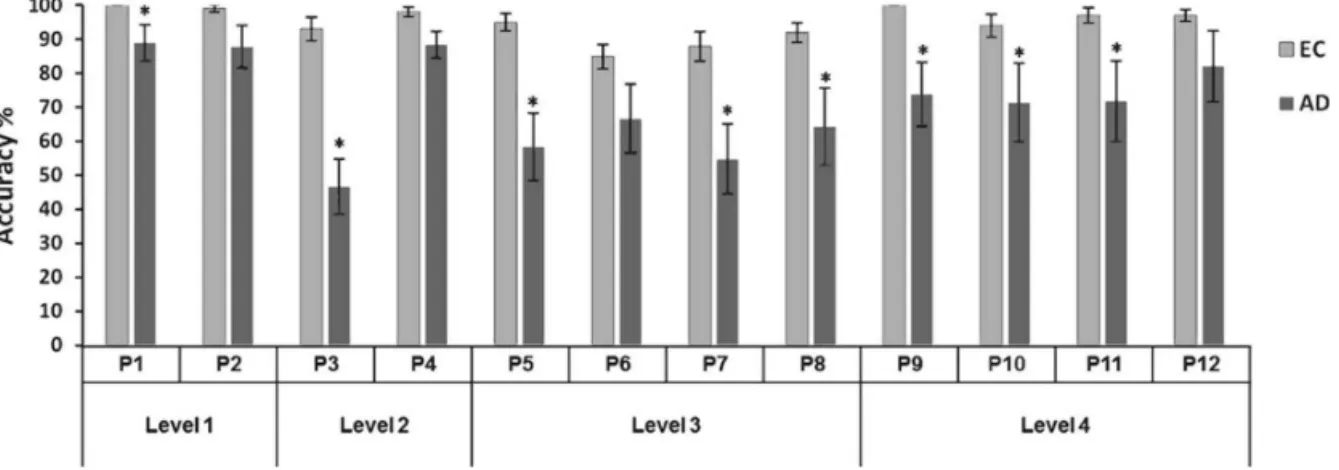
signiicant diferences between the four levels of the test (p<.035), except between level 1 and 2 (p=.088), level 1 and 4 (p=.057), and level 2 and 4 (p=.557) (Figure 1).
Analyses of individual problems revealed signiicant
diferences between groups (p<.050), except for
Table 2. Performance analysis for Alzheimer’ disease patients (AD) and elderly controls (EC).
Group
F(1,49) p η2 f2 95%CIs
AD EC
M (SD) M (SD)
Total success score 21.50 10.08 34.12 1.89 27.67 .000 .36 .99 27.67
Initiation time 200.75 118.92 151.06 112.74 .72 .398 .01 .13 .72
Execution time 440.06 223.85 241.19 76.10 11.18 .002 .18 .90 11.18
Excess movements 4.30 3.41 2.45 2.62 2.44 .124 .04 .33 2.44
Rule breaking 9.92 6.28 1.96 2.33 22.50 .000 .31 .99 22.50
Wrong final configuration 5.25 4.24 1.90 1.99 5.29 .026 .09 .61 5.29
Hesitation behavior 42.11 44.05 18.18 10.93 8.72 .005 .15 .82 8.72
Interrupted move 10.38 7.87 5.17 3.94 14.70 .000 .23 .96 14.70
Regret behavior 9.25 8.33 3.51 2.98 11.50 .001 .19 .91 11.50
Perseverative behavior 1.31 2.33 .03 .21 1.61 .210 .03 .23 1.61
Closing-in behavior 6.43 7.20 .113 .50 17.47 .000 .26 .98 17.47
Mean and standard deviation are raw scores.
Figure 1. Mean success score (%) in each level of the TOL test for Alzheimer’s disease patients (AD) and elderly controls (EC). Significant differences within groups are indicated as follows: *p < .001; **p < .05. AD patients obtained a higher percentage of success for
the easiest problems when compared to the more dif-icult problems. In problems 1, 2 and 4, which require only 2 or 3 moves, they obtained close to 90% success, and only a 46.6% success rate for problem 3 (see Figure 2). he EC group obtained a success rate of 91-100% for most problems, except problems 6 and 7.
Correlations for TOL performance scores of AD patients. Results showed a signiicant correlation between the
success score and EMs (p<.001). here was a signiicant
negative correlation between RuleB (p=.040) and CB
(p=.003) (Table 3). As expected, there was a signiicant
Table 3. Partial correlations for TOL performance scores of patients with Alzheimer’s disease.
Measures TOL IT ET EM RuleB WFC HB IM RB PB
TOL
IT –.06
ET –.12 .62*
EM .51* .00 –.06
RuleB –.28** .21 .41* –.15
WFC –.20 .50* .65* –.20 .38*
HB –.13 .56* .81* –.02 .22 .50*
IM –.22 .49* .71* .09 .51* .45* .69*
RB –.21 .52* .78* –.12 .46* .41* .77* .51*
PB –.08 .15 .37* –.08 .10 .60* .05 .16 .36**
CB –.40* .13 .43* –.17 .44* .32** .33** .24 .38* .20
TOL: Tower of London success score. IT: Initiation Time score. ET: Execution Time score. EM: Excess Movements score. RuleB: Rule Breaking score. WFC: Wrong Final Configuration score. HB: Hesitation Behavior score. IM: Interrupted Move score. RB: Regret Behavior score. PB: Perseverative Behavior score. CB: Closing–in behavior score. *p < .005. **p < .05.
Table 4. Partial correlations for closing-in behaviors of patients with Alzheimer’s disease.
Measures Closing-in B CDR FAQ MMSE DRS
Closing-in B
CDR .44*
FAQ .52* .94*
MMSE -.27** -.87* -.85*
DRS -.50* -.87* -.87* .86* –
Closing-in B: Closing-in behavior score. CDR: Clinical Dementia Rating. FAQ: Functional Activities Questionnaire. MMSE: Mini-Mental State Examination total score. DRS: Mattis Dementia Rating total score. *p < .005. **p < .05.
correlation between IT and ET (p<.001). Regarding
analysis of errors, there was a signiicant correlation
between RuleB and WFC (p=.006), IM (p<.001), and
CB measurements (p<.001). Complementary behavior
measurements identiied signiicant correlations
(p<.001) between the following: HB and IM; HB and
RB; HB and CB; IM and RB, RB and PB, and RB and CB. Finally, results showed a signiicant correlation
(p<.001) between closing-in behavior and CDR, FAQ,
and a signiicant negative correlation with MMSE (p=.045) and DRS (p<.001) (Table 4).
DISCUSSION
he purpose of this study was to examine whether AD patients retain the ability to plan ahead, by analyzing speciicities of their behavior in successfully achieving a pre-set goal. We hypothesized that this ability would
be relatively well retained in ECs, as opposed to AD
patients. In line with previous evidence,20,36 we found
that ECs outperformed AD patients, indicating that planning ability is diminished in these patients.
Success rates were lower in AD patients compared to ECs. Although AD patients obtained a high accuracy for some problems, they failed to ind the correct solution on the irst attempt for most problems, indicating dii-culties in generating and executing a sequence of moves to achieve a predetermined goal. AD patients had the greatest trouble solving problem 3. his problem is the irst that involves an intermediate move and anticipa-tory load, so it seems that this problem relies on more complex mental strategies than the irst two problems.
he TOL test is a complex planning task, which relies on multiple cognitive processes involving a variety of EF
cognitive skills are diminished in AD patients. his is bolstered by the observation that AD patients have sev-eral cognitive impairments even in very early stages of
the disease,1,5 with the presence of executive diiculties
being common.4,8
We also observed time diferences between the groups during the test. Although age-related changes
in processing speed are expected,40 AD patients showed
signiicantly higher time-related measurements than ECs. hese results are in line with evidence that AD patients sufer an abnormal decline in mental
process-ing speed.5 Owen et al.41 examining a group of patients
with frontal lobe lesions, described slower performance compared to controls, which was associated with inef-icient preplanning and the need for extra on-line plan-ning during the execution of the test.
For problem 12, AD patients had the longest ET and an 80% success rate, suggesting more time with a bet-ter performance, contrary to problem 3, where a longer execution time and a low success score was observed. Taking the success score and time-related measurements into account, our indings therefore disagree with
Kriko-rian et al.15 who claimed that levels 1 and 2 could be
solved through a perceptual strategy. his reinforces growing evidence suggesting that problem diiculty is not restricted only to the number of required
move-ments,42,43 and that some problems with few moves
exert complex cognitive demands.
Findings for WFC showed that AD patients needed more attempts than ECs to achieve the correct inal model, with an average of ive attempts throughout the test.
Research has emphasized the role of inhibition on
performance during the TOL test,12,36 since the task
includes speciic rules that must be adhered to in ind-ing the solution. Although we simpliied the rules in our study, AD patients committed an average of seven prohibited actions during the test, which may be associ-ated with a decline in working memory and inhibitory control, including self-monitoring of planning eforts.
AD patients performed more complementary behav-iors than ECs. he overuse of IM, hesitation, and RBs in the former may be associated with the presence of goal-subgoal conlict resolution diiculties. his lack of plan-ning is based on the fact that an early incorrect move can make the problem virtually unsolvable, thereby requiring a step back and a new plan on how to achieve the correct solution. hese high scores suggest diicul-ties in mentally storing and manipulating information
over short periods, and may additionally be associated with the use of trial and error.
Perseverations and CBs were also seen in AD patients. During the TOL test, this phenomenon was exhibited by AD patients who failed to switch to a new coniguration, repeating the same responses from a
pre-ceding coniguration. Sandson and Albert44 categorized
this perseverative behavior as “stuck-in-set”, proposing that it involves an underlying deicit of EF. his type of behavior is frequently demonstrated during various cognitive tests, indicating impairment of inhibitory processes.31
Regarding CBs, our results are consistent with other studies, which have described this phenomenon in AD patients.37,45 We highlight the ‘‘attraction hypothesis’’,46 which describes this phenomenon as a relection of the disinhibition of a primitive behavior (automatic
ten-dency). Additionally, as suggested by other researchers,45
this behavior was noticeable in our clinical sample and showed a signiicant positive correlation with dementia severity (CDR).
Several conclusions can be drawn from this research: (1) Our indings are consistent with previous studies showing that AD patients had diiculties in planning ahead and executing complex predetermined plans; (2) he diiculties encountered when taking the TOL test are not restricted to the number of required movements; (3) Reducing the number of rules did not improve AD patient performance; (4) he TOL test was able to dis-tinguish AD patients from ECs, considering both quali-tative and quantiquali-tative approaches. We recommend further studies that include complementary analyses, which can aid clinicians in identifying the nature of the poor performance of AD patients; (5) Speciic behaviors (RuleB and CB) exhibited by AD patients are useful indi-cators of impairments in inhibitory processes. Finally, the TOL test provides clinically relevant information that can be used to augment treatment planning and care, prioritizing well-being and quality of life of AD patients.
Further studies involving larger sample groups are necessary to conirm these results.
Acknowledgements. C. Satler received a doctoral fellow-ship from the CNPq, Brazil. No author has any conlict of interest relating to this article.
REFERENCES
1. Salmon DP, Bondi MW. Neuropsychological Assessment of Dementia. Annu Rev Psychol. 2009;60:257-82.
2. Braak H, Braak E. Neuropathological stageing of Alzheimer-related changes. Acta Neuropathol. 1991;82(4):239-59.
3. Chételat G, Desgranges B, Landeau B, Mezenge F, Poline JB, de la Sayette V, et al. Direct voxel-based comparison between grey matter hypometabolism and atrophy in Alzheimer’s disease. Brain, 2008; 131(Pt 1):60-71.
4. Bondi MW, Jak AJ, Delano-Wood L, Jacobson MW, Delis DC, Salmon DP. Neuropsychological contributions to the early identification of Alzheimer’s disease. Neuropsychol Rev. 2008;18(1):73-90.
5. Twamley EW, Ropacki SA, Bondi MW. Neuropsychological and neuro-imaging changes in preclinical Alzheimer’s disease. J Int Neuropsychol Soc. 2006;12(5):707-35.
6. Lange KW, Sahakian BJ, Quinn NP, Marsden CD, Robbins TW. Comparison of executive and visuospatial memory function in Hunting-ton’s disease and dementia of Alzheimer type matched for degree of dementia. J Neurol Neurosurg Psychiatry. 1995;58(5):598-606. 7. Lefleche G, Albert MS. Executive function deficits in mild Alzheimer’s
disease. Neuropsychology. 1995;9(3):313-20.
8. Perry RJ, Hodges JR. Attention and executive deficits in Alzheimer’s Disease: A critical review. Brain. 1999;122(Pt 3):383-404.
9. Swanberg MM, Tractenberg RE, Mohs R, Thal LJ, Cummings JL. Execu-tive dysfunction in Alzheimer disease. Arch Neurol. 2004;61(4):556-60. 10. Diamond A. Executive functions. Annu Rev Psychol. 2013;64:135-68. 11. Aron A. Progress in executive-function research. From tasks to
func-tions to regions to networks. Current Direcfunc-tions Psychol Sci. 2008;17(2): 124-9.
12. Unterrainer JM, Owen AM. Planning and problem solving: From neuropsychology to functional neuroimaging. J Physiol Paris. 2006; 99(4-6):308-17.
13. Asato MR, Sweeney JA, Luna B. Cognitive process in the development of TOL performance. Neuropsychologia. 2006;44(12):2259-69. 14. Shallice T. Specific impairments of planning. Philos Trans R Soc Lond B
Biol Sci. 1982; 298(1089):199-209.
15. Krikorian R, Bartok J, Gay N. Tower of London procedure: A standard method and developmental data. J Clin Exp Neuropsychol. 1994; 16(6):840-50.
16. Andrews G, Halford GS, Chappell M, Maujean A, Shum, DHK.Planning Following Stroke: A Relational Complexity Approach Using the Tower of London. Front Hum Neurosci. 2014;23(8):1032.
17. Shum D, Gill H, Banks M, Maujean A, Griffin J, Ward H. Planning ability following moderate to severe traumatic brain injury: perfor-mance on a 4-disk version of the Tower of London. Brain Impairment. 2009;10(3):320-4.
18. Carlin D, Bonerba J, Phipps M, Alexander G, Shapiro M, Grafman J. Planning impairments in frontal lobe dementia and frontal lobe lesion patients. Neuropsychologia. 2000;38(5):655-65.
19. Culbetson WC, Moberg PJ, Duda JE, Stern MB, Weintraub D. Assessing the executive functions deficits of patients with Parkinson’s disease: utility of the Tower of London-Drexel. Assessment. 2004;11(1):27-39. 20. Franceschi M, Caffarra P, De Vreese L, Pelati O, Pradelli S, Savarè R,
et al. Visuospatial planning and problem solving in Alzheimer’s disease patients: a study with the Tower of London Test. Dement Geriatr Cogn Disord. 2007;24(6):424-8.
21. Sullivan JR, Riccio CA, Castillo CL. Concurrent validity of the tower tasks as measures of executive function in adults: A meta-analysis. Appl Neuropsychol. 2009;16(1):62-75.
22. Masson JD, Dagnan D, Evans J. Adaptation and validation of the Tower of London test of planning and problem solving in people with intellectual disabilities. J Intellect Disabil Res. 2010;54(5):457-67.
23. Cattie JE, Doyle K, Weber E, Grant I, Woods SP. Planning Deficits in HIV-Associated Neurocognitive Disorders: Component Processes, Cognitive Correlates, and Implications for Everyday Functioning. J Clin Exp Neuro-psychol. 2012;34(9):906-18.
24. Burgess PW, Alderman N, Forbes C, Costello A, Coates LM, Dawson DR, et al. The case for the development and use of “ecologically valid”
measures of executive function in experimental and clinical neuropsy-chology. J Inter Neuropsychol Soc. 2006;12(2):194-209.
25. Doherty TA, Barker LA, Denniss R, Jalil A, Beer MD. The cooking task: making a meal of executive functions. Front Behav Neurosci. 2015; 11(9):22.
26. Fortin S, Godbout L, Braun CMJ. A test of Shallice’s and Grafman’s neuropsychological models of executive functions with head trauma patients performing activities of daily living. Cortex. 2003;39:273-91. 27. Giovannetti T, Schmidt KS, Gallo JL, Sestito N, Libon DJ. Everyday
action in dementia: evidence for differential deficits in Alzheimer’s disease versus subcortical vascular dementia. J Inter Neuropsychol Soc. 2006;12(1):45-53.
28. Dubois B, Feldman HH, Jacova C, Cummings JL, Dekosky ST, Barberger-Gateau P, et al. Revising the definition of Alzheimer’s disease: a new lexicon. Lancet Neurol. 2010; 9(11):1118-27.
29. Sacco G, Joumier V, Darmon N, Dechamps A, Derreumaux A, Lee JH, et al. Detection of activities of daily living impairment in Alzheimer’s disease and mild cognitive impairment using information and communication technology. Clin Interv Aging. 2012;7:539-49.
30. Amieva H, Phillips LH, Della Sala S, Henry JD. Inhibitory functioning in Alzheimer’s disease: A review. Brain. 2004;127(Pt 5):949-64. 31. Marchegiani A, Giannelli MV, Odetti PR. The tower of London test: a test
for dementia. Aging Ment Health. 2010;14(2):155-8.
32. Sanchez-Benavides G, Gomez-Anson B, Quintana M, Vives Y, Manero RM, Sainz A, et al. Problem-solving abilities and frontal lobe cortical thickness in healthy aging and mild cognitive impairment. J Int Neuro-psychol Soc. 2010;16(5):836-45.
33. de Paula JJ, Moreira L, Nicolato R, de Marco LA, Côrrea H, Romano Silva MA, et al. The Tower of London Test: Different scoring criteria for diagnosing Alzheimer’s disease and Mild Cognitive Impairment. Psychol Rep. 2012;110(2):477-88.
34. Rainville C, Lepage E, Gauthier S, Kergoat M-J, Belleville S. Executive function deficits in persons with mild cognitive impairment: A study with a Tower of London task. J Clin Exp Neuropsychol. 2012;34(3):306-24. 35. Rainville C, Amieva H, Lafont S, Dartigues JF, Orgogozo JM, Fabrigoule
C. Executive function deficits in patients with dementia of the Alzheimer’s type: A study with a Tower of London task. Arch Clin Neuropsychol. 2002;17(6):513-30.
36. Hughes C, Berg L, Danziger W, Coben L, Martin R. A new clinical scale for the staging of dementia. Br J Psychiatry. 1983;140:566-72. 37. Jorm A. A short-form of the Informant Questionnaire on cognitive decline
in the Elderly (IQCODE): Development and cross-validation. Psychol Med. 1994;24(1):145-53.
38. Salthouse TA. The processing-speed theory of adult age differences in cognition. Psychol Rev. 1996; 103(3):403-28.
39. Owen AM, Downes JD, Sahakian BJ, Polkey CE, Robbins TW. Plan-ning and spatial working memory following frontal lobe lesions in man. Neuropsychologia. 1990;28(10):1021-34.
40. Kaller CP, Unterrainer JM, Rahm B, Halsband U. The impact of problem structure on planning: Insights from the Tower of London task. Cogn Brain Res. 2004;20(3):462-72.
41. McKinlay A, Kaller CP, Grace RC, Kalrymple-Alford JC, Anderson TJ, Fink J, et al. Planning in Parkinson’s disease: a matter of problem struc-ture? Neuropsychologia. 2008;46(1):384-9.
42. Sandson J, Albert ML. Varieties of perseveration. Neuropsychologia. 1984;22(6):715-32.
43. Gainotti G, Marra C, Villa G, Parlato V, Chiarotti F. Sensitivity and specificity of some neuropsychological markers of Alzheimer dementia. Alzheimer Dis Associ Disord. 1998; 12(3):152-62.
44. Ambron E, McIntosh RD, Allaria F, Della Sala S. A large-scale retrospec-tive study of closing-in behavior in Alzheimer’s disease. J Inter Neuro-psychol Soc. 2009;15(5):787-92.
45. McIntosh RD, Amieva E, Della Sala S. Evidence for an attraction account of closing-in behaviour. Cogn Neuropsychol. 2008;25(3):376-94. 46. Michalec J, Bezdicek O, Nikolai T, Harsa P, Jech R, Silhan P, et al. A