Influence of age and education
on the Rivermead Behavioral Memory
Test (RBMT) among healthy elderly
Nicole Maineri Steibel1, Maira Rozenfeld Olchik2, Mônica Sanches Yassuda3, Geisa Finger4, Irênio Gomes5
ABSTRACT. Memory is a cognitive domain extensively evaluated in the neuropsychiatric setting. Assessment tools with appropriate norms for age and educational level are necessary for the proper interpretation of results. Objective: To present normative data for older adults stratified by age and education for the Rivermead Behavioral Memory Test (RBMT). The effect of age and education on the total and sub-test scores was also analyzed. Methods: A cross-sectional study involving a sample of 233 healthy elderly from a third-age group in Porto Alegre with an average age of 70 (SD 7.9) years and 10.7 (SD 4.8) years of education was carried out. The RBMT is considered an ecologically valid memory test, since it includes tasks similar to everyday situations. The sample was stratified into the following age groups: 60-69 years, 70-79 years and > 80 years. The sample was also divided into individuals with < 8 years and ≥ 8 years of education. Pearson’s Chi-squared test and Spearman correlations were used. Results: The elderly participants with low educational level had worse performance on all sub-tests, except the Pictures, Messages, Belongings and Orientation. Older elderly performed worse for total RBMT score and on the Face Recognition, Immediate and Delayed Route, Messages and Belongings subtests (p ≤ 0.005). Conclusion: Education and age significantly influenced RBMT scores. Therefore, norms for this test should be stratified according to these factors.
Key words: memory, aging, educational level, neuropsychological tests.
INFLUÊNCIA DA IDADE E DA ESCOLARIDADE NO TESTE COMPORTAMENTAL DE MEMÓRIA RIVERMEAD (RBMT) EM IDOSOS SAUDÁVEIS
RESUMO. A memória é um domínio cognitivo amplamente avaliado no contexto neuropsiquiátrico. Instrumentos de avaliação adequados com normas por idade e escolaridade são necessárias para interpretação correta dos resultados. Objetivo: Apresentar dados normativos para idosos estratificados por idade e escolaridade para o Teste de Comportamental de Memória Rivermead (RBMT). O efeito da idade e da escolaridade também foi analisado. Métodos: Estudo transversal com uma amostra de 233 idosos saudáveis, provenientes de um grupo de terceira idade do Município de Porto alegre, com média de idade de 70 anos (7,9 DP) e 10,7 (4,8 DP) anos de escolaridade. O RBMT é considerado um teste ecológico de memória, pois inclui tarefas semelhantes a situações cotidianas. A amostra foi dividida em idosos entre 60-69 anos, 70-79 anos e acima de 80 anos. A escolaridade foi dividida entre idosos abaixo de 8 anos e maior ou igual a 8 anos de estudo. Foram utilizados os testes Qui-Quadrado de Pearson e teste de correlação de Spearman. Resultados: Os idosos com baixa escolaridade apresentaram pior desempenho em todas as tarefas, exceto no reconhecimento de figuras, envelope, pertence e na orientação. Idosos mais velhos tiveram desempenho inferior no escore total do RBMT e nas tarefas de reconhecimento de faces, no caminho imediato e recente, no recado e pertence (p ≤ 0,005). Conclusão: A escolaridade e a idade influenciam significativamente nos escores do RBMT e as normas para este teste devem ser estratificadas de acordo com estes fatores.
Palavras-chave: memória, envelhecimento, escolaridade, testes neuropsicológicos.
This study was conducted at the Pontifícia Universidade Católica do Rio Grande do Sul, Porto Alegre RS, Brazil.
1Doutoranda do Programa de Gerontologia Biomédica da Pontifícia Universidade Católica do Rio Grande do Sul, Porto Alegre RS, Brasil. 2Professora Adjunto do
Curso de Fonoaudiologia da UFRGS, Departamento de Cirurgia e Ortopedia, Doutora em Educação e Mestre em Fonoaudiologia, Porto Alegre RS, Brasil. 3Escola
de Artes, Ciências e Humanidades, Universidade de São Paulo, São Paulo SP, Brasil. 4Mestranda do Programa de Pós-Graduação em Gerontologia Biomédica -
Instituto de Geriatra Gerontologia da Pontifícia Universidade Católica do Rio Grande do Sul, Porto Alegre RS, Brasil. 5Programa de Pós-Graduação em Gerontologia
Biomédica do Instituto de Geriatria e Gerontologia da Pontifícia Universidade Católica do Rio Grande do Sul, Porto Alegre RS, Brasil.
Maira Rozenfeld Olchik. Av. Ramiro Barcelos, 2492 – 90035-007 Porto Alegre RS – Brazil. E-mail: [email protected] Disclosure: The authors report no conflits of interest.
Received November 21, 2015. Accepted in final form January 26, 2016.
INTRODUCTION
he increase in longevity is being accompanied by diseases such as neurocognitive disorders.1-3 Despite
advances in scientiic research on cognitive aging, few adapted and validated instruments are available for Latin American countries. his creates a need for greater availability of valid, reliable, standardized and normal-ized instruments for use in the Brazilian elderly popula-tion.4,5 he interpretation of neuropsychological results
should consider education, age, socioeconomic context and cultural background of the patient.6
Studies have shown that educational level has a sig-niicant impact on cognitive performance, which may confound the interpretation of test results, even those with ecological validity.7-9 In Brazil, there is signiicant
heterogeneity in relation to cultural and socioeconomic status, making it especially important to develop, adapt and standardize cognitive tests that take into account at least educational level in the interpretation of their results.7,10-12
Memory is a cognitive domain widely investigated in the neurological and psychiatric setting. hus, the ade-quacy of norms considering age and education is con-sidered important for proper interpretation of results. he Rivermead Behavioural Memory Test (RBMT) is distinguished among several memory batteries for being presumably an ecologically valid memory test, as it rep-licates memory demands frequently faced in everyday life. It has been widely used for memory assessment in aging11,16,17 and can be very useful for the diagnosis of
neurocognitive disorders alone and also as part of formal cognitive batteries.
RBMT sub-tests resemble daily tasks involving visual and auditory episodic memory, such as memorizing a short story, faces and objects. Moreover, it is one of the few memory tests that evaluates prospective memory, which has been shown to be important in identifying early cognitive changes.17 Studies report that the RBMT
has appropriate psychometric properties and high accu-racy for distinguishing elderly people with preserved cognition from those with neurocognitive disorders.11,17
However, to date, no RBMT norms are available for Bra-zilian elderly.
hus, the aim of this study was to suggest normative data for older adults for the RBMT, stratiied by age and educational level. he efect of age and education on the RBMT total and sub-test scores was also investigated.
METHODS
his is an observational cross-sectional study. Partici-pants were drawn from companionship groups (public
and private) for senior citizens in the city of Porto Alegre. his study was part of a larger study on the cognitive proile of community-dwelling older adults living in the city of Porto Alegre. Elderly people of diferent socioeco-nomic status and education were included in the sample. All volunteers who participated in the study signed the informed consent form. he study was approved by the Central Ethics Committee of the Federal University of Rio Grande do Sul under No. 23866
Inclusion criteria were: age over 60 years, normal cog-nitive proile. Individuals with a history of neurological disease, illiterate, or with language and/or hearing dif-iculties that prevented completion or understanding of the test instructions were excluded. he normal cogni-tive proile was determined by a multidisciplinary team based on the following criteria: absence of memory com-plaints, absence of impairment in instrumental activi-ties of daily living, performance on the Mini-Mental State Examination above the education-adjusted cut-of scores, and not meeting DSM-V diagnostic criteria for dementia.
he RBMT was created by Baddeley, Cockburn and Wilson (1985). he test is divided into the 12 sub-tests Names, Belongings, Pictures, Story (immediate and delayed), Faces, Route (immediate and delayed), Mes-sages (immediate and delayed), Orientation and Date. For each task, scores range from 0 to 2, where two points indicate normal performance; one point intermedi-ate performance and zero points indicintermedi-ates error on the task. he RBMT proile score ranges from 0 to 24 points. he screening score (points 0-12) was not used in this study. he version employed was adapted to Brazilian Portuguese.22
he test was applied , individually, with an average duration of 30 minutes. he data collection period was from March 2010 to July 2014. he sample was divided into older adults aged 60-69 years, 70-79 years and 80 years or older. For educational level, the sample was divided into individuals with < 8 years’ education and ≥ 8 years.
RESULTS
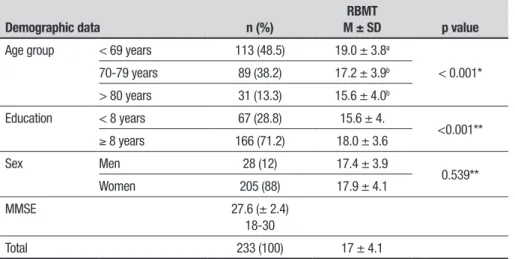
he study included 233 healthy older adults, 28 men and 205 women, with mean age of 70.7 ± 7.9 years and mean education of 10.75 ± 4.8 years. Individuals with educational level below 8 years corresponded to 28.8%, and with over eight years, 71.2%. Sociodemographic characteristics are given in Table 1.
he analyses showed signiicant diferences between educational levels and age groups, with worse perfor-mance for the group with low education. Regarding age, individuals younger than 69 years of age had lower scores than the other age groups.
Correlational analyses showed negative associations with most RBMT sub-tests and total score (except Mes-sages, Date and Orientation) and positive associations with the total and most sub-test scores (except Pictures and Belongings) (Table 2).
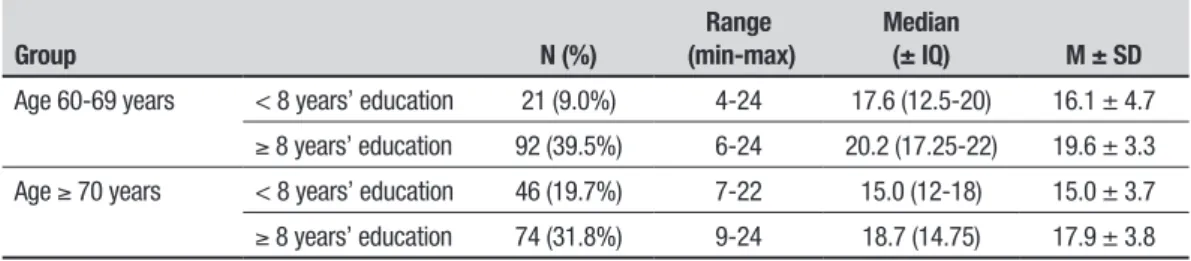
Table 3 shows the distribution of values for total RBMT score stratiied by age and level of education. Medians for RBMT scores and groups with < 8 years’ education and ≥ 8. Years are given. In an initial analysis, no signiicant diferences were found between the age groups 70-79 years and > 80 years, therefore these two groups were analyzed together, as shown in Table 3.
Table 1. RBMT scores according to sociodemographic characteristics.
Demographic data n (%)
RBMT
M ± SD p value
Age group < 69 years 113 (48.5) 19.0 ± 3.8a
< 0.001* 70-79 years 89 (38.2) 17.2 ± 3.9b
> 80 years 31 (13.3) 15.6 ± 4.0b
Education < 8 years 67 (28.8) 15.6 ± 4.
<0.001**
≥ 8 years 166 (71.2) 18.0 ± 3.6
Sex Men 28 (12) 17.4 ± 3.9
0.539** Women 205 (88) 17.9 ± 4.1
MMSE 27.6 (± 2.4)
18-30
Total 233 (100) 17 ± 4.1
*ANOVA. ** t-test. aANOVA: This group is statistically different from the oldest group. bANOVA: These groups are statistically similar.
Table 2. Correlation of tasks with age and educational level
Tests
Age Educational level
ρ p* ρ p*
1. Immediate Story –0.175 0.007 0.266 0.000 2. Delayed Story –0.176 0.007 0.300 0.000
3. Pictures –0.143 0.029 0.074 0.265
4. Faces –0.211 0.001 0.234 0.000
5. Immediate Route –0.153 0.019 0.215 0.001 6. Delayed Route –0.214 0.001 0.228 0.000 7. Immediate Messages –0.030 0.653 0.126 0.056
8. Names –0.150 0.022 0.188 0.004
9. Delayed Messages –0.196 0.003 0.264 0.000 10. Belongings –0.236 0.000 0.084 0.201
11. Date –0,092 0.160 0.248 0.000
12. Orientation –0.020 0.761 0.123 0.061
Total –0.329 0.000 0.240 0.000
DISCUSSION
he results showed that both age and level of educa-tion had a signiicant impact on RBMT performance. Results suggested the existence of a negative correla-tion between age and performance on the RBMT and a positive correlation with education. Most studies using the RBMT have been conducted in groups of elderly with Alzheimer’s disease and mild cognitive impair-ment.12,16,17 In studies published since 1998, the RBMT
was shown to be a memory test capable of diferenti-ating these clinical groups from healthy controls, these studies.24 Some translations were found for the RBMT
into Japanese but diferent scoring values are found in the Brazilian population.23 hus far, we have found
no studies comparing the RBMT with the MMSE, only with other mostly verbal tests. However, all the articles showed that the RBMT is a good test for discriminating diferent clinical groups. A study in a Turkish population found the RBMT to be reliable, valid and suitable for use in patients with acquired brain injury. he authors also provided a valid unidimensional summed score.25 In
Brazil, a previous study involving the RBMT showed a modest efect of education on healthy subjects’ perfor-mance on the test.10 he results showed no diferences
on the RBMT among healthy controls with diferent levels of education. It is believed that these indings may be due to the small sample in each group (n = 22 for aged individuals with less than eight years of education and n = 23 for up to nine years). In the present study, scores for the population of the same educational level were 67 and 166, respectively. One of the few studies in the literature which also used the RBMT in a sample of healthy individuals showed a signiicant correlation with education.18 However, the correlation found was
greater for other memory tests used (Wechsler Memory Scale, and Everyday Memory Questionnaire) than for the RBMT. Also, other studies conducted in Brazil have indicated that the RBMT is less inluenced by educa-tional experience than other cognitive tests such as the CAMCOG, the MMSE and the Wechsler Intelligence Scale Revised-WAIS-R.11
he MMSE was applied only as a criterion for inclu-sion by ruling out dementia. However, it was evident that in our population the mean neared the ceiling efect, and the RBMT appeared to be more sensitive for some tasks.23,24 he values of the MMSE were adjusted for age
and education in accordance with Brazilian references.26
It is important to highlight that some RBMT sub-tests (Faces, Pictures and Name) were not inluenced by educa-tion levels in a previous study.18 Similarly, in the present
study, the Pictures and Orientation sub-tests were not inluenced by educational level.
According to other studies, low educational level afects cognitive skills, as well as complex activities of daily living.19 Several studies have shown an association
between education and cognitive performance. Our ind-ings are not in agreement with previous studies where the efects of educational level was non-linear, tending to plateau, as marked increases in performance are not expected beyond 10 years of study.21 he indings of this
study are relevant, showing that even ecological cogni-tive batteries may be inluenced by education and age in developing countries such as Brazil.
Futures studies should investigate the RBMT pro-iles in a clinical sample and provide cut-of scores, aspects which could not be incorporated in the present study.
In conclusion, normative data were suggested for age and educational levels. Results suggest these aspects need to be taken into consideration in the context of the neuropsychological evaluation of Brazilian elderly.
Author contribution. Nicole Maineri Steibel: analysis of
the data and writing of the manuscript. Maira Rozen-feld Olchik: design of the study, data collect and intel-lectual contribution to the writing of the manuscript. Monica Sanches Yassuda: design of the study and intel-lectual contribution to the writing of the manuscript. Geise Finger: literature review. Irenio Gomes da Silva Filho: analysis of the data and intellectual contribution to the writing of the manuscript.
Table 3. Distribution of RBMT values according to age group and schooling in 233 elderly without cognitive decline.
Group N (%)
Range (min-max)
Median
(± IQ) M ± SD
Age 60-69 years < 8 years’ education 21 (9.0%) 4-24 17.6 (12.5-20) 16.1 ± 4.7
≥ 8 years’ education 92 (39.5%) 6-24 20.2 (17.25-22) 19.6 ± 3.3 Age ≥ 70 years < 8 years’ education 46 (19.7%) 7-22 15.0 (12-18) 15.0 ± 3.7
REFERENCES
1. Fagundes SD, Silva MT, Thees RS, Pereira MG. Prevalence of dementia among elderly Brazilians. São Paulo Med J 2011;129:46-50. 2. Meng X, D’Arcy C. Education and dementia in the context of the
cogni-tive reserve hypothesis: a systematic review with meta-analyses and qualitative analyses. Plos One 2012;7:e38268.
3. Jacob-Filho W, Grinberg LT, Nitrini R, et al.Prevalence of dementia subtypes in a developing country: a clinicopathologicalstudy. Clinics 2013;68:1140-1145.
4. Pawloskj J, Trentini CM, Bandeira DR. Discutindo procedimentos psico-métricos a partir da análise de um instrumento de avaliação neuropsi-cológica breve. PsicoUSF 2007;12:211-219.
5. Figueiredo SCS, Mioto EC, Serrão VT, Jungerman FS, Lucia MCS, Scaff M. Investigação neuropsicológica de uma amostra de idosos saudáveis. Psico Hosp 2009;7:85-99.
6. Chaves MLF, Godinho CC, Porto CS, et al. Doença de Alzheimer: Aval-iação cognitiva, comportamental e funcional. Dement Neuropsychol 2011;5:21-33.
7. De Paula JJ, Bertola L, Ávila RT, et al. Clinical Applicability and Cutoff Values for an Unstructured Neuropsychological Assessment Protocol for Older Adults with Low Formal Education. Plos One 2013;8: e73167 8. Brewster PW, Tuokko H, MacDonald SW. Measurement equivalence of
neuropsychological test across education levels in older adults. J Clin Exp Neuropsychol 2014;36:1042-1054.
9. Zimmermann N, Cardoso CDO, Trentini CM, Grassi-Oliveira R, Fonseca RP. Brazilian preliminary norms and investigation of age and education effects on the Modified Wisconsin Card Sorting Test, Stroop Color and Word testand Digit Span test in adults. Dement Neuropsychol 2015; 9:120-127.
10. Hamdan AC, Pereira DA. Avaliação neuropsicológica das funções execu-tivas: considerações metodológicas. Psicol Reflex Crit 2009;22:386-393. 11. Yassuda MS, Diniz BS, Flaks MK, et al. Neuropsychological profile of
Brazilian older adults with heterogeneous educational backgrounds. Arch Clin Neuropsychol 2009;24:71-79.
12. Pereira FS, Yassuda MS, Oliveira A, et al. Profiles of functional defi-cits in mild cognitive impairment and dementia: benefits from objective measurement. J Int Neuropsychol Soc 2010;16:297-305.
13. Meléndez-Moral JC, Tomás JM, Blasco-Bataller S, Oliver A, Navarro E. Comparison between Spanish young and elderly people evaluated using Rivermead Behavioural Memory Test. Neuropsychol Dev Cogn B Aging Neuropsychol Cogn 2010;17:545-555.
14. Atalaia-Silva KC, Lourenço RA. Tradução, adaptação e validação de
construto do Teste do Relógio aplicado entre idosos no Brasil. Rev Saúde Pública 2008;42:930-937.
15. Fichman HC, Teresa Dias LB, Fernandes CS, Lourenço R, Caramelli P, Nitrini R. Normative data and construct validity of the Rey Auditory Verbal Learning Test in a Brazilian elderly population. Psychol Neurosci 2010;3:79-84.
16. Johansson M, Wressle E. Validation of the neuro behavioral cognitive status examination and the rivermead behavioural memory test in inves-tigations of dementia. Scand J OccupTher. 2011;19:282-287. 17. Bolló-Gasol S, Piñol-Ripoll G, Cejudo-Bolivar JC, Llorente-Vizcaino A,
Peraita-Adrados H. Ecological assessment of mild cognitive impairment and Alzheimer disease using the RivermeadBehavioural Memory Test. Neurología 2014;29:339-345.
18. Efklides A, Yiultsi E, Kangellidou T, Kounti F, Dina F, Tsolaki M. Wechsler Memory Scale, Rivermead Behavioral Memory Test, and Everyday Memory Questionnaire in Healthy Adults and Alzheimer Patients. Eur J Psychol Assess 2002;18:63-77.
19. Amieva, H, Mokri H, Le Goff M, et al. Compensatory mechanisms in higher-educated subjects with Alzheimer’s disease: a study of 20 years of cognitive decline. Brain 2014;137:1167-1175.
20. Ardila A. Cultural values underlying psychometric cognitive testing. Neuropsychology Rev 2005;15:185-195.
21. Ardila A, Ostrosky-Solis F, Rosselli M, Gómez C. Age-related cognitive decline during normal aging: the complex effect of education. Arch Clin Neuropsychol 2000;15:495-513.
22. Oliveira R, Schmidt SL. Teste Comportamental de Rivermead (Rivermead Behavioral Memory Test). Rio de Janeiro. Cognição;1999.
23. Matsuda A, Kazui H, Hirono N, Mori E. Validity of the Japanese version of Rivermead Behavioural Memory Test for evaluation of everyday memory function in patients with mild Alzheimer’s disease. No To Shinkei 2002;54:673-8.
24. Glass JN. Differential subtest scores on the Rivermead Behavioural Memory Test (RBMT) in an elderly population with diagnosis of vascular or nonvascular dementia. Appl Neuropsychol 1998;5:57-64.
25. Kucukdeveci A, Kutlay S, Elhan A, Tennant A. Construct validity and reliability of the rivermead behavioural memory test in the Turkish popula-tion. Brain Injury 2008;22:75-82.