INTRODUCTION
Beidellite is one of the members of smectite clay mineral group. The smectites form 2:1 layer phyllosilicates, according to layer silicate minerals classiication, where one sheet of aluminum in octahedral coordination forms between two sheets of silica in tetrahedral coordination. The main structural characteristic in beidellite is that Al3+ replaces part of the SiIV in the tetrahedral sheet. This isomorphic
substitution results in negative charges on the layer, which are balanced by cations such as Na+, Ca2+, K+, Mg2+ situated in the interlayer position [1-6].
Thermal treatment up to around 500 °C of intercalated smectites by hydroxy-Cr species results in materials named as Cr-pillared clay (Cr-PILCs) which can be applied in different disciplines: catalyst, adsorbents and gas separation [7-10]. Cr-PILCs prepared from different smectite members and treated at high temperatures have also been analyzed
Structural changes of Cr-beidellite treated up to
1350
°
C
in oxygen or nitrogen atmospheres
(Alterações estruturais de Cr-beidelita tratada até 1350
°
C
em atmosferas de oxigênio ou nitrogênio)
H. S. Santos1, A. M. Cesio2, M. Gauna2, V. F. Justo1, C. Volzone2*
1Laboratório de Matérias-Primas e Sólidos Não Metálicos, Departamento de Engenharia Metalúrgica e de
Materiais, Escola Politécnica da USP, Av. Prof. Mello Moraes 2463, S. Paulo, SP, Brazil 05508-900
2Centro de Tecnología de Recursos Minerales y Cerámica (CONICET La Plata-CIC-CICPBA), C.C. 49, Cno Centenario y 506, (1897) M. B. Gonnet, Prov. Buenos Aires, Argentina
Abstract
Beidellite clay mineral after intercalation of OH-Cr(III) species were thermally analyzed up to 1350 °C in oxygen and nitrogen atmospheres. OH-Cr-beidellite can be used as a pillared clay precursor for catalysis or as adsorbent applications. However, in this paper beidellite enriched in chromium were analyzed at different thermal treatments up to high temperature for evaluating structural changes for possible future ceramic applications. The structural changes were followed by thermal analysis and X-ray
diffraction. The thermal treatment of OH-Cr-beidellite in oxygen and nitrogen atmospheres developed different mineralogical
phases up to 1050 °C, but at higher temperatures, the same phases were developed in both atmosphere treatments. Eskolaite phase (Cr2O3) appeared in the sample after heating at 400 °C in oxygen atmosphere, whereas grimaldite (CrO-OH) in nitrogen atmosphere, maintaining the starting phases. At 1000 °C the raw clay minerals disappeared, as it is knew. At 1050 °C in nitrogen atmosphere, grimaldite was absent and eskolaite appeared. At 1350 °C in the samples calcined in both atmospheres, quartz,
cristobalite and mullite as the main phases and in lower contents aluminum oxide and aluminum-chromium oxide [(Al,Cr)2O3]
were present.
Keywords: oxygen and nitrogen atmospheres, beidellite, clay, chromium, high temperature.
Resumo
O mineral de argila de beidelita após intercalação das espécies OH-Cr(III) foi termicamente analisado até 1350 °C em atmosferas
de oxigénio e nitrogênio. A OH-Cr-beidelita pode ser utilizada como um precursor de argila pilarizada para catálise ou para
aplicações adsorventes. No entanto, neste trabalho, a beidelita enriquecida em cromo foi analisada em diferentes tratamentos térmicos até alta temperatura para avaliação de mudanças estruturais para possíveis aplicações cerâmicas futuras. As alterações estruturais foram acompanhadas por análise térmica e difração de raios X. O tratamento térmico da OH-Cr-beidelita em
atmosferas de oxigênio e nitrogênio desenvolveu diferentes fases mineralógicas até 1050 °C, mas em temperaturas mais altas, as
mesmas fases foram desenvolvidas em ambas atmosferas. A fase eskolaita (Cr2O3) apareceu na amostra após aquecimento a 400
°C em atmosfera de oxigênio, enquanto grimaldita (CrO-OH) em atmosfera de nitrogênio, mantendo as fases iniciais. Em 1000 °C, os minerais originais da argila desapareceram, como é conhecido. Em 1050 °C em atmosfera de nitrogênio, a grimaldita estava
ausente e apareceu eskolaita. Em amostras calcinadas a 1350 °C em ambas as atmosferas, estavam presentes quartzo, cristobolita e mulita como fases principais e em menores teores óxido de alumínio e óxido de alumínio e cromo [(Al,Cr)2O3].
and the phases of the products were close to the initial chemical composition [11, 12]. The hydroxy-Cr species are formed by Cr(III) and the thermal treatment can change to Cr(VI). It has been demonstrated that in one smectite and α-Al2O3 samples, both treated with OH-Cr species solution and after air thermal treatment up to 1000 °C, oxidized species of chromium (VI) were found on α-Al2O3 but not on smectite [13]. The intercalation of species in smectite helped to remain oxidation species. There is little information about the inluence of atmosphere during thermal treatment on the intercalated OH-Cr beidellite. The aim of this paper was to evaluate the structural changes on OH-Cr-beidellite thermally treated up to 1350 °C in oxygen and nitrogen atmospheres by using thermogravimetric measures and X-ray diffraction.
EXPERIMENTAL
Beidellite from Black Jack Mine, Idaho, USA was used in this work. The clay was treated three times with 3 M NaCl solution and dialyzed with distilled water up to negative reaction with Ag+. Then, the beidellite was transformed into beidellite-Na and named HB in this study. The OH-Cr solution was prepared from 0.1 M chromium nitrate solution by the addition of 0.2 M NaOH (OH/Cr=2) at 60 °C and hydrolyzed for 1 day [14]. The OH-Cr solutions contained mainly trimeric species, Cr3(OH)45+, followed by tetra-, Cr4(OH)66+; mono-, Cr(H2O)3+ and dimer-, Cr2(OH)23+ species [15]. OH-Cr-beidellite was obtained by slowly adding hydrolyzed OH-Cr-solution to beidellite (HB) water suspension (2% w/w). The amount of Cr added was 10 mmol.g-1 of sample. After having intercalated OH-Cr species the solid was washed several times with distilled water and the solid was named OHCr-HB.
HB and OHCr-HB samples were stored at room temperature and at a relative humidity (RH) of 55% prior to analysis. The differential thermal analysis (DTA) and thermogravimetric analysis (TGA) curves were obtained by a Netzsch STA 409 equipment. The heating rate was 5 °C.min-1 and α-Al2O
3 was used as a reference. The heating of the samples was carried out in an oxygen or nitrogen atmosphere at a low rate of 50 mL.min-1. The heating rate was maintained up to 1350 °C and the sample was cooled in oxygen or nitrogen atmosphere down to room temperature without programme. After that, the sample was removed from the thermal equipment. The diffractograms of samples were obtained in a X-ray equipment X’PERT systems using the PW3710 Electronic Control Unit with Philips 3020 Goniometer, CuKα radiation (λ= 1.5405 Å) at 40 kV and 20 mA and Ni ilter by scanning at 1 °(2q)/min between 3 and 70° (2q).
RESULTS AND DISCUSSION
Beidellite characterization
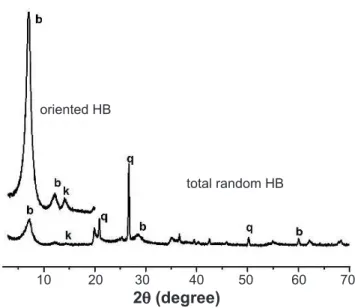
Fig. 1 shows the X-ray diffraction of Na-beidellite (HB)
in random and oriented conditions. The beidellite was the principal clay mineral composition with small amount of kaolinite as a clay mineral and quartz as impurity. Oriented conditions identiied better (001) and (002) relexions of beidellite (at 7.1 and 14.2°, 2q) and (001) relexion of kaolinite (at 12.7°, 2q) [16, 17]. The structural formulae calculated from chemical analysis was: (Si6.96Al1.04)(Al3.96Fe0.04Mg0,02)
(Na0.90K0.02)O10(OH)2. The irst term in parenthesis of the formula indicates the chemical composition of the tetrahedral sheet, while the second parenthesis corresponds to the octahedral sheet of beidellite.
Fig. 2 shows DTA-TG analysis of the beidellite-Na (HB) previous to OH-Cr modiication. The irst endothermic peak at 145 °C corresponded to the dehydration of the beidellite clay mineral (water intercalated between layers). The size, shape and temperature of this peak depend on the saturating interlayer cation [18], in this case Na+ is the main
Figure 2: DTA-TG curves of HB. [Figura 2: Curvas de ATD-TG de HB.]
Figure 1: X-ray diffraction pattern of beidellite, HB. [Figura 1: Difratograma de raios X de beidelita, HB.]
oriented HB
total random HB
-10 10
0
-30
-50 -20
-40
-60
Temperature (ºC) 800
400 1200 1400
200
0 600 1000
DT
A
(a.u.) / TG (wt%)
10
2q (degree) 50
30 70
cation in interlayer position as previously mentioned. The second endothermic dehydroxylation peak of the beidellite corresponded to loss of constitution water and it was situated at 561 °C. The endothermic-exothermic peaks of the beidellite in this case at 1001 and 1021 °C corresponded to the destruction of the lattice and recrystallization into new phases. The mass losses of 8.8% up to 165 °C and 5.10% in the range 485-600 °C, were attributed to dehydration and dehydroxylation of the structure, respectively.
OHCr-beidellite characterization
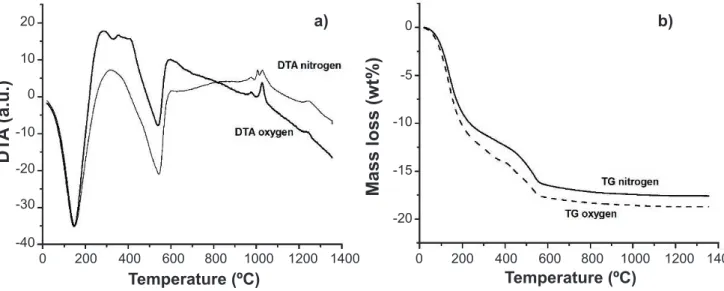
Thermal analysis: complete thermal treatments (DTA-TG) at both atmospheres (oxygen and nitrogen) up to 1350 °C of the beidellite-chromium (OHCr-HB) sample were performed (Fig. 3) before a detailed thermal studies in step way. The endo-exothermic peak values are shown in Table I for a better comparison. The dehydration temperatures in oxygen and nitrogen atmospheres were similar (146 and 150 °C, respectively) and dehydroxylation
peaks were shifted slightly from 561 °C for HB to 539 and 544 °C for OHCr-HB in oxygen and nitrogen atmospheres, respectively. This kind of peak depends on perfection of stacking of the layers and gross substitution [18, 19]. The exothermic peak in the range of 355-410 °C is related to formation of Cr2O3 in oxygen atmosphere [15]. A new endothermic peak at 1243 °C for beidellite-chromium in
oxygen and two peaks for the same sample but in nitrogen atmosphere (1005 and 1248 °C), regarding to untreated
beidellite, appeared and they were analyzed in the following section by using XRD analysis. The total mass losses obtained by thermal gravimetric analysis of the samples heated at both atmosphere were similar (18.5% and 17.6% in oxygen and nitrogen atmosphere, respectively, Fig. 3b) and higher than the raw material (12.9%, Fig. 2), attributed to loss of OH- come from OH-Cr species in interlayer position, because they occurred at temperatures lower than 600 °C. For analyzing the possible structural modiications due to different thermal treatment, both samples were heated in oxygen and nitrogen atmospheres at a deined temperature (400, 1000, 1050, 1250 and 1300 °C) taking into account the main changes in thermal analysis (Fig. 3a).
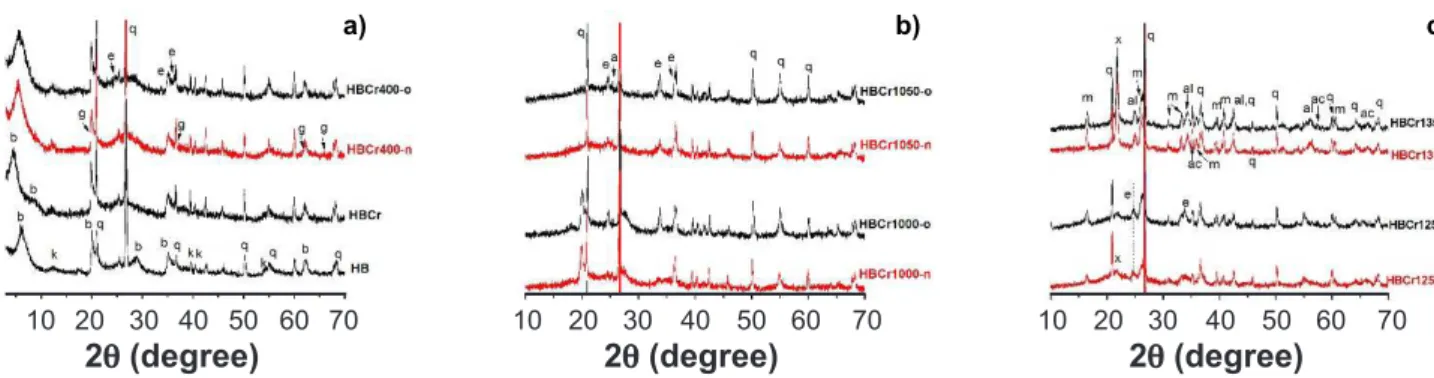
X-ray diffraction of samples at different thermal treatment: Fig. 4 and Table II show the X-ray diffraction and developed phases, respectively, of the OH-Cr-beidellite after different thermal treatments. Diffractograms of the HB and OH-Cr-HB without treatment were included for comparison. As commented the HB was constituted by beidellite, kaolinite and quartz as impurity. The initial interlayer spacing d(001) of HB sample was 14.3 Å (7.10°, 2q) and it increased up to 21.2 Å after OH-Cr species intercalation. This behavior is due to the Na+ in interlayer cations was exchanged by OH-Cr cation specie. The 21.2 Å value is equivalent to a separate distance between layers of the 11.7 Å (21.2-9.5, 2:1 layer
Figure 3: DTA (a) and TG (b) curves of OHCr-HB heated in oxygen and nitrogen atmospheres up to 1350 °C.
[Figura 3: Curvas de ATD (a) e TG (b) de OHCr-HB aquecida em atmosferas de oxigénio e nitrogênio até 1350 ºC.]
-10 -10
-5 20
10
0
0
-30 -20
-20 -15
-40
Temperature (ºC) Temperature (ºC)
800 800
400 1200 1400 400 1200 1400
200 200
0 600 1000 0 600 1000
DT
A
(a.u.)
Mass loss (wt%)
a) b)
Sample End Exo End End Exo Exo Exo
HB 144 -- 561 1001 -- 1021
--OHCrHB-oxy 146 355-410 539 1002 -- 1029 1243
OHCrHB-nitr 145 -- 544 991 1005 1028 1248
Table I - Endothermic and exothermic peak temperatures (°C) of the samples after thermal analysis.
thickness). Taken into account that the trimeric species is the principal ones, (Cr3(OH)4(H2O)9)5+ in the prepared OH-Cr solution, and the height of the constituent octahedral of such species is 5.43 Å [15], the arrangement species in interlayer spacing can be in two horizontal sheets.
The heating up to 400 °C of the OH-Cr-HB (HBCr-400),
shifted the value from 21.2 to 14.0 and 18.6 Å depending on treatment in oxygen or nitrogen atmospheres, respectively. This different reduction in spacing is indicative of a different modiication of the Cr species with temperature. The diffractogram of OHCr-HB heated at 400 °C in oxygen (HBCr400-o, Fig. 4a) showed the presence of the eskolaite, α-Cr2O3 [5], ‘e’ in diffractogram, which is in concordance with the occurrence of exothermic peak at 355-410 °C (Fig. 3a) [11, 12]. Howard and Taylor [20] observed occurrence of opalescence with Cr2O3 formation with exothermic behaviour of Cr(III). Such phase was not present in beidellite-chromium heated in nitrogen atmosphere (HBCr400-n), and grimaldite (CrO-OH) has been observed. Eskolaite peaks at 24.49, 33.59 and 36.18° (2q) and grimaldite peaks at 19.86, 37.28 and 60.1° (2q) can be observed in Fig. 4a. This behavior could be associated with the different dehydration degree of the OH-Cr species situated in interlayer position. The eskolaite and grimaldite remained in oxygen and nitrogen atmosphere heated samples at 1000 °C, respectively (Fig. 4b). A very important change was observed after 1050 °C heating of the beidellite chromium at both atmospheres.
They showed the same crystalline phases (quartz, eskolaite and anatase). The exothermic peak at 1005 °C of sample in nitrogen atmosphere (Fig. 3, Table I) originated the eskolaite, and disappearance of grimaldite. The heating at 1250 °C originated new phases: cristobalite and mullite appeared due to exothermic peak at 1243-1248 °C (Fig. 3, Table I, Fig. 4c). Such phases increased at 1350 °C, quartz remained, the eskolaite disappeared and new phases, aluminum oxide (Al2O3) and aluminum-chromium oxide [(Al,Cr)2O3] with low chromium content, were present in both samples (Fig. 4c, Table II).
The incorporation of chromium to smectite, with high aluminum in tetrahedral sheet such as a beidellite, originated a ceramic material at 1350 °C containing mullite (3SiO2.2Al2O3) and two types of corundum: Al2O3 and (Al,Cr)2O3. According to published papers [21-23], it is known that Al2O3 and (Al,Cr)2O3 offer good high-temperature characteristics with respect to oxidation resistance, strength and chemical stability, whereas the 3SiO2.2Al2O3 also has excellent high-temperature properties. Therefore, future studies may allow the evaluation of mullite, aluminum oxide and aluminum-chromium oxide contents in ceramic materials prepared from different chromium-treated clay minerals.
CONCLUSIONS
OHCr-beidellite treated thermally in oxygen and nitrogen Figure 4: X-ray diffraction patterns of HB, and OHCr-HB heated at different temperatures (natural, 400, 1000, 1050, 1250 and 1350 °C) in
oxygen and nitrogen atmospheres. b: beidellite; k: kaolinite; g:grimaldite; a: anatase; m: mullite; q: quartz; x: cristobalite; e: eskolaite; al: aluminum oxide; ac: aluminum-chromium oxide (Al,Cr)2O3.
[Figura 4: Difratogramas de raios X de HB e OHCr-HB aquecida em diferentes temperaturas (natural, 400, 1000, 1050, 1250 e 1350 °C) em
atmosferas de oxigênio e nitrogênio. b: beidelita; k: caulinita; g: grimaldita; a: anatásio; m: mulita; q: quartzo; x: cristobalita; e: eskolaita;
al: óxido de alumínio; ac: óxido de alumínio e crômio (Al,Cr)2O3.]
10
2q (degree) 50
30 70
20 40 60
10
2q (degree) 50
30 70
20 40 60
a)
10
2q (degree) 50
30 70
20 40 60
c) b)
Temperature (°C) O2 atmosphere N2 atmosphere
400 b k q e b k q g a
1000 q e a q g e
1050 q e a q - e a
1250 q e - x m q - e - x m
1350 q - - x m al ac q - - - x m al ac
Table II - Phases of OHCr-HB after thermal treatments.
[Tabela II - Fases de OHCr-HB após tratamentos térmicos.]
b: beidellite; k: kaolinite: q: quartz; g: grimaldite; e: eskolaite (Cr2O3); m: mullite; x: cristobalite; a: anatase; al: aluminum oxide;
atmospheres showed structural differences up to 1000 °C and above 1050 °C the mineralogical phases were the same. The intercalated Cr-species on beidellite at room temperature originated an increase in interlayer spacing in beidellite. The treatment at low temperature (400 °C), eskolaite (Cr2O3) was developed when the heating was in oxygen atmosphere, and grimaldite (CrO-OH) in nitrogen atmosphere, together with starting phases (beidellite, kaolinite and quartz). At 1000 °C the clay minerals (beidellite and kaolinite) disappeared and the other phases remained. Cr-beidellite in oxygen and nitrogen atmospheres since 1050 °C showed the same behaviour up to 1350 °C (maximum temperature in this work). At 1050 °C, quartz and eskolaite were the main phases and at 1250 °C mullite and cristobalite developed. Finally, at 1350 °C, quartz, cristobalite and mullite were the main phases, eskolaite disappeared and Al2O3 and (Al,Cr)2O3 were present.
ACKNOWLEDGMENT
This paper is dedicated to Prof. Dr. Pérsio de Souza Santos, who was one of those who proposed this contribution. We are grateful to have met a great person and one of the greatest researchers in the clay’s world.
REFERENCES
[1] D.M. MacEwan, M.J. Wildson, in: Crystal structure of clay minerals and X-ray identiication, G.W. Brindley, G. Brown, Eds., Mineral. Soc., London (1980) 197.
[2] J.L. Suter, M. Sprik, E.S. Boek, Geochim. Cosmochim. Acta 91 (2012) 109.
[3] G.D. Yuan, B.K.G. Theng, G.J. Churchman, W.P. Gates,
in: Handbook of clay science, 2nd Ed.; F. Bergaya, G. Lagaly, Eds., Elsevier, Amsterdam B (2013).
[4] L. Bouna, B. Rhouta, L. Daoudi, F. Maury, M. Amjoud, F. Senocq, M.C. Lafont, A. Jada, A.A. Aghzzaf, Clays Clay Miner. 60 (2012) 278.
[5] H. Souza Santos, P. Souza Santos, Cerâmica 41 (1995)
141.
[6] P. Souza Santos, Ciencia e tecnologia de argilas, v. 2, Edgar Blucher, S. Paulo (1992) 506.
[7] D.E.W. Vaughan, R.J. Lussier, in: Proc. 5th Int. Zeolite
Conf., L.V.C. Rees (Ed.), Heyden Press, London (1980) 94. [8] T.J. Pinnavaia, M.S. Tzou, S.D. Landau, J. Am. Chem. Soc. 107 (1985) 4783.
[9] R.T. Yang, L.S. Cheng, in: Access in nanoporous materials, T.J. Pinnavaia, M.F. Thorpe, Eds., Plenum Press, New York (1995) 73.
[10] C. Volzone, L.B. Garrido, J. Ortiga, E. Pereira, in: Desarrollo de adsorbentes para la separación de gases, F. Rodríguez Reinoso, P. Andreu, Eds., CYTED, España (1998) 97.
[11] C. Volzone, Clays Clay Miner. 43 (1995) 377.
[12] C. Volzone, A.M. Cesio, Mater. Chem. Phys. 48 (1997)
216.
[13] C. Volzone, A.M. Cesio, J. Mater. Sci. Lett. 14 (1995)
658.
[14] C. Volzone, A.M. Cesio, R.M. Torres Sánchez, E. Pereira, Clays Clay Miner. 41 (1993) 702.
[15] H.L. Stunzi, L. Spiccia, F.P. Rotzinger, W. Marty, Inorg. Chem. 28 (1989) 66.
[16] E. Ferrage, B. Lanson, L.J. Michot, J.L. Robert, J. Phys. Chem. C 114 (2010) 4515.
[17] J.A. Greathouse, R.T. Cygan, Environ. Sci. Technol. 4
(2006) 3865.
[18] R.C. Mackenzie, Caillere, in: Data handbook for clay materials and other nonmetallic minerals, H. van Olphen, J.J. Fripiat, Eds., Pergamon, Oxford (1979) 243.
[19] R.H. Loeppert, M.M. Mortland, Clays Clay Miner. 27
(1979) 373.
[20] J. Howard, H.S. Taylor, Am. Chem. Soc. 56 (1934) 2259.
[21] F. Bondioli, A.M. Ferrari, C. Leonelli, T. Manfredini, L. Linati, P. Mustarelli, J. Am. Ceram. Soc. 83 (2000) 2036. [22]S. Ponmudi, R. Sivakumar, C. Sanjeeviraja, Int. Conf. Cond. Matter Appl. Phys. (ICC 2015), AIP Conf. Proc. 1728, 020288-1.
[23] H. Schneider, R.X. Fischer, J. Schreuer, J. Am. Ceram. Soc. 98 (2015) 2948.
(Rec. 08/01/2017, Rev. 04/04/2017, Ac. 28/04/2017)