Preparation of Zinc Tungstate (ZnWO
4) Particles by Solvo-hydrothermal Technique and
their Application as Support for Inulinase Immobilization
Eric da Cruz Severoa, Ederson Rossi Abaidea, Chayene Gonçalves Anchietaa, Vitória Segabinazzi
Fo-lettob, Caroline Trevisan Webera, Tais Bisognin Garleta, Gabriela Carvalho Collazzoa, Marcio Antonio
Mazuttia, André Gündelc, Raquel Cristine Kuhna*, Edson Luiz Folettoa
aDepartment of Chemical Engineering, Federal University of Santa Maria – UFSM, 97105-900, Santa
Maria, RS, Brazil
bPharmacy Undergraduate Course, Federal University of Santa Maria – UFSM, 97105-900, Santa
Maria, RS, Brazil
cFederal University of Pampa – UNIPAMPA, University Campus, 96413-170, Bagé, RS, Brazil
Received: February 05, 2015; Revised: July 14, 2015; Accepted: September 01, 2015
ZnWO4 particles were synthesized as a single-phase by a simple and easy solvo-hydrothermal technique using water-ethylene glycol mixture as solvent, without using surfactant. Physical properties
of produced particles were analyzed by X-ray difraction (XRD), infrared spectroscopy (FTIR), surface area (BET), particles size distribution and atomic force microscopy (AFM). This material was used as support for inulinase immobilization by physical adsorption and the inluence of temperature (30 and
50 oC) was evaluated. Material with mesoporous characteristic and with a surface area of 35.5 m2.g-1
was obtained. According to the indings, ZnWO4 present a satisfactory inulinase adsorption, and the
better result was 605 U.g-1 support at 30 oC. Therefore, ZnWO
4 particles prepared by one-step solvo/
hydrothermal route provide a new potential support for inulinase immobilization.
Keywords: ZnWO4, synthesis, characterization, inulinase, immobilization
1. Introduction
Metal tungstates with formula MWO4 (where M is a
divalent metal ion) are important ceramic materials that have high application potential in various technological ields1,2.
Speciically zinc tungstate (ZnWO4) have attracted attention
due to its unique physical and chemical properties, possessing
a high application potential in various ields, such as scintillator
material3, photoluminescence4, electronic and optical properties5,
photovoltaic property6, humidity sensor7, hydrogen sensor8,
ether sensor9, photocatalyst10 and high-power lithium-ion
batteries11. In this work, a new application is proposed for
the ZnWO4 oxide, as support for enzymes immobilization.
The use of enzymes has been increased in the last years
due the variety application such as food production, medicine, textile and pharmaceutical12. Immobilization presents some
advantages such as lowering downstream purification requirements because the products are easily removed from the immobilized enzymes13 and lowering the costs because
enzyme can be reuse. Enzymes are supported in solid matrix
for the immobilization by a variety of methods such as physical and chemical mechanisms12. The physical adsorption
of enzyme12,14 is entrapment on porous matrix, and in the
chemical immobilization enzyme is attachment by covalent bonds15 and cross-linking between enzyme and matrix16. The
immobilization by adsorption usually preserves the catalytic activity of the enzyme17, therefore, sometimes during its use
the immobilized enzyme can be lost when the interactions
between adsorbent and enzyme are relatively weak17,18, and
in this case, the support can be reused. Inulinases are enzymes
useful on industrial processes, which can be applied for the
production of sugars. It may produce high fructose syrups
by enzymatic hydrolysis, and are used for the production of fructooligosaccharides, which are functional food ingredients.
Inulinase has been immobilized by adsorption on diferent
supports such as grafted alginate beads19, aminated non-porous
silica20 and chitin21. However, the inulinase immobilization
using the ZnWO4 oxide as support has not been explored yet.
ZnWO4 particles have been synthesized by various
routes such as polymerized complex method22, microwave
assisted technique23, hydrothermal24, ligand-assisted
hydrothermal25, template-free hydrothermal26, solid-state
reaction27, polyol-mediated synthesis28, solid-state metathetic
approach29, mechanochemical synthesis30, sol–gel31, calcining
co-precipitated precursor32 and combustion method33, electrodeposition34 and high direct voltage electrospinning process35. In this work, ZnWO4 particles were prepared by the one-step solvo/hydrothermal method due be simple, easy, mild reaction temperature, and environmentally friendly, because use not surfactant.
In this context, we aimed prepare ZnWO4 particles by
one-step solvo-hydrothermal route and investigate their ability as support for inulinase immobilization.
2. Experimental Procedure
2.1 Preparation and characterization of ZnWO
4ZnWO4 support was prepared by solvo/hydrothermal method
using sodium tungstate (Na2WO4.2H2O) and zinc chloride
(ZnCl2) as starting materials. For the material synthesis, 0.14
containing deionized water and ethylene glycol (1:1, v/v), under magnetic stirring by 30 min. The same procedure was taken to ZnCl2, however using 0.13 g. The sodium tungstate
solution was added into the zinc chloride solution under
magnetic stirring. Then the resulting homogeneous solution was transferred into Telon-lined stainless-steel autoclave. This autoclave was sealed and maintained at 180 ºC for 24 h and then cooled to room temperature. The obtained white
powers were collected and washed with deionized water and ethanol for several times to remove impurities, and then the
product was dried at 110 ºC for 4 h.
ZnWO4 particles were characterized by X-ray difraction
(XRD), Fourier transform infrared spectroscopy (FTIR), BET
surface area measurement, particles size distribution and
atomic force microscopy (AFM). X-ray difraction patterns were obtained using a Rigaku Minilex 300 difractometer. The X-ray source was Cu-Kα radiation, powered at 30 kV and 10 mA. Data were collected over the 2θ range 10–70º with a step size of 0.03º and a count time of 0.9 s per step. By
means of infrared spectroscopy, Fourier transform infrared
spectra (FTIR) for all samples pressed into KBr pellets (10 mg zinc tungstate/300 mg KBr) were recorded by a Shimadzu IR-Prestige-21 spectrometer. IR spectra were measured in the range 3700-475 cm-1. Nitrogen adsorption–desorption
isotherms were obtained from nitrogen adsorption isotherms
at 77 K, carried out on an ASAP 2020 apparatus at relative pressure (P/P0) ranging from 0 to 0.99. The particle size
distributionof sample was measured using a laser particle
size analyzer (Mastersizer 2000). The morphology of particles was examined by atomic force microscopy (AFM) (Agilent Technologies 5500 equipment). Before analysis,
the sample was sonicated in acetone for 15 min to break up the possible agglomerates, and then dropped onto a freshly
cleaved mica substrate. AFM image was acquired at room
temperature, in non-contact mode using high resolution
probes SSS-NCL (Nanosensors, force constant = 48 N.m-1,
resonance frequency = 154 kHz). Image was captured and analyzed using PicoView 1.14.4 software (Molecular Imaging Corporation, USA).
2.2 Enzyme immobilization assays
Adsorption experiments were carried out to investigate the inulinase immobilization from aqueous solution. Commercial inulinase was obtained from Aspergillus niger (fructozyme, exo-inulinase EC 3.2.1.80 and endo-inulinase EC 3.2.1.7) was purchased from Sigma-Aldrich. The inluence of temperature (30 and 50 oC) on the immobilization process
was investigated. The adsorption of inulinase was performed using a batch technique. Typically, ZnWO4 (0.025 g)
were placed in Erlenmeyers lasks containing of inulinase solution (1.3 % v/v) in sodium acetate bufer (pH 4.8) and 1:400 of adsorbent:adsorbate ratio. The resulting solution was maintained under agitation (150 rpm), and then an aliquot of the aqueous solution was taken at various time intervals and iltered through a polyvinylidene diluoride (PVDF) membrane (0.22 μm) before analysis. The inulinase
activity in the aqueous solution was determined according
to section 2.3.
2.3 Inulinase Activity Assay
An aliquot of the enzyme (0.5 mL) was incubated with sucrose solution (4.5 mL, 2% w/v) in sodium acetate bufer (0.1 M, pH 4.8) at 50 °C. Released reducing sugars were measured by the
3.5-dinitrosalicylic acid method36. A separate blank was set
up for each sample to correct for the non-enzymatic release
of sugars. One unit of inulinase activity was deined as the
amount of enzyme necessary to hydrolyze 1 µmol of sucrose
per minute under the mentioned conditions (sucrose as a substrate). The inulinase immobilization capacity (Qt) was determined using the Equation (1).
( )
Q
tA
m
A V
1
t 0
=
]
-
g
Where: Ao and At (U.mL-1) are the inulinase activities
at t = 0 and time t, respectively; V (mL) is the volume of
solution, and m (g) is the mass of support.
3. Results and discussion
The XRD pattern of the ZnWO4 prepared through
solvo/hydrothermal process is shown in Figure 1. The XRD peaks of ZnWO4 sample can be assigned to monoclinic
ZnWO4, accordingly to JCPDS (Joint Committee on Powder
Difraction Standards) card No. 73-544, indicating that the synthesized sample is single-phase. The major difraction peaks at 2θ of 18.89o, 30.44 o, 36.43o and 53.6o correspond
to the (100), (111), (002) and (221) planes of ZnWO4. The
average crystallite size of ZnWO4 was calculated by the Scherrer equation37:
( )
cos
D
h
K
1
2
2
$
$
i
m
=
where D is the average crystallite size, K is the Scherrer
constant (0.90), λ is the wavelength of the X-ray radiation
(0.1541 nm for Cu-Kα ), h1/2 is the peak width at half height
and θcorresponds to the peak position (in the current study, 2θ= 30.44o). The average crystallite size of ZnWO
4 sample
was 11 nm.
The nitrogen adsorption–desorption isotherms and pore
size distribution corresponding to ZnWO4 support are depicted
in Figure 2. The nitrogen adsorption-desorption isotherms (Fig. 2a) showed weak adsorption at low relative pressure
and a H1-type hysteresis loop at higher relative pressure
(P/P0 = 0.70–0.90). This suggests that the material presents
mesoporosity, which can be attributed to the interparticle pores due to the crystallites agglomeration. According to
the IUPAC classiication, the isotherms are type IV and typical of mesoporous solids. Pore size distribution (Figure 2b) consisted of one wide peak centered at around 15 nm. The Brunauer Emmett-Teller (BET) surface area, average
pore size and total pore volume of the ZnWO4 sample were
Figure 1: XRD pattern of ZnWO4 powders prepared by solvo/ hydrothermal crystallization. Inset at igure: ZnWO4 reference according to JCPDS card No. 73-544.
Figure 2: (a) Nitrogen adsorption–desorption isotherms and (b) pore size distribution curve of ZnWO4 support.
physical characteristics regarding the pores structure are essential for immobilization purposes by adsorption process.
The particle size distribution pattern for the zinc tungstate
obtained by the solvo-hydrothermal technique was expressed
on a logarithmic scale, as shown in Figure 3. The particles size for the oxide sample range between 0.30 µm and 240 µm, resulting in an average size of 26 µm. These particle
Figure 3: Particle size distribution plot for zinc tungstate prepared by the solvo-hydrothermal route.
sizes in micrometric scale can explain the mesoporosity of material due to a variety of accumulated pore voids among the particles formed by the agglomeration of crystallites.
Thus this mesoporous structure can be interesting for enzyme
immobilization purposes.
Figure 4 shows the morphology of some isolated particles
of ZnWO4 oxide measured by atomic force microscopy
(AFM). The average size of particles was around 0.30 µm.
Also, it is possible to observe that the particles present an irregular shape.
Figure 4: AFM image of some isolated particles of ZnWO4 sample
after sonication.
In order investigate the immobilization of enzyme
on the ZnWO4 support, FTIR spectra of ZnWO4 support, immobilized enzyme on the support and free enzyme
were recorded (Figure 5). The ZnWO4 support (Figure 5a)
shows main absorption bands between 475 and 1000 cm−1
38. The bands to 820 and 880 cm−1 are due to the stretching modes of W–O bonds. The bands at 600 and 700 cm−1 are assigned to Zn–O–W bonds. Bands at 1600 and 3400 cm-1
Figure 5: FTIR spectra of (a) ZnWO4 support, (b) immobilized
enzyme on the ZnWO4 support and (c) free enzyme.
sample. These results indicate the formation of ZnWO4 single
phase, corroborating to the results from XRD analysis. Bands around 2300 cm-1 are assigned to the adsorbed atmospheric
CO2. Inulinase free (Figure 5c) shows bands associated with
amino groups (CONH) at 1400-1600 cm-1 39,40. Bands around
1000cm-1 correspond to –C = O binding of enzyme on the
support. These bands are also displayed in the spectrum of the immobilized enzyme on the support (Figure 5b), conirming
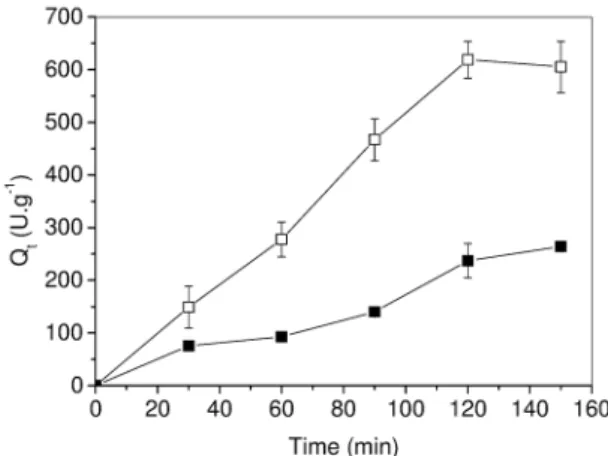
the immobilization of inulinase on the ZnWO4 support. According to the results of inulinase immobilization shown in Figure 6, it is possible to observe that the adsorption equilibrium was obtained in 120 min for both temperatures
(30 and 50 oC). Figure 6 also demonstrates that the increase
of the temperature had a negative efect in the improvement
of enzyme adsorption, with loading capacity of 605 U.g-1
support and 264 U.g-1 support at 30 and 50 oC, respectively.
For comparison purposes,Missau et al.16 found similar results
regarding the inulinase immobilization on alginate-chitosan beads, achieving 668 U.g-1 gel beads at 50 oC. Grafted alginate
beads showed an inulinase loading capacity of 530 U.g-1 gel
beads19. Chitin21 and silica41 were used as inulinase supports,
reaching 291 U.g-1 chitin and 43 U.g-1 silica, respectively.
Therefore, these indings indicate that the ZnWO4 particles
present satisfactory inulinase immobilization, which can be attributed to their porous structure.
4. Conclusions
ZnWO4 powders were successfully synthesized through one-step solvo-hydrothermal crystallization at a mild
temperature, without using additives. ZnWO4 particles
presented porous structure with surface area of 35.5 m2.g-1.
Inulinase could be successfully immobilized using ZnWO4
particles. Temperature had a signiicant efect on enzyme immobilization process. In the best condition, the enzyme
loading capacity was 605 U.g-1 at 30 oC using 1.3% (v/v)
enzyme concentration and a 1:400 adsorbent:adsorbate
ratio. Therefore, the ZnWO4 support prepared in this work
shows attractive physical characteristics for the potential application on inulinase immobilization.
Figure 6: Inulinase adsorption capacity (U.g-1) on ZnWO
4 particles at () 30 oC and (■) 50 oC.
5. Acknowledgments
The authors would like to thank CAPES and CNPq for their inancial support and scholarships.
6. References
1. Zawawi SMM, Yahya R, Hassan A, Mahmud HNME, Daud MN. Structural and optical characterization of metal tungstates (MWO4; M=Ni, Ba, Bi) synthesized by a sucrose-templated
method. Chemistry Central Journal. 2013;7(1):80.
2. Kumar RD, Karuppuchamy S. Microwave-assisted synthesis of copper tungstate nanopowder for supercapacitor applications.
Ceramics International. 2014;40(8):12397-12402.
3. Bavykina I, Angloher G, Hauf D, Kiefer M, Petricca F, Pröbst F. Development of cryogenic phonon detectors based on CaMoO4
and ZnWO4 scintillating crystals for direct dark matter search
experiments. Optical Materials. 2009;31(10):1382-1387.
4. Kalinko A, Kuzmin A. Raman and photoluminescence spectroscopy of zinc tungstate powders. Journal of Luminescence. 2009;129(10):1144-1147.
5. Brik MG, Nagirnyi V, Kirm M. Ab-initio studies of the electronic and optical properties of ZnWO4 and CdWO4 single crystals. Materials
Chemistry and Physics. 2012;134(2-3):1113-1120.
6. Kim DW, Cho IS, Shin SS, Lee S, Noh TH, Kim DH, et al. Electronic band structures and photovoltaic properties of MWO4 (M =
Zn, Mg, Ca, Sr) compounds. Journal of Solid State Chemistry. 2011;184(8):2103-2107.
7. You L, Cao Y, Sun YF, Sun P, Zhang T, Du Y, et al. Humidity sensing properties of nanocrystalline ZnWO4 with porous structures.
Sensors and Actuators B: Chemical. 2012;161(1):799-804.
8. Tang Z, Li X, Yang J, Yu J, Wang J, Tang Z. Mixed potential hydrogen sensor using ZnWO4 sensing electrode. Sensors and Actuators B: Chemical. 2014;195:520-525.
9. Cao X, Wu W, Chen N, Peng Y, Liu Y. An ether sensor utilizing cataluminescence on nanosized ZnWO4. Sensors and Actuators
B: Chemical. 2009;137(1):83-87.
10. Fu H, Pan C, Zhang L, Zhu Y. Synthesis, characterization and photocatalytic properties of nanosized Bi2WO6, PbWO4 and ZnWO4
11. Zhang L, Wang Z, Wang L, Xing Y, Zhang Y. Preparation of ZnWO4/graphene composites and its electrochemical properties for lithium-ion batteries. Materials Letters. 2013;108:9-12.
12. Daoud FBO, Kaddour S, Sadoun T. Adsorption of cellulase
Aspergillus niger on a commercial activated carbon: Kinetics
and equilibrium studies. Colloids and Surfaces B: Biointerfaces. 2010;75(1):93-99.
13. Fernandes P, Marques MPC, Carvalho F, Cabral JMS. A simple method for biocatalyst immobilization using PVA-based hydrogel particles. Journal of Chemical Technology and Biotechnology. 2009;84(4):561-564.
14. Garlet TB, Weber CT, Klaic R, Foletto EL, Jahn SL, Mazutti MA, et al. Carbon nanotubes as supports for inulinase immobilization.
Molecules. 2014;19(9):14615-14624.
15. Elnashar MMM, Danial EN, Awad GEA. Novel carrier of grafted alginate for covalent immobilization of inulinase. Industrial & Engineering Chemistry Research. 2009;48(22):9781-9785.
16. Missau J, Scheid AJ, Foletto EL, Jahn SL, Mazutti MA, Kuhn RC. Immobilization of commercial inulinase on alginate–chitosan beads. Sustainable Chemical Processes. 2014;2(1):13.
17. Brena B, González-Pombo P, Batista-Viera F. Immobilization of enzymes: A literature survey. Methods in Molecular Biology. 2013;1051:15-31.
18. Feng W, Ji P. Enzymes immobilized on carbon nanotubes.
Biotechnology Advances. 2011;29(6):889-895.
19. Danial EN, Elnashar MMM, Awad GEA. Immobilized inulinase on grafted alginate beads prepared by the one-step and the two-steps methods. Industrial & Engineering Chemistry Research.
2010;49(7):3120-3125.
20. Karimi M, Chaudhury I, Jianjun C, Safari M, Sadeghi R, Habibi-Rezaei M, et al. Immobilization of endo-inulinase on non-porous amino functionalized silica nanoparticles. Journal of Molecular Catalysis B: Enzymatic. 2014;104:48-55. 21. Nguyen QD, Rezessy-Szabó JM, Czukor B, Hoschke Á. Continuous
production of oligofructose syrup from Jerusalem artichoke juice by immobilized endo-inulinase. Process Biochemistry. 2011;46(1):298-303.
22. Ryu JH, Lim CS, Auh KH. Synthesis of ZnWO4 nanocrystalline
powders, by the polymerized complex method. Materials Letters. 2003;57(9-10):1550-1554.
23. Kumar RD, Karuppuchamy S. Synthesis and characterization of nanostructured Zn-WO3 and ZnWO4 by simple solution growth technique. Journal of Materials Science: Materials in Electronics. 2015;26(5):3256-3261.
24. Arin J, Dumrongrojthanath P, Yayapao O, Phuruangrat A, Thongtem S, Thongtem T. Synthesis, characterization and optical activity of La-doped ZnWO4 nanorods by hydrothermal method. Superlattices and Microstructures. 2014;67:197-206. 25. Kim MJ, Huh YD. Ligand-assisted hydrothermal synthesis of ZnWO4 rods and their photocatalytic activities. Materials
Research Bulletin. 2010;45(12):1921-1924.
26. Hojamberdiev M, Zhu G, Xu Y. Template-free synthesis of ZnWO4
powders via hydrothermal process in a wide pH range. Materials Research Bulletin. 2010;45(12):1934-1940.
27. Kumar GB, Sivaiah K, Buddhudu S. Synthesis and characterization of ZnWO4 ceramic powder. Ceramics International. 2010;36(1):199-202. 28. Ungelenk J, Speldrich M, Dronskowski R, Feldmann C. Polyol-mediated low-temperature synthesis of crystalline tungstate nanoparticles MWO4 (M = Mn, Fe, Co, Ni, Cu, Zn). Solid State
Sciences. 2014;31:62-69.
29. Parhi P, Karthik TN, Manivannan V. Synthesis and characterization of metal tungstates by novel solid-state metathetic approach. Journal of Alloys and Compounds. 2008;465(1-2):380-386.
30. Mancheva M, Iordanova R, Dimitriev Y. Mechanochemical synthesis of nanocrystalline ZnWO4 at room temperature. Journal of Alloys
and Compounds. 2011;509(1):15-20.
31. Wu Y, Zhang SC, Zhang LW, Zhu YF. Photocatalytic Activity of Nanosized ZnWO4 Prepared by the Sol-gel Method. Chemical
Research in Chinese Universities. 2007;23(4):465-468.
32. Huang G, Zhu Y. Synthesis and photocatalytic performance of ZnWO4 catalyst. Materials Science and Engineering: B. 2007;139(2-3):201-208.
33. Dong T, Li Z, Ding Z, Wu L, Wang X, Fu X. Characterizations and properties of Eu3+-doped ZnWO
4 prepared via a facile
self-propagating combustion method. Materials Research Bulletin. 2008;43(1):1694-1701.
34. Rahimi-Nasrabadi M, Pourmortazavi SM, Ganjali MR, Hajimirsadeghi SS, Zahedi MM. Electrosynthesis and characterization of zinc tungstate nanoparticles. Journal of Molecular Structure. 2013;1047:31-36.
35. Keereeta Y, Thongtem T, Thongtem S. Fabrication of ZnWO4 nanoibers by a high direct voltage electrospinning process. Journal of Alloys and Compounds. 2011;509(23):6689-6695.
36. Miller GL. Use of dinitrosalicylic acid reagent for determination of reducing sugar. Analytical Chemistry. 1959;31(3):426-428.
37. Jenkins R, Snyder RL. Introduction to X-ray powder difractometry.
New Jersey: John Wiley & Sons; 1996. 432p.
38. Yu C, Yu JC. Sonochemical fabrication, characterization and photocatalytic properties of Ag/ZnWO4 nanorod catalyst. Materials Science and Engineering: B. 2009;164(1):16-22.
39. Cipolatti EP, Valério A, Nicoletti G, Theilacker E, Araújo PHH, Sayer C, et al. Immobilization of Candida antarctica lipase B on
PEGylated poly(urea-urethane) nanoparticles by step miniemulsion polymerization. Journal of Molecular Catalysis B: Enzymatic. 2014;109:116-121.
40. Verma ML, Barrow CJ, Kennedy JF, Puri M. Immobilization of β-d-galactosidase from Kluyveromyces lactis on functionalized silicon dioxide nanoparticles: Characterization and lactose hydrolysis. International Journal of Biological Macromolecules. 2012;50(1):432-437.
41.Gaspari JW, Gomes LH, Tavares FCA. Imobilização da inulinase de Kluyveromycesmarxianuspara a hidrólise de extratos de