Rationality and Methods - Registry of Clinical Practice in High-risk
Cardiovascular Patients
Luiz Alberto Piva e Mattos
Sociedade Brasileira de Cardiologia, Rio de Janeiro, RJ - Brazil
Mailing address: Luiz Alberto Piva e Mattos •
Av. Jandira, 550/121 - Moema - 04080-003 - São Paulo, SP - Brazil E-mail: [email protected], [email protected]
Manuscript received December 29, 2010; revised manuscript received February 21, 2011; accepted March 16, 2011.
Abstract
Background: To date, no Brazilian registry has been designed to document the clinical practice regarding assistance to patients at high cardiovascular risk in a large representative sample of research centers, including public and private hospitals nationwide. Thus, this study will identify gaps in the incorporation of interventions with proven benefit in our area.
Objective: To record information on the Brazilian clinical practice with regard to the patients at high cardiovascular risk.
Methods: Registry-type prospective observational study intended to document the current clinical practice applied to outpatients at high cardiovascular risk classified by the presence of one of the following variables: evidence of coronary artery disease, cerebrovascular disease, peripheral vascular disease in diabetics or non-diabetics; or in the presence of at least three of the following cardiovascular risk factors: hypertension, active smoking, dyslipidemia, age over 70 years, chronic kidney disease, family history of coronary artery disease and/or asymptomatic carotid artery disease. Patients will be collected in 43 centers across Brazil, including public and private hospitals, as well as in basic health care units, and clinically reviewed for one year after inclusion.
Results: The findings will be presented one year after the start of collection (September 2011), and consolidated after a meeting with the population to discuss the objectives sought.
Conclusion: The analysis of this multicenter registry will design a horizontal perspective for the treatment of patients suffering from cardiovascular disease in Brazil. (Arq Bras Cardiol. 2011; [online].ahead print, PP.0-0)
Keywords: Evidence-based practice; cardiovascular diseases/epidemiology; risk factors; multicenter studies.
Introduction
Based on systematic reviews of observational evidence (studies of prevalence), the World Health Organization has provided consistent estimates of causes of death by sex and age, in countries and regions. Recent data show that cardiovascular diseases (CVD) are the leading cause of disability and mortality in both sexes, both in Brazil and in the world1-3. Additionally, this rapid growth in developing countries represents one of the most relevant public health issues today, where 80.0% of deaths from chronic diseases (mainly cardiovascular diseases) occur precisely in less privileged regions in the world1-6.
According to forecasts from the classic study Global Burden of Diseases, by Murray and Lopez7 for the year 2020, there are indications that CVD will not only remain the leading cause of death, but will also represent the leading cause of disability, whereas Disability Adjusted Life Years (DALYs) attributable to CVD will increase to about 140 to 160 million, and the higher proportion will come from developing countries.
Within the current concept of cardiovascular prevention, more important than classifying an individual as having diabetes mellitus (DM), hypertension (HTN) or dyslipidemia (DLP), it is to characterize them in terms of cardiovascular risk3. Prevention based on the concept of cardiovascular risk means guiding prevention efforts not for the risks attributable to the increase of isolated factors, such as blood pressure or cholesterol, but the sum of risk due to multiple factors, estimated by overall absolute risk in each individual.
To date, no Brazilian registry has been designed to document the clinical practice regarding assistance to patients at high cardiovascular risk in a large representative sample of research centers, including public and private hospitals nationwide. In this sense, knowing the current clinical practice in the country will identify gaps in the incorporation of evidence-based interventions.
In addition, following up major cardiovascular events, though to a lesser term, it is necessary for the understanding and development of projects for improvement of quality of care in order to reduce such events.
Methods
Piva e Mattos The REACT investigators
Design
Cross sectional observational study (registry) intended to document the clinical practice of managing patients at high cardiovascular risk in the country. Additionally, there will be longitudinal follow-up of these patients in 6 to 12 months.
Eligibility and inclusion criteria
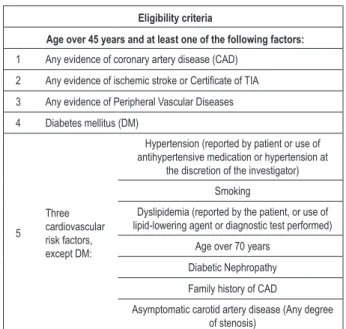
The eligibility of patients for inclusion in this study is described in Box 1.
Exclusion criteria
• Refusal to provide Informed Consent (IC);
• Neurocognitive or psychiatric condition that prevents obtaining reliable clinical data (as judged by investigators); • Life expectancy of less than 6 months (e.g., malignant
metastatic neoplasm or others as clinically judged by investigators).
Sample characteristics and operational lowchart
Data will be collected from 2,305 patients at high cardiovascular risk, after consent, as identified in Public Hospitals and Private Hospitals and Basic Health Units (BHU). Non-probability sampling will be used, including consecutive patients who meet eligibility criteria. Figure 1 shows the flowchart for the analysis and inclusion of patients for participation in this registry.
Details of clinical visits
Index visit - measuring the inclusion and exclusion criteria, demographics, past medical and surgical history, physical examination, approach to the patient about
non-Box 1 - Eligibility criteria for inclusion in the REACT registry
Eligibility criteria
Age over 45 years and at least one of the following factors:
1 Any evidence of coronary artery disease (CAD)
2 Any evidence of ischemic stroke or Certiicate of TIA
3 Any evidence of Peripheral Vascular Diseases
4 Diabetes mellitus (DM)
5
Three
cardiovascular risk factors, except DM:
Hypertension (reported by patient or use of antihypertensive medication or hypertension at
the discretion of the investigator)
Smoking
Dyslipidemia (reported by the patient, or use of lipid-lowering agent or diagnostic test performed)
Age over 70 years
Diabetic Nephropathy
Family history of CAD
Asymptomatic carotid artery disease (Any degree of stenosis)
Figure 1 -Patient recruiting algorithm.
pharmacological measures to reduce cardiovascular risk and adherence to drug therapies based on evidence.
Clinical follow-up visit at 6 and 12 months - checking adherence to evidence-based therapies and the occurrence of major cardiovascular events.
Primary outcome
Piva e Mattos The REACT investigators
(e.g., aspirin, statins, ACE inhibitors), their impact on adherence and late outcomes.
Secondary outcomes
The following events will be recorded:
• Proportion of hypertensive patients with controlled levels according to SBC guidelines;
• Proportion of patients with target levels of LDL according to SBC guidelines;
• Proportion of patients receiving recommendations for quit smoking, physical activity and nutrition guidelines; • Occurrence of serious cardiovascular events
(myocardial infarction, stroke, fatal and non fatal cardiac arrest and cardiovascular mortality) within 12 months, tested in combination and alone.
Sample calculation
In order to detect a proportion of 40% for the occurrence of the primary outcome, considering a sampling error of 2%, an alpha of 5% and a statistical power of 90%, 2,305 patients must be included. This sample size is sufficient to meet the primary objectives of the study, which is feasible within the first year of recruitment.
Statistical analysis
Quantitative variables are expressed as mean and standard deviation in the presence of normal or median distribution and interquartile range in the presence of asymmetric distribution. Qualitative variables are presented in absolute frequencies (number of patients) and relative frequencies (percentage).
The primary and secondary outcomes will be described by an overall percentage, considering all centers, and the percentage prescribed in each center. Also, these will be expressed by means of proportions and their confidence intervals of 95%. Where there is great variability in prescription, a weighted average variance at each center will be generated.
For regression models, we will report the odds ratio (logistic regression) or hazard ratio [HR] (for the regression of Cox proportional hazards), the corresponding standard error, the confidence intervals of 95% and p-values. We will report the p-values up to three decimal places with p-values below 0.001 reported as p < 0.001. In all tests, we will use the two-tailed alpha significance level = 0.05. An examination of residues will provide an assessment of model assumptions for the regression analyses. The Goodness-of-fit test for the models will be performed using appropriate Hosmer-Lemeshov tests. We will carry out all analyses using Stata, version 10.0 (StataCorp. 2007. College Station, TX: StataCorp LP).
Financing
This Registry is owned by the Brazilian Society of Cardiology using funds dedicated to this purpose for its implementation. The Instituto de Ensino e Pesquisa do Hospital do Coração de São Paulo (HCor/ASS) was contracted to implement this registry, under the coordination of the Brazilian Society of Cardiology. The steering committee of the registry is described later in this article.
Quality control and data management
For the quality control of study data the following strategies will be used: initial classroom training, e-CRF and central check of data and tutoring.
Ethical considerations
The clinical trial is being conducted in accordance with the principles of the current revision of the Declaration of Helsinki and the latest version of the Guidelines for Good Clinical Practice (ICH-GCP), as well as Resolution 196/96. The study will be performed according to the local and regulatory legal requirements enforceable in Brazil. The opinion of the Research Ethics Committee of Hospital do Coração approved the study on June 22, 2010, under number 118/2010.
Data collection
Patient inclusion started in July 2010, at 43 participating centers until December 27, 2010; 127 patients had been included. The active recruitment should follow by the end of the third quarter of 2011.
Publishing policy
All presentations of the study and/or publication of findings will be based on clear evidence verified and validated in order to ensure accurate results. Details about the responsibility and sequence of these presentations and/or publications will be defined with the Brazilian Society of Cardiology.
The authorship of publication of the main conclusions of this study will be based the contributions from the study centers in general. All participants in the registry (investigators and committee members) should make an advance delegation of authority to the Brazilian Society of Cardiology and the
Instituto de Ensino e Pesquisa do Hospital do Coração - IEP - HCor for the submission and/or publication of the main findings. Any presentation or publication by any participant in the test should indicate the study and have the approval of the Brazilian Society of Cardiology.
Organization
Main investigators - Luiz Alberto Piva e Mattos and Otávio Berwanger.
Steering committee - Luiz Alberto Piva e Mattos, Jorge Ilha Guimarães, Fábio Sândoli de Brito, Renato A. Kalil. Ângelo V. de Paola, Hélio Penna Guimarães, Alexandre Biasi Cavalcanti.
Coordination of the Institute for Teaching and Research -
Hélio Penna Guimarães, Eliana Vieira Santucci, Luis Paulo Duprat, Karina Normilio da Silva, Alessandra Akiko Kodama. Marcos Thadeu de Tenuta Junior, Ana Denise Zazula.
Intellectual property - Brazilian Society of Cardiology.
Coordination and supervision - Brazilian Society of Cardiology and IEP-HCor.
Research centers
Piva e Mattos The REACT investigators
de Porto Alegre - Centro de DM, Porto Alegre/RS: Beatriz D’ Agord Schaan. Grupo Hospitalar Conceição, Porto Alegre/RS: Elizabete Rosa.Hospital São Lucas da PUCRS, Porto Alegre/RS: Luiz Carlos Bodanese. Santa Casa de Porto Alegre - Hospital São Francisco, Porto Alegre/RS: Paulo Ernesto Leaes. Hospital Moinhos de Vento, Porto Alegre/RS: Eduardo Barbosa. Instituto de Cardiologia - IC-FUC, RS: José Luis da Costa Vieira. Hospital São Vicente, Passo Fundo/RS: Hugo Vargas Filho. Hospital Santa Isabel - Clínica Procárdio, Blumenau/SC: Sergio Luiz Zimmermann. Hospital Costantini, Curitiba/PR: Costantino R Costantini. Hospital de Caridade São Vicente de Paulo, Guarapuava, PR: Stefan Wolanski Negrao. Irmandade Santa Casa de Curitiba, PR: José Augusto Ribas Fortes. Sociedade Hospitalar Angelina Caron, Campina Grande do Sul/PR: Dalton Bertolim Precoma. Hospital do Coração, São Paulo/SP: Otavio Berwanger. Hospital das Clínicas - FMUSP, São Paulo/ SP: Décio Mion. Instituto do Coração de São Paulo - Incor, São Paulo/SP: Luiz Antonio Machado Cesar. Instituto Dante Pazzanese de Cardiologia - Angioplastia Coronária, São Paulo/ SP: Áurea J. Chaves. Instituto Dante Pazzanese de Cardiologia - IMN, São Paulo/SP: Daniel Magnoni. Ambulatório de Especialidades Maria Zélia, São Paulo/SP: Carlos Alberto Machado. Hospital Maternidade Celso Pierro - PUCCAMP, Campinas/SP: José Francisco Kerr Saraiva. Hospital São Paulo - UNIFESP (Disciplina de Clínica Médica), São Paulo/SP: Renato D Lopes. Instituto de Moléstias Cardiovasculares, São José do Rio Preto/SP: Gilmar Valdir Greque. Faculdade Estadual de Medicina de São José do Rio Preto, São José do Rio Preto/SP: Jose Fernando Vilela Martin. HC - Unesp Botucatu, Botucatu/ SP: Ana Lucia Cogni. Hospital Maternidade e Pronto Socorro Santa Lucia, Poços de Caldas/MG: Frederico Toledo Campo Dall’Orto. Nossa Senhora Auxiliadora, Caratinga/MG: Valeria Nunes Martins Michel. Hospital Barra D’Or, Rio de Janeiro/
RJ: João Luiz Fernandes Petriz. Hospital Prontocor, Rio de Janeiro/RJ: Paulo Godoy. Instituto Nacional de Cardiologia, Rio de Janeiro/RJ: Antonio Luiz da Silva Brasileiro. Hospital Escola Álvaro Alvim, Rio de Janeiro/RJ: Felipe Montes Pena. Hospital Instituto de Pesquisa Científica São Bernardo, Colatina/ES: João Miguel Malta Dantas. Hospital do Coração do Brasil, Brasília/DF: Alberto Gomes Taques Fonseca. Hospital da Cidade, Salvador/BA: Marcelo Silveira Teixeira. Hospital Português, Recife/PE: Sergio Montenegro. Procape, Recife/PE: Isly Lucena de Barros. Hospital do Coração do Cariri, Barbalha/CE: Francisco Carleial Feijó de Sá. Hospital de Terapia Intensiva - HTI, Teresina/PI: Paulo Marcio Sousa Nunes. Hospital Getulio Vargas, Teresina/PI: Maurício Batista Paes Landim. Hospital João Pessoa, João Pessoa/PB: Lenine Ângelo Silva. Hospital Universitário da Universidade Federal do Maranhão, São Luis/MA: José Albuquerque de Figueiredo Neto. Universidade Estadual do Pará, Belém/PA: Claudia Abdelnor Hanna Diniz. Hospital Universitário Francisca Mendes, Manaus/AM: Mariano Brasil Terrazas.
Potential Conflict of Interest
No potential conflict of interest relevant to this article was reported.
Sources of Funding
This study was funded by Sociedade Brasileira de Cardiologia.
Study Association
This study is not associated with any post-graduation program.
References
1. World Health Organization. The World Health Report 2005: health systems: improving performance. Geneva: WHO; 2005.
2. Ministério da Saúde. Indicadores de Saúde. [Citado em 2010 mar 9]. Disponível em: http://www.datasus.gov.br.
3. Heart Disease and Stroke Statistics - 2009 Update: a report from the America Subcommittee; Lloyd-Jones D, Adams R, Carnethon M, De Simone G, Ferguson TB, Flegal K, et al. Circulation. 2009;119(3):e21-e181.
4. Avezum A, Guimarães HP, Berwanger O. Aspectos epidemiológicos: educação continuada em pós-infarto do miocárdio. São Paulo: SOCESP; 2004. p. 1-16.
5. Yusuf S, Hawken S, Ounpuu S, Bautista L, Franzosi MG, Commerford P, et al. Obesity and the risk of myocardial infarction in 27,000 participants from 52 countries: a case-control study. Lancet. 2005;366(9497):1640-9.
6. Bonaw RO, Smaha LA, Smith Jr SC, Mensah GA, Lenfant C. World Heart Day 2002 - the international burden of cardiovascular disease: responding to the emerging global epidemic. Circulation. 2002;106(13):1602-5.