1
Original Article
Amiodarone Causes Endothelium-Dependent
Vasodilation in Canine Coronary Arteries
Alfredo José Rodrigues, Paulo Roberto Barbosa Evora, Ayako Maruo, Hartzell V. Schaff
Ribeirão Preto,SP / Mayo Clinic - Rochester, MN, USA
Faculdade de Medicina de Ribeirão Preto - USP, Ribeirão Preto, SP, Brazil, and Mayo Clinic, Rochester, MN, USA
Mailing address: Alfredo José Rodrigues – Campus Universitário – Monte Alegre s/nº - Cep 14048-900 – Ribeirão Preto, SP, Brazil E-mail: [email protected]
Received for publication: 09/01/2003 Accepted for publication: 01/26/2004 English version by Stela Maris Costalonga
Objective
To assess the vasodilating effects of amiodarone on canine coronary arteries by using solutions of amiodarone dissolved in polysorbate 80 or water.
Methods
Rings of coronary arteries, with or without intact endothelium, were immersed in Krebs solution and connected to a transducer for measuring the isometric force promoted by a vascular con-traction. The arteries were exposed to increasing concentrations of polysorbate 80, amiodarone dissolved in water, amiodarone dissolved in polysorbate 80, and a commercial presentation of amiodarone (Cordarone). The experiments were conducted in the presence of the following enzymatic blockers: only indome-thacin, Nω-nitro-L-arginine associated with indomethacin, and
only Nω-nitro-L-arginine.
Results
Polysorbate 80 caused a small degree of nonendothelium-dependent relaxation. Cordarone, amiodarone dissolved in water, and amiodarone dissolved in polysorbate 80 caused endothelium-dependent relaxation, which was greater for amiodarone dissolved in polysorbate and for Cordarone. Only the association of
indo-methacin and Nω-nitro-L-arginine could eliminate the
endo-thelium-dependent relaxation caused by amiodarone dissolved in polysorbate 80.
Conclusion
The results obtained indicate that vasodilation promoted by amiodarone in canine coronary arteries is mainly caused by stimu-lation of the release of nitric oxide and cyclooxygenase-dependent relaxing endothelial factors.
Key words
endothelium, amiodarone, nitric oxide, cyclooxygenase, coronary circulation
Currently, amiodarone is exclusively used as an antiarrhythmic agent. However, it was primarily introduced as a vasodilator for the treatment of angina pectoris 1. Although its vasodilating effect
is well known and frequently evidenced as hypotension after its intravenous use 2,3, the mechanisms responsible for vasodilation
have not been totally clarified. Amiodarone and its metabolite, N-desethylamiodarone, have been shown to cause endothelium-dependent relaxation in human veins 4,5. However, information
about the mechanisms involved in relaxation of systemic arteries, mainly coronary arteries, is still scarce.
In addition to the intrinsic effects of amiodarone, polysorbate 80, a solvent used in commercial amiodarone, may influence the effect of other drugs 6-8, cause histamine release 9, and be
poten-tially harmful to the endothelium 10,11. These effects may be
clini-cally relevant, and have led to the search for other aqueous pre-sentations of amiodarone 12.
The present investigation aimed at assessing the vasodilating effects of amiodarone, as well as those of polysorbate 80, in canine coronary arteries, by using a solution of amiodarone dissolved in polysorbate 80, a solution of amiodarone diluted in water, and a solution of polysorbate 80 diluted in water. To separately assess each of the 2 major pathways of production and release of vaso-dilating endothelial factors (nitric oxide and prostacyclins), the experiments were performed in the presence of the nitric oxide synthetase inhibitor (Nω-nitro-L-arginine), of cyclooxygenase
(in-domethacin), and of both.
Methods
2
with a gas mixture composed of 95% O2 and 5% CO2 (pH = 7.4). Each vascular ring was suspended by 2 stainless steel hooks passed through the lumen of the vessels. One hook was attached to the end of the chamber and the other to the force transducer Statham UC 2 (Gould, Cleveland, Ohio, USA). After stabilization of the preparation, the rings were progressively stretched until the pre-established tension of 10 g.
In all experiments, the absence or presence of intact endothe-lium was assessed through the response to a single dose of ace-tylcholine (10-6 M) after contraction induced by 20 mM of potassium
chloride. Removal of the endothelium was mechanically performed by introducing the arm of a delicate tweezers in the lumen of the vessel, and by rolling the vessel under that arm of the tweezers. After assessing the functional status of the endothelium, the vessels were maintained in the chambers immersed in Krebs solu-tion with no drug for 30 minutes before beginning the experiments. All experiments were performed in parallel, using pairs of vas-cular rings composed of one ring with endothelium and another ring without endothelium. Initially, concentration-response curves were obtained for the following solutions: amiodarone dissolved in distilled water (AMA) at concentrations from 10-9 M to 10-4 M;
amiodarone dissolved in polysorbate 80 (AMPO) at concentrations from 10-9 M to 10-4 M of amiodarone and 10–13 M to 10-8 M of
polysorbate; polysorbate 80 (10-13 M to 10-8 M of polysorbate);
and a commercial preparation of amiodarone (Cordarone, 10-9 M
to 10-4 M of amiodarone). All solutions were simultaneously tested
in rings with and without endothelium.
The first group of concentration-response curves was obtained without blocking the cyclooxygenases or nitric oxide synthetase. Afterwards, concentration-response curves were built for amioda-rone in water (AMA) and in polysorbate 80 (AMPO) in the presence of indomethacin (2x10⁻⁵ M), indomethacin (2x10⁻⁵ M) in
com-bination with Nω-nitro-L-arginine (L-NA) (2x10⁻⁴ M), and L-NA
(2x10⁻⁴ M) only. The enzymatic blockers were added 1h before
beginning to build the concentration-response curves. Prostaglandin F2α (2x10⁻⁶ M) was used to contract the vessels in all experiments.
Acetylcholine, indomethacin, prostaglandin F2α, amiodarone,
polysorbate 80, and Nω-nitro-L-arginine were acquired from Sigma
Chemical Company (St. Louis, Mo, USA). Cordarone (150 mg/3 mL) was provided by Wyeth Laboratories Inc., USA. All drugs were prepared with distilled water, except for indomethacin, which was dissolved in a solution of NaHCO3 (10 -5 M), and amiodarone,
when dissolved in polysorbate 80.
The solution of amiodarone in polysorbate 80 (AMPO) was obtai-ned by dissolving polysorbate 80 in distilled water to obtain a solu-tion with an initial concentrasolu-tion of 10-9 M of polysorbate. Then,
amiodarone was added to the solution to obtain an amiodarone concentration of 10–4 M. That initial solution of amiodarone and
polysorbate was used to obtain the subsequent dilutions, and that initial concentration of polysorbate 80 (10-9 M) chosen was
obtai-ned by diluting 1 flask of Cordarone (150 mg/3 mL, Wyeth Labora-tories, Inc.), aiming at an amiodarone concentration of 10-4 M.
Amiodarone dissolved only in water was obtained by diluting amiodarone in distilled water at 40°C and agitating with ultrasound in a warmed bath until obtaining a clear solution.
The results are expressed as mean ± standard deviation of the percentage of the plateau of contraction induced by prosta-glandin F2α. The plateau of contraction, the initial point of the
concentration-response curve, was considered as 0% of relaxation. “n” indicates the number of animals from which the vascular rings were obtained.
The following statistical tests were used: 2-way ANOVA follo-wed by the Bonferroni post-test, the Kruskal-Wallis test, and the Dunn multiple comparisons test. GraphPad Prism software, version 3.03 (GraphPad Software Inc.) was used. The differences were considered significant when P < 0.05.
Results
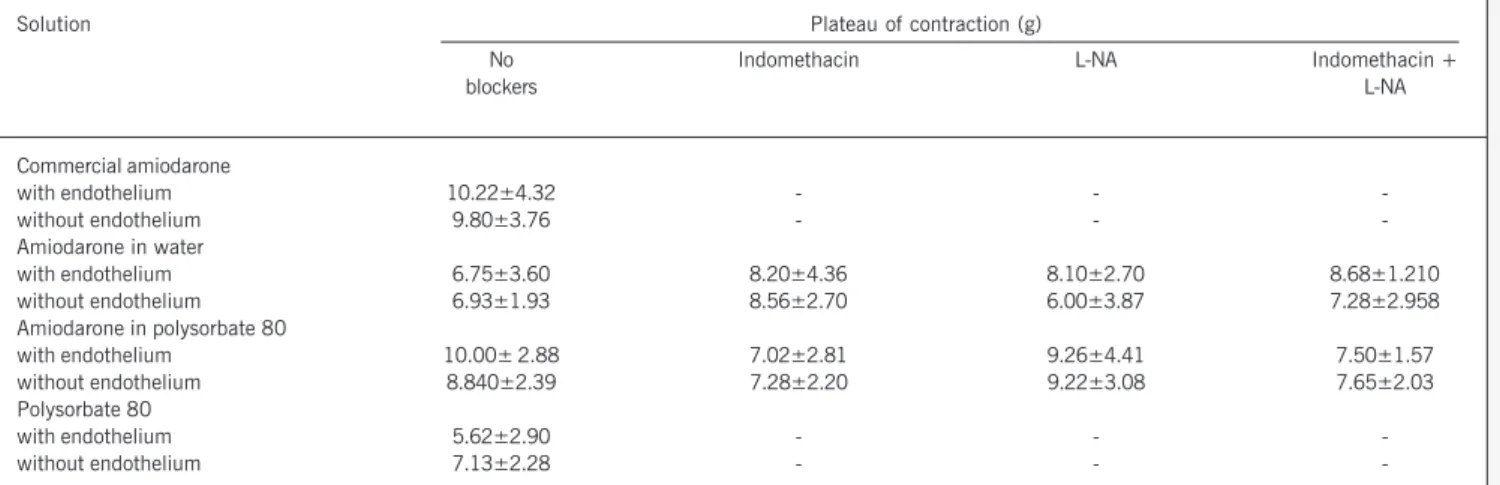
No significant difference was observed between the plateaus of contraction (tab. I) when comparing arteries with and without endo-thelium within the same experimental group or between groups.
The relaxation caused by AMA (fig. 1, n=9) in arteries with endothelium ranged from 0% to 57.0%±17.9%, and, in arteries without endothelium, from 0.37%±1.11% to 17.2%±15.56%. The differences were significant (P < 0.001) for the concentrations of 3.16x10⁻⁵ M and 10-4 M.
Cordarone (fig. 1, n=6) caused relaxation that ranged from 0.4%±1.02%, at the minimum concentration, to 94.40% ± 10.10%, at the maximum concentration, in vessels with endo-thelium. In vessels without endothelium, the relaxation ranged from 0% to 40.26% ± 18.44%. The differences between relaxa-tion of the vessels with and without endothelium were significant (P<0.001) for the concentrations of amiodarone of 3.16x10⁻⁵
and 10-4 M.
The solution of amiodarone in polysorbate (AMPO) (fig. 1, n=6) caused relaxation in arteries with endothelium that ranged from 0%, at the minimum concentration, to 100% ± 0%, at the maximum concentration. In arteries without endothelium, relaxa-tion ranged from 0% to 28.46% ± 13.87%. The differences between the arteries with and without endothelium were signifi-cant (P < 0.001) for the concentrations from 10-5 M to 10-4 M.
Polysorbate 80 caused a mild relaxation in arteries with and without endothelium (fig. 2, n=6). The maximum relaxation in arteries with and without endothelium was 27.43%±24.10% and 18.35%±15.08%, respectively. The difference was not sig-nificant. It is worth noting that the addition of a single dose of amiodarone dissolved in water (10-4 M) after the last dose of the
concentration-response curve for polysorbate 80 (10-8 M) caused
immediate relaxation of 99.37%±1.39% in arteries with endo-thelium and of 24.55%±15.28% in arteries without endoendo-thelium (P<0.001).
Comparing the curves obtained with Cordarone with those obtained with amiodarone in polysorbate (AMPO), a difference in relaxation was observed only for the concentration of 10-5 M, and
AMPO caused greater relaxation than that provided by commercial amiodarone (P < 0.01) in the arteries with endothelium.
Thus, as polysorbate 80 caused mild relaxation independently of the endothelium, and as the relaxation provided by AMPO was similar to that caused by commercial amiodarone, the subsequent experiments were performed only with amiodarone dissolved in water (AMA) and amiodarone dissolved in the polysorbate 80 so-lution (AMPO).
The presence of indomethacin (2 x 10⁻⁵ M) caused a significant
endo-3
thelium was still significantly greater (38.81%±15.07%, P<0.001) than that observed in vessels without endothelium (13.35%±6.63%).
Indomethacin did not significantly affect the relaxation caused by AMPO (fig. 3, n=6). Relaxation in the arteries with endothelium ranged from 0% to 85.76%±19.90%, and from 0% to 16.75%± 8.30% in the vessels without endothelium. The difference in rela-xation between the vessels with and without endothelium was significant (P<0.001) for the concentrations from 10-5 to 10 -4 M.
Nω-nitro-L-arginine (L-NA) (2x10⁻⁴ M) eliminated the
endothe-lium-dependent relaxation caused by AMA (fig. 4, n=6), because no significant differences in relaxation were observed in vessels with and without endothelium. Although Nω-nitro-L-arginine has
cau-sed some deviation in the concentration-response curve to the right, it has not inhibited endothelium-dependent relaxation caused by AMPO (n=6, maximum of 88.73%±15.67%). The relaxation obtai-ned with the AMPO concentrations of 3.16x10⁻⁵ M and 10-4 M was
significantly greater in arteries with endothelium (P<0.001). The combination of Nω-nitro-L-arginine (2x10⁻⁴ M) with
indo-methacin (2x 10⁻⁵ M) eliminated completely the
endothelium-dependent relaxation caused by both AMA and AMPO (fig. 5, n=6), because no significant difference was observed between relaxation of arteries with and without endothelium for both drugs, although some endothelium-independent relaxation occurred.
Discussion
As already emphasized, amiodarone and its metabolite, N-desethylamiodarone, have already been shown to cause endothe-lium-dependent relaxation in human veins similarly to that observed in canine coronary arteries, although only amiodarone dissolved in polysorbate was used in those investigations 4,5.
Our results show that amiodarone causes relaxation, which is mainly endothelium-dependent in canine coronary arteries. Ho-wever, although polysorbate 80 alone does not cause endothelium-dependent relaxation, it seems that the presence of the solvent polysorbate influences that vasodilation, because its association with amiodarone significantly influences the magnitude of endo-thelium-dependent relaxation.
Considering the results obtained with amiodarone dissolved in water, it is evident that the isolated blockage of cyclooxygenases decreased, but did not eliminate, vasodilation. However, the iso-lated blockage of nitric oxide synthetase blocked vasodilation pro-moted by amiodarone in water. Such a fact emphasizes the greater importance of nitric oxide in the vasodilation promoted by amio-darone. However, only the simultaneous inhibition of
cyclooxyge-T T T T
Table I - Plateau of contractionable I - Plateau of contractionable I - Plateau of contractionable I - Plateau of contractionable I - Plateau of contraction, in , in , in , in , in ggggg, of the concentration-response cur, of the concentration-response cur, of the concentration-response cur, of the concentration-response cur, of the concentration-response curvesvesvesvesves Solution Plateau of contraction (g)
No Indomethacin L-NA Indomethacin +
blockers L-NA
Commercial amiodarone
with endothelium 10.22±4.32 - - -without endothelium 9.80±3.76 - - -Amiodarone in water
with endothelium 6.75±3.60 8.20±4.36 8.10±2.70 8.68±1.210 without endothelium 6.93±1.93 8.56±2.70 6.00±3.87 7.28±2.958 Amiodarone in polysorbate 80
with endothelium 10.00± 2.88 7.02±2.81 9.26±4.41 7.50±1.57 without endothelium 8.840±2.39 7.28±2.20 9.22±3.08 7.65±2.03 Polysorbate 80
with endothelium 5.62±2.90 - - -without endothelium 7.13±2.28 - - -The results are expressed as mean ± standard deviation. -The differences are not significant.
% relaxation% relaxation% relaxation% relaxation% relaxation
0 0 0 0 0 25 25 25 25 25 50 50 50 50 50 75 7575 75 75 100 100 100 100 100
commercial amiodarone commercial amiodarone commercial amiodarone commercial amiodarone commercial amiodarone
AMA AMA AMA AMA AMA AMPO AMPO AMPO AMPO AMPO
-10 -10 -10 -10
-10 -9-9-9-9-9 -8-8-8-8-8 -7-7-7-7-7 -6-6-6-6-6 -5-5-5-5-5 -4-4-4-4-4 -3-3-3-3-3 Log [M]
Log [M] Log [M] Log [M] Log [M]
Fig. 1 - Concentration-response curve for the commercial presentation of amio-darone (Coramio-darone), amioamio-darone dissolved in water (AMA) and in polysorbate 80 (AMPO) in canine coronary arteries with (solid symbols) and without (clear symbols) endothelium, contracted with prostaglandin F2α (2.5 x 10⁻⁶ M). The
results are expressed as mean ± standard deviation. * indicates P<0.001 compared with AMA, and ∆ indicates P<0.001 comparing arteries with and
without endothelium.
% relaxation% relaxation% relaxation% relaxation% relaxation
0 00 00
25 2525 25 25
50 50 50 50 50
75 75 75 75 75
100 100 100 100 100
with endothelium with endothelium with endothelium with endothelium with endothelium without endothelium without endothelium without endothelium without endothelium without endothelium
polysorbate (10 polysorbate (10 polysorbate (10 polysorbate (10 polysorbate (10-9-9-9-9-9M)M)M)M)M)
after after after after after
amiodarone (10 amiodarone (10 amiodarone (10 amiodarone (10 amiodarone (10-4-4-4-4-4M)M)M)M)M)
-14 -14 -14 -14
-14 -13-13-13-13-13 -12-12-12-12-12 -11-11-11-11-11 -10-10-10-10-10 -9-9-9-9-9 -8-8-8-8-8 polysorbate 80 Log [M] polysorbate 80 Log [M] polysorbate 80 Log [M] polysorbate 80 Log [M] polysorbate 80 Log [M]
Fig. 2 - Concentration-response curve for polysorbate 80 in canine coronary arteries. The arrow points to the relaxation caused by a single dose of amiodarone dissolved in water (10-4 M) after the addition of the last concentration of
polysorbate (10-9M). The results are expressed as mean ± standard deviation.
4
nases and nitric oxide synthetase eliminated vasodilation promoted by amiodarone dissolved in polysorbate 80. Whether polysorbate 80 acted merely promoting better solubilization of amiodarone or whether it also modulated the effects of amiodarone, in both situations propitiating amplification of the vasodilating effect of amiodarone, is still questionable.
Evidence suggests that surfactants, such as polysorbates, may influence the enzymatic activity of the arachidonic acid. Surfactants have been shown to significantly reduce the inhibition promoted by the substrate of 15-lipoxygenases13 and promote the release of
arachidonic acid14,15. In addition, polysorbate 80 has been shown
to facilitate the transportation of several ions (K+, Na+, NH4+,
Ca++) and inorganic molecules through membrane models 16-19.
Evidence exists that polysorbates may also modulate sensitivity to certain antitumor agents, increasing the transportation of those agents through the membrane or facilitating their interaction 6,19,
considering that amiodarone is a highly lipophilic drug 20.
% relaxation% relaxation% relaxation% relaxation% relaxation
0 0 0 0 0 25 25 25 25 25 50 5050 5050 75 75 75 75 75 100 100100 100 100 with endothelium with endothelium with endothelium with endothelium with endothelium without endothelium without endothelium without endothelium without endothelium without endothelium -10 -10 -10 -10
-10 -9-9-9-9-9 -8-8-8-8-8 -7-7-7-7-7 -6-6-6-6-6 -5-5-5-5-5 -4-4-4-4-4 -3-3-3-3-3 Log [M]
Log [M]Log [M] Log [M] Log [M]
Fig. 3 - Concentration-response curve for amiodarone diluted in water (AMA) and in polysorbate 80 (AMPO) in canine coronary arteries in the presence of indome-thacin (2 x 10⁻⁵ M) and contracted with prostaglandin F2α (2.5 x 10⁻⁶ M). The
results are expressed as mean ± standard deviation. * indicates P<0.001 compared with AMA and ∆ indicates P<0.001 comparing arteries with and
without endothelium.
with endothelium with endotheliumwith endothelium with endothelium with endothelium without endothelium without endothelium without endothelium without endothelium without endothelium AMA AMAAMA AMAAMA AMPO AMPO AMPO AMPO AMPO
% relaxation% relaxation% relaxation% relaxation% relaxation
0 0 0 0 0 25 25 25 25 25 50 50 50 50 50 75 75 75 75 75 100 100100 100 100 with endothelium with endothelium with endothelium with endothelium with endothelium without endothelium without endothelium without endothelium without endothelium without endothelium -10 -10 -10 -10
-10 -9-9-9-9-9 -8-8-8-8-8 -7-7-7-7-7 -6-6-6-6-6 -5-5-5-5-5 -4-4-4-4-4 -3-3-3-3-3 Log [M]
Log [M] Log [M] Log [M] Log [M]
Fig. 4 - Concentration-response curve for amiodarone diluted in water (AMA) and in polysorbate 80 (AMPO) in canine coronary arteries in the presence of Nω
-nitro-L-arginine (2 x 10⁻⁴ M) and contracted with prostaglandin F2α (2.5 x 10⁻⁶ M).
The results are expressed as mean ± standard deviation. * * * * indicates P < 0.001* compared with AMA, and ∆ indicates P < 0.001 comparing arteries with and without endothelium.
with endothelium with endotheliumwith endothelium with endotheliumwith endothelium without endothelium without endotheliumwithout endothelium without endothelium without endothelium AMA AMA AMA AMA AMA AMPO AMPOAMPO AMPO AMPO
% relaxation% relaxation% relaxation% relaxation% relaxation
0 0 0 0 0 25 25 25 25 25 50 50 50 50 50 75 75 75 75 75 100 100100 100 100 with endothelium with endotheliumwith endothelium with endothelium with endothelium without endothelium without endothelium without endothelium without endothelium without endothelium -10 -10 -10 -10
-10 -9-9-9-9-9 -8-8-8-8-8 -7-7-7-7-7 -6-6-6-6-6 -5-5-5-5-5 -4-4-4-4-4 -3-3-3-3-3 Log [M]
Log [M] Log [M] Log [M] Log [M]
Fig. 5 - Concentration-response curve for amiodarone diluted in water (AMA) and in polysorbate 80 (AMPO) in canine coronary arteries in the presence of Nω
-nitro-L-arginine (2x10⁻⁴ M) in combination with indomethacin (2x10⁻⁵ M) and contracted
with prostaglandin F2α (2.5 x10⁻⁶ M). The results are expressed as mean ±
standard deviation. No significant differences were observed between the arteries with and without endothelium.
with endothelium with endothelium with endothelium with endothelium with endothelium without endothelium without endothelium without endothelium without endothelium without endothelium AMA AMAAMA AMAAMA AMPO AMPO AMPO AMPO AMPO
In vivo studies have also suggested that polysorbates are not inert and may influence the systemic effects of amiodarone 7,8,21,
although other authors have shown that polysorbate may damage the vascular endothelium at concentrations greater than those used in our study 4,5,10,11.
The exact mechanism by which amiodarone causes the release of relaxing endothelial factors has not been completely clarified, but amiodarone 22 and N-desethylamiodarone 23 have been shown
to promote a sustained increase in the concentrations of cytoplas-mic calcium in endothelial cells. Such calcium elevation may trigger the activation of the calmodulin-dependent pathway, which results in the release of vasodilating factors. In addition, evidence exists that amiodarone stimulates protein-G type receptors 24.
Although the results have clearly shown that the release of endothelial factors is the major mechanism of vascular relaxation, the results obtained with the simultaneous inhibition of the cy-clooxygenases and nitric oxide synthetase have also shown that amiodarone causes some nonendothelium-dependent vasodilation (fig. 5), because a similar discreet relaxation is observed in arteries with and without endothelium. This fact may be related to its calcium channel blocking properties 25.
Although hypotension after the intravenous use of amiodarone is a well-known side effect 2,3,26, several mechanisms may be
involved in vivo, in addition to the release of endothelial relaxing factors. Amiodarone has been shown to cause a reduction in cardiac performance or to induce a state of low peripheral vascular resis-tance due to an alpha-adrenergic blocking effect 27,28. In addition,
polysorbate, present in the commercial formulation of amiodarone, may cause the release of histamine 9, and result in hypotension.
5
1. Singh BN. Amiodarone: historical development and pharmacologic profile. Am Heart J 1983;106:788-797.
2. Kowey PR, Marinchak RA, Rials SJ et al. Intravenous amiodarone. J Am Coll Cardiol 1997;29:1190-1198.
3. Mets B, Michler RE, Delphin ED et al. Refractory vasodilation after cardiopulmo-nary bypass for heart transplantation in recipients on combined amiodarone and angiotensin-converting enzyme inhibitor therapy: a role for vasopressin administra-tion. J Cardiothorac Vasc Anesth 1998;12:326-329.
4. Grossmann M, Dobrev D, Himmel HM et al. Local venous response to N-desethy-lamiodarone in humans. Clin Pharmacol Ther 2000;67:22-31.
5. Grossman M, Dobrev D, Kirch W. Amiodarone causes endothelium-dependent va-sodilation in human hand veins in vivo. Clin Pharmacol Ther 1998;64:302-311. 6. Yamazaki T, Sato Y, Hanai M et al. Non-ionic detergent Tween 80 modulates VP-16 resistance in classical multidrug resistant K562 cells via enhancement of VP-16 influx. Cancer Lett 2000;149:153-161.
7. Path GJ, Dai XZ, Schwartz JS et al. Effects of amiodarone with and without polys-orbate 80 on myocardial oxygen consumption and coronary blood flow during treadmill exercise in the dog. J Cardiovasc Pharmacol 1991;18:11-16. 8. Munoz A, Karila P, Gallay P et al. A randomized hemodynamic comparison of
in-travenous amiodarone with and without Tween 80. Eur Heart J 1988;9:142-148. 9. Masini E, Planchenault J, Pezziardi F et al. Histamine-releasing properties of polys-orbate 80 in vitro and in vivo: correlation with its hypotensive action in the dog. Agents Actions 1985;16:470-477.
10. Zengil H, Hodoglugil U, Guney Z. Effects of polysorbates and cremophor EL on vascular responses in rat aorta. Experientia 1995;51:1055-1059.
11. Uluoglu C, Korkusuz P, Uluoglu O et al. Tween 80 and endothelium: functional reduc-tion due to tissue damage. Res Commun Mol Pathol Pharmacol 1996;91:173-183. 12. Somberg JC, Bailin SJ, Haffajee CI et al. Intravenous lidocaine versus intravenous amiodarone (in a new aqueous formulation) for incessant ventricular tachycardia. Am J Cardiol 2002;90:853-859.
13. Mogul R, Holman TR. Inhibition studies of soybean and human 15-lipoxygenases with long-chain alkenyl sulfate substrates. Biochemistry 2001;40:4391-4397. 14. Muller-Decker K, Heinzelmann T, Furstenberger G et al. Arachidonic acid
metabo-lism in primary irritant dermatitis produced by patch testing of human skin with sur-factants. Toxicol Appl Pharmacol 1998;153:59-67.
References
15. Moreno JJ. Arachidonic acid release and prostaglandin E2 synthesis as irritant index of surfactants in 3T6 fibroblast cultures. Toxicology 2000;143:275-282. 16. Thoman CJ. Ionophoric properties of polysorbate 80. J Pharm Sci
1986;75:983-986.
17. Heppel LA, Makan N. Methods for rapidly altering the permeability of mammalian cells. J Supramol Struct 1977;6:399-409.
18. Thoman CJ. The versatility of polysorbate 80 (tween 80) as an ionophore. J Pharm Sci 1999;88:258-260.
19. Tsujino I, Yamazaki T, Masutani M et al. Effect of tween-80 on cell killing by etoposide in human lung adenocarcinoma cells. Cancer Chemother Pharmacol 1999;43: 29-34. 20. Kodama I, Kamiya K, Toyama J. Cellular electropharmacology of amiodarone.
Cardiovasc Res 1997;35:13-29.
21. Gough WB, Zeiler RH, Barreca P, El-Sherif N. Hypotensive action of commercial in-travenous amiodarone and polysorbate 80 in dogs. J Cardiovasc Pharmacol 1982;4:375-380.
22. Powis G, Olsen R, Standing JE et al. Amiodarone-mediated increase in intracellu-lar free Ca2+ associated with celluintracellu-lar injury to human pulmonary artery endothe-lial cells. Toxicol Appl Pharmacol 1990;103:156-164.
23. Himmel HM, Dobrev D, Grossmann M et al. N-desethylamiodarone modulates in-tracellular calcium concentration in endothelial cells. Naunyn Schmiedebergs Arch Pharmacol 2000;362:489-496.
24. Hageluken A, Nurnberg B, Harhammer R et al. The class III antiarrhythmic drug amiodarone directly activates pertussis toxin-sensitive G proteins. Mol Pharmacol 1995;47:234-240.
25. Lubic SP, Nguyen KP, Dave B et al. Antiarrhythmic agent amiodarone possesses calcium channel blocker properties. J Cardiovasc Pharmacol 1994;24:707-714. 26. Crystal E, Kahn S, Roberts R et al. Long-term amiodarone therapy and the risk of complications after cardiac surgery: results from the Canadian Amiodarone Myo-cardial Infarction Arrhythmia Trial (CAMIAT). J Thorac Cardiovasc Surg 2003; 125:633-637.
27. Liberman BA, Teasdale SJ. Anaesthesia and amiodarone. Can Anaesth Soc J 1985;32:629-638.