
ACCEPTED MANUSCRIPT
Evidences and perspectives in the utilization of CLNA isomers as bioactive compound in
foods
Ana L. Fontes, Lígia L. Pimentel, Catarina D. Simões, Ana M. P. Gomes* and Luís M. Rodríguez-Alcalá
CBQF - Centro de Biotecnologia e Química Fina – Laboratório Associado, Escola Superior de Biotecnologia, Universidade Católica Portuguesa/Porto, Rua Arquiteto Lobão Vital, Apartado 2511, EC Asprela, 4202-401 Porto, Portugal.
*
Address correspondence to Ana M. P. Gomes: CBQF - Centro de Biotecnologia e Química Fina – Laboratório Associado, Escola Superior de Biotecnologia, Universidade Católica Portuguesa/Porto, Rua Arquiteto Lobão Vital, Apartado 2511, EC Asprela, 4202-401 Porto, Portugal. Email: [email protected]
ABSTRACT
Conjugated linolenic acid (CLNA) isomers are promising lipids due to their similarities with CLA but exerting their bioactivity at lower doses; some isomers also belong to the omega 3 family. This review aims to summarize the state of the art about the utilization of CLNA as a functional ingredient. Indeed, in vitro and in vivo studies reported that CLNA exerted anti-cancer, anti-inflammatory, anti-obese and antioxidant activities. However, CLNA has not been tested in humans yet.
These compounds are naturally present in meat and milk fat from ruminants but the highest concentrations are found in vegetable oils. Their incorporation in foodstuffs is one of the most effective strategies to elaborate CLNA-enriched products together with the microbiological production. Lactobacilli, propionibacteria and bifidobacteria strains have been assayed to
ACCEPTED MANUSCRIPT
produce CLNA isomers but at the current moment there are not high CLNA concentration products elaborated using these strains. Furthermore, it is known that CLNA are highly prone to oxidation when compared with linoleic acid and CLA but it is unknown the possible effects of elaboration and storage on high CLNA products.
The utilization of CLNA as a functional compound remains still a challenge that requires more research to address all the technological and bioactivity aspects about it.
Keywords
ACCEPTED MANUSCRIPT
INTRODUCTION
Cardiovascular diseases (CVD), like ischemic heart disease and stroke, are the leading worldwide death causes, being responsible for 17 million deaths in 2008 (Alwan, 2011). Overweight and obesity are the major risk factors for cardiovascular diseases, and it was estimated that between 1980 and 2008 the prevalence of overweight and obese adults (≥20 years old) increased from 24.6% to 34.4% and from 6.4% to 12.0%, respectively (Stevens et al., 2012). Although lipids are involved in the development of these conditions, recent studies have also stated their positive health effects on humans. Thus, dietary sources of omega 3 have shown to be capable of reducing the incidence of CVD, through decreasing the number of sudden deaths as well as the effect of risk factors such as obesity, hypertension and cholesterol (Harris, 2008). Furthermore, the bioactivity of CLA has been well characterized, namely for its anticarcinogenic, antiobese, antidiabetic and antihypertensive properties effects (Koba and Yanagita, 2014). However, CLA are not the only bioactive conjugated fatty acids and recently CLNA have also shown bioactive potential as anti-carcinogenic, anti-inflammatory, anti-obese and antioxidant compounds (Yuan et al., 2014) being a promising new bioactive ingredient. Thus, this review aims to summarize the evidences about the beneficial health effects of CLNA and the possibilities of their utilization in new functional foodstuffs.
CLNA IN FOODS: MAIN SOURCES AND CONTENTS
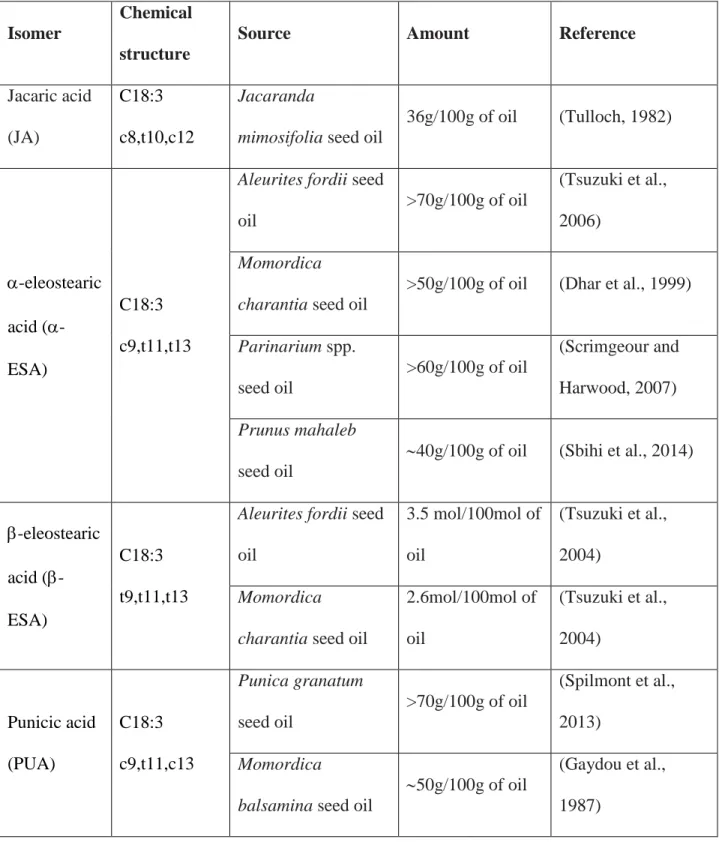
It has been reported that CLNA isomers occur naturally in milk fat and meat of ruminants, however, it is mostly found in vegetable oils (Mapiye et al., 2013) (Table 1). Despite all the possible isomers, only seven compounds are found in plant seed oils: jacaric acid (JA) (C18:3 c8,t10,c12), -eleostearic acid (-ESA) (C18:3 c9,t11,t13), -eleostearic acid (-ESA) (C18:3
ACCEPTED MANUSCRIPT
t9,t11,t13), punicic acid (PUA) (C18:3 c9,t11,c13), -calendic acid (-CDA) (C18:3 t8,t10,c12), -calendic acid (-CDA) (C18:3 t8,t10,t12) and catalpic acid (CPA) (C18:3 t9,t11,c13) (Tanaka et al., 2011). The main source of JA is the seed oil of the argentine native tree Jacaranda mimosifolia, with 36g/100g of oil (Kraus et al., 2005). The isomer -ESA is the main compound of tung oil (Aleurites fordii) (70g/100g of oil), a native tree from Southeast Asia and the Pacific Islands (Burrows and Tyrl, 2013), bitter melon (Momordica charantia) (50g/100g of oil) (Dhar et al., 1999) and Parinarium spp. (60g/100g of oil) (Scrimgeour and Harwood, 2007). This isomer can be found in white mahlab (Prunus mahaleb) (40g/100g of oil), a small tree native to southern Europe that grows wild in the Mediterranean region across to Turkey (Sbihi et al., 2014).
Tung and bitter melon seeds also contain -ESA but in lower concentrations (3.5 and 2.6 mol/100mol of oil, respectively) than -ESA (Tsuzuki et al., 2004). PUA is mainly found in pomegranate (Punica granatum) (70g/100g of oil) (Spilmont et al., 2013) and balsam apple (Momordica balsamina) (50g/100g of oil) (Gaydou et al., 1987), while snake gourd of Trichosanthes anguina and Trichosanthes kirilowii species have approximately 40g/100g of oil and above 30g/100g of oil, respectively (Yang et al., 2012). Trichosanthes anguina is a native vine from tropical Asia and it is cultivated in China, while Trichosanthes kirilowii is distributed through several Chinese provinces and also occurs in Korea and Japan (Hu, 2005). In pot marigold (Calendula officinalis) it is possible to find -CDA (>50g/100g of oil) and a small amount of -CDA (<1g/100g of oil) (Dulf et al., 2013). CPA is mainly present in Catalpa ovata (40g/100g of oil), a species originating in China (Suzuki et al., 2006). Among the seeds that
ACCEPTED MANUSCRIPT
contain CLNA isomers, only those from pomegranate, snake gourd T. kirilowii and white mahlab are edible. Pomegranate is native form Persia and cultivated in Mediterranean countries, Afghanistan, India, China, Japan, Russia and some parts of the United States. Its edible parts are comprised of 80% juice and 20% seeds, also used to produce fresh juice, syrups, canned beverages, jelly, jam and for flavouring drinks (Fadavi et al., 2006). T. kirilowii seeds have long been used as a traditional Chinese medicine to reduce infections and are a popular snack food in China (Yuan et al., 2014). White mahlab powder is used in Greece, Cyprus, Turkey and neighboring Arab countries from Syria to Saudi Arabia, for flavouring breads and pastries while in Sudan it is also used as a medicine for diarrhea in children (Ieri et al., 2012).
The isomers C18:3 c9,t11,c15 (Rumelenic acid, RLA) and C18:3 c9,t11,t15 have been described as the main CLNA isomers in milk fat and meat of ruminants. In bovine milk, RLA has been detected at concentrations between 0.03 and 0.39 g/100g of fat and C18:3 c9,t11,t15 between 0.02 and 0.06 g/100g of fat (Lerch et al., 2012; Plourde et al., 2007b). Relatively to ruminant meat, RLA and C18:3 c9,t11,t15 isomers, were found in steer (0.08 and 0.02 mg/g, respectively), cow (0.06 and 0.02 mg/g, respectively) and goat (0.28 and 0.03 g/100g of meat fat, respectively) (Ebrahimi et al., 2014; Mapiye et al., 2013; Nassu et al., 2011). In comparison to the vegetable oils, the concentration of CLNA in these foodstuffs is very low, which suggests that the intake of CLNA, in order to highlight its potential health benefits, would not be viable through this natural source, therefore, strategies to enhance its intake will have to be studied.
ACCEPTED MANUSCRIPT
CLNA BIOACTIVITY
Anti-cancer activity
Some studies have reported the cytotoxic effect of CLNA isomers on different human tumor cell lines, including MDA-MB-231, MCF-7 (breast) (Moon et al., 2010), HT-29 (colon) (Degen et al., 2011), MDA-MB-231 (estrogen insensitive breast cancer cells), MDA-ER7 (estrogen sensitive breast cancer cells cloned from MDA-MB-231 cells) (Grossmann et al., 2010), T24 (bladder) (Sun et al., 2012), HeLa (cervix) (Eom et al., 2010), LNCaP, PC-3 (prostate) (Gasmi and Sanderson, 2013) and DLD-1 (colorectal) (Shinohara et al., 2012b). The works found that the anti-proliferative activity was due to an increment in the number of cells in G0/G1 phase (cells are arrested in the initial phases of cell cycle and do not continue to proliferate) and the increase of apoptosis rate are the main anti-cancer activity evidences verified for CLNA isomers.
These activities seem to be influenced by the configuration of the double bonds. Degen et al. (Degen et al., 2011), when evaluating growth inhibition effects of pure CLNA isomers against HT-29 colon cancer cells, found that in the presence of an all-trans isomer, as C18:3 t9,t11,t13 resulted in greater inhibition than with C18:3 c9,t11,t13. Furthermore, Shinohara et al. (Shinohara et al., 2012b) assaying the cytotoxic effects of several pure CLNA isomers from vegetable sources on DLD-1 colorectal cancer cells, observed that jacaric acid (JA) (C18:3 c8,t10,c12) exerted a stronger effect in terms of decreasing cell survival and inducing apoptosis when compared with -eleostearic acid (-ESA) (C18:3 c9,t11,t13), punicic acid (PUA) (C18:3 c9,t11,c13), catalpic acid (CPA) (C18:3 t9,t11,c13) and the trans-isomers -eleostearic acid (-ESA) (C18:3 t9,t11,t13) and -calendic acid (-CDA) (C18:3 t8,t10,t12), all tested at the same
ACCEPTED MANUSCRIPT
JA, PUA, -CDA and -CDA cytotoxicity was investigated against LNCaP and PC-3 prostate cancer cells results pointed out to PUA and JA as the most effective (Gasmi and Sanderson, 2013). At the time PUA and JA 3-D conformations were analyzed and overlapped, shape and feature similarity values were highly correlated, indicating that the cis, trans, cis configuration of their double bonds is the reason of their bioactivity.
It has been also suggested that the mechanism of CLNA anti-cancer activity may be related to lipid peroxidation, since the addition of -tocotrienol, an antioxidant, lead to the loss of PUA cytotoxic properties against MDA-MB-231 and MDA-ER7 breast cancer cells (Grossmann et al., 2010). These authors also associated the CLNA´s cytotoxicity to the induction of protein kinase C (PKC) that leads to the inhibition of cell proliferation and activation of apoptosis. Other studies have reported increase of caspase-3 expression, decrease of apoptosis suppression factor Bcl-2 expression, formation of reactive oxygen species (ROS), activation of caspase-9 cascade, DNA fragmentation, poly ADP-ribose polymerase (PARP) cleavage, increase of tumor suppressor gene p53 expression, activation of peroxisome proliferator-activated receptor gamma (PPAR) and inhibition of extracellular signal-regulated kinases 1 and 2 (ERK 1/2) (Sun et al., 2012; Moon et al., 2010).
CLNA anti-carcinogenic activity has been also assayed in vivo, mainly with natural plant sources. Tung oil, which is rich in -ESA, when administered at doses of 50 and 100 mg/kg body to mice transplanted with DLD-1 colorectal cancer cells, suppressed vessel formation: in doses of 100 mg/kg body weight tumor vessel length was significantly lower than with 50 mg/kg body weight (Tsuzuki and Kawakami, 2008). Bitter gourd seed oil (rich in -ESA) was also able
ACCEPTED MANUSCRIPT
with at 0.01, 0.1 and 1% (Kohno et al., 2002). Furthermore, feeding mice treated with nitrobenzene, a genotoxic inductor, with 100, 200 and 400 mg/kg body weight of pomegranate seed oil (PUA rich source), caused a significant reduction in the percentage of aberrant cells and sperm shape and chromosome aberrations (Aly et al., 2014). When pomegranate seed oil was administration to rats, led to a significant suppression of adenocarcinomas incidence and multiplicity in colon. Most of the studies described above have associated CLNA cytotoxicity in vivo to enhanced PPAR expression. CLNA anti-cancer properties could also be due to the metabolization of CLNA to CLA, since lipid analysis on liver and colon of rats fed with pomegranate seed oil did not detect CLNA isomers, but CLA content was elevated in a dose-dependent manner (Kohno et al., 2004). When compared to CLA, -ESA suppressed tumor vessel formation at doses 10 times lower (Tsuzuki and Kawakami, 2008) supporting the fact that CLNA isomers could exert a more powerful bioactivity than CLA.
However, despite these promising results no studies focusing on CLNA anti-cancer properties have been carried out on human subjects so far.
Anti-inflammatory activity
Cells (e.g. neutrophils, macrophages and monocytes) and biochemicals, like tumor necrosis factor (TNF-), interleukins (IL), platelet activating factor (PAF), leukotrienes and ROS are involved in inflammatory diseases. Therefore, an increment of these mediators is an indicator of occurring inflammation.
Anti-inflammatory activity of CLNA in vitro has only been reported for PUA on human breast cancer cells (MDA-MB-231 and MCF-7) in the presence of pomegranate seed oil for 24h
ACCEPTED MANUSCRIPT
at 37ºC (Costantini et al., 2014). The levels of 9 pro-inflammatory cytokines, including ILs and TNF-, were significantly decreased at amounts ranging from 0.24 to 0.6µL.
Necrotising enterocolitis (NEC) is characterized pathologically by inflammatory and coagulative necrosis that occurs throughout the intestinal tract of, especially, newborns. Pomegranate seed oil administration at 1.5% to NEC rats caused significant reduction on ileal damage while expression levels of IL-6, IL-8, IL-12, IL-23 and TNF- mRNA were significantly lower (Coursodon-Boyiddle et al., 2012).
On the other hand, inflammatory bowel disease (IBD) is a chronic inflammatory disease that can manifest itself as ulcerative colitis (affects only the large intestine) or Crohn’s disease (affects the whole digestive tract). -ESA was shown to be able to ameliorate IBD phenotypes when incorporated in induced-IBD mice diet, through equally PPAR-dependent and independent mechanisms (Lewis et al., 2011). Both -ESA and PUA, were also capable to significantly reduce IL-6, Il-1 and TNF- expressions in rats treated with sodium arsenite and streptozotocin (Saha et al., 2012b; Saha and Ghosh, 2012). According to Saha and Ghosh (Saha and Ghosh, 2011), high concentrations of arachidonic acid (ARA: C20:4 ,c8,c11,c13,c16) together with low leves of -linolenic acid (γ-LNA: C18:3 c6,c9,c12) in tissues are indicators of inflammation. Vegetable oils containing -ESA or PUA were capable of normalizing ARA and γ-LNA amounts in rats when an inflammatory process altered their concentrations.
Both in vitro and in vivo studies, suggest that CLNA can interference on inflammation mediators. At the current moment the anti-inflammatory effects of CLNA have not been tested on humans.
ACCEPTED MANUSCRIPT
Antioxidant activity
Some works have reported also antioxidant properties for CLNA. Karela seed oil (rich in -ESA) was added at 0.05 and 0.1% to human blood samples of diabetic and non-diabetic subjects reducing lipid peroxidation at both doses in samples from diabetic subjects (Dhar et al., 2007). Other assays comparing bitter (-ESA) and snake (PUA) gourd seed oils revealed that the antioxidant activity was greater for bitter gourd seed oil, possibly due to -ESA better oxidative stability (Saha et al., 2012c), since trans double bonds are more stable than cis.
Some in vivo studies have been carried out to test the activity of CLNA isomers against chemically induced oxidative stress. As in the in vitro research works mentioned above, -ESA and PUA showed antioxidant properties in rats treated with sodium arsenite to induce oxidative stress being -ESA the most effective at the lowest dose as increased the activity of antioxidant enzymes (SOD, CAT and GPx) and glutathione (GSH) levels while decreased nitric oxide synthase (NOS) activity and lipid and protein oxidation in plasma and kidney (Saha and Ghosh, 2013). Some of these effects were also observed with -ESA against the oxidative stress caused by methyl mercury and induced diabetes in rats (Paul et al., 2014).
On the other hand, the effect of PUA was tested on 15 healthy young humans, consuming an equivalent of 3g/day of PUA from Trichossanthes kirilowii seeds during 28 days (Yuan et al., 2009); results concuded that PUA exhibited a pro-oxidant activity. These findings seem to be controversial with the in vivo studies described above, however, animal studies revealed that PUA has both antioxidant and pro-oxidant activity depending on the dose used: feeding rats with an equivalent of 0.6 g/kg of PUA lead to antioxidant effects, whereas a higher dose of 1.2 g/kg
ACCEPTED MANUSCRIPT
Anti-obesity activity
CLA isomers has been described to exert positives effects on body weight and due to the similarities among these fatty acids, some works have been focused in the study of the possible anti-obesity properties of CLNA. When 3T3-L1 adipose cells were exposed to a mixture of two CLNA isomers: RLA and C18:3 c9,t13,c15 at 10 and 100µM triacyglycerol content decreased at both concentrations (Miranda et al., 2011). However, a dose of 10 µM increased the expression hormone-sensitive lipase (HSL) while 100 µM affected adipose triglyceride lipase (ATL).
Moreover, oral administration of -ESA and PUA, caused decrease of triacylglycerol (TAG), cholesterol and LDL-C levels and increase of HDL-C level in plasma, erythrocytes, liver and brain of obese and hypercholesterolemic rats (Saha et al., 2012a; Sengupta et al., 2015). Although no significant weight loss was observed, body weight gain and fat mass were reduced. Interestingly, the activity of HMG-CoA reductase, responsible for cholesterol biosynthesis, was found to decrease. Authors concluded that -ESA was more effective than PUA and associated such effects to the trans configuration of this fatty acid.
It has been elsewhere suggested that effects of CLNA on lipolysis are due to the activation of cAMP-activated protein kinase (PKA) pathway and apoptosis in white adipose tissue (Chen et al., 2012). Nevertheless, the administration of JA (5 mg/day) for 1 week to normal rats increased the accumulation of palmitic acid (C16:0) and stearic acid (C18:0) while decreasing palmitoleic acid (C16:1 c9) and oleic acid (C18:1 c9) in liver and white adipose tissues (Shinohara et al., 2012a). The results were associated to the inhibition of stearoyl coenzyme A desaturase (SCD) activity, an endoplasmic reticulum enzyme that catalyzes the biosynthesis of MUFAS from SFAs, since the expression level of SCD-1 mRNA was significantly decreased.
ACCEPTED MANUSCRIPT
Recently a study was carried out with humans. The effect of pomegranate seed oil, was investigated by monitoring lipid profile of 23 volunteer hyperlipidaemic subjects (<20 yr) enrolled in a parallel, randomized, double-blind and placebo-controlled study (Mirmiran et al., 2010). The test group consumed one capsule containing 400 mg of seed oil twice a day during 4 weeks. The results revealed a significantly decrease in TAG and TAG:HDL-C ratio levels although cholesterol and LDL-C levels remained unchanged.
According to the already reported research works, there are strong evidences supporting the bioactivity of CLNA isomers (mainly -ESA and PUA) and their potential to be used as a functional ingredient. However little research has been performed on humans. Thus, to fully understand the mechanisms and possibilities of these compounds more investigations focused on this topic have to accomplish.
STRATEGIES FOR CLNA ENHANCEMENT IN FOOD
It is accepted that the effective dose of CLA to obtain the beneficial effects in humans is 3 g/day (Ip et al., 1994) and for CLNA 2-3 g/day (Shinohara et al., 2012b). However, both values were assumed based on animal models. Specifically, the CLNA dose was calculated from the amount of jacaranda seed oil administered to mice (1 mg/day), exerting anti-cancer properties against transplanted human colorectal adenocarcinoma cells. Since it is a value obtained from animal studies, it cannot be completely assumed as the correct effective dose for humans as our metabolism and absorption of nutrients is different from that in animals.
Furthermore, obtaining this amount from milk and meat of ruminants, would be difficult according to the concentration of CLNA in these foodstuffs. On the other hand, the vegetable oils may be an alternative but pomegranate seed oil is the only one that currently is
ACCEPTED MANUSCRIPT
commercialized, among those edible. No side effects were reported when this vegetable oil was administered to hyperlipidaemic subjects, however, the dose administered (800 mg/day of oil that is equivalent to 560 mg/day of PUA) is much lower than the abovementioned effective dose (Mirmiran et al., 2010). Moreover, pomegranate seed oil has been successfully incorporated in margarine (0.5 g/100g PUA) and goat milk was naturally enriched with PUA (1.19 g/100g of fat) using 12% of pomegranate seed pulp added to the feeding of the animals (Franczyk-Żarów et al., 2014; Modaresi et al., 2011).
Some other studies have assayed a different approach: the production of enriched supplements like nanoparticles and nanoemulsions containing vegetable oils rich in CLNA isomers (50 mg/kg body weight/day in nanoparticles and 2g in nanoemulsions) (Paul et al., 2014; Sengupta et al., 2015). These matrices were used to enhance CLNA bioavailability and stability and according to the results were efficient in attenuating the effects of hypercholesterolemia and diabetes in an animal model.
The manipulation of ruminants’ diet leads to interesting results in the enhancement of CLA concentrations in milk and ruminants’ meat and it has also been assayed for CLNA. The studies focused in the addition of extruded seeds or oils rich in LNA but in general the results were very limited (Ebrahimi et al., 2014; Mapiye et al., 2013).
Microbiological production of CLNA: From rumen to cultures
Ruminant products, such as meat, milk and other dairy foods, represent the main source of CLA for humans. CLA isomers are formed during LA (C18:2 c9,c12) and -LNA (C18:3 c9,c12,c15) biohydrogenation process that occurs in rumen, a multi-step pathway carried out by different microorganisms on unsaturated fatty acids (Fig.1). Once in the rumen, LA and -LNA
ACCEPTED MANUSCRIPT
from diet are hydrolyzed through microbial lipases from Butyrivibrio fibrisolvens (hydrolyses phospholipids) and Anaerovibrio lipolytica (hydrolyses di- and triacylglycerols), for further reactions of isomerization and hydrogenation (Buccioni et al., 2012). The biohydrogenation of LA involves two main steps: isomerization of LA to C18:2 c9,t11 (CLA) and then hydrogenation of the cis-double bond of the conjugated diene to yield C18:1 t11 (trans-vaccenic acid, TVA), that is further hydrogenated to stearic acid (C18:0) while C18:2 9,11 isomers, C18:2 8,10 and C18:2 t10,c12 isomers are also produced through this pathway (Chilliard et al., 2007). LNA biohydrogenation involves similar reactions in rumen, differing in the intermediate products, yielding CLA and CLNA: after hydrolysis, this fatty acid is first isomerized at cis-12 position producing RLA. Subsequently, this compound is reduced to C18:2 t11,c15 and further converted to three different products: C18:1 t11 (TVA); C18:1 c15 and C18:1 t15. Only TVA is reduced up to stearic acid (C18:0) (Van Nieuwenhove et al., 2012). Previous works suggested that CLA isomers can be formed from -LNA as well, namely, C18:2 c9,c11, C18:2 t8,t10, C18:2 c10,c12 and C18:2 11,13 (Lee and Jenkins, 2011). All intermediates of biohydrogenation are absorbed in the gut and transported through the blood stream to different body tissues, thus CLA and CLNA can appear in milk and meat fat (Gorissen et al., 2013). CLA is also produced at the mammary gland of lactating cows, through the conversion of TVA coming from rumen by the 9-desaturase. This pathway represents the primary source of CLA in milk (64%) (Griinari et al., 2000). On the other hand, CLNA does not have another synthesis pathway yet evidenced, so all ruminant milk content apparently comes exclusively from -LNA biohydrogenation and ruminants diet.
ACCEPTED MANUSCRIPT
The main ruminal bacteria that is involved in the biohydrogenation process is Butyrivibrio fibrisolvens, whose mechanism of transformation is carried out by linoleate isomerase bound to the bacterial membrane (Bauman et al., 1999). However, it has been reported that ruminal bacteria are not the only ones capable of producing CLA. Species isolated from dairy products and human intestine showed a similar capacity, namely, strains of lactobacilli, bifidobacteria and propionibacteria. Therefore, it has been proposed that other microorganisms can produce CLNA or by other able to produce CLA. This hypothesis has been confirmed in some studies using strains of lactobacilli, propionibacteria and bifidobacteria (Table 2).
CLNA production by lactobacilli
Lactobacillus plantarum AKU 1009a was able to produce CLNA isomers in MRS medium supplemented with LNA (Kishino et al., 2003). At optimal conditions (37ºC, 72h, 63 mg/mL of pure LNA and anaerobic conditions) CLNA was formed at a conversion rate of 40% under two isomer forms: RLA (67% of total CLNA) and C18:3 t9,t11,c15 (33% of total CLNA). In a further study by these authors (Kishino et al., 2009) with the same strain (MRS, 37ºC, 72h, 4 mg/mL of pure substrate and anaerobic conditions), evidenced a 47% conversion rate of -LNA after 48h, yielding RLA and C18:3 t9,t11,c15 (17% and 83% of total CLNA, respectively). This study also revealed the formation of conjugated isomers of -LNA (C18:3 c6,c9,c12) at a 46% rate after 24h. Those isomers were C18:3 c6,c9,t11 (19% of total CLNA) and C18:3 c6,t9,t11 (81% of total CLNA).
Besides L. plantarum, other lactobacilli strains have also been tested (Gorissen et al., 2011): L. curvatus LMG 13553, L. plantarum ATCC 8014, L. plantarum, IMDO 130201, L. plantarum LMG 6907, L. plantarum LMG 13556, L. plantarum LMG 17682, L. sakei 23K, L. sakei CG1,
ACCEPTED MANUSCRIPT
L. sakei CTC 494 and L. sakei LMG 13558. These strains assayed with 0.5 mg/mL of pure LA or -LNA for 72h at 37ºC (except for L. sakei and L. curvatus strains that were cultured at 30ºC), converted -LNA to different CLNA isomers (RLA and C18:3 t9,t11t,c15). Authors concluded that -LNA conversion was strain dependent, since there were significant statistical differences. On the other hand, LA was converted by only three of these ten strains, pointing out to higher efficiency in converting -LNA than LA. The highest CLNA conversion percentage was observed for L. sakei LMG 13558 (60.1%). Using this particular bacteria strain in a bioreactor with MRS medium and 0.5 mg/mL of pure LA or -LNA for 48h, the authors tested the effects of temperature (20, 25, 30 and 37ºC) and pH (5.5 and 6.2) during fermentation. Temperature and pH influenced LA and -LNA conversion, as well as bacterial growth. These authors also reported the presence of linoleate isomerase genes in the genome of strains able to produce CLA and CLNA.
CLNA production by propionibacteria
To the best of our knowledge, Verhulst et al. (Verhulst et al., 1987) were the first to evidence CLNA production using propionibacteria strains. The strains were cultured under anaerobic conditions for 48h at 37ºC in Brain Heart Infusion (BHI) medium with 20 µg/mL of different pure substrates, including -LNA and -LNA (C18:3 c6,c9,c12), in order to test their capability in isomerizing polyunsaturated long chain fatty acids. Propionibacterium freudenreichii subsp. freudenreicbii NCIB 8896 and NCIB 5959, P. freudenreichii subsp. shermanii NCIB 10585, NCIB 5964 and NCIB 8099, P. acidi-propionici NCIB 8070 and NCIB 5958 and P. tecbnicum NCIB 5965 converted, on total, over 30% of the -LNA to RLA. Propionibacterium acnes was
ACCEPTED MANUSCRIPT
In a recent study (Hennessy et al., 2012), dairy starter propionibacteria were cultured under anaerobic condition at 30ºC for 72h in cys-MRS medium with 0.45 mg/mL of pure LA, -LNA, -LNA or stearidonic acid (C18:4 c6,c9,c12,c15), for evaluation of further conversion into the conjugated forms. For -LNA, P. freudenreichii subsp. shermanii 9093 showed the highest conversion rate, producing two different isomers: RLA (50.3%) and C18:3 t9,t11,c15 (3.2%). Comparing with the above mentioned study, this strain showed higher conversion capacity than the other eight bacteria. Nevertheless it may be noted that P. freudenreichii subsp. shermanii 9093 was cultured during more time, at lower temperatures and in a different medium. This strain was also grown in the presence of a twenty-fold higher -LNA concentration (0.45 mg/mL vs. 0.02 mg/mL).
Despite the good production of CLNA by propionibacteria strains, this group is the less studied among the CLNA-producers bacteria. Thus, more studies are needed to support the -LNA isomerizing ability of these microorganisms.
CLNA production by bifidobacteria
According to the current bibliography, this genus is the most promising and has attracted much of the investigations. Coakley et al. (Coakley et al., 2003), investigated -LNA isomerization ability of 6 CLA-producing bifidobacteria, derived from human intestinal sources: Bifidobacterium lactis Bb12 and Bifidobacterium breve NCIMB 702258, NCTC 11815, NCIMB 8815, NCIMB 8807 and DPC 6035. The strains were grown in cys-MRS medium containing 0.24 and 0.41 mg/mL of pure -LNA at 37ºC for 42h under anaerobic conditions. The B. breve strains were capable of converting -LNA to RLA and C18:3 t9,t11,c15 at conversion rates
ACCEPTED MANUSCRIPT
Recently, Bifidobacterium breve strains, isolated from human breast milk, isomerized 94-97% of 0.5 mg/mL -LNA to RLA in milk-based medium (24h at 37ºC) under anaerobic conditions (Villar-Tajadura et al., 2014).
According to Jiang et al. (Jiang et al., 1998), the conversion of LA to CLA may be a detoxification mechanism. Previous results suggest that -LNA is more toxic than LA, since B. bifidum, B. pseudolongum subsp. pseudolongum and B. breve strains, cultured at 37ºC for 72h in cys-MRS medium with 0.5 mg/mL of -LNA under anaerobic conditions, showed a higher conversion rate of -LNA (55.6%-78.4%) than LA (19.5%-53.5%) and strains growth was inhibited in the presence of -LNA (Gorissen et al., 2010).
Gorissen et al. (Gorissen et al., 2012) conducted a research work with the aim of producing a fermented milk with enhanced CLA and CLNA concentrations. Microorganisms (B. bifidum, B. breve and B. pseudolongum subsp. pseudolongum), were inoculated in milk containing sunflower (5.00 mg/mL of LA) and rapeseed oils (0.75 mg/mL of α-LNA) at 37ºC for 24h under anaerobic conditions, with or without co-inoculation of a commercial yoghurt starter culture (Lactobacillus delbrueckii subsp. bulgaricus Danisco LYO120 and Streptococcus thermophilus YC180). The starter culture was added to increase the amount of free LA and -LNA, due to their lipolytic activity. The results demonstrated that the growth of bifidobacteria strains was not inhibited when the starter culture was added, however, no significant differences were found for rumenic acid content in comparison to control (0.08 mg/g fermented milk) and CLNA was not even detected with or without starter culture. The results suggest that the amount of free LA and -LNA was too low, possibly because of lack of lipolytic activity.
ACCEPTED MANUSCRIPT
Furthermore, human-derived bifidobacteria strains previously described as CLA and CLNA producers, B. breve DPC 6330 and B. breve NCIMB 702258 (Hennessy et al., 2012), have been incorporated in mice diet to evaluate the in vivo production and their effect on lipid metabolism (Barrett et al., 2012; Wall et al., 2009). A significant modification of the lipid profiles in liver, adipose tissue, brain, serum and intestines was observed, being palmitoleic acid (C16:1 c9), eicosapentaenoic acid (C20:5 ω3) and docosahexaenoic acid (C22:6 ω6) the principal FAs altered. CLA levels were also significantly higher in comparison to the control samples. However, CLA could have been metabolized from CLNA, since this has been observed in vivo (Tsuzuki et al., 2006). These results are very promising but further research must be accomplished since mechanisms behind lipid profile modification are still unknown.
In comparison to other groups of microorganisms, bifidobacteria appears to be the best CLNA producers showing high potential for future elaboration of new CLNA-enriched foods.
LINOLEATE ISOMERASE AS A SCREENING TOOL
Commercial high CLA oils are currently produced mainly through alkaline isomerization of LA. However this strategy has not been utilized for the elaboration of high CLNA to bring more easily available sources. Furthemore, chemical catalysts are not isomer selective, resulting in a mixture of different positional isomers that cannot be selected (Reaney et al., 1999). An alternative to this process is the bioconversion of LA and -LNA into pure CLA and CLNA single isomers using specific enzymes. As previously mentioned, specific microorganisms are capable of producing CLA and CLNA as an intermediate in the biological process of biohydrogenation. Isomerization represents the initial step of this pathway, occurring in FA containing a c9,c12 double bond structure. Linoleate isomerase (LAI) (EC 5.2.1.5) is the enzyme
ACCEPTED MANUSCRIPT
responsible for the conversion of LA and -LNA in their conjugated forms, by forming conjugated double bonds from the c9,c12 double bond system (Bauman et al., 1999). The presence of a double bond at the c15 position in -LNA has little or no effect on the system and therefore biohydrogenation of LNA follows the same pathway as that of LA in rumen microorganisms (Kepler and Tove, 1967).
LAI from the rumen bacterium B. fibrisolvens was first described in 1967 (Kepler and Tove, 1967). Thereafter, LAI enzymes from Clostridium sporogenes (Peng et al., 2007) and Propionibacterium acnes (Liavonchanka et al., 2006) have been characterized. Several attempts to solubilize the B. fibrinogens LAI were ineffective, suggesting an association of this enzyme to the cell membrane (Kepler and Tove, 1967). Similarly, the C. sporogenes LAI is membrane associated and both isomerases are only active on substrates containing c9,c12 double bonds in C18 fatty acids (Peng et al., 2007). However, C. sporogenes LAI shows higher Vmax and Km with LNA than with LA, suggesting that the extra double bond increases the reaction rate while decreasing its affinity for the substrate. On the other hand, although the P. acnes LAI has similar substrate specificity to that of the B. fibrisolvens and C. sporogenes, it is an intracellular soluble cytoplasmic protein capable of converting LA to CLA t10,c12 single isomer (Rosberg-Cody et al., 2007). Due to its high solubility and high catalytic activity, P. acnes LAI is a promising candidate for the biosynthesis of conjugated fatty acids (He et al., 2015).
To the present date, different LAI protein sequences have been annotated in GenBank including sequences of the strains P. acnes, L. acidophilus, L. plantarum, L. reuteri, Lactococcus lactis ssp. lactis, B. dentium, B. breve, Rhodococcus erythropolis, L. delbrueckii ssp. bulgaricus, P. freudenreichii ssp. shermanii, B. fibrisolvens and C. sporogenes. According to the amino acid
ACCEPTED MANUSCRIPT
identity percentage of the annotated sequences, LAIs can be divided into four groups: 1) LAI from P. acnes that did not show any identity to other LAIs; 2) LAI from L. reuteri, L. acidophilus and Lact. lactis spp. lactis; 3) LAIs of L. plantarum and R. erythropolis and 4) LAIs of B. dentium and B. breve (Farmani et al., 2010). The P. acnes isomerase shares no significant sequence homology to other enzymes except a flavin-binding domain in the N-terminal region (Deng et al., 2007). In addition, with the exception of P. acnes, LAIs from the species mentioned have significant homology with myosin cross-reactive antigen (MRCA) proteins. MCRA-like LAIs are mostly 9,11-isomerases and are mainly associated with the cell membrane (Farmani et al., 2010).
Molecular techniques have been recently used to screen and study the putative LAI of different species within the genera Lactobacillus and bifidobacteria (Macouzet et al., 2010; Gorissen et al., 2011). Among Lactobacillus strains studied the LAI gene sequence is highly identical and the putative LAI gene sequence was only identified in the genome of strains able to produce CLA and CLNA isomers. Therefore, genotypic screening appears to be a reliable method to detect the presence of CLA and CLNA producing strains.
In order to increase the CLA and CLNA production levels, the use of recombinant technologies has been tested during the last decade. The LAI gene has been successfully introduced in other microorganisms such as Saccharomyces cerevisiae (Hornung et al., 2005; He et al., 2015), Escherichia coli (Rosberg-Cody et al., 2007; Luo et al., 2013) and Bacillus spp. (Saengkerdsub, 2013). In addition, LAI gene has been introduced in plants such as in tobacco seeds (Hornung et al., 2005) and rice (Kohno-Murase et al., 2006). Most of studies focused on the recombinant production of LAIs from P. acnes since it is more difficult to develop a
ACCEPTED MANUSCRIPT
recombinant biocatalyst based on membrane-bond enzymes and problems regarding their solubility may rise during recombinant production.
STABILITY OF CLNA IN ENRICHED PRODUCTS
A bioactive compound must be stable after elaboration and during storage period of the product. Otherwise it may result in ingestion of hazardous compounds (e.g peroxides from lipid oxidation) and/or an insufficient intake as to obtain de effective dose. There is an utter lack of data describing the stability of high CLNA products during storage and after elaboration.
However, interesting information can be obtained from studies focused on CLA. Its stability in enriched food matrixes has been investigated in terms of influence of elaboration (i.e thermal processing) and storage conditions (time and temperature). Thus, CLA content was stable in naturally enriched milk after UHT processing (142C; 2s), since total CLA content (4.67 g/100g of FA) was similar to that in raw milk (4.68 g/100g of FA) (Jones et al., 2005). Furthermore, after elaboration of butter and cheese, CLA contents were 4.34 g/100g of fat and 4.80 g/100g of fat, respectively and not significantly different from that in the UHT milk. However, Campbell et al. (2003) observed a significant loss of C18:2 c9,t11 in fortified milk (2% CLA) after HTST pasteurization (77.2C; 16s).
The first clear insight about the effects of processing where reported after assaying cooking and frying of milk fat (200-300ºC, 15 min) as elaidic acid (C18:1 t9) increased proportionally to temperature as result of isomerization of oleic acid (OA, C18:1 c9) while C18:1 c9,t11 decreased (Precht et al., 1999). In further experiments it was reported that linoleic acid can be oxidized at high temperatures to produce CLA isomers (namely C18:2 c9, t11 and C18:2 t10, c12) or
ACCEPTED MANUSCRIPT
(Destaillats and Angers, 2005) that can also affect to CLA isomers (Destaillats et al., 2005). According to these findings it could be thought that these effects occur only with high temperature processing. However, it was demonstrated that trans fatty acids and CLA isomers in milk increased as result of pasteurization and sterilization processes in agreement with the reactions above mentioned (Herzallah et al., 2005; Rodríguez-Alcalá et al., 2014).
It is known that the deodorization of linseed oil lead, as expected, to the formation of trans, trans isomers (Wolff, 1993) while oxidation conditions during derivatization of pomegranate oil transformed PUA into trans, trans, trans compounds (Chen et al., 2007). Moreover, the stability of CLNA to oxidation was compared to of CLA, LA and -LNA and it was quite lower than in those former fatty acids (Yang et al., 2009).
Finally, other investigations focused in the study of the stability of CLA during storage. It was found elsewhere that throughout 14d at 4C in dark or light exposure, the fatty acid concentration including CLA (18:2 c9,t11) did not change in naturally enriched pasteurized milk (Lynch et al., 2005) while CLA butter aged (8 wk, 6ºC) in a similar way to regular samples (Mallia et al., 2008). On the other hand, skimmed-milk added with high CLA oils showed loss of C18:2 c9, t11 while in fresh cheese were for C18:2 c11, t13, C18:2 c9, c11 and C18:2 c10, c12 as result of microbiological growth after 3 and 10 wk of refrigerated storage (Campbell et al., 2003; Rodríguez-Alcalá and Fontecha, 2007). Recent results seem to confirm these findings as in yoghurts elaborated with cow´s milk, the concentration of C18:1 c9, t11 decreased after 14d (5ºC) (Serafeimidou et al., 2013) while in feta cheese levels decreased during aging (Laskaridis et al., 2013).
ACCEPTED MANUSCRIPT
Then, studies concerning CLA stability in enriched products after temperature treatments have shown that this FA is affected by temperature, occurring changes in both total content and isomers distribution. Due to the recent interest in the CLNA as well as the lack of rich edible and commercial sources, little is known about the thermal and storage stability of these compounds. These issues must be considered in future research works; available data suggests that temperature will increase trans moieties while during storage, if microbiological growth takes place, some CLNA isomers may decrease. However, chemical differences with CLA as well as presence of other compounds in the assayed high CLNA sources (e.g. antioxidanst in oils), may lead to unexpected results.
CONCLUSIONS AND FUTURE CHALLENGES
At the current moment a high number of investigations are focused in the utilization of CLNA isomers as bioactive compounds and their addition to foods. This interest is based on the previous promising results showing anticancer, anti-inflammatory, antioxidant and anti-obesity properties both in vitro and in vivo at lower doses than with CLA. However, its effectiveness at human level has not been already studied deeply enough and therefore future research will need to be accomplished in the future even to know a more accurate dose instance of the 0.8-3 g/d that the current bibliography points out.
Another challenge in the utilization of these compounds as a functional ingredient is how to obtain high rich sources. At the current moment ruminant products are discarded as natural products has very low concentrations and feeding strategies are obtaining useful improvements. Vegetable seed oils bring a high variety of concentrations but until now form the edible sources only pomegranate seed oil is commercially available. Research works studying the
ACCEPTED MANUSCRIPT
microbiological production has reported that strains of bifidobacteria, lactobacilli and propionibacteria are able to convert LNA into CLNA. However the production seems to be far from the effective dose and few studies had obtained results in the elaboration of foodstuffs. Nevertheless, it has been elsewhere found that bifidobacteria strains showed in vivo production as well as modification of the lipid metabolism in rats towards a healthier fatty acid profile in specific tissues. This brings new interesting possibilities while how these strains exert these effects is unknown.
Finally, when foods with enhanced contents in CLNA were obtained it will be also needed to know how elaboration and storage will affect to the fatty acid composition of such products. The current knowledge suggests that thermal treatment can alter the distribution of conjugated isomers while microbiological growth during storage can decrease their content. These effects may change their recommended intake of commercial high CLNA products.
The main outcome of this review of the state of the art about the possible utilization of CLNA isomers as a bioactive ingredient in the development of new functional foods is that although CLNA appears to have a great potential, future research will have to focus in the positive health effects on humans, methods to obtain high concentration sources as well as issues regarding stability and safety during elaboration and storage.
ACCEPTED MANUSCRIPT
REFERENCES
Alwan, A. (2011). Global status report on noncommunicable diseases 2010. Geneva. WHO, editor.
Aly, F.A.E., Salman, A.S., and Hassan, Z.M. (2014). Evaluation of the Antimutagenic Effect of Pomegranate Seed Oil Against Genotoxicity Induced by Nitrobenzene in Mice. Glob. J. Pharmacol. 8:189–195.
Barrett, E., Fitzgerald, P., Dinan, T.G., Cryan, J.F., Ross, R.P., Quigley, E.M., Shanahan, F., Kiely, B., Fitzgerald, G.F., O’Toole, P.W., and Stanton, C. (2012). Bifidobacterium breve with α-linolenic acid and linoleic acid alters fatty acid metabolism in the maternal
separation model of irritable bowel syndrome. PLoS One. 7:e48159.
Bauman, D.E., Baumgard, L.H., Corl, B.A., and Griinari, J.M. (1999). Biosynthesis of conjugated linoleic acid in ruminants. In Proceedings of the American Society of Anmal Science. 1–15.
Buccioni, A., Decandia, M., Minieri, S., Molle, G., and Cabiddu, A. (2012). Lipid metabolism in the rumen: New insights on lipolysis and biohydrogenation with an emphasis on the role of endogenous plant factors. Anim. Feed Sci. Technol. 174:1–25.
Burrows, G.E., and Tyrl, R.J. (2013). Toxic Plants of North America. . John Wiley & Sons, Oxford. 2nd ed.
ACCEPTED MANUSCRIPT
Campbell, W., Drake, M.A., and Larick, D.K. (2003). The Impact of Fortification with Conjugated Linoleic Acid (CLA) on the Quality of Fluid Milk. J. Dairy Sci. 86:43–51.
Chen, J., Cao, Y., Gao, H., Yang, L., and Chen, Z.-Y. (2007). Isomerization of conjugated linolenic acids during methylation. Chem. Phys. Lipids. 150:136–42.
Chen, P.-H., Chen, G.-C., Yang, M.-F., Hsieh, C.-H., Chuang, S.-H., Yang, H.-L., Kuo, Y.-H., Chyuan, J.-H., and Chao, P.-M. (2012). Bitter melon seed oil-attenuated body fat
accumulation in diet-induced obese mice is associated with cAMP-dependent protein kinase activation and cell death in white adipose tissue. J. Nutr. 142:1197–204.
Chilliard, Y., Glasser, F., Ferlay, A., Bernard, L., Rouel, J., and Doreau, M. (2007). Diet, rumen biohydrogenation and nutritional quality of cow and goat milk fat. Eur. J. Lipid Sci.
Technol. 109:828–855.
Coakley, M., Banni, S., Johnson, M.C., Mills, S., Devery, R., Fitzgerald, G., Paul Ross, R., and Stanton, C. (2009). Inhibitory effect of conjugated alpha-linolenic acid from bifidobacteria of intestinal origin on SW480 cancer cells. . 2008/12/03 ed.Lipids. 44:249–256.
Coakley, M., Ross, R.P.P., Nordgren, M., Fitzgerald, G., Devery, R., and Stanton, C. (2003). Conjugated linoleic acid biosynthesis by human-derived Bifidobacterium species. J. Appl. Microbiol. 94:138–145.
Costantini, S., Rusolo, F., De Vito, V., Moccia, S., Picariello, G., Capone, F., Guerriero, E., Castello, G., and Volpe, M.G. (2014). Potential anti-inflammatory effects of the hydrophilic
ACCEPTED MANUSCRIPT
fraction of pomegranate (Punica granatum L.) seed oil on breast cancer cell lines. Molecules. 19:8644–60.
Coursodon-Boyiddle, C.F., Snarrenberg, C.L., Adkins-Rieck, C.K., Bassaganya-Riera, J., Hontecillas, R., Lawrence, P., Brenna, J.T., Jouni, Z.E., and Dvorak, B. (2012).
Pomegranate seed oil reduces intestinal damage in a rat model of necrotizing enterocolitis. Am. J. Physiol. Gastrointest. Liver Physiol. 303:G744–51.
Degen, C., Ecker, J., Piegholdt, S., Liebisch, G., Schmitz, G., and Jahreis, G. (2011). Metabolic and growth inhibitory effects of conjugated fatty acids in the cell line HT-29 with special regard to the conversion of t11,t13-CLA. Biochim. Biophys. Acta. 1811:1070–1080.
Deng, M.-D., Grund, A.D., Schneider, K.J., Langley, K.M., Wassink, S.L., Peng, S.S., and Rosson, R.A. (2007). Linoleic acid isomerase from Propionibacterium acnes: purification, characterization, molecular cloning, and heterologous expression. Appl. Biochem.
Biotechnol. 143:199–211.
Destaillats, F., and Angers, P. (2005). Thermally induced formation of conjugated isomers of linoleic acid. Eur. J. Lipid Sci. Technol. 107:167–172.
Destaillats, F., Japiot, C., Chouinard, P.Y., Arul, J., and Angers, P. (2005). Short
communication: rearrangement of rumenic Acid in ruminant fats: a marker of thermal treatment. J. Dairy Sci. 88:1631–5.
ACCEPTED MANUSCRIPT
Dhar, P., Chattopadhyay, K., Bhattacharyya, D., Roychoudhury, A., Biswas, A., and Ghosh, S. (2007). Antioxidative affect of conjugated linolenic acid in diabetic and non-diabetic blood: an in vitro study. J. Oleo Sci. 56:19–24.
Dhar, P., Ghosh, S., and Bhattacharyya, D.K. (1999). Dietary effects of conjugated octadecatrienoic fatty acid (9 cis, 11 trans, 13 trans) levels on blood lipids and nonenzymatic in vitro lipid peroxidation in rats. Lipids. 34:109–114.
Dulf, F. V, Pamfil, D., Baciu, A.D., and Pintea, A. (2013). Fatty acid composition of lipids in pot marigold (Calendula officinalis L.) seed genotypes. Chem. Cent. J. 7:8.
Ebrahimi, M., Rajion, M.A., and Goh, Y.M. (2014). Effects of oils rich in linoleic and alpha-linolenic acids on fatty acid profile and gene expression in goat meat. Nutrients. 6:3913– 3928.
Eom, J.-M., Seo, M.-J., Baek, J.-Y., Chu, H., Han, S., Min, T., Cho, C.-S., and Yun, C.-H. (2010). Alpha-eleostearic acid induces autophagy-dependent cell death through targeting AKT/mTOR and ERK1/2 signal together with the generation of reactive oxygen species. Biochem. Biophys. Res. Commun. 391:903–908.
Fadavi, A., Barzegar, M., and Hossein Azizi, M. (2006). Determination of fatty acids and total lipid content in oilseed of 25 pomegranates varieties grown in Iran. J. Food Compos. Anal.
ACCEPTED MANUSCRIPT
Farmani, J., Safari, M., Roohvand, F., Razavi, S.H., Aghasadeghi, M.R., and Noorbazargan, H. (2010). Conjugated linoleic acid-producing enzymes: A bioinformatics study. Eur. J. Lipid Sci. Technol. 112:1088–1100.
Franczyk-Żarów, M., Czyżyńska, I., Drahun, A., Maślak, E., Chłopicki, S., and Kostogrys, R.B. (2014). Margarine supplemented with conjugated linolenic acid (CLnA) has no effect on atherosclerosis but alleviates the liver steatosis and affects the expression of lipid
metabolism genes in apoE/LDLR -/- mice. Eur. J. Lipid Sci. Technol. 116:1–12.
Gasmi, J., and Thomas Sanderson, J. (2013). Jacaric acid and its octadecatrienoic acid
geoisomers induce apoptosis selectively in cancerous human prostate cells: A mechanistic and 3-D structure-activity study. Phytomedicine. 20:734–742.
Gaydou, E.M., Miralles, J., and Rasoazankolona, V. (1987). Analysis of Conjugated Octadecatrienoic Acids in Momordica baisamina Seed Oil by GLC and 13C NMR Spectroscopy. J. Am. Oil Chem. Soc. 64:997–1000.
Gorissen, L., Leroy, F., De Vuyst, L., De Smet, S., and Raes, K. (2013). Bacterial production of conjugated linoleic and linolenic acid in foods: a technological challenge. Crit. Rev. Food Sci. Nutr. :37–41.
Gorissen, L., Raes, K., De Smet, S., De Vuyst, L., and Leroy, F. (2012). Microbial production of conjugated linoleic and linolenic acids in fermented foods: technological bottlenecks. Eur. J. Lipid Sci. Technol. 114:486–491.
ACCEPTED MANUSCRIPT
Gorissen, L., Raes, K., Weckx, S., Dannenberger, D., Leroy, F., De Vuyst, L., and De Smet, S. (2010). Production of conjugated linoleic acid and conjugated linolenic acid isomers by Bifidobacterium species. Appl. Microbiol. Biotechnol. 87:2257–66.
Gorissen, L., Weckx, S., Vlaeminck, B., Raes, K., De Vuyst, L., De Smet, S., and Leroy, F. (2011). Linoleate isomerase activity occurs in lactic acid bacteria strains and is affected by pH and temperature. J. Appl. Microbiol. 111:593–606.
Griinari, J.M., Corl, B.A., Lacy, S.H., Chouinard, P.Y., Nurmela, K.V. V, and Bauman, D.E. (2000). Conjugated linoleic acid is synthesized endogenously in lactating dairy cows by Delta(9)-desaturase. J. Nutr. 130:2285–2291.
Grossmann, M.E., Mizuno, N.K., Schuster, T., and Cleary, M.P. (2010). Punicic acid is an omega-5 fatty acid capable of inhibiting breast cancer proliferation. Int. J. Oncol. 36:421– 426.
Harris, W.S. (2008). The omega-3 index as a risk factor for coronary heart disease. Am. J. Clin. Nutr. 87:1997S–2002S.
He, X., Shang, J., Li, F., and Liu, H. (2015). Yeast cell surface display of linoleic acid isomerase from Propionibacterium acnes and its application for the production of trans-10, cis-12 conjugated linoleic acid. Biotechnol. Appl. Biochem. 62:1–8.
ACCEPTED MANUSCRIPT
Hennessy, A.A., Barrett, E., Paul Ross, R., Fitzgerald, G.F., Devery, R., and Stanton, C. (2012). The production of conjugated alpha-linolenic, gamma-linolenic and stearidonic acids by strains of bifidobacteria and propionibacteria. Lipids. 47:313–327.
Herzallah, S.M., Humeid, M. a, and Al-Ismail, K.M. (2005). Effect of heating and processing methods of milk and dairy products on conjugated linoleic acid and trans fatty Acid isomer content. J. Dairy Sci. 88:1301–1310.
Hornung, E., Krueger, C., Pernstich, C., Gipmans, M., Porzel, A., and Feussner, I. (2005). Production of (10E,12Z)-conjugated linoleic acid in yeast and tobacco seeds. Biochim. Biophys. Acta. 1738:105–114.
Hu, S.-Y. (2005). Vascular plants: pteridophytes and spermatophytes. In Food Plants of China. The Chinese University Press, Hong Kong. 271–752.
Ieri, F., Pinelli, P., and Romani, A. (2012). Simultaneous determination of anthocyanins, coumarins and phenolic acids in fruits, kernels and liqueur of Prunus mahaleb L. Food Chem. 135:2157–2162.
Ip, C., Singh, M., Thompson, H.J., and Scimeca, J.A. (1994). Conjugated linoleic acid
suppresses mammary carcinogenesis and proliferative activity of the mammary gland in the rat. Cancer Res. 54:1212–1215.
Jiang, J., Bjorck, L., and Fonden, R. (1998). Production of conjugated linoleic acid by dairy starter cultures. J. Appl. Microbiol. 85:95–102.
ACCEPTED MANUSCRIPT
Jones, E.L., Shingfield, K.J., Kohen, C., Jones, A.K., Lupoli, B., Grandison, A.S., Beever, D.E., Williams, C.M., Calder, P.C., and Yaqoob, P. (2005). Chemical, Physical, and Sensory Properties of Dairy Products Enriched with Conjugated Linoleic Acid. J. Dairy Sci.
88:2923–2937.
Kepler, C.R., and Tove, S.B. (1967). Biohydrogenation of Unsaturated Fatty Acids. J. Biol. Chem. 242:5686–5692.
Kishino, S., Ogawa, J., Ando, A., and Shimizu, S. (2003). Conjugated alpha-linolenic acid production from alpha-linolenic acid by Lactobacillus plantarum AKU 1009a. Eur. J. Lipid Sci. Technol. 105:572–577.
Kishino, S., Ogawa, J., Yokozeki, K., and Shimizu, S. (2009). Metabolic diversity in
biohydrogenation of polyunsaturated fatty acids by lactic acid bacteria involving conjugated fatty acid production. Appl. Microbiol. Biotechnol. 84:1–11.
Koba, K., and Yanagita, T. (2014). Health benefits of conjugated linoleic acid (CLA). Obes. Res. Clin. Pract. 8:e525–32.
Kohno, H., Suzuki, R., and Noguchi, R. (2002). Dietary conjugated linolenic acid inhibits azoxymethane-induced colonic aberrant crypt foci in rats. Cancer Sci. 93:133–142.
Kohno, H., Suzuki, R., Yasui, Y., Hosokawa, M., Miyashita, K., and Tanaka, T. (2004).
Pomegranate seed oil rich in conjugated linolenic acid suppresses chemically induced colon carcinogenesis in rats. Cancer Sci. 95:481–486.
ACCEPTED MANUSCRIPT
Kohno-Murase, J., Iwabuchi, M., Endo-Kasahara, S., Sugita, K., Ebinuma, H., and Imamura, J. (2006). Production of trans-10, cis-12 Conjugated Linoleic Acid in Rice. Transgenic Res.
15:95–100.
Kraus, J.E., Holfling, E., Rodrigues, M.T., and Sampaio, M.R.A. (2005). Fauna and flora of the campus of the Cidade Universitaria Armando De Salles Oliveira. . EDUSP, São Paulo.
Laskaridis, K., Serafeimidou, A., Zlatanos, S., Gylou, E., Kontorepanidou, E., and Sagredos, A. (2013). Changes in fatty acid profile of feta cheese including conjugated linoleic acid. J. Sci. Food Agric. 93:2130–6.
Lee, Y.-J., and Jenkins, T.C. (2011). Biohydrogenation of linolenic acid to stearic acid by the rumen microbial population yields multiple intermediate conjugated diene isomers. J. Nutr.
141:1445–1450.
Lerch, S., Shingfield, K.J., Ferlay, A., Vanhatalo, A., and Chilliard, Y. (2012). Rapeseed or linseed in grass-based diets: effects on conjugated linoleic and conjugated linolenic acid isomers in milk fat from Holstein cows over 2 consecutive lactations. J. Dairy Sci. 95:7269– 87.
Lewis, S.N., Brannan, L., Guri, A.J., Lu, P., Hontecillas, R., Bassaganya-Riera, J., and Bevan, D.R. (2011). Dietary alpha-eleostearic acid ameliorates experimental inflammatory bowel disease in mice by activating peroxisome proliferator-activated receptor-gama. PLoS One.
ACCEPTED MANUSCRIPT
Liavonchanka, A., Hornung, E., Feussner, I., and Rudolph, M.G. (2006). Structure and
mechanism of the Propionibacterium acnes polyunsaturated fatty acid isomerase. Proc. Natl. Acad. Sci. U. S. A. 103:2576–2581.
Luo, X., Zhang, L., Li, H., Zhang, S., Jiao, Y., Wang, S., Xue, C., and Fan, R. (2013).
Comparison of enzymatic activity of two linoleic acid isomerases expressed in E. coli. Mol. Biol. Rep. 40:5913–5919.
Lynch, J.M., Lock, a L., Dwyer, D. a, Noorbakhsh, R., Barbano, D.M., and Bauman, D.E. (2005). Flavor and stability of pasteurized milk with elevated levels of conjugated linoleic acid and vaccenic acid. J. Dairy Sci. 88:489–98.
Macouzet, M., Lee, B.H., and Robert, N. (2010). Genetic and structural comparison of linoleate isomerases from selected food-grade bacteria. J. Appl. Microbiol. 109:2128–2134.
Mallia, S., Piccinali, P., Rehberger, B., Badertscher, R., Escher, F., and Schlichtherle-Cerny, H. (2008). Determination of storage stability of butter enriched with unsaturated fatty
acids/conjugated linoleic acids (UFA/CLA) using instrumental and sensory methods. Int. Dairy J. 18:983–993.
Mapiye, C., Aalhus, J.L., Turner, T.D., Rolland, D.C., Basarab, J. a, Baron, V.S., McAllister, T. A., Block, H.C., Uttaro, B., Lopez-Campos, O., Proctor, S.D., and Dugan, M.E.R. (2013). Effects of feeding flaxseed or sunflower-seed in high-forage diets on beef production, quality and fatty acid composition. . Elsevier B.V.Meat Sci. 95:98–109.
ACCEPTED MANUSCRIPT
Miranda, J., Lasa, A., Fernández-Quintela, A., García-Marzo, C., Ayo, J., Dentin, R., and Portillo, M.P. (2011). cis-9,trans-11,cis-15 and cis-9,trans-13,cis-15 CLNA mixture
activates PPARα in HEK293 and reduces triacylglycerols in 3T3-L1 cells. Lipids. 46:1005– 1012.
Mirmiran, P., Fazeli, M.R., Asghari, G., Shafiee, A., and Azizi, F. (2010). Effect of pomegranate seed oil on hyperlipidaemic subjects: a double-blind placebo-controlled clinical trial. Br. J. Nutr. 104:402–406.
Modaresi, J., Fathi Nasri, M.H., Rashidi, L., Dayani, O., and Kebreab, E. (2011). Short
communication: effects of supplementation with pomegranate seed pulp on concentrations of conjugated linoleic acid and punicic acid in goat milk. J. Dairy Sci. 94:4075–4080.
Moon, H.-S., Guo, D.-D., Lee, H.-G., Choi, Y.-J., Kang, J.-S., Jo, K., Eom, J.-M., Yun, C.-H., and Cho, C.-S. (2010). Alpha-eleostearic acid suppresses proliferation of MCF-7 breast cancer cells via activation of PPARγ and inhibition of ERK 1/2. Cancer Sci. 101:396–402.
Mukherjee, C., Bhattacharyya, S., Ghosh, S., and Bhattacharyya, D.K. (2002). Dietary effects of punicic acid on the composition and peroxidation of rat plasma lipid. J. Oleo Sci. 51:513– 522.
Nassu, R.T., Dugan, M.E.R., He, M.L., McAllister, T. a, Aalhus, J.L., Aldai, N., and Kramer, J.K.G. (2011). The effects of feeding flaxseed to beef cows given forage based diets on fatty acids of longissimus thoracis muscle and backfat. Meat Sci. 89:469–77.
ACCEPTED MANUSCRIPT
Paul, D., Dey, T.K., Mukherjee, S., Ghosh, M., and Dhar, P. (2014). Comparative prophylactic effects of α-eleostearic acid rich nano and conventional emulsions in induced diabetic rats. J. Food Sci. Technol. 51:1724–36.
Peng, S.S., Deng, M.-D., Grund, A.D., and Rosson, R. a. (2007). Purification and characterization of a membrane-bound linoleic acid isomerase from Clostridium sporogenes. Enzyme Microb. Technol. 40:831–839.
Plourde, M., Destaillats, F., Chouinard, P.Y., and Angers, P. (2007a). Conjugated alpha-linolenic acid isomers in bovine milk and muscle. J. Dairy Sci. 90:5269–5275.
Plourde, M., Ledoux, M., Grégoire, S., Portois, L., Fontaine, J.J., Carpentier, Y.A., Angers, P., Chardigny, J.M., and Sébédio, J.L. (2007b). Adverse effects of conjugated alpha-linolenic acids (CLnA) on lipoprotein profile on experimental atherosclerosis in hamsters. Animal.
1:905–910.
Precht, D., Molkentin, J., and Vahlendieck, M. (1999). Influence of the heating temperature on the fat composition of milk fat with emphasis on cis-/trans-isomerization. Nahrung. 43:25– 33.
Reaney, M.J.T., Ya-Dong, L., Westcott, N.D., Yurawecz, M.P., Mossoba, M.M., Kramer, J.K.G., Pariza, M.W., and Nelson, G. (1999). Commercial production of conjugated linoleic acid. . AOCS Press.Adv. Conjug. linoleic acid Res. Vol. 1. 1:39–54.
ACCEPTED MANUSCRIPT
Rodríguez-Alcalá, L.M., Alonso, L., and Fontecha, J. (2014). Stability of fatty acid composition after thermal, high pressure, and microwave processing of cow milk as affected by
polyunsaturated fatty acid concentration. J. Dairy Sci. 97:7307–7315.
Rodríguez-Alcalá, L.M., and Fontecha, J. (2007). Hot topic: Fatty acid and conjugated linoleic acid (CLA) isomer composition of commercial CLA-fortified dairy products: evaluation after processing and storage. J. Dairy Sci. 90:2083–90.
Rosberg-Cody, E., Johnson, M.C., Fitzgerald, G.F., Ross, P.R., and Stanton, C. (2007).
Heterologous expression of linoleic acid isomerase from Propionibacterium acnes and anti-proliferative activity of recombinant trans-10, cis-12 conjugated linoleic acid.
Microbiology. 153:2483–2490.
Saengkerdsub, S. (2013). Linoleic Acid Isomerase Expression in Escherichia coli BL21 ( DE3 ) and Bacillus spp Bacterial strains. Agric. Food Anal. Bacteriol. 3:145–158.
Saha, S.S., Chakraborty, A., Ghosh, S., and Ghosh, M. (2012a). Comparative study of
hypocholesterolemic and hypolipidemic effects of conjugated linolenic acid isomers against induced biochemical perturbations and aberration in erythrocyte membrane fluidity. Eur. J. Nutr. 51:483–95.
Saha, S.S., Dasgupta, P., Sengupta Bandyopadhyay, S., and Ghosh, M. (2012b). Synergistic effect of conjugated linolenic acid isomers against induced oxidative stress, inflammation and erythrocyte membrane disintegrity in rat model. Biochim. Biophys. Acta. 1820:1951–
ACCEPTED MANUSCRIPT
Saha, S.S., and Ghosh, M. (2011). Antioxidant effect of vegetable oils containing conjugated linolenic acid isomers against induced tissue lipid peroxidation and inflammation in rat model. Chem. Biol. Interact. 190:109–120.
Saha, S.S., and Ghosh, M. (2012). Antioxidant and anti-inflammatory effect of conjugated linolenic acid isomers against streptozotocin-induced diabetes. Br. J. Nutr. 108:974–83.
Saha, S.S., and Ghosh, M. (2013). Protective effect of conjugated linolenic acid isomers present in vegetable oils against arsenite-induced renal toxicity in rat model. Nutrition. 29:903–910.
Saha, S.S., Patra, M., and Ghosh, M. (2012c). In vitro antioxidant study of vegetable oils containing conjugated linolenic acid isomers. LWT - Food Sci. Technol. 46:10–15.
Sbihi, H.M., Nehdi, I.A., and Al-Resayes, S.I. (2014). Characterization of white Mahlab (Prunus mahaleb L.) seed oil: a rich source of α-eleostearic acid. J. Food Sci. 79:C795–801.
Scrimgeour, C.M., and Harwood, J.L. (2007). Fatty Acid and Lipid Structure. In The Lipid Handbook. F.D. Gunstone, J.L. Harwood, and A.J. Dijkstra, editors. CRC Press, Boca Raton. 1472.
Sengupta, A., Gupta, S. Sen, Nandi, I., and Ghosh, M. (2015). Conjugated linolenic acid
nanoparticles inhibit hypercholesterolemia induced by feeding a high-fat diet in male albino rats. J. Food Sci. Technol. 52:1–7.
ACCEPTED MANUSCRIPT
Serafeimidou, A., Zlatanos, S., Kritikos, G., and Tourianis, A. (2013). Change of fatty acid profile, including conjugated linoleic acid (CLA) content, during refrigerated storage of yogurt made of cow and sheep milk. J. Food Compos. Anal. 31:24–30.
Shinohara, N., Ito, J., Tsuduki, T., Honma, T., Kijima, R., Sugawara, S., Arai, T., Yamasaki, M., Ikezaki, A., Yokoyama, M., Nishiyama, K., Nakagawa, K., Miyazawa, T., and Ikeda, I. (2012a). Jacaric Acid, a Linolenic Acid Isomer with a Conjugated Triene System, Reduces Stearoyl-CoA Desaturase Expression in Liver of Mice. J. Oleo Sci. 61:433–441.
Shinohara, N., Tsuduki, T., Ito, J., Honma, T., Kijima, R., Sugawara, S., Arai, T., Yamasaki, M., Ikezaki, A., Yokoyama, M., Nishiyama, K., Nakagawa, K., Miyazawa, T., and Ikeda, I. (2012b). Jacaric acid, a linolenic acid isomer with a conjugated triene system, has a strong antitumor effect in vitro and in vivo. Biochim. Biophys. Acta. 1821:980–8.
Spilmont, M., Léotoing, L., Davicco, M.-J., Lebecque, P., Mercier, S., Miot-Noirault, E., Pilet, P., Rios, L., Wittrant, Y., and Coxam, V. (2013). Pomegranate seed oil prevents bone loss in a mice model of osteoporosis, through osteoblastic stimulation, osteoclastic inhibition and decreased inflammatory status. J. Nutr. Biochem. 24:1840–8.
Stevens, G.A., Singh, G.M., Lu, Y., Danaei, G., Lin, J.K., Finucane, M.M., Bahalim, A.N., McIntire, R.K., Gutierrez, H.R., Cowan, M., Paciorek, C.J., Farzadfar, F., Riley, L., and Ezzati, M. (2012). National, regional, and global trends in adult overweight and obesity prevalences. Popul. Health Metr. 10:1–16.
ACCEPTED MANUSCRIPT
Sun, Z., Wang, H., Ye, S., Xiao, S., Liu, J., Wang, W., Jiang, D., Liu, X., and Wang, J. (2012). Beta-eleostearic acid induce apoptosis in T24 human bladder cancer cells through reactive oxygen species (ROS)-mediated pathway. Prostaglandins Other Lipid Mediat. 99:1–8.
Suzuki, R., Yasui, Y., Kohno, H., Miyamoto, S., Hosokawa, M., Miyashita, K., and Tanaka, T. (2006). Catalpa seed oil rich in 9t,11t,13c-conjugated linolenic acid suppresses the
development of colonic aberrant crypt foci induced by azoxymethane in rats. Oncol. Rep.
16:989–996.
Tanaka, T., Hosokawa, M., Yasui, Y., Ishigamori, R., and Miyashita, K. (2011). Cancer chemopreventive ability of conjugated linolenic acids. Int. J. Mol. Sci. 12:7495–7509.
Tsuzuki, T., and Kawakami, Y. (2008). Tumor angiogenesis suppression by alpha-eleostearic acid, a linolenic acid isomer with a conjugated triene system, via peroxisome proliferator-activated receptor gamma. Carcinogenesis. 29:797–806.
Tsuzuki, T., Kawakami, Y., Abe, R., Nakagawa, K., Koba, K., Imamura, J., Iwata, T., Ikeda, I., and Miyazawa, T. (2006). Conjugated Linolenic Acid Is Slowly Absorbed in Rat Intestine, but Quickly Converted to Conjugated Linoleic Acid. J. Nutr. Biochem. Mol. Genet. Mech.
136:2153–2159.
Tsuzuki, T., Tokuyama, Y., Igarashi, M., and Miyazawa, T. (2004). Tumor growth suppression by alpha-eleostearic acid, a linolenic acid isomer with a conjugated triene system, via lipid peroxidation. Carcinogenesis. 25:1417–1425.
![Table 2. CLNA-producing strains, culture growth conditions (medium, [LNA], temperature (T) and time (t)), LNA conversion rate (%) and isomer(s) formed](https://thumb-eu.123doks.com/thumbv2/123dok_br/15237470.1022716/47.918.104.822.226.1058/table-producing-strains-culture-growth-conditions-temperature-conversion.webp)
