Information Systems Projects
Tomás Didier Cerejeira
Evaluation of team performance
Dissertation presented as partial requirement for obtaining
the master’s degree in Information Management
NOVA Information Management School
Instituto Superior de Estatística e Gestão de Informação
Universidade Nova de LisboaINFORMATION SYSTEMS PROJECTS
Evaluation of team performance
Tomás Didier Cerejeira
Dissertation presented as partial requirement for obtaining the master’s degree in Information Management, with specialization in Information Systems and Technologies Management Advisor / Co‐supervisor: Vitor Manuel Pereira Duarte dos Santos / João Eduardo Quintela Alves De Sousa VarajãoMay 2020
iii
ABSTRACT
Data is the new gold. Information Systems help organizations exploit their data to develop new information and insights, from their industry and their clients, which will enable to increase efficiency, create business value, and provide an overall better service. Therefore, every organization, from small to large organizations, aspire to own an Information System capable of managing their massive amount of data to bring value to the organization.
To exploit the maximum usefulness of their data, companies can hire consultant firms specialized in the development and implementation of Information Systems, taking advantage of the best available expertise and technologies.
Technologies are evolving faster than ever, and the amount of data that is being accumulated is also increasing exponentially. This data is being accumulate because, with the help of the ever-evolving developments of technologies, the consultant firms, with teams composed of skilled people in the most recent technologies, can leverage this data retrieved, to find patterns and help organizations better understand their customers to provide them the best service possible. The organizations that provide those Information Systems must at all-time, keep track of their employees work and performance, as the Information Systems they develop are such an important component for the businesses.
Evaluation of performance has traditionally focused on individual performance. Nevertheless, it is recognized that the team performance is not only related to the individual performance of the teams’ constituents, but also the synergies among the team members and their joint work. There is, therefore, a gap in the research and practice of performance evaluation, which is even more noticeable in the field of Information Systems and Technologies (IST) projects, with work focused on this area practically absent. This dissertation presents a new process that allows the continuous monitoring of project performance, from the beginning, to the closing of the project, keeping track of which employees had better synergies with whom, to better manage teams for upcoming projects.
KEYWORDS
iv
INDEX
Abstract ... iii
Keywords ... iii
Index ... iv
1.
Introduction ... 1
1.1. Motivation ... 1
1.2. Objectives ... 2
1.3. Thesis Outline ... 2
2.
Literature review ... 3
2.1. Information Systems ... 3
2.2. Information Systems Project Management ... 3
2.2.1.
Roles of an Information System Project ... 4
2.2.2.
Approaches and Strategies ... 7
2.3. Team Management ... 14
2.3.1.
Teams ... 14
2.3.2.
Team Stages... 15
2.3.3.
Team Performance ... 16
2.3.4.
Team Discipline ... 19
2.4. Challenges in Team Measurement ... 21
3.
Methodology ... 25
3.1. Design Science Research ... 25
3.2. Research Strategy ... 27
4.
Process for the Evaluation of Team Performance in Information Systems Projects . 28
4.1. Assumptions ... 28
4.2. Process Definition ... 30
4.3. Process Evaluation ... 36
4.4. Discussion ... 46
5.
Conclusions ... 48
5.1. Summary of the Research ... 48
5.2. Research Limitations ... 48
5.3. Further Research ... 49
v
LIST OF ABBREVIATIONS AND ACRONYMS
IT Information Technologies
IS Information Systems
IST Information System technologies
DSS Decision Support System
CRM Customer Relationship Management
ERP Enterprise Resource Planning
MIS Management Information System
DSR Design Science Research
IP Influences positively
1
1. INTRODUCTION
In today's globalized world, data is the new gold and organizations understand the importance of Information Systems on their business to collect, process, and disseminate data. Data, by itself, does not bring the desired information however, the Information System will transform the raw data into new information and disseminate it to the right people at the right time, for them to make the right decisions to achieve better business results (Buckingham, 1987).
The understanding of the positive impact an Information System delivers to an organization has increased over time, as technology evolved, and customers’ demand increased. Every transaction and interaction that a customer has with an organization generates data, and organizations are storing that data. Organizations generate data from very different sources, including customers, products, machinery, processes, and from any other possible origin. This data generation is increasing exponentially as time goes by.
Organizations understand the importance of that data, but the raw data by itself bring low to zero benefits to organizations. The data must be organized, grouped, treated, and transformed, for organizations to extract information in a way that supports the decision makers, to be more informed about their organization, customers, products and services, so they can make better decisions, based on collected data.
Information Systems are made for organizations, and organizations are very different one from another. They can be from different industries, they can be from different sizes; for that reason, each Information System should be developed taking in consideration the organization the system is being built for. To assure it, an Information System project development requires extensive work with groups of people with different skills.
1.1. M
OTIVATIONInformation systems are complex systems that require a multi-disciplinary team with a wide range of skills. The development of Information Systems (IS), being developed by several members, require a team orchestration to ensure the knowledge that each member brings to the team is taken into consideration. For a good IS development is not only demanded to have a team composed by members with extended knowledge and experience, these members must cooperate with each other as some have a deeper business analysis skill, and others more technical skills. Both types of skills are required to ensure the IS development is, not only properly developed, but also meets the
2 customers’ needs and expectations. For that reason, it is crucial to understand, analyze, and predict the team dynamic in order to enhance the Information System development.
1.2. O
BJECTIVESThis thesis proposes a process for the evaluation of team performance in Information Systems projects, which introduces the idea of evaluating performance based on teams instead of individual people. This is one of the top concerns of Information Systems Management, to better perceive how well the project is being developed, to present to the customer the best possible solution for their problem, and to obtain a system that will be properly aligned with the business needs. This evaluation process will confer to organizations a way to keep track of how well a team is performing, during the development of the project until its closing.
Additionally, is required that the process provides adaptability and simplicity of use, as it will be used by teams, and project managers. Furthermore, since each project is unique, the process must also easily adapt to different environments of Information Systems’ development.
1.3. T
HESISO
UTLINEIn the second chapter is the literature review where are presented important concepts on: Information Systems (IS), IS project management, which is the principle object of evaluation of the presented artifact. Closing the literature review, are identified some of the challenges related to measuring team performance.
Following the literature review, in chapter three is presented the research methodology. The process for the evaluation of team performance in Information Systems projects is presented and discussed in chapter four. First, each process phase is explained, following is presented an example of the process usage in practice.
Finalizing the thesis, in chapter five, is presented a summarization of the findings, the research limitations, and further research.
3
2. LITERATURE REVIEW
In this section key concepts like Information Systems, Information Systems Management, teams, team performance, team discipline, and the challenges faced when trying to measure a team, will be defined.
2.1. I
NFORMATIONS
YSTEMSTo define the concept of Information Systems is important to define first what data and information are. Data is just a number or a word, it does not have any context or value, it does not create knowledge or insight, usually is kept in big amounts from different users. On the other hand, information is also data, however, it received meaning by relating the data to a context (Bellinger et al., 2004).
In today’s world, Information Systems (IS) play a central role in the organization of data and extraction of information. Corporations see every day an exponential growth on their volume of data stored, about their business and their clients, which is explained by the complexity of the present organizations, the evolution of technology, and even the society. With this amount of data is critical for an organization to have an efficient IS to collect, store, process, and communicate critical information, to the appropriate persons, at the right time, to assist in the decision making to better carry out the organization processes (Varajão, 2002).
2.2.
I
NFORMATIONS
YSTEMSP
ROJECTM
ANAGEMENTInformation Systems project management is the process of planning, organizing, staffing, directing, and controlling IS project activities. Information Systems project management is present from the conceptualization of the system, going through its development, and to the release of the fully developed system (Cooper & Fisher, 2002). An IS must be developed taking into consideration several aspects, the organization, the data they have, and ultimately the objectives of the specific IS. Information and people are the assets showing the bigger impact in differentiating an organization, and its success is the result of the management of those assets (Varajão, 2002).
Each developed IS is a very different IS, and that is the reason behind the need of a good Information System Project Management, because the system must answer the organization’s needs. Many times, organizations do not know exactly what they want, and Information Systems Project Managers must have experience in extracting the
4 needs of the business to align their project development, making sure the outcome will give the desired results.
The development of an IS require a multidisciplinary team; there are several technologies and business requirements that must be understood, taken into consideration, and aligned so that the system works as a single optimized piece.
2.2.1. Roles of an Information System Project
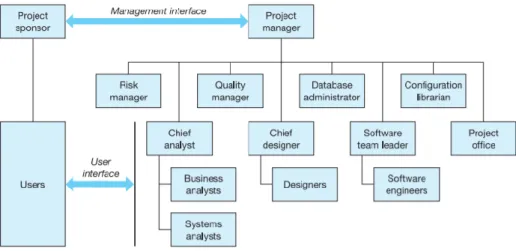
Figure 1 shows generic project organization and roles, as presented by Cadle and Yeates (Cadle & Yeates, 2008). To note, that there are several other roles and they are not all necessary in the development of every Information System, as previously said, each IS is different in its own way.
This section will only include explanation of the first level development roles, beneath the project manager, as the second level perform similar work, as the first level, and are only required for very large projects.
Figure 1 - Generic project organization and roles (Cadle & Yeates, 2008)
Project sponsor
The project sponsor is the responsible for the achievements of the project. The project sponsor is the one connecting the project manager with the persons responsible for the project on the side of the end-users. The sponsor is responsible for establishing the requirements of the project and is going to be the one to justify the project to the board of the organization. The sponsor can be seen as someone representing the final customer, as s/he is the one who must guarantee the project will bring value to the customer and meets the requirements. The sponsor must have experience in Information Systems, and client management, as s/he is the one defending the project on the board.
5
Users
The user will use the system on their daily work, which means s/he is the one who must define the requirements of the system as s/he is the one affected directly with the outcomes of the project. The user must have a full understanding of the business processes and how the system will facilitate them. Usually, the developers must communicate with different users who have different insights about the processes that are going to be improved.
Project manager
The project manager, which is aligned with the project sponsor, is the responsible for the project on a day to day progress. The project manager is also responsible to assure that the work being developed will lead to the achievement of the business objectives, defined by the project sponsor. The project manager has the crucial job of planning, monitoring, and controlling the deliverables and should keep the sponsor aware of the project progress to guarantee that the project will achieve the best outcomes without overpassing the time and cost assuring the quality of the product. The project manager must have experience, as a project manager, as s/he is the one responsible for the overall development of the project, and if his/her predictions are not correct it will have a negative impact on the development.
Risk manager
The risk manager role does not need to have a person dedicated in full time. However, it has a crucial role, as s/he is the one responsible for identifying, classifying and quantifying the risks and their impact in the project. The project manager is the one responsible for the project risk, but the risk manager must and will have an impact on the overall success of the project because it should alert the project manager to eventual risks and also should provide some possible resolutions.
Chief analyst
The chief analyst must be someone with a significant experience in the business as s/he is the one analyzing the businesses processes and understanding where the project can have the most impact. The chief analyst must work side-by-side with the project manager, as s/he is the one who can imagine the bigger picture of the finalized project, and how the system will impact the clients’ processes.
6
Quality manager
The same way as the risk manager, the quality manager role usually is not assigned to a single person at full time. However, in a big project it will bring value to the project making sure there are a quality plan and quality control procedures, to guide the developers on quality-related issues.
Chief designer
The chief designer must have experience with the technology of the final product, as s/he is the one responsible for guiding the design team, and probably the developers as well. The chief designer is the one that will understand the business requirements and guide the team to design and develop the system to ensure that the requirements are met.
Database administrator
The database administrator is the one responsible to develop, manage and integrate the database with the final system. S/he is responsible for all the data that the system will take advantage of. The database administrator will work closely with the chief designer and with the programming team, as s/he is the one who understands the database end-to-end.
Software team leader
The project manager is responsible for the whole team; however, it can have a software team leader, or even more than one, working close to him regarding the detailed management of the software development staff. The software team leaders are responsible for small groups, of software engineers, and are responsible for their daily tasks to guarantee that the whole team is aligned to develop the system in a way that will achieve the business requirements.
Configuration librarian
The configuration librarian is responsible for the system configurations. S/he needs to assume the responsibility for defining the procedures of the systems configuration to ensure the final customer can have the system configured for their specific needs. On extensive projects, the configuration librarian assumes a full-time role.
Project office
The project office is responsible to provide administrative support to the project manager. It is responsible to collect and record timesheets, organize meetings and disseminate
7 information inside the organization, as well as to perform other administrative tasks. Normally, a project officer is assigned to several projects at the same time.
2.2.2. Approaches and Strategies
All information system projects differ, either it is in size, the company for whom it is built, the technologies that are going to be exploited, the industry in which the project is going to have an impact, and many other impactful aspects. Organizations, depending on many factors, have different approaches and strategies to plan an information system project development and implementation.
For a long time now, it is known the several conditions the IS projects must respect and fully interact with. Moreover, the computer science community are aware that, because of the many conditions and specifications necessary to successfully implement an information system project, all projects must include two essential steps (figure 2); the first one is an analysis step, where the requirements for the solutions will be understood to ensure the final product is going to perform as expected, and the second one is a coding step, when the system is developed (Royce, 1987) this applies, of course, only to software development projects, and not to implementation systems projects.
Although these two steps are essential, they are not even close to being enough to respond to the needs of large information system projects, where a full understanding of the business, the organization, and the industry is mandatory. On top of that, the solution must be fully tested to ensure that it responds to all the requirements and there are not any security or design flaws that will make the project unsuccessful.
Figure 2 - implementation steps to deliver a small computer program for internal operations Source: (Royce, 1987)
Along the years, many approaches and strategies have appeared and evolved. However, in the research community there is no consensus to which approach or strategy works better, it all depends on the characteristics of the project. On the other hand, there are two main approaches that are usually used in an IS project, waterfall and agile.
8
2.2.2.1. Waterfall
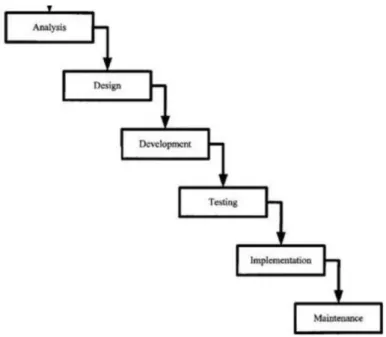
The waterfall approach is the oldest and most used of all the strategies used for software development, being a well-known approach. The waterfall approach is characterized by a sequence of consecutive phases. The phases flow from top to bottom as can be seen in figure 3. This characteristic is the reason behind this approach name, the phases progress from the highest position to the lowest, much alike a waterfall, where the water falls from the highest point to the lowest (Balaji & Sundararajan Murugaiyan, 2012).
Figure 3 - Waterfall approach life cycle Source: (Royce, 1987)
The first publication related to the waterfall approach was the work of Walter Royce in the article “Managing the development of large software systems: concepts and techniques”, with its first publication dated to 1970. Since then, the approach, although being the most used in software development, has received a considerable amount of criticism (Petersen et al., 2009).
Figure 3 is the visual description of the basic phases of software development, using the waterfall approach, however, the identified steps can be different depending on the characteristics related to the project. The visual description of this approach is the baseline to use it, however, there are several aspects that are not described in the image, like who is responsible for each phase. The waterfall approach is very popular, since it allows the manager to have a groundwork to plan their Information Systems projects and adapt the approach for the specificities of the project.
9 The waterfall approach states that each phase should only be finished when everything is documented, as it guarantees that the project is explained in-depth on those documents, which concede to people, who did not perform the actual development, the ability to have full understanding of the software and perform any modification, if necessary (Balaji & Sundararajan Murugaiyan, 2012; Petersen et al., 2009; Sommerville et al., 2011).
In figure 3 it is possible to identify six necessary phases for a project life cycle using waterfall. These phases are:
Analysis
In this phase, the scenario in which the project will be developed is going to be fully analyzed. This task is performed by the business and system analysts to understand the business challenge and requirements for the project.
The outcome of this phase is the baseline for the entire project, as the problem is identified and described. It is critical to have a good analysis as the following phases will use the knowledge created in this phase to achieve a solution that meets the organization needs.
Design
Based on the outcome of the analysis, the design of the information system to be developed is carried out. This design phase not only looks to the software design but must also identify the hardware needed for the solution, as well as the integration between the new software, hardware, and the already existing ones.
The outcome of this phase is going to be the overall architecture of the solutions and integrations with the other existing software, as well as the design of the actual solution to be developed.
Development
This phase, performed by software engineers (developers), organized by the software team leader, is where the idealization of the software performed in the design phase, is going to become real. The software is typically developed as program units. The outcome of this phase is the aggregation of all the program units (the information system software core).
10
Testing
In this phase the outcome of the previous phase should be fully tested to guarantee that it performs as it should, and to ensure that the requirements defined in the analysis phase are met. This task is performed by testers, which one may or may not be their only function for the project. It is critical to have a good set of tests to perform, because the software should be finished in this phase.
Implementation
After the testers approve the software, the system is going to be handled to the final user; however, most systems require an integration with other systems, as predicted in the design phase. In this phase, based on the architecture designed in the design phase, is going to happen the integration between the several systems.
Maintenance
Generally, this phase is the longest of them all, and starts after the project closing. In this phase, the system is already installed and in use. It involves the correction of errors that were not expected, commonly associated with the integration of the different systems. It can also be evolutive maintenance, where newly identified requirements are going to be met (in this case, it may happen in the context of new projects).
Based on the authors Balaji & Murugaiyan (2012), Petersen, K., Wohlin, C., & Baca, D., (2009) and Sommerville, I., Columbus, B., New, I., San, Y., Upper, F., River, S., Cape, A., Dubai, T., Madrid, L., Munich, M., Montreal, P., Delhi, T., São, M. C., Sydney, P., Kong, H., Singapore, S., & Tokyo, T., (2011), the advantages and disadvantages of the waterfall approach are simply identified bellow.
Advantages
• Development only starts when the requirements are clearly identified, and the design of the information system is done. This is positive, because developers have a clear understanding of the requirements for the project, and already have the design of the system and the software done;
• Being a linear approach, it simplifies its implementation. The resources needed to take advantage of this approach can be at minimal levels;
• Documentation. This approach requires that each phase to be completed only when the documentation for that phase is finished. This is also positive hence it answers any question regarding the phases that came before, and everything is explained in documents;
11 • Managers can keep track of the development because, as a phase only begins after the previous phase is finished and documented, it can visually see in which phase the project is and compare to the plan to identify any delays early on.
Disadvantages
• One disadvantage of this approach is the lack of flexibility. If the client requirements change during the project, those requirements cannot be met. The project is plan-based, which means that there is a strict plan to follow, and the first phase is always analysis, where the project requirements are described. Once that phase is finished, so that the next phase can start, changes cannot be made, so any requirement change will only be implemented after the current project is finalized;
• Another problem regarding this methodology is related to problem fixing. The problems related to a specific phase are usually only found on the phase that follows. For example, it is common to find problems in the design of the solution, however those problems are normally found during the development phase. The problem is that if the project is in the development phase, then the design phase should be finished, but if problems are found, then the project structure is going to change, and it should take a step back and go to the design phase again. Only after the design is readjusted, the development phase can continue. This is very expensive and time-consuming;
• This approach is only indicated to a project that can be very well detailed, which means the client should have no doubt towards the information system it needs. If the client is always changing the requirements, then it is the perfect scenario for this methodology to fail, increasing the project budget, and timing delays.
2.2.2.2. Agile
The agile approach is very different from the waterfall approach. It was actually created to overcome the disadvantages of a plan-based strategy, such as the waterfall approach (Royce, 1987).
One of the major weaknesses of plan-based strategies is the lack of agility to adapt the project development to a scenario different than the one planed; in simpler words, the lack of adaptability to change. The reason behind the lack of agility of the plan-based approaches is due to the waterfall idea, that each phase succeeds the previous one in a planned sequence. This planned sequence establishes the project requirements early on, without the possibility to adapt them to the ever-changing client expectations (Barlow
12 et al., 2011). To overcome this challenge it appeared the agile software development, to enable corporations to embrace change and dynamically overcome any required adjustment for the project, facilitating more flexible development (Cockburn & Highsmith, 2001).
Let’s look at the four agile guidelines that the creators of the agile methodologies identified in the agile manifesto (Beck et al., 2001):
Individuals and interactions over processes and tools
In agile, it is not necessary to discriminate in detail the design and the requirements, everything is going to be well thought taking advantage of the entire team, where everyone has a voice to disclosure their own ideas. It is not important to have a process strict to follow, and everyone must be responsible for the project.
Working software over comprehensive documentation
Rather than having people focused on documenting every little detail of the project development, people have the necessary time and freedom to think for their own on the software that is going to be developed, and let them test new ideas and fail, so that in the end the software is completed in the image of the team, making sure that the software is developed for the people that are going to use it.
Customer collaboration over contract negotiation
One critical aspect of agile software development is the relationship with the customer. It is critical to involve the client in the software development, understand their needs, let them test the software and, most importantly, let them contribute with their ideas.
Responding to change over following a plan
In agile, nothing is fixed, everything can change. The software is done in incremental iterations, however, when a new iteration starts, it may change completely the previous logic develop.
“Agile software development is a group of software development methodologies based on iterative and incremental development, where requirements and solutions evolve through collaboration between self-organizing, cross-functional teams” (Balaji & Murugaiyan, 2012)
When an information system project is using an agile approach, it must take advantage of the four guidelines described earlier. The agile software development methodologies work in incremental iterations, which means the project also has phases, must alike in
13 the waterfall approach, except that in agile it is not previously planned on what is going to be done in each phase. The agile methodology, many times, uses prototypes to ensure the software is aligned with the client desired outcome. In each phase of the agile methodology, the outcome can be a prototype with more features than the previous one, in each iteration the software increments in size, making agile an incremental iteration methodology.
In agile, it is very important to have the client involved, to achieve the results the client is looking for, to guarantee the customer understand how the software must be used and for what purposes (reducing the need for so many documents), and to shorten the distance between the problem finders (developers) and the people who accept or reject the necessary changes. The software developed in agile should be consistently made available for the customer to test in small and frequent releases. This allows the customer to engage more efficiently with the project development by frequently integrate with the software that it is going to be available. This engagement with the client, allowing to test the software, is positive not only for the relationship the client has with the project, but it also makes sure the software is rigorously tested (Barlow et al., 2011; Cao et al., 2009).
Based on the authors Cockburn & Highsmith (2001), Beck, K., Beedle, M., Bennekum, A. van, Cockburn, A., Cunningham, W., Fowler, M., Grenning, J., Highsmith, J., Hunt, A., Jeffries, R., Kern, J., Marick, B., Marin, R. C., Mellor, S., Schwaber, K., Sutherland, J., & Thomas, D. (2001), Balaji & Murugaiyan (2012), Barlow, J. B., Giboney, J. S., Keith, M. J., Wilson, D. W., Schuetzler, R. M., Lowry, P. B., & Vance, A. (2011), and Cao, L., Mohan, K., Xu, P., & Ramesh, B. (2009), the advantages and disadvantages of the agile approach are simply identified bellow.
Advantages
• One of the most significant advantages of the agile approach is the adaptability it gives. Information system projects developed in agile methodology are from the first day thought to be flexible to the ever-changing requirements of the customer. • Another big advantage of agile is the involvement of the client in the development of the system. It allows the customer to be very close to the developers, which is good to ensure the system will give answers to the problems the client is facing. Even if the client changes its ideas during the development, the developers, being close to them, can fully understand the needs of the client regarding the information system.
14
Disadvantages
• Agile may be great for smaller projects, where the development is mostly done by one or two developers. On the other hand, more complex software requires several developers to working in parallel which demands the project to have well defined requirements, which may not be appropriate for the agile methodology. • Compared to waterfall methodologies, agile lacks detailed documentation. In the
waterfall methodology, everything is very well documented, which is imperative for a future escalation of the information system. However, agile focus on delivering quickly the best possible software, which it leads to lack of documentation because there is not explicitly defined when and how documents should be elaborated.
2.3. T
EAMM
ANAGEMENT2.3.1. Teams
A team is a group of people where each team member should have complementary skills. The team must share the same goal or objective; however, each team member has different tasks and functions. In the end, all the tasks aggregated will allow the team to achieve their goal or objective (Brannick, 2014).
One of the most crucial aspects of teams is coordination. Coordination means that the team members work adaptively to other members, each member must make some adjustments on their work so that the bigger team goal is achieved effectively and efficiently. Sometimes, it even means that a smaller task is going to be harder to achieve or is going to take more of your time. However, this must happen so that the bigger task, the team goal, is achieved faster and with better outcomes (Brannick, 2014).
It is important to work in teams, as in the case a team member find a challenge, he has a group of people who, having the same bigger goal, want as much as him to finish the task, to allow the team to achieve the common goal. Usually, inside the team, it is possible to find someone who can help, as each team member has a different set of skills for different challenges the team find (Baldwin & Migneault, 1996).
15
2.3.2. Team Stages
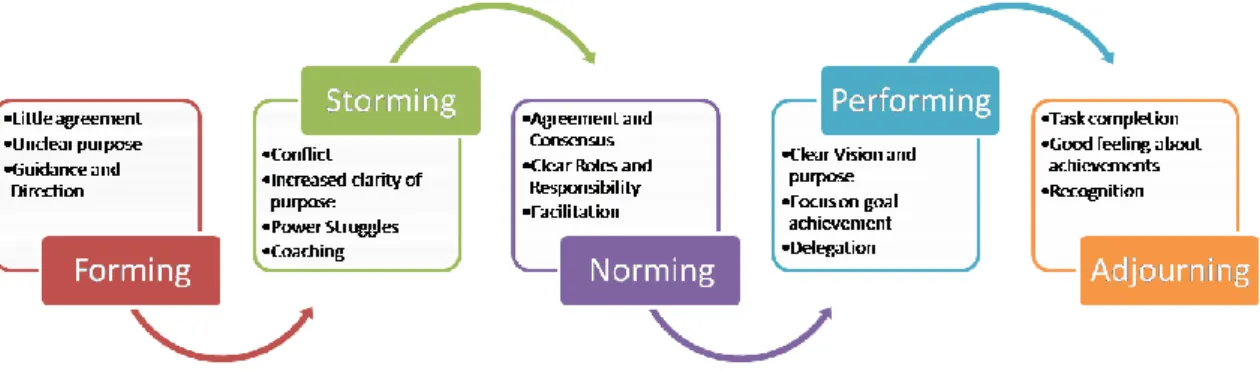
Tuckman (1965) developed a model, in his publication “Developmental sequence in small groups” which tries to describe the stages a team goes through when working together. The first model was composed of four stages: Forming, Storming, Norming and Performing. Later, in 1977, Tuckman and Jensen did a revision of the model where they added a fifth stage: Adjourning. In figure 4 it is possible to see, what happens and the interactions between team members of each phase (Tuckman & Jensen, 2010).
Figure 4 - Team development stages Source: (Tuckman, 2012)
Forming
This is the very first stage of team creation. This is when everyone will meet, so there may be anxiety “in the room”. This is a “pleasant” stage, as everyone is going to be polite and positive towards the work, as they are not comfortable to confront anyone. This stage is critical to align the team towards the same goal while they are still friendly with each other and are starting to know each other. It is also good to establish some ground rules for the members to feel comfortable during the project.
Storming
Each member of the team has a different working style, and in this phase is where problems with the other team members’ working style are going to happen. People will not feel comfortable with the others’ style and may feel that s/he is not doing what it should be doing, or it is not giving the same amount of effort as the others. This will bring discomfort for the team, however, is very important that people communicate and let others know that something they are doing is letting you uncomfortable and ask them to change. It is important, to be honest, and confront every problem with others as soon as possible, so that the team can align their style as fast as possible.
16
Norming
In this phase, the team is starting to get along. Members already know what everyone does in his role, and it does not bother the others anymore. People know what others are doing and can identify and appreciate all their colleagues’ strengths. As new difficult tasks appear some teams can go back to the storming phase, as it may happen some disagreement between members.
Performing
This stage is where the team is working as a team, achieving the best possible performance. People know how to coordinate his tasks with the others’ tasks, people know each other’s strengths, take advantage of them, and their weaknesses and are proactive in helping them. Everyone is happy working in the team, members know exactly what to do to achieve the best results possible, everyone is learning with other members, and the team is growing in efficiency as members already know what to expect from the others.
Adjourning
This is the end of the team. This phase means the dismantlement of the team. Teams are made for a specific goal, when the goal is achieved the team separates and everyone goes its own way. This phase may be difficult for a lot of members who actually developed a friendship inside the team, and they will get demotivated as they will have to go through all team formation phases again.
2.3.3. Team Performance
For Hackman (2002) the very best effective working team must, always, do three things: serve their customers well; become increasingly capable performing units over time; and, finally, provide settings in which each individual member can find in his/her teamwork, a good measure of personal learning and fulfillment. Further is a deep dive on the Hackman view for each of these three criteria.
Serving clients
All teams have a goal or objective to be achieved, developing a new product or improving a process. However, it is rare the number of teams that will take advantage of the outcome of their work, usually the team is developing their work to enable other people to perform a better job.
17 With that being said, it can be easily understood the importance of serving the client. At the end of the day, if the client, that is going to take advantage of the solution, does not see the value or is unhappy with the solution, it is clear the team did not perform as good as expected.
“The productive output of the team (that is, its products, service, or decision) meets or exceeds the standards of quantity, quality, and timeliness of the team’s clients – the people who receive, review, or use the output.” (Hackman, 2002)
In the business world, there is no right or wrong answer to all the problems; usually, there is more than one path to go through to achieve the client objectives. This arises another problem, even when the team perfectly achieves the objectives, were they effective in doing so?
Effectiveness is challenging to measure in organizational settings. The clients are the ones who must be satisfied with the teamwork outcome, so instead of focusing the efforts in evaluating the effectiveness of a team, it is more important to understand how well the team identified the client ambition, and if it was totally achieved. On the other hand, it is not straightforward for a team to understand what the client wants, occasionally not even the client knows what it wants. The manager plays a critical role in the definition of the standards and assessments that have more weight on the client judgment of the teamwork relevance. The manager usually being the one with more experience and the one who bridges the team-client interactions, should have a clear view of the client objectives, and should enable the teamwork to be aligned with those objectives.
“(…) good performance means is whatever the group’s clients think it means. Good teams know that and meet their clients’ expectations. Great teams actively shape those expectations, and then exceed them.” (Hackman, 2002)
Growing as a team
When working in a team you will use social processes, between the team member; these social processes enables team members to reinforce the capability of working with other members over time. At the same time, as one reinforces their social capabilities, s/he will learn to work with the specific team members, as you will start to understand how they work, what their strengths and weaknesses are, and the team will better synchronize their activities and predict one another work. This will enable teams to become highly coordinated and even prepare for eventual problems as they are starting to appear.
18 A working team must have shared commitment, a big spectrum of different skills and good coordination on strategy and tasks distribution if they want to be a very effective and well-performing one. The team, as one, become very effective in detecting and correcting errors before things get out of control. They not only become highly skilled in detecting troubles in their work, but they also develop the capability to detect opportunities to perform better or more efficient.
Taking advantage of all these possibilities is not easy, an effective work team needs to periodically meet to discuss what is going well and what could have gone better. These short meetings are crucial to align the whole in the expectations and enable team member to speak between them so that individuals can tweak their work to better meet the team commitment.
“An effective team is a more capable performing unit when its work is finished than it was when work began.” (Hackman, 2002)
Individual Members’ Learning
Teams are composed by different persons with a different set of skills, which is critical for effective work, because, even if a team member lacks knowledge from a specific topic, there is a big probability that another team member can support him and help to solve the task. This mutual support between team members enables, not only the ability to perform tasks in a better way, but also enables team members, who seek help from another member, to gather new knowledge that s/he did not have before.
Working in teams make individuals feel pleased with being of something bigger. This group experience, usually, brings good feelings, not only for the organization but also to the individual members of the group. Being part of a group that can create a good environment between members will not only contribute to the personal satisfaction of individuals, will certainly develop an environment of learning, where members help each other mutually through discussions.
Everyone is different, everyone has gone through different experiences, everyone has seen different places, and everyone overcame different challenges. Since everyone has gone through different things, people see new objectives, challenges or tasks with a different pair of eyes. This means, people may recognize something from previous experiences, or they may have already a solution for a question that s/he has already answered. This is crucial to understand on a team, people with different skills and experiences should be part of the same team as they complement each other. Ones should be more technical, and more fact-oriented, while others should be more practical
19 and feeling-oriented, so they can present a solution based on facts but that also brings a feeling of satisfaction to the customer.
Working in teams not only should bring a better outcome but also should bring a better feeling, towards working, on the team members. No one likes to be left apart from a group, people like to feel they belong in a group with more people, they support each other against all the troubles on the path, they have someone to seek for help and ultimately, they should create a bound beyond the professional empathy.
“(…) working with others on a shared task can spawn satisfying interpersonal relationships, some of which may flower into friendships that extend well beyond the group setting where they were formed.” (Hackman, 2002)
2.3.4. Team Discipline
Katzenbach and Smith (1993) defend that is crucial for a team to share a unified discipline.
“To achieve these benefits, team members must do more than listen, respond constructively, and provide support to one another. In addition to sharing these team-building values, they must share an essential discipline.” (Katzenbach &
Smith, 1993)
The discipline mentioned by Katzenbach and Smith is characterized in five aspects, these five aspects are the following:
A meaningful common purpose that the team has helped shape
Teams usually are managed by someone superior to the members of the team. The manager is the one to think of the objectives the team should achieve. Things should not be this way. The team should be present on the definition of the scope, the purpose for the team to exist. The team will be more dedicated in achieving a goal defined by them, then defined by someone else.
Defining the purpose is also crucial to guarantee that everyone is on the same page. Having someone outside of the team defining the goal, it can lead to misunderstanding. The manager may feel comfortable with the explanation it gave to the team; however, s/he may only meet the team again when the work is, supposedly, done. It can happen that the team at first understood the main objective, but as time went by, the focus of the whole team shifted a little, and the final outcomes are not totally aligned with the manager first explanation and expectations.
20
Specific performance goals that flow from the common purpose
As discussed previously, the team should define together the purpose, goal or objective of the work to be done. To help in keeping track of the team direction, the next step a team should follow is to define specific performance goals.
These performance goals should have characteristics aligned with the common purpose, the team must guarantee that when the performance goals are meat, little is left to be done to achieve the defined common purpose. The second thing is that it should be measurable; teams should be able to measure if they are too far from meeting the performance goals, or if they are almost achieving them.
Specific performance goals are good to align the team on the common purpose, if the team knows exactly what the common purpose will bring (e.g. reduce the time to market by half, decrease the waiting time by three seconds, etc.) they can be sure that meeting the specific performance goals, there is a huge probability that the work is done accurately.
A mix of complementary skills
A team must be composed of multidisciplinary individuals, each should have a set of skills different from everyone else and those skills should be complementary.
“These include technical or functional expertise, problem-solving and
decision-making skills, and interpersonal skills.” (Katzenbach & Smith, 1993)
This topic was already covered, however, from one perspective, is one of the most important aspects in a team. Imagine a team where everyone has the same skills. The team will be locked on the work it can do, people do not complement each other, which lock the possibility to create something that neither of the individuals has ever done. Individuals should have complementary skills so that they can split a solution into parts, each part should be allocated to an individual who has the skills to perform the specific task, and where, in the end, the solution is multidisciplinary and is impressive in the sense it does more than the individual parts of the solution.
Once again, the sum of all the individual capabilities is always inferior to the capabilities of a team composed of those elements, as they mutually help each other to develop a better solution.
21
A strong commitment to how the work gets done
Teams must be coordinated. Everyone has its own jobs to perform, and every job should be arranged by a scheduled. The scheduled must be defined at the beginning and shared between everyone.
The sum of the jobs of each team member, the leader included, should be equal; no one should perform more tasks, neither should have more difficult tasks and should take the same amount of time from everyone. This is crucial to avoid misunderstandings and bad feelings towards someone that does less work then the rest of the team.
It is also important to define when and how decisions should be made and modified. The work of everyone must contribute to the final product, service or outcome of the team.
Mutual accountability
Everyone is individual accountable, which means that everyone is responsible for its own actions, the work done by that person is by the responsibility of that person. It is important for everyone to understand that no one should ever find excuses for a bad performance. It should look to the factors that explain it and learn from them so that next time it does repeat the same mistakes. For a team to perform it is important that every member has individual and mutual accountability. Mutual accountability is crucial in teams, in every member of the team. If everyone has mutual accountability their objective is the success of the team. It can lead to astonishing results as members trust that everyone is going to perform at its best in every step of the work.
“The process of agreeing upon appropriate goals serves as the crucible in which members forge their accountability to each other—not just to the leader.”
(Katzenbach & Smith, 1993)
2.4.
C
HALLENGES INT
EAMM
EASUREMENTThere has been a lot of effort to evaluate team performance, however, it seems that those efforts usually fail based on one or more of three main aspects.
Brannick, Salas, and Prince (1997) have done an effort in classifying those mistakes. First, they defend that based on their analysis the main goal is to evaluate the global outcome of the team. On the other hand, they acknowledge that some teams give more importance to the individuals, that must at all cost work together, instead of evaluating the team. Finally, the last problem identified was in count that some researches use
22 measures as they seem to be more useful, in particular, they give the example of measuring the outcome of the process.
There will always be some difficulty in evaluating teams, however, one can say that there is always a difficulty in evaluating things. Evaluation is bias, as everyone who perform evaluations, have different experiences and have seen different things, which means that the performance of a team not only depends on their actual performance but also on the perspective of the evaluator. Let’s dig into the three main challenges in team measurement, as defended by Brannick, Salas, and Prince (1997).
The Unit of Analysis
The objective of a team evaluation is, obviously, evaluate the team, however, what does the team does without its members? The team is composed of several members, and the outcome of the teamwork comes from the work of all team members.
There is a challenge in here: should the team be evaluated as one single unit or as a sum of the several elements? There is the possibility to identify what task comes from the team (meetings, brainstorm, task allocation, task changes, etc.) and which tasks are from individuals, and evaluate them as team tasks and individual tasks, and then merge them together to achieve the team evaluation. However, it is not easy to identify which ones are from individuals and which are from the team.
Process versus Outcomes
Which is more important, the process or the outcome? This question is not relevant only to measure team performance. Is common to encounter in our life a complicated decision, where we must decide between doing the right thing, which will lead to bad results, or doing the wrong thing, which will lead to good results.
The outcome of a team may not be only dependent on the team. Usually, there is a lot of factors that influence the outcomes, like the data they are working with, or the weather, or the previous legacy system in place.
“If we look at the distribution of times to complete a sailboat race, for example, part of the variance will be due to the team operating the boat, but part will be due to characteristics of the boat itself.” (Brannick et al., 1997)
Evaluating the process to achieve the objectives may be more accurate. Evaluate how the team dealt with the problems and overcome them, however it does not uncover everything, as there is not one single process to follow to achieve good results. Teams can have a good process, but how do you identify if the process makes sense? There is
23 more than one way of doing the work, and at the end of the day what really counts is what the customer receives, the outcome.
There is no one correct answer to this problem, people may defend one or the other aspect, but there is not a single answer. Following the opinion of Brannick, Salas, and Prince (1997), both the process and the outcome matters. If the team achieved the desired outcome but its process was complicated and frustrating, then the team did not perform well. On the other hand, if the team have a harmonious process where everyone knows exactly what to be done, and the outcomes do not meet the client expectations, then that team did not perform well. The secret is in evaluating both the process and outcome to guarantee that both the client and the team are satisfied with their job and the outcome.
The Organization of Teamwork and the Naming of the Constructs
One final issue regards the basis of good teamwork. Not all teams need to share the same basis to achieve good results. Some teams need more respect, others may need more communication. It depends on the work that the team is going to perform and even on the individual members, as we are all different, some of us pay more attention to some details and others to other details.
Brannick, Salas, and Prince (1997) give four examples of people who tried to define a set of “dimensions, factors, skills, or activities that can explain differences in team functioning”.
According to Morgan et al. (1986), the most important processes in a team are three: communication, coordination, and adaptability.
Prince and Salas (1989) define seven dimensions, in team processes that are related to aircrews: communication, leadership, decision making, adaptability, assertiveness, situation awareness, and mission analysis (planning).
Helmreich and Foushee (1993) suggested four major group processes: communication and decision behaviors, team building, workload management, and situation awareness and operational integrity.
Lastly, Cannon-Bowers et al. (1995) expected an agglomerate of skills based on constructs such as adaptability, shared situational awareness, and performance monitoring and feedback.
24 There are several skills shared in all the examples given, however, there is not even one common to them all. The identification of the constructs that are crucial for the team is dependent on the team itself and on the objective for the outcome. It is impossible to define a set of mandatory skills to evaluate all teams. It all depends on a set of project and/or organization related factors.
25
3.
METHODOLOGY
A research methodology is a set of guidelines a researcher should follow to obtain knowledge and to properly expose their knowledge creation to the scientific community. In other words, is a set of rules and procedures accepted by the academic community to recognize scientific knowledge (Micheletto et al., 1996).
In this thesis, the methodology used is Design Science Research (DSR), which is commonly used in the research on Information Systems (Ferreira et al., 2012).
The objective of this thesis is to present a process artifact for the evaluation of team performance in the development of IS projects. Design Science Research is a methodology that provides guidelines to easily present knowledge, acquired during the research (Gregor & R. Hevner, 2013; Van Aken, 2005)
3.1. D
ESIGNS
CIENCER
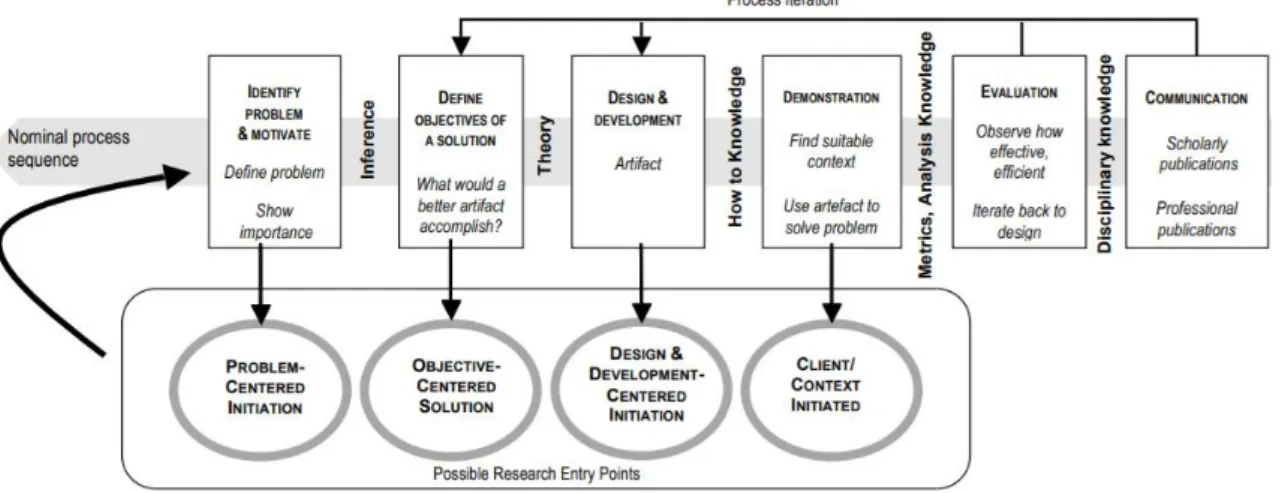
ESEARCHThis paper follows the Design Science Research methodology as described by Peffers et al. (2008), comprising six activities, as showed in figure 5.
Figure 5 - DSR Method Adaptation Source: (Peffers et al., 2008)
Identify the problem & motivation
The first activity in the DSR methodology is the problem identification and motivation. In this activity the researcher identifies a problem, gap or flaw in the area of research and understands the importance a solution can bring. The problem definition is the base for the artifact development; the artifact must be developed taking into consideration the identified problem. Previously to the abstract construction, the research must fully
26 understand the problem complexity, so it can justify the value that will add. The justification of the solution value brings two benefits: first, the researcher and the audience are motivated to understand and accept the innovative solution; second, it supports the researcher’s reasoning of the solution for the identified problem.
Define objectives of a solution
The problem is identified, and the researcher is motivated to produce an innovative artifact to resolve the presented problem. The next phase is to infer the objectives for the solution. It is required to properly define clear objectives for the solution, so that the researcher does not defocus from the main goal.
Design & development
Design and development of an artifact is the core work of this thesis. A design research artifact is object in which there is knowledge contribution and creation to the area of research. The artifact design and development is an extensive work which requires several iterations. Each iteration should incrementally improve the artifact until the objectives are accomplished.
Demonstrations
It is important to demonstrate the usefulness of the purposed artifact. The researcher must experiment, simulate, proof, or realize any other type of activity that exhibit the artifact in use in a real or near real situation.
Evaluation
The artifact must be put to test in a real scenario so the researcher can observe and measure the performance of it regarding the identified problem and the achievement of the purposed objectives resolution. In this activity, the artifact is used, and the problem resolution is evaluated. Outcomes of this phase allow the research to evidence the need for further artifact development or, in the case the results are satisfactory, the communication of the new knowledge is required.
Communication
The last activity of the methodology is the communication, to the scientific community, of the problem identified, its importance to the area, the artifact developed, its usage and evaluation, and its effectiveness. Design Science Research methodologies arms the researcher with a guide on how to impactfully communicate his knowledge creation.
27
3.2.
R
ESEARCHS
TRATEGYThe research here presented followed the methodology of DSR. It started with the problem identification and motivation. This activity required extensive research to understand what previous knowledge existed in the relevant topics. The relevant topics identified in this research are raised in the literature review, where it was studied broader concepts like Information Systems and Team Management. Nevertheless, previous similar work related to team evaluation was studied to ensure the proposed solution would not only be innovative for the community but would also take in consideration previously identified aspects by researcher in the field of evaluating teams developing Information Systems.
After understanding the knowledge created by previous researchers, the objectives to achieve were straightforward. These objectives are declared in the introduction and are the connection between the identification of the problem and motivation, and the actual development of the solution. It is required to have well defined objectives to guarantee the proposed solution will resolve the identified problem.
Design and development was an activity that required several iterations. The objective in this phase was to develop an innovative artifact that would achieve the defined objectives for the solution, based on the problem identification. This activity required several iterations, it was necessary to progressively improve the artifact. At each iteration it was necessary to carefully and cautiously understand where the artifact could be improved. After a few iterations, the artifact is an improvement version of the first design and development iteration.
Demonstration is the activity responsible for proving the efficacy of the proposed artifact in a real or near real scenario. In this paper, the demonstration is present in chapter four, where the artifact is exanimated. Initially, it is explained in a simulated scenario, with imagined data.
Also in chapter four, following the demonstration of the proposed process, there is the evaluation of the artifact, after it was used by a real team developing an IS project. The last activity of the Design Science Research methodology is to communicate the findings to the scientific community. This thesis fulfills this activity, as it has the objective of communicating the problem, its relevance, as well as the artifact, its applicability and efficacy. It is a crucial activity as it presents to researchers, and any other relevant audience, a depth examination of a solution relevant to address a very well-known problem.
28
4. PROCESS FOR THE EVALUATION OF TEAM PERFORMANCE IN
INFORMATION SYSTEMS PROJECTS
In this chapter the developed artifact is thorough demonstrated. It is divided in four phases, it begins by stating some assumptions considered for the development of the artifact, taking in consideration the research done by previous authors. Following is the process definition, where the artifact is defined and explained with fictious data. Later the process is evaluated by allowing a team developing an actual IS project use the process throughout the project development, and afterwards the outcomes, the efficacy, and simplicity of use of the process are analyzed. To conclude it is presented a discussion of the relevant topics identified during the process development and utilization.
4.1. A
SSUMPTIONSBased on what was studied in the literature review, for the process to be used in an IS project development and guarantee it has the desired outcome, the manager, regarding the project planning, must consider:
• The framework to be used. It can be any, waterfall, agile, etc., provided that the project phases are well identified, as they are critical for the classification of the team to follow a methodic process with clearly identifies milestones;
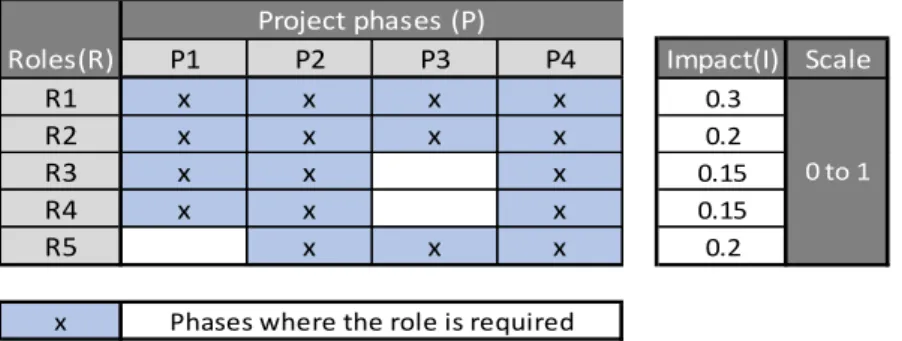
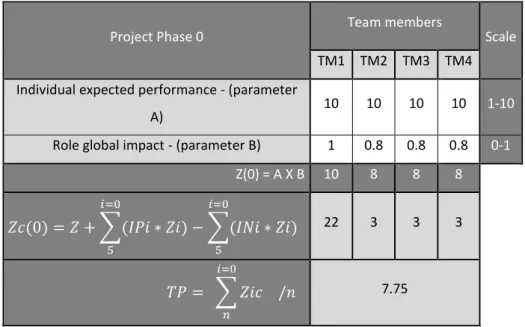
• An Information System project require a handful of different roles, with different skills. For that reason, for simplicity of use, and because the objective is to evaluate the team as a whole, the process does not evaluate differently the team members, the only aspect that differs from role to role is the impact that each role has on the project, and in each project phase (Cadle & Yeates, 2008).
Regarding the metrics that the process will evaluate, and based on the literature review, there are some assumptions considered for the presented process:
• The process does not specific strict parameters to evaluate the team. The parameters used can be perceived differently according to the managers perspective. Nevertheless, this is important as in some projects there are more important aspects than on others (Brannick et al., 1997). Letting the metrics be abstract will allow a better adoption by the managers as they can adopt the process using their know-how about the specifications of the project and the team. No other person, than the manager, should know better the most important aspects and contributions of the team to the project;
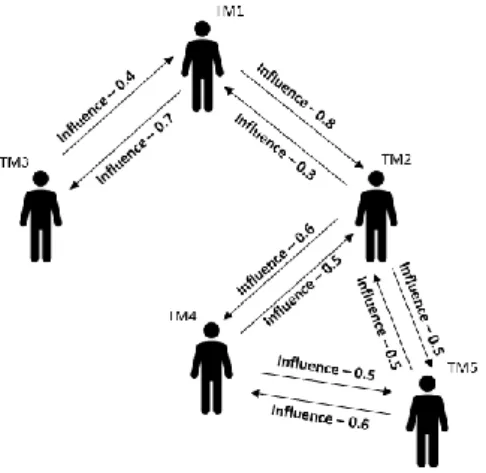
29 • For a team to achieve its maximum potential there are three fundamental aspects, on the eyes of Hackman (2002), team members learn and improve their individual performance, the team grows together to improve their performance, and the client is well served. For that reasons, the process evaluates two critical aspects, first the individual performance, throughout the project phases, to observe the evolution of team members and guarantee the client is served correctly. Secondly, the synergies between team members, to quantify the relations between members and to perceive the team growth, as well as the members impact on each other, to retrieve the best relations between all the team members.
In chapter 2.4 the main challenges faced when trying to evaluate a team were identified. Based on that chapter, and to mitigate the risk of having a process which will fail in evaluating the team as a whole, the process should:
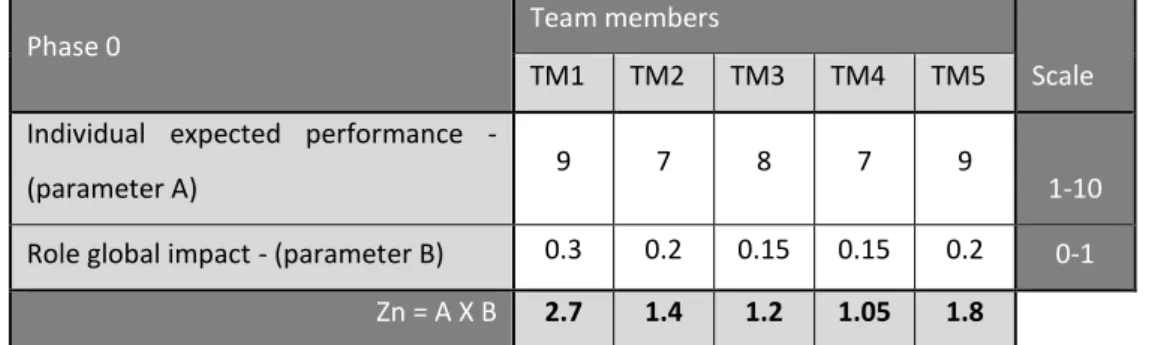
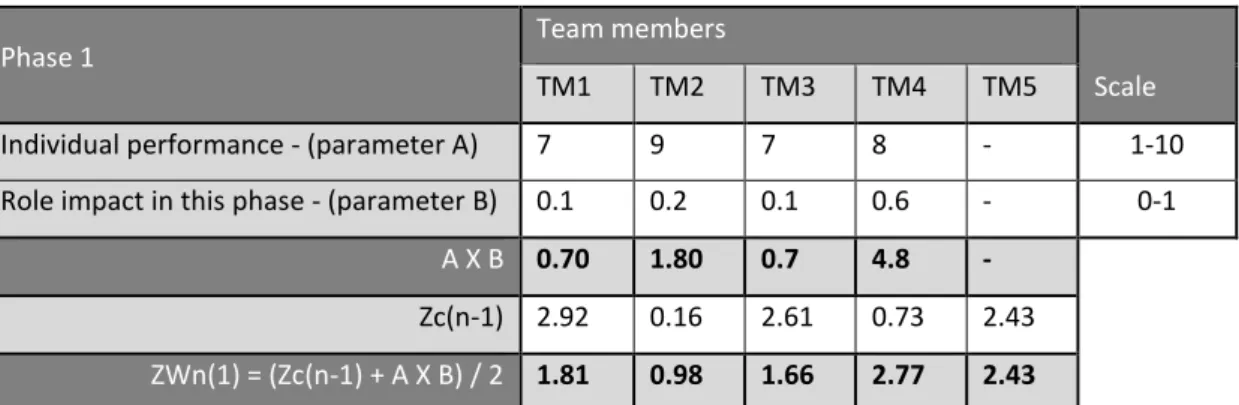
• Have clearly identified the unit of analysis (Brannick et al., 1997). In the proposed process there is a metric which is related to individual performance and one other which evaluates the relations between team members, the synergies. This two metrics together allows to evaluate the team as a whole. These metrics are captured at each project phase, which means, the process evaluates the team performance, phase by phase, until the end of the project. By the end of the project the process has measured the team performance during the entire project.
• Evaluate both the process and the outcome of the IS development. The process has two metrics to evaluate the team performance. The individual performance metric should be used to evaluate the work performed by the team members, which will evaluate the outcome of the project. The synergies between their team members evaluates the process throughout its development, as it evaluates the relations and dependencies between team members;
• Not have the constructs of its evaluation criteria closely defined. Each IS is completely different from each other, thus the metrics used to evaluate can have different impact in different projects. This process does not define clear metrics, but it rather has two metrics (individual performance and synergies between team members) to allow the manager to adopt the process without regards of the more important criteria of the project it is going to be developed.