Revista Portuguesa de
Cardiologia
Portuguese Journal of Cardiology
www.revportcardiol.org
REGISTRY
National Registry on Cardiac Electrophysiology (2012)
夽
Mário Oliveira
a,∗, Francisco Madeira
b, Daniel Bonhorst
c, Carlos Morais
daVice-Presidente da APAPE para a área da Eletrofisiologia (Direc¸ão de 2011-13), Hospital de Santa Marta, Lisboa, Portugal bSecretário-Geral da Associac¸ão Portuguesa de Arritmologia, Pacing e Eletrofisiologia - APAPE (Direc¸ão de 2011-13), Hospital
Fernando Fonseca, Amadora, Portugal
cPresidente do Instituto Português do Ritmo Cardíaco --- IPRC, Oeiras, Portugal
dPresidente da APAPE (Direc¸ão de 2011-13), Hospital Fernando Fonseca, Amadora, Portugal
Received 4 January 2014; accepted 27 January 2014 Available online 19 October 2014
KEYWORDS Cardiac electrophysiology; Catheter ablation; Implantable cardioverter-defibrillator; Cardiac resynchronization therapy
Abstract Based on a survey sent to Portuguese centers that perform diagnostic and interven-tional electrophysiology and/or implantable cardioverter-defibrillator (ICD) implantations, the authors analyze the number and type of procedures performed during 2012 and compare these data with previous years.
In 2012, a total of 2561 diagnostic electrophysiologic studies were performed, which were followed by ablation in 2017 cases, representing a steady situation compared with the previous year. There was a 12% increase in the number of ablation procedures for atrial fibrillation, making it for the first time the most frequent indication for ablation, overtaking atrioventricular nodal reentrant tachycardia.
The total number of first ICD implantations was 1048 (around 100 per million population), of which 375 were cardiac resynchronization devices (BiV ICDs). This represents a slight decrease (3.3%) in the total number of new implants, with a relative increase of 10% in the number of BiV ICDs compared to the previous year. However, there was a considerable increase in the number of ICD generator replacements, resulting in an overall increase of 3.5% in implantations performed in 2012.
Some comments are made regarding developments in this activity and its current status, and on some factors that may influence the dynamics of this area of interventional cardiology. © 2014 Sociedade Portuguesa de Cardiologia. Published by Elsevier España, S.L.U. All rights reserved.
夽 Please cite this article as: Oliveira M, Madeira F, Bonhorst D, et al. Registo nacional de eletrofisiologia cardíaca (2012).
Rev Port Cardiol. 2014;33:583---589.
∗Corresponding author.
E-mail address:[email protected](M. Oliveira).
PALAVRAS-CHAVE Eletrofisiologia cardíaca;
Ablac¸ão por cateter; Cardioversor-desfibrilhador implantável; Ressincronizac¸ão cardíaca
Registo nacional de eletrofisiologia cardíaca (2012)
Resumo Os autores analisam o número e tipo de procedimentos efetuados durante o ano de 2012 com base em inquéritos enviado aos centros nacionais que durante este ano praticaram eletrofisiologia diagnóstica e de intervenc¸ão e/ou implantaram cardioversores-desfibrilhadores (CDI), e comparam estes dados com os de anos anteriores. Em 2012 foram efetuados 2.561 estudos eletrofisiológicos diagnósticos, seguidos de ablac¸ão em 2.017 dos casos, o que repre-senta uma estabilizac¸ão comparativamente ao ano anterior. Registou-se um aumento de 12% no número de ablac¸ões de fibrilhac¸ão auricular, que passou a representar a indicac¸ão mais frequente para ablac¸ão, ultrapassando a taquicardia por reentrada nodal auriculoventricular.
O número total de primeiras implantac¸ões de CDI foi de 1.048 (cerca de 100/milhão de habitantes), sendo que, destes, 375 eram CDI com ressincronizac¸ão ventricular (CDI BIV). Estes dados traduzem um ligeiro decréscimo (3,3%) do número de primeiras implantac¸ões, com um aumento relativo de 10% no número de CDI BIV face ao ano anterior. No entanto, verificou-se um crescimento muito significativo no número de substituic¸ões de geradores de CDI, de que resultou um acréscimo de 3,5% no total de implantac¸ões efetuadas em 2012. São feitas algumas considerac¸ões acerca da evoluc¸ão e estado atual desta atividade hospitalar e sobre alguns fatores que poderão influenciar a dinâmica verificada nesta área da cardiologia de intervenc¸ão. © 2014 Sociedade Portuguesa de Cardiologia. Publicado por Elsevier España, S.L.U. Todos os direitos reservados.
Introduction
The National Registry on Cardiac Electrophysiology is an annual registry maintained by the Portuguese Association of Arrhythmology, Pacing and Electrophysiology (APAPE) and the Portuguese Institute of Cardiac Rhythm (IPRC) that, in collaboration with all national electrophysiology centers (public and private), records data on invasive electrophys-iology (electrophyselectrophys-iology studies and catheter ablations) and implantation of implantable cardioverter-defibrillators (ICDs) in Portugal.
This is an area of considerable dynamism in cardiology in terms of technical advances, clinical implementation and updating of international guidelines. It is therefore impor-tant to assess not only the scientific aspects of the activity but also the number of procedures performed, to provide an overall picture of the situation in Portugal with regard to the number of participating centers and their volume of activity and the number and type of procedures performed, as well as development over time. These data are also important in determining the training capabilities of the different cen-ters in order to provide the national health authorities with information on the activity of this hospital sector.
The Registry is also used for comparing Portugal with other countries, particularly as it forms the basis for Portuguese participation in the European Heart Rhythm Association (EHRA) White Book,1an annual publication that
presents statistics on invasive electrophysiology in European Society of Cardiology member countries.
This article presents the data for Portugal for 2012.
Methods
Although most centers in Portugal have computerized records, it has not been possible to achieve centralized data collection for the Registry, the main reason being
the different data formats used by the various centers. Thus, as in previous years, data were collected following personal contact with the heads of the pacing and electro-physiology laboratories, and forms were sent on which the required information was to be entered, which were sub-mitted by email in most cases. This information was used to assess the number and type of diagnostic electrophysio-logic studies (EPS) and ablation procedures performed, types of arrhythmia treated by ablation and number and type of ICDs implanted or replaced, including biventricular cardiac resynchronization devices (BiV ICDs).
Results
Responses were obtained from all public and private cen-ters. In 2012 the number of centers performing EPS and/or ICD implantation remained at 27, of which 20 were public hospitals and seven private institutions.
Electrophysiologic studies and catheter ablations There were 18 centers performing EPS in 2012, of which 10 were public (three in the north of the country, one in the central region, and six in the south) and eight private (one in the north, two in the central region, and five in the south). One public hospital (Faro), which had begun operat-ing in this field in 2011, suspended activity in 2012, while one private center (Idealmed, Unidade Hospitalar de Coimbra) began performing EPS in 2012.
The total number of diagnostic EPS was 2561, around 1% more than in 2011, followed by ablation in 2017 of cases, a similar number of ablation procedures to the previous year (Figures 1 and 2).
With regard to the types of arrhythmia treated, there was a considerable increase in ablation of atrial fibrillation (AF) (Figure 1), rising from 467 cases in 2011 to 524 in 2012,
0 500 1000 1500 2000 2500 2011 2012 2013 2017 467 524
Total ablations AF ablations
Figure 1 Total number of ablations and of atrial fibrillation ablations performed in Portugal in 2011 and 2012. AF: atrial fibrillation.
an increase of 12.2%, making AF the arrhythmia most often treated by catheter ablation. However, AF ablation was per-formed in only 11 of the 18 centers, of which five were private; in four centers the number of AF ablations was <10 per year, while the two centers with the greatest volume of activity performed >100 procedures per year.
Figure 3 shows the numbers and types of ablation procedures performed in 2012. AF accounted for 26% of interventions, for the first time exceeding atrioven-tricular nodal reentrant tachycardia (25%), followed by
3.2% 3.1% AVNRT AF AV AFL VT AT AVN 26.0% 19.9% 17.4% 5.2% 25.2%
Figure 3 Indications for ablation in Portugal in 2012. AF: atrial fibrillation; AFL: atrial flutter; AT: atrial tachycardia; AV: atrioventricular accessory pathways; AVN: atrioventricular node; AVNRT: atrioventricular nodal reentrant tachycardia; VT: ventricular tachycardia. 0 500 1000 1500 2000 2500 1992 1993 1994 1995 1996 1997 1998 1999 2000 2001 2002 2003 2004 2005 2006 2007 2008 2009 2010 2011 2012 64 130 212 252 279 309 448 453 648 763 759 832 952 1112 1360 1523 1596 1668 1811 2013 2017
0 100 200 300 400 500 600 Hospital de Sta Cruz
Hospital de VN Gaia (CHGE) Hospital da Luz Hospital de Sta Maria (CHLN) Hospitais Universidade de Coimbra Hospital de Sta Marta (CHLC) Hospital de Sto António Hospital da Arrábida Hospital de São João Hospital Garcia da Orta Hospital Fernando Fonseca Hospital dos Lusíadas Hospital de Setúbal Hospital dos SAMS Hospital da CUF Infante Santo CLiaRia - Hospital Privado de Aveiro Hospital de Faro Hospital da Cruz Vermelha
*-Private centers
*
*
*
*
*
*
*
AVNRT AV AFL AT AVN VT AFFigure 4 Number of ablation procedures by center in 2011. AF: atrial fibrillation; AFL: atrial flutter; AT: atrial tachycardia; AV: atrioventricular accessory pathways; AVN: atrioventricular node; AVNRT: atrioventricular nodal reentrant tachycardia; VT: ventricular tachycardia.
Hospital de Sta Cruz Hospital de VN Gaia (CHGE) Hospital da Luz Hospital de Sta Maria (CHLN) Hospital de Sta Marta (CHLC) Hospitais Universidade de Coimbra Hospital de Sto António Hospital da Arrábida Hospital dos Lusíadas Hospital Fernando Fonseca Hospital de São João Hospital de Setúbal Hospital Garcia da Orta Hospital dos SAMS Hospital da CUF Infante Santo CliRia-Hospital Privado de Aveiro Idealmed - Unidade Hospitalar Coimbra Hospital da Cruz Vermelha
*-Private centers AVNRT AV AFL AT AVN VT AF 0 100 200 300 400 500 600
*
*
*
*
*
*
*
*
Figure 5 Number of ablation procedures by center in 2012. AF: atrial fibrillation; AFL: atrial flutter; AT: atrial tachycardia; AV: atrioventricular accessory pathways; AVN: atrioventricular node; AVNRT: atrioventricular nodal reentrant tachycardia; VT: ventricular tachycardia.
atrioventricular accessory pathways (20%) and atrial flutter (17.4%), similar percentages to previous years.2
Abla-tion of ventricular arrhythmia and atrial tachycardia remained uncommon indications (≤5% each), despite tech-nical advances in the procedure and improved success rates with the use of three-dimensional mapping systems. Atrio-ventricular junction ablation continued to be the least frequent intervention (3.1%), although this represents an increase of 1%, probably due to its indication for patients with permanent AF treated by ventricular resynchronization therapy for heart failure.
Figures 4 and 5 show the numbers and types of abla-tion procedures performed in 2011 and 2012 in the different centers. Only six centers exceeded 100 ablations per year, but of these, two performed 200---300 procedures per year and two exceeded 300. These figures indicate an increase in the range of options in Portugal to acquire the training required for subspecialty cardiac electrophysiology accord-ing to international standards, especially in the area of clinical electrophysiology and complex arrhythmias, includ-ing AF, non-isthmus-dependent atrial flutter, ventricular tachycardia, sinus node modification, ablations in patients with congenital heart disease, and epicardial approaches.3---5
Implantable cardioverter-defibrillators
There were 26 centers implanting ICDs in Portugal in 2012, of which 21 were public and five private (eight in the north, three in the central region, 12 in the south and three in Madeira and the Azores), corresponding to 2.4 centers per million population, which is close to the average figure in the EHRA White Book.1
The total number of ICDs implanted was 1048, of which 375 were BiV ICD devices. This corresponds to around 100 per million population, also similar to the average figure for 44 countries in the EHRA White Book for 2011, but only half of the average total of ICDs and BiV ICDs implanted in the 18 most developed European countries.1,6 However,
data from EHRA show marked differences between European countries, four of which implant more than 200 ICDs per million population, while the rates in several other countries are less than 10 per million.
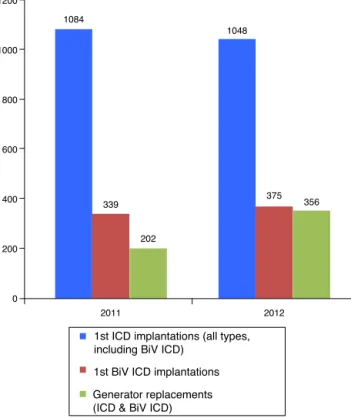
The figures for 2012 reveal a slight fall (3.3%) in the num-ber of first implantations and an increase of 10% in the number of BiV ICDs implanted compared to the previous year. There was, however, a considerable increase in the number of generator replacements, which rose from 202 to 356, resulting in an increase of 3.5% in the total number of implantations in 2012 (Figure 6). In the same year a total of 76 surgical revisions were reported.
Figure 7shows developments in the annual rate of new ICD implantations (all types, including BiV ICDs) per mil-lion population in Portugal; the number has been relatively stable (close to 100 per million population) since 2008.
Figure 8 shows the distribution of first ICD implanta-tions performed by the various centers in 2012, with 80.8% performing ≥10 implantations per year, and six centers exceeding 50 implantations per year. For this year all cen-ters submitted data on ICDs and BiV ICDs; in 85% of cases a single-chamber system was used.
0 200 400 600 800 1000 1200 2011 2012 1084 1048 339 375
1st ICD implantations (all types, including BiV ICD)
1st BiV ICD implantations Generator replacements (ICD & BiV ICD)
202
356
Figure 6 Number of first implantations of implantable cardioverter-defibrillators and biventricular pacemakers with defibrillator back-up, and generator replacements in Portugal in 2011 and 2012. BiV ICD: biventricular pacemaker with defi-brillator back-up; ICD: implantable cardioverter-defidefi-brillator.
0 20 40 60 80 100 120 2000 2001 2002 2003 2004 2005 2006 2007 2008 2009 2010 2011 2012 8.5 12.3 15.3 21.6 34.4 54.7 67.4 82.7 96.5 98.1 96 102.6 99.9 * *
Figure 7 Number of first implantations of implantable cardioverter-defibrillators, including biventricular pacemakers with defibrillator back-up, per million population in Portugal from 2000 to 2012. *Population resident in Portugal, based on 2011 census and 2012 data from the National Institute of Statis-tics.
Discussion and Conclusions
This registry shows that invasive electrophysiology in Portu-gal is relatively stable in terms of numbers of active centers and of procedures, and that the numbers of AF ablations and BiV ICD implantations has increased, in line with recent changes in international guidelines for the treatment of AF and heart failure.5,7 One point to note is the continuing
heterogeneity in the geographical distribution of centers and the number of ablations performed, with two-thirds of
0 50 100 150 200 250 ICD (VVI/DDD/VDD) BiV ICD
*
*Private centers*
*
*
*
Hospital de Santa Cruz (CHLO) Hospitais Universidade Coimbra Hospital de São João Hospital de Sta Marta (CHLC) Hospital de Sta Maria (CHLN) Hospital de Braga Hospital de Sto António Centro Hospitalar de Coimbra Hospital de Ponta Delgada Hospital de Faro Hospital de Guimarães Hospital de Setúbal Hospital Garcia da Orta Hospital de Vila Real Hospital da Luz Hospital Fernando Fonseca Hospital de Viseu Hospital de VN Gaia (CHGE) Hospital de Beja Hospital do Funchal Hospital da Arrábida Hospital da CUF Infante Santo Hospital de Angra Hospital dos Lusíadas Hospital da Cruz Vermelha Hospital de Viana do Castelo
Figure 8 Number and type of implantable cardioverter-defibrillators implanted in Portugal in 2012 by center. BiV ICD: biventricular pacemaker with defibrillator back-up; ICD: implantable cardioverter-defibrillator; VVI/DDD/VDD: pacing modes.
centers performing less than 100 ablations per year, which may reflect local difficulties in human and logistical resources, or a saturation point may have been reached in terms of national requirements.
A tendency towards greater complexity of interventions can be seen, which demonstrates that despite the shortfalls in available resources, clinical electrophysiology continues to develop in a variety of ways. It is nevertheless to be hoped that the number of AF ablations per center will continue to increase, seeing that of the 11 centers with facilities for AF ablation, only 45.5% carry out more than 20 ablations per year.
As in previous years, the number of ablations for atrial tachycardia and ventricular tachyarrhythmia remains low (<10% of the total), but with the introduction of three-dimensional mapping systems and improvements in clinical outcomes this is predicted to rise, particularly in patients with ICDs receiving appropriate therapies and those who have undergone AF ablation, in whom recurrent left atrial reentrant tachycardia has been shown to be related to gaps in ablation lines.
A slight increase was seen in the number of atrioventric-ular junction ablations, which may be due to its growing use in patients with cardiac resynchronization systems and permanent AF that does not respond to pharmacological ventricular rate control.
With regard to training in clinical electrophysiology, the situation improved compared to previous years: in 2012 there were six centers (five public and one private) in the northern, central and southern regions that performed more than 100 ablations per year, which can thus provide the minimum recommended procedural numbers during the two years’ training required for the subspecialty of clinical elec-trophysiology (participation in 150 catheter ablations, 35 of which as the primary operator).3
ICD implantations remained stable, while there was an increase of around 10% in first implantations of BiV ICDs. The significant rise in the number of generator replacements resulted in an overall increase of 3.5% in the total num-ber of ICD implantations. Surgical revisions of the pocket accounted for 5.1% of all procedures, compared to 4.5% in the previous year.
Concerning training in device implantation, the European guidelines recommend participation in 30 ICD (15 as the primary operator) and 20 BiV ICD implantations (10 as the primary operator).3In 2012, around half of Portuguese
cen-ters were able to provide this training experience. Although data are not available on lead extraction, this procedure is increasingly necessary in Europe and must be covered in the training of electrophysiologists.8
The economic constraints resulting from the crisis affect-ing Portugal may have acted as a significant brake on
growth in this important area with well known clinical benefits, despite falls in the cost of ICDs. This situation should be brought to the attention of the health authorities, since the figures for Portugal are still below the European average.
Ethical disclosures
Protection of human and animal subjects. The authors declare that no experiments were performed on humans or animals for this study.
Confidentiality of data. The authors declare that no patient data appear in this article.
Right to privacy and informed consent. The authors declare that no patient data appear in this article.
Conflicts of interest
The authors have no conflicts of interest to declare.
Acknowledgments
The authors wish to express their gratitude to all the physi-cians involved in collecting the data for this Registry, whose efforts succeeded in overcoming the limitations imposed by the lack of an online platform that would facilitate data collection and analysis.
The heads of the national pacing and electrophysiology laboratories were as follows: Dr. Dinis Martins (Hospital de Ponta Delgada), Dr. Francisco Madeira (Hospital Fernando da Fonseca), Dr. Hipólito Reis (Hospital de Santo António), Dr. Vítor Sanfins (Hospital Senhora da Oliveira), Dr. Grac¸a Caires (Hospital do Funchal), Dr. João de Sousa (Hospital de Santa Maria and Hospital dos SAMS), Dr. João Primo (Centro Hospitalar de Vila Nova de Gaia and Hospital da Arrábida), Dr. Júlio Campos (Hospital de S. João), Dr. Leonor Parreira (Hospital de S. Bernardo), Dr. Luis Brandão (Hospital Garcia de Orta and Hospital da CUF), Dr. Luís Elvas (Hospitais da Universidade de Coimbra), Dr. Nogueira da Silva (Hospital de Santa Marta and Hospital da CUF), Dr. Paulo Fontes
(Hospital de Vila Real), Prof. Dr. Pedro Adragão (Hospital de Sta. Cruz and Hospital da Luz), Prof. Dr. Mário Oliveira (Hospital da Cruz Vermelha Portuguesa), Dr. Pinheiro Vieira (Hospital de Sto. António), Dr. Rui Candeias (Hospital de Faro), Dr. António Costa (Hospital de S. Teotónio), Dr. José Nascimento (Centro Hospitalar de Coimbra --- Covões), Dr. Francisco Morgado (Hospital dos Lusíadas), Dr. Miguel Ventura (CliRia and IdealmEd), Dr. Adília Rebelo Hospital de São Marcos); Dr. Luís Duarte (Hospital de Beja); Dr. Virgílio Schneider (Hospital de Angra do Heroísmo).
References
1. Aurichio A, Kuck K-H, Hatala R, et al. The EHRA White Book 2012. The current status of cardiac electrophysiology in ESC mem-ber countries, vol. 14. Sophia Antipolis, France: EHRA Europace; 2012. p. iii1---5,http://dx.doi.org/10.1093/europace/eus256. 2. Madeira F, Oliveira M, Ventura M, et al. National Registry on
Cardiac Electrophysiology (2010 and 2011). Rev Port Cardiol. 2013;32:95---100.
3. Merino JL, Arribas F, Botto GL, et al. Core curriculum for the heart rhythm specialist. Europace. 2009;11:iii1---26.
4. Aliot EM, Stevenson WG, Almendral-Garrote JM, et al. EHRA/HRS expert consensus on catheter ablation of ventricular arrhyth-mias: developed in a partnership with the European Heart Rhythm Association (EHRA), a registered branch of the Euro-pean Society of Cardiology (ESC), and the Heart Rhythm Society (HRS); in collaboration with the American College of Cardiology (ACC) and the American Heart Association (AHA). Heart Rhythm. 2009;6:886---933.
5. Calkins H, Kuck KH, Cappato R, et al. 2012 HRS/EHRA/ECAS expert consensus statement on catheter and surgical ablation of atrial fibrillation: Recommendations for patient selection, procedural techniques, patient management and follow-up, def-initions, endpoints, and research trial design: a report of the Heart Rhythm Society (HRS) task force on catheter and surgi-cal ablation of atrial fibrillation. Heart Rhythm. 2012;9:632---96, e621.
6. Eucomed data 2013 [source population data: Eurostat]. 7. McMurray J, Adamopoulos S, Anker S, et al. ESC Guidelines for
the diagnosis and treatment of acute and chronic heart failure 2012. Eur Heart J. 2012;33:1787---847.
8. Bongiorgni MG, Blomströn-Lundqvist C, Kennergren C, et al. Current practice in transvenous lead extraction. A Euro-pean Heart Rhythm Association EP network survey. Europace. 2012;14:783---6.