Different silicon forms sinalize an input of urbanized river and indicate
the presence of phytoplankton with silicon structures in the tropical
coastal area of Recife (PE-Brazil)
The urbanized areas mark its presence in the hydrological systems with some biogeochemical signs including silicon inputs. Natural influence of leaching and erosion is done by silicate contribution and sometimes, the agriculturally soil contains microphytoliths and contributes with biogenic silica. Once in the hydrological system, the silicon can integrate the biogeochemical cycles showing a balance or not between inorganic and biological forms that reveals a tendency of processes that occur in each sector of the estuarine-marine interface. This study aims to evaluate the impact of a heavily polluted/urbanized river, whose input can be evidenced by the contribution of different forms of silicon that can evidence the terrestrial contribution, erosion process, the presence of phytoplankton species with siliceous structures, mainly associated to diatoms and also, to study the river plume spreading on the coastal area by undertaking silicon profiles in the region adjacent to the river mouth. The coastal region of Recife is under influence of fluvial inputs from Capibaribe and Beberibe rivers verified by observed low salinity (min. 33.93). The distribution of silicon forms showed sectorial variation, and the maximum values were dissimilar. Dissolved silicate reached 14.40 µmol L-1, lithogenic silicon (LSi) maximum of 25.76 µmol L-1 and biogenic silica (BSi) reaching 7.39 µmol L-1 near the river mouth toward the sea, evidencing the river influence coming from the west, achieving the port barrier at the end and propagating in the sea toward northeast. Due to higher nutrient availability in the stations nearest to the coast, primary production was encouraged with evidencing by high values of chlorophyll-a associated to silicate (r=0.71) and to BSi (r=0.44). In the stations more distant to the coast, the forms of silicon showed very low concentrations and BSi/ Chlorophyll-a showed negative correlation associated with chlorophyll-a concentrations evidencing the participation of non-silicon actors in the primary production in medium depth in oligotrophic tropical waters.
A
bstrAct
Ana Teresa Cordeiro Cid Bastos
1, Elisabete de Santis Braga
1*
1 Laboratory of Nutrients, Micronutrients and Traces in oceans (LABNUT) - Instituto Oceanográfico da Universidade de São Paulo (Praça do Oceanopgráfico, 191 - Butantã - SP - 05508120 - Brazil)
*Corresponding author: [email protected]
Descriptors:
Lithogenic silica, Biogenic silica,
Silicate, Biogeochemistry, Tropical region, Polluted
estuary.
As áreas urbanizadas marcam sua presença nos sistemas
hidrológicos com alguns sinais biogeoquímicos, incluindo
entradas de silício. A influência natural da lixiviação e ero
-são é feita por contribuição de silicato e, às vezes, o solo agrícola possui microfilóticos e contribui com sílica biogê
-nica. Uma vez no sistema hidrológico, o silício pode inte -grar os ciclos biogeoquímicos mostrando um equilíbrio ou
não entre formas inorgânicas e biológicas que revela uma tendência de processos que ocorrem em cada setor da in
-terface estuarino-marinha. Este estudo tem como objetivo avaliar o impacto de um rio fortemente poluído/urbaniza
-do, cujo aporte pode ser evidenciado por diferentes formas
de silício que podem marcar o aporte terrestre, processo
de erosão, a presença de espécies de fitoplâncton com es
-truturas silicosas, principalmente associada a diatomáceas e, também, estudar a pluma do rio espalhando-se na área costeira realizando perfis de silício na região adjacente à foz do rio. A região costeira do Recife está sob influência dos insumos fluviais dos rios Capibaribe e Beberibe veri
-ficados pela baixa salinidade observada (mínimo 33,93). A distribuição de formas de silício mostrou variação setorial e os valores máximos foram distintos. O silicato dissolvido atingiu 14,40 μmol L-1, silício litogênico (LSi) no máximo de 25,76 μmol L-1 e sílica biogênica (BSi) atingindo 7,39 μmol L-1 perto da foz do rio em direção ao mar, evidencian -do a influência -do rio vin-do -do oeste, alcançan-do a barreira portuária no final e se propagando no mar em direção ao nordeste. Devido à maior disponibilidade de nutrientes nas estações mais próximas da costa, a produção primária foi incentivada com a evidência de altos valores de clorofila-a
associados ao silicato dissolvido (r=0.71) e ao SiB (r=0.44). Nas estações mais distantes da costa, as formas de silício apresentaram concentrações muito baixas e BSi/Clorofila --a mostrou correlação negativa associada a concentrações
de clorofila-a, evidenciando a participação de atores não
silicosos na produção primária em profundidade média em águas tropicais oligotróficas.
r
esumo
Descritores:
Silício litogênico, Sílica biogênica,
Sili-cato, Biogeoquímica, Região tropical, Estuário
po-luído.
http://dx.doi.org/10.1590/S1679-87592018149206601 Submitted on: 29/June/2017
INTRODUCTION
Rock weathering is the main source of silicon to the aquatic systems. The silicate input via rivers constitutes a representative contribution to oceanic biogeochemical cycle of this nutrient element. Silicon is present in the ma -rine environment under three different forms: dissolved silicate (DSi), particulate biogenic silica (BSi) and par -ticulate lithogenic silica (LSi). Continental margins have great importance for the Si cycle due two main reasons: i) considering that these areas are the most productive, they are sites of BSi sinking; and ii) these areas act as a filter to withholding the input of Si to the open ocean as, for example, discussed by Ragueneau et al. (2005).
The major part of the studies of silicon is centered in the dissolved reactive silicon (DSi) presenting varied con -clusion on the behavior in estuaries as showed in the clas -sical work of DeMaster (1981) and Blancherd (1988). The conservative profile associated to salinity is always men -tioned considering DSi, and the LSi is easily associated to terrestrial inputs and sediment resuspension, however, about BSi, the noticed data is rare in estuarine and coastal waters. The association of these forms could play relevant information about the metabolism of the hydrological sys -tems and show the anthropogenic influence concerning to the human soil occupation, eroded areas, sewage disposal and so on. Studies about silicon form on the continental shelf. This could contribute to elucidate some biogeoche -mical processes.
The State of Pernambuco, located in Brazilian tropical northeastern area is 187 km long and lodge 44% of the population, resulting in places with a population density higher than 900 habitants km-2 (Araújo et al., 2007). The
Recife city, considered the main urban center of northeas -tern Brazilian region (Santiago et al., 2010) is an impor -tant local for studies of environmental impact.
The coastal region of Recife has a common estuary to Capibaribe and Beberibe Rivers, where a port terminal is located. It is also close to the estuaries of the Timbo river and Jaboatão River, that receiving a considerable input of domestic and industrial effluents (Souza, 2011). The main river of the region is the Capibaribe River, whose basin covers an area of 7454.88 km2 and has an average flow of
20 m3 s-1 (Anjos et al., 2012).
The first records of erosion in the region date back to the early twentieth century, due to the construction and expansion of the port that altered the conditions of coastal currents (SHR, 2010; Borges et al., 2012). This problem
was aggravated by the absence of major rivers and the nar -row continental shelf (Araújo et al., 2007; Souza, 2011). In this area, there is a strong human intervention to control erosion, which includes actions such as the construction of rock-fill breakwaters and the nourishment of beaches (Araújo et al., 2007).
The dominate climate is classified as warm, with ave -rage annual temperature of 25.6 °C, and humid (avera -ge humidity of 90%) (Bor-ges et al., 2012). The rainfall pattern is divided into two distinct periods: rainy season, from May to August, with monthly rainfall ranging from 100 mm to 400 mm, and dry season, from September to April, with monthly precipitation lower than 100 mm (Rollnic et al., 2011).
The tides are semidiurnal, with an average height of 2.6 m in spring tides and 1.6m in neap tides (Santiago et al., 2010). During the rainy season, the SE winds are stronger and more constant, resulting in a transport to nor-thern throughout the water column. In the dry season, the winds are more variable, with the majority being of NE-E, resulting in surface transport to the southern and not deter -mined in the bottom (Rollnic et al., 2011).
This study aims to evaluate the environmental im -pact of a heavily urbanized river observing the behavior of different silicate forms, undertaking biogeochemical profiles in the region adjacent to the river mouth with spe -cial regard on terrestrial transport signalized by LSi and by biogenic silica that have significative relation with the phytoplankton, mainly associated to diatoms.
MATERIAL AND METHODS
Study area
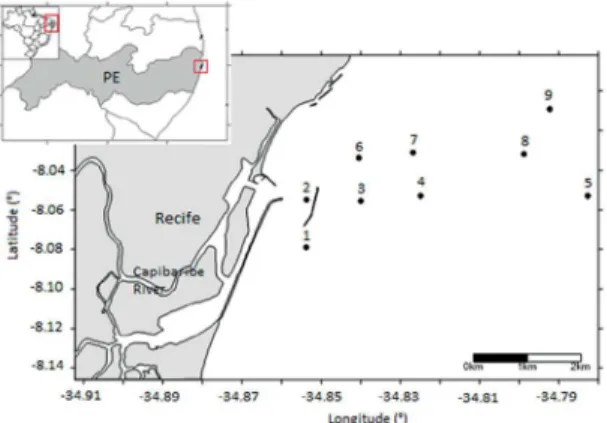
This study was performed in the coastal region ad -jacent to the mouth of Capibaribe River, where the port channel is located. The Capibaribe River has a hydrolo -gical system that crosses the metropolitan area of Recife, after passing through several cities of Pernambuco state. A total of 9 stations was evaluated to compose a silicon distribution scenario in this area (Fig. 1).
Figure 1. Location of the sampling stations in the Recife coast,
Pernambuco state, Brazil, (July, 2013).
Methodology
Water temperature and salinity profiles were measu -red in situ using a CTD Seabird®, with precision of ±0.01
°C and ±0.01, respectively. Water pH was measured with an Orion® 290A pHmeter, accuracy of ±0.001, following the recommendations of Aminot and Chaussepied (1983). Turbidity was analysed with 2100P Turbidimeter, Hach®.
Water samples were filtered in Whatman GF/F®
mem-branes, porosity of 0.45 µm. and the filters were used to determine the content of suspended particulate matter (SPM), via the gravimetric method (precision of ±0.01 mg L-1) and chlorophyll-a, determined by colorimetric method (precision of ±0.01 mg m-3), both described in Strickland
and Parsons (1968).
Water samples for the analyses of dissolved silicate were filtered in polycarbonate membrane (porosity of 0.45 µm - HTTP04700 isopore Millipore®) and preserved in polyethylene bottles at -20°C until chemical analysis. Reactive dissolved silicate (DSi) was analyzed following the colorimetric method described in Grasshoff et al. (1983), precision of ±0.01 µmol L-1. Biogenic silica (BSi) was obtained by the digestion method as presented by Ragueneau and Tréguer (1994). The material, previously retained on a polycarbonate filter, was dried for 12 hours at 60 °C and treated with 4.0 ml of NaOH 0.2 mol L-1 at 100 °C for 40 min in a plastic tube. After cooling, 1.0 ml de HCl 1 mol L-1 was added to solution. The sample was centrifuged for 10 min at 1500 rpm. After that, 1.0 ml of supernatant was removed and diluted to 50 ml with distil -led water. The analysis of dissolved silicate followed the described in Grasshoff et al. (1983), yielding the apparent biogenic silica (BSia). To eliminate the interference of li -thogenic silica, the following correction was made:
BSi = BSia - k.LSia,
where k is a constant depended on the mineralogy of the considered area. In this study, a mean of 0.15 was adopted for k. LSia corresponds to the apparent lithogenic silica, whose determination is next described. The accu-racy of the method is ±0.1 mmol L-1.
After BSi digestion, the supernatant was removed and discarded; following 12 ml of distilled water were added. The tubes were shaken and centrifuged for 10 min at 1500 rpm and then 12ml supernatant extracted and discarded. If the concentration of BSi was greater than 5.0 mmol L-1, the procedure was repeated. The tube containing the filter was then covered with a sheet of aluminum foil and dried at 80 °C for 12h. The sample was treated with 0.2 ml of HF 2.9 mol L-1 f, resting for 48h. Then, add 10 ml of distilled water and stir. The remaining solution was diluted until the HF concentration reaches values less than 0.002 mmol L-1. The analysis of dissolved silicate follows the described in Grasshoff et al. (1983), yielding the apparent silicon li -thogenic (LSia). The LSi concentration was calculated by the expression: LSi = TSi - BSi, where TSi is the total concentration of silicon present in the filter (BSia + LSia). The accuracy of the method is ± 0.5 mmol L-1.
Data treatment
Spearman’s nonparametric correlation (rs) was per -formed using the Excel 2013® software. Principal compo
-nent (PCA) and group (cluster) analyses were undertaken using Primer 6 (Past x) software. The spatial distribution of the parameters studied was set out using figures com -posed in Excel.The data were treated with a significance level α=0.05 to identify whether there were spatial diffe -rences between the Pearson and PCA graphics.
RESULTS
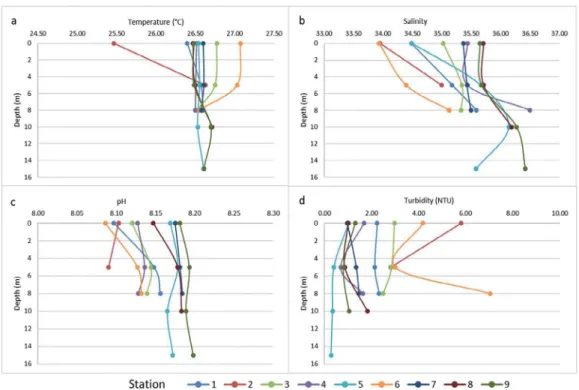
The range of variables (temperature, salinity, turbidity, DSi, BSi, LSi, SPM and Chlorophyll-a) obtained in this study are showed in the Fig 1. Concerning to water tem -perature, a little variation, from 25.46 °C to 26.08 °C, was observed. In most of stations, the temperature was cons -tant throughout the water column. The exception occurred at station 2, located closer to the mouth of the Capibaribe River and in the port area, which showed a slightly lower surface temperature. The stations 3 and 6 presented a weak thermal stratification with minor temperatures in the bot -tom waters (Fig. 2a).
Figure 2. Vertical profile per station of temperature (°C), salinity, pH and turbidity (NTU) in Recife (PE), Brazil, in July 2013.
influence of river water, once they are located near the mouth of the Capibaribe River and in northeastern sense. In general, salinity was lower at the surface and increased toward the bottom, however showing lower values in sta -tions 2 and 6 (Fig. 2b). The sta-tions 7, 8 and 9, relatively distant from the river influence showed the highest values of pH (Fig. 2c).
The turbidity had a minimum value of 0.29 NTU and a maximum of 7.04 NTU. Stations 2 and 6, where terrestrial input has a greater influence, exhibited the highest values, while the lowest were found in the stations farthest from the coast (5, 8 and 9 stations), with the lowest values ob -served in station 5, the more distant from the coast (Fig. 2d).
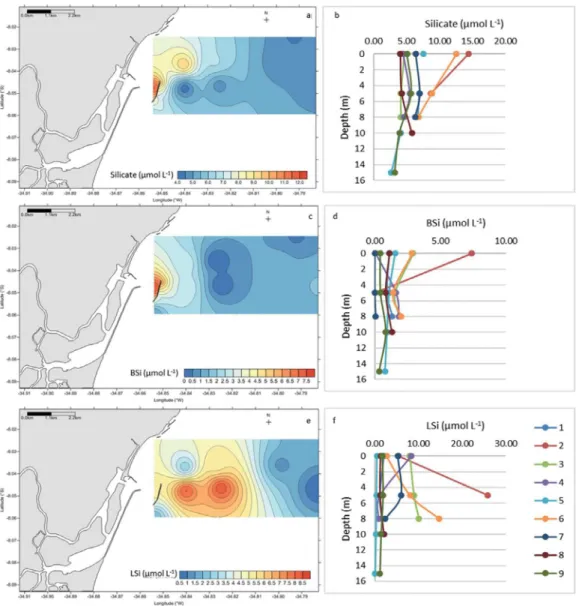
Dissolved silicate (DSi) concentrations ranged from 2.63 µmol L-1 to 14.40 µmol L-1. The highest va -lues were found on the surface of the stations 2 and 6, where the influence of river input was higher (Fig. 3a), toward the bottom, concentration decreases. In the other stations further away from the mouth of the Capibaribe River, silicate concentrations were lower and decreased slightly with depth, excepted in station 8, that demonstrated a slight increase in the bottom concentration (Fig. 3b).
In general, BSi concentrations were relatively low, ran -ging from values below the detection limit of the method reaching 7.39 µmol L-1. The maximum concentration of BSi was observed on the surface of station 2 (Fig. 3c), in -fluenced by river input, decreasing toward the bottom. In the other stations, the values were smaller than 2 µmol L-1, being constant throughout the water column, with different beha -vior in station 4 which showed lower concentrations of BSi on the surface, increasing toward the bottom (Fig. 3d). LSi concentrations showed values lower than the detection limit of the method, reaching 25.76 µmol L-1. The highest values were found in the bottom layer of the stations 2 and 6 (greater fluvial influence), decreasing toward the surface, while the lowest concentrations observed in stations 5, 8 and 9, which are further away from the coast, with little vertical variation. LSi in station 4 had an inverse behavior to that observed for the BSi, i.e., the concentration was higher on the surface, de -creasing toward the bottom (Figs. 3e and 3f).
Figure 3. Surface and vertical distribution of silicate (µmol L-1) (a, b), BSi (µmol L-1) (c, d) and LSi (µmol L-1) (e, f) in the coast of Recife (PE), in July 2013.
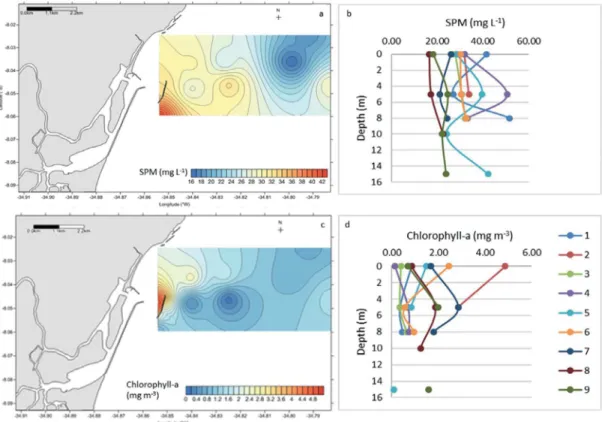
The concentrations of chlorophyll-a ranged from 0.10 mg m-3 to 4.87 mg m-3 (Tab. 1). The surface distribution of chlorophyll-a (Fig. 4c) was similar to that of dissolved silicate and BSi, namely, it was higher at the mouth of Capibaribe River, decreasing in the eastern stations. The highest values of chlorophyll-a were found on the surface of stations 2 and 6 (Figs. 4c, d), where the concentration of dissolved nutrients is enhanced due to the influence of riverine input, as demonstrate by silicate concentrations.
DISCUSSION
Figure 4. Surface and vertical distribution of SPM (mg L-1) (a, b) and chlorophyll-a (mg m-3) (c, d) in the coast of Recife (PE), in July 2013.
T
(°C) S pH
Turb. (NTU)
DSi
(µmol L-1)
BSi
(µmol L-1)
LSi
(µmol L-1)
SPM (mg L-1)
Chlo-a
(mg m-3)
Max. 27.08 36.50 8.20 7.04 14.40 7.39 25.76 51.69 4.87
Min. 25.46 33.93 8.09 0.29 2.63 <DL <DL 16.50 0.10
Mean 26.57 35.38 8.15 2.02 6.07 1.29 4.19 29.95 1.28
SD ±0.26 ±0.67 ±0.03 ±1.60 ±2.71 ±1.43 ±5.72 ±8.94 ±1.08
Median 26.56 35.44 8.15 1.63 5.56 1.08 1.83 29.50 0.86
Table 1. Descriptive statistics (maximum, minimum, mean, median and standard deviation - SD) of the water parameters: temperature (°C), salinity, pH, turbidity (NTU), silicate (µmol L-1), BSi (µmol L-1), LSi (µmol L-1), SPM (mg L-1) and chlorophyll-a (mg m-3) analyzed in Recife (PE), July - 2013, (n=28).
The salinity as a conservative property showed the mi -xing of the waters from the river to the ocean and a northe -astward displacement. According to this, some dissolved properties could present a similar behavior under river and marine current influence and also, associated to the mixing process (Liss, 1976). The non-conservative properties, on the other hand, suffer influence of biogeochemical pro -cesses, contributing to a differenced behavior. In the other side, the anthropogenic actions contribute in both proces-ses. The turbidity presented significant negative relation (r= -0.59) with the salinity, showing the riverine source of material from river and reflecting the inputs from erosion and sewage disposal along the river.
In seawater, the pH normally exhibit slightly varia -tion due to the buffer property of the seawater associated to carbonate system and others weak acid interactions as the orthosilicic acid, however under influence of the fresh water, the buffer property decrease and the pH changing contributes as tracer of the river plume and, in this study, it was either associated to the SPM transport.
highest values in southwestern stations, decreasing toward the Eastern. The SPM values were superior to those found by Medeiros and Kjerfve (1993) in Itamaracá (from 5 mg L-1 to 30 mg L-1) and by Bastos et al. (2011) in Ipojuca (from 2.2 mg L-1 to 30 mg L-1), both located in the coastal area of State of Pernambuco, receiving influence of rainy period.
Dissolved silicate (DSi) presented significant nega -tive correlation with salinity and pH (r= -0.81). It also showed a significant positive correlation with turbidity (r=0.63), indicating fluvial source, with higher values near the mouth of the river, decreasing towards the East. The values obtained in this study were similar to those observed by Koening and Macêdo (1999), with a variation of 1.42 µmol L-1 to 10.71 µmol L-1 in Itamaracá (State of Pernambuco), and those observed by of Costa (2007) that showed a variation from 2.13 µmol L-1 to 11.47 µmol L-1 in Porto Seguro (State of Bahia). They also noted a decre -ase in nutrient concentrations, increasing with the distance from the coast. A significant positive correlation (r=0.72) was also observed with chlorophyll (discussion below) showing its availability to siliceous organisms.
The classical role of salinity and temperature as tracer of fresh water contribution in estuarine and coastal waters is confirmed and enhanced by pH, SPM and DSi data as observed by Hunt and Foster (1977); Helder et al. (1983); Bell (1994) and others.
The BSi showed significant negative correlations wi -th temperature (r= -0.55), salinity (r= -0.52) and pH (r= -0.50), and positive correlations with turbidity (r=0.64) and DSi (r=0.62). Its distribution was quite similar to that of silicate, indicating that presence of marine diatoms and siliceous organisms are most evident in the stations closer to the shore which presented lowest values of salinity in relation to the distant stations. Certainly, the availability of essential nutrients is an important factor to favoring the marine diatoms development promoting the incorporation of BSi, on the other hand, the turbidity increasing and BSi correlation showed the possibility of the contribution of freshwater phytoplankton species. The case of the BSi in the stations next to the mouth of the river could be associa -ted not only to diatoms, but also to microphytoliths.
The LSi had no correlation with salinity or with other forms of silicon, but had negative correlation with pH (r= -042) and positive with turbidity (r=0.39). Its distribution was different from that of the other parameters with the highest concentrations on the surface of stations 3 and 4, and near the bottom. This suggests that the major LSi
source in this area is linked to sediment re-suspension and/ or to silicate adsorption in the SPM, yielding LSi. So, LSi source is mainly associated to particle transport and re-mobilization and therefore not only so associated to fresh water dispersion.
The contribution to the pH mechanism present diffe -rent participation of the DSi in brackish waters and salt waters, but a significant correlation was observed between DSi and pH (r=0.58).
There are few studies that present data of BSi and LSi in continental margins. Table 2 summarizes the results of other studies, allowing comparison with those obtained in the present study. Rare as the results found of BSi and LSi the Brazilian coast reiforncing this contribution.
In relation to the values cited in the Table 2, the BSi maximum value in this study are bellow from that obser -ved at California Bay, by Firme et al. (2003), reported as 42 µmol L-1 being associated to makeable presence of diatoms and to a fertilization process. In the case of the LSi, the maximum value (25.8 µmol L-1 ) was presented by this study, with value above the maximum observed by Ragueneau et al. (2005) in the North Sea (19.0 µmol L-1), which was also associated to the terrestrial inputs from the ice sliping. The corroboration to the erosion by anthropo-genic influence is reasonable to explain the high values of these parameters observed in the current study.
In relation to the concentration of determined Si forms (Fig. 5) in the studied system, it was observed the repre -sentative participation of DSi in the station 2, located in the mouth of Capibaribe river and in the station 6 (0m), located westward in river plume. LSi showed a presen -ce more evident as the DSi increased the station 3 signal. The biogenic form, BSi, presented no signal in station 7, located relatively distant from the coast, and the lowest values were observed really far from the coast, exception in the station 1, due to the marine current that bring oligo-trophic waters from southern to near the coast. Effectively, the BSi value in the station 2 was the highest observed, possibly reflecting terrestrial contribution, and autoctone production resulting from the nutrients availability to a population that survive in the estuarine mixing condition.
Considering the biological aspects, the observed con -centrations of chlorophyll-a (from 0.10 mg m-3 to 4.87 mg m-3) had lower values than those obtained by Bastos et al. (2011) (from 1.11 mg m-3 to 18.72 mg m-3) and by Fonseca
et al. (2002) (from 0.16 mg m-3 to 9.36 mg m-3) in Ipojuca
Area BSi LSi Reference (µmol L-1) (µmol L-1)
Santa Barbara (USA) 0 - 3.5 0 - 2.0 Shipe & Brzezinski (2001)
California Coast (USA) 0.1 - 42.0 - Firme et al. (2003)
South America West Coast
(0°N-14°N) <0.1 - 4.2 - Shipe et al. (2006)
China East Sea 0.2 - 2.8 - Liu et al. (2005)
Bay of Brest (France) 0.4 - 2.1 1.2 - 2.8 Ragueneau et al. (2005)
Bay of Seine (France) 1.1 - 5.8 0.7 - 3.8 Ragueneau et al. (2005)
North Sea 0.1 - 2.3 2.5 - 19.0 Ragueneau et al. (2005)
Concéption (Chile) 0.4 - 23.0 0.1 - 8.0 Sánchez et al. (2008)
Recife coast (Brazil) 0 - 7.4 0 - 25.8 This study
Table 2. Values of BSi e LSi found by this and other studies in continental margins.
Figure 5. Concentration of DSi (blue); BSi (red) and LSi (gray) in the coast of Recife (PE), in July 2013.
indicating the general oligothrophic conditions with punc-tual fertilization supporting a wholesome primary produc -tion in coastal area, but needing monitoring ac-tion to avoid eutrophication process besides the estuarine environment. Chlorophyll-a showed a significant negative correlation with temperature (r= -0.50) and salinity (r= -0.38), and po -sitive correlation with DSi (r=0.72) and BSi (r=0.44) con -firming the link with siliceous organisms.
It was observed also relatively high values of chloro -phyll-a in stations 7, 8 and 9 at 5m depth, not exactly asso -ciated to BSi, but possibly it could be asso-ciated to others kind of primary producers as coccolihophores that have a calcareous skeleton and they are considered important ac-tors of the primary production (Honjo, 1976; Hay, 2004; Rost and Riebesell, 2004) in the oceans, contributing to car -bon cycle. It is also important to the mentioned participa -tion of the calcareous algae in primary produc-tion, overall on northern of this area, in front of Itamaraca island and
in other Brazilian coastal sectors as showed by Silva et al. (1987); Torres et al. (2004); Figueiredo et al. (2008).
To better understand the relationship between BSi and primary production, the ratio BSi/Chlorophyll-a (BSi/ Chlo-a) was calculated (Fig. 6). Where the values of BSi and chlorophyll-a were proportional (i.e., low BSi low chlorophyll-a or high BSi high chlorophyll-a) the ratio BSi/ Chlo-a approached 1, probably indicating that diatoms and other siliceous phytoplankton have a major role in primary production. The ratio was near 1 at the surface of stations 1, 2, 5, 6 and 8, in station 5 at 5 m and in station 8 at 10 m. Based on these points a tendency line was plotted (Fig. 6) showing that the values of BSi and chlorophyll-a have a significant positive linear correlation with r=0.99.
Figure 6. Chlorophyll-a versus BSi, and the ratio BSi/Chlo-a. BSi/ Chlo-a <1 is represented by a cross, BSi/Chlo-a=1 in circles and BSi/ Chlo-a >1 in stars. The tendency line refers to the points where BSi/ Chlo-a=1 only.
phytoplankton is responsible for primary production. In Figure 5 these points are plotted above the tendency line.
Where the ratio BSi/Chlo-a was above 1, BSi was high and chlorophyll-a had lower values, suggesting the pre -sence of frustules of diatoms (and other siliceous phyto -plankton) and perhaps microphytoliths. These particles may be sinking or being ressuspended from the sediment since the points that had this behavior are located mainly at the bottom of stations 1, 3, 4, 5, and 6. These points are plotted in Figure 5 bellow the tendency line.
The adjacent coastal area of Recife in its nothwestern portion has a more pronounced fluvial influence, due to the circulation action on the river plume spreading (Schettini et al., 2016) and the role of the breakwater indicated by lower salinity and higher dissolved silicate concentrations, leading to a higher primary production indicated by higher concentrations of chlorophyll-a and BSi. The more eastern section present stations with more significant characteris -tics of oligotrophic waters, evidenced by low concentra -tions of all forms of silicon.
The influence of the estuary water in this coastal area was observed by some authors between them Bryner et al. (2003); Guenther et al. (2015); Maciel et al. (2015); Travassos et al. (2016); and Martins et al. (2016), whose studied some pollution markers introduced by the urbani-zed and industrialiurbani-zed Capibaribe rivers. This study sho -wed that the behavior and association of the components of silicon cycle can corroborate these river inputs and to evidence coastal biogeochemical and physical processes on this coastal zone with emphasis to testimony of primary production actors contribution.
Considering nutrients data support as nitrate, nitrite, N-ammonium and silicate from databank of the Carecos
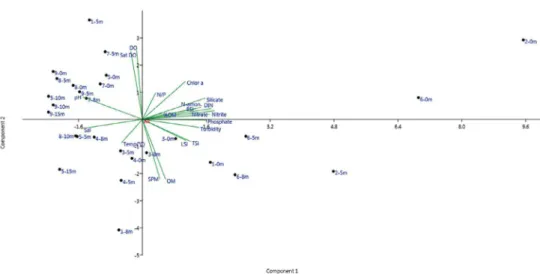
Project, it was possible to verify the proximity between N and P nutrients to the forms of silicate studied (DSi and BSi) and major relation of LSi to SPM, MO and turbidity (Fig. 7).
In future perspectives, this study could encourage the continuity of investigation to link the preterit process of deposition and resuspension of silicon forms in sediments under influence of the time, climate changes and the displa -cement of the ITCZ, as indicated by Romero et al. (1999) on the continental shelf sectors, with possibility of distinc -tion of the natural and anthropogenic influence.
CONCLUSION
The coastal region of Recife (PE), although located in the tropical zone, characterized by waters poor in nutrient, is under the influence of fluvial inputs from the Capibaribe and Beberibe Rivers that crossing the city. Thus, distribu -tions of certain parameters, including silicate and BSi ha -ve shown that ri-verine influence, coming from the west, reaching the barrier and propagating toward the northeast traced by physical signal as salinity and turbidity but also by members of silicon cycle that signalize physical and bio -geochemical processes.
As there was a highlighted nutrient input in this region, primary production was encouraged, recorded by chloro-phyll-a values accompanied by BSi, indicating the partici -pation of marine diatoms. In this situation, the BSi gave an excellent sign of the presence of siliceous phytoplankton associated with the values of chlorophyll-a, proving to be an excellent indicator of bioprocesses in the region, corres -ponding to an important member of the silicon biogeoche -mical cycle. The LSi showed a different behavior than the other fractions of silicon, being more related to sediment resuspension process and interaction with the SPM than flu -vial influence. In the stations more distant, a signal of not significant correlation of BSi/Chlorophyll-a evidenced the participation of another actors, not siliceous contributing to primary production where parameters had characteristics values of oligotrophic waters, with the silicon fractions showing very low concentrations.
ACKNOWLEDGEMENT
Figure 7. Data from Principal component analysis (PCA) of inorganic and organic variables of the Inner Sea coast of Fernando
de Noronha Island - Pernambuco (Brazil). (A) Ordering of environmental variables, (B) ordering of samples (SPM=suspended particulate material, N-nitrite, N-nitrate, P-phosphate, Si-silicate, LSi=Lithogenic silicon, BSi=Biogenic silica; DOP=Dissolved Organic Phosphorus, DIN=Dissolved Inorganic Nitrogen, SPM=Suspended particulate matter, SPOM= Suspended particulate organic matter, pH, N-ammon.=N-ammonium, DO=Dissolved oxygen, Sal= salinity, T=temperature, Turbidity, Chlor.=Chlorophyll-a obtained in March 2015.
of Nutrients, macronutrients and traces in the oce -an (LABNUT-IOUSP) for the support in the chemical analysis.
REFERENCES
AMINOT, A. & CHAUSSEPIED, M. 1983. Manuel des analyses
chimiques en milieu marin, Brest, CNEXO.
ANJOS, D. L., PASSAVANTE, J. Z. O., SILVA-CUNHA, M. G. G. & HONORATO DA SILVA, M. 2012. Biomassa fitoplanc-tônica correlacionada aos fatores hidrológicos no estuário do rio Capibaribe (Recife, Pernambuco, Brasil). Tropical
Ocea-nography, 40, 167-168.
ARAÚJO, M. C. B., SOUZA, S. T. S., CHAGAS, A. C. O.; BAR-BOSA, S. C. T. & COSTA, M. F. 2007. Análise da ocupação urbana das praias de Pernambuco, Brasil. Revista da Gestão
Costeira Integrada, 7, 97-104.
BASTOS, R. B., FEITOSA, F. A. N., KOENING, M. L. MA-CHADO, R. C. A. & MUNIZ, K. 2011. Caracterização de uma zona costeira tropical (Ipojuca-Pernambuco-Brasil): pro-dutividade fitoplanctônica e outras variáveis ambientais.
Bra-zilian Journal of Aquatic Science and Technology, 15, 1-10.
BELL, R. G. 1994. Behaviour of dissolved silica, and estuarine/ coastal mixing and exchange processes at Tairua Harbour, New Zealand. New Zealand Journal of Marine and
Freshwa-ter Research, 28, 55-68.
BLANCHERD, S. F. 1988. Dissolved silica in the tidal Potomac
River and Estuary. 1979-81 water years, Denver, United
Sta-tes Geological Survey water supply paper 2234-H.
BORGES, G. C. P., SILVA-CUNHA, M. G. G., SANTIAGO, M. F. & LIMA, J. C. 2012. Comunidade fitoplanctônica e variá-veis ambientais em área portuária, nordeste do Brasil.
Tropi-cal Oceanography, 40, 309-318.
BOYLE, E., COLLIER, R., DENGLER, A. T., EDMOND, J. M., NG, A. C. & STALLARD, R. F. 1974. On the chemical mass--balance in estuaries. Geochimica et Cosmochimica Acta, 38,
1719-1728.
BRYNER, F. M. M., FREITAS BARBOSA, A. M., PHILLIPINI DA SILVA, H. K. & VIERA DE MELO, M. 2003. Behaviour of heavy metals in the estuarine area of the Capibaribe River in the Northeast of Brazil. Journal de PhysiqueIV (France), 107, 221-225.
COSTA, O. S. 2007. Anthropogenic nutrient pollution of coral reefs in southern Bahia, Brazil. Brazilian Journal of
Oceano-graphy, 55, 265-279.
DEMASTER, D. J. 1981. The supply and accumulation of sili-ca in the marine environment. Geochimica et Cosmochimica Acta, 45, 1715-1732.
FIGUEIREDO, M. A. O., HORTA, P. A., PEDRINI, A. G. & NUNES, J. M. C. 2008. Benthic marine algae of the coral reef of Brazil: a literature review. Oecologia Brasiliensis, 12,
258-269.
FIRME, G. F., RUE, E. L., WEEKS, D. A., BRULAND, K. W. & HUTCHINS, D. A. 2003. Spatial and temporal variability in phytoplankton iron limitation along the California coast and consequences for Si, N and C biogeochemistry. Global
Bio-geochemical Cycle, 17, 1016-1029.
FONSECA, R. S., PASSAVANTE, J. Z. O., MARANHÃO, G. M. B. & MUNIZ, K. 2002. Ecossistema recifal da praia de Porto de Galinhas (Ipojuca, Pernambuco): biomassa fitoplanctônica e hidrologia. Boletim Tecnico Cientifico do Cepene, 10, 9-26. GUENTHER, M., ARAÚJO, M., FLORES-MONTES, M.,
GONZALEZ-RODRIGUEZ, E. & NEUMANN-LEITÃO, S. 2015. Eutrophication effects on phytoplankton size-frac-tioned biomass and production at a tropical estuary. Marine
GRASSHOFF, K., EHRHARDT, M. & KREMLING, K. 1983.
Methods of seawater analysis, 2nd ed, Weinhein, Verlag
Che-mie.
HAY, W. W. 2004. Carbonate fluxes and calcareous nanno-plankton. In: THIERSTEIN, H. R. & YOUNG, J. R. (Eds.) Coccolithophores - From Molecular Processes to Global Im-pact. Berlin Heidelberg: Springer-Verlag.
HELDER, W., DE VRIES, R. T. P. & RUTGERS VAN DER LOEFF, M. M. 1983. Behavior of Nitrogen Nutrients and Dissolved Silica in the Ems–Dollard Estuary. Canadian
Jour-nal of Fisheries and Aquatic Sciences, 40, 188-200.
HONJO, S. 1976. Coccoliths: Production, transportation and se-dimentation. Marine Micropaleontology, 1, 65-79.
HUNT, D. T. E. & FOSTER, P. P. 1977. Studies of the mixing of coastal waters in Liverpool Bay using dissolved silicate as a tracer. Water Research, 11, 465-470.
KOENING, M. L. & MACÊDO, S. J. 1999. Hydrology and phytoplankton community structure at Itamaracá-Pernam-buco (Northeast Brazil). Brazilian Archives of Biology and
Technology, 42.
LISS, P. S. 1976. Conservative and non-conservative behavior of dissolved constituent during estuarine mixing. In: BURTON,
J. D. & LISS, P. S. (eds.) Estuarine Chemistry. London:
Aca-demic Press.
LIU, S. M., ZHANG, J. & LI, R. X. 2005. Ecological significance of biogenic silica in the East China Sea. Marine Ecology
Pro-gress Series, 290, 15-25.
MACIEL, D. C., SOUZA, J. R. B., TANIGUCHI, S., BÍCEGO, M. C. & ZANARDI-LAMARDO, E. 2015. Sources and dis-tribution of polycyclic aromatic hydrocarbons in a an urbani-zed tropical estuary and adjacent shelf, Northeast of Brazil.
Marine Pollution Bulletim, 101, 429-433. DOI: http://dx.doi.
org/10.1016/j.marpolbul.2015.09.051.
MARTINS, S. E. M., BARCELLOS, R. L., FLORES-MONTES, M. J. & FRANÇA, E. J. 2016. Depositional evolution in a estuarine lagoonal system under a port influence in Northeas-tern Brazil. Journal of Coastal Research, 75, 84-88.
MEDEIROS, C. & KJERFVE, B. 1993. Hydrology of a tropical estuarine system: Itamaracá, Brazil. Estuarine, Coastal and
Shelf Science, 36, 495-515.
RAGUENEAU, O., SAVOYE, N., AMO, Y. D., COTTON, J., TARDIVEAU, B. & LEYNAERT, A. 2005. A new method for the measurement of biogenic silica in suspended matter of coastal waters: using Si:Al ratios to correct for the mineral interference. Continental Shelf Research, 25, 697-710.
RAGUENEAU, O. & TRÉGUER, P. 1994. Determination of bio-genic silica in coastal waters: applicability and limits of the alkaline digestion method. Marine Chemistry, 45, 43-51.
ROLLNIC, M., MEDEIROS, C. & FREITAS, I. 2011. Coastal circulation along the southern metropolitan region of Recife, northeastern Brazil. Journal of Coastal Research, 64,
135-138.
ROMERO, O. E., FISCHER, G., LANGE, C. B. & WEFER, G. 1999. Siliceous phytoplankton of the western equatorial Atlantic: sediment traps and surface sediments. Deep Sea Research Part II:
Topical Studies in Oceanography, 47, 1939-1959.
ROST, B. & RIEBSELL, U. 2004. Coccolithophore calcification and the biological pump: response to environmental changes.
In: THIERSTEIN, H. R. & YOUNG, J. R. (eds.)
Coccolitho-phores From Molecular Processes to Global Impact. Berlin
Heidelberg: Springer-Verlag.
SÁNCHEZ, G. E., PANTOJA, S., LANGE, C. B., GONZÁLEZ, H. E. & DANERI, G. 2008. Seasonal changes in particulate biogenic and lithogenic silica in the upwelling system of Con-cépcion (~36°S) Chile, and their relationship to fluctuations in marine productivity and continental input. Continental
Shelf Research, 28, 2594-2600.
SANTIAGO, M. F., SILVA-CUNHA, M. G. G., NEUMMAN--LEITÃO, S., COSTA, K. M. P., PALMEIRA, G. C. B., POR-TO NEPOR-TO, F. F. & NUNES, F. S. 2010. Phytoplankton dyna-mics in a highly eutrophic estuary in tropical Brazil. Brazilian
Journal of Oceanography, 58, 185-205.
SCHETTINI, C. A. F., PAIVA, B. P., BATISTA, R. A. L., OLI-VEIRA FILHO, J. C. & TRUCCOLO, E. C. 2016. Observa-tion of an estuarine turbidity maximum in the highly impac-ted Capibaribe estuary, Brazil. Brazilian Journal of
Oceano-graphy. 64, 185-190.
SHIPE, R. F. & BRZEZINSKI, M. A. 2001. A time series study of silica production and flux in an eastern boundary region: Santa Barbara Basin, California. Global Biogeochemical Cycles, 15, 517-531.
SHIPE, R. F., CURTAZ, J., SUBRAMANIAN, A., CARPEN-TER, E. J. & CAPONE, D. G. 2006. Diatom biomass and productivity in oceanic and plume-influenced waters of the western tropical Atlantic ocean. Deep Sea Research Part I:
Oceanographic Research Papers, 53, 1320-1334.
SILVA, R. L., PEREIRA, S. M. B., OLIVEIRA, E. C. & ESTON, V. R. 1987. Structure of a bed of Gracilaria spp.
(Rhodo-phyta) in northeastern Brazil. Botanica Marina, 30, 517-523.
SOUZA, W. L. S. 2011. Produção de sedimentos na bacia
hi-drográfica do rio Capibaribe para zona costeira da região
metropolitana do Recife. Dissertation. (MSc). Universidade
Federal Rural de Pernambuco.
SHR – SECRETARIA DE RECURSOS HÍDRICOS. 2010. Plano
hidroambiental da bacia hidrográfica do rio Capibaribe: re
-sumo executivo e Projetos técnicos, Recife, SHR.
STRICKLAND, J. D. H. & PARSONS, T. R. 1968. A practical
handbook of seawater analyses, Ottawa, Fisheries Research
Board of Canada.
TORRES, J., PEREIRA, S. M. B. & YONESHIGUE-VALEN-TIN, Y. 2004. Ceramiaceae (Rhodophyta) de áreas recifais do estado de Pernambuco, Brasil. Hoehnea, 31, 201-212.