Army ANT: A Workbench for
Innovation in Entity-Oriented Search
External Option: Scientific Activities – TREC Open Search
MAP-i 2016/2017
José Devezas
[email protected]
Contents
1 Introduction 1
1.1 Text REtrieval Conference . . . 1
1.1.1 Open Search Track . . . 2
1.2 Innovating Entity-Oriented Search . 3 1.2.1 Methodology . . . 3
1.2.2 Graph-Based Approach . . . 4
2 Army ANT 5 2.1 System Architecture . . . 5
2.1.1 Command Line Interface . . . 6
2.1.2 Reader . . . 7 2.1.3 Index . . . 7 2.1.4 Database . . . 8 2.1.5 Evaluation . . . 8 2.1.6 Server . . . 9 2.1.7 Util . . . 9 2.1.8 Extras . . . 9 2.2 User’s Manual . . . 9
2.2.1 Requirements and Installation 9 2.2.2 Command Line Interface . . . 11
2.2.2.1 Index . . . 11 2.2.2.2 Search . . . 11 2.2.2.3 Server . . . 12 2.2.2.4 Extras . . . 13 2.2.3 Web Interface . . . 13 2.2.3.1 Search . . . 13 2.2.3.2 Learn Mode . . . . 14 2.2.3.3 Evaluation . . . 15 3 Graph-Based Models 19 3.1 Datasets for Combined Data . . . . 19
3.1.1 Wikipedia Relation Extrac-tion Data v1.0 . . . 20 3.1.2 INEX 2009 Collection . . . . 21 3.2 Graph of Word . . . 21 3.2.1 Document Representation . . 22 3.2.2 Document Retrieval . . . 22 3.3 Graph of Entity . . . 25 3.3.1 Document Representation . . 25 3.3.2 Document Retrieval . . . 25
3.3.2.1 Query Entity Linking 27 3.3.2.2 Entity Weighting . . 27
3.3.2.3 Factoring in Text . 27 3.3.2.4 Practical Example . 28 3.4 Evaluation . . . 29
3.4.1 Index Performance Statistics 29 3.4.2 Retrieval Model Effectiveness 30 4 Conclusion 32 4.1 Future Work . . . 32
Acknowledgments 34 Bibliography 36 A Code Listings 37 A.1 Graph of Word . . . 37
Abstract
This report has been submitted in partial fulfillment of the requirements for the approval of the External Option curricular unit, of the MAP-i Doctoral Programme in Computer Science, 2016/2017 edition. In this document, we present the scientific output regarding the work developed in preparation for the Open Search track of the Text REtrieval Conference (TREC), in the context of the Scientific Activities curricular option. We being by presenting an overview of how TREC works. Search engine evaluation in TREC has been historically based on a set of fixed topics, accompanied by relevance judgments provided by human assessors. The Open Search track changed this approach by introducing the concept of a Living Labs, where results can be evaluated by real users of real web search engines. The calendar for the 2017’s edition of this track hasn’t been released as of May 2017. Accordingly, we present the system we prepared to enable the participation in the TREC Open Search track, when it becomes available.
Army ANT is a workbench we developed to support innovation in entity-oriented search, which also makes it an essential tool for this doctoral work. While it provides an adequate level of freedom for information retrieval researchers to build their own search engine implementations, it also provides reusable code, such as a basic analyzer for tokenization and stopword removal, as well as some structure to enable the integration of different engines. Each engine should provide documentation on its ranking functions and indexed datasets, as well as the values for the score components of individual documents. Army ANT then provides a parallel coordinates visualization to support the understanding of the ranking function through its individual components, as an aid to explain the final score of each document.
We implemented two graph-based document representation and retrieval models that we integrated with Army ANT. First, we studied and explored the graph-of-word model. This was originally imple-mented using an inverted file, replacing the term frequency by a term weight that was computed based on the graph-of-word for each individual document. Our implementation, however, was done directly on a graph database, and the ranking function was implemented using the Gremlin domain-specific language (DSL). While this severely impacted efficiency, both for indexing and retrieval, it provided a purely graph-based approach that enabled a focused and clear method to explore the relations among terms, entities, and terms and entities. As one of the goals of this doctoral thesis is to prove that several retrieval tasks can be unified in a single model, in particular through a graph data structure, we felt this was a fundamental step, in spite of expected performance issues. While the graph-of-word only contained a single dimension of nodes representing terms, we also proposed an improvement and extension of this model, which we called graph-of-entity. The graph-of-entity slightly redefines the edges between term nodes (it does not use sliding windows) and it also includes entity nodes. Nodes are connected through edges that model all the available structured and unstructured information as a unified document rep-resentation. We then integrate two essential tasks of entity-oriented search through this model — query entity linking and entity ranking — and show that query entity linking can directly contribute to the ranking process instead of being considered a separate step. The intuition was that the uncertainty of query entity linking should seamlessly contribute to the weighting scheme as a regular feature.
Given the unexpected delay of the TREC Open Search track, we were required to implement our own evaluation benchmark, based on available datasets. In particular, we used the Wikipedia Relation Extraction Data v1.0, which provides textual content about an entity, along with labeled relations to other entities. This dataset enabled us to build the first implementations of the graph-of-word and graph-of-entity models. However, since it did not provide any relevance judgments, we also indexed a subset of the INEX 2009 Wikipedia Collection, which provided a two-fold contribution to this work. On one hand, it enabled us to test the indexing process of a dataset with a different format and, on the other hand, it provided a list of topics, assessed by real users, that could be used to evaluate the models, calculating metrics like the mean average precision (MAP) or the normalized discounted cumulative gain for the top-p results (NDCG@p).
We close with some final remarks on Army ANT and the two graph-based document representation and retrieval models that we implemented. Given the lack of enough evidence, we could not conclude whether there is an improved effectiveness for the graph-of-entity over the graph-of-word model. With a little tuning, however, our platform should be able to successfully index the complete INEX 2009 Collection, enabling us to assess effectiveness and further extend the range of unified entity-oriented search subtasks supported by the graph-of-entity.
Chapter 1
Introduction
In this chapter, we introduce the Text REtrieval Conference (TREC), covering some of its most relevant tracks on entity-oriented and semantic search, as well as presenting the Open Search track, for which we are preparing through the work we describe in this report. We also describe the methodology used to structure the process of innovation in entity-oriented search and, in particular, how we will take advantage of the Living Labs for the second Academic Search Edition of the TREC Open Search track to assess the effectiveness of two graph-based models.
Text REtrieval Conference
The Text REtrieval Conference (TREC) began in 1992 and has ever since brought together the informa-tion retrieval (IR) community to participate in several research tracks. Each research track represents a different open challenge in the area of IR — tracks can be discontinued when a problem has been solved or interest has faded, and new tracks are frequently created to better represent new relevant challenges in the area. TREC participants are expected to choose one or multiple tracks, each providing specific resources (e.g., document collections, relevance judgments, APIs, etc.), in order to develop a search en-gine that will be evaluated on a common framework. The event is organized as a competition rather than a typical conference. In the past, FEUP has already participated in TREC multiple times. In particular, during the last Blog Track, in 2010, we explored the effects of graph-based query-independent features for blog retrieval, comparing the indegree with the h-index, as two link analysis metrics —– we established an analogy to bibliometrics, where we considered blogs as scientists and posts as publica-tions (Devezas, Nunes, and Ribeiro [2010]). We found that the indegree actually decreased performance, while the h-index was a good score component to improve blog retrieval.
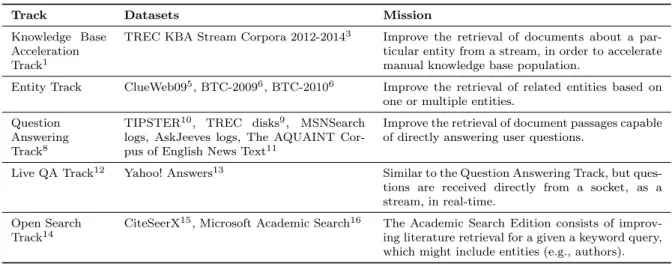
As the result of a TREC participation, a research paper must be submitted to publish in a NIST Special Publication dedicated to TREC, describing the approach taken and the obtained results. The focus is on using traditional IR metrics, such as mean average precision (MAP) or normalized discounted cumulative gain (NDCG@p), to measure the quality of different models or different parameter values based on human relevance judgments. Most tracks, including the Open Search Track (Balog et al. [2016]), also provide an overview on the competition, where the quality of the participants’ search engines is compared. This works as a state-of-the-art assessment of a particular information retrieval task. Knowledge Base Acceleration Knowledge Base Acceleration (KBA) ran consecutively from 2012 to 2014 and was succeeded by the Dynamic Domain Track in 2015, which also ran in 2016 and is running again in 2017. KBA describes their mission as follows1: “Given a rich dossier on a subject, filter a stream of documents to accelerate users filling in knowledge gaps.”. This track tackled the challenge of increasing the speed at which a news article is cited in a knowledge base from the moment of its publication. In 2014, the median number of days a news article waited to be cited in Wikipedia was 356 days (nearly a year!)2. The KBA track dealt with this issue by focusing on improving entity-oriented filtering of large
1http://trec-kba.org/
Table 1.1: Overview of semantic and entity-oriented research tracks from TREC.
Track Datasets Mission
Knowledge Base Acceleration Track1
TREC KBA Stream Corpora 2012-20143 Improve the retrieval of documents about a
par-ticular entity from a stream, in order to accelerate manual knowledge base population.
Entity Track ClueWeb095, BTC-20096, BTC-20106 Improve the retrieval of related entities based on
one or multiple entities. Question
Answering Track8
TIPSTER10, TREC disks9, MSNSearch
logs, AskJeeves logs, The AQUAINT Cor-pus of English News Text11
Improve the retrieval of document passages capable of directly answering user questions.
Live QA Track12 Yahoo! Answers13 Similar to the Question Answering Track, but
ques-tions are received directly from a socket, as a stream, in real-time.
Open Search Track14
CiteSeerX15, Microsoft Academic Search16 The Academic Search Edition consists of
improv-ing literature retrieval for a given a keyword query, which might include entities (e.g., authors).
streams, in order to help human curators fill in the knowledge gaps more quickly. Tasks were based on the TREC KBA Stream Corpora 2012-20143
Entity Track The Entity Track4 ran consecutively from 2009 to 2011 and it consisted of two main tasks. The first task, Related Entity Finding (REF), was based on the ClueWeb095 dataset, as well as the Billion Triples Challenge datasets (BTC-20096 and BTC-20107). The second task, Entity List Completion (ELC), was also based on the BTC-2009 and BTC-2010 Linked Open Data. The overall problem tackled by the Entity Track consisted of taking one (REF) or several (ELC) entities as a query and returning a ranked list with the best related entities.
Question Answering Track Question Answering Track8is one of the longest running tracks organized by TREC, starting on 1999 and running until 2007, based on several static datasets shared by other tracks, such as TREC disks 4&59, accompanied by a set of test questions, either manually created or taken, for instance, from search logs donated by Microsoft or AOL. The track was inactive for eight years, until 2015, when it was revived as the Live QA Track. The Live QA Track also ran in 2016 and is running again in 2017. The Live QA track was different from its precursor in the sense that it is required to find answer to questions submitted to Yahoo Answers and pushed to participants as a data stream.
Table 1.1 presents a summary on the most relevant research tracks, their datasets and mission, in the context of semantic and entity-oriented search. We also included the Open Search track since, in the particular context of this doctoral work, we will take advantage of an implicit presence of entities, namely the authors, within academic publications, to compare the impact of indexing only text versus indexing combined data (i.e., text and knowledge).
Open Search Track
We will take this opportunity to participate in TREC 2017 Open Search track with the main goal of understanding and creating a working implementation of the graph-of-word model (Rousseau and Vazirgiannis [2013]), described in Section 3.2. As a secondary goal, we aim to explore novel ways of extending this graph-based model with information such as entities or relations, while linking with the indexed text within the same data structure. We implement such approach with the graph-of-entity
3 http://s3.amazonaws.com/aws-publicdatasets/trec/kba/index.html 4https://web.archive.org/web/20110811014305/http://ilps.science.uva.nl/trec-entity/ 5https://lemurproject.org/clueweb09/ 6https://km.aifb.kit.edu/projects/btc-2009/ 7 https://km.aifb.kit.edu/projects/btc-2010/ 8http://trec.nist.gov/data/qamain.html 9http://trec.nist.gov/data/docs_eng.html
model, described in Section 3.3. The TREC 2017 participation will provide a benchmark for evaluation that will support the remaining work of this thesis as we improve the indexing and ranking strategies of our graph-based entity-oriented search framework. The event will continue beyond the ending of the semester and, therefore, in this report, we only present the preparation work we have done for the Open Search track, running in TREC 2017, describing how the graph-based models that we plan to evaluate with the academic data provided by the Living Labs API17 for the track.
This year, the Open Search Track is partly organized by Krisztian Balog18, a well-known IR scientist working on entity-oriented search. This task will follow last year’s format, where participants are given access to an API that provides them with documents from well-known search engines, like CiteSeerX or Microsoft Academic Search. These documents must be indexed, using whatever strategy the participant chooses. Then, a list of frequent queries is provided to the participants, who must run these queries through their search engines and submit the results to the Living Labs platform. This infrastructure is linked with the real-world search engines that initially provided the documents. The search engines dedicate a small part of their traffic to evaluating runs from participants, whenever a real user issues one of the supported queries, participant’s results are interpolated with the search engine’s results and shown to the final user. Feedback is sent back to the participant with information on which results (theirs or the search engine’s) were clicked. This implicit feedback can then be used to evaluate the system or even to train for a learning to rank approach, during the train stage. Two other evaluation stages exist before the final evaluation metrics can be computed.
Innovating Entity-Oriented Search
When, in 199019, Alan Emtage created the first search engine, Archie20, search was still heavily based on keyword queries, as inspired by the search potential of back-of-the-book indexing. However, as the web evolved, so did people’s information needs. Queries changed from simple topic keywords to more complex entity-oriented queries. Bautin and Skiena (2007) found that nearly 87% of all queries contained entities, based on the analysis of 36 million queries released by AOL21.
The word entity comes from the Medieval Latin entitas, which means being. Consistently, entity is defined in the Oxford English dictionary as “a thing with a distinct and independent existence” and in the English Wikipedia as “something that exists as itself, as a subject or as an object, actually or potentially, concretely or abstractly, physically or not”.
Traditionally, in information retrieval, we define document as a kind of material of an unstructured nature, usually consisting of text (Manning, Raghavan, Schütze, et al. [2008]). According to the definition of entity, we might therefore consider any document to be an entity, however, most systems that index combined data, usually distinguish between text and knowledge (Bast, Buchhold, Haussmann, et al. [2016]). We redefine the concept of document, in the context of entity-oriented search, as having three main components: a unique identifier, an optional textual block, consisting of one or several fields, and an optional knowledge block, consisting of triples representing statements directly associated with the concept or concepts illustrated in the document.
Methodology
In order to do any research on entity-oriented search, we must first assume we have access to a collection of combined data (text and knowledge) and we must then define a specific search task over this collection. For instance, we might want to use a keyword query to retrieve text, in which case we might take advantage of any knowledge associated with the text, in order to rank documents based on links to entities (or relations) in the query. Or we might want to, instead, retrieve entities, either by name, or through context, as obtained from directly associated text or from indirectly associated text from any of the linked entities.
While obtaining a dataset is an essential step to start developing a document representation and retrieval model, it is useless without a way to assess the impact, particularly in effectiveness (as efficiency
17http://doc.trec-open-search.org/en/latest/api-participant.html 18http://krisztianbalog.com/ 19http://www.searchenginehistory.com/ 20 http://archie.icm.edu.pl/archie-adv_eng.html 21https://techcrunch.com/2006/08/06/aol-proudly-releases-massive-amounts-of-user-search-data/
can usually be measured with time). In order to evaluate a retrieval model, we frequently use a ground truth made of a selection of topics (i.e., queries, usually with additional information, such as a narrative describing the information need) and the respective relevance judgments made by humans and usually represented through a 0 to 3 grading system. Based on the ground truth, we can them compare two different retrieval models, either representing a simple parameter tune or a completely different approach. In order to support research work in entity-oriented search, we decided to build a workbench platform, called Army ANT, that provides a basic programmatic interface to any search engine back-end, as long as it implements search() and index() functions, where the index() function iterates over a reader for a particular collection, returning documents that can either contain: (i) solely text, (ii) solely triples, or (iii) a combination of text and triples. Using such an approach, enabled, for instance, the comparison of a text-based retrieval model with a retrieval model for combined data, potentiating the measurement of the impact of entity-awareness in search engines, which will be our main goal for the TREC 2017 Open Search track. In Chapter 2, we will provide further detail on the Army ANT workbench, namely regarding the evaluation module used to compare different engines.
Graph-Based Approach
Over the years, in information retrieval, the inverted file has been the uncontested winner in efficiency, as an index data structure inspired by back-of-the-book indexing. Zobel and Moffat (2006) present a survey on index storage, index construction and query evaluation, where they indicate two alternative index data structures and a retrieval model that were less efficient, when compared to the inverted index and state-of-the-art weighting functions, such as TF-IDF or BM25. In particular, regarding index data structures, they have listed suffix arrays (Manber and Myers [1990]) and signature files (Faloutsos and Christodoulakis [1984]) as two competing alternatives to the inverted file, that were also proposed for document indexing and retrieval. However, research over the years (Zobel and Moffat [2006]; Zobel, Moffat, and Ramamohanarao [1998]) has shown that the inverted file achieves higher compression and therefore higher efficiency. Furthermore, for the particular case of suffix arrays, there is no equivalent of ranked querying. Regarding retrieval models, cluster retrieval was also studied (Voorhees [1986]) and, when compared to inverted file approaches, it was also found to be less efficient.
This doctoral work begins an inglorious but extremely important journey through one of those al-ternative paths, where the goal is to explore the graph as an index data structure. This can be done either conceptually, like Rousseau and Vazirgiannis (2013), who, as we will describe in Section 3.2, used a graph to represent a text document and compute a term weight (analogous and replacing of the term frequency) that was then stored in an inverted index. This can also be done concretely by implementing a graph-based index data structure in disk and using it to issue queries and retrieve documents in real time. As we will show further along this document, in this particular case we followed the second path, implementing the two graph-based retrieval models using a graph database and incurring in (rather ex-pected) efficiency issues. The main goal, however, was to explore and assess the graph data structure as a good (or bad) index data structure for a scenario where there are multiple heterogeneous information sources that, together, should contribute to an improved ranking of the results.
We propose that the graph would be a particularly good data structure to unify entity-oriented retrieval tasks, such as query entity linking and document ranking. There has already been work on using graphs to combine text and entities (Moro, Raganato, and Navigli [2014]), as well as on unifying machine learning models, in the quest to find a general-purpose learning algorithm, or a “master algo-rithm” (Domingos [2015]). In this work, we focus on unifying all information sources through a graph — as opposed to having an inverted file for full-text search and a separate triple store for inference and knowledge retrieval —, but also to integrate tasks from information extraction and information retrieval in a way that uncertainty is propagated through a pipeline in a probabilistic manner, obtaining the best possible ranked list of results without taking any deterministic assumption at a prior step.
Specifically, in this work, we show how we can build a graph of terms and entities, which we call the graph-of-entity (Section 3.3), as a logical next step to the graph-of-word (Rousseau and Vazirgiannis [2013]), used to seamlessly index text and knowledge. In this model, we implement a ranking function that is inclusive of the query entity linking process and, in fact, takes that signal into consideration when computing the final score of a document or entity, instead of using that process as a separate step where only the best linking is to be considered.
Chapter 2
Army ANT
Army ANT is a Python-based software package developed as a workbench for innovation in entity-oriented search. The goal is to make it easier for researchers, teachers or students to experiment with different search engine implementations, easily switching from between retrieval models (engines) to ex-plore differences in results and to learn about the datasets and the scoring function, with the aid of visual tools to explore individual values of score components per document or entity. Besides centralization and exploration, it is also important, for innovation, to evaluate different retrieval models over the same queries and given a ground truth. Army ANT also provides a framework to easily implement evaluation schemes, where evaluation tasks can be queued by uploading a topics file with queries and an assessments file with relevance judgments usually given by human evaluators.
In the following sections, we will describe the Army ANT workbench from an engineering perspective. First, we will provide details on the system architecture, describing how it can be used by IR researchers or students to test and evaluate their engines on different datasets. Next, we provide a user’s manual both for the command line interface and for the web interface, in order to illustrate how the workbench should be used for research or even for teaching IR.
System Architecture
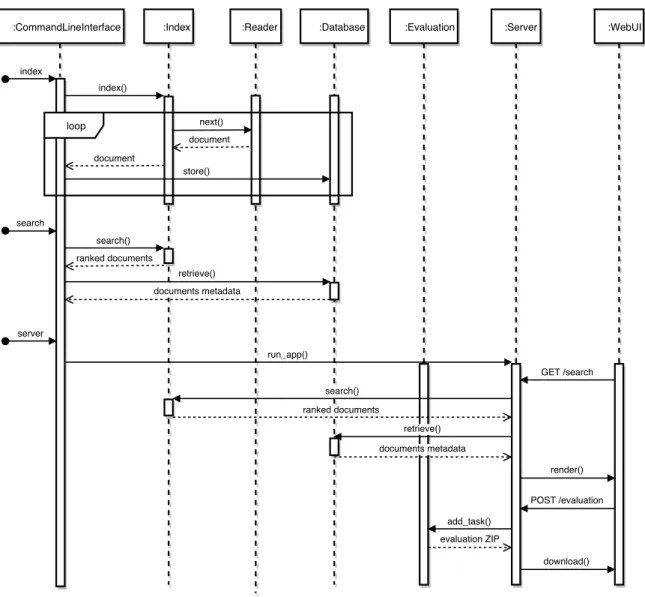
A typical workflow for Army ANT begins with the implementation or reusing of a reader for a particular dataset. A reader is essentially an iterator of documents (instances of army_ant.reader.Document). Each Document contains four main fields: doc_id (a number or string that uniquely identifies the document), text (a string representing the textual block of the document), triples (a list of string tuples representing the knowledge block of the document, where each tuple has a subject, a predicate and an object, and the subject is usually a representation of the main concept or entity covered within the document), and metadata (a map of document properties). During the indexing process, the index also acts as an iterator of documents. Documents yielded by the index can be different in content from documents yielded by the reader, for example extending the knowledge block with additional entities and relations extracted from the textual block. The metadata for these documents is then stored in the database. Figure 2.1 illustrates the main dispatchable actions from the command line (index, search and server), along with the two main HTTP requests handled by the server (GET /search and POST /evaluation). Most actions, with the exception of the evaluation, involve contacting the index to either index or search documents, as well as the database to either store or retrieve the metadata for a set of documents. The evaluation is based on the queuing of tasks that batch retrieve results for a set of queries, which are then compared with a ground truth and assessed using metrics like the mean average precision (MAP) or the normalized discounted cumulative gain for the top-p results (NDCG@p).
Next, we will go through each module, describing existing implementations, as well as the necessary steps to implement new instances of Reader, Index, Database or Evaluator. We will also present an overview on the CommandLineInterface and Server modules, although we do not anticipate any extensions to be developed for these modules, as it would tamper with the normal operation of the workbench.
Figure 2.1: Army ANT sequence diagram for index, search and server actions.
Command Line Interface
The command line interface (CLI), implemented using Python Fire1, provides an interface to index, search, launch the web server, and access any available extras. Python Fire automatically transforms the methods of a class into application commands and the parameters of the methods into individual command line arguments for a command. Listing 2.1 shows the usage for all commands implemented in Army ANT’s CLI. As we can see, a reader is selected through the --source-reader argument and, since it is only used within the index command, there is no command to only read a dataset, outside of this context. There is also a --source-path argument to select the path of the dataset to be indexed. Generally, we use the location designation instead of path or hostname, but we haven’t yet converted the Reader class to respect this convention. This is justifiable given the general aspect of Army ANT as a workbench, where a reader should be able to either iterate over documents in a database, in a compressed file or in a directory. Or an index could be accessed through a web service like Apache Solr2or, in our case, Apache TinkerPop Gremlin Server3, just as easily as a disk interface to an inverted file. In fact, we have already applied this convention to the index, search and fetch-wikipedia-images commands, accepting <hostname> or <hostname>:<port> as the index location for our particular
1https://github.com/google/python-fire 2
http://lucene.apache.org/solr/
Listing 2.1: Usage help for all Army ANT commands.
Usage: ./army-ant.py index SOURCE_PATH SOURCE_READER [INDEX_LOCATION] [INDEX_TYPE] [DB_LOCATION ] [DB_NAME] [DB_TYPE] [LIMIT]
./army-ant.py index --source-path SOURCE_PATH --source-reader SOURCE_READER [--index-location INDEX_LOCATION] [--index-type INDEX_TYPE] [--db-location DB_LOCATION] [--db -name DB_NAME] [--db-type DB_TYPE] [--limit LIMIT]
Usage: ./army-ant.py search QUERY [OFFSET] [LIMIT] [INDEX_LOCATION] [INDEX_TYPE] [DB_LOCATION] [DB_NAME] [DB_TYPE]
./army-ant.py search --query QUERY [--offset OFFSET] [--limit LIMIT] [--index-location INDEX_LOCATION] [--index-type INDEX_TYPE] [--db-location DB_LOCATION] [--db-name DB_NAME] [--db-type DB_TYPE]
Usage: ./army-ant.py fetch-wikipedia-images DB_NAME [DB_LOCATION] [DB_TYPE]
./army-ant.py fetch-wikipedia-images --db-name DB_NAME [--db-location DB_LOCATION] [--db -type DB_TYPE]
Usage: ./army-ant.py server
implementations of graph-of-word and graph-of-entity. This way, the index location is dependent only on the index implementation. Finally, a --limit argument can be used to only read or retrieve the first n documents from a dataset. In the following paragraphs, we will present further details on the inner workings of each module.
Reader
The army_ant.reader package contains two main classes: Reader and Document. The Reader class must be extended for implementing a particular dataset iterator that returns Document instances. It can also be used to instantiate readers, given a source_reader argument to the factory() method, which must also be extended with a new elif condition to instantiate any new implemented reader. Implementing a new Reader consists of overriding the __next__() method that must either return the next Document from the dataset or raise a StopIteration exception indicating that it has finished iter-ating. This first version of Army ANT already implements two readers: WikipediaDataReader, for the Wikipedia Relation Extraction Data v1.04 (Culotta, McCallum, and Betz [2006]) and INEXReader, for the INEX 2009 Collection5(Schenkel, Suchanek, and Kasneci [2007]). Both readers share a
Wikipedia-Entity class that will, later on, be made available generally to any other reader that indexes a knowledge block, at which point it will simply be renamed to Entity in resemblance to Document.
Index
The army_ant.index package contains two main classes: Index and ServiceIndex. The Index class, which also acts as a factory to instantiate any supported index, must be extended for implementing a particular engine by overriding the index() and search() methods. Alternatively, a ServiceIndex
class can be extended instead, in order to obtain an index_host and an index_port property from the index_location (e.g., “localhost:8182”). The index() method can, optionally, yield instances of Document that will then be passed to a Database instance to store document metadata. Each implemented Index or engine must use Python’s new async API, since this will then be served via
aiohttp in the army_ant.server package. This first version of Army ANT already implements two engines: GraphOfWord and GraphOfEntity. These retrieval models are detailed in Chapter 3, however there is a relevant technical detail about either model that we will share here. While GraphOfWord yields a Document instance directly from the reader, as it focuses on indexing text documents, GraphOfEntity
4http://cs.iit.edu/~culotta/data/wikipedia.html
Listing 2.2: Army ANT MongoDatabase example of a JSON document in the documents collection.
{
"_id" : ObjectId("591dad4c02f3ddaa2d990d1b"),
"doc_id" : "7577000",
"metadata" : {
"url" : "http://en.wikipedia.org/?curid=7577000",
"name" : "Johnny Burke"
} }
instead yields a Document instance for the subject entity in the list of triples, consisting of the same
doc_id as the original document and providing metadata for the url and name of the entity. We might say that the retrieval unit for the graph-of-word is a text document, while the retrieval unit for the graph-of-entity is an entity. In this case, however, both are represented by a URL associated with the respective Wikipedia article.
Database
The army_ant.database package contains a single main class: Database. The Database class, which also acts as a factory to instantiate any supported metadata databases, must be extended for implement-ing a facade to access the storage layer by overridimplement-ing the store() and retrieve() methods, which take an Index and a results list from an Index.search() method, respectively. Storing and retrieving batches of documents, instead of individual documents, gives a chance to the storage layer for improving performance with transactions and batch operations. This first version of Army ANT already imple-ments a database facade for MongoDatabase. It stores metadata in a documents collection, following the schema illustrated in Listing 2.2.
Evaluation
The army_ant.evaluation package contains three main classes: EvaluationTaskManager, Evalu-ationTask and Evaluator. The EvaluationTaskManager class is called by the army_ant.server
module to add a task to a batch via add_task(), to queue all added tasks via queue(), to process the next task via process() or to list queued tasks via get_tasks(). It also manages other lower level activities like removing unreferenced files or reseting the status of running tasks in the event of a server interruption. The EvaluationTask is a data class to store the following fields associated with an evaluation task: topics_filename (original filename when uploaded), topics_path (internal path of the file, pointing to a temporary file in a spool directory), topics_md5, assessments_filename,
assessments_path, assessments_md5, index_location, index_type (currently “gow” and “goe” are supported), eval_format (currently “inex” is supported, with plans to also implement a “trec” eval-uator), status (an IntEnum implemented through EvaluationTaskStatus with values for WAITING,
RUNNING and DONE), time (the timestamp for the queue time), results (only for DONE tasks) and
_id (only for tasks loaded from the database). Finally, the Evaluator class, which also acts as a fac-tory to instantiate any supported evaluator, must be extended for implementing a particular evaluation format by overriding the run() method, which must generate an output CSV on the results directory, with three columns: rank (positive integer), doc_id (string or number) and relevant (“True” or “False” string values). It can also generate a series of CSV files in the assessments directory, with in-termediate data required by each computed evaluation metric. A results property can be set during any stage of the run, containing a map of metric 7→ value to be displayed in the web interface. This first version of Army ANT already implements the INEXEvaluator for the topic and assessment files of the INEX 2009 Collection. In particular, this iterates over the title child element (the query) of each topic element, creating a results file named with the id attribute of the topic element. Results are then assessed using a binary grade (relevant/not relevant), based on the relevance judgments and,
in particular for INEX, on whether the number of relevant characters was zero (not relevant) or larger then zero (relevant). Based on this information, we then calculate MAP and NDCG@10, which we store in the database; any intermediate files are stored in the evaluation output directory and can then be downloaded as a ZIP file, along with a CSV with the values for the two evaluation metrics.
Server
The army_ant.server package implements an aiohttp6 server. HTTP methods are directly defined within the __init__.py of the module, using the templates directory to store Jinja27HTML templates and the static directory to store css, img or js files. CSS and JavaScript web packages are managed by NPM8 through a packages.json file on the root directory of the project. The server module implements the following HTTP requests: GET / for the home page, GET /search for the search and learn mode interface, GET /evaluation to manage evaluation tasks, POST /evaluation to launch a new evaluation task, GET /evaluation/results to download ZIP files containing the output of an evaluation task, GET /about with information about Army ANT and GET /static to serve static files. The server also runs the EvaluationTaskManager.manage() method, which periodically launches
WAITing tasks.
Util
The army_ant.util package simply implements functions that can be reused throughout the application and currently includes, for this first version of Army ANT: html_to_text() to strip HTML tags from an HTML fragment string, load_gremlin_script() to load a Gremlin script as a string, md5() to compute the MD5 of a file given its filename, get_first() to get the first element of a list or None if empty, and zipdir to create a ZIP archive of a given directory.
Extras
The army_ant.extras package provides additional functions that are frequently called from the com-mand line interface and that are particular to a given dataset or engine implementation. In this first version of Army ANT, we provide the procedure fetch_wikipedia_images() to complement metadata for Wikipedia documents with the first image in the infobox of the corresponding web page. This enables us to display a thumbnail next to a Wikipedia result within the web interface.
User’s Manual
In this section, we will provide an overview of the requirements for a normal operation of Army ANT, including any dependencies for the implemented classes. We will then provide examples for the command line interface, in particular listing supported values for the arguments of implemented readers, engines and extras. Finally, we will describe the web interface and how it can be used to learn about, explore and evaluate implemented engines.
Requirements and Installation
In order to run Army ANT, you first require an installation of Python 3.6.x. Since the latest version of Python is not widely available in the software repositories for the main Linux distributions, we instead managed the Python version through pyenv9. As of the writing of this report, pyenv should be installed and configured as follows:
git clone https://github.com/pyenv/pyenv.git ~/.pyenv
echo ’export PYENV_ROOT="$HOME/.pyenv"’ >> ~/.bashrc
6
http://aiohttp.readthedocs.io/en/stable/
7http://jinja.pocoo.org/ 8https://www.npmjs.com/
echo ’export PATH="$PYENV_ROOT/bin:$PATH"’ >> ~/.bashrc
echo ’eval "$(pyenv init -)"’ >> ~/.bashrc
After installing pyenv and restarting the terminal emulator to load the ∼/.bashrc script (or simply by running source ∼/.bashrc, Python 3.6.0 will automatically be used within the Army ANT directory, as configured in the .python-version file. At this point, you should run the following command, in the root of the project, to install Python dependencies:
pip install -r requirements.txt
For the MongoDatabase, you will also need a MongoDB instance running. In a Debian based distribution, you can simply run the following command to do this:
sudo apt-get install mongodb-server sudo service mongodb start
For the provided GraphOfWord and GraphOfEntity implementations, you will also need Java 8 and Apache TinkerPop Gremlin Server. Java 8 can be installed through the following command:
sudo apt-get install openjdk-8-jdk
You can install Apache TinkerPop Gremlin server by visiting the website10, downloading the binary for the 3.2.4 version of the Gremlin Server and uncompressing it in /opt/apache-tinkerpop-gremlin-server-3.2.4. The Neo4j Plugin must then be installed, otherwise the server will not provide any persistence and will not work with the provided configurations:
cd /opt/apache-tinkerpop-gremlin-server-3.2.4
bin/gremlin-server.sh -i org.apache.tinkerpop neo4j-gremlin 3.2.4
In the event that the installation fails, try to create the Groovy configuration file ∼/.groovy/groovyCon-fig.xml, with the following contents, in order to reconfigure the download location for Grapes (the Groovy dependency management software) and retry the previous command:
<ivysettings>
<settings defaultResolver="downloadGrapes"/> <resolvers>
<chain name="downloadGrapes"> <filesystem name="cachedGrapes">
<ivy pattern="${user.home}/.groovy/grapes/[organisation]/[module]/ivy-[revision].xml"/> <artifact pattern="${user.home}/.groovy/grapes/[organisation]/[module]/[type]s/[artifact
]-[revision].[ext]"/> </filesystem>
<ibiblio name="codehaus" root="http://repository.codehaus.org/" m2compatible="true"/> <ibiblio name="central" root="http://central.maven.org/maven2/" m2compatible="true"/> <ibiblio name="jitpack" root="https://jitpack.io" m2compatible="true"/>
<ibiblio name="java.net2" root="http://download.java.net/maven/2/" m2compatible="true"/> </chain>
</resolvers> </ivysettings>
After installing the Neo4j Plugin, we suggest you create symbolic links to the provided configuration files in /opt/apache-tinkerpop-gremlin-server-3.2.4/conf:
cd /opt/apache-tinkerpop-gremlin-server-3.2.4/conf
ln -s <Army ANT directory>/config/gremlin-server-neo4j-graph-of-word-wikipedia.yaml ln -s <Army ANT directory>/config/gremlin-server-neo4j-graph-of-entity-wikipedia.yaml ln -s <Army ANT directory>/config/gremlin-server-neo4j-graph-of-word-inex.yaml ln -s <Army ANT directory>/config/gremlin-server-neo4j-graph-of-entity-inex.yaml ln -s <Army ANT directory>/config/neo4j-graph-of-word-wikipedia.properties ln -s <Army ANT directory>/config/neo4j-graph-of-entity-wikipedia.properties ln -s <Army ANT directory>/config/neo4j-graph-of-word-inex.properties ln -s <Army ANT directory>/config/neo4j-graph-of-entity-inex.properties
Finally, create the directory structure for Army ANT on /opt/army-ant:
mkdir /opt/army-ant
mkdir /opt/army-ant/{data,eval}
mkdir /opt/army-ant/eval/{spool,results,assessment}
You can now try to run for instance Army ANT server to ensure everything went right:
cd <Army ANT directory> ./army-ant.py server
In the following sections, we will present further details on how to use the command line interface to index one of the supported collections using one of the implemented engines, as well as to use the web interface to issues queries and explore results to the indexed collections and to evaluate different engines over the INEX 2009 Collection.
Command Line Interface
In this section, we will illustrate the four commands supported by army-ant.py, presenting a complete example for each of them and a list of the supported values for each argument.
Index
The first step in a workflow, assuming a reader and an engine has already been implemented, is to index a supported dataset. Next, we exemplify the indexing action based on the INEX 2009 Collection, the graph-of-word index type and a MongoDB instance to store metadata:
cd <Army ANT directory>
./army-ant.py index --source-path "INEX 2009/dataset/pages25.tar.bz2" --source-reader "inex" --index-location "localhost:8184" --index-type "gow" --db-location "localhost:27017" --db-name "graph_of_word_inex" --db-type "mongo"
Valid --source-reader values include wikipedia_data for Wikipedia Relation Extraction Data v1.0 and inex for INEX 2009 Collection. Valid --index-type values include gow for the graph-of-word engine and goe for the graph-of-entity engine. Valid --db-type values only include mongo. Any of these adapted for different dataset sources, retrieval models and storage layers, respectively, by extending the base classes as described previously in Section 2.1.
Search
While the command line is not the preferred search interface (we suggest you use the web interface instead, for obvious reasons), Army ANT still provides some facilities to test the engine via the command line. Next, we present an example of a search query to the graph-of-word engine for the INEX 2009 Collection:
cd <Army ANT directory>
./army-ant.py search --query "york" --offset 0 --limit 3 --index-location "localhost:8184" --index-type "gow" --db-location "localhost:27017" --db-name "graph_of_word_inex" --db-type " mongo"
This will result in the following output, with the rank, score, document identifier and metadata for each returned item:
===> 1 75.08 193001
url: http://en.wikipedia.org/?curid=193001 name: Louis Brandeis
===> 2 56.76 15334002
url: http://en.wikipedia.org/?curid=15334002 name: New York State Route 323
===> 3 50.02 19346003
url: http://en.wikipedia.org/?curid=19346003 name: Bond Clothing Stores
The same set of valid values described for the index command can be used with the search command, specifically for --index-type and --db-type.
Server
Listing 2.3: Army ANT server configuration file for a graph-of-word and a graph-of-entity index per dataset: Wikipedia Relation Extraction Data v1.0 and INEX 2009 Collection.
[DEFAULT]
db_location=localhost db_type=mongo
eval_location=/opt/army-ant/eval
[gow-wikipedia_data]
name=Wikipedia Data - Graph of Word index_type=gow
index_location=localhost:8182 db_name=graph_of_word_wikipedia
[goe-wikipedia_data]
name=Wikipedia Data - Graph of Entity index_type=goe
index_location=localhost:8183 db_name=graph_of_entity_wikipedia
[gow-inex]
name=INEX - Graph of Word index_type=gow
index_location=localhost:8184 db_name=graph_of_word_inex
[goe-inex]
name=INEX - Graph of Entity index_type=goe
index_location=localhost:8185 db_name=graph_of_entity_inex
In order to run the server and access the learning mode and evaluation modules, you must first configure a set of valid engines and other parameters through the server.cfg file. Listing 2.3 presents an example of the configuration file used during this experience. The properties defined in DEFAULT
section are shared by the remaining sections, unless redefined in that section. In particular, we use the localhost instance of MongoDB on the default port (unspecified). We also use the /opt/army-ant/eval
directory as the base directory for evaluation task input and output. Besides DEFAULT, each of the other sections contains the configuration for an engine, with the name of section defined in the format <en-gine>-<dataset> and directly used as the value of the selection dropdown in the web interface. The
name of the engine is used to display each option in the dropdown to the user. The index_type
property determines the engine to use and the index_location property defines the location of the index of the given type, for the particular dataset it refers to. Finally, db_name simply points to the MongoDB database that stores metadata about the documents. While, in this example, we use different instances for all engines, we could have used the same database per dataset, since both indexes would reference the same document collection. The server, which runs in port 8080, can then be run using the following command:
./army-ant.py server
Extras
As we have previously described in Section 2.1, we have only implemented one extra feature that can be called through the command line interface with the fetch-wikipedia-images command, as shown below:
./army-ant.py fetch-wikipedia-images --db-name "graph_of_word_inex" --db-location "localhost :27017" --db-type "mongo"
This will read a url metadata attribute and, if it matches a Wikipedia URL, visit the corresponding web page and extract the first image from the infobox table, if any exists. The URL for the image is then stored in the img_url metadata attribute and will be used, when available, to display an image next to each search result.
Web Interface
In this section, we describe the web interface and how it can be used to learn about, explore and evaluate implemented retrieval models (engines). This can only be done after implementing the required reader, index and evaluator classes, and indexing any relevant collections. First, we describe the basic search interface, not unlike a common search engine, with the exception of the ability to select a retrieval model to search with and an indexed dataset to search over. Then, we describe the learn mode interface, where information for the first 30 results is displayed, with the goal of explaining how the scores for each document were calculated. This also includes bibliographic references to scientific publications describing the retrieval model (document representation and weighting scheme) and the indexed dataset. Finally, we explain how the evaluation interface works, presenting further details on accepted formats and generated output.
Search
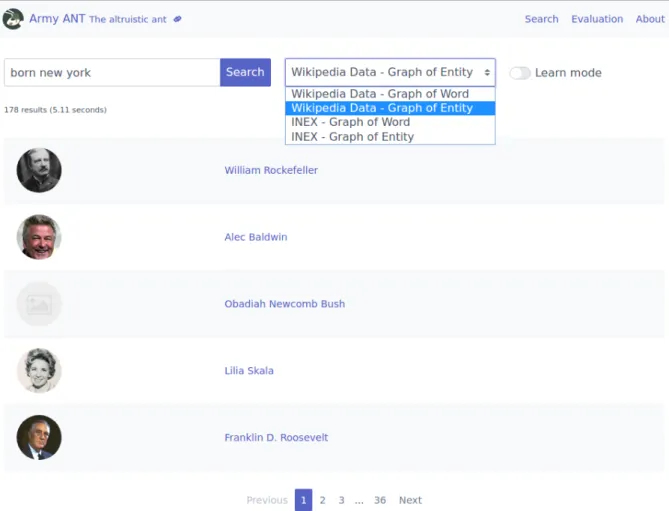
When you first access Army ANT server, for example on http://localhost:8080, you will be taken to a Home page, suggesting you visit the About page for further information. From the Home page, you can also access the search and learn mode interface via the Search anchor, or the evaluation interface via the Evaluation anchor. When you first press the Search anchor, you will be taken to an empty search page with a query input box, an engine selection dropdown and a learn mode toggle button. Let us say we wanted to search for born new york, using the graph-of-entity retrieval model over the Wikipedia Relation Extraction Data v1.0. The result of this action is illustrated in Figure 2.2. As we can see, we
Figure 2.2: Army ANT basic search and engine selection.
present a clean interface, paginating results and providing an image and link to each web document when possible. This provides a basic interface to explore indexed datasets with different retrieval models. Learn Mode
The learn mode was created with two goals in mind. First, it can be used to help in the design of a retrieval model by explaining a document’s score through its individual components. Secondly, it can be used to teach information retrieval, as an interactive documentation platform for retrieval models and document collections. It clearly shows how each particular weighting function works and provides further web and bibliographic references on the subject, as well as on the document collection, aiding with understanding the structure of indexed contents.
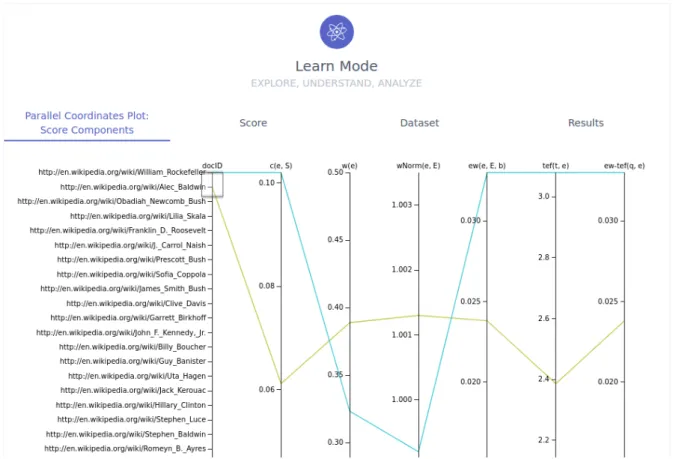
Parallel Coordinates Plot Figure 2.3 shows a visualization of individual score components — we chose the parallel coordinates system (Inselberg [1985]), since it allows for a condensed and useful view of multivariate data. This kind of plot acts as a decision support mechanism, in order to choose whether a component is redundant, has too low or too high of an impact, requiring scaling or normalization, and to build an intuition on the discriminative power of a score component.
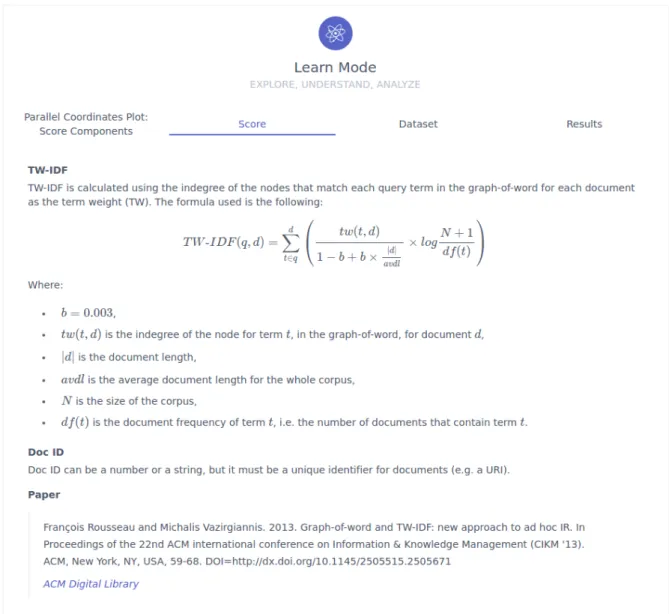
Score As a complement to the parallel coordinates plot, we also provide descriptive content on the score components, fully describing the weighting function and providing a bibliographic citation and corresponding link to the publication that details that particular retrieval model, usually also covering the document representation model. Figure 2.4 illustrates such information for the graph-of-word retrieval model.
Figure 2.3: Army ANT learn mode parallel coordinates plot for score components per document.
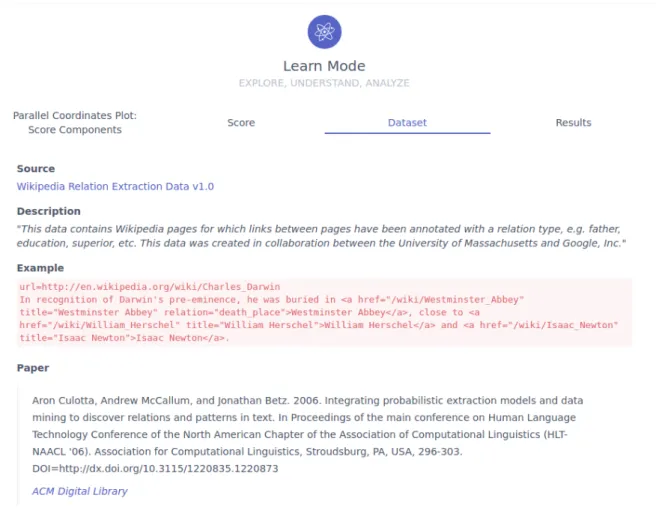
Dataset Similarly, we also provide descriptive content on the indexed dataset, including a link to its web page, usually providing a download location, when available. We then present a short description of the collection, along with an example of the structure and content of a particular document. When available, we provide a bibliographic citation and corresponding link to the main publication associated with the dataset. This usually corresponds to a data collection and characterization paper, but sometimes it only describes a particularly relevant usage of the dataset.
Results Finally, as illustrated in Figure 2.7, we present the ranked list of results, displaying the rank position, the computed score and the document identifier, stripped of any metadata. This is useful in clarifying the difference between indexing and storage. Indexing solutions like Apache Solr have lately been used as databases, since documents are analyzed and indexed but also stored within this software. This has made the two processes harder to distinguish for a new student of information retrieval and, therefore, showing the results without any metadata is a useful tool to clarify this. While solutions like Apache Lucene/Solr also implement a kind of document database storage layer, the index is not, per se, a database! In fact, in Army ANT, we separate the two layers — nevertheless, it is useful to mention that this logical segmentation of indexing and storage might result in a slight loss of performance unless, of course, there is no interest in retrieving document metadata. This is because, at a low level, the index might directly store the offset of the metadata to retrieve for a document, while separating this would require a database index or a sequential search to reach the same metadata. For educative purposes, however, we believe this is the right choice, to separate the two layers.
Evaluation
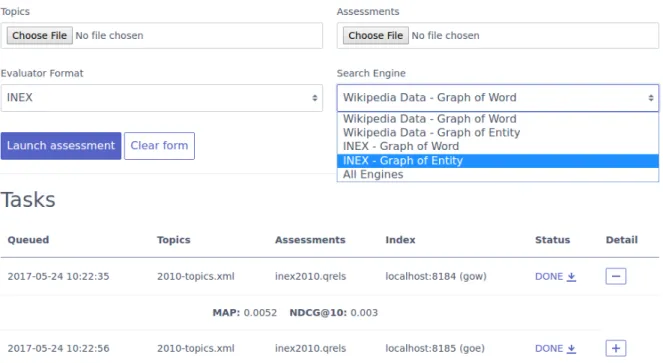
Finally, we describe the evaluation interface, which requires the prior indexing of a dataset with relevance judgments for a set of search topics. In particular, the first version of Army ANT supports the inex
evaluation format. This means that, in order to launch an evaluation task, we must first select the topics and assessments files, picking the INEX evaluator format and one of the available INEX engines
Figure 2.4: Army ANT learn mode descriptive explanation of the ranking function.
to evaluate. In the current version, only one evaluator can be active per topics file, assessments file and index, but this will changed in the future. The ability to delete evaluation tasks will also be added. An evaluation task has three possible statuses: when it’s queued, it enters the queue in the WAIT status and, when the EventTaskManager.process() method is periodically called, the next available task will be started (only one task can currently run at a time). At this point, the task will change its status to RUNNING and, when it finishes, it will change its status to DONE. Finished tasks, enable an interface button with a plus/minus to toggle the results of the evaluation, in the form of a dictionary and usually displaying the values for MAP and NDGC@10. Additionally, the user can download a ZIP file containing a CSV with these metrics, as well as intermediate files used to compute the metrics, by pressing the download link in a DONE status.
Figure 2.5: Army ANT learn mode descriptive explanation of the indexed dataset(s).
Chapter 3
Graph-Based Models
As a net is made up of a series of ties, so everything in this world is connected by a se-ries of ties. If anyone thinks that the mesh of a net is an independent, isolated thing, he is mistaken. It is called a net because it is made up of a series of an interconnected meshes, and each mesh has its place and responsibil-ity in relation to other meshes.
— Gautama Buddha
In this chapter, we describe the two graph-based document representation and retrieval models imple-mented in Army ANT. First, we cover the graph-of-word model, proposed by Rousseau and Vazirgiannis (2013), along with our implementation of the model. We used a common graph structure for all docu-ments, built for the sake of generalization within our explorative approach. This was stored on a graph database and queried through the Gremlin1domain-specific language for graphs. We also propose a novel graph-of-entity model, where we extend the notion of document beyond textual content, associating text with a set of statements that portray knowledge related to the text. This was an attempt to structure and more clearly define the task of entity-oriented search, looking at the document as a richer source of information. The graph-of-entity is therefore an early attempt at integrating different information sources, seamlessly and in a unified model, where text, entities and their relations are included in a common graph structure. While we certainly sacrifice efficiency, by using a graph database instead of an inverted file to index the documents, our goal is to be able to explore graph-based approaches, with a focus on benchmarking effectiveness, in order to determine whether it is worth it to further invest on developing graph-based index data structures.
In the following sections, we will begin by describing the two datasets we used to build and evaluate the two models. We will introduce the graph-of-word, describing graph-based document representation and comparing the original implementation based on an inverted file with our implementation based on a graph database. We then describe the process of doing document retrieval on the graph database, as well as the graph-of-word ranking function and the information retrieval theory behind it. We follow this with a description of the graph-of-entity model, as a proposal to extend the graph-of-word with a knowledge block of entities and their relations in connection to the text. We then show how we can take advantage of graph querying to unify the information extraction task of query entity linking with the information retrieval task of entity ranking. We close the chapter with the evaluation of the two retrieval models, using MAP and NDCG@10 for the topics and relevance judgments of the INEX 2009 Collection.
Datasets for Combined Data
In order to experiment with entity-oriented search, we first had to obtain a dataset. We had two options to do this. We could find a collection of textual documents and then apply information extraction
Listing 3.1: Example of Wikipedia Relation Extraction Data v1.0.
url=http://en.wikipedia.org/wiki/Charles_Darwin
In recognition of Darwin’s pre-eminence, he was buried in <a href="/wiki/Westminster_Abbey"
title="Westminster Abbey" relation="death_place">Westminster Abbey</a>, close to <a href="/wiki /William_Herschel" title="William Herschel">William Herschel</a> and <a href="/wiki/
Isaac_Newton" title="Isaac Newton">Isaac Newton</a>. url=http://en.wikipedia.org/wiki/John_Quincy_Adams
Adams’s most important contributions to American history came before and after his relatively ineffective term as President. Before becoming President, he was the most experienced diplomat in the United States. While serving as <a href="/wiki/United_States_Secretary_of_State" title=" United States Secretary of State" relation="job_title">Secretary of State</a> under President <
a href="/wiki/James_Monroe" title="James Monroe" relation="superior">James Monroe</a>, Adams negotiated the <a href="/wiki/Adams-On%C3%ADs_Treaty" title="Adams-Onís Treaty">Adams-Onís Treaty</a> with <a href="/wiki/Spain" title="Spain">Spain</a> and devised the <a href="/wiki/ Monroe_Doctrine" title="Monroe Doctrine">Monroe Doctrine</a>, both of which were of long lasting importance. For these activities he has been called "the most influential American grand strategist of the nineteenth century" and "perhaps the greatest secretary of state in American history."<span class="reference"><sup id="fn_1_back"><a href="#fn_1" title="">1</a></
sup></span>
techniques, like named entity recognition and relation extraction, to build the associated knowledge base. Or we could find a dataset of combined data that already provides knowledge (i.e., entities and relations) along with the textual content. In order to focus on the construction of the workbench and the study and implementation of the retrieval models, we chose the latter. We found a small dataset — Wikipedia Relation Extraction Data v1.0 — that fit the criteria and was ideal for the development stage and for continuous experimentation. Lacking topics and relevance judgments, we were required to find another dataset that provided this information, in order to evaluate the retrieval models. Another alternative would be to test the system with real users, but, given the time constraints, this was not an option. Furthermore, we used an already established dataset — INEX 2009 Collection —, which has been used to evaluate several information retrieval tasks, in competition tracks similar to TREC. Using this dataset also helped position the two tested models in regards to the state of the art. Next, we will describe the two datasets in more detail, identifying the parts that were indexed as text and the parts that were indexed as knowledge.
Wikipedia Relation Extraction Data v1.0
Wikipedia Relation Extraction Data v1.02is freely provided by Aron Culotta, who leads TAPI Lab (Text Analysis in the Public Interest Laboratory). This dataset was created from a collaboration between the University of Massachusetts and Google, Inc. It contains two text files, wikipedia.train and
wikipedia.test, with several passages (paragraphs) from Wikipedia pages. Anchors provided within each passage are annotated with the relation between the entities described by the current Wikipedia page and the target Wikipedia pages. Overall, it covers 441 Wikipedia pages (257 in the training set and 184 in the test set), 1110 passages (777 in the training set and 333 in the test set), 4681 relations (3332 in the training set and 1349 in the test set) and 53 relation types. Listing 3.1 shows the first two passages of the wikipedia.train file — for our experiments, we only indexed the training file. Each passage beings with its corresponding URL from Wikipedia and is followed by a paragraph containing an HTML fragment with a elements annotated with a special relation attribute.
There can be multiple passages per Wikipedia page. In Army ANT, we consider all the passages per Wikipedia page as a single document. We use the concatenated passages, stripped of HTML tags, as our text block, and associate each Wikipedia page with its implicit entity, as extracted from the URL ending, building a knowledge block based on the relations between such entities. During indexing, we
Listing 3.2: Example of INEX 2009 Collection.
<?xml version="1.0" encoding="UTF-8"?>
<!-- generated by CLiX/Wiki2XML [MPI-Inf, MMCI@UdS] $LastChangedRevision: 92 $ on 17.04.2009 04:39:56[mciao0825] -->
<!DOCTYPE article SYSTEM "../article.dtd">
<article xmlns:xlink="http://www.w3.org/1999/xlink"> <header>
<title>Portal:Comedy/Did you know/61</title> <id>18359000</id>
[...] </header> <bdy>
... that the <link xlink:type="simple" xlink:href="../616/44616.xml">
British radio sitcom</link> <b><it><link xlink:type="simple" xlink:href="../276/18249276.xml"> Safety Catch</link></it></b> is built around the moral dilemmas of a man who inadvertently became an <link xlink:type="simple" xlink:href="../296/608296.xml">
arms dealer</link>? [...]
</bdy> </article>
annotate any retrievable instance of a document or entity with a doc_id equal to the URL, in order to distinguish between entities that are used for enriching the model versus entities that are to be retrieved. Ideally, we should not have to do this, but during our experiments we found that adding incomplete data (i.e., entities without associated text) would somehow imbalance the model and introduce noise that would decrease the quality of the results. While we did not measure this explicitly, it was clear from the results that, for the two studied models, the retrieval unit had to be properly identified. In the future, we would like to further explore this issue and generalize retrieval to any available information.
INEX 2009 Collection
While the focus was on measuring the effectiveness of the retrieval models, we had visible performance issues while indexing the INEX 2009 Collection. This is a larger dataset that comprises 50.7 GB of Wikipedia articles, in XML format, annotated with entity categories and internal links to other doc-uments; it contains over 2.6 million documents, from October 8, 2008, with over 1.4 billion XML ele-ments. Listing 3.2 shows the structure of document 18359000.xml from pages/000 of the sample-25-000.tar.bz2 archive — each document has a header element, with metadata, and a bdy element, with the main content of the document. Out of all the available XML annotations, we have only taken into consideration link elements, in order to establish a relation from the current document to other documents in the collection. This was used as the knowledge block of the entity-oriented document, mapping Wikipedia pages to their implicit entity and considering only related_to relations to other entities. The textual block of the document consisted on the text of the bdy tag, stripped of XML tags. We indexed the textual block with the graph-of-text and both the textual and knowledge blocks with the graph-of-entity. The intent was to build a better graph-based model by also taking available knowledge into consideration. We were able to assess the quality of our proposed model based on the topics and relevance judgments provided along the INEX 2009 Collection.
Graph of Word
The graph-of-word model has been proposed by Rousseau and Vazirgiannis (2013) as a novel graph-based document representation, defying the term independence assumption of the bag-of-word approach. In particular, they used an unweighted directed graph (the graph-of-word), where nodes represent terms
Listing 3.3: Example document consisting of the first sentence of the “Semantic Search” Wikipedia page, with DOCID=https://en.wikipedia.org/wiki/Semantic_search.
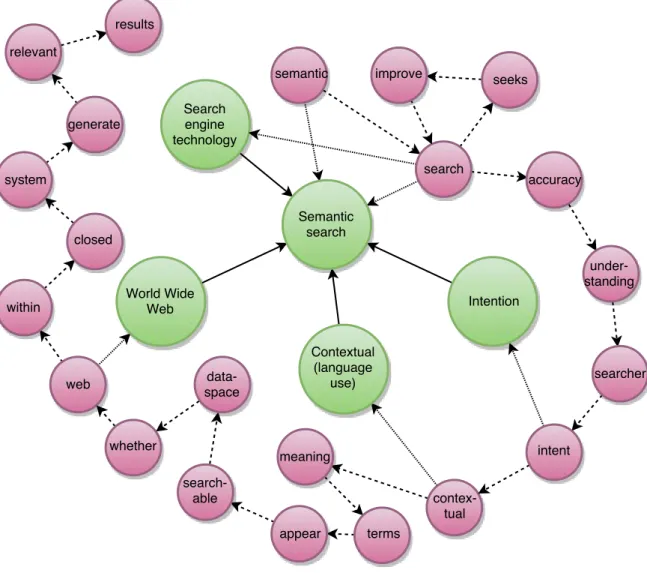
<b>Semantic search</b> seeks to improve <a href="/wiki/Search_engine_technology" title="Search engine technology">search</a> accuracy by understanding the searcher’s <a href="/wiki/ Intention" title="Intention">intent</a> and the <a href="/wiki/Context_(language_use)"
title="Context (language use)">contextual</a> meaning of terms as they appear in the searchable dataspace, whether on the <a href="/wiki/World_Wide_Web" title="World Wide Web"> Web</a> or within a closed system, to generate more relevant results.
and edges link each term to its following terms within a sliding window of size 3, in order to capture context. They also defined the TW-IDF retrieval model, based on retrieval heuristics (Fang, Tao, and Zhai [2004]), over the graph representation, and built on the indegree of the nodes. The idea was to measure the “number of contexts” a given term appears in. In their implementation, the graph-of-word was generated per document, computing the TW metric and storing it within an inverted file instead of the typical TF, and so the graph structures for each document were discarded. They evaluated their TW-IDF weighting function with and without regularization over document length, as well as with and without parameter tuning for the pivoted document length normalization b parameter. They did a comparison of TW-IDF with TF-IDF (Salton and McGill [1986]) and BM25 (Robertson et al. [1994]), as well as Piv+ and BM25+ (Lv and Zhai [2011]), showing that TW-IDF consistently outperformed the other weighting functions, particularly in realistic conditions, where parameter tuning is costly and is seldom an option.
Document Representation
In order to illustrate how document representation is done in the graph-of-word model, we first introduce an example document based on the first sentence of the Wikipedia page for “Semantic Search”, as shown in Listing 3.3. The resulting graph-of-word for the document, assuming a sliding window of 3 that covers the analyzed term, is illustrated in Figure 3.1. As we can see, words were converted to lowercase and stopwords were removed. Working under the assumption that the terms following a given term would be a good representation of context, the indegree of this graph is a measurement of term relevance that takes term dependence into consideration.
The authors originally build this graph for each document, extracting the term weight (TW) from the indegree of each node and storing the value in the inverted index, discarding the graph structure. Instead of following this implementation approach, we stored each graph in a Neo4j3 graph database, using a
name property with the term adding a doc_id property to each edge, in order to enable the indegree computation for any document-induced subgraph. This incurs in an obvious cost in efficiency that is justified only by the flexibility to explore and extend the graph, as well as the ability to produce graph computations using the Gremlin DSL. By definition, a graph database is a graph storage and retrieval system that provides index-free adjacency, that is, each node can access any of its neighbors without first querying an index. The Neo4j instances we use throughout this work are configured with node and relationship (edge) auto indexing. This means that nodes and edges can be reached or filtered through their properties using an index, but traversals are still index-free. In fact, Gremlin graphs follow the property graph model, which can be formally defined as a directed, binary, labeled, attributed multigraph. This means that relationships are binary (i.e., it’s not a hypergraph), (v1, v2) 6= (v2, v1) : ∀v1, v2 ∈ V (i.e., direction matters in defining a relationship), nodes and edges have types (i.e., the graph is labeled), and nodes and edges can have properties (i.e., the graph is attributed).
Document Retrieval
Document retrieval consists of computing the TW-IDF for each term in the query, over each document in the collection. Next, we will present a short summary of the most relevant techniques used by Rousseau
Figure 3.1: Graph-of-word document representation model. Nodes represent terms, while arrows link each term to the following two terms (within a sliding window of size three). This aims at capturing context.
and Vazirgiannis (2013) to construct their retrieval model. The TW-IDF weighting function is displayed in Equation 3.1.
T W -IDF (t, d) = tw(t,d) 1 − b + b ×avdl|d|
× logN + 1
df (t) (3.1)
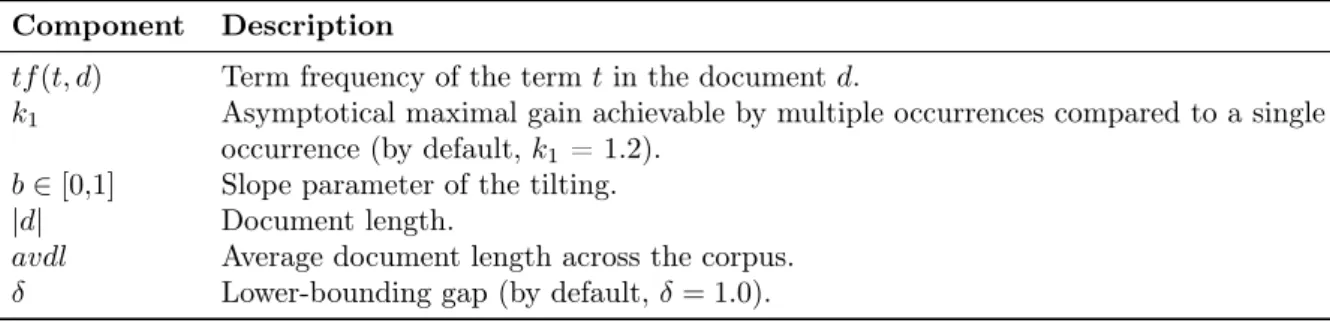
The authors took advantage of information retrieval heuristics, as formally studied by Fang, Tao, and Zhai (2004) and, later, by Lv and Zhai (2011), to obtain a valid weighting function. These heuristics form a toolkit of functions that can either replace TF or be combined through composition, in order to obtain many of the well-known weighting schemes, such as TF-IDF (vector space model), BM25 (divergence from randomness) or Dirichlet prior smoothing (language modeling). Table 3.1 presents an overview, based on the description by Rousseau and Vazirgiannis (2013), on information retrieval heuristics, and Table 3.2 describes each individual component used within the functions. TW-IDF was obtained by applying pivoted document length normalization to the term weight (TW) a multiplying it by the inverse document frequency (IDF).