http://www.uem.br/acta ISSN printed: 1679-9275 ISSN on-line: 1807-8621
Doi: 10.4025/actasciagron.v38i1.25621
Occurrence of
Aspergillus
sp.,
Fusarium
sp., and aflatoxins in corn
hybrids with different systems of storage
Adriana Sbardelotto Di Domenico1,3*, Cleverson Busso1, Elisabete Hiromi Hashimoto2, Marcela Tostes Frata1, Divair Christ3 and Sílvia Renata Machado Coelho3
1
Universidade Tecnológica Federal do Paraná, Estrada para Boa Esperança, Km 4, 85660-000, Dois Vizinhos, Paraná, Brazil. 2
Universidade Tecnológica Federal do Paraná, Francisco Beltrão, Paraná, Brazil. 3
Universidade Estadual do Oeste do Paraná, Rua Universitária, 2069, 85819-110, Cascavel, Paraná, Brazil. *Author for correspondence. E-mail: [email protected]
ABSTRACT. The aim of this study was to assess alternatives for viable corn storage for small rural properties in two annual storage experiments. A 4×5 factorial design was used with four types of storage (conventional bags, hermetic bags, metal silos and corncobs) and five periods of storage (0, 3, 6, 9 and 12 months). We used corn hybrids 2B688RR and 30K73Hx cultivated in winter 2012 and summer 2012/2013 in the city of Dois Vizinhos, Paraná, Brazil. The moisture contents, counts of Aspergillus sp. and
Fusarium sp., and the occurrence of aflatoxins (B1, B2, G1 and G2) were assessed. The kernels stored in
hermetic bags had lower moisture contents. Aspergillus sp. and Fusarium sp. were observed in 20.37 and 86.11% of winter storage samples, respectively, and in 83.3 and 91.6% of summer storage samples, respectively. The storage system and time of storage had no influence on the occurrence of Aspergillus sp. and aflatoxins in the winter crop samples. The corncobs from the summer crop samples had the lowest counts of Aspergillus sp. and did not have aflatoxins. We detected aflatoxins at concentrations of 2.8-14.5 and 3-197.5 μg kg-1 in the winter and summer crop samples, respectively.
Keywords: Zea mays L., fungi, mycotoxins, grain storage, food safety.
Ocorrência de
Aspergillus
sp.,
Fusarium
sp. e aflatoxinas em híbridos de milho submetidos a
diferentes acondicionamentos de armazenagem
RESUMO. O objetivo deste trabalho foi avaliar alternativas de armazenagem de milho viáveis a pequenas propriedades rurais em dois experimentos anuais de armazenagem. Um esquema fatorial 4x5 foi utilizado, com quatro tipos de acondicionamentos de armazenagem (sacarias convencionais, bolsas herméticas, silo metálico e espigas) e cinco períodos de tempo (0, 3, 6, 9 e 12 meses). Utilizou-se híbridos de milho (2B688RR, 30K73Hx) cultivados nas safras de inverno 2012 e verão 2012/2013 em Dois Vizinhos, Paraná. Os parâmetros avaliados foram: teor de água, contagem de Aspergillus sp., Fusarium sp. e ocorrência de aflatoxinas (B1, B2, G1 e G2). Os grãos das bolsas herméticas apresentaram o menor teor de água.
Verificou-se Aspergillus sp. e Fusarium sp. respectivamente em 20,4 e 86,1% e em 83,3 e 91,6% das amostras do armazenamento safra de inverno e de verão. Não houve influência do acondicionamento e do tempo de armazenagem na ocorrência de Aspergillus sp. e de aflatoxinas no armazenamento safra de inverno. O milho em espigas, do armazenamento safra de verão, apresentou a menor contagem de Aspergillus sp. e não apresentou aflatoxinas. Detectou-se aflatoxinas em níveis de 2,8-14,5 e de 3-197,5 μg kg-1 nos
armazenamentos safra de inverno e de verão, respectivamente.
Palavras-chave:Zea mays L., fungos, micotoxinas, armazenamento de grãos, segurança alimentar.
Introduction
Brazil is third largest producer of corn kernels in the world, producing 78.8 million tons in the 2013/2014 season (Companhia Nacional de Abastecimento [CONAB], 2014). To meet demands in the dry season, much of the corn produced is stored and thus is susceptible to deterioration, which is primarily influenced by factors such as kernel moisture content, air temperature, relative humidity, storage atmosphere,
Because of the economic and dietary importance of corn, fungal contamination is currently one of the primary problems in the storage of kernel corn (Moreno et al., 2009). As a substrate rich in starch, corn is one of the cereals most likely to suffer contamination by fungi, primarily Aspergillus and
Fusarium (Abbas, Cartwright, Xie, & Shier, 2005;
Mohale, Medina, Rodriguez, Sulyok, & Magan, 2013). These fungi are known for the mycotoxigenic potential (Rocha et al., 2009).
Among the mycotoxins detected in corn, toxic secondary metabolites that are produced by filamentous fungi and aflatoxins (B1, B2, G1 and G2)
that are produced by several species of Aspergillus
have great importance for the toxic effects to humans and animals and because of the carcinogenic, mutagenic and teratogenic properties (Moreno et al., 2009; Thompson & Henke, 2000). Aflatoxins are a worldwide economic problem because of the effects on the export of grains and livestock production (Rocha et al, 2009).
Many studies assessed the physical-chemical properties (Costa, Faroni, Alencar, Carvalho, & Ferreira, 2010) and health concerns of corn during storage (Hirooka et al., 2007; Mohale et al., 2013; Santin, Gutokoski, Eichelberger, Portella, & Durigon, 2009; Thompson & Henke, 2000). However, most of these studies evaluated storage alternatives used at large scales and did not consider the rudimentary systems still in use on small farms in developing countries such as Brazil.
Because of the necessity to store corn and the lack of information on viable storage alternatives for small rural properties, this research aimed to assess the sanitary quality of corn hybrids from two agricultural seasons (winter 2012 and summer 2012/2013) that were stored for 12 months in four different storage systems. The corn was analyzed for kernel moisture content, occurrence of Aspergillus sp. and Fusarium sp., and aflatoxin contamination.
Material and methods
Two corn storage experiments were conducted (winter season 2012 and summer season 2012/2013) at the Federal Technological University of Paraná (UTFPR), Dois Vizinhos campus in the southwest region of Paraná State, located at latitude 25° 44’ 35” s and longitude 53° 4’ 30” W with an altitude of 509 m. The corn samples were from the Dow AgroSciences hybrids 2B688RR and Pioneer 30K73Hx, which were cultivated in the microregion of Dois Vizinhos. Corncob and kernel samples were collected, and the cobs were harvested manually, whereas the kernels were harvested with a combine
harvester. The moisture content of the samples from winter 2012 was 29.9 and 31.5% (wet basis, wb) for corn hybrids 30K73Hx and 2B688RR, respectively, whereas the moisture content of the samples from summer 2012/2013 was 27 and 30% (wb) for corn hybrids 30K73Hx and 2B688RR, respectively.
After harvest, corn samples were naturally dried in the sun until reaching a moisture content ≤ 13% wb. The kernels were then cleaned in a classifying machine. The samples from the winter (July 2012 to July 2013) and summer seasons (February 2013 to February 2014) were stored for 12 months in a brick room at ambient conditions. Weather conditions were monitored.
The corn hybrid samples were stored in four types of packaging: 1) conventional polypropylene bags (38 × 52 cm) with 4 kg of kernels each, stacked on wooden pallets; 2) hermetically sealed polyethylene bags (40 × 50 cm) with double layers (external layer of double-sided polyethylene and inner layer of vacuum polyethylene, with thicknesses of 200 and 0.18 μm, respectively) and 4 kg of kernels each, also stacked on wooden pallets; 3) prototypes of metal silos (30 diameter × 50 cm height) with 20 kg each and no aeration system; and 4) corncobs arranged on plastic baskets, with approximately 60 kg each.
Fifty-four samples were analyzed of each corn hybrid in each experiment. Six samples were collected at time 0 (3 of corncobs and 3 of corn), and 12 samples of each were collected on the remaining sample dates (four storage treatments with three replications) for a total of 108 samples per storage experiment (winter crop and summer crop).
The samples were analyzed for kernel moisture content, counts of Aspergillus sp. and Fusarium sp., and occurrence of aflatoxins (B1, B2, G1 and G2). The
analyses were performed at UTFPR, except for aflatoxins, which were analyzed in the Laboratory of Quality Control (LACON) of the State University of West Paraná (Unioeste), Cascavel campus. The moisture content (%) was determined with the standard greenhouse method of 105 ± 3ºC for 24 hours (Ministério da Agricultura, Pecuária e Abastecimento [Mapa], 2009).
The technique described by Silva, Junqueira and Silveira (2010) was used to count Aspergillus sp. and
Fusarium sp. Corn samples, 200 g, were ground to pass
through a 50 mesh. A subsample of 10 g was mixed with 90 mL of 0.1% sterile peptone water, and serial dilutions were performed to 10-5. One milliliter of each
dilution was transferred to Petri dishes with the Pour
Plate technique with potato dextrose agar (PDA, pH
(CFU g-1), the colonies with morphological
characteristics of Aspergillus sp. and Fusarium sp. were isolated, and the microculture technique was used for identification, which was based on the macroscopic and microscopic aspects of the vegetative and reproductive structures of the colonies, in accordance with Singh, Frisvad, Thrane and Mathur (1991).
In all samples with Aspergillus, the aflatoxins B1,
B2, G1 and G2 were analyzed with high performance
liquid chromatography (HPLC), as described in the methodology from the immunoaffinity column maker (Aflatest, VICAM). The extraction was performed with 50 g of ground samples. Methanol-water (80:20) was used as a solvent. The extract was purified by passing through the immunoaffinity column and derivatization with trifluoroacetic acid:acetic acid:water (2:1:7). For the analysis, 20 μL of the eluate was injected into the HPLC system (Shimadzu, Kyoto, Japan), which consisted of an automatic injector, a quaternary pump, a column oven adjusted to 40ºC, a C18 chromatographic column (5 μm) measuring 150 × 4.6 mm, and a fluorescence detector set at 365 nm excitation and 450 nm emission. The mobile phase used was the isocratic mixture of water-methanol (60:40) at a flow of 0.8 mL min.-1. The identifications and
quantifications (μg kg-1) were performed with
calibration curves (0.025, 0.05, 0.075, 0.1, and 0.125 μg mL-1) obtained with standards of B
1, B2, G1
and G2 (Sigma-Aldrich) with linear regression. For
the detection limit, a series of dilutions of working solutions was used. For the recovery tests, the corn samples were analyzed in triplicate after fortification with 10 μg kg-1 of aflatoxins B
1, B2, G1 and G2.
Statistical analyses were conducted separately for the storage experiments (winter and summer seasons) and the corn hybrids. Both experiments were conducted with a completely randomized design, with a 4 × 5 factorial scheme; the factors were the four types of storage (conventional bags, hermetic bags, metal silos and corncobs) and the five storage periods (0, 3, 6, 9 and 12 months), totaling 20 treatments per corn hybrid with three replications each. Additionally, each analysis was performed in triplicate. The experimental units for each hybrid were 1 conventional bag, 1 hermetic bag, 50 corncobs and 3 kg of kernels in a silo.
The data for kernel moisture contents and for counts of Fusarium sp. and Aspergillus sp. in the samples of the summer season were transformed to meet the assumptions of the mathematical model (normality and homoscedasticity of variances). The data were subjected to analysis of variance (ANOVA) and to Tukey’s test at 5% error probability. Results for the incidence of Aspergillus
sp. in the samples collected in the winter season and the occurrence of aflatoxins (B1+B2+G1+G2) for
both storage experiments were analyzed by nonparametric Kruskal-Wallis tests, also at 5% error probability, as these data did not meet the assumptions of normality even after transformations. The statistical analyses were conducted with the software Assistat version 7.7.
The Kruskal-Wallis test is analogous to the F-test (ANOVA), with the same purpose to compare three or more independent treatments, and indicates if there are differences between at least two of the treatments. The difference is that the Kruskal-Wallis test does not require restrictions on variance, normality and homogeneity. In this test, the values are transformed in posts, and the comparison among groups is performed by the differences in post averages (Virgilito, 2006). Leal and Penteado (1994) stated that in completely randomized designs, the Kruskal-Wallis test had the same efficiency as the F-test.
Results and discussion
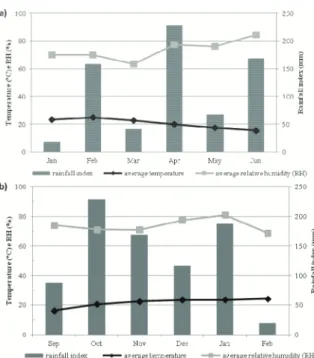
The weather conditions during cultivation from planting to harvest are shown in Figure 1 (a and b), and the weather conditions during storage are shown in Figure 2 (a and b).
Figure 1. Weather data (monthly average temperature in ºC, relative humidity in %, and rainfall index in mm) for the periods of cultivation of corn hybrids used in the storage experiment. (a) Winter season 2012 (planted on January 25, 2012, and harvested on June 28, 2012). (b) Summer season 2013/2014 (planted on September 17, 2012, and harvested on February 18, 2013).
Figure 2. Weather data (monthly average temperature in ºC, relative humidity in %, and rainfall index in mm) for the periods of storage of corn hybrids used in the storage experiment with cultivation: (a) Winter season. (b) Summer season.
Table 1. Moisture content (%)1 of corn kernels from both summer and winter seasons with different types of storage (CB: conventional
bags; HB: hermetic bags; MS: metallic silo; and CC: corncobs) during 12 months.
Storage system
Time (months) CB HB MS CC
Winter crop storage 2B688RR
0 12.41±0.15Bb 12.41±0.15Ab 12.41±0.15Ab 13.14±0.23Aa
3 12.14±0.21Ba
12.30±0.17Aa
11.83±0.46Aba
10.98±0.38Cb
6 12.35±0.17Ba 11.47±0.43Bb 11.38±0.13Bb 12.52±0.32Ba
9 12.80±0.22ABab
11.14±0.07Bc
12.32±0.24Ab
12.97±0.19Ba
12 13.36±0.34Ab 11.36±0.08Bd 12.45±0.29Ac 14.46±0.70Aa
CV(%) = 2.31 30K73Hx
0 11.57±0.12Db 11.57±0.12Ab 11.57±0.12Cb 13.48±0.19Aa
3 11.93±0.15CDa 11.90±0.13Aa 11.70±0.05BCa 11.25±0.09Cb
6 12.06±0.21Cb
11.73±0.07Abc
11.45±0.15Cc
12.58±0.40Ba
9 12.86±0.32Ba 10.90±0.17Bc 12.09±0.35ABb 12.56±0.10Ba
12 13.53±0.29Aa 11.58±0.12Ac 12.36±0.10Ab 13.45±0.19Aa
CV(%) =1.54 Summer crop storage
2B688RR
0 12.09±0.15Ba 12.09±0.15Aa 12.09±0.15Ba 11.35±0.25Ba
3 12.64±1.14ABa 11±0.08Bb 11.94±0.37Ba 11.71±0.18ABab
6 13.19±0.24Aa 11.12±0.28Bb 12.71±0.17ABa 12.64±0.40Aa
9 12.52±0.57ABab 11.03±0.23Bc 13.3±1.14Aa 11.69±0.12ABbc
12 11.82±0.12Bb
11.27±0.29ABb
13.65±0.54Aa
11.44±0.33Bb
CV(%) = 3.34 30K73Hx
0 10.95±0.12Da
10.95±0.12Aa
10.95±1.12Ba
10.50±0.19Db
3 11.42±0.05Cb 9.75±0.09Bd 10.59±0.18Cc 11.99±0.35Ba
6 12.79±0.19Aa 9.57±0.10Bc 11.24±0.33ABb 12.46±0.06Aa
9 11.92±0.02Ba 9.6±0.02 Bc 10.99±0.22Bb 11.02±0.07Cb
12 11.33±0.11Cab 9.69±0.01Bc 11.41±0.20Aa 11.03±0.15Cb
CV(%) =1.38%
1Mean value of three replications ± standard deviation, expressed in percentage and on a wet weight basis. Means followed by different letters, lowercase in the row and uppercase in
The corn hybrid 30K73Hx planted in winter (Table 1) had the highest percentage of moisture at the beginning and at the end of the storage when stored in corn ears, whereas in kernels stored in bags and silos moisture contents tended to increase with time. When stored in hermetic bags, kernels maintained moisture levels during storage, with the lowest moisture content among samples after three months. Costa, Faroni, Alencar, Carvalho and Ferreira (2010) also did not observe variation in corn kernel moisture content when stored in hermetic bags.
The corn hybrid 2B688RR planted in summer (Table 1) had statistically similar moisture contents when stored in bags and corncobs, with the highest levels from three to nine months (May 2013 to November 2013). In this period, the average relative humidity was 75.3%. According to Silva (2008), moisture content is a direct function of relative humidity, and when it exceeds 70%, moisture in the air increases the moisture in grains. Kernels stored in silos showed stability until three months, when the moisture content then increased. When kernels were stored in hermetic bags, a reduction in the moisture content occurred until three months, which then stabilized, possibly because kernels reached moisture equilibrium (Rupollo, Gutkoski, Marini, & Elias, 2004).
For the corn hybrid 30K73Hx stored in the summer (Table 1), the moisture content in the different types of storage was similar to that obtained with the hybrid 2B688RR. The highest moisture content level was recorded at six months with kernels stored in bags (12.8%), and kernels stored in silos had the highest content at twelve months, 11.4%, as did the kernels stored in bags, 11.3%. Silva (2008) considered moisture content the most important factor in the deterioration of grains during storage and recommended a range between 12 and 13% (wb) for corn stored for one year and a maximum of 11% for longer storage.
We observed after twelve months of storage (table 1) that corn stored in cobs and bags from both hybrids planted in winter, as well as from hybrid 2B688RR stored in silos in summer, had moisture contents above the limit (13%) recommended for safe storage (Mohale et al., 2013; Silva, 2008). Additionally, the kernels stored in hermetic bags, both in summer and winter seasons, regardless of the hybrid type, had the lowest moisture content at the end of the storage period.
We verified the presence of Aspergillus sp. in 22 of the 108 corn samples analyzed during winter storage, from which 18.5% were on hybrid
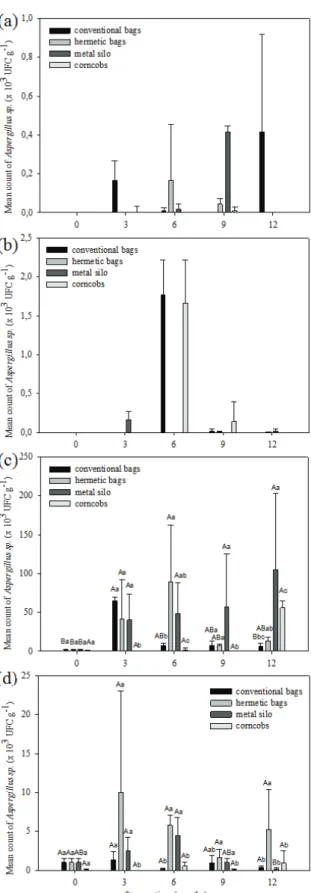
2B688RR corn and 22.2% were on hybrid 30K73Hx corn. However, the counts of Aspergillus sp. (Figure 3 a and b) did not differ among the treatments (p > 0.05, Kruskal-Wallis test) for both corn hybrids. Thus, neither the effect of the interaction between type of storage and storage period nor the effects of individual factors were significant.
We only observed Aspergillus sp. after three months in the winter storage (Figure 3 a and b), with a progressive increase until nine months with hybrid 2B688RR and until six months with hybrid 30K73Hx. This increase in the count of colonies at six months of storage (January 2012) in both hybrids might be attributed to weather conditions that were favorable for fungal development. As shown in Figure 2 (a), between four and seven months of storage (November 2012 to February 2013), the temperature exceeded 20.5ºC. According to Thompson and Henke (2000), temperatures above 21ºC are propitious to the germination of spores and to the mycelial growth of Aspergillus sp.
In the summer storage, we observed Aspergillus
sp. in 82 of the 108 samples (40 samples of hybrid 2B688RR and 42 samples of 30K73Hx). The counts of Aspergillus sp. were influenced (p < 0.05) by the interaction between type of storage and storage time in the summer storage.
The corn hybrid 2B688RR planted in summer and stored in corncobs did not show significant variation in the counts of Aspergillus sp. as a function of time (Figure 3 c), whereas kernels stored in silos showed a progressive increase and had the highest counts among treatments at the end of the experiment. We also observed an increase in the counts of Aspergillus sp. during the storage period for the kernels stored in conventional bags and hermetic bags, with respective peaks at three and six months, followed by stability in counts. After three months, the corn stored in corncobs differed from the others, with the lowest counts of Aspergillus sp.
For the corn hybrid 2B688RR stored in conventional and hermetic bags, as well as in corncobs in summer (Figure 3 d), there was no significant variation (p < 0.05) in the counts of
Aspergillus sp. during storage. The kernels stored in
silos showed an increase until the sixth month, which was followed by a reduction. After three months of storage in cobs for this corn hybrid, the treatment had one of the lowest incidences of
Aspergillus sp. At the end of the storage period, the
Figure 3. Means of counts of colonies of Aspergillus sp. (× 103
CFU g-1) in corn hybrids (a) 2B688RR and (b) 30K73Hx during
12 months in winter storage and in hybrids (c) 2B688RR and (d) 30K73Hx during summer storage. Different letters, lowercase for storage types and uppercase for storage times, indicate significant differences from each other by the Tukey test at 5% probability.
The increase in the incidence of Aspergillus sp. in the kernels of both hybrids from the beginning of storage to the sixth month when stored in bags and in silos during summer storage (Figures 3 c and d) might be attributed to the high relative humidity, with monthly averages that ranged from 73.4 to 88.4%, as shown in Figure 2 (b). According to Arrus, Blank, Abramson, Clear and Holley (2005), the incidence of Aspergillus sp. increases with increases in relative humidity and temperature.
The higher occurrence of Aspergillus sp. in the summer storage was attributed to weather conditions that were more favorable for the development of fungi during the harvest period (Figures 1 a and b). Hirooka et al. (2007) related fungi development during storage to spore loads in grain mass from cultivation. The average relative humidity recorded during the harvest of corn used in winter storage was over 80%, whereas relative humidity of approximately 70% was recorded for the harvest of the corn used in the summer storage. The average temperatures were 15.2 and 23°C for winter and summer storage, respectively. According to Thompson and Henke (2000), A. flavus and A.
parasiticus can grow and produce aflatoxins in
temperatures above 21°C. Additionally, Arrus et al. (2005) verified an increase of Aspergillus sp. with a relative humidity of 70%.
In addition to climate, other factors such as the place where these hybrids were cultivated might have contributed to a higher count of Aspergillus sp. in the summer storage. Although the corn hybrids used in both experiments were cultivated in the microregion of Dois Vizinhos, the cultivation sites were different. Ramos, Brasil and Geraldine (2008) also found differences in the incidence of Aspergillus
sp. from different cultivation sites. Aspergillus sp. was found in 100% of the samples from Jataí-Go, in 41.7% of the samples from Goiânia-Go and in one sample from Montividiu-Go. Hirooka et al. (2007) further highlighted the influence of management practices, sowing time and density, water stress, high rainfall indices, invasive plant infestation, crop rotation, soil fertility, microbiota of soil and surrounding vegetation and period between physiological maturity and harvest on the prevalence of Aspergillus sp.
The Fusarium fungus in the corn from winter
A reduction in the incidence of this fungus was verified for both corn hybrids after the sixth month of storage (Figures 4 a and b). This reduction was expected as this type of fungus is a field fungus, and the proliferation demands grains with high moisture content and environments with high relative humidity (Moreno et al., 2009). When Santin, Gutokoski, Eichelberger, Portella and Durigon (2009) assessed the microbiological quality of corn kernels stored in steel mesh silos, the incidence of the Fusarium fungi decreased after harvest and during storage, with loss of inoculum viability at 112 days from harvest.
Moreover, the decrease in the incidence of
Fusarium sp. during storage might be associated with
competition between species. At 6 months, the corn hybrid 30K73Hx showed a high incidence of
Aspergillus sp. (Figure 3 b), whereas the corn hybrid
2B688RR had this level of incidence between the sixth and ninth month of storage (Figure 3 a). Competition between species in appropriate environmental conditions favors the development of some species and inhibits others. Rocha et al. (2009) observed a negative correlation (r = -0.61) between the growth of Fusarium sp. and the growth of
Aspergillus sp. in which the growth of one fungus
varied inversely with the growth of the other. During summer storage, Fusarium sp. was detected in 99 of the 108 corn samples analyzed, with 92.6% of the samples of hybrid 2B688RR and 90.7% of the samples of hybrid 30K73Hx with Fusarium sp. A significant influence (p < 0.05) was detected for the interaction between storage type and storage time on
the Fusarium sp. counts (Figure 4 c and d). The
Fusarium sp. count was low in the corn hybrid
2B688RR (Figure 4 c) stored in corncobs for the first 6 months, with a significant increase from the third to the ninth month, followed by a decrease. For the samples stored in bags and silos, an increase occurred only up to the third month, followed by a progressive reduction in counts during storage. For the hermetic bags, counts oscillated, with a decrease in the count at the end of storage. The peaks of colony counts occurred at three months for conventional bags and silos, at six months for hermetic bags and at nine months for corncobs.
The counts of Fusarium sp. in the kernels of corn hybrid 30K73Hx in the summer storage (Figure 4 d) were similar to those of the kernels of corn hybrid 2B688RR stored in cobs and hermetic bags (Figure 4 c). However, a reduction in Fusarium
sp. counts only occurred during storage in conventional bags and silos.
Figure 4. Means of the colony counts of Fusarium sp. assessed in
corn hybrids (a) 2B688RR (× 104
CFU g-1
) and (b) 30K73Hx
(× 103 CFU g-1) in summer storage, and in corn hybrids
(c) 2B688RR (× 104 CFU g-1) and (d) 30K73Hx (× 104 CFU g-1)
In the winter storage, the counts of Fusarium
sp. were only influenced by time, with reductions after the sixth month in both corn hybrids. The same effect of time occurred in the kernels of hybrid 30K73Hx stored in bags and silos from the beginning of the summer storage. Corn stored on corncobs had the lowest Fusarium sp. incidence.
The limits of detection for aflatoxins were 1.0 μg kg-1 for B
2 and 0.50 μg kg-1 for B1, G1 and G2.
The recovery rates for aflatoxins B1, B2, G1 and G2
from contaminated samples were 70.4, 97.7, 74.5 and 71.4%, respectively.
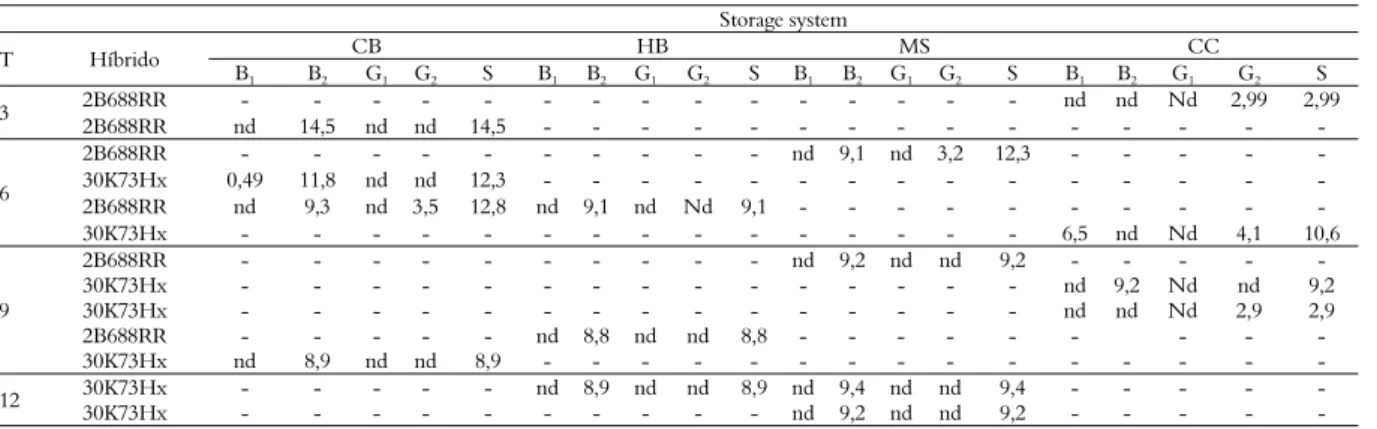
Of the 22 corn samples in winter storage with
Aspergillus, aflatoxins (B1+B2+G1+G2) were
detected in 15 samples, with levels ranging from 2.8 to 14.5 μg kg-1 (table 2), from which 8 samples were
hybrid 30K73Hx and 7 samples were hybrid 2B688RR. Aflatoxin B2 was the most common and
was detected in 12 samples, followed by G2 and B1,
which were detected in 5 and 2 samples, respectively. Dilkin, Mallman, Santurio and Hickmann (2000) stated that the toxicity of the group decreased in the order B1 > G1 > B2 > G2,
with toxicity proportions of 50, 20 and 10% in relation to B1, respectively. The contamination levels
did not compromise the use of these grains as food in Brazil. First, the contamination levels (B1+B2+G1+G2) were less than 20 μg kg-1, which is
the maximum limit permitted by The National Health Surveillance Agency (Agência Nacional de Vigilância Sanitária [Anvisa], 2011). Second, compound (B1) with the highest virulence also had
the lowest incidence, with only 13.3% of the samples contaminated.
Table 2 shows that 20% of aflatoxin contamination occurred in corn stored in hermetic bags, with 26.7% in each of the other storage types. Additionally, 66.6% of these occurrences (10 samples) were recorded between the sixth and ninth months of storage, which coincided with the period of highest average air temperature and of relative humidity over 70%. The values were 19.2°C and 69.3%, 23.7°C and 73.1%, 21.4°C and 77.3%, and 16.2°C and 81.9% for the periods 0–3 months, 3–6 months, 6–9 months and 9–12 months, respectively (Figure 2 (a)). However, the occurrence of aflatoxins (B1+B2+G1+G2) in corn samples in the
summer storage was neither influenced by the interaction between type of storage and storage time nor by these factors individually (p > 0.05, Kruskal-Wallis test).
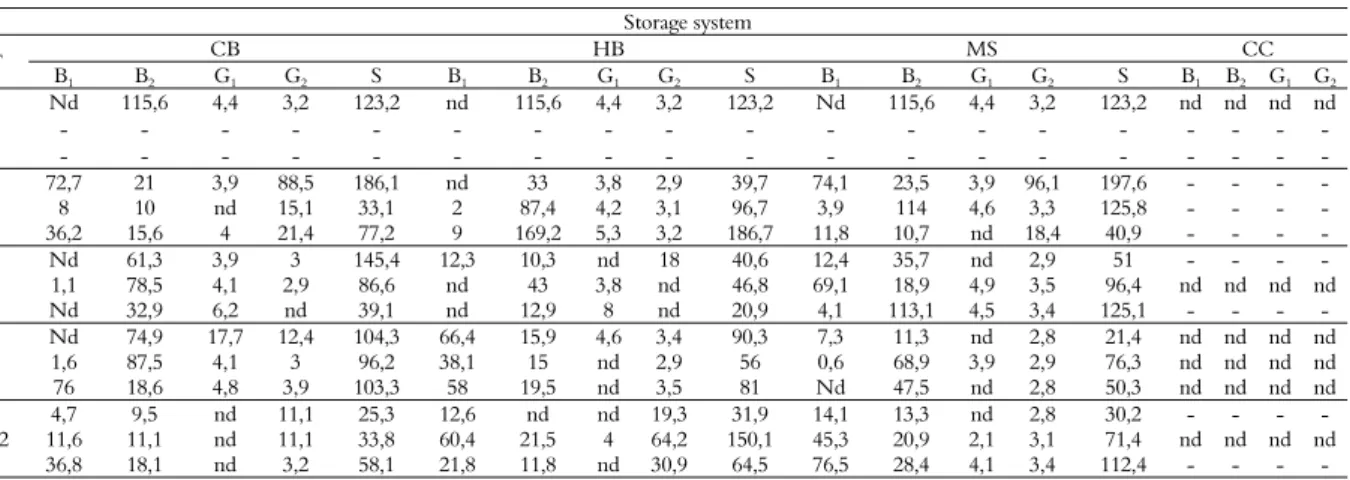
From the 82 corn samples of the summer storage that contained Aspergillus, we detected the presence of aflatoxins (B1+B2+G1+G2) in 70
samples, with levels ranging from 3 to 197.5 μg kg-1, of which 37 samples were hybrid
2B688RR corn (Table 3) and 33 samples were hybrid 30K73Hx corn (Table 4). Although the presence of Aspergillus sp. was verified from the harvest in kernel samples as well as in corncobs, the aflatoxin contamination was detected after the drying of the kernel samples. Marques et al. (2009), in a study on aflatoxin contamination of corn kernels in the field, found that weather conditions at harvest might favor the development of aflatoxins and also that the density of plants can create a microclimate adequate for the development of Aspergillus.
Table 2. Occurrence of aflatoxins B1, B2, G1 and G2 (μg kg-1) in the samples of corn hybrids 2B688RR and 30K73HX that contained
Aspergillus sp. during winter storage with different storage systems (CB: conventional bags; HB: hermetic bags; MS: metal silo; and CC: corncobs).
Storage system
T Híbrido CB HB MS CC
B1 B2 G1 G2 S B1 B2 G1 G2 S B1 B2 G1 G2 S B1 B2 G1 G2 S
3 2B688RR - - - - - - - - - - - - - nd nd Nd 2,99 2,99
2B688RR nd 14,5 nd nd 14,5 - - - - - - - - - - -
6
2B688RR - - - nd 9,1 nd 3,2 12,3 - - -
30K73Hx 0,49 11,8 nd nd 12,3 - - - - - - - - - - -
2B688RR nd 9,3 nd 3,5 12,8 nd 9,1 nd Nd 9,1 - - - - - - -
30K73Hx - - - - - - - - - - - - - 6,5 nd Nd 4,1 10,6
9
2B688RR - - - nd 9,2 nd nd 9,2 - - -
30K73Hx - - - - - - - - - - - - - nd 9,2 Nd nd 9,2
30K73Hx - - - - - - - - - - - - - nd nd Nd 2,9 2,9
2B688RR - - - - - nd 8,8 nd nd 8,8 - - - - - - - - -
30K73Hx nd 8,9 nd nd 8,9 - - - - - - - - - - -
12 30K73Hx - - - nd 8,9 nd nd 8,9 nd 9,4 nd nd 9,4 - - - - -
30K73Hx - - - nd 9,2 nd nd 9,2 - - -
T: time (months) of sampling; S: sum of aflatoxins (B1+B2+G1+G2) in μg kg-1; -: samples not analyzed because of the absence of Aspergillus sp.; nd: presence of toxins B1, B2, G1 or G2
Table 3. Occurrence of aflatoxins B1, B2, G1 and G2 (μg kg-1) in samples of corn hybrid 2B688RR during summer storage with different
storage systems (CB: conventional bags; HB: hermetic bags; MS: metal silo; and CC: corncobs).
Storage system
T CB HB MS CC
B1 B2 G1 G2 S B1 B2 G1 G2 S B1 B2 G1 G2 S B1 B2 G1 G2
0
Nd 115,6 4,4 3,2 123,2 nd 115,6 4,4 3,2 123,2 Nd 115,6 4,4 3,2 123,2 nd nd nd nd
- - -
- - -
3
72,7 21 3,9 88,5 186,1 nd 33 3,8 2,9 39,7 74,1 23,5 3,9 96,1 197,6 - - - -
8 10 nd 15,1 33,1 2 87,4 4,2 3,1 96,7 3,9 114 4,6 3,3 125,8 - - - -
36,2 15,6 4 21,4 77,2 9 169,2 5,3 3,2 186,7 11,8 10,7 nd 18,4 40,9 - - - -
6
Nd 61,3 3,9 3 145,4 12,3 10,3 nd 18 40,6 12,4 35,7 nd 2,9 51 - - - -
1,1 78,5 4,1 2,9 86,6 nd 43 3,8 nd 46,8 69,1 18,9 4,9 3,5 96,4 nd nd nd nd
Nd 32,9 6,2 nd 39,1 nd 12,9 8 nd 20,9 4,1 113,1 4,5 3,4 125,1 - - - -
9
Nd 74,9 17,7 12,4 104,3 66,4 15,9 4,6 3,4 90,3 7,3 11,3 nd 2,8 21,4 nd nd nd nd
1,6 87,5 4,1 3 96,2 38,1 15 nd 2,9 56 0,6 68,9 3,9 2,9 76,3 nd nd nd nd
76 18,6 4,8 3,9 103,3 58 19,5 nd 3,5 81 Nd 47,5 nd 2,8 50,3 nd nd nd nd
12
4,7 9,5 nd 11,1 25,3 12,6 nd nd 19,3 31,9 14,1 13,3 nd 2,8 30,2 - - - -
11,6 11,1 nd 11,1 33,8 60,4 21,5 4 64,2 150,1 45,3 20,9 2,1 3,1 71,4 nd nd nd nd
36,8 18,1 nd 3,2 58,1 21,8 11,8 nd 30,9 64,5 76,5 28,4 4,1 3,4 112,4 - - - -
T: time (months) of sampling; S: sum of aflatoxins (B1+B2+G1+G2) in μg kg-1; -: samples not analyzed because of the absence of Aspergillus sp.; nd: presence of toxins B1, B2, G1 or G2
not detected.
Table 4. Occurrence of aflatoxins B1, B2, G1 and G2 (μg kg-1) in samples of corn hybrid 30K73Hx during summer storage with different
storage systems (CB: conventional bags; HB: hermetic bags; MS: metal silo; and CC: corncobs).
Storage system
T CB HB MS CC
B1 B2 G1 G2 S B1 B2 G1 G2 S B1 B2 G1 G2 S B1 B2 G1 G2
0
nd nd nd 3,24 3,24 nd nd nd 3,24 3,24 nd nd nd 3,24 3,24 nd nd nd nd
- - -
- - -
3
- - - nd 13,3 nd nd 13,3 nd 29,3 nd nd 29,3 - - - -
nd 14,7 nd 5,7 20,4 nd nd nd 5,5 5,5 nd 10,3 nd nd 10,3 - - - -
nd 18 nd nd 18,0 nd 13,5 nd nd 13,5 nd 9,3 nd 7 16,3 - - - -
6
nd 9,3 nd nd 9,3 nd nd nd 3,75 3,75 nd nd nd 4,5 4,5 nd nd nd nd
nd 11,9 nd 3,9 15,8 nd 9 nd 6,3 15,3 nd nd nd 6 6 nd nd nd nd
nd 14,3 nd nd 14,3 2,9 15,1 nd nd 18,0 nd 15,2 4,1 6,7 26 - - - -
9
nd nd nd 4,4 4,4 nd 11,3 11,6 nd 22,9 nd nd nd 5,7 5,7 - - - -
- - - - - nd 15,6 nd nd 15,6 nd nd nd 4,9 4,9 nd nd nd nd
nd nd nd 3,2 3,2 nd 14,9 nd nd 14,9 16,1 13,1 nd 22,4 51,6 - - - -
12
nd nd nd 3,0 3,0 nd nd nd 4,2 4,2 nd nd nd 4,9 4,9 nd nd nd nd
- - - - - nd nd nd 3,9 3,9 nd nd nd 3,2 3,2 nd nd nd nd
nd nd nd 3,1 3,1 - - - nd nd nd 4,4 4,4 nd nd nd nd
T: time (months) of sampling; S: sum of aflatoxins (B1+B2+G1+G2) in μg kg
-1; -: samples not analyzed because of the absence of Aspergillus sp.; nd: presence of toxins B
1, B2, G1 or G2
not detected.
Among the samples of corn hybrid 2B688RR contaminated by aflatoxins (table 3), 91.9% (34) contained toxin B2, 86.5% (32) contained toxin G2,
73% (27) contained toxin B1, and 56.8% (21)
contained toxin G1. Whereas for corn hybrid
30K73Hx (table 4), 66.7% (22) contained toxin G2,
51.5% (17) contained toxin B2, 6.1% (2) contained
toxin B1, and 6.1% (2) contained toxin G1.
All samples of corn hybrid 2B688RR that contained aflatoxins (Table 3) presented sums of B1+B2+G1+G2 that were above the maximum limit
agreed on and standardized for corn kernels by The National Health Surveillance Agency (20 μg kg-1),
with average contamination of 76.1 μg kg-1 in which
the minimum amount was 20.9 μg kg-1 and the
maximum amount was 197.5 μg kg-1. For corn
hybrid 30K73Hx (Table 4), only 12.1% (4) of samples contaminated by aflatoxins were above the limit, with average contamination of 11.9 μg kg-1,
and with a minimum amount of 3.0 μg kg-1 and a
maximum amount of 51.6 μg kg-1.
With a Kruskal-Wallis test, a significant difference (p < 0.05) was verified for the occurrence of aflatoxins (B1+B2+G1+G2) in the corn hybrids,
but only according to the storage system. Factors such as the interaction between time and storage systems and time (individually) were not significant. The corncob storage differed from the other storage systems with both corn hybrids, as no detection of aflatoxins was found in the corn subjected to this system in any of the periods assessed. The values of occurrence of aflatoxins (B1+B2+G1+G2) in kernels
from corn hybrid 2B688RR stored in conventional bags, hermetic bags and silos were 85.4, 85 and 91.2 μg kg-1, respectively. For corn hybrid 30K73Hx,
the equivalent values were 6.8, 9.4 and 11.8 μg kg-1.
high occurrence of Aspergillus sp. and aflatoxins in the corn samples in this study contradicted the hypothesis presented in previous research (Hirooka et al., 2007; Mohale et al., 2013; Rocha et al., 2009). The hypothesis stated that the elevated incidence of
Fusarium sp. might reduce the occurrence of
Aspergillus sp. and aflatoxin production. According to Abbas, Cartwright, Xie and Shier (2006), the high incidence of Fusarium sp. in corn kernels does not protect them from aflatoxin development.
The high occurrence of aflatoxins and the elevated levels of contamination in the summer storage were associated with the agent Aspergillus sp., and from harvest, climatic conditions were favorable for fungal development and aflatoxin production during this experiment (Figure 2 a and b). Because this storage experiment (summer storage) started in summer (February 2003), with an average temperature of 23°C, the germination and proliferation of the spores of Aspergillus sp. found in kernels from harvest were likely with the immediate production of aflatoxins, which was confirmed after drying.
Bento et al. (2012) also found different aflatoxin contamination levels in corn samples stored during the 2009 and 2010 seasons. In the first harvest, 19% of the samples were contaminated, and all samples had a B1+B2+G1+G2 sum less than 20 μg kg-1. In
the following harvest, 23% of the samples contained aflatoxins, from which 60% showed levels that exceeded the maximum limit established by The National Health Surveillance Agency, with the highest level detected of 108.7 μg kg-1.
Moreover, Marques et al. (2009) verified differences in the incidence of Aspergillus sp. and the occurrence of aflatoxins in crops cultivated in Astorga, north of Paraná. They found low incidence of Aspergillus sp. and did not detect aflatoxins in the samples from the second harvest (autumn/winter) regardless of the humidity at harvest, which was inverse to what occurred with samples from the summer season of 2007/2008, in which those authors found high incidence of Aspergillus sp. and presence of aflatoxins at harvest.
Conclusion
Corn kernels stored in hermetic bags had the lowest moisture content during summer and winter storages.
No influence of storage system or period was observed for Aspergillus sp. and aflatoxins in the winter crop samples. Corncobs in summer storage had the lowest counts of Aspergillus sp. and absence of aflatoxins.
None of winter storage samples had contamination (B1+B2+G1+G2) above the limit
standardized by Brazilian legislation, whereas 41 samples stored in summer were above the limit.
Differences in weather, cultivation, and storage period might have caused some of the disparity in
Aspergillus sp. incidence and aflatoxin contamination
in both experiments.
References
Abbas, H. K., Cartwright, R. D., Xie, W., & Shier, W. T. (2005). Aflatoxin and fumonisin contamination of corn (maize, Zea mays) hybrids in Arkansas. Journal of Crop Protection, 25(1), 1-9.
Anvisa-Agência Nacional de Vigilância Sanitária. (2011). Resolução - RDC n.° 7, de 18 de fevereiro de 2011.
Diário Oficial da União. Brasilía, DF: Anvisa. Recuperado de http://www.abitrigo.com.br/
pdf_legislacao/RESOLUCAO-RDC_N_7_DE_18-02-2011-09.03.201_%20p66_%20e_67.pdf
Arrus, K., Blank, G., Abramson, D., Clear, R., & Holley, R. A. (2005). Aflatoxin production by Aspergillusflavus
in Brazil nuts. Journal of Stored Products Research, 41(5), 513-527.
Bento, L. F., Caneppele, M. A. B., Albuquerque, M. C. F., Kobayasti, L., Caneppele, C., & Andrade, P. J. (2012). Ocorrência de fungos e aflatoxinas em grãos de milho.
Instituto Adolfo Lutz, 71(1), 44-49.
Mapa-Ministério da Agricultura, Pecuária e Abastecimento. (2009). Regras para análise de sementes. Brasília, DF: Mapa/ACS.
Conab-Companhia Nacional de Abastecimento. (2014).
Acompanhamento da safra brasileira de grãos – 2014.
Recuperado de http://www. conab.gov.br/OlalaCMS/uploads/arquivos/13_12_10_1
6_06_56_boletim_portugues_dezembro_2013.pdf Costa, A. R., Faroni, L. R., Alencar, E. R., Carvalho, M. C.
S., & Ferreira, L. G. (2010) Qualidade de grãos armazenados em silos bolsa.Ciência Agronômica, 41(2), 200-207.
Dilkin, P., Mallman, C. A., Santurio, J. M., & Hickmann, J. L. (2000). Classificação macroscópica, identificação da microbiota fúngica e produção de aflatoxinas em híbridos de milho. Ciência Rural, 30(1), 137-141. Hirooka, E. Y., Ono, E. Y. S., Itano, E. N., Homechin, M.,
Kawamura, O., Garcia, G. T., Fungaro, M. H. (2007). Micotoxinas em grãos armazenados: Monitoramento e controle pós-colheita. Tropical Plant Pathology, 32(1), 34-36.
Leal, M. A. A., & Penteado, A. F. (1994). Eficiência dos métodos não-paramétricos sobre a capacidade de nodulação em leguminosas. Pesquisa Agropecuária Brasileira, 29(2), 177-182.
em função da umidade de colheita. Acta Scientiarum Agronomy, 31(4), 667-675.
Mohale, S., Medina, A., Rodriguez, A., Sulyok, M., & Magan, N. (2013). Mycotoxigenic fungi and mycotoxins associated with stored maize from different regions of Lesotho. Mycotoxin Research, 29(4), 209-219.
Moreno, E. C., Garcia. G. T., Ono, M. A., Vizoni, É., Kawamura, O., Hirooka, E. Y., & Ono, E. Y. S. (2009). Co-occurrence of mycotoxins in corn samples from the northern region of Paraná State, Brazil. Food Chemistry, 116(1), 220-229.
Ramos, C. R. B. A., Brasil, E. M., & Geraldine, R. M. (2008). Contaminação por aflatoxinas em híbridos de milho cultivados em três regiões do Estado de Goiás.
Pesquisa Agropecuária Tropical, 38(2), 95-102.
Rocha, L. O., Nakai, V. K., Braghini, R., Reis, T. A., Kobashigawa, E., & Correa, B. (2009). Mycoflora and co-ocurrence of fumonisins and aflatoxins in freshly harvested corn in different regions of Brazil. International Journal of Molecular Sciences, 10(11), 5090-5103.
Rupollo, G., Gutkoski, L. C., Marini, L. J., & Elias, M. C. (2004). Sistemas de armazenamentos hermético e convencional na conservabilidade de grãos de aveia.
Ciência Rural, 34(6), 1715-1722.
Santin, J. A., Gutokoski, L. C., Eichelberger, L., Portella, J. A., & Durigon, A. (2009). Qualidade microbiológica de grãos de milho armazenados em silos de alambrado e secados com ar natural forçado. Revista Brasileira de Milho e Sorgo, 8(2), 131-144.
Santos, S. B., Martins, M. A., Faroni, L. R., & Brito Junior, V. R. (2012). Perda de matéria seca em grãos de milho armazenados em bolsas herméticas. Ciência Agronômica, 43(4), 674-682.
Silva, J. S. (2008). Secagem e armazenagem de produtos agrícolas. Viçosa, MG: Aprenda Fácil.
Silva, N., Junqueira, V. C. A., & Silveira, N. F. A. (2010).
Manual de métodos de análise microbiológica de alimentos (4a ed.). São Paulo, SP: Varela.
Singh, K., Frisvad, J. C., Thrane, U., & Mathur; S. B. (1991). An illustrated manual on identificationof some seed-born Aspergilli, Fusaria, Penicillia and their mycotoxins. Hellerup, GT: Danish Government Institute of Seed Pathology for Developing Countries.
Thompson, C., & Henke, S. E. (2000). Effect of climate and typ of storage container on aflatoxin production in corn and its associated risks to wildlife species. Journal of Wildlife Diseases, 36(1), 172-179.
Virgilito, S. B. (2006). Estatística Aplicada (3a ed.). São Paulo, SP: Edicon.
Received on November 8, 2014. Accepted on January 9, 2015.
License information: This is an open-access article distributed under the terms of the Creative Commons Attribution License, which permits unrestricted use, distribution, and reproduction in any medium, provided the original work is properly cited.