Genome-wide characterization of the NRAMP gene family in
Phaseolus
vulgaris
provides insights into functional implications during common bean
development
Juliane Karine Ishida
1, Danielle G. G. Caldas
1, Lucas Roberto Oliveira
1, Gabriela Campos Frederici
1, Lucas
Margato Pereira Leite
1and Tsai Siu Mui
11
Centro de Energia Nuclear na Agricultura, Universidade de São Paulo (CENA-USP), Piracicaba, SP,
Brazil.
Abstract
Transporter proteins play an essential role in the uptake, trafficking and storage of metals in plant tissues. The Natu-ral Resistance-Associated Macrophage Protein (NRAMP) family plays an essential role in divalent metal transport.
We conducted bioinformatics approaches to identify sevenNRAMP genes in the Phaseolus vulgaris genome,
inves-tigated their phylogenetic relation, and performed transmembrane domain and gene/protein structure analyses. We
found that theNRAMP gene family forms two distinct groups. One group included the PvNRAMP1, -6, and -7 genes
that share a fragmented structure with a numerous exon/intron organization and encode proteins with mitochondrial or plastidial localization. The other group is characterized by few exons that encode cytoplasmic proteins. In addition,
our data indicated thatPvNRAMP6 and -7 may be involved in mineral uptake and mobilization in nodule tissues,
while the genesPvNRAMP1, -2, -3, -4 and -5 are potentially recruited during plant development. This data provided a
more comprehensive understanding of the role of NRAMP transporters in metal homeostasis inP. vulgaris.
Keywords:Phaseolus vulgaris, transporter, NRAMP, gene family, phylogenetic analysis.
Received: September 05, 2017; Accepted: February 20, 2018.
Introduction
The common bean (Phaseolus vulgarisL.) is one of the most consumed crops worldwide (www.fao.org/faostat). It is rich in protein, carbohydrates, and minerals (Geptset al., 2008) and its frequent consump-tion may prevent illnesses like cardiovascular diseases (Bouchenak and Lamri-Senhadji, 2013), colon cancer (Bennink, 2002), and diabetes (Geil and Anderson, 1994). In the developing world, bean is a main source of nutrition. For example, in sub-Saharan Africa, one of the most critical areas for food security, beans represent 15% of the calories and 36% of the proteins in dairy supplies (www.fao.org/faostat). In Latin America, the per capita beans consumption is around 16 kg/year (Broughtonet al., 2003). The nutritional benefits of consuming beans require a deeper understanding of the molecular mechanisms in-volved in nutrient accumulation and mobilization in plant tissues, especially in the seeds.
The identification of a specific set of transporters that provides the fine balance of metal concentration across the cellular membrane is essential to understanding the
physio-logical function of these elements in plant development (Dordas, 2008). One relevant transporter family is NRAMP (Natural Resistance-Associated Macrophage Protein). NRAMP genes encode integral membrane proteins respon-sible for the transport of divalent metals across the cellular membrane. The NRAMP family is highly conserved from bacteria to mammals, showing a preserved consensus motif and 10–12 transmembrane domains (Cellieret al., 1995). The emergence of NRAMPs occurs parallel to the increase in atmospheric oxygen content (Cellieret al., 2001), and it may have evolved from the LeuT superfamily cation-driven transporter (Cellier 2012) in a putative anaerobic prokaryote ancestor, probably close to the Chlorobium
group (Cellieret al., 2001). In prokaryotes, the biological function of NRAMP is associated with defense and nutri-tion (Nevo and Nelson, 2006), while in animals the primary function of NRAMP lies in the maintenance of iron homeo-stasis (Gunshinet al., 2001; Iolascon and De Falco, 2009; Shawki et al., 2012; Victoria et al., 2012). The plant NRAMP family is responsible for keeping the right balance of divalent ions (Fe2+, Mn2+, Cu2+, and Zn2+) (Sebastien and Schroeder, 2004; Victoriaet al., 2012) and the trivalent (Al3+) ion (Xiaet al., 2010) across the plasma and vascular membranes. Phylogenetic data revealed the existence of two NRAMP subgroups (Sebastien and Schroeder 2004): one obtained from a bacterial genome during the
endosym-DOI: http://dx.doi.org/10.1590/1678-4685-GMB-2017-0272
Send correspondence to Juliane Karine Ishida. Laboratório de Biologia Celular e Molecular, CENA-USP, Av. Centenário 303, 13416-000 Piracicaba, SP, Brazil. E-mail: [email protected]
biotic process that originated double-membrane organelles; and another group that shares high amino acid identity/sim-ilarity with proteins found in the animal genome, raising the hypothesis of multiple origins of the NRAMP family (Sebastien and Schroeder, 2004).
There are six NRAMP genes inArabidopsis (Tho-mineet al., 2000). Mutants missing the vacuole membrane proteins AtNRAMP3 and -4 show a reduction in germina-tion rate under iron deficient condigermina-tions (Lanquar et al., 2005) and an impairment in photosynthesis capacity if manganese is limited (Lanquaret al., 2010). Additionally, AtNRAMP1 is a key transporter for iron homeostasis (Cu-rie et al., 2000). Rice contains seven members of the NRAMP family (Belouchiet al., 1997). OsNRAMP1 trans-locates the beneficial Fe2+and also the toxic arsenic (As3+) and cadmium (Cd2+) in rice (Takahashiet al., 2011; Tiwari
et al., 2014). The transporters OsNRAMP4 and OsNRAMP5 play a role in the intracellular mobilization of Al3+ (Xia et al., 2010) and Mn2+/ Cd2+ (Ishimaru et al., 2012), whereas OsNRAMP3 is present in conducting vas-cular cells and responsible for allocating Mn2+from source to sink tissues. Apparently, OsNRAMP3 does not act in Fe2+ translocation (Yamaji et al., 2013). Similarly, the HvNRAMP5 in barley enables the uptake of Mn2+and the toxic Cd2+, but not of Fe2+(Wuet al., 2016). In the hyper ac-cumulating species Thlaspi caerulescens and Thlaspi japonicum,the NRAMP protein is responsible for mobiliz-ing the heavy metals Cd2+and Ni2+in plant tissues (Mizuno
et al., 2005; Oomenet al., 2009).
A synapomorphic trait of Fabaceae is the symbiotic association with nitrogen-fixing bacteria at specialized root organs, the nodules (Gage, 2004). There are two types of nodules in leguminous plants with different developmental strategies. The determinate type found inP. vulgarisand soybean(Glycine max)roots is characterized by a spherical shape due to the reduction of activity in meristematic tis-sues shortly after nodule initiation (Gage, 2004). The inde-terminate nodules present in roots ofMedicago truncatula
and peas have a typically elongated shape. The meris-tematic region is continuously producing new cells along the active period of the nodule, generating different zones related to the developmental stage of symbiotic bacterial cells (bacterioid) (Joneset al., 2007). In Zone I, the meris-tem actively forms new nodule tissues. In Zones II and III occur the infection and nitrogen fixation, and in Zone IV (closer to the root) the bacteroid starts to degenerate (Jones
et al., 2007). A better comprehension of nodule formation may provide insights towards employing bacteria to in-crease the availability of nitrogen in the soil, hence reduc-ing the need for fertilizers. Iron is a required micronutrient for establishing symbiosis with nitrogen-fixing bacteria, since it is a cofactor of the enzyme nitrogenase recruited for atmospheric nitrogen uptake (Brear et al., 2013). In M. truncatula, the protein MtNRAMP1 presented high expres-sion in the nodule region, acting as an iron transporter across the plasma membrane during nodulation
(Tejada-Jiménez et al., 2015). In G. max, a NRAMP member (GmDMT1) located in the symbiosome membrane is re-sponsible for the iron absorption in rhizobia-symbiotic tis-sues (Kaiseret al., 2003). Thus, the NRAMP transporters are apparently of relevance in the import of nutrients for nodule formation, regardless of whether they are of a deter-minate or indeterdeter-minate type.
The availability of a fully sequenced genome for common bean provides opportunities to characterize gene transporter families and to identify their potential roles in uptake, allocation and storage of soil minerals in plant tis-sue. A better understanding of dynamics metal ions is an important step to improve crop breeding. So far, informa-tion on the major proteins involved in the transport of met-als in common bean remains incipient. Here we identified and characterized seven homologs of NRAMP transporters inP. vulgaris. The gene structure, chromosomal distribu-tion, phylogenetic tree, and the expression of NRAMP homologs were investigated using bioinformatics ap-proaches. The results obtained contribute to comprehend the biological role of the players involved in metal homeo-stasis duringP. vulgarisdevelopment.
Material and Methods
Identification and annotation of NRAMP genes inP. vulgarisgenome
The keyword NRAMP was used to search the Phy-tozome database (http://www.phyPhy-tozome.net) in the Ara-bidopsis thalianagenome (TAIR10). AtNRAMP sequen-ces were identified and used as query to identify their protein homologs in theP. vulgarisgenome (G19833). All sequences with a similarity score above 50% were consid-ered. To search forP. vulgarisNRAMP genes we used the web tool TMHMM server (http://cbs.dtu.dk)(Kroghet al., 2001) to predict transmembrane domains in putative pro-tein sequences and the TargetP 1.1 Server (Emanuelssonet al., 2007) for the prediction of subcellular localization. The general information of NRAMP genes, including the ge-nomic, cDNA, and coding sequences, protein length, etc., were extracted from the Phytozome website (www.phytozome.jgi.doe.g.,ov). The exon/intron organi-zation was accessed using the online tool GSDS 2.0 (http://gsds.cbi.pku.edu.cn) (Huet al., 2015), and the simi-larities among exons were compared using the BLASTN algorithm (Altschul 1997). The Ka/Ks ratio was calculated using the option Compute Pairwise Distances in MEGA7 software (Kumaret al., 2016); the analysis was conducted using the Nei-Gojobori Method with all the positions con-taining gaps and missing values eliminated.
Chromosome distribution, syntenic and regulatory elements analysis of common bean NRAMP genes
(www.geneious.com). All figures were edited using the Adobe Illustrator package. Thecis-elements of promoter sequences and IRE motifs were identified by PlantCARE (Lescotet al., 2002) and SIRE programs (Campilloset al., 2010), respectively, under default parameters.
Model structure and phylogenetic tree construction of NRAMPs
The putative protein sequences were aligned using the CLUSTALW (Thompsonet al., 2002) algorithm with default settings, and the phylogenetic trees were generated using MEGA7 software (Kumaret al., 2016) with the Max-imum Likelihood statistical method set to a 10,000 boot-strap value. Protein structures of NRAMPs were predicted using the Swiss-model software based on data of the Staph-ylococcus capitisdivalent ion transporter (DMT) complex with manganese (ID: 4wgw.1). Putative models were visu-alized and edited using the Ras Top Molecular Visualiza-tion Software (www.geneinfinity.org/rastop).
RNA-Seq analysis of NRAMP genes
The gene expression atlas data was obtained from the website www.plantgrn.noble.org/PvGEA. The expression levels were obtained from the Phytozome website, and RNA-Seq data ofP. vulgarisembryo were retrieved from public database under the code GSE57535. To download the large dataset in Phytozome a login and password were created for access to the JG1 genome portal, and the latest version of theP. vulgaristranscriptome was downloaded for analysis (P. vulgaris_442_ver2.1). Heatmaps were gen-erated using the GenePattern 2.0 program (Reich et al., 2006) with a hierarchical algorithm. Distance measures for column and raw clustering were performed using the Pear-son’s correlation coefficient (absolute value) with the Pair-wise Average-Linkage method, which calculates the dis-tance between two clusters based on the average disdis-tance between elements located in the two clusters. Expression levels of NRAMP genes inM. truncatula were obtained from PLEXdb (www.plexdb.org), a database for gene ex-pression resources for plants and pathogens.
P. vulgarisinfection byColletotrichum lindemuthianum.
Colletotrichum lindemuthianum(race 73) was culti-vated in MATHUR medium (8 g/L dextrose, 2.5 g/L MgSO4.7H2O, 2.7 g/L KH2PO4, 2.4 g/L peptone, 2 g/L yeast extract, and 16 g/L agar) at 28 °C in darkness until sporulation. The medium surface was scraped with the aid of a Drigalsky loop and the spores suspended in 40 mL of sterile Milli-Q water containing 0.01% (v/v) Tween 20. The spore concentration was adjusted to 1.0 x 10⁶cells/mL using a Neubauer chamber. P. vulgaris seeds (genotype SEL1308) were immersed for 10 min in 10% (v/v) sodium hypochlorite solution, followed by five washes with sterile water. The seeds were germinated on a wet filter paper in darkness. Plants were grown in a vermiculate/sand (1:1)
substrate at 22 °C under a photoperiod of 16 h light and 8 h dark. First trifoliate leaves from 10-day-old seedlings were inoculated with a drop of theC. lindemuthianumspore sus-pension (1.0 x 10⁶ cells/mL). Simultaneously, the same number of plants was inoculated with a solution of 0.01% Tween 20 diluted in sterile water. Plants were covered with colorless and translucent plastic bags to keep the humidity close to 100%. Inoculated-leaf pieces (5 x 5 mm) were col-lected 65 hours after the fungal infection (65 hai), using a razor blade. They were immediately frozen in liquid nitro-gen and stored at -80 °C. The experiment was conducted with biological triplicates.
RNA extraction and qRT-PCR analysis
Total RNA from all samples was extracted using a NucleoSpin RNA XS kit (Macherey-Nagel). First strand cDNAs were synthesized from 0.1mg of total RNA follow-ing the instructions for the MAXIMA First Strand cDNA synthesis kit (Fermentas). As internal control for the qRT-PCR assays we used the primer pairs IDE and Act11 (Bor-geset al., 2012) which are specific for transcripts encoding an insulin degrading enzyme and actin, respectively. The primers for PvNRAMP genes were designed using Primer3Plus software (Untergasseret al., 2007) under de-fault qPCR settings, as listed in Table S1. The qRT-PCR as-says were carried out in a StepOnePlus Real Time PCR System (Applied Biosystems) using 5mL of SYBR® Green 2X Mix (Thermo-Fisher), 250 nM of each primer and 100 ng of cDNA, in a total volume of 10mL. The amplification condition was 95 °C for 10 min, 40 cycles of 95 °C for 15 s, 59 °C for 20 s and 72 °C for 30 s, A final step of 15 s at 95°C, 1 min at 59°C and fluorescence measure at each 0.7°C variation (from 60 °C to 95 °C) was included to ob-tain the melting curve. Two to three technical replicates were performed.
To calculate thePvNRAMPrelative expression, the raw data of fluorescence levels were submitted to LinRegPCR software (Ramakerset al., 2003) to establish the baseline correction and run a linear regression analysis on each amplification curve. Next, the optimal set of data points (Window-of-Linearity) was defined for each ampli-fication data set to allow the calculation of the threshold and quantification cycle (Cq) values for each sample. The reaction efficiency was calculated based on slope of the line (E = 10slope), considering an ideal value range (1.8£E£2) and a correlation of R ³ 0.995. Expression comparisons were done using the Pair Wise Fixed Reallocation Ran-domization test (with bootstrap = 2000 permutations), im-plemented in the Relative Expression Software Tool
(REST©- 384 version 2)
Results
Identification and classification ofNRAMPgenes in theP. vulgarisgenome
Nine sequences were initially found in theP. vulgaris
genome using as query the homologs of A. thaliana
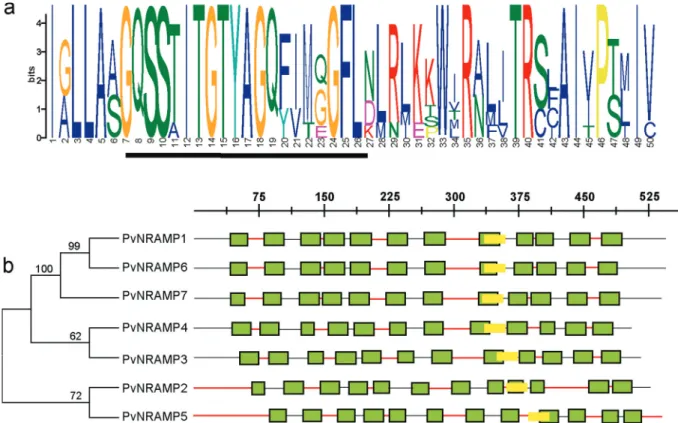
NRAMP genes. Among these, only seven genes carried the consensus residues GQSSTITGTYAGQFIMGGFLN (Fig-ure 1a), a unique motif associated with the NRAMP metal transporter family (Cellieret al., 1995). To facilitate under-standing we renamed the NRAMP homologs inP. vulgaris
asPvNRAMP1 to -7. The corresponding Phytozome code, gene length, and protein length are summarized in Table 1. They encode putative proteins ranging from 507 to 554 amino acid residues in length, with an average of 58.5 kDa of molecular mass and a deduced isoelectric point (pI) ranging from 4.81 to 7.89 (Table 1). The genes
PvNRAMP1,-6,and-7encode proteins with a basic pI and with plastid localization, while the genesPvNRAMP2,-3,
-4,and-5generate a cytoplasmic protein with acid pI (Ta-ble 1). Twelve transmembrane domains (TM) were verified for all the members, with N- and C- tails pointing to oppo-site sides of the plasma membrane forPvNRAMP2, and C-and N-terminal turned to the intracellular region for
PvNRAMP5and the extracellular side for otherPvNRAMPs
(Figure 1b). For all thePvNRAMPs, the conservative motif was localized between TM 8 and 9 (Curieet al., 2000; Hall
and Williams, 2003), placed between 401–418 and 431–453 aa, similar to previously characterized NRAMP genes in plants (Kaiseret al., 2003; Mizunoet al., 2005; Vatanseveret al., 2016).
Gene structure and chromosomal distribution of NRAMPgene inP. vulgaris
To investigate the evolutionary relationship among
NRAMPgenes inP. vulgaris, their chromosome map was constructed (Figure 2). ThePvNRAMP1,-3and-4genes were localized in chromosome 5, 3, and 2, respectively. The genesPvNRAMP2and-7were at chromosome 9, while
PvNRAMP5and-6were at chromosome 10 (Figure 2). The selection pressure acting on NRAMP genes was inferred from the ratio of non-synonymous (Ka) to synonymous (Ks) substitution values, and our data indicated that all the
PvNRAMPswere under evolutionary pressure showing on average a 1.5 Ka/Ks ratio. Additionally, the gene structures were compared among thePvNRAMPs. The organization of introns and exons indicated that NRAMP genes could be divided into two types (Figure 3). Type I was formed by 13 short exons with lengths ranging from 79 to 342 bp and intron sizes of 76 bp to 1018 bp. This group included
PvNRAMP1, -6, and -7, with an average identity of approx-imately 86% at some significant sequences, with the high-est identity equal to 100% and the lowhigh-est equal to 75%. In addition, the fifth exon inPvNRAMP1had similarity to two
Figure 1- Diagrammatic representation of architecture of the NRAMP putative protein inP. vulgaris. (a) The conserved motif graph generated by the
exons inPvNRAMP6, meaning that this exon was split into two coding sequence at the fifth and seventh exon position inPvNRAMP6. In another type formed byPvNRAMP4,-3,
-2,and-5, the exon numbers were restricted to four, with high similarities among them and with exon lengths from 137 bp to 653 bp and intron lengths of 91 bp to 1540 bp. To investigate if such exon-intron organization was conserved amongNRAMPs, we analyzed 20 homologs inG. max,M. truncatula, A. thaliana and O. sativa (Figure S1).
AtNRAMP1and-6fromArabidopsisdisplayed 11 and 13 exons, respectively.OsNRAMP1,-3,-4,and-5 from rice andMtNRAMP1,-2,and-3fromM. truncatulashowed 13 exons with limited size variation, while intron size varied largely (Figure S1). Type II grouped AtNRAMP2, -3,-4,
and-5 fromArabidopsis, and the rice genesOsNRAMP2
and-6,MtNRAMP4,-5,-6,and-7fromM. truncatula,and
GmDMT1fromG. max displayed preserved number and size of exons/introns (Figure S1). Our results indicated that two types of gene structure were conserved amongNRAMP
homologs.
Phylogenetic comparison ofPvNRAMPgenes with their homologs inA. thaliana,O. sativa,G. maxand M. truncatula
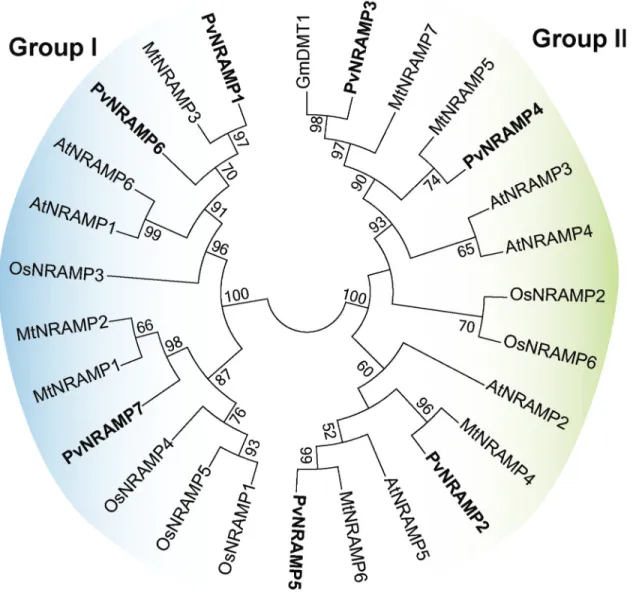
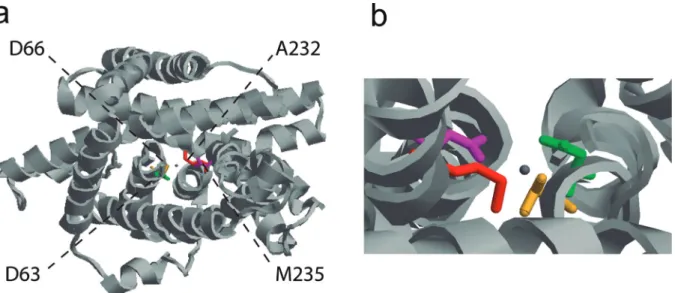
To explore the phylogenetic association among NRAMP homologs in plant genomes, we generated a phylogenetic tree based on putative amino acid sequences of 30 NRAMPs fromArabidopsis,rice (Oryza sativa),M. truncatulaand common bean. The tree topology indicated separation into two distinct groups (Figure 4). Each group contained sequences from different species, which suggests a close genetic conservation among them. Group I con-sisted of 12 members and their protein alignment showed that 26% of the amino acids were identical and localized at conserved positions. This group included previously char-acterized cation transporters, including AtNRAMP1 and OsNRAMP1, that are involved in the maintenance of iron homeostasis in Arabidopsis and rice, respectively (Curieet al., 2000; Takahashi et al., 2011), and the importer MtNRAMP1 that is required for the iron and manganese uptake by rhizobia-infected nodules inM. truncatula (Teja-da-Jiménezet al., 2015). In several organisms, the absorp-tion of manganese and iron occurs in an interdependent manner, using the same transport proteins (Fitsanakiset al., 2010). According to our data, the closest homolog of MtNRAMP1 in common bean wasPvNRAMP7(Figure 4) with 83% of shared amino acid identity. To investigate its association with metal transportation, the tertiary structure was predicted using bioinformatics tools. ThePvNRAMP7
structure was modeled usingStaphylococcus capitisDMT as template (Ehrnstorferet al., 2014) (Figure 5a). The qual-ity of property combinations between target and template was estimated by GMQE (Global Model Quality Esti-mation), resulting in a score of 0.56. The predicted structure showed 12 transmembrane domains (Figure 5a) and poten-tial Mg-coordinating amino acids at the positions Asp60,
-Asn63, Ala232 and Met235 (Figure 5b). Results analogous to those found in MtNRAMP1 (Tejada-Jiménez et al., 2015) were observed forPvNRAMP1(Figure S2a) and-6
(Figure S2b), which shared 58% of amino acid identity with MtNRAMP1. Therefore, our data suggest that these genes might play a role in iron homeostasis and potentially also for manganese transport inP. vulgaris. Group II consisted of 18 sequences, sharing 38.2% of identical amino acids lo-cated at conserved positions across the members. This group includedPvNRAMP3 and-4, which were grouped
with the GmDMT1 (Figure 4), a transporter from soybean involved in the nodulation process (Kaiseret al., 2003).
PvNRAMP5 was closer to the transporter AtNRAMP5 (Figure 4) that negatively responds to higher concentra-tions of iron in flowers (Ravetet al., 2009).PvNRAMP2
and -4were placed at the same branch as MtNRAMP4 and -5 (Figure 4), respectively, the functions of which have not yet been characterized. None of thePvNRAMPsequences showed enough affinity to the vacuolar transporters AtNRAMP3 and -4.
Figure 2- Distribution of genes inP. vulgarischromosome. Chromosome size is indicated by its relative length. The scale on the bottom is shown in
megabases (Mb). The blue bars mark the gene location at the forward direction, while the red bars mark the gene at the reverse position. The figure was generated by Geneious software and edited using the package Adobe Illustrator.
Figure 3- Schematic structure ofPvNRAMPinP. vulgaris. Phylogenetic tree with introns, exons and UTRs. Lines connected to similar exons and
Expression analysis ofPvNRAMPgenes during common bean development
To gain further insights into biological function of
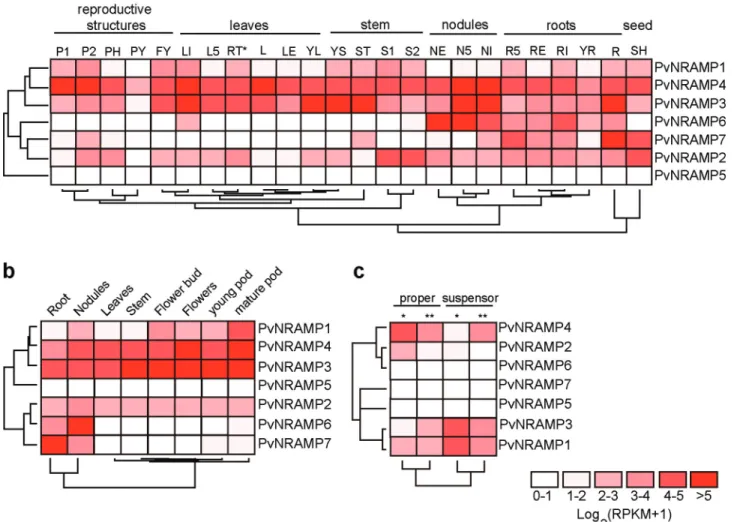
PvNRAMPs, their expression levels were investigated us-ing available RNA-Seq data retrieved from different com-mon bean tissues across developmental processes. In Group I,PvNRAMP3 and-4 shared a similar expression pattern, indicating that both were recruited during all stages of common bean development. The expression levels of
PvNRAMP2also exhibited expression in distinct tissues; nevertheless, the levels were lower compared with
PvNRAMP3, -4,and-5 (Figure. 6a-c). For Group II, the
PvNRAMP6and-7genes were preferentially expressed in the root system, with the highest expression ofPvNRAMP6
in active nodules (Figure 6a, b). PvNRAMP1 showed higher expression in reproductive structures, including seeds (Figure 6b, c). At early stages of common bean devel-opment,PvNRAMP3andPvNRAMP4 were differentially up-regulated.PvNRAMP3was mainly recruited in the sus-pensor, an embryonic region formed by few cells that con-nect the embryo to the surrounding endosperm (Kawashi-ma and Goldberg, 2010), whilePvNRAMP4was preferably expressed in the embryo proper (Figure 6c).PvNRAMP5,
-6,and-7 were not expressed (Figure 6c) at this stage of
Figure 4- Phylogenetic tree of NRAMP protein sequences. The unrooted tree was generated based on the Maximum Likelihood statistical method and
bean ontogenesis. Therefore, the genes from Group I showed a broad expression across different plant tissues (Figure 6a-c). In contrast, the transporters from Group II exhibited an expression pattern limited to certain tissues.
For further comparisons, the expression levels of the
NRAMPhomologs in other Fabaceae species were obtained (Figures S3, S4). Analysis of the gene expression atlas ofG. max(Qinet al., 2017) andM. truncatula(Beneditoet al., 2008) indicated that besidesGmDMT1andMtNRAMP1, essential genes for nodulation (Kaiser et al., 2003)(Tejada-Jiménezet al., 2015),GmNRAMP7(Figure S4) (Qinet al., 2017) andMtNRAMP2(Figure S3a) were highly expressed during the root interaction with rhizobia. Comparing different tissues at distinct developmental stages, MtNRAMP2 showed an expression level close to
MtNRAMP1(Figure S3a). Investigation of micro-dissected tissues indicated that the biological function of
MtNRAMP2 relied on surrounding tissues of rhizobia-infected and nematode-rhizobia-infected cells (Figure S3b). In the phylogenetic branch of GmNRAMP7, MtNRAMP1 and -2 were closest to PvNRAMP7 (Figure S5), that was seen up-regulated in active nodules (Figure 6b and Figure S4). Similar expression patterns were found for PvNRAMP6
(Figure 6b) and for its homologs GmNRAMP5a and
GmNRAMP5b (Figure S4, S5). From Group I, the
PvNRAMP5showed weak expression signal in several tis-sues (Figure 6a), similar to its homolog in soybean (Figure S4). Expression levels in meristematic, vegetative, and re-productive structures of corresponding homologs of
PvNRAMP1,-2,-3,-4,and-5inM. truncatula(Figure S3a, S5) andG. max(Figures S4, S5) were also compared. Anal-ogous to these NRAMP genes in common bean (Figure 6a, b), the homologs in other Fabaceae plants showed similar transcriptional patterns during plant development (Figures S3, S4), including the nodule-essential gene GmDMT1
which was preferentially expressed in root hairs and nodules compared with other tissues (Figure S4). Taken to-gether, our data indicated that the biological functions of these genes are highly conserved among the three species.
Transcriptional regulatory elements inPvNRAMP genes
To get further insights into the putative biological function ofNRAMPgenes inP. vulgaris, regulatorycis -el-ements located in the promoter and untranslated regions (UTR) were investigated. First, we searched for Iron Re-sponsive Elements (IREs) motifs in the NRAMP trans-criptional sequences. One single IRE regulatory motif (AG TTGTTCATTCAGAGAGTTAGGTAATCAAT) was found in the 3’UTR region of PvNRAMP3, starting at 1584bp–1615bp. The GmDMT1, an IRE-contained soy-bean gene (Kaiser et al., 2003), and PvNRAMP3 were placed at the same branch (Figure S5). To obtain further in-formation of transcriptional regulation of PvNRAMPs, we investigated the presence of regulatory elements in their promoter regions. Regulatorycis-elements of each putative
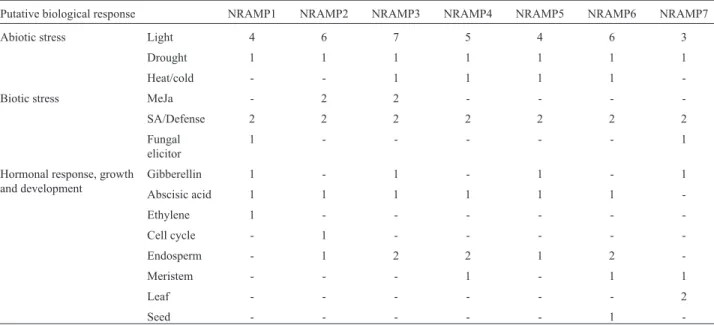
PvNRAMPpromoter sequences were identified using the PlantCARE program (Table 2). We observed that the drought- and light-responsive regulatory elements were present in all sequences. The regulatory elements associ-ated with Methyl Jasmonate (MeJa) were limited to the promotors ofPvNRAMP2,-3,and-6, whereas the upstream sequences ofPvNRAMP1and-7showed elements respon-sive to fungal elicitors. We also observed that all analyzed regions exhibited at least one regulatory element associated with regulation and maintenance of biological processes like hormonal responses. Among them,PvNRAMP7is the only gene in which the transcriptional response might be regulated by abscisic acid. These results indicated that the regulation ofPvNRAMPtranscriptional activity may be
ac-Figure 5- Predicted 3D structure of NRAMP transporter. Tertiary structure of PvNRAMP7 predicted by SWISS-MODEL software based on the
tivated during the plant development and by external biotic and abiotic stresses.
Expression ofPvNRAMPgenes in response to Colletotrichum lindemuthianum infection
To further investigate the potential involvement of
PvNRAMPgenes in biotic stress, as suggested by the analy-sis of regulatory elements, we infected common bean lea-ves with the pathogenic fungus Colletotrichum lindemuthianum.The transcriptional response ofNRAMP
genes showed that in general the transporters were down-regulated followingC. lindemuthianuminfection (Table 3). We observed strong suppression with statistical support for
PvNRAMP1, -2 and -3, while no amplification was ob-served for thePvNRAMP7and -5 genes (Table 3). These data suggested a potential interruption of NRAMP-me-diated transport in common bean during the pathogen inva-sion.
Discussion
Common bean is an important source of nutrients in developing countries. It provides critical metals for human health, such as iron, manganese, zinc, etc. (Beebeet al., 2000). Thus, understanding the mechanisms involved in the accumulation and transport of metals in common bean tissues is relevant for food security. Previous studies have
Figure 6- Expression levels ofP. vulgarisNRAMP genes. Heatmaps showing the hierarchical clustering of NRAMP family genes grouped according to
demonstrated the relevance of the NRAMP carrier family to maintain metal homeostasis in Arabidopsis, rice, andM. truncatula(Sebastien and Schroeder, 2004). However, de-tailed information on this transport family in the common bean was missing. Here, we used a bioinformatics approach to identify the members of NRAMP family in the P. vulgarisgenome and to determine their biological role dur-ing common bean development.
There are two groups of plant NRAMPs that differed in their origins
The MntH/NRAMP family metal transport emerged as an adaptation to the oxygen-rich environment, and this family is found in the genomes of eukaryotes and proka-ryotes (Cellieret al., 1996). The key characteristic of this transporters is the presence of the bacterial Consensus Transport Sequence in the core of the preserved hydropho-bic pocket (Cellieret al., 1995). The protein structure re-flects the preserved biological role of MntH/NRAMP that conveys the control of the redox metal concentration
(Cellieret al., 2001). In plants, the differences seen among members of the NRAMP family raised the hypotheses that it is a polyphyletic group (Sebastien and Schroeder, 2004). The first group (Group I) has a putative primary amino acid sequence that is apparently closer to MntH/NRAMP from bacteria, whereas the second group (Group II) is more re-lated to those from animals (Sebastien and Schroeder, 2004). Indeed, our phylogenetic data and comparison of protein features, gene structure, and expression patterns are in support of the hypothesis of distinct origins. Similar to AtNRAMP3, -4 inA. thaliana(Lanquaret al., 2005,2010) and GmNRAMP1a, 2a, 2b and 3a in soybean (Qinet al., 2017), the bacteria-like PvNRAMPs showed a potential function at membranous organelles (Table 1). The putative proteins showed a basic IP, which differed from the ani-mal-like group that showed an acidic isoelectric point (Ta-ble 1). Consistently, the fragmented and numerous short exons sequences from Group I contrasted with the concise gene structure seen in Group II (Figure 3 and S1). Addi-tionally, the expression patterns of the NRAMP homologs in Fabaceae also differed between the groups. The stable expression across multiple plant organs suggested that genes from Group II may serve to maintain the biological role in basic cellular processes, transporting metals for growing tissues when they are necessary. In contrast, the genes from Group I showed a higher expression that was generally limited to certain tissues, suggesting a more spe-cific function during plant development. Therefore, our data indicated that NRAMP sequences in plants may be di-vided into two groups that diverged early during evolution.
Potential role of NRAMP genes inP. vulgaris
Interactions between different organisms are often accompanied by morphological changes, including the for-mation of specialized organs. For example, parasitic knot
Table 2- List of regulatorycis-elements identified in the putative promoter regions of sevenNRAMPgenes inP. vulgaris.
Putative biological response NRAMP1 NRAMP2 NRAMP3 NRAMP4 NRAMP5 NRAMP6 NRAMP7
Abiotic stress Light 4 6 7 5 4 6 3
Drought 1 1 1 1 1 1 1
Heat/cold - - 1 1 1 1
-Biotic stress MeJa - 2 2 - - -
-SA/Defense 2 2 2 2 2 2 2
Fungal elicitor
1 - - - 1
Hormonal response, growth and development
Gibberellin 1 - 1 - 1 - 1
Abscisic acid 1 1 1 1 1 1
-Ethylene 1 - - -
-Cell cycle - 1 - - - -
-Endosperm - 1 2 2 1 2
-Meristem - - - 1 - 1 1
Leaf - - - 2
Seed - - - 1
-Table 3- Quantitative RT-PCR forPvNRAMPsinC. lindemuthianum-
in-fected leaves.
Name qRT-PCR (fold change) p-value
PvNRAMP1 -3.34 0.001
PvNRAMP6 -2.42 0.0615
PvNRAMP7 No amplification
-PvNRAMP2 -10.57 0.001
PvNRAMP3 -5.43 0.0385
PvNRAMP4 -1.01 0.861
PvNRAMP5 No amplification
nematodes provoke the reorganization of root compart-ments to form giant multinuclear cells at the nematode feeding sites (Jones, 1981). Similarly, symbiotic interac-tions between nitrogen-fixing bacteria and leguminous plants result in the development of root structures called nodules (Masson-Boivinet al., 2009), which require an tense iron mobilization as cofactor of critical enzymes in-volved in nodulation (Tanget al., 1990). During nodule formation, when drastic morphological changes occur, the surrounding cells harbor transporter proteins to fully sup-ply the newly-formed organ with necessary nutrients. The up-regulation ofMtNRAMP2limited to the region that is circumjacent to the rhizobia-infecting zone and root galls (Figure S3) suggests a conserved function of this protein as a carrier to supply minerals for plant-interacting organisms throughout their life cycle. The closest gene toMtNRAMP2
in amino acid sequence isMtNRAMP1, which is recruited for both iron and manganese uptake for nodulation inM. truncatula(Tejada-Jiménezet al., 2015). Its homolog in soybean,GmNRAMP7(Figure S5) gene is highly regulated during nodulation (Figure S4), activated upon iron starva-tion and suppressed under iron toxicity (Qinet al., 2017). Our data comparison indicated that orthologous pairs among Fabaceae maintained similar expression patterns, suggesting a potential conserved biological function. The predicted tertiary structure ofPvNRAMP7and-6(Figures 5, S2), their high similarities with the homologs
MtNRAMP1 (Figures S3, S5) andGmNRAMP7 (Figures S4, S5) in terms of expression patterns allowed us to infer thatPvNRAMP7and-6might be the NRAMP transporters used for iron/manganese trafficking involved in initiating the nodules inP. vulgaris.
Plants adopted two strategies for iron uptake from the environment (Marschner and Römheld, 1994). The first strategy, found in all the plants except Poaceae, is that root cells release into the rhizosphere substances that reduce the iron forms so that they can be absorbed by carrier proteins, such as AtNRAMP1 (Curie et al., 2000), MtNRAMP1 (Tejada-Jiménezet al., 2015) and GmDMT1 (Kaiseret al., 2003). The second strategy is followed by the Poaceae fam-ily, which release into the soil the Fe-chelating molecules known as siderophores, where specific transporters facili-tate the entry of the ferric-iron-siderophores complex into the plant cell (Marschner and Römheld, 1994).
Most genes encoding iron transporters harbor an IRE motif that plays a direct role in iron regulation (Mucken-thaleret al., 2008). Briefly, under iron deficiency, the IRE motif becomes an available binding site for iron-regulating proteins (IRPs) responsible for stabilizing the mRNA, al-lowing an increase in the transcriptional level (Mucken-thaler et al., 2008). Several iron-regulated plant genes contain IRE motifs at their UTRs (Petitet al., 2001; Vertet al., 2001, 2002), although the role of the IRE/IRP mecha-nism in iron homeostasis in plants is controversial (Arnaud
et al., 2007). The iron-inducedGmDMT1gene encoding an NRAMP transporter shows a single IRE motif in its 3’UTR,
and it is recruited to absorb iron into soybean root nodules (Kaiseret al., 2003). InP. vulgaris, only thePvNRAMP3
transcript showed a single IRE motif in its 3’UTR, associat-ing this gene with iron metabolism in beans. The expression spectrum ranging from embryo to mature pods (Figure 6a-c), including the nodules, indicated that this function is widely required and that it is not limited to the plant-rhizobia interaction.
In the early stages of plant development, embryo growth is one of the critical events in which the metal trans-porters are intensively required (Kawashima and Goldberg, 2010). During the embryo formation, a set of cells called suspensor maintains the embryo connected to the surround-ing tissue. The basic function of the suspensor is to trans-port necessary metabolites to embryo proper. The differen-tial transcriptional regulation of NRAMP genes in P. vulgarisindicated that three genes are recruited during the early stages of bean formation (Figure 6c).PvNRAMP4is up-regulated in suspensor cells and might facilitate the reg-ulation of the concentration of divalent metals from endo-sperm to embryo, whilePvNRAMP1and-3might be acting in the embryo proper to allocate the metals to needed cell compartments.
Besides the recruitment of NRAMP transporters dur-ing plant development and host-microorganism intertions, members of this family actively participate in the ac-cumulation of toxic metals in plants (Thomineet al., 2000; Mizunoet al., 2005; Oomenet al., 2009). The pollution in water bodies and river tributaries that supply agricultural fields caused increased concern over the accumulation of toxic metals in crop cultivation (Clemens and Ma, 2016). OsNRAMP1 is directly associated with arsenic (As) and cadmium (Cd) uptake in rice (Takahashiet al., 2011; Ti-wariet al., 2014), while TjNRAMP4, TcNRAMP3 and -4 are recruited in the heavy-metal-tolerant species T. japonicum (Mizuno et al., 2005) and T. caerulescens
(Oomen et al., 2009). In the common bean, few studies have investigated the impact of metal pollutants in plant metabolism. Thus, the identification and characterization ofPvNRAMPtransporters provided in this study may help us to elucidate the involvement of these proteins in toxic metal uptake and accumulation in beans.
This nutritional immunity strategy through metal retention found in vertebrates might also occur in plants. The modu-lation of two isoforms of OsNRAMP6 by a microRNA dur-ingMagnaporthe oryzaeinfection was described as con-tributing to disease resistance (Campo et al., 2013; Peris-Periset al., 2017). Here, we observed that three mem-bers of the NRAMP family inP. vulgaris(PvNRAMP1, -2
and-3) were suppressed uponC. lindemuthianuminvasion during its biotrophic stage (Table 3). This data may indicate that PvNRAMP transporters may play a role inP. vulgaris
as a defense strategy, retaining the accessibility of metals essential for the pathogenic growth, thereby restricting dis-ease advance in plant tissues.
Conclusions
Common bean has seven members of the NRAMP family. The phylogenetic analysis using sequences from representative species indicated that there are two NRAMP groups inP. vulgaris. An expression pattern comparison of
NRAMPgenes in Fabaceae from multiple tissues at differ-ent developmdiffer-ental stages indicated a conserved biological function among NRAMP homologs. The transcriptional level analysis revealed thatPvNRAMP6and-7may have a role during symbiosis with beneficial microorganism, whereasPvNRAMP1, -2, -3, -4 and -5might be required for general metal homeostasis during all developmental stages of the common bean. The qRT-PCR analysis indicated that
NRAMP genes are not required during infection by the pathogenC. lindemuthianum. Taken together, the system-atic genome-wide-analysis of NRAMP genes in the P. vulgarisgenome, supplies basic information on their role in regulating metal homeostasis during development and in-teraction with microorganisms in common bean.
Acknowledgments
The authors thank Dr. Margarida Ito from the Agro-nomic Institute of Campinas for kindly providing g C. lindemuthianumisolates used in this study. The project re-ceived financial support from the Science Without Borders Program from the Brazilian Federal Government (88887.092433/2015-00). DGGC, LRO and GCF received scholarships from the São Paulo State Research Foundation (FAPESP 2013/06301-2, 2016/00385-8 and 2016/00359-7). LML obtained a scholarship from the Co-ordination for the Improvement of Higher Education Per-sonnel (CAPES 88887.092433/2015-00).
References
Altschul S (1997) Gapped BLAST and PSI-BLAST: A new gen-eration of protein database search programs. Nucleic Acids Res 25:3389–3402.
Aragão FJL, Brondani RPV and Burle ML (2011) Phaseolus. In: Kole C (ed) Wild Crop Relatives: Genomic and Breeding Resources. Springer, Berlin, pp 223–236.
Arnaud N, Ravet K, Borlotti A, Touraine B, Boucherez J, Fizames C, Briat JF, Cellier F and Gaymard F (2007) The
iron-responsive element (IRE)/iron-regulatory protein 1
(IRP1)–cytosolic aconitase iron-regulatory switch does not operate in plants. Biochem J 405:523-531.
Beebe S, Gonzalez AV and Rengifo J (2000) Research on trace minerals in the common bean. Food Nutr Bull 21:387–391. Belouchi A, Kwan T and Gros P (1997) Cloning and characteriza-tion of theOsNrampfamily fromOryza sativa, a new family of membrane proteins possibly implicated in the transport of metal ions. Plant Mol Biol 33:1085–1092.
Benedito VA, Torres-Jerez I, Murray JD, Andriankaja A, Allen S, Kakar K, Wandrey M, Verdier J, Zuber H, Ott T, et al.
(2008) A gene expression atlas of the model legume
Medicago truncatula. Plant J 55:504–513.
Bennink MR (2002) Consumption of black beans and navy beans (Phaseolus vulgaris) reduced azoxymethane-induced colon cancer in rats. Nutr Cancer 44:60–65.
Borges A, Tsai SM and Caldas DGG (2012) Validation of refer-ence genes for RT-qPCR normalization in common bean during biotic and abiotic stresses. Plant Cell Rep 31:827–838.
Bouchenak M and Lamri-Senhadji M (2013) Nutritional quality of legumes, and their role in cardiometabolic risk preven-tion: A review. J Med Food 16:185–198.
Brear EM, Day DA and Smith PMC (2013) Iron: An essential micronutrient for the legume-rhizobium symbiosis. Front Plant Sci 4:359.
Broughton WJ, Hernández G, Blair M, Beebe S, Gepts P and Vanderleyden J (2003) Beans (Phaseolusspp.) – model food legumes. Plant Soil 252:55–128.
Campillos M, Cases I, Hentze MW and Sanchez M (2010) SIREs: Searching for iron-responsive elements. Nucleic Acids Res 38:W360-W367.
Campo S, Peris-Peris C, Siré C, Moreno AB, Donaire L, Zytnicki M, Notredame C, Llave C and San Segundo B (2013) Identi-fication of a novel microRNA (miRNA) from rice that tar-gets an alternatively spliced transcript of theNramp6( Natu-ral resistance-associated macrophage protein 6) gene involved in pathogen resistance. New Phytol 199:212–227. Cellier MFM (2012) NRAMP: From sequence to sructure and
mechanism of divalent metal import. In: Lutsenko S and Argüello JM (eds) Metal transporters. Elsevier-Academic Press, Oxford, p 435.
Cellier M, Privé G, Belouchi A, Kwan T, Rodrigues V, Chia W and Gros P (1995) NRAMP defines a family of membrane proteins. Proc Natl Acad Sci U S A 92:10089–10093. Cellier M, Belouchi A and Gros P (1996) Resistance to
intra-cellular infections: comparative genomic analysis of Nramp. Trends Genet 12:201–204.
Cellier MF, Bergevin I, Boyer E and Richer E (2001) Polyphyletic origins of bacterial NRAMP transporters. Trends Genet 17:365–370.
Clemens S and Ma JF (2016) Toxic heavy metal and metalloid ac-cumulation in crop plants and foods. Annu Rev Plant Biol 67:489–512.
Curie C, Alonso JM, Le Jean M, Ecker JR and Briat JF (2000) In-volvement of NRAMP1 fromArabidopsis thalianain iron transport. Biochem J 347:749–755.
Damiani I, Baldacci-Cresp F, Hopkins J, Andrio E, Balzergue S, Lecomte P, Puppo A, Abad P, Favery B and Hérouart D (2012) Plant genes involved in harbouring symbiotic rhi-zobia or pathogenic nematodes. New Phytol 194:511–522. Dordas C (2008) Role of nutrients in controlling plant diseases in
sustainable agriculture: Agron Sustain Dev 28:33-46. Ehrnstorfer IA, Geertsma ER, Pardon E, Steyaert J and Dutzler R
(2014) Crystal structure of a SLC11 (NRAMP) transporter reveals the basis for transition-metal ion transport. Nat Struct Mol Biol 21:990–996.
Emanuelsson O, Brunak S, von Heijne G and Nielsen H (2007) Locating proteins in the cell using TargetP, SignalP and re-lated tools. Nat Protoc 2:953–971.
Fitsanakis VA, Zhang N, Garcia S and Aschner M (2010) Manga-nese (Mn) and Iron (Fe): Interdependency of transport and regulation. Neurotox Res 18:124–131.
Gage DJ (2004) Infection and invasion of roots by symbiotic, ni-trogen-fixing rhizobia during nodulation of temperate le-gumes. Microbiol Mol Biol Rev 68:280–300.
Gan P, Ikeda K, Irieda H, Narusaka M, O’Connell RJ, Narusaka Y, Takano Y, Kubo Y and Shirasu K (2013) Comparative genomic and transcriptomic analyses reveal the hemibio-trophic stage shift of Colletotrichum fungi. New Phytol 197:1236–1249.
Geil PB and Anderson JW (1994) Nutrition and health implica-tions of dry beans: A review. J Am Coll Nutr 13:549–558. Gepts P, Aragão FJL, Barros E de, Blair MW, Brondani R,
Broughton W, Galasso I, Hernández G, Kami J, Lariguet P,
et al.(2008) Genomics of Phaseolus beans, a major source of dietary protein and micronutrients in the tropics. In: Moore PH and Ming R (eds) Genomics of Tropical Crop Plants. Springer, New York, pp 113–143.
Gunshin H, Allerson CR, Polycarpou-Schwarz M, Rofts A, Rog-ers JT, Kishi F, Hentze MW, Rouault TA, Andrews NC and Hediger MA (2001) Iron-dependent regulation of the diva-lent metal ion transporter. FEBS Lett 509:309–316. Hall JL and Williams LE (2003) Transition metal transporters in
plants. J Exp Bot 54:2601–2613.
Hu B, Jin J, Guo A-Y, Zhang H, Luo J and Gao G (2015) GSDS 2.0: An upgraded gene feature visualization server. Bioin-formatics 31:1296–1297.
Iolascon A and De Falco L (2009) Mutations in the gene encoding DMT1: Clinical presentation and treatment. Semin Hematol 46:358–370.
Ishimaru Y, Takahashi R, Bashir K, Shimo H, Senoura T, Sugi-moto K, Ono K, Yano M, Ishikawa S, Arao T,et al.(2012) Characterizing the role of rice NRAMP5 in manganese, iron and cadmium transport. Sci Rep 2:286.
Jones KM, Kobayashi H, Davies BW, Taga ME and Walker GC (2007) How rhizobial symbionts invade plants: the Sinor-hizobium-Medicago model. Nat Rev Micro 5:619–633. Jones MGK (1981) Host cell responses to endoparasitic nematode
attack: Structure and function of giant cells and syncytia. Ann Appl Biol 97:353–372.
Kaiser BN, Moreau S, Castelli J, Thomson R, Lambert A, Bo-gliolo S, Puppo A and Day DA (2003) The soybean NRAMP homologue, GmDMT1, is a symbiotic divalent metal trans-porter capable of ferrous iron transport. Plant J 35:295–304.
Kawashima T and Goldberg RB (2010) The suspensor: Not just suspending the embryo. Trends Plant Sci 15:23–30. Kehl-Fie TE and Skaar EP (2010) Nutritional immunity beyond
iron: a role for manganese and zinc. Curr Opin Chem Biol 14:218–224.
Krogh A, Larsson B, von Heijne G and Sonnhammer EL (2001) Predicting transmembrane protein topology with a hidden Markov model: Application to complete genomes. J Mol Biol 305:567–580.
Kumar S, Stecher G, Tamura K (2016) MEGA7: Molecular Evo-lutionary Genetics Analysis Version 7.0 for Bigger Datasets. Mol Biol Evol 33:1870–1874.
Lanquar V, Lelièvre F, Bolte S, Hamès C, Alcon C, Neumann D, Vansuyt G, Curie C, Schröder A, Krämer U,et al.(2005) Mobilization of vacuolar iron by AtNRAMP3 and AtNRAMP4 is essential for seed germination on low iron. EMBO J 24:4041–4051.
Lanquar V, Ramos MS, Lelièvre F, Barbier-Brygoo H, Krieger-Liszkay A, Krämer U and Thomine S (2010) Export of vacuolar manganese by AtNRAMP3 and AtNRAMP4 is re-quired for optimal photosynthesis and growth under manga-nese deficiency. Plant Physiol 152:1986–1999.
Lescot M, Déhais P, Thijs G, Marchal K, Moreau Y, Van de Peer Y, Rouzé P and Rombauts S (2002) PlantCARE, a database of plant cis-acting regulatory elements and a portal to tools forin silicoanalysis of promoter sequences. Nucleic Acids Res 30:325–327.
Marschner H and Römheld V (1994) Strategies of plants for ac-quisition of iron. Plant Soil 165:261–274.
Masson-Boivin C, Giraud E, Perret X and Batut J (2009) Estab-lishing nitrogen-fixing symbiosis with legumes: How many rhizobium recipes? Trends Microbiol 17:458–466. Mizuno T, Usui K, Horie K, Nosaka S, Mizuno N and Obata H
(2005) Cloning of three ZIP/Nramp transporter genes from a Ni hyperaccumulator plant Thlaspi japonicum and their
Ni2+-transport abilities. Plant Physiol Biochem
43:793–801.
Muckenthaler MU, Galy B and Hentze MW (2008) Systemic iron homeostasis and the Iron-Responsive Element/Iron-Regu-latory Protein (IRE/IRP) reguElement/Iron-Regu-latory network. Annu Rev Nutr 28:197–213.
Nevo Y and Nelson N (2006) The NRAMP family of metal-ion transporters. Biochim Biophys Acta - Mol Cell Res 1763:609–620.
O’Rourke JA, Iniguez LP, Fu F, Bucciarelli B, Miller SS, Jackson SA, McClean PE, Li J, Dai X, Zhao PX,et al.(2014) An RNA-Seq based gene expression atlas of the common bean. BMC Genomics 15:866.
Oomen RJFJ, Wu J, Lelièvre F, Blanchet S, Richaud P, Bar-bier-Brygoo H, Aarts MGM and Thomine S (2009) Func-tional characterization of NRAMP3 and NRAMP4 from the metal hyperaccumulatorThlaspi caerulescens.New Phytol 181:637–650.
Perfect SE, Hughes HB, O’Connell RJ and Green JR (1999)
Colletotrichum: A model genus for studies on pathology and fungal–plant interactions. Fungal Genet Biol 27:186–198. Peris-Peris C, Serra-Cardona A, Sánchez-Sanuy F, Campo S,
Petit JM, van Wuytswinkel O, Briat JF and Lobreaux S (2001) Characterization of an Iron-dependent regulatory sequence involved in the transcriptional control ofAtFer1andZmFer1
plant ferritin genes by iron. J Biol Chem 276:5584–5590. Pfaffl MW, Horgan GW and Dempfle L (2002) Relative
expres-sion software tool (REST(C)) for group-wise comparison and statistical analysis of relative expression results in real-time PCR. Nucleic Acids Res 30:e36
Qin L, Han P, Chen L, Walk TC, Li Y, Hu X, Xie L, Liao H and Liao X (2017) Genome-wide identification and expression analysis of NRAMP family genes in soybean (Glycine max
L.). Front Plant Sci 8:1436.
Ramakers C, Ruijter JM, Deprez RHL and Moorman AFM (2003) Assumption-free analysis of quantitative real-time polymer-ase chain reaction (PCR) data. Neurosci Lett 339:62–66. Ravet K, Touraine B, Boucherez J, Briat JF, Gaymard F and
Cellier F (2009) Ferritins control interaction between iron homeostasis and oxidative stress in Arabidopsis. Plant J 57:400–412.
Reich M, Liefeld T, Gould J, Lerner J, Tamayo P and Mesirov JP (2006) GenePattern 2.0. Nat Genet 38:500–501.
Schmutz J, McClean PE, Mamidi S, Wu GA, Cannon SB, Grim-wood J, Jenkins J, Shu S, Song Q, Chavarro C,et al.(2014) A reference genome for common bean and genome-wide analysis of dual domestications. Nat Genet 46:707-713. Sebastien T and Schroeder JI (2004) Plant metal transporters with
homology to proteins of the NRAMP family. In: Cellier M and Gros P (eds) The NRAMP family. Kluwer Academic Publishers-Plenum Publishers, New York, pp 113–123. Shawki A, Knight PB, Maliken BD, Niespodzany EJ and
Mac-kenzie B (2012) H+-coupled divalent metal-ion transpor-ter-1. Curr Top Membr 70:169–214.
Takahashi R, Ishimaru Y, Senoura T, Shimo H, Ishikawa S, Arao T, Nakanishi H and Nishizawa NK (2011) The OsNRAMP1 iron transporter is involved in Cd accumulation in rice. J Exp Bot 62:4843–4850.
Tang C, Robson AD and Dilworth MJ (1990) The role of iron in nodulation and nitrogen fixation inLupinus angustifoliusL. New Phytol 114:173–182.
Tejada-Jiménez M, Castro-Rodríguez R, Kryvoruchko I, Lucas MM, Udvardi M, Imperial J and González-Guerrero M (2015)Medicago truncatulaNatural Resistance-Associated Macrophage Protein1 is required for iron uptake by rhizo-bia-infected nodule cells. Plant Physiol 168:258–272. Thomine S, Wang R, Ward JM, Crawford NM and Schroeder JI
(2000) Cadmium and iron transport by members of a plant metal transporter family in Arabidopsis with homology to NRAMP genes. Proc Natl Acad Sci U S A 97:4991–4996. Thompson JD, Gibson TJ and Higgins DG (2002) Multiple
se-quence alignment using ClustalW and ClustalX. Curr Protoc Bioinformatics Chapter 2:Unit 2.3.
Tiwari M, Sharma D, Dwivedi S, Singh M, Tripathi RD and Trivedi PK (2014) Expression inArabidopsisand cellular
localization reveal involvement of rice NRAMP,
OsNRAMP1, in arsenic transport and tolerance. Plant Cell Environ 37:140–152.
Untergasser A, Nijveen H, Rao X, Bisseling T, Geurts R and Leunissen JAM (2007) Primer3Plus, an enhanced web inter-face to Primer3. Nucleic Acids Res 35:W71–W74. Vatansever R, Filiz E and Ozyigit II (2016)In silicoanalysis of
Mn transporters (NRAMP1) in various plant species. Mol Biol Rep 43:151–163.
Vert G, Briat JF and Curie C (2001) Arabidopsis IRT2 gene en-codes a root-periphery iron transporter. Plant J 26:181–189. Vert G, Grotz N, Dédaldéchamp F, Gaymard F, Guerinot M Lou,
Briat JF and Curie C (2002) IRT1, an Arabidopsis trans-porter essential for iron uptake from the soil and for plant growth. Plant Cell 14:1223–1233.
Victoria FC, Bervald CMP, da Maia LC, de Sousa RO, Panaud O and de Oliveira AC (2012) Phylogenetic relationships and selective pressure on gene families related to iron homeosta-sis in land plants. Genome 55:883–900.
Wessling-Resnick M (2015) NRAMP1 and other transporters in-volved in metal withholding during infection. J Biol Chem 290:18984–18990.
Wu D, Yamaji N, Yamane M, Kashino-Fujii M, Sato K and Feng Ma J (2016) The HvNramp5 transporter mediates uptake of cadmium and manganese, but not iron. Plant Physiol 172:1899–1910.
Xia J, Yamaji N, Kasai T and Ma JF (2010) Plasma mem-brane-localized transporter for aluminum in rice. Proc Natl Acad Sci U S A 107:18381–18385.
Yamaji N, Sasaki A, Xia JX, Yokosho K and Ma JF (2013) A node-based switch for preferential distribution of manga-nese in rice. Nat Commun 4:1306–1313.
Supplementary Material
The following online material is available for this article: Figure S1 - Schematic structure ofNRAMP genes inP. vulgaris, M. truncatula, A. thaliana, O. sativaandG. max. Figure S2 - Putative 3D structure of NRAMP transporter. Figure S3 - Expression levels of NRAMP genes in M. truncatula.
Figure S4 - The expression of NRAMP genes in vegetative and reproductive tissues in soybean.
Figure S5 - Phylogenetic tree of NRAMP genes in Fabaceae.
Table S1 - Gene specific primers forP. vulgaris NRAMP
genes.
Associate Editor: Everaldo Gonçalves de Barros