Abstract
This paper presents a functional classification plan supported on business processes for the Portuguese public administration as a tool to promote semantic interoperability. The author initiates discussion by presenting the classification of functional information, briefly reviewing literature to justify the classification of systems in archival information systems. Then, he presents the business plan classification and how it was constructed, to later conclude that it is a new approach not only in the organization, representation and retrieval of information/knowledge, but also in the management of archival information, making it a matrix model that links functions to business processes. Also, despite the importance of this tool, he recognizes the need to develop the business plan classification tool to an ontology based on WOL (Web Ontology Language), a language for knowledge representation, which has been proposed by W3C as a ‘standard’ to codify ontologies from the semantic web’s perspective.
Introduction
Considering the framework of European policies and strategies for interoperability, for the promotion of information access and for its reusability, as defined by the Decision No. 922/2009 and by the Directive 2013/37/EU of the European Parliament and of the Council, Portugal defined a structure of information classification for its entire public administration. The DGLAB (General-Administration of Book, Archives
and Libraries), the coordinating body for the national archival policy, conceived this
structure while working alongside with more than two hundred bodies of public administration (central, regional and local), over the last five years.
Regarding the Program for Electronic Government and Interoperability, DGLAB created Meta-information for Interoperability (MIP), «a set of meta-information elements with the purpose of supporting semantic interoperability within an electronic government’s information production» (Silva, Guardado da, 2013, 4), as well as the Functional Macro-Structure (MEF) for Public Administration (version 2.0), which «is
1
Universidade de Lisboa, Faculdade de Letras, Centro de Estudos Clássicos.
the standardization of the MIP element classification code», with the purpose of «identifying the significance of the information asset within the corporate body’s functional context, which has to be posited transversally from an inter-organizational perspective» (Penteado, 2013, 4).
The Functional Macrostructure for public administration defines the classes for the 1st and 2nd levels of public administration functions, indicating, for each represented unit, a code, a name, a description, execution notes and exclusion notes. The aim is to support the conception of an incremental classification plan for public administration. It is based on a consolidated list of business processes that may be materialized at different levels in the classification plan, depending on the activities undertaken by the different organizations. The Functional Macro-Structure in grounded on a conceptual model rooted on the establishment of four domains for functions, from which the 19 functions (F) for the Portuguese Public Administration were defined. Therefore, it is characterized by a functional structure that can best precise not only the identity of the administration’s identity, but of society itself.
Fig. 1 - Functional Macrostructure – Portuguese Public Administration Conceptual model
Functional Macrostructure
(1st level classes)
100 LEGAL AND REGULATORY FRAMEWORKS 150 PLANNING AND STRATEGIC MANAGEMENT 200 IMPLEMENTATION OF EXTERNAL POLICY 250 ADMINISTRATION OF WORK RELATIONS
300 ADMINISTRATION OF RIGHTS, GOODS AND SERVICES 350 ADMNISTRATION OF FINANCES
400 SERVICES PROVISION IN IDENTIFICATION AND REGISTRY 450 ACKNOWLEDGEMENTS AND PERMISSIONS
500 SUPERVISION, CONTROL AND ACCOUNTABILITY
550 IMPLEMENTATION OF SECURITY, PROTECTION OR DEFENSE OPERATIONS 600 ADMINISTRATION OF JUSTICE
650 SERVICES PROVISION IN PROTECTION AND SOCIAL INCLUSION 700 PROVISION OF HEALTH CARE
710 SERVICES PROVISION IN HYGIENE AND PUBLIC WHOLESOMENESS 750 SERVICES PROVISION IN TEACHING AND TRAINNING
800 SERVICES PROVISION IN TECHNICAL, SCIENTIFIC, RESEARCH AND DEVELOPMENT SERVICES
850 IMPLEMENTATION OF PROGRAMS AND ENCOURAGEMENT INITIATIVES 900 DYNAMIZATION AND INSTITUCIONAL COMMUNICATION
950 ADMINISTRATION OF CIVIC PARTICIPATION
The classification of functional information
The selection of a classification scheme that lays its foundations both on functions and sub-functions, which can be regarded as activities, and on business processes is increasingly becoming a prerequisite for the conception of organizational information systems. Firstly, as it is our belief, it’s the functional nature of information that justifies a functional approach since such information is the result of a function and activity, according to the diplomatic concept of “function” proposed by L. Duranti, i.e., “the set of activities necessary to accomplish a goal, posited in abstract terms” (1998, 90).
Such approach is not recent, since it has at least been observed in the Registratur system in Prussia, during the sixteenth and seventeenth centuries, where classification was already based on functions and subjects. During the twentieth century, the British archivist H. Jenkinson demonstrated the alignment between function and structure, typical in the first bureaucratic organizations, so that archival series should report to a specific administrative function necessary for their existence. Likewise, he showed that the highest-level class in a classification scheme should match the division of the
organizational unit or service that produced it (Jenkinson, 1937, 1965, 111; Jenkinson, 1943, 1980, 201).
When R. Schellenberg formulated a set of principles for the classification of North American records, he bolstered functional analysis by creating a hierarchical structure of functions, actions and transactions. He considered the action (the function) as the first and most relevant criteria for records creation, since most public records are the result of an action, i.e., a function, therefore, they should be classified as such (Schellenberg, 1956, 53, 62-63). Schellenberg is commonly praised by bibliography for this innovation, although the idea that records result from a function can already be found in E. Campbell (1941), in the context of the National Archives of the United States.
The ‘80s of the twentieth century witness the first attempts in devising a functional classification in classification systems developed in order to promote interoperability under the Administrative records classification system (ARCS) and the Operational
records classification system (ORCS), in the Canadian provinces of British Columbia
and Nova Scotia, respectively. By maintaining the main goals of information classification, regardless of dealing with hierarchical or enumerative and multifaceted classification systems, the systems brought on some benefits, such as the relation between classification and appraisal and retention, at the lowest level in the classification plan, with the indication of administrative retention schedules as well as the final destination, in order to favor the management of the complete life cycle of information.
By the end of the ‘90s, the former National Archives of Canada initiated a new project that endeavored to review the information classification system based on a methodology of functional appraisal, known as macro-appraisal, which led to the creation of the Business Activity Structure classification system (BASCS). As a consequence, information is now arranged according to the structure of the activity (mentioned in the acronym BASCS), a functional structure conceived as a principle of original order through the decomposition of functions and activities, hierarchically and sequentially, down to the level of transactions that generate informational processes (Foscarini, 2010, 48).
In such context, the archival discipline grants appraisal a major role, as opposed to bibliographic classifications. Despite the fact that appraisal is also useful for the organization, representation and recovery of information, it is mostly crucial for information management as it provides the grounds for administrative efficiency and effectiveness (Silva, 2015, 8) ‹‹since it promotes the organization and management of information›› (Simões & Freitas, 2013, 99). As a result, archival classification plays a significant part in the permanent management of information and knowledge that allows it to maintain the original, necessary and incremental bond — the organic nature that L. Duranti defined as the archival bond (1997), present in every organizational information, bonding records and data because they were created as a consequence of the same function, activity, or business process. Its purpose is to determine the initial network of relations that each informational unit has with other informational units and with the activity and function that produced it. This refers to the original principle of organization that must be maintained, and that is ensured by the classification of archival information, justified by the relevance and up-to-dateness of classification systems in archival information systems. However, we also recognize the added value of taxonomies and ontologies under the perspective of the semantic web. In this topic we second B. HjØrland’s reply to his own question: is classification necessary after Google? (2012). Despite the fact that automated classification is possible and desired, there are multiple ways to classify information produced by public administration. However, collaborative appraisal still shows an insufficient level of quality. In other words, no matter the possibilities of classification, organizational information still relies on classification to guarantee that certain information ‘belongs’ to a class that ascertains its archival bond. Nevertheless, we recognize the semantic web’s high potential, accomplished not with order and hierarchy, but with integration, collaboration and cooperation (San Segundo & Martinez Ávila, 2012, 420).
We believe to have demonstrated the role that classification plays in the organization of archival information, as well as its significance for management. Its preponderance justifies the fact that classification is, on par with archival theory, the most discussed topic in the journals American Archivist and Archivaria over the last
twenty years (Barros, 2012, 165), owing the most relevant revisions on classification and, more particularly, on functional classification to T. Eastwood and L. Millar.
Business Classification Plan
Following the legacy of the Functional Macro-Structure, a third product for information/knowledge organization and information representation, retrieval and management is under development. It is an information classification plan for Portuguese public administration (PCI-AP), with a multi-level hierarchical structure, elaborated according to three levels, so that the first and second levels match the Functional Macro-Structure’s functions and sub-functions, respectively, while the third level relates to business processes. This is a process that replicates the theories proposed by archivists that have leaned towards information classification systems that rely on functions and business processes (Bak, 2010, 59, 71).
Fig. 2 - From the Structural Macrostructure to the Classification Plan
Considering that ‘business process’ is a polysemic concept, we revisit the definitions proposed by Thomas Davenport as a « (…) specific ordering of work activities across time and space, with a beginning and an end, and clearly defined inputs and outputs: a structure for action» (1993), and by Michael Hammer and James Champy, for whom business process is a « (…) collection of activities that takes one or more kinds of inputs and creates an output that is of value to the customer» (1995). We deconstructed this concept in order to establish the set of requirements for the profiling of a business process, namely:
FMS Functional Macrostructure
Classification Plan 3rd Level
2nd Level 1st Level REPRESEN TATI ON Business processes Public Administration’s functions
- The identification in the framework of a Function and Sub-function (which we’d call ‘respect for the function’);
- The definition of input and output; identification of an output with a service or product; - The understanding of a structured set of actions, tasks and transactions;
- The identification of the participants, regardless of their nature (owner or participant); - The inexistence of a link between business process and work business or procedure; - The existence of legal support, although the relation between law and process is not necessarily unambiguous;
- And finally, the observation of mutual relationships (for instance, if one pays, other receives; if one purchases, other sells) (Grupo de Trabalho para a elaboração do Plano de Classificação para a Administração Local, 2012, 10).
The creation of the classification plan had the following purposes:
1. To expand classification to the third levels, based on the Functional Macrostructure (MEF);
2. To elaborate a single Plan that could be used as a common tool for the entire Portuguese Public Administration;
3. To identify and represent the Business Processes (BP) carried out by the Public Administration (PA) throughout their duration (principle of wholesomeness).
4. To create a tool able to promote semantic interoperability in services and in e-government.
5. To standardize the classification of information in Portuguese public administration. 6. To include appraisal (administrative retention schedules and final destinations) in the classification plan.
7. To facilitate the creation of digital preservation plans; and 8. To promote accountability.
The project was initiated with an analysis of the law, in addition to research on the organizational context of the participating institutions. Once the concept of business process was consensual, the different processes, which would later be represented and integrated in the corresponding function in the conceptual model, were identified and described. Simultaneously, the business processes were classified as specific, common or overarching, in order to identify the owner and the participants in each of them but, mostly, in order to identify the nature of their participation, so that the descriptions of the identified common and overarching business processes could be harmonized.
Table 1 – Representation of a business process
In their representation in the classification plan, we adopted a hierarchical and multilevel structure, from Function (F) to Sub-function (SF), and from sub-function to Business Process (BP). In the Macrostructure, each business process is represented by a numeric code, a description (that defines what it is, not what it is used for; where it begins and ends; and stages of transmission), execution and exclusion notes. Finally, it is also represented by information concerning appraisal.
In the next step we created conceptual maps, according to function and sub-function, that would contribute to the identification and perception of granularity at the third level, with implications on the representation of the business processes. Amongst the range of available theories for the establishment of division principles applied specifically to the creation of the conceptual maps, we adopted I. Dahlberg’s theory (1978, 101-107) that suggests the following types of semantic relations: genus-species relations (all elements in the subdivision have identical features, but each of them has one more feature than the root-element where it comes from that specifies it); partitive relations (between a whole and its parts or a product and its constitutive elements); opposite relations (contradiction); and functional relations (a subdivision created according to functional deconstruction). Lastly, we clarified the rules for coding and representation of the third levels.
Fig. 3 - Class 100 - Legal and Regulatory Frameworks
100.10 – Preparation of legal and regulatory diplomas and technical standards
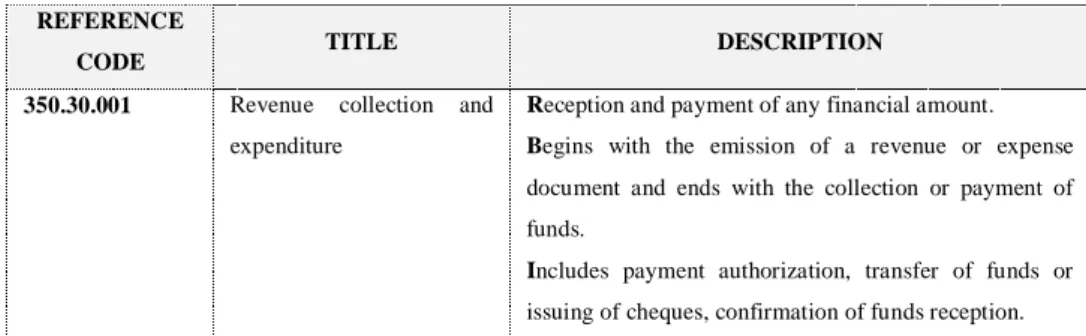
REFERENCE
CODE TITLE DESCRIPTION
350.30.001 Revenue collection and expenditure
Reception and payment of any financial amount. Begins with the emission of a revenue or expense document and ends with the collection or payment of funds.
Includes payment authorization, transfer of funds or issuing of cheques, confirmation of funds reception.
The understanding of the conceptual map paved the path for codification upon three basic rules that explain the structure of the classification plan:
1. divide 999 by the number of branches obtained in the subdivision of each function and sub-function (999/x);
2. round up in the hundreds;
3. begin the first branch in 001 and the following in 100, 200, 300, etc. depending on the number of branches.
One of the main achievements of the project can be considered to be the creation of different tools that define a new system of information classification in the Portuguese public administration (Meta-information for Interoperability, Functional Macrostructure and Classification Plan), based on a functional structure and a approach to business processes. These promote semantic interoperability and are essential for the organization, representation, retrieval and management of information within the framework of e-government services that reflect European and national directives for interoperability. The research endeavored by the project has the potential to benefit the entire public administration in its several levels: central, regional and local. The classification plan already includes a Consolidated List with more than a thousand
business processes that is managed by DGLAB, the body that coordinates the national archival policy. It is responsible for codification, which offers the various Portuguese public administration bodies a set of advantages, such as:
- The production and use of a single classification tool at the disposal of public administration for the classification of organizational information, leading to an economy in resources;
- The availability of a standardized functional classification plan, which is particularly significant when considering the vast number of bodies that have none;
- Simplification in when preparing other information management tools, such as preservation plans;
- Assistance in appraisal and selection of archival information;
- Contribution to the development of projects in business processes’ reengineering (Millar, L.; Roper, M. & Stewart, K., 1999, 6);
- Improvements in the efficiency and effectiveness of public administration; - Optimization in the management of internal resources by each body in public administration;
- Improvements in the internal and external mobility of resources; - Support and anticipate decision making;
- Enhancement of horizontal and vertical interinstitutional communication.
- Assistance to bodies undergoing restructuration regarding the permanent management of information;
- Promotion of information reuse;
- The possibility of integration with performance metrics.
Conclusion: from the functional classification plan to the creation of an ontology
Overall, regardless of the need of improvement, both the Functional Macro-Structure (MEF-AP) and the Information’s Classification Plan for Portuguese Public Administration (PCI-AP) contribute significantly to the emergence of a new paradigm concerning the management of archival information and documentation within the framework of public administration. In this new paradigm, functions are matched with business processes, both transversely and supra-institutionally. The public
administration bodies are posited as open systems, according to the analytic paradigm (von Bertalanffy, 1973; Crubellate, 2007, 201). Likewise, an organization is considered to be an open system, in line with the phenomenological school (Gherardi and Nicoli, 2003) and with the Organizational Theory (Scott, 1992).
Simultaneously, the public administration and, more specifically, the archival community, also gain a new standardized tool for information management that is useful for the classification, appraisal and selection of information. It is also currently being developed an ontology based on WOL (Web Ontology Language), a language for knowledge representation, which has been proposed by W3C as a ‘standard’ to codify ontologies from the semantic web’s perspective.
The paradigm suggested by Portugal represents a new approach not only in the organization, representation and retrieval of information/knowledge, but also in the management of archival information, making it a matrix model that links functions to business processes. Such change definitively places the manager of the information system at the elaboration, planning and development of the information system, granting him a leading role in the organizational management centered around the asset information, perceived as an object, process and product.
References
Bak, Greg (2010). La clasificación de documentos electrónicos: documentando relaciones entre documentos. Tabula. N.º 13, pp. 59-78.
Barros, Thiago (2012). A classificação funcional em Arquivística: uma análise da colaboração científica nos periódicos Archivaria e American Archivist = The functional classification in Archival Science: an analysis of the scientific collaboration in the Journals Archivaria and American Archivist. 20 Años del Capítulo Español de ISKO. Actas del X Congreso ISKO Capítulo Español (Ferrol, 2011). Universidade da Coruña (España), pp. 157-169.
Crubellate, João Marcelo (2007). Três contribuições conceituais neofuncionalistas à teoria institucional em organizações. RAC: Revista de Administração Contemporânea, pp. 199-222. Dahlberg, Ingetraut (1978). Teoria do conceito [online]. Ciência da Informação. Rio de Janeiro, Instituto Brasileiro de Informação em Ciência e Tecnologia, 7(2): 101-107. Available at
http://revista.ibict.br/ciinf/index.php/ciinf/article/viewFile/1680/1286. [Accessed 22 January 2013].
Duranti, Luciana (1998). Diplomatics. New uses for an Old Science. Lahnam and London: The Society of American Archivists and Association of Canadian Archivists in association with The Scarecrow Press.
Duranti, Luciana (1997). The archival bond. Archives and Museum Informatics. N.º 11, pp. 213-218.
Foscarini, Fiorella (2010). La clasificación de documentos basada en funciones: comparación de la teoría y la práctica. Tabula. N.º 13, pp. 41-57.
Gherardi, Silvia & Nicolini, Davide (2003). The sociological foundations of organizational learning. In Dierkes; Antal; Child; Nonaka (ed.). Handbook of organizational learning & knowledge. Oxford: Oxford Universityu Press, pp. 35-60.
HjØrland, Birger (2012). Is classification necessary after Google? 20 Años del Capítulo Español de ISKO. Actas del X Congreso ISKO Capítulo Español (Ferrol, 2011). Universidade da Coruña (España), pp. 19-30.
Millar, Laura, Roper, Michael y Stewart, Kelly (1999). Glossary [online] London, International Records Management Trust.
Penteado, Pedro, coord.; Lourenço, Alexandra; Henriques, Cecília (2013). Macroestrutura Funcional (MEF) [em linha]. Versão 2.0. Lisboa, Direção Geral do Livro, dos arquivos e das Bibliotecas, 2013. <http://dgarq.gov.pt/files/2013/04/2013-03-28_MEF-v2_0.pdf>. [Accessed 8 de May 2013].
San Segundo, Rosa y Martínez, Daniel (2012). El orden de los saberes y la organización digital = The order of knowledge and the digital organization. 20 Años del Capítulo Español de ISKO. Actas del X Congreso ISKO Capítulo Español (Ferrol, 2011). Universidade da Coruña (España), pp. 413-421.
Schellenberg, Theodore R. (1956). Modern Archives: Principles and techniques. Chicago: University of Chicago Press.
Scott, W. Richard (1992). Organisations: rational, natural and open systems. 3rd ed. Thousand Oaks: SAGE.
Silva, Carlos Guardado da (2015). Sumário pormenorizado da lição para obtenção do título de agregado. Coimbra: Universidade de Coimbra.
Silva, Carlos Guardado da (2013) - A classificação da informação arquivística da administração local nos países ibéricos: uma análise comparada. [pen disk]. In Jornadas Ibéricas de Arquivos Municipais: Políticas, sistemas e instrumentos. Lisboa, Câmara Municipal. Arquivo Municipal, 4 e 5 de Junho 2013.
Simões, M. G. & Freitas, M. C. V. (2013). A classificação em arquivos e em bibliotecas à luz da teoria da classificação: pontos de convergência e de divergência. PontodeAcesso, Salvador, Vol. 7, n.º 1, p. 81-115.
Von Bertalanffy, Ludwig (1973). General system theory: foundations, development, applications. Harmondsworth: penguin.