Repositório ISCTE-IUL
Deposited in Repositório ISCTE-IUL:
2018-06-05Deposited version:
Post-printPeer-review status of attached file:
Peer-reviewedCitation for published item:
Ferreira, J. C., Silva, H., Afonso, J. A. & Afonso, J. L. (2017). An Android-based personalized public transportation advisor. In World Congress on Engineering 2017. London: International Association of Engineers.
Further information on publisher's website:
http://www.iaeng.org/WCE2017/index.htmlPublisher's copyright statement:
This is the peer reviewed version of the following article: Ferreira, J. C., Silva, H., Afonso, J. A. & Afonso, J. L. (2017). An Android-based personalized public transportation advisor. In World Congress on Engineering 2017. London: International Association of Engineers.. This article may be used for non-commercial purposes in accordance with the Publisher's Terms and Conditions for self-archiving.
Use policy
Creative Commons CC BY 4.0
The full-text may be used and/or reproduced, and given to third parties in any format or medium, without prior permission or charge, for personal research or study, educational, or not-for-profit purposes provided that:
• a full bibliographic reference is made to the original source • a link is made to the metadata record in the Repository • the full-text is not changed in any way
The full-text must not be sold in any format or medium without the formal permission of the copyright holders.
Serviços de Informação e Documentação, Instituto Universitário de Lisboa (ISCTE-IUL) Av. das Forças Armadas, Edifício II, 1649-026 Lisboa Portugal
Phone: +(351) 217 903 024 | e-mail: [email protected] https://repositorio.iscte-iul.pt
Abstract— This work presents the development of a mobile application which allows the user to access real time data related with public transportation information. This application combines the geographic user context and preferences with the data provided by a public transportation information system, fulfilling the necessities of today’s passengers and providing an incentive for the population to use the public transportation infrastructure. The proposed application, still in prototype stage, allows the user to benefit from real time access to public transportation data in a simple and intuitive form. Results from use cases and real world tests using data from a Brazilian bus fleet operator were employed to validate the operability and features of the developed prototype.
Index Terms—mobile application, intelligent public transportation, personalization, geographic information system.
I. INTRODUCTION
HE growing complexity of the public transportation networks, which enable the daily commuting of tens of millions of people living in the metropolitan areas of the world, together with the worldwide proliferation and reduction of cost of mobile data has opened an opportunity for mobile technology to contribute with a very significant improvement in everyday life for commuters all around the world. The immediate availability of real time information on the status of the public transportation network can be considered a top priority issue in cities like London, Tokyo and São Paulo, where the disruption of a single transportation line could lead to chaos. It is beyond any kind of practicality to know every one of the 19000 stops that London buses makes available to people in London, or to plan a trip that takes into consideration the commuting times between so many different buses, let alone know if there is a problem with the network branch you are planning to use,
Manuscript received December 26, 2016. This work is supported by FCT with the reference project UID/EEA/04436/2013, by FEDER funds through the COMPETE 2020 – Programa Operacional Competitividade e Internacionalização (POCI) with the reference project POCI-01-0145-FEDER-006941.
Joao C. Ferreira is with Instituto Universitário de Lisboa (ISCTE-IUL), ISTAR, Lisbon, Portugal and Centro Algoritmi (e-mail: [email protected]).
Henrique Silva is with Tecmic, Porto Salvo, 2740-120, Portugal (e-mail: [email protected]).
Jose A. Afonso is with CMEMS-UMinho, University of Minho, Campus of Azurem, Guimaraes, 4800-058, Portugal (phone: 351-253510190; fax: 351-253510189; e-mail: [email protected]).
Joao L. Afonso is with Centro Algoritmi, University of Minho, Campus of Azurem, Guimaraes, 4800-058, Portugal (phone: 351-253510190; fax: 351-253510189; e-mail: [email protected]).
since there are 673 different bus routes in London alone [1]. This topic has stirred a high level of interest from local governments and the public, as well as investment from companies worldwide, due the impact that information technology can have.
The solution proposed in this work makes use of the widespread availability of Android smartphones to create a personalized public transportation advisor taking into account the user’s personal preferences, current location and desirable destination. Making use of high speed mobile networks, like 4G and Wi-Fi, available today in big cities, this prototype combines the user’s current context with the XTraN Passenger API (Application Programming Interface) [2], which was developed by Tecmic, a Portuguese company. Instead of putting all the information in front of the user, the application’s main objective is to filter the overwhelming complexity of the modern transportation network information extracted from the XTraN Passenger system, showing only what is most relevant to the particular user context, through the app, in real time, whenever it is needed.
Although the typical everyday commuter will be familiar with his/her route, the added value of having a real time tracker for the public transportation of choice presents the user with the opportunity of obtaining much better travel time estimates, helping the user know when to leave home for work or if he can afford to wait for the next bus. When the user is not familiar with the routes, the value of this app is even higher, because, among other features, the user can check at any time which bus stops and routes are closer to his current position, and from this starting point he can then check the waiting times at these stops. For the purpose of this application, network connections at speeds of 3G and above will suffice for a fluent user experience.
II. RELATED WORK
There is a diversity of public transportation information systems that support transportation operators in their activity. Each big operator has its own system, but that does not fit in user needs because he needs real time information from the diversity of available operators.
XTraN Passenger is a public transportation information system developed by Tecmic, and it is implemented in a diversity of public transportation operators in Portugal and Brazil. This system is customized for each client, as the example of the operator Carris, in Lisbon. The XTraN Passenger system [2] was engineered to produce detailed real-time statistics on the fleets’ activity, giving the operators the capability to improve their services and
An Android-Based Personalized
Public Transportation Advisor
Joao C. Ferreira, Henrique Silva, Jose A. Afonso, Member, IAENG, and Joao L. Afonso
strategy based on the feedback gained from the system. The basic functionality of the system includes real time data on individual vehicles equipped with the XTraN Passenger on-board device, allowing for precise estimations of arrival times (ETAs) and varied channels to share information with the public (such as bus stop panels and SMS information services), integration with ticketing systems, continuous voice and text communication with the driver, fuel consumption statistics and analysis, as well as an on-board security feed and an engine kill-switch [3]. An overall schematics of a bus with the XTraN Passenger system installed can be seen in Fig. 1.
Fig. 1. Components of the XTraN Passenger system installed on a bus [2]. The widespread use of geographical information systems (GIS) for the purpose of intelligent transportation systems (ITS) during the last decade, and an increased demand for business intelligence systems which optimize a city’s public transportation network created a necessity for advances in the mechanisms through which geographic information systems are used. Continuous research and the worldwide use of mobile devices for the purpose day to day commute together with the mature state of current Web service technology paved the path to the creation of GIS-T (geographic information systems for transportation). As the symbiotic use of both GIS and ITS is of extreme importance for city councils or public transport operators, such is the need for an effective translation of geographic coordinates into usable data and the business intelligence derived from that data. The last decade also brought huge advances on the Internet and the proliferation of service-oriented architectures promoted the adaptation of GIS systems so that they could easily become accessible through other media [4]. In [5] the author explores the use of GIS Web services and service-oriented architectures with the objective of achieving a symbiotic architecture and building a Web service enabled GIS-based intelligent transportation application system [6].
The literature review done in the beginning of this work shows that there is a wide variety of research being done in the field of public transportation information on mobile devices. The list of analyzed apps was reduced to the following final pool based on the application area (Lisbon city) and relevance: (1) IZI Carris (Lisbon specific, single-operator: Carris) [7]; (2) Lisboa Move-Me (Lisbon specific, multi-operator) [8]; (3) Moovit (international, multi-city, operator) [9]; (4) Citymapper (international, multi-city, multi-operator) [10]. These apps were tested for the purpose of comparing not only the available features in these applications but also their degree of usability, graded by user
satisfaction rating recorded on the Google Play store. The combined outputs of the author’s own testing together with the public’s praise and criticism of these apps helped to mold the specifics of each of the use cases chosen for the prototype’s final version.
III. DEVELOPED MOBILE APPLICATION
This mobile application, named XTraN App, aims to not only provide real-time accurate data about buses, stops and routes, but also to present this information in a logical intuitive manner. An example would be that the user does not want to consult an extensive list of all buses provided by the operator as much as he wants to know when his commute bus is arriving; therefore, the home screen of the application always displays commute transports first.
A. App Requirements
The following software requirements specification was established based on others the study of related apps and public transportation experts experience:
R0: Interoperable. The mobile app must be compatible between different operators and countries, because it is available to all different public transportation operators that use XTraN Passenger in Brazil and Portugal.
R1: Static consultation. The mobile app must make available to users the complete static timetables and static estimated times of arrival (ETAs) of desired buses at any point in the chosen company’s network. There are multiple public transportation providers to choose from. R2: Real time XTraN information access. The app enables
the user to sort through the immensity of information made available by the XTraN Passenger system, keeping in mind the commuter-oriented nature of the application (discerning between the features that are needed to the user and the ones that are administrator-oriented). R3: Dynamic contextualized consultation. The user may
know at any time which bus stops are closer to his current position, the respective bus routes and the ETA of the next bus in each route.
R4: Personalized information. The app is able to access the huge database provided by Tecmic and sort through the information available, only exposing the user to what is relevant for him based on the current context.
R5: Personalized bus stop status. The app must provide notifications in the morning with the current status for the user’s morning commute bus stop and bus route.
R6: Locate next buses. The user is able to know in real time the ETAs for the next buses departing from the intended point of boarding. Time estimates for the bus arrival (ETA) are provided based on the current traffic context – available time-variants such as peak and off-peak daily variants, as well as weekday, weekend, holiday and seasonal changes, allowing for precise planning of arrival at the stop. The developed TimeEstimator service is a key part in obtaining realistic estimations based on thousands of buses making that same course on similar days.
R7: Trip mode 1. The user will be able to know where he is relatively to the planned bus route at all times when this
trip-mode is on. This feature provides warnings to allow a user in an unknown route to know when to press stop and leave the bus without previously knowing the place. R8: Trip mode 2. The prototype is able to access events
made available by the system in real time, providing the user real time guidance and warnings relevant to his commute, the traffic, and delays on the routes considered relevant (such as favorites) to the user.
R8: Intuitive UI. The UI designed for this application must be responsive and present data in an intuitive manner in such a way that a new user can easily use the application for its purpose without the initial struggle typical of other applications managing complex data. R10: Bus detection. The detection of the start of the user’s
journey is challenging, since there is currently no direct communication between the phone and the bus. The self-triggering of trip-mode and correct bus detection was done in another work [11].
R11: Social network. Integration and interaction with social networks such as Facebook and Google+ will be provided with the objective of establishing user ratings for the chosen bus routes, keeping companies accountable for delays and other deviations from the static timetable and creating social pressure for providing reliable bus services.
R12: RSS feed. Subscription of the RSS feeds of relevant bus companies will be possible. Integration with Android notification for disruption in the operation of the network will be provided.
B. Platform Architecture
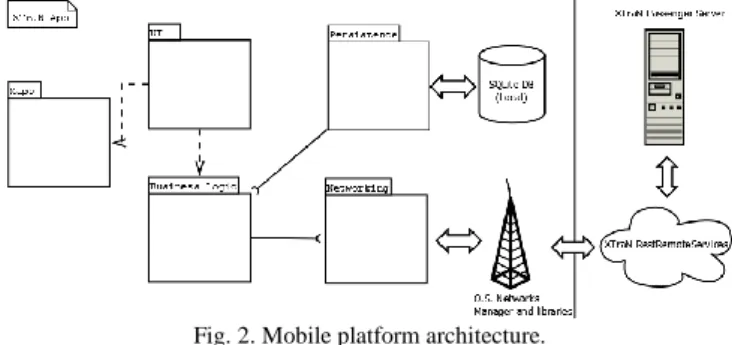
The architecture of this mobile application platform was designed to follow a layered structure adapted to the Android operating system’s operational requirements. The modules can be logically divided in five big components (Fig. 2): User Interface (UI), Business Logic, Persistence, Networking and Maps.
Fig. 2. Mobile platform architecture.
The UI module was one of the main investments during the development, and constituted a considerable part of the “prototyping phase” of this work. The UI module of this prototype follows Google guidelines, taking advantages of the latest developments in activities, adapters and fragments, so that a more fluid experience can be achieved. In situations where the components made available by Google were not considered by the authors as the best fit, new ones were developed, such is the case of the home screen. The UI module includes components which can be organized in two groups: customization and performance optimization.
The Business Logic module deals with data structures
which represent the real world public transportation companies from a commuter perspective: it is composed by buses and bus routes, bus stops and waiting times in a way which allows an accurate modeling of the business. This module uses both the Persistence and the Networking module.
The Persistence module deals with local storage, following the data access object (DAO) pattern to access a SQLite database.
The Networking module makes use of one of Google’s latest developments in networking implementation, the Volley library. This alternative to the native AsyncTask class allows for faster networking over HTTP, supports caching of requests, and is perfectly integrated with JSON requests, which suits the needs of this app. The Networking module deals with the crucial task of optimizing communications on top of the operating system’s network manager and libraries, allowing for asynchronous communication, coherent cache management and other features offered by Android Volley.
The Maps module deals with bringing geographic information [12] to the user, representing user location and other geographic data such as bus stop locations in an easily understandable visual language. It uses the OpenStreetMap library for Android, which provides complete overlay customization (which suits our needs to draw objects on the map) and interchangeable tile servers, so that a change on the tile server, if desired, can be made by changing just a few lines of code.
C. User Interface
The presentation layer of the UI module is mostly composed by activities, fragments, layouts and drawable resources. Taking a simple case as example (Fig. 3) where one activity groups together the most used features in swipe view tabs, these components work in sets: each activity uses a layout and drawable resources. Activities may also contain fragments with their own lifetime cycle, which in turn also have their own layouts that may use drawable resources.
The presentation layer is loosely coupled with the Business Logic and Persistence modules, and all code here aims at making a better use experience and displaying the information provided by the Business Logic module in a way that makes sense for the user.
D. Business Logic
The Business Logic module was planned to fit the needs of a real world public transportation business, while simultaneously simplifying whenever it was possible to do so. One of such examples is the model and the equivalent factories needed to obtain the correct object instances. Most instances of the model are then used by the adapters referenced previously as parts of the datasets feeding the adaptation layer sitting between the business model/business logic and the presentation layer.
Fig. 3. User Interface example: activity hosting a fragment that features all
the available bus routes.
The XTraN Passenger system offers a comprehensive set of features and entities describing real world public transportation business. The system was designed to serve the needs of fleet owners, managers and planners, which includes much a much larger amount of meta-data and results in a respectively more complex model than the one that needs to be publicly exposed or that is needed for the scope of a public domain application. For the purpose of building this prototype, a task of slimming down the existing model was performed (for example, the bus commuter does not need an app entity representing each bus driver). In order to fulfill the needs of the prototype’s use cases, the following model and entities are used: Bus, BusStop, City, Route, RouteVariant and TimeEstimation. These entities are instantiated by the corresponding factories, which make an optimized use of network requests through the addition of an intermediate network layer (using Android Volley).
IV. SYSTEM EVALUATION
The methodology followed in the validation of results obtained with the prototype consists in two phases. The first is a detailed walk-through of the steps in each use case to validate the operability of the prototype. Phase two is designed to validate the features offered by the prototype by matching the results against real world data from a commercially deployed setting of the XTraN Passenger system.
A. Current Position Information
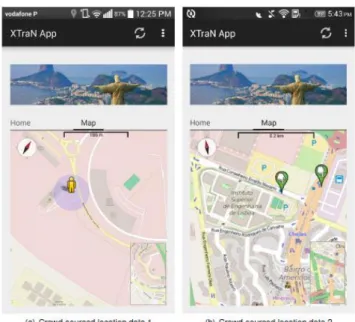
This use case tests the capability of the application to offer to the user information on his whereabouts, providing geographic location information in a map. The first position checking, performed at a Tecmic office near the IST Taguspark campus (IST and ISEL are two Portuguese higher education institutions located in Lisbon), shows the user location and his surroundings (Fig. 4(a)). A working example is shown in Fig. 4(b), with the closest bus stops to ISEL campus being drawn using the Open Overlays mechanism.
Fig. 4. Current position information results.
B. Route List and Route Data
This use case shows the user the complete list of RouteVariants provided by the public transport operator. The results show that the user can get the app to show the complete list with one swipe. A partial list of routes is shown in the left side of Fig. 5.
Fig. 5. Route list (left) and route data (right).
With a single click on an entry on the route list, the app shows the corresponding route data representing all this RouteVariant bus stops, as shown in the right side of Fig. 5. With only another swipe, the user can check the composition of the return way of the RouteVariant, which is frequently composed of different stops, due to one way streets and other transit regulations.
C. Bus Stop Status
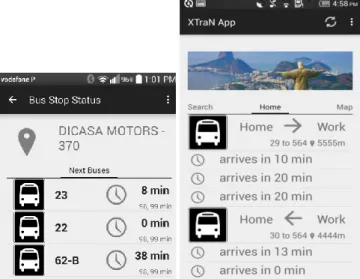
This screen displays an interactive real-time version of the bus stop timetable, showing the expected waiting time for the next buses (Fig. 6, left) and also identifying the different RouteVariants currently passing through that bus stop. This feature is working as expected, but when looking for
anomalous cases, results show that the prototype also displays buses which are registered as “not yet in voyage”. These vehicles are shown with a real position relative to normal working buses but always with a 0 waiting time associated to the bus (a real case of one of these anomalies can be seen in Fig. 6). From this test it was also observable that the layout and adapter are ready to accept multiple buses registered to a single RouteVariant, but as of the current date the API was not optimized for this UX (User Experience) usability feature.
Fig. 6. Bus stop status (left) and frequent buses and routes (right).
D. Frequent Buses and Routes
This test (Fig. 6, right) represents the predicted most used feature of the application - the user simply opens the app and is quickly shown real-time data on his most frequently used buses (trip home-work and work-home). We show also the average time (29 minutes) for the path home-work, the maximum trip time (56 minutes) and the distance (5555 m). The test shows that the performance mechanisms implemented in each of the different adapters work almost flawlessly, allowing the user to scroll customized rows taking into account the limit space available in a mobile device to show the information, at any speed that he likes.
E. Real World Tests
This set of evaluation tests used a VPN connection to the Brazilian servers of the public transportation company “Auto Lotação Ingá”, which operates in the cities of Rio de Janeiro and Niteroi, for direct access to the commercially deployed XTraN Passenger system. Through this connection, real world experimental data was obtained, which was used to validate the features of the developed mobile application. A desirable complementary method, which will be applied before production, includes users personally testing the prototype “on the ground” in Rio de Janeiro. Each of the features of the application will be verified against results from the fleet management functions of the XTraN Passenger system deployed on the company.
Fig. 7 puts side by side the synoptic map representation of a bus route variant with its respective counterpart verified in the operations’ center software.
Fig. 7. Validation of bus stops constituting a synoptic route map. The next validation test was performed by accessing the live feed in the new generation public information panel screens at the company’s bus stops (Fig. 8) and comparing the estimated times with what is shown in the XTraN App (Fig. 9, left). All ETAs from buses which are actively in voyage are shown in the application correctly; furthermore, the prototype shows ETAs for other “in voyage” buses which are not represented in the physical panel, but that also go through the “Moinho Atlântico” bus stop. The right side of Fig. 9 shows the screen for selection of favorite lines and bus stops.
Other features of the app, associated to the bus list, current position and bus stop status, were validated in a similar way. The conclusions that can be drawn from this experiment are very encouraging. The results obtained by the comparison between the prototype’s displayed values and the data available in the fleet management center in Brazil match perfectly, and the prototype can offer more relevant information to the user, as intended from the start.
V. CONCLUSION
This work presents the development of a mobile app for the XTraN Passenger intelligent transportation system, from Tecmic. The developed prototype meets the needs of the company for a successful implementation in the market.
The software requirements specification was first established for the prototype, based both on the features desired by Tecmic and the study performed to other apps available in the market. The comparison of features, usability and user satisfaction helped to mold the specifics of each of the use cases chosen for the prototype’s final version.
Another objective of the developed prototype was to implement the results of the use cases in ways that could be translated into a personalized user experience, where the user’s own inputs are significant for the resulting output of the application. Inputs such as the users’ preferences on the most used transports and the current geographic position are relevant factors for the use of the application and for taking the most benefits out of it.
Fig. 8. Waiting times at bus stops as seen in the public information panel at the bus stops in Brazil.
Fig. 9. Waiting times at bus stops as seen in the mobile app (left) and selection of favorites lines and bus stops (right).
Important work was also done in the field of optimization of Android resources and base classes, such as BaseAdapter, and the interaction with AdapterView classes, as well as in the field of customization of existing user interface classes and views. All of these developments resulted in an overall different and improved experience for the user, which will lead to a better future commercial product.
Even though there is a high degree of customization, there is very little to no noticeable lag in the utilization of the developed prototype, with the exception of some transitions between tabs (Home screen – Map screen – Route Search screen). This is a point to be improved in the future, but that do not hinder the current usability of the application.
REFERENCES
[1] Henrique C.M. Silva, “Personalized public transportation information,” MSc Thesis, ISEL - Instituto Politécnico de Lisboa, Sept. 2015.
[2] Tecmic “XTraN passenger - operating support systems for passenger transport,” [Online]. Available http://www.tecmic.pt/en/portfolio/ xtran-passenger/. [Accessed July 5, 2015].
[3] Tecmic, “XTraN passenger infopublic,” [Online]. Available http://www.tecmic.com/wp-content/uploads/2014/05/InfoPublic_EN. png. Accessed July 5, 2015].
[4] IBM, “Web services architecture overview - the next stage of evolution for ebusiness,” [Online]. Available http://www.ibm.com/ developerworks/library/w-ovr/. [Accessed July 5, 2015].
[5] X. Lu. “Develop Web GIS Based Intelligent Transportation Application Systems with Web Service Technology,” in Proceedings of 6th Int. Conference on ITS Telecommunications, Jun. 2006, pp. 159-162.
[6] W. Tang and J. Selwood, “Connecting our world: GIS Web services,” ESRI Press, Redlands, Calif., 2003.
[7] IZIMOOVE, “IZI Carris,” [Online]. Available https://play.google. com/store/apps/details?id=pt.izimoove.carris. [Accessed July 5, 2015].
[8] OPT, “Lisboa Move-me,” [Online]. Available https://play.google. com/store/apps/details?id=pt.izimoove.carris. [Accessed July 5, 2015].
[9] Moovit, “Moovit: Next bus and train info,” [Online]. Available https://play.google.com/store/apps/details?id=com.tranzmate&hl=en. [Accessed July 5, 2015].
[10] Citymapper Limited, “Citymapper - real time transit,” [Online]. Available https://play.google.com/store/apps/details?id=com. citymapper.app.release. [Accessed July 5, 2015].
[11] N. Baeta, A. Fernandes and J.C Ferreira, “Tracking Users Mobility at Public Transportation,” in Proceedings of PAAMS 2016 - 14th International Conference on Practical Applications of Agents and Multiagent Systems, Jun. 2016.
[12] M.Fasel, “A good look at android location data,” [Online]. Available https://shinesolutions.com/2011/10/14/a-good-look-at-android-location-data/. [Accessed August 20, 2016].
![Fig. 1. Components of the XTraN Passenger system installed on a bus [2].](https://thumb-eu.123doks.com/thumbv2/123dok_br/18088403.866145/3.892.70.439.306.504/fig-components-xtran-passenger-installed-bus.webp)