Article
0103 - 5053 $6.00+0.00
*e-mail: [email protected], [email protected]
Enzymatic Kinetic Resolution of (
RS
)-1-(Phenyl)ethanols by
Burkholderia cepacia
Lipase Immobilized on Magnetic Nanoparticles
Lya P. Rebelo,a Caterina G. C. M. Netto,b Henrique E. Toma*,b and
Leandro H. Andrade*,a
aLaboratoryof Fine Chemistry and Biocatalysis and bSupramolecular NanotechLab, Institute of
Chemistry, University of São Paulo, 05508-900 São Paulo-SP, Brazil
A lipase proveniente da Burkholderia cepacia imobilizada em nanopartículas superparamagnéticas usando diferentes metodologias de imobilização (adsorção e quimiosorção) foi eicientemente aplicada como biocatalisador reciclável na resolução cinética de (RS)-1-(fenil) etanols através de reações de transesteriicação. Os (R)-ésteres e os (S)-alcoóis foram obtidos com excelente excesso enantiomérico (> 99%), o que corresponde a um perfeito processo de resolução cinética enzimática (conversão 50%, E > 200). As reações de transesteriicação catalisadas pela lipase de B. cepacia imobilizada pela metodologia com glutaraldeído apresentaram os melhores resultados em termos de conversão após 8 ciclos de reação.
Lipase from Burkholderia cepacia immobilized on superparamagnetic nanoparticles using adsorption and chemisorption methodologies was eficiently applied as recyclable biocatalyst in the enzymatic kinetic resolution of (RS)-1-(phenyl)ethanols via transesteriication reactions. (R)-Esters and the remaining (S)-alcohols were obtained with excellent enantiomeric excess (> 99%), which corresponds to a perfect process of enzymatic kinetic resolution (conversion 50%,
E > 200). The transesteriication reactions catalysed with B. cepacia lipase immobilized by the glutaraldehyde method showed the best results in terms of reusability, preserving the enzyme activity (conversion 50%, E > 200) for at least 8 successive cycles.
Keywords: superparamagnetic nanoparticles, lipase, transesteriication catalysis, enantiomeric resolution
Introduction
Immobilized lipases have been successfully employed in hydrolysis1 and trans-esteriication catalysis, exhibiting
high enantioselectivity.2 Industrial use of such expensive
biocatalysts suffers yet from a critical point, which is the lack of efficient enzyme recovery processes.3
This is actually a general problem in catalysis. For this reason great efforts have been made, pursuing the best immobilization strategies for the enzymes on suitable solid supports.3 As a very promising alternative,
superparamagnetic nanoparticles based on magnetite (γ-Fe3O4) can provide outstanding support materials for the enzymes, exhibiting striking characteristics, such as large surface area, mobility and high mass transference. More than this, they can be easily recovered by simple application of an external magnetic ield.4 In addition to
their excellent environmental compatibility, the use of such superparamagnetic supports represents an effective green chemistry approach, allowing to extend, through the successive recovery cycles, the useful lifetime of the biocatalyst. Among the several synthetic routes to prepare iron-oxide superparamagnetic nanoparticles,4 the
most employed one for enzyme immobilization is the co-precipitation methodology which makes use of aqueous Fe2+/Fe3+ salt solutions. In addition, we can also mention
the use of other magnetic materials5-25 to immobilize
enzymes, such as magnetic metallic nanoparticles, magnetic microspheres prepared from copolymers with magnetic particles, hybrid materials (Fe3O4–silica–NiO) and magnetite-containing mesoporous silica spheres. A literature survey revealed that several enzymes including lactase,5 lipase,6 esterase,7 β-galactosidase,8 oxidase,9
dehydrogenase,10α-chymotripsin,11 chloroperoxidase,12
Penicillin G acylase,13 L-asparaginase,14 tyrosinase,15
levansucrase,20 amylase,21 streptokinase,22 dispase,22
dehalogenase,23 laccase24 and epoxide hydrolase25 have been
immobilized onto magnetic particles for different purposes. In this work, we report on the successful application of the immobilized form of Burkholderia cepacia lipase (BCL) on superparamagnetic nanoparticles, exploring three different immobilization methodologies and their inluence in the enzymatic kinetic resolution of secondary alcohols.
Results and Discussion
Magnetite (Fe3O4) nanoparticles of about 10 nm size, were obtained by the co-precipitation method26,27
exhibiting a typical superparamagnetic behavior. In order to improve their stability and add reactive amino groups for enzyme immobilization purposes, they were treated with 3-aminopropyltrimethoxysilane (APTS), generating APTS-coated nanoparticles, here referred as APTS-MagNP (Scheme 1).
The immobilization of B. cepacia lipase on the superparamagnetic nanoparticles was carried out according to three different methods28 pursuing the best performance
in the enzymatic kinetic resolution of secondary alcohols. The irst method consisted in the direct interaction of the enzyme with APTS-MagNP (Scheme 1A). It should be noticed that at pH 7, lipase from B. cepacia is negatively charged (isoelectric point = 5.2)29 while the
superparamagnetic nanoparticles exhibit a positive charge due to the protonation of the aliphatic amines (pKa ca. 9).30
In this way, the APTS shell can act as effective binding site for the lipase protein chains, either via hydrogen bonding or electrostatic interactions with the amide and aminoacid residues of the enzyme. Typically, it was employed in the preparations a protein solution (550 µg L-1; 1 mL) for 20 mg
of APTS-MagNP. After work-out, the amount of protein immobilized on the superparamagnetic nanoparticles was determined by Bradford method,31 yielding 0.21 mg
protein/20 mg APTS-MagNP.
The second lipase immobilization method consisted in the previous modiication of the APTS-functionalized nanoparticles with carboxybenzaldehyde, in order to make the covalent attachment of the lipase (Scheme 1B). In the next step, the amino groups from APTS-MagNP react with the carboxybenzaldehyde, yielding imines, which can be converted into their secondary amines by the reduction with NaBH4. Then, the remaining carboxylic groups from carboxybenzaldehyde moieties can react with EDC (1-ethyl-3-(3-dimethyl aminopropyl) carbodiimide hydrochloride), and inally perform the coupling with the lipase (550 µg L-1). This protocol led to immobilization of
0.23 mg protein on 20 mg Carboxy-APTS-MagNP. The third immobilization method was based on glutaraldehyde (Glu) as the coupling agent for making the covalent attachment of the lipase enzyme to the APTS-MagNP (Scheme 1C). Glutaraldehyde reacts with the amino group from APTS-MagNP forming imine bonds, leaving the terminal aldehyde group for reacting with the amino residues of the enzyme. In this case, it was possible to bind 0.26 mg protein to 20 mg of Glu-APTS-MagNP.
Fe3O4 O
O O
Si NH2 Fe3O4 OH
OH OH
(ii) Fe2+
2 Fe3+
(i)
Fe3O4 O
O O
Si N
H
O OH
Fe3O4 O
O O
Si N
H
O
H N
Lipase
Fe3O4 O
O O
Si N
(iii)
O
Fe3O4 O
O O
Si N N Lipase
APTS-MagNP
Carboxy-APTS-MagNP
BCL-Carboxy-APTS-MagNP
Glu-APTS-MagNP
BCL-Glu-APTS-MagNP
(vi,iii) (iii)
Fe3O4 O O O
Si NH3OOC Lipase
BCL-APTS-MagNP
(iv,v) (vii)
(A) (B) (C)
Scheme 1. Immobilization of B. cepacia lipase on superparamagnetic nanoparticles (A = Adsorption method; B = Carboxybenzaldehyde method; C = Glutaraldehyde method); (i) Fe2+/Fe3+ oxides, NaOH (0.5 mol L-1), 0.5 h; (ii) (3-aminopropyl)trimethoxysilane, 12 h; (iii) B. cepacia lipase (550 µg
Enzyme activity: enzymatic kinetic resolution of (RS)-1-(phenyl)ethanol derivatives
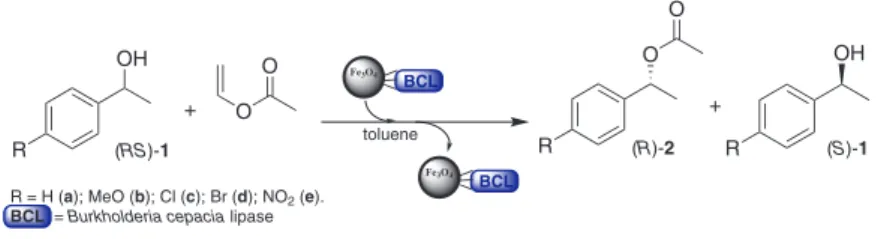
The lipase activity was determined for the enzymatic kinetic resolution of (RS)-1-(phenyl)ethanols (1) via
enantioselective acetylation, yielding the corresponding esters (2) (Scheme 2).
In the control experiments, a sample of B. cepacia
lipase solution, employed in the immobilization studies, was lyophilized and used in the enzymatic resolution of (RS)-1-(phenyl)ethanol and (RS)-1-(4-nitro-phenyl)ethanol. Typical results are shown in Table 1, and can be taken as reference for comparison purposes with respect to the catalytic activity of the immobilized enzyme (Figure 1).
As one can see in Figure 1, free B. cepacia lipase afforded the ester 2 with high E-value, but with lower conversion than in the cases of using immobilized lipase. This is a remarkable aspect, since besides the possibility of recycling the biocatalyst, the immobilization process seems also to improve the enzyme activity, increasing the conversion rates.
The results from the KR of a racemic mixture of substituted (RS)-1-(phenyl)ethanols 1a-e using immobilized B. cepacia lipase are shown in Table 1. The substituents attached to the aromatic ring were chosen to
Scheme 2. Enzymatic resolution of (RS)-1-(phenyl)ethanols via enantioselective acetylation catalyzed by B. cepacia lipase. O
O
+
OH
(RS)-1 (R)-2 (S)-1
O O
+
toluene
R R R
OH
Fe3O4 BCL Fe3O4
BCL
R = H (a); MeO (b); Cl (c); Br (d); NO2 (e).
BCL = Burkholderia cepacia lipase
Figure 1. Comparison of the conversion obtained in the KR of (RS)-1a and (RS)-1e catalyzed by free (Free BCL) and B. cepacia lipase immobilized by adsorption (BCL-APTS-MagNP), glutaraldehyde (BCL-Glu-APTS-MagNP) and carboxybenzaldehyde method (BCL-Carboxy-APTS-MagNP): (S)-alcohols and (R)-esters (ee > 99%; E > 200).
provide a wide range of electron donor and withdrawing characteristics.
As one can see in Table 1, all reactions yielded the corresponding (R)-acetates in excellent conversion rates (50%) with E-value > 200. It is important to mention that the stereochemistry of the resolved chiral alcohols and their acetates is in accordance with Kazlauska’s rule.34
Surprisingly, no signiicant difference between the results of KR using B. cepacia lipase immobilized by the three methodologies could be detected.
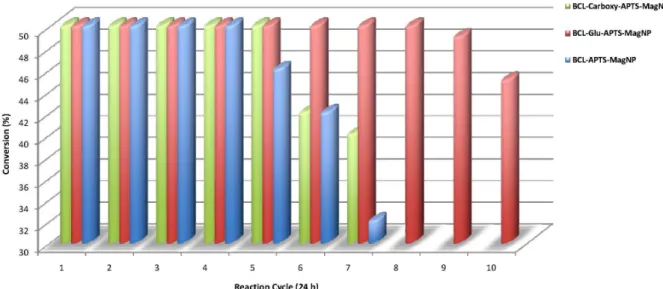
In order to evaluate the recycling potential of the different immobilized forms of the B. cepacia lipase on magnetic nanoparticles [(immobilized by adsorption method APTS-MagNP), by carboxybenzaldehyde method (BCL-Carboxy-APTS-MagNP) and by glutaraldehyde method (BCL-Glu-APTS-MagNP)], the KR of (RS)-1a was carried out in several repetitive reaction cycles (24 h). The immobilized B. cepacia lipase was collected with a magnet, and used again in a new experiment (Figure 2).
As can be seen in Figure 2, the glutaraldehyde method provided the best lipase reusability, exceeding 8 cycles with the same conversion eficiency (50%) and enantioselectivity (> 99%), while the other two methods collapsed after the ifth cycle. These results can be attributed to the eficient covalent binding of lipase to the magnetic nanoparticles using glutaraldehyde, which is known as a good cross-linking agent between enzyme and solid supports containing amino groups.3 It should be noted that
the long period of each reaction cycle (24 h) employed in the experiments can be contributing to the decrease of enzymatic activity. Since the enzymatic kinetic resolution is carried out in organic solvent, some protein denaturation can also occur, and consequently, an undesired loss of lipase activity is observed.3
Conclusions
Immobilization of lipase from B. cepacia onto superparamagnetic nanoparticles using different methodologies afforded a magnetically recoverable, highly eficient biocatalyst. The lipase activity determined in the KR of different secondary alcohols afforded excellent
O O
+
OH
(RS)-1 (R)-2 (S)-1
O O
+
toluene
R R R
OH
Fe3O4
BCL
Fe3O4
BCL
R = H (a); MeO (b); Cl (c); Br (d); NO2 (e).
Figure 2. Reusability of the B. cepacia lipase immobilized by different methodologies (Carboxy-APTS-MagNP, Glu-APTS-MagNP and BCL-APTS-MagNP) in the KR of (RS)-1a to afford the (R)-ester 2a (ee > 99%; E > 200).
Table 1. Enzymatic kinetic resolution of (RS)-1-(phenyl)ethanols by B. cepacia lipase immobilized by different methodologiesa
O O
+
OH
(RS)-1 (R)-2 (S)-1
Fe3O4
BCL
O O
+
R R R
OH
BCL = Burkholderia cepacia lipase
Toluene
Entry Substrate R Immobilized form of B. cepacia lipase ee (%)c Conversion
(%)d
Ee
(R)-2 (S)-1
1 1a H BCL-APTS-MagNP > 99 > 99 50 > 200
2 1b MeO BCL-APTS-MagNP > 99 > 99 50 > 200
3 1c Cl BCL-APTS-MagNP > 99 > 99 50 > 200
4 1d Br BCL-APTS-MagNP > 99 > 99 50 > 200
5 1e NO2 BCL-APTS-MagNP > 99 > 99 50 > 200
6 1a H BCL-Carboxy-APTS-MagNP > 99 > 99 50 > 200
7 1b MeO BCL-Carboxy-APTS-MagNP > 99 > 99 50 > 200
8 1c Cl BCL-Carboxy-APTS-MagNP > 99 > 99 50 > 200
9 1d Br BCL-Carboxy-APTS-MagNP > 99 > 99 50 > 200
10 1e NO2 BCL-Carboxy-APTS-MagNP > 99 > 99 50 > 200
11 1a H BCL-Glu-APTS-MagNP > 99 > 99 50 > 200
12 1b MeO BCL-Glu-APTS-MagNP > 99 > 99 50 > 200
13 1c Cl BCL-Glu-APTS-MagNP > 99 > 99 50 > 200
14 1d Br BCL-Glu-APTS-MagNP > 99 > 99 50 > 200
15 1e NO2 BCL-Glu-APTS-MagNP > 99 > 99 50 > 200
aBCL immobilized by adsorption method (BCL-APTS-MagNP), by carboxybenzaldehyde method (BCL-Carboxy-APTS-MagNP) and by glutaraldehyde
method (BCL-Glu-APTS-MagNP); bGeneral conditions: Substrates (0.01 mmol), vinyl acetate (30 μL), toluene (1 mL), lipase (adsorption method =
0.21 mg lipase/20 mg APTS-MagNP; carboxybenzaldehyde method = 0.23 mg lipase/20 mg APTS-MagNP; glutaraldehyde method = 0.26 mg lipase/ 20 mg APTS-MagNP), 800 rpm, 24 h, 32 ºC. cee = Enantiomeric excess was determined by chiral GC analysis. d Conversion =ee
S/(eeS + eeP). eE = {ln[ee
P(1 - eeS)]/(eeP+ eeS)}/{ln[eeP(1 + eeS)]/(eeP + eeS)}.
32 The absolute conigurations of all compounds were determined by comparison of the
sign of the measured speciic rotation with those in the literature.33
O O
+
OH
(RS)-1 (R)-2 (S)-1
Fe3O4 BCL
O O
+
R R R
OH
BCL = Burkholderia cepacia lipase
conversion (50%) and enantiomeric ratio (E > 200). The lipase immobilized by glutaraldehyde method showed the best results in terms of reusability, preserving the enzyme activity for at least 8 successive cycles. These results validate a new green approach to be used in the KR of secondary alcohols.
Experimental
General procedure for enzymatic kinetic resolution of
substituted (RS)-1-(phenyl)ethanols (1a-e)
To 2 mL microtube (eppendorff®) containing 20 mg ofmagnetic nanoparticles with immobilized lipase by appropriate methodology (see Table 1), substituted (RS)-1-(phenyl)ethanols (1a-e) (0.01 mmol) and vinyl acetate (0.3 mmol) were dispersed in toluene and stirred with 800 rpm at 32 ºC for 24 h. After the reaction, the samples were analyzed by GC analysis using a chiral capillary column.
Reusability of B. cepacia lipase on the enzymatic kinetic
resolution of (RS)-1-(phenyl)ethanol (1a)
To 2 mL microtube (eppendorff®) containing 20 mg ofmagnetic nanoparticles with immobilized B. cepacia
lipase by appropriate methodology (see Figure 2), (RS)-1-(phenyl)ethanol (1a) (0.01 mmol) and vinyl acetate (0.3 mmol) were dispersed in toluene and stirred at 32 oC
for 24 h under 800 rpm. After 24 h reaction, the magnetic nanoparticles were controlled by magnetic and supernatant, containing the alcohol 1a and ester 2a, was collected for determination of the enantiomeric excess and conversion. Then, the immobilized B. cepacia lipase on the magnetic nanoparticles was washed with toluene (3×1 mL) and then used for the next cycle.
Acknowledgments
The authors acknowledge the support from FAPESP, CNPq and PETROBRAS.
References
1. For some examples, see: Shaw, S.-Y.; Chen, Y.-J.; Ou, J.-J.; Ho, L.; Enzyme Microb. Technol.2006,39, 1089; Palomo, J. M.; Segura, R. L.; Fernandez-Lorente, G.; Fernandez-Lafuente, R.; Guisan, J. M.; Enzyme Microb. Technol.2007,40, 704; Fernandez, R. E.; Bhattacharya, E.; Chadha, A.; Appl. Surf. Sci.
2008,254, 4512; da Silva V. C. F.; Contesini F. J.; Carvalho P.
O. J. Braz. Chem. Soc. 2008, 19, 1468.
2. For some examples, see: Hara, P.; Hanefeld, U.; Kanerva, L. T.;
J. Mol. Catal. B: Enzym.2008,50, 80; Hara, P.; Hanefeld, U.; Kanerva, L. T.; Green Chem.2009,11, 250; Itoh, T.; Han, S.; Matsushida, Y.; Hayase, S.; Green Chem.2004,6, 437; Zhang, Y.; Li, J.; Han, D.; Zhang, H.; Liu, P.; Li, C.; Biochem. Biophys.
Res. Commun.2008,365, 609.
3. For some reviews on enzyme immobilization, see: Hanefeld, U.; Gardossi, L.; Magner, E.; Chem. Soc. Rev.2009, 38, 453; Mateo, C.; Palomo, J. M.; Fernandez-Lorente, G.; Guisan, J. M.; Fernandez-Lafuente, R.; Enzyme Microb. Technol. 2007,
40, 1451; Sheldon, R. A.; Adv. Synth. Catal.2007, 349, 1289. Cao, L.; Curr. Opin. Chem. Biol.2005, 9, 217; Cao, L.; van Langen, L.; Sheldon, R. A.; Curr. Opin. Biotechnol.2003, 14, 387.
4. Lu, A. H.; Salabas, E. L.; Schüth, F.; Angew. Chem. Int. Ed. 2007, 46, 1222; Huang, S.-H.; Liao, M.-H.; Chen, D.-H.;
Biotechnol. Prog.2003, 19, 1095; Dyal, A.; Loos, K.; Noto, M.; Chang, S. W.; Spagnoli, C.; Shai, K. V. P. M.; Ulman, A.; Cowman, M.; Gross, R. A.; J. Am. Chem.Soc. 2003, 125, 1684. 5. Dekker, R. F. H.; Appl. Biochem. Biotechnol.1989, 22, 289. 6. For some recent examples, see: Netto , C. G. C. M.; Andrade,
L. H.; Toma, H. E.; Tetrahedron: Asymmetry2009,20, 2299; Wang, X.; Dou, P.; Zhao, P.; Zhao, C.; Ding, Y.; Xu, P.;
ChemSusChem2009, 2, 947; Chaubey, A.; Parshad, R.; Taneja, S. C.; Qazi, G. N.; Process Biochem.2009, 44, 154; Hu, B.; Pan, J.; Yu, H.-L.; Liu, J.-W.; Xu, J.-H.; Process Biochem. 2009, 44, 1019; Lee, D. G.; Ponvel, K. M.; Kim, M.; Hwang, S.; Ahn, I. S.; Lee, C. H.; J. Mol. Catal. B: Enzym.2009, 57, 62. 7. Shaw, S.-Y.; Chen, Y.-J.; Ou, J.-J.; Ho, L.; Enzyme Microb.
Technol. 2006, 39, 1089.
8. Pan, C.; Hu, B.; Li, W.; Sun, Y.; Ye, H.; Zeng, X.; J. Mol. Catal. B: Enzym.2009, 61, 208.
9. Sulek, F.; Drofenik, M.; Habulin, M.; Knez, Z.; J. Magn. Magn. Mat.2010,332, 179; Sohn, O. J.; Kim, C. K.; Rhee, J. I.; Biotechnol. Bioprocess Eng.2008, 13, 716; Betancor, L.; Fuentes, M.; Dellamora-Ortiz, G.; Lopez-Gallego, F.; Hidalgo, A.; Alonso-Morales, N.; Mateo, C.; Guisan, J. M.; Fernandez-Lafuente, R.; J. Mol. Catal. B: Enzym.2005, 32, 97; Kouassi, G. K.; Irudayaraj, J.; McCarty, G.; J. Nanobiotech.2005, 3, 1; Rossi, L. M.; Quach, A. D.; Rosenzweig, Z.; Anal. Bioanal. Chem.2004, 380, 606.
10. Yusdy; Patel, S. R.; Yapa, M. G. S.; Wang, D. I. C.; Biochem. Eng. J.2009, 48, 13; Li, G. Y.; Huang, K. L.; Jiang, Y. R.; Yang, D. L.; Ding, P.; Int. J. Biol. Macromol.2008, 42, 405; Goldberg, K.; Krueger, A.; Meinhardt, T.; Kroutil, W.; Mautner, B.; Liese, A.; Tetrahedron: Asymmetry2008, 19, 1171.
11. Yu, J.; Wang, C.; Hong, J.; Huang, J.; J. Macromol. Sci., Part A: Pure Appl. Chem. 2009, 46, 943; Hong, J.; Gong, P.-J.; Yu, J.-H.; Xu, D.-M.; Sun, H.-W.; Yao, S.; J. Mol. Catal. B: Enzym.2006, 42, 99. 12. Wang, W.; Xu, Y.; Wang, D. I. C.; Li, Z.; J. Am. Chem. Soc.
13. Huang, J.; Li, X.; Zheng, Y.; Zhang, Y.; Zhao, R.; Gao, X.; Yan, H.; Macromol. Biosc.2008, 8, 508; Wang, W.; Deng, L.; Peng, Z. H.; Xiao, X.; Enzyme Microb. Technol. 2007, 40, 255. 14. Teodor, E.; Truica, G.; Lupescu, I.; Roum. Biotechnol. Lett.
2008, 13, 3907.
15. Wang, S.; Tan, Y.; Zhao, D.; Liu, G.; Biosens. Bioelectron.2008,
23, 1781.
16. Zhang, H.-L.; Lai, G.-S.; Han, D.-Y.; Yu, A.-M.; Anal. Bioanal. Chem.2008, 390, 971.
17. Kuroiwa, T.; Noguchi, Y.; Nakajima, M.; Sato, S.; Mukataka, S.; Ichikawa, S.; Process Biochem. 2008, 43, 62.
18. Liang, Y.-Y.; Zhang, L.-M.; Biomacromolecules2007, 8, 1480; Lei, H.; Wang, W.; Chen, L.-L.; Li, X.-C.; Yi, B.; Deng, L.;
Enzyme Microb. Technol. 2004, 35, 15.
19. Prakasham, R. S.; Devi, G. S.; Laxmi, K. R.; Rao, C. S.; J. Phys. Chem. C2007, 111, 3842.
20. Jang, K.-H.; Song, K.-B.; Park, B.-S.; Kim, C. H.; Chung, B. H.; Choue, R. W.; Lee, K. S.; Lee, C.; Chun, U.-H.; Rhee, S.-K.;
Process Biochem. 2001, 37, 339.
21. Namdeo, M.; Bajpai, S. K.; J. Mol. Catal. B: Enzym.2009, 59, 134; Bahar T.; Çelebi, S. S.; Enzyme Microb. Technol. 2000,
26, 28.
22. Koneracká, M.; Kopcansky, P.; Timko, M.; Ramchand C. N., Sequeira A.; Trevan, M.; J. Mol. Catal. B: Enzym.2002, 18, 13. 23. Johnson, A. K.; Zawadzka, A. M.; Deobald, L. A.; Crawford,
R. L.; Paszczynski, A. J.; J. Nanopart. Res.2008, 10, 1009. 24. Zhu, Y.; Kaskel, S.; Shi, J.; Wage, T.; van Pée, K. -H.; Chem.
Mater. 2007, 19, 6408.
25. Lee, K. S.; Woo, M. H.; Kim, H. S.; Lee, E. Y.; Lee, I. S.; Chem.
Commun.2009, 3780.
26. Kim, D. K.; Mikhaylova, M.; Zhang, Y.; Muhammed, M.; Chem. Mat. 2003, 15, 1617.
27. Yamaura, M.; Camilo, R. L.; Sampaio, L. C.; Macedo, M. A.; Nakamura, M.; Toma, H. E.; J. Magn. Magn. Mat.2004,279, 210.
28. Andrade, L. H.; Rebello, L. P.; Netto, C. G. C. M.; Toma, H. E.; J. Mol. Catal. B: Enzym.2010, 66, 55.
29. Schrag, J. D.; Li, Y.; Cygler, M.; Lang, D.; Burgdorf, T.; Hecht, H. J.; Schmid, R.; Schomburg, D.; Rydel, T. J.; Oliver, J. D.; Strickland, L.C.; Dunaway, C. M.; Larson, S. B.; Day, J.; McPherson, A.; Structure 1997,5 187.
30. Handbook of Chemistry and Physics, 67ª ed.; CRC Press: Florida, USA.
31. Bradford, M. M.; Anal. Biochem. 1976,72, 248.
32. Chen, C. S. F., Y.; Girdaukas, G.; Sih, C. J.; J. Am. Chem. Soc.
1982,104, 7294; Straathof, A. J. J.; Jongejan, J. A.; Enzyme
Microb. Technol. 1997,21, 559.
33. Naemura, K.; Murata, M.; Tanaka, R.; Yano, M.; Hirose, K.; Tobe, Y.; Tetrahedron: Asymmetry1996, 7, 3285; Yadav, J. S.; Nanda, S.; Reddy, P. T.; Rao, A. B.; J. Org. Chem.2002, 67, 3900; Kim, M.-J.; Kim, H. M.; Kim, D.; Ahn, Y.; Park, J.; Green Chem.2004, 6, 471.
34. Kazlauskas, R. J.; Weissloch, A. N. E.; Rappaport, A. T.; Cuccia, L. A.; J. Org. Chem.1991, 56, 2656.
Received: December 18, 2009
Web Release Date: April 22, 2010