0103 - 5053 $6.00+0.00
Short Repport
* e-mail: [email protected]
Leaf-Cutting Ants Toxicity of Limonexic Acid and Degraded Limonoids from
Raulinoa
echinata.
X-Ray Structure of Epoxy-fraxinellone
Maique W. Biavatti*,a, Rosângela Westerlona, Paulo C. Vieirab, M. Fátima G. F. da Silvab, João B. Fernandesb, M. Fernanda G. V. Peñaflorc, Odair C. Buenoc and Javier Ellenad
a
Universidade do Vale do Itajaí, Programa de Pós-Graduação em Ciências Farmacêuticas, CP 360, 88303-202 Itajaí – SC, Brazil
b
Departamento de Química, Universidade Federal de São Carlos, CP 676, 13565-905 São Carlos – SP, Brazil
c
Centro de Estudos de Insetos Sociais, Universidade Estadual de São Paulo, Rio Claro – SP, Brazil
d
Instituto de Física de São Carlos, Universidade de São Paulo, São Carlos – SP, Brazil
A investigação fitoquímica das raízes de Raulinoa echinata, planta endêmica do Vale do Itajaí/
SC, levou ao isolamento e identificação dos limonóides degradados: fraxinelona, fraxinelonona e epoxi-fraxinelona. O último foi anteriormente isolado dos caules, porém sua configuração relativa não foi resolvida por experimentos de RMN. Este trabalho apresenta a análise de difração de raios-X da epoxi-fraxinelona, descreve o isolamento da fraxinelonona e fraxinelona pela primeira vez em Raulinoa, e a atividade tóxica da primeira sobre formigas cortadeiras (Attasexdens rubropilosa). Pouca atividade foi observada para o limonóide degradado testado; entretanto, o
limonóide ácido limonéxico isolado dos caules, apresentou alta toxicidade contra as formigas cortadeiras, reduzindo consideravelmente a longevidade das mesmas, em comparação com o controle.
Phytochemical survey of roots extracts of the South Brazilian endemic plant Raulinoa echinata
Cowan, Rutaceae led to the isolation of known degraded limonoids: fraxinellone, fraxinellonone and epoxy-fraxinellone. The latter was previously isolated also from the stems, but the relative configuration could not be solved by NMR experiments. This paper deals with the X-ray diffraction analysis of epoxy-fraxinellone and its toxicity to leaf-cutting ants, describes the isolation of fraxinellonone and fraxinellone for the first time in Raulinoa. Epoxy-fraxinellone showed no toxicity to the leaf-cutting ants (Attasexdens rubropilosa). The limonoid limonexic acid, isolated from stems, presented high
toxicity to the leaf-cutting ants, diminishing considerably their longevity.
Keywords:Raulinoa echinata, degraded limonoids, limonexic acid, Atta sexdens rubropilosa,
X-ray structure
Introduction
Raulinoa is a monospecific genus and the species Raulinoa echinata Cowan (Rutaceae) is endemic in the
Itajaí Valley, SC, Brazil.1 This endangered perennial woody
shrub is characterized by the presence of spines (popularly know as Cutia-de-espinho) and has only been found in a short interval (1000 m) on the frequently inundated banks of Itajaí river in an approximate altitude of 100 m, showing a high degree of adaptation to the environment.
We have previously reported the isolation and
biological activities of some compounds of R. echinata.2
In continuation of our search for compounds and natural products to be used in the control of leaf-cutting ants, we have investigated the hexane extracts of roots of R. echinata
leading to the isolation of typical rutaceous degraded
limonoids: fraxinellone (1), fraxinellonone (2) and new
epoxy-fraxinellone (3). The extracts of the stems furnished
the known limonin precursor, limonexic acid (4).
Leaf-cutting ants are one of the most serious agricultural pests in South American countries and the biological control of these insects has been the aim of many studies. Their control can be achieved by means of intoxicating the leaf-cutting ants3 or inhibiting the growth of their symbiotic fungus.
limonoids and limonoids as toxicants to the leaf-cutting
ants Atta sexdens rubropilosa.
Experimental
General experimental procedures
NMR spectra: a Bruker DRX-400 spectrometer,
operating at 400.13 MHz for 1H and 100.62 MHz for 13C
was used.2 All spectra were run in CDCl3 using TMS as
internal standard.
Single crystal X-ray analysis
Low temperature X-ray diffraction data collection was performed at 120(2) K, on an Enraf-Nonius Kappa-CCD diffractometer equipped with an Oxford Cryosystem liquid
N2 device, using graphite-monochromated MoKα radiation
(0.71073 Å). Data were collected up to 52.7° in 2θ, with a
redundancy of 4. The final unit cell parameters were based on all reflections. Data collections were made using the
COLLECT program;4 integration and scaling of the
reflections were performed with the HKL Denzo-Scalepack
system of programs.5 No absorption corrections were
applied.
The structure was solved by direct methods with
SHELXS-97.6 The model was refined by full-matrix least
squares on F2 with SHELXL-97.7All the hydrogen atoms
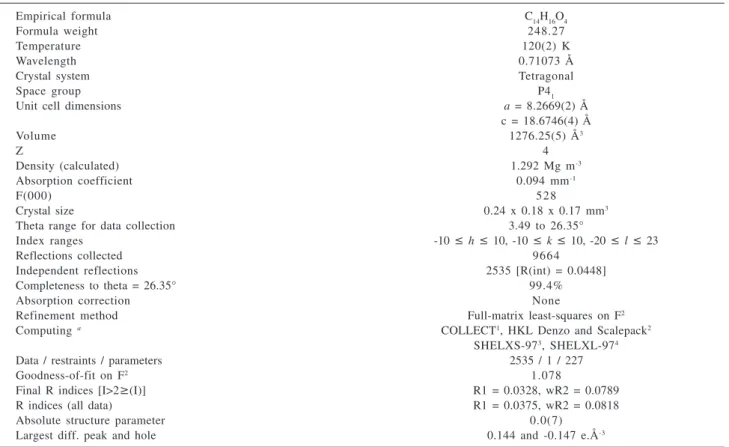
were set isotropic and freely refined. Data collections and experimental details for the complexes are summarized in
Table 1. The programs SHELXL-97,7 and ORTEP-38 were
used within WinGX9 to prepare materials for publication.
Data collections and experimental details for compound 3
are summarized in Table 1.
Plant material
Roots of R. echinata were collected in Ressacada,
Ibirama, SC, Brazil and identified by A. Reis (Universidade Federal de Santa Catarina) and J. R. Pirani (Universidade de São Paulo). Voucher specimens [A. Reis & M. Biavatti 2.570 (26/07/98)] were deposited at the Herbário Barbosa Rodrigues (HBR), Itajaí, Santa Catarina, Brazil.
Extraction and isolation of compounds
The dried and powdered roots (397 g) were extracted with hexane (4 g) and MeOH (20 g). Successively, the hexane extract was fractionated over silica gel 60 (70-230 mesh) into three fractions: hexane, EtOAc and MeOH. The hexane sub-fraction (576 mg) was chromatographed over
silica gel (230-400 mesh) using as eluent CH2Cl2-EtOAc
(9:1 and gradient) to furnish the compounds (in eluting order): fraxinellone (1) (37.1 mg), epoxy-fraxinellone (3)
(76 mg), and the fraction named E (30 mg), that was rechromatographed over silica gel (230-400 mesh) using
as eluent CH2Cl2-EtOAc (99:1 and gradient) to afford
fraxinellonone (2) (6 mg).
The methanol extract of the stems (80 g) was partitioned with dichloromethane (yielding 9 g) then chromatographed over silica gel (70-230 mesh) using as eluent hexane-acetone (9:1 and gradient), furnishing 17 sub-fractions (A-P). Sub-fractions D-G (4.1 g) were grouped and chromatographed over silica gel and hexane-acetone (9:1 and gradient) as eluent, originating sub-fractions A-T. The sub-fraction T (1.2 g) was purified by preparative TLC using
hexane-benzene (1:1), yielding 650 mg of limonexic acid (4).
Identification of the isolated compounds
The isolated degraded limonoids fraxinellone10,11,12 (1),
fraxinellonone10,11,12 (2), epoxy-fraxinellone13 (3) and
limonexic acid13 (4) presented spectral data in agreement
with the literature.
epoxy-fraxinellone (3).
5-Furan-3-yl-1a,4a-dimethyl-hexahydro-1,6-dioxa-cyclopropa[d]inden-7-one, [α]D –
22.5o (c 0.02, CH
2Cl2). Colorless needles, mp 80-82 oC.
Atta sexdens bioassay
The toxicity of the compounds to Atta sexdens
rubropilosa was determined by ingestion bioassay,
according to established protocol described in Bueno et
al. (1997).14
Each treatment consisted of 50 ants distributed in 5 Petri dishes. The leaf-cutting ants were isolated from their nest and fed with an artificial diet. The ants from the treatment received a diet added with epoxy-fraxinellone or limonexic acid, at a concentration of 200 μg. The ants from the control treatment were fed with a diet without this compound.
During 25 days, the number of dead ants for each Petri dish was counted and a new portion of artificial diet given. It was estimated the survival curve of leaf-cutting ants of each treatment and calculated the median longevity. The test used for the statistic analyze of data was the Log rank-test (α=0.05).
Results and Discussion
The isolated degraded limonoids 1-3 were respectively
identified as fraxinellone (1), fraxinellonone (2),
epoxy-fraxinellone (3) and limonexic acid (4) by comparison with
the spectral data described in the literature.10-13
Epoxy-fraxinellonehas a quaternary epoxy group
attached to C8-C14, instead of the double bond as in
fraxinellone. The spectroscopic data published13 could not
furnish clear evidence of the spatial configuration of this moiety. In an attempt to confirm the epoxy group position, nOe difference experiments were performed, but the
defining signals were superimposed (in d-chloroform and
benzene-d6), frustrating clear conclusions. In order to solve
these indistinguishable findings, an X-ray analysis (Figure 1) was performed to confirm the epoxy group position.
Single crystal of epoxy-fraxinellone was produced by recrystallization followed by a crystal-growing process. The recrystallization involved dissolution of the material in proper amount of ethyl acetate-acetone followed by drops of water. Suitable crystals were selected and analysed by single crystal X-ray diffraction which established
undoubtedly the structure of the compound 3. Figure 1
shows an Ortep8 type view of 3 showing the thermal
ellipsoids and atoms labels. This study shows that the
molecular conformation of 3 is fixed by the presence of
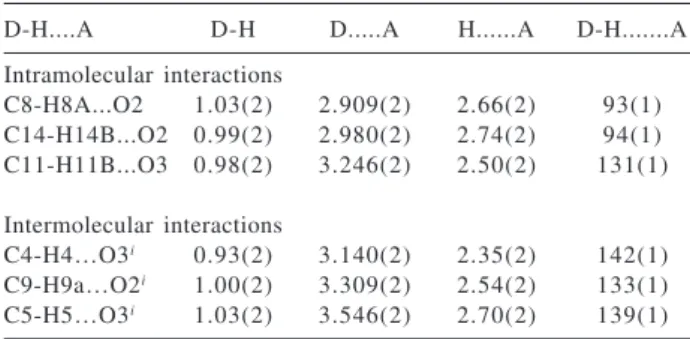
three main intramolecular interactions (Table 2). The analyses of the crystal packing showed the presence of
others three intermolecular interactions in 3 (Table 3).
These interactions give rise to the formation of infinite
chains along the c axis (Figure 2). All geometrical details
of the intermolecular contacts were interpreted as
Table 1. Crystal data and structure refinement of compound 3
Empirical formula C14H16O4
Formula weight 248.27
Temperature 120(2) K
Wavelength 0.71073 Å
Crystal system Tetragonal
Space group P41
Unit cell dimensions a = 8.2669(2) Å
c = 18.6746(4) Å
Volume 1276.25(5) Å3
Z 4
Density (calculated) 1.292 Mg m-3
Absorption coefficient 0.094 mm-1
F(000) 528
Crystal size 0.24 x 0.18 x 0.17 mm3
Theta range for data collection 3.49 to 26.35°
Index ranges -10 ≤ h≤ 10, -10 ≤ k≤ 10, -20 ≤ l≤ 23
Reflections collected 9664
Independent reflections 2535 [R(int) = 0.0448]
Completeness to theta = 26.35° 99.4%
Absorption correction None
Refinement method Full-matrix least-squares on F2
Computing a COLLECT1, HKL Denzo and Scalepack2
SHELXS-973, SHELXL-974
Data / restraints / parameters 2535 / 1 / 227
Goodness-of-fit on F2 1.078
Final R indices [I>2≥(I)] R1 = 0.0328, wR2 = 0.0789
R indices (all data) R1 = 0.0375, wR2 = 0.0818
Absolute structure parameter 0.0(7)
Largest diff. peak and hole 0.144 and -0.147 e.Å-3
intermolecular interactions on geometrical grounds,15 and
the Table 2 show their selected geometrical parameters.
The structures of compounds 1 and 2 were elucidated
on the basis of 1H NMR and EIMS spectra, and were in
agreement with published data.10-12 The EI-mass spectra of
both compounds shown to be formed mainly from the molecular ion by the consecutive exclusion of furan-3-aldehyde, CH3, HCHO and CO fragments.
As previously reported, crude extracts of leaves and
stems as well as fractions of R. echinata showed good
inhibitory activity on L. gongylophorus growth, the fungus
cultured by the leaf-cutting ant Atta sexdens rubropilosa.16
Epoxy-fraxinellone showed not be toxic to the leaf-cutting ants, although limonexic acid displayed a significant reduction on lifetime (11 days) of leaf cutting ants, when compared with the control group (22 days) (Figure 3).
Limonexic acid was also isolated from Dictamnus
angustifolius17a traditional plant used in China and from Tetradium trichotomum18root barks, and together with
isolimonexic acid are the main constituents of the fruit of
Citrus nippokoreana.19 Despite being known since 1948,20
no significant reference of its bioactivity was found. Just a dozen degraded limonoids have been published, mainly from Rutaceae and Meliaceae plants. As the parent limonoids, some of them have been tested for biological activities including antifeeding and growth regulating activities against insects, and some relationship between
the structures and biological activity has been studied.11
Table 2. Intramolecular and intermolecular interactions geometry
(Å,°) of compound 3
D-H....A D-H D...A H...A D-H...A
Intramolecular interactions
C8-H8A...O2 1.03(2) 2.909(2) 2.66(2) 93(1) C14-H14B...O2 0.99(2) 2.980(2) 2.74(2) 94(1) C11-H11B...O3 0.98(2) 3.246(2) 2.50(2) 131(1)
Intermolecular interactions
C4-H4…O3i 0.93(2) 3.140(2) 2.35(2) 142(1)
C9-H9a…O2i 1.00(2) 3.309(2) 2.54(2) 133(1)
C5-H5…O3i 1.03(2) 3.546(2) 2.70(2) 139(1)
Symmetry codes: (i) -y+1,+x,+z+1/4.
Figure 1.ORTEP-3 view of the asymmetric unit of 3, showing the atoms labelling and the 50% probability ellipsoids.
Figure 3. Survival curve of leaf-cutting ants for treatment and
con-trol, calculated the median longevity. Statistic analyze of data: log rank-test (a=0.05).
Figure 2. Intermolecular interactions in 3 that form an infinite chain
In roots they were also found in Melia azedarach21 and Dictamnus dasycarpus.12
Ichthyotoxic and insect antifeedant activities have been described for fraxinellone and fraxinellonone against
Oryzias latipes and Spodoptera littoralis respectively.10
Antifertility, antiplatelet aggregation and vasorelaxant activities are also described for fraxinellone, that also reduced the growth rate and food consumption of both
adults and larvae of Tribolium castaneum at concentration
of 10 ppm and above in a concentration dependent manner,
but was less active than commercial feeding deterrents.12
Supplementary Information
Supplementary Crystallographic data have been deposited with the Cambridge Crystallographic Data Centre as supplementary publication no. CCDC 265853. Copies of available material can be obtained, free of charge on application to the Director, CCDC, 12 Union Road, Cambridge CH2 1EZ, UK (fax: +44-1223-336-033 or e-mail: [email protected] or http://www. ccdc.cam.ac.uk).
Acknowledgements
We wish to thank Prof. A. Reis for collecting and identifying, Prof. J. R. Pirani for identifying the plant material and CNPq for financial support.
References
1. Kaastra, R.C.; Flora Neotropica, monograph n. 33, 1982.
2. Biavatti, M.W.; Vieira, P. C.; Silva, M. F. G. F. da; Fernandes, J. B.; Albuquerque, S.; Magalhães, C. M. I.; Pagnocca, F. C.;
Phytomedicine2001, 8, 121.
3. Silva, A.; Bacci Jr., M.; Siqueira, C. G.; Bueno, O. C.; Pagnocca, F. C.; Hebling, M. J. A.; J. Insect Physiol.2003, 49, 307.
4. Enraf-Nonius COLLECT.; Nonius BV, Delft, The Netherlands,
1997-2000.
5. Otwinowski, Z.; Minor, W. In Methods in Enzymology; Carter
Jr., C.W.; Sweet, R.M., eds.; Academic Press: New York, 1997, vol. 276, pp. 307-326.
6. Sheldrick, G.M.; SHELXS-97, Program for Crystal Structure Resolution; Univ. of Göttingen: Göttingen, Germany, 1997.
7. Sheldrick, G.M.; SHELXL-97,Program for Crystal Structures Analysis; Univ. of Göttingen: Göttingen, Germany, 1997.
8. Farrugia, L. J.; ORTEP-3 for Windows;J. Appl. Crystallogr. 1997, 30, 565.
9. Farrugia, L. J.; Win, G. X.; J. Appl. Crystallogr.1999, 32, 837.
10. Nakatani, M.; Huang, R.C.; Okamura, H.; Iwagawa, T.; Tadera, K.; Phytochemistry1998, 49, 1773.
11. Okamura, H.; Yamauchi, K.; Miyawaki, K.; Iwagawa, T.; Nakatani, M.; Tetrahedron Lett.1997, 38, 263.
12. Liu, Z.L.; Xu, Y.J.; Wu, J.; Goh, S.H.; Ho, S.H.; J. Agric. Food Chem. 2002, 50, 1447.
13. Biavatti, M.W.; Vieira, P. C.; Silva, M. F. G. F. da; Fernandes, J. B.; Albuquerque, S.; Z. Naturforsch., C: J. Biosci.2001, 56,
570.
14. Bueno, O. C.; Morini, M. S. C.; Pagnocca, F. C.; Hebling, M. J. A.; Silva, O. A.; An. Soc. Entomol. Brasil1997, 26, 107.
15. Ellena, J.; Goeta, A. E.; Howard, J. A. K.; Punte, G.; J. Phys. Chem.2001, A105, 8696.
16. Biavatti, M.W.; Vieira, P. C.; da Silva, M. F. G. F.; Fernandes, J.B.; Victor, S. R.; Pagnocca, F. C.; Albuquerque, S.; Caracelli, I.; Zukerman-Schpector, J.; J. Braz. Chem. Soc.2002, 13, 66.
17. Wu, T-S.; Li, C-Y.; Leu, Y-L.; Hu, C-Q.; Phytochemistry 1999, 50, 509.
18. Quader, A.; But, P.P.; Gray, A.I.; Hartley, T.G.; Hu, Y.; Waterman, P.G.; Biochem. Syst. Ecol. 1990, 18 251.
19. Connolly, J.D.; Hill, R.A.; Nat. Prod. Rep. 2001, 5, 560.
20. Kondo, Y.; Suzuki, H.; Nozoe, S.; Yakugaku Zasshi1985, 105, 742.
21. D’Ambrosio, M.; Guerriero, A.; Phytochemistry 2002, 60,
419.
Received: May 18, 2005
Published on the web: September 22, 2005