Rev Odontol UNESP. 2017 Sept-Oct; 46(5): 284-291 © 2017 - ISSN 1807-2577 ORIGINAL ARTICLE
Doi: http://dx.doi.org/10.1590/1807-2577.23916
Educational program in oral health for caregivers
on the oral hygiene of dependent elders
Programa educacional em saúde bucal para cuidadores sobre a higiene oral de idosos dependentes
Jéssica Damares LAGO
a, Laiza Maria Grassi FAIS
a, Andréia Afonso Barretto MONTANDON
a,
Lígia Antunes Pereira PINELLI
a*
aFaculdade de Odontologia de Araraquara, UNESP – Universidade Estadual Paulista, Araraquara, SP, Brasil
Resumo
Objetivo: Devido ao aumento do número de idosos que vivem em instituições de longa permanência são essenciais projetos de ações para melhorar a saúde bucal. Assim, o objetivo deste estudo foi avaliar o impacto de um programa educacional para os cuidadores de idosos institucionalizados por meio da avaliação da higiene bucal. Material e método: O programa de educação consistiu em palestras para cuidadores sobre saúde bucal que foram realizadas uma vez por mês. Foram avaliados 40 idosos institucionalizados dependentes funcionalmente e 14 cuidadores. Os hábitos de higiene, o índice de placa e o revestimento/descoloração da língua dos idosos foram avaliados antes do programa educacional (T0) e após 6 (T1), 12 (T2), 18 (T3) e 24 meses (T4). Os cuidadores responderam perguntas sobre seus conhecimentos, suas dúvidas e sobre a implementação de cuidados bucais (T0 a T4). Resultado: Após análise dos dados (Friedman, Qui-quadrado e Spearman, α = 0,05), observou-se melhora gradual na higiene oral dos idosos, com maior freqüência de escovação (p = 0,0005), alteração do tipo de escova (p = 0,0065) e redução do índice de placa (p <0,05) e revestimento da língua (p <0,05). Os cuidadores mostraram uma melhoria acentuada no seu conhecimento sobre saúde bucal. Conclusão: Concluiu-se que o programa educacional para cuidadores teve um impacto positivo na saúde bucal dos idosos institucionalizados observado pelo aumento na eficácia dos parâmetros de higiene bucal, como índice de placa e revestimento da língua, contribuindo para o ganho de conhecimento em higiene pelos cuidadores.
Descritores: Cuidadores; assistência odontológica para idosos; educação; instituição de longa permanência para idosos; assistência à idosos.
Abstract
Objective: Due increased number of elders living in long-term care institutions, actions designs to improve their oral health are essential. Thus, the aim of this study was to evaluate the impact of an educational program for the caregivers through the assessment of the oral hygiene of institutionalized elders. Material and method: The education program consisted in lectures to caregivers about oral health that were performed once a month. The subjects were 40 functionally dependent institutionalized elders and 14 caregivers. Hygiene habits, plaque index, and tongue coating/discoloration of the elders were measured before the educational program (baseline- T0) and after 6 (T1), 12 (T2), 18 (T3) and 24 months (T4). Caregivers answered questions about their knowledge, doubts and implementation of dental care (T0 to T4). Result: After analyzing the data (Friedman, Chi-square and Spearman α = 0.05), a gradual improvement in the oral hygiene of the subjects was observed, with an increased frequency of brushing (p=0.0005), a change in the brush type (p=0.0065) and a reduction in the plaque index (p<0.05) and tongue coating (p<0.05). Caregivers showed a marked improvement in their dental care knowledge. Conclusion: It was concluded that the educational program for caregivers had a positive impact in the oral health of institutionalized elderly observed by the increased in the effectiveness of oral hygiene parameters such as plaque index and tongue coating, contributing to the knowledge gain in hygiene by caregivers.
Descriptors: Caregivers; dental care for aged; education; homes for the aged; old age assistance.
INTRODUCTION
he number of elders living in long-term care institutions (LTCI) has been increasing in many countries1. Elders with
poorer systemic health and more cognitive defects require regular
professional support2, which is an increasing challenge for health
care providers3; such elders oten have chronic diseases that lead
of dependence in daily activities and requiring a multidisciplinary treatment, with contributions from nurses, caregivers and other health professionals4, associated to the impact in the inancial
system5. Moreover, factors such as cognitive decline6, sarcopenia7
and lack of mobility in elders due to either physical disabilities or tissue and organ impairments resulting from aging or degenerative diseases also contribute signiicantly to poor oral health8.
Simons et al.9 have shown that the institutionalized elders have
a higher incidence of oral diseases than those living with their families. here is a failure between the high need for dental care and the limited services ofered to the institutionalized elders10;
thus, there is a need to educate caregivers about oral health to be potential care educators. here are some barriers10-12 to achieving
adequate oral health for the residents of LTCIs; these barriers include high costs, restricted mobility, a low level of awareness about the needs of elders, the perceived need for dental care among the institutionalized elders, the number of teeth, the functional and clinical status of the elders, inancial restrictions, resistance to care and fear and lack of caregiver knowledge about oral health10;
knowing that the health education of caregivers contributes to the improvement of the oral health of the elderly6,13,14.
Wårdh et al. 3 reported that oral care assistance is viewed as a
more disagreeable task than most other nursing activities and as low-skilled caregivers experienced more disgust towards cleaning the oral cavity of the elders. Studies done on education of caregivers are mostly conducted during times not exceeding 12 months11,15.
Studies such as Paulsson et al.16 and Samson et al.17 were conducted
in longer periods of time, the former found ater three years of study the efectiveness of a program composed of 4 lessons of one hour each that were sent to caregivers and the second one evaluated caregivers and elders ater 3 months and 6 years, however with diferent methodologies and without the same intervals between lectures. Regardless the study time, no matter the kind of change introduced to working conditions, the result will be an increased in productivity which itself is a good achievement18, with a positive
efect on care home nurses’ oral healthcare knowledge and attitude.
hus, the aim of this study was to evaluate the impact of an educational program for caregivers through the assessment of the oral hygiene of institutionalized elders, using indicators such as tongue coating and plaque index, as well as the gain of knowledge of caregivers on speciic questions about oral health, degree of interest for their own oral health and frequency of hygiene implemented in the LTCI in elderly with partially functional dependency ater educational program. hereby, the following hypotheses were tested: H0-he caregiver educational program will not afect the oral hygiene quality of dependents elderly; H1- he caregiver educational program will afect the oral hygiene quality of dependents elderly.
MATERIAL AND METHOD
Ethical Principles
Ater the approval of the Araraquara Dental School Ethics Committee (CAAE 0055.0.199.000-11), caregivers and elders at the St. Francis of Assisi Home of Araraquara, Sao Paulo, Brazil, were
invited to participate in the study. All caregivers gave informed consent and had their anonymity preserved, and the elderly had their consents signed by themselves or by a family responsible.
Study Population and Inclusion Criteria
he inclusion criteria were: the elder should consent in participate, have a minimum age of 60 years, be classiied as partially functional dependent by Barthel index19, as well as have
impairment according to Mini Mental State Examination score20.
Barthel’s index, originally proposed by Mahoney, Barthel19
was used to assess the degree of functional dependence of the individual on daily activities that are composed basically of personal care, mobility, locomotion and eliminations, having a maximum score of 100 for fully independent patients. Scores 61 to 90 were considered for selection of moderately dependent patients21, who were selected for this study.
he cognitive status of the patients was determined with the Mental State Examination (MMSE)20, a widely-used instrument
for this proposal, considered objective and easy to apply. he instrument is composed of questions subdivided into six items: temporo-spatial orientation, recent memory, evocation, calculation, constructional ability and language (aphasia, agnosia and apraxia). he maximum score is 30 and a score of 23 or less indicated cognitive impairment.
he inclusion criteria for caregivers were: be an employee of the institution (formal caregiver) and attend all lectures meetings; caregivers that failed to attend all lectures were excluded from the study.
his research was held during the activities performed by the staf of the Extension Project entitled “Sorriso Solidário” of the Araraquara Dental School which consists in the development and implementation of an educational program in oral health targeted for caregivers, contributing to the insertion of the knowledge of buccal hygiene of dependents elderly in the routine of daily care provided by caregivers.
Pilot Study and Researcher’s Calibration
Initial Collection of Study Variables (T0)
At baseline (T0) the same researcher that conducted the lectures collected the sociodemographic data of all caregivers, additionally applying a questionnaire with basic questions regarding oral health based in concepts stablished in the literature14, 22 and about the
caregiver’s interest in oral health.
Regarding the elderly, socio-demographic data were collected from the LTCI records to characterize the elderly population and information about oral hygiene habits (frequency of brush, toothbrush type, use of mouthwash, use of dental loss) and the use of prostheses in elderly residents were collected at ive times (T0, T1, T2, T3 and T4) along with a clinical examination to assess the number of remaining teeth, prostheses use, plaque index (PI)23,
tongue coating and mucosal discoloration24.
he global PI (GPI)23 corresponds to the sum of all obtained
scores, divided by the number of examined surfaces. he scores received number according the presence and quantity of bioilm: 0-no plaque, 1- separate plaque particles at the cervical margin; 2 - thin and continuous strip of plate at the cervical margin; 3 - plate strip wider than 1 mm, but covering less than 1/3 of the crown; 4 - plate covering at least 1/3, but less than 2/3 of the crown; and 5 - plate covering 2/3 or more of the crown.
he tongue coating and tongue discoloration were evaluated according to an index described by Winkel et al.24. For tongue
coating the scores varied from 0 to 2, being 0 the score determined for the absence of tongue coating, 1 for little tongue coating and 2 for severe tongue coating. he tongue was divided into six parts and the sum of the scores divided by six determined the score for the patient. he discoloration score followed the same principle with scores varying from 0 to 2: 0 for non-discoloration, 1 for mild discoloration and 2 for severe discoloration.
Educational Program
he educational program addressed oral hygiene techniques and the importance of oral health. It was carried out by the principal researcher who was trained to use a simple and objective language and comprised monthly lectures (once a month) and distribution of lyers. Each lecture had about two hours and exposed diferent themes related to oral health, allowing the interaction with caregivers in formulating questions. he lectures were conducted in the LTCI in an appropriated room with projectors to PowerPoint presentations and with caregivers outside their working hours.
he topics addressed were: Aging and oral changes (2 hours); Main oral lesions present in the elderly and myths of tooth loss (2 hours); Mouth cancer - epidemiology and etiology (2 hours); Etiology and evolution of the main oral diseases: caries and periodontal disease (4 hours); Main chronic diseases and their efects on oral cavity (4 hours); Auxiliary devices of oral hygiene (2 hours); Types of dental prostheses and importance of hygiene (2 hours); Chemical control of bioilm (2 hours); Importance of elderly patients stimulus through cleaning and morbidity concepts (2 hours); Hygiene routine in bed and alternative devices (2 hours). he lectures were complemented by the distribution of lyers with igures for home reading. Ater the lectures, it was exhibited
devices of buccal hygiene with practical demonstrations according to each subject of the lecture. he institution also received hygiene devices suitable for use in each elderly, which should incorporate learned principles in daily routine care, such as the use of 0.12% chlorhexidine digluconate, mucosal swabs, dental and prosthesis brushes, tongue scraper and dental loss.
Additionally, to achieve the program goals, the main points that were objectively charged of caregivers were: compulsory oral hygiene at least three times a day during the elderly’s daily routine and training on directly supervises the hygienic procedure, including the oral mucosa.
Reapplication of Questionnaires
he questionnaire was re-administered six months (T1), twelve months (T2) eighteen months (T3) and twenty-four months (T4) ater the baseline, as well as the collection of clinical variables of elderly health and their attitudes and habits of buccal hygiene applied.
Statistical Analysis
he data were organized into a database in Excel 2010 and analyzed statistically using the BioEstat 5.0 program. Habits and clinical variables of oral hygiene from T0 to T4 were compared using the Friedman test; Spearman test was used to correlate daily hygiene habits and clinical variables at T0, T2 and T4. Chi-square was used to analyze the elders’ satisfaction with the prostheses. A signiicance level of 5% was adopted.
RESULT
Of the 150 elders living in the assessed LTCI, 56 were eligible to participate at baseline; however, only 40 could be evaluated through the end of the program (T4) as several died or moved to diferent institutions. he mean age of the LTCI residents was 82.3 years (60-97 years), and the population was predominantly female (n = 21; 52.5%) and Caucasian (n = 34; 85.0%). All elderly were classiied as having some kind of dependency and cognitive impairment observed through the scores of Barthel index (with average of 40) and Mini Mental State Examination (average of 20) respectively. his strategy (dependent and cognitive impairment elders) was used to guarantee that only the caregiver participation in the hygiene process was known, considering that the diet also has not changed during the study period.
Twenty elders were fully edentulous, eight had both maxillary and mandibular teeth, one had only maxillary teeth and 11 had only mandibular teeth. here were 45 remaining maxillary teeth and 99 remaining mandibular teeth in the residents assessed. Concerning the wear of prostheses, 29 subjects used some type of prosthesis and 11 did not use any type of prosthesis. Among prostheses wearers, 12 had both maxillary and mandibular complete dentures (CDs), 14 only a maxillary CD, 2 used a maxillary CD and mandibular removable partial denture (RPD), and one had only a maxillary RPD, totaling 43 prostheses.
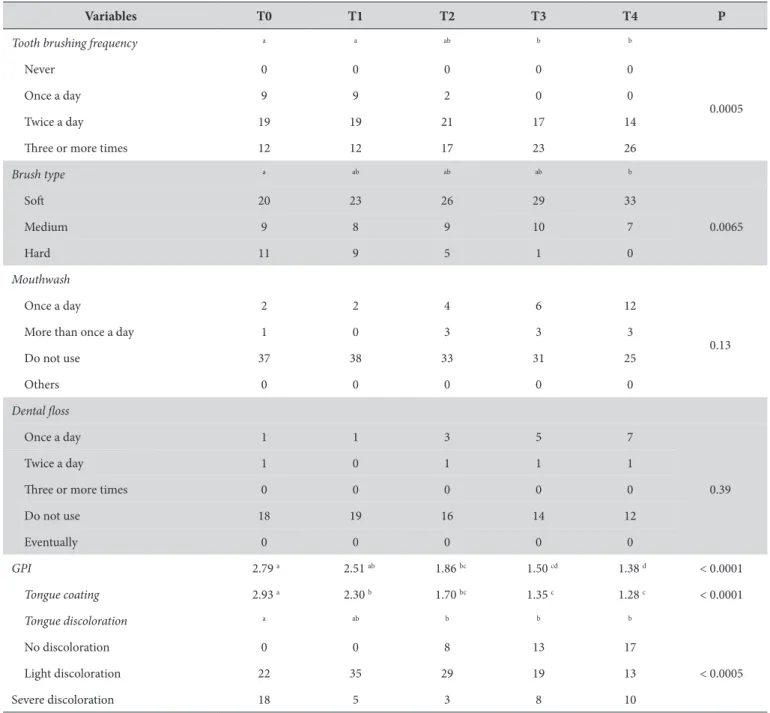
progressive reduction in the GPI (Table 1) starting as early as T2 (p < 0.0001). A similar pattern of improvement was observed for the tongue coating (Table 1). Although the number of subjects with tongue discoloration (Table 1) increased in T4, it was still lower than in T0; there was also a concomitant increase in the number of elders without tongue discoloration (p <0.0005). Table 2 shows the correlation between oral hygiene and the clinical variables assessed at T0, T2 and T4.
Of the 21 caregivers that were recruited at baseline, only 14 attended all lectures (inclusion criteria). All caregivers began the education program, however, over the 24 months, a reduction in the initial sample number (about 67%) was observed due to staf changes. Few of the caregivers originally trained were still working in the LTCI ater two years of evaluation. he new employees have been invited to participate, however they
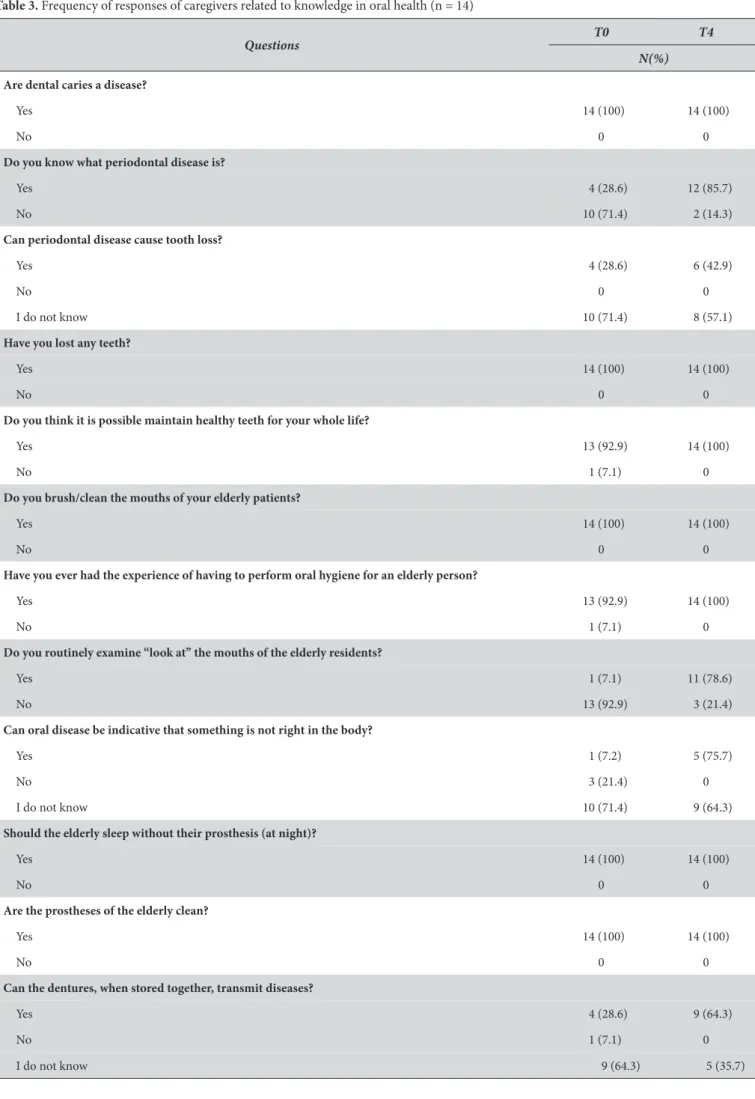
were not included at the database. he mean caregiver age was 38.8 years (29-49 years), and 13 of the caregivers were women (92.9%). he average working time in the LTCI was three years. Most caregivers (64.3%) were only educated through elementary school, and 8 attended the appropriate programming courses; however, only two caregivers had completed Certiied Nursing Assistant training. Concerning the time spent in the elderly care, 12 subjects were part-time workers and 2 were full-time workers, with an average workload of 38 hours per week. he factors that led to working as caregivers in the LTCI were related as inancial need (35.7%), experience in the ield (35.7%) and personal enjoyment (28.6%). All caregivers reported interest in obtaining information about oral health, with oral cancer as the topic of greatest interest. he results concerning the caregivers’ knowledge of oral health are shown in Table 3.
Table 1. Habits and clinical variables of oral hygiene of elderly from T0 to T4. Absolute numbers and p values refer to comparisons made using the Friedman test
Variables T0 T1 T2 T3 T4 P
Tooth brushing frequency a a ab b b
Never 0 0 0 0 0
0.0005
Once a day 9 9 2 0 0
Twice a day 19 19 21 17 14
hree or more times 12 12 17 23 26
Brush type a ab ab ab b
Sot 20 23 26 29 33
0.0065
Medium 9 8 9 10 7
Hard 11 9 5 1 0
Mouthwash
Once a day 2 2 4 6 12
0.13
More than once a day 1 0 3 3 3
Do not use 37 38 33 31 25
Others 0 0 0 0 0
Dental loss
Once a day 1 1 3 5 7
0.39
Twice a day 1 0 1 1 1
hree or more times 0 0 0 0 0
Do not use 18 19 16 14 12
Eventually 0 0 0 0 0
GPI 2.79 a 2.51 ab 1.86 bc 1.50 cd 1.38 d < 0.0001
Tongue coating 2.93 a 2.30 b 1.70 bc 1.35 c 1.28 c < 0.0001
Tongue discoloration a ab b b b
No discoloration 0 0 8 13 17
Light discoloration 22 35 29 19 13 < 0.0005
Severe discoloration 18 5 3 8 10
DISCUSSION
his study evaluated the impact of a long-term educational program for caregivers on the oral hygiene quality of institutionalized partially dependent elders by assessing factors related to daily oral habits, GPI and tongue coating/discoloration. he null hypothesis of our study was rejected because the educational program had an impact on oral hygiene of the studied elders, although Weening-Verbree et al.12 state that all strategies have a positive and
statistically signiicant efect on the knowledge and health beliefs of caregivers and that this efect was not associate with improvements in the oral health of the elderly.
Several studies have been conducted with the aim of improving the oral and systemic health of the institutionalized elderly population through diferent types of interventions2,8,12,13,25. he caregiver
educational program used in this study was comprised of monthly lectures with two hours each and was found to be efective, as determined by improvements in the frequency of tooth brushing (p = 0.0005), the toothbrush type (p = 0.0065) and in the clinical variables evaluated (GPI, tongue discoloration and tongue coating). hese indings are consistent with other research25 showing that,
regardless of the measured variables, better oral health could be achieved for institutionalized elders ater their caregivers improved their knowledge through lectures. he educational program staf in the LTCI also likely played a role in the improved oral hygiene,
as they reinforced the importance of oral health and the methods of cleaning the oral cavity.
Despite the descriptive results, Table 3 indicates that the caregivers already had prior knowledge and interest in factors related to oral health at baseline, highlighting the signiicant increase from 7.1% to 78.6% of caregivers who reported routinely examining the mouths of the institutionalized elders. Our indings agree with the results of Delgado et al.14 who showed that professional
caregivers would like more training in oral health, especially in brushing and lossing. hus, the presence of a trained dental staf and the maintenance of an educational program can help caregivers overcome diiculties in providing appropriate oral health care to LTCI residents, although Wårdh et al.3 and Unfer et al.11 emphasizes
the divergence between the knowledge and the performance of oral care by caregivers, nurses and nursing assistants. Most of the caregivers who composed the sample had only elementary school (64.3%), being common in under-resourced countries the use of non-oral health workers in the promotion of oral health, and this situation, although not ideal, can contribute to improve oral health in LTCI22. In this sense, the staf, with higher knowledge, can feel
more safety and decisive, with a positive efect on their attitudes with elderly.
An important observation of this study was an increase of elders’ own initiative to the oral hygiene. At baseline, one of the daily tasks of the caregivers was brushing the teeth and prostheses of the subjects during the morning bath; any other brushings were
Table 2. Values of ρ and p referring to correlations between the daily hygiene habits and clinical variables at T0, T2 and T4
Period GPI Tongue coating Tongue discoloration
Frequency of tooth brush-ing
T0 ρ = -0.0953
p = 0.56
ρ = -0.1284 p = 0.43
ρ = -0.1648 p = 0.31
T2 ρ = -0.0953
p = 0.56
ρ = 0.0482 p = 0.77
ρ = -0.0396 p = 0.81
T4 ρ = -0.0684
p = 0.67
ρ = -0.3789 p = 0.02*
ρ = -0.0971 p = 0.55
Type of toothbrush
T0 ρ = -0.0414
p = 0.80
ρ = -0.0075 p = 0.96
ρ = -0.0664 p = 0.68
T2 ρ = -0.0832
p =0.61
ρ = 0.1452 p = 0.37
ρ = 0.0550 p = 0.74
T4 ρ = 0.0267
p = 0.87
ρ = -0.0680 p = 0.68
ρ = -0.0061 p = 0.97
Use of mouthwash
T0 ρ = -0.1939
p = 0.23
ρ = 0.0956 p = 0.56
ρ = 0.0620 p = 0.70
T2 ρ = -0.4127
p =0.008*
ρ = -0.1768 p = 0.27
ρ = 0.0576 p = 0.72
T4 ρ = -0.2954
p = 0.06
ρ = 0.1703 p = 0.29
ρ = 0.0275 p = 0.87
Use of dental loss
T0 ρ = -0.2557
p = 0.11
ρ = -0.0319 p = 0.84
ρ = -0.0173 p = 0.91
T2 ρ = -0.2431
p =0.13
ρ = -0.2908 p = 0.07
ρ = -0.0762 p = 0.64
T4 ρ = -0.0250
p = 0.88
ρ = 0.0749 p = 0.65
Table 3. Frequency of responses of caregivers related to knowledge in oral health (n = 14)
Questions
T0 T4
N(%)
Are dental caries a disease?
Yes 14 (100) 14 (100)
No 0 0
Do you know what periodontal disease is?
Yes 4 (28.6) 12 (85.7)
No 10 (71.4) 2 (14.3)
Can periodontal disease cause tooth loss?
Yes 4 (28.6) 6 (42.9)
No 0 0
I do not know 10 (71.4) 8 (57.1)
Have you lost any teeth?
Yes 14 (100) 14 (100)
No 0 0
Do you think it is possible maintain healthy teeth for your whole life?
Yes 13 (92.9) 14 (100)
No 1 (7.1) 0
Do you brush/clean the mouths of your elderly patients?
Yes 14 (100) 14 (100)
No 0 0
Have you ever had the experience of having to perform oral hygiene for an elderly person?
Yes 13 (92.9) 14 (100)
No 1 (7.1) 0
Do you routinely examine “look at” the mouths of the elderly residents?
Yes 1 (7.1) 11 (78.6)
No 13 (92.9) 3 (21.4)
Can oral disease be indicative that something is not right in the body?
Yes 1 (7.2) 5 (75.7)
No 3 (21.4) 0
I do not know 10 (71.4) 9 (64.3)
Should the elderly sleep without their prosthesis (at night)?
Yes 14 (100) 14 (100)
No 0 0
Are the prostheses of the elderly clean?
Yes 14 (100) 14 (100)
No 0 0
Can the dentures, when stored together, transmit diseases?
Yes 4 (28.6) 9 (64.3)
No 1 (7.1) 0
performed without supervision. With the educational program, caregivers began to clean the mouth and prostheses twice a day and the elderly also began to make their own hygiene more frequently which may have been inluenced by the knowledge and behavior change of caregivers. In addition, considering the elderly’s skills, the caregivers guided and supervised the elderly in their routine cleaning of oral mucosa with gauze soaked in 0.12% chlorhexidine digluconate or with brush and mouthwash, given the importance of this procedure for oral health.
A statistically signiicant progressive decrease was observed between the baseline and the end of the educational program for the clinical variables assessed (GPI, tongue coating and tongue discoloration). Similarly, Simons et al.9 showed an equal reduction
in the plaque index, denture stomatitis and periodontal disease following an oral health educational program for caregivers.
his study had some limitations. It focused exclusively on the population of one Brazilian LTCI, had a reduced sample of caregivers due to caregiver turnover, and it only used three clinical variables (GPI, tongue discoloration and tongue coating), which do not represent all aspects of oral health. However, even given these limitations, this study stands out by the joint assessment of caregivers’ knowledge and quality of oral health of institutionalized elderly by relatively long follow-up which is not usual in the literature12,
emphasizing the study of Simons et al.15 with assessments conducted
in shortest period. According McCarney et al.18 reviews in short
time can cause Hawthorne efect, which consists is a positive change in the behavior of a group when they are evaluated, not necessarily relecting a real change over time. It is important to draw attention to the fact that the applied strategy of mensal lectures was conirmed ater three years of living experienced at “Sorriso Solidário” Extension Project with various caregivers that identify settings and barriers to improve oral health in elders. he participation of undergraduate students in the mentioned project has brought to
them fundamental contribution in their scientiic and humanistic formation, as MacEntee13 draws attention.
Although it is known that the resource is scarce5 and that the
education and training are not suitable due to be based only on scientiic issues, associated to the necessity of a more comprehensive and humanistic health professional formation in the elderly care13,
this study clearly showed the need and the efectiveness of the development of educational program for caregivers, prioritizing the oral hygiene in daily routine care by the LTCI staf. hus, integrating or even relocating government-employed dentists to conduct lectures and activities in LTCI can motivate both the caregivers and their patients, reducing the negligence observed in the oral health care of the institutionalized elders.
his study suggests that the use of an educational program for caregivers is efective in improve the elderly’s health and hygiene indicators, as previously reported by Wang et al.6, suggesting that
such programs should be installed as routine in LTCI contributing to better health conditions.
CONCLUSION
Considering the limitations of this study the results showed that the educational program for caregivers had a positive impact in the oral health of institutionalized elderly observed by the increased in the efectiveness of oral hygiene parameters such as plaque index and tongue coating, contributing to the knowledge gain in hygiene by caregivers.
ACKNOWLEDGEMENTS
To Fundação de Amparo à Pesquisa do Estado de São Paulo- FAPESP for the grant (#2011/20557-4). To PROEX- Pró-Reitoria de Extensão Universitária, UNESP- Universidade Estadual Paulista.
REFERENCES
1. Junges R, Portella FF, Hugo FN, Padilha DM, Samuel SM. Caregivers’ attitudes regarding oral health in a long-term care institution in Brazil. Gerodontology. 2014 Sep;31(3):178-83. PMid:23134197. http://dx.doi.org/10.1111/ger.12019.
2. Baat C, Kalk W, Schuil GR. The effectiveness of oral hygiene programmes for elderly people-a review. Gerodontology. 1993 Dec;10(2):109-13. PMid:7713526. http://dx.doi.org/10.1111/j.1741-2358.1993.tb00091.x.
3. Wårdh I, Andersson L, Sörensen S. Staff attitudes to oral health care. A comparative study of registered nurses, nursing assistants and home care aides. Gerodontology. 1997 Jul;14(1):28-32. PMid:9610300. http://dx.doi.org/10.1111/j.1741-2358.1997.00028.x.
4. Durso SC. Interaction with other health team members in caring for elderly patients. Dent Clin North Am. 2005 Apr;49(2):377-88. PMid:15755411. http://dx.doi.org/10.1016/j.cden.2004.10.009.
5. MacEntee MI, Kazanjian A, Kozak JF, Hornby K, Thorne S, Kettratad-Pruksapong M. A scoping review and research synthesis on financing and regulating oral care in long-term care facilities. Gerodontology. 2012 Jun;29(2):e41-52. PMid:22098091. http://dx.doi.org/10.1111/j.1741-2358.2011.00575.x.
6. Wang TF, Huang CM, Chou C, Yu S. Effect of oral health education programs for caregivers on oral hygiene of the elderly: A systemic review and meta-analysis. Int J Nurs Stud. 2015 Jun;52(6):1090-6. PMid:25724550. http://dx.doi.org/10.1016/j.ijnurstu.2015.01.015.
7. Walls A. Developing pathways for oral care in elders: challenges in care for the dentate the subject? Gerodontology. 2014 Feb;31(Suppl 1):25-30. PMid:24446976. http://dx.doi.org/10.1111/ger.12087.
9. Simons D, Kidd EA, Beighton D. Oral health of elderly occupants in residential homes. Lancet. 1999 May;353(9166):1761. PMid:10347991. http://dx.doi.org/10.1016/S0140-6736(99)01343-4.
10. Chalmers JM, Hodge C, Fuss JM, Spencer AJ, Carter KD, Mathew R. Opinions of dentists and directors of nursing concerning dental care provision for Adelaide nursing homes. Aust Dent J. 2001 Dec;46(4):277-83. PMid:11838875. http://dx.doi.org/10.1111/j.1834-7819.2001. tb00292.x.
11. Unfer B, Braun KO, Ferreira AC, Ruat GR, Batista AK. Challenges and barriers to quality oral care as perceived by caregivers in long-stay institutions in Brazil. Gerodontology. 2012 Jun;29(2):e324-30. PMid:21453416. http://dx.doi.org/10.1111/j.1741-2358.2011.00475.x. 12. Weening-Verbree L, Huisman-de Waal G, van Dusseldorp L, van Achterberg T, Schoonhoven L. Oral health care in older people in long
term care facilities: a systematic review of implementation strategies. Int J Nurs Stud. 2013 Apr;50(4):569-82. PMid:23290098. http://dx.doi. org/10.1016/j.ijnurstu.2012.12.004.
13. MacEntee MI, Wyatt CC, Beattie BL, Paterson B, Levy-Milne R, McCandless L, et al. Provision of mouth-care in long-term care facilities: an educational trial. Community Dent Oral Epidemiol. 2007 Feb;35(1):25-34. PMid:17244135. http://dx.doi.org/10.1111/j.1600-0528.2007.00318.x. 14. Delgado AM, Prihoda T, Nguyen C, Hicks B, Smiley L, Taverna M. Professional Caregivers’ oral care practices and beliefs for elderly clients
aging in place. J Dent Hyg. 2016 Aug;90(4):244-8. PMid:27551145.
15. Simons D, Baker P, Jones B, Kidd EA, Beighton D. An evaluation of an oral health training programme for carers of the elderly in residential homes. Br Dent J. 2000 Feb;188(4):206-10. PMid:10740904.
16. Paulsson G, Söderfeldt B, Fridlund B, Nederfors T. Recall of an oral health education programme by nursing personnel in special housing facilities for the elderly. Gerodontology. 2001 Jul;18(1):7-14. PMid:11813391. http://dx.doi.org/10.1111/j.1741-2358.2001.00007.x. 17. Samson H, Berven L, Strand GV. Long-term effect of an oral healthcare programme on oral hygiene in a nursing home. Eur J Oral Sci. 2009
Oct;117(5):575-9. PMid:19758255. http://dx.doi.org/10.1111/j.1600-0722.2009.00673.x.
18. McCarney R, Warner J, Iliffe S, van Haselen R, Griffin M, Fisher P. The Hawthorne Effect: a randomised, controlled trial. BMC Med Res Methodol. 2007 Jul;7(1):30. PMid:17608932. http://dx.doi.org/10.1186/1471-2288-7-30.
19. Mahoney FI, Barthel DW. Functional evaluation: the Barthel Index. Md State Med J. 1965 Feb;14:61-5. PMid:14258950.
20. Folstein M, Anthony JC, Parhad I, Duffy B, Gruenberg EM. The meaning of cognitive impairment in the elderly. J Am Geriatr Soc. 1985 Apr;33(4):228-35. PMid:3989183. http://dx.doi.org/10.1111/j.1532-5415.1985.tb07109.x.
21. Shah S, Vanclay F, Cooper B. Improving the sensitivity of the Barthel Index for stroke rehabilitation. J Clin Epidemiol. 1989;42(8):703-9. PMid:2760661. http://dx.doi.org/10.1016/0895-4356(89)90065-6.
22. Walid EI, Nasir F, Naidoo S. Oral health knowledge, attitudes and behavior among nursing staff in Lesotho. SADJ. 2004 Aug;59(7):288, 290, 292. PMid:15537032.
23. Quigley GA, Hein JW. Comparative cleansing efficiency of manual and power brushing. J Am Dent Assoc. 1962 Jul;65(1):26-9. PMid:14489483. http://dx.doi.org/10.14219/jada.archive.1962.0184.
24. Winkel EG, Roldán S, Van Winkelhoff AJ, Herrera D, Sanz M. Clinical effects of a new mouthrinse containing chlorhexidine, cetylpyridinium chloride and zinc-lactate on oral halitosis. A dual-center, double-blind placebo-controlled study. J Clin Periodontol. 2003 Apr;30(4):300-6. PMid:12694427. http://dx.doi.org/10.1034/j.1600-051X.2003.00342.x.
25. Munoz N, Touger-Decker R, Byham-Gray L, Maillet JO. Effect of an oral health assessment education program on nurses’ knowledge and patient care practices in skilled nursing facilities. Spec Care Dentist. 2009 Jul-Aug;29(4):179-85. PMid:19573046. http://dx.doi.org/10.1111/ j.1754-4505.2009.00084.x.
CONFLICTS OF INTERESTS
he authors declare no conlicts of interest.
*CORRESPONDING AUTHOR
Lígia Antunes Pereira Pinelli, Departamento de Materiais Odontológicos e Prótese, Faculdade de Odontologia de Araraquara, UNESP – Universidade Estadual Paulista, Rua Humaitá, 1680, 14801-903 Araraquara-SP, Brasil, e-mail: [email protected]