Marcia Furquim de AlmeidaI
Gizelton Pereira AlencarII Daniela SchoepsIII
Elaine Garcia MinuciIV
Zilda Pereira da SilvaI
Luis Patrício OrtizI Hillegonda Maria Dutilh NovaesI
Airlane Pereira AlencarI
Priscila Ribeiro RaspantiniIII
Patrícia Carla dos SantosIII
I Departamento de Epidemiologia. Faculdade de Saúde Pública. Universidade de São Paulo (USP). São Paulo, SP, Brasil II USP. São Paulo, SP, Brasil
III Programa de Pós-Graduação em Saúde Pública. FSP-USP. São Paulo, SP, Brasil IV Fundação Sistema Estadual de Análise de
Dados. São Paulo, SP, Brasil Correspondence:
Marcia Furquim de Almeida Faculdade de Saúde Pública Universidade de São Paulo
Av. Dr. Arnaldo, 715 – Cerqueira César 01246-904 São Paulo, SP, Brasil E-mail: [email protected] Received: 10/28/2010 Approved: 5/13/2011
Article available from: www.scielo.br/rsp
Quality of information
registered on fetal deaths
certifi cates in São Paulo,
Southeastern Brazil
ABSTRACT
OBJECTIVE: To evaluate the quality of information registered on fetal death certifi cates.
METHODS: Records were reviewed from 710 fetal deaths registered in the consolidated database of deaths from the State System for Data Analysis and the São Paulo State Secretary of Health, for deaths in São Paulo municipality (Southeastern Brazil) during the fi rst semester of 2008. Completeness was analyzed for variables on fetal death certifi cates issued by hospitals and autopsy service. The death certifi cates from a sub-sample of 212 fetal deaths in hospitals of the National Unifi ed Health System (public) were compared to medical records and to the records from Coroner’s Offi ce.
RESULTS: Among death certifi cates, 75% were issues by Coroner’s Offi ce, with Coroner’s greater frequency in public hospitals (78%). Completeness of variables on death certifi cates issued by hospitals was higher among non-public hospitals. There was greater completeness, agreement and sensitivity in death certifi cates issued by hospitals. There was low agreement and high specifi city for variables related to maternal characteristics. Increased reporting of gender, birth weight and gestational age was observed in certifi cates issued by Coroner’s Offi ce. Autopsies did not result in improved ascertainment of cause of death, with 65.7% identifi ed as unspecifi ed fetal death as 24.3% as intrauterine hypoxia, while death certifi cates by hospitals reported 18.1% as unspecifi ed and 41.7% as intrauterine hypoxia.
CONCLUSIONS: Completeness and the ascertainment of cause of fetal death need to be improved. The high proportion of autopsies did not improve information and ascertainment of cause of death. The quality of information generated by autopsies depends on access to hospital records.
DESCRIPTORS: Fetal Death. Death Certifi cates. Cause of Death. Autopsy. Mortality Information System. Information quality.
INTRODUCTION
Although fetal deaths account for the majority of perinatal deaths, they are not well understood and studied,7,8,16,17 and remain almost invisible throughout the
a Fundação Seade. Nascidos vivos, nascidos mortos, óbitos neonatais precoces e perinatais e taxas de mortalidade segundo distritos do Município de São Paulo. São Paulo; 2008 [cited 2011 Jun 12]. Available from: http://www.seade.gov.br/produtos/mortinf/tabelas/2008/pdf/ tabela06_2008_distritos.pdf
tool to identify potential risk factors. Based on mortality data, studies have identifi ed the role of twins,8 maternal
age5,13,17 and gestational age5,13 on fetal mortality.
The Euro Perinatal Statistics project of the European Union defi ned specifi c indicators for monitoring peri-natal mortality, like birth weight, gestational age, time of death (antenatal/intrapartum), maternal age and parity.25 The indicators are obtained from vital statistics
databases.
Causes of death are also important for understanding and preventing fetal deaths. Performance of autopsies can improve data quality. Some countries such as the United Kingdom propose that 100% of fetal deaths should be autopsied, although a study in Whales found an autopsy rate of 60.5% for fetal deaths between 1994 and 2003.1 Comparison of vital statistics with hospital
records is a method to evaluate information quality and should be used in quality improvement.10,12,20,21
There have been few studies about fetal mortality in Brazil,3,7,18,22 and this indicator is not included among
the basic Brazilian health indicators. Eight Brazilian federative units have perinatal mortality data considered as good quality. Under-notifi cation of fetal deaths and low completeness of information on death certifi cates contribute to this problem.2,4 Nonetheless, perinatal and
fetal mortality merits increased attention in national health research, given their growing importance.
In São Paulo, São Paulo state, 99.4% of deliveries occur in hospital wards, mainly in high complexity hospitals.23 Fetal mortality was 7.2 per one thousand
births and accounted for 56% of perinatal deaths in 2008. It has been the principal component of perinatal mortality since 1996.aFetal deaths were 14.6 times
more frequent than maternal deaths and constituted 60% of infant deaths in 2008.a
Vital statistics in São Paulo have good coverage of events. Data from 2006a show that the majority of
fetal death certifi cates (70%) were autopsied, a similar proportion as in developed countries, which may suggest good quality information.
The study objective was to evaluate the quality of information from fetal death certifi cates in São Paulo municipality, in southeast Brazil.
METHODS
The study analyzed 710 fetal deaths among resident mothers delivering in hospitals of São Paulo munici-pality, during the fi rst semester of 2008. Data were
obtained from the unifi ed database of deaths from the Fundação Sistema Estadual de Análise de Dados (SEADE, State System Foundation of Data Analysis) and the São Paulo State Health Secretary. Deaths that occurred at home were excluded. Deaths from deliv-eries in hospitals with less than 100/births per year were also excluded due to infrequent fulfi lling of fetal death certifi cates.
Identifi cation of the institution responsible for fulfi lling of the death certifi cate was performed using fi eld 52 of the death certifi cate (Did signing physician attended the death? 1- Yes; 2-Substitute; 3-Medical Legal Institute; 4-Coroner’s Offi ce [CO] and 5-Others). Responses 1, 2 and 5 were considered as death certifi cates by hospitals. Events identifi ed as Medical Legal Institute and with those not fi lled in were excluded.
The hospital where death occurred was identifi ed on the death certifi cate and subsequently classifi ed as part of the Sistema Único de Saúde (SUS, National Unifi ed Health System) or non-SUS, according to informa-tion from the Cadastro Nacional de Estabelecimentos
de Saúde (CNES, National Registration of Health Establishments). Death certifi cates without hospital name and code were excluded.
Completeness of data on certifi cates was classifi ed as excellent (above 95%); good (from 90% to 95%); moderate (from 70% to 90%); poor (from 50% to 70%); and very poor (less than 50%).6 The variables
analyzed were maternal characteristics (age; educa-tion; number of previous children alive and deceased); pregnancy/delivery (gestational age, type of pregnancy and delivery mode) and fetal (sex and birth weight).
In a second step of the study, fetal deaths from a sample of SUS hospitals in São Paulo municipality were analyzed. The 11 SUS hospitals studied (ten high complexity and one medium complexity)23 are
repre-sentative of the SUS network. Fetal deaths occurring in four municipal owned hospitals, two state hospitals, three university hospitals (two public and one phil-anthropic) and two from the Social Organizations of Health were studied. Education (medical residency) take place in the university hospitals and in three other public institutions.
extract information from the obstetric medical records at hospitals. A specifi c protocol was applied to obtain data from the records of the CO.
Agreement was calculated for each variable based on data registered in hospital records and death certifi cates. Sensitivity and specifi city were estimated for the infor-mation recorded, with the gold standard being hospital records.15 Sensitivity was defi ned as the proportion
of information present in medical records and death certifi cates in relation to the total hospital records with information. Specifi city was defi ned as the proportion of information missing in the two data sources, among events that were not included in hospital records.
The project was approved by the Research Ethics Committee of the Faculdade de Saúde Pública da Universidade de São Paulo (Process nº 049/07) on 20 of April of 2007.
RESULTS
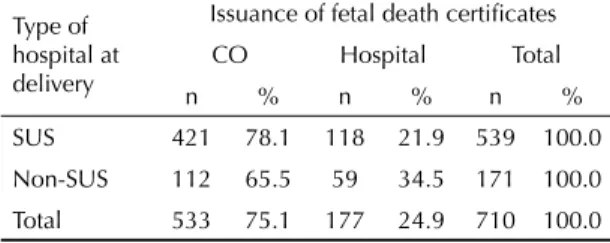
Among the 710 deaths, 75.1% of death certifi cates were issued by the CO and 24.9% by hospitals that provided delivery care (Table 1). Death certifi cates were issued by the CO 19% more frequently for deaths in SUS hospitals compared to non-SUS hospitals (p < 0.001; 95%CI 1.06;1.34).
Completeness for fetal sex and birth weight was excel-lent for fetal death certifi cates issued by CO and were respectively excellent and good in death certifi cates emitted by hospitals. The variables related to maternal characteristics (age, education and previous children) had poor completeness, and hospitals performed better than the CO, especially non-SUS hospitals which had completeness between moderate and good. Completeness was good and excellent for variables related to pregnancy and delivery in non-SUS hospitals and moderate in the SUS network. Death certifi cates issued by CO showed large variability in data complete-ness: good (gestational age and birth weight), moderate (type of pregnancy) and very poor (delivery mode). Death certifi cates from hospitals, especially non-SUS hospitals, presented greater completeness than those
fi lled in by the CO (Table 2).
Fetal deaths in the 11 SUS hospitals represented 39% of the total deaths in SUS hospitals during the study period. Of the sample, 66% of death certifi cates were emitted by CO and 34% by hospitals (Table 3).
For referral of fetal deaths to CO, a police report must be made, authorizing removal of the corpse from the
Table 1. Institutions responsible for issuance of fetal death
certificates, by type of hospital at delivery. São Paulo, Southeastern Brazil, 2008.
Type of hospital at delivery
Issuance of fetal death certifi cates
CO Hospital Total
n % n % n %
SUS 421 78.1 118 21.9 539 100.0
Non-SUS 112 65.5 59 34.5 171 100.0
Total 533 75.1 177 24.9 710 100.0
SUS: Brazilian Unifi ed Health System CO: Coroner’s Offi ce
Table 2. Completeness of variables on fetal death certifi cates, by type of hospital and institution responsible for issuance. São
Paulo, Southeastern Brazil, 2008.
Variável
SUS Non-SUS Total Total
Overall (n = 710) CO
(n = 421)
Hospital (n = 118)
CO (n = 112)
Hospital (n = 59)
CO (n = 533)
Hospital (n = 177)
n % n % n % n % n % n % n %
Maternal
Age 165 39.2 90 76.3 30 26.8 55 93.2 195 36.6 145 81.9 340 47.9 Education 12 2.9 63 53.4 1 0.9 46 78.0 13 2.4 109 61.6 122 17.2 Previous live births 153 36.3 84 71.2 18 16.1 51 86.4 171 32.1 135 76.3 306 43.1 Previous deaths 99 23.5 65 55.1 17 15.2 43 72.9 116 21.8 108 61.0 224 31.5 Gestation/delivery
Gestational age 394 93.6 106 89.8 96 85.7 57 96.6 490 91.9 163 92.1 653 92.0 Type of pregnancy 319 75.8 102 86.4 83 74.1 57 96.6 402 75.4 159 89.8 561 79.0 Delivery mode 17 4.0 92 78.0 4 3.6 54 91.5 21 3.9 146 82.5 167 23.5 Fetal
Sex 421 100.0 117 99.2 111 99.1 58 98.3 532 99.8 175 98.9 707 99.6 Birth weight 415 98.6 108 91.5 110 98.2 53 89.8 525 98.5 161 91.0 686 96.6 SUS: Brazilian Unifi ed Health System
Table 3. Completeness, agreement, sensitivity and specifi city of variables in fetal death certifi cates from deliveries in hospitals of the Brazilian Unifi ed Health System, according to the institution responsible for issuance. São Paulo, Southeastern Brazil, 2008.
Variables
Completeness
A Se Sp
Medical Record DC
n % n %
DC issued by CO (n=140) Maternal
Age 138 98.6 55 39.9 40.7 39.9 100.0
Education 24 17.1 5 3.6 80.7 0.0 97.4
Previous live births 103 73.6 77 55.8 55.0 43.7 86.5 Previous child deaths 100 71.4 50 36.2 45.7 29.0 87.5 Gestation/delivery
Gestational age 93 66.4 135 97.8 64.3 95.7 2.1 Type of pregnancy 121 86.4 111 80.4 71.4 79.3 21.1 Delivery mode 138 98.6 2 1.4 2.9 1.4 100.0 Fetal
Sex 133 95.0 140 100 95.0 100.0 0.0
Birth weight 127 90.7 137 99.3 88.6 97.6 0.0 DC issued by hospitals (n = 72)
Maternal
Age 72 100 57 79.2 81.9 81.9
-Education 9 12.5 44 61.1 37.5 44.4 36.5 Previous live births 45 62.5 63 87.5 56.9 84.4 11.1 Previous child deaths 38 52.8 39 54.2 34.7 39.5 29.4 Gestation/delivery
Gestational age 54 75 62 86.1 63.9 83.3 5.6 Type of pregnancy 60 83.3 59 81.9 81.9 88.3 50.0 Delivery mode 70 97.2 53 73.6 70.8 72.9 0.0 Fetal
Sex 70 97.2 71 98.6 97.2 98.6 0.0
Birth weight 69 95.8 62 98.6 87.5 88.4 66.7 A: agreement; Se: sensitivity; Sp: specifi city
DC: fetal death certifi cate CO: Coroner’s Offi ce
hospital. In 88.6% of deaths, the police report was solic-ited by family members, and in the remaining cases, by other people, including hospital staff made the request. The Municipal Health Secretary introduced Cadaver Referral Guidelines, in order to improve hospital infor-mation sent to the CO; nonetheless, the guidelines were present in only 21.4% of records at the CO.
The analysis according to source of death certifi cate (hospital or CO) did not show signifi cant differences in completeness of records. Differences were observed when comparing the proportion of variables recorded on medical records and death certifi cates, although there was no consistent trend. Maternal characteristics had lower completeness in death certifi cates issued by CO compared to hospital records. Recording of maternal education was minimal (3.6%). Gestational age was complete in 97.8% of death certifi cates and 66.4% of
medical records, and type of pregnancy was complete in 80.4% and 86.4%, respectively. Type of delivery was practically not registered on death certifi cates (1.4%), although it was present in 98.6% of hospital records. In regards to the fetal characteristics, completeness was high in medical records and death certifi cates, especially in the later (Table 3).
The agreement between medical records and death certifi cates issued by the CO was obtained. Data from medical records were considered the gold standard, since they are a primary information source and easily recovered (Table 3). In death certifi cates emitted by CO, there was high agreement for the variables birth weight and sex and low agreement for the other variables. Birth weight and sex presented high sensitivity, and the other variables had low sensitivity.
In death certifi cated fulfi lled by hospitals, there was good agreement between the variables sex, birth weight, type of pregnancy and maternal age. High sensitivity (above 80%) was found for birth weight, sex and type of pregnancy, indicating good recording of these vari-ables in the two data sources. Nonetheless, the high agreement for maternal age was due to the absence of information in the two sources.
Fetal deaths sent to the CO were predominantly pre-term (96.4%), with high concentration during the period of 32 to 36 weeks (35.7%). There were differ-ences in the cause of death between the hospital death certifi cates and those from CO (Table 4). Unspecifi ed fetal death was the principal cause of death on death certifi cates issues by CO, and more frequent than those fulfi lled by hospitals (OR=8.6, 95%CI 4.37;17.78; p <0.001); intrauterine hypoxia was more common on hospital death certifi cates (OR=0.45; 95%CI 0.24;0.83; p<0.001) and the main cause of death for this group. These two causes of deaths were responsible for almost 80% of total deaths.
Among death certifi cates emitted by hospitals there was more diversity of primary cause of death, and placenta and umbilical cord complications were present, but these causes were absent in the group sent to the CO. Congenital malformations did not present a statistically
signifi cant difference (OR=0.50; 95%CI 0.11;2.29; p=0.179) between death certifi cates emitted by CO and hospitals, nor did other perinatal causes (OR=0.77; 95%CI: 0.11-6.58; p=0.770).
DISCUSSION
Completeness of fetal death certifi cates in São Paulo municipality was good or excellent when consid-ering gestational age, sex and birth weight. Type of pregnancy had moderate completeness, and the other variables presented very poor completeness, Therefore, specific mortality indicators cannot be calculated according to maternal characteristics, such as age, education and parity.
SUS and non-SUS hospitals presented differences in completeness for variables based on information routinely collected in hospital care, demonstrating greater care in the transcription of data from hospital records to death certifi cates.
Performance of fetal autopsies is supposed to produce more detailed and higher quality information. Two-thirds of fetal deaths were referred to the CO for autopsy, a level that approximated developed coun-tries.1,14 Nonetheless, recording of data on death certifi
-cates from CO was less consistent than in hospitals.
In death certifi cates from CO, the variables obtained either directly or indirectly by autopsy (sex, birth weight and gestational age) presented similar, and sometimes higher, completeness than death certifi cates emitted by hospitals. CO do not have access to hospital records and instead only have access to data registered on the police reports emitted by the police precinct. The use of the Cadaver Referral Guideb was unable to resolve the
Table 4. Primary cause of fetal death listed on death certifi cates for hospitals of the Brazilian Unifi ed Health System, according
to the institution responsible for issuance. São Paulo, Southeastern Brazil, 2008.
Primary Cause of Death (ICD-10) CO Hospital Total
n % n % n %
Fetal death of unspecifi ed cause (P95) 92 65.7 13 18.1 105 49.5 Intra-uterine hypoxia, unspecifi ed (P209) 34 24.3 30 41.7 64 30.2 Maternal complications (P000;P002;P011;P015;P371) 7 5.0 14 19.4 21 9.9 Placental complications (P021;P022;P023) 0 0.0 6 8.3 6 2.8 Umbilical cord complications (P024-P025) 0 0.0 3 4.2 3 1.4 Malformations (Q000;Q240;Q249;Q602;Q913) 4 2.9 4 5.6 8 3.8 Other perinatal causes (P072;P832;P964;P969) 3 2.1 2 2.8 5 2.4
Total 140 100.0 72 100.0 212 100
ICD-10: International Statistical Classifi cation of Diseases and Related Health Problems, 10th Revision. CO: Coroner’s Offi ce
problem, since it was present in CO records for 21.4% of reviewed deaths (SUS hospitals), which explains the low completeness of variables that depend on informa-tion unobtainable by fetal autopsy.
High completeness for birth weight was observed for death certifi cates emitted by CO, although the measure-ment was performed at autopsy and did not represent true birth weight. Gestational age, which had good completeness overall, is provided by family members and is written in months in CO records. The calcula-tion for weeks is performed when death certifi cates are fi lled out, which can involve measurement errors in data transcription.
The high proportion of fetal death certifi cates emitted by CO can be related to the combination of four factors: a) performance of fetal autopsies is thought to improve the identifi cation of cause of death by obstetricians; b) the high proportion of antepartum fetal deaths (approximately 90%)3 combined with the
lack of integration between prenatal care and delivery, results in the woman’s health records not being sent to the delivery hospital; c) the relative proximity of CO in the capital; d) the reluctance of health professionals to report unfavorable outcomes.8 These factors can
incen-tivize obstetricians to judge antepartum fetal deaths as undefi ned deaths and to refer them to autopsy. The situation was more frequent in SUS hospitals, probably due to the need of family authorization.
Recording of data in hospital records was more complete than information in death certifi cates, except for the vari-ables birth weight, sex and gestational age. For almost all the other variables there was a loss of data during transcription from medical records to death certifi cates, especially those emitted by the CO. This results in a low degree of agreement for the majority of variables.
The type of pregnancy had lower agreement for death certifi cates emitted by SUS hospitals and CO, when compared to a study in Washington in the USA.15 The
variable for previous live births had even lower agree-ment than in the Washington study.15 These results
suggest a lower preoccupation in the recording of information on death certifi cates emitted in São Paulo. The study in the United States compared the values recorded in death certifi cates and medical records, and in the current study, agreement refers to the presence of information and not their values in death certifi cates and medical records.
The presence of birth weight and gestational age had a high sensitivity in the death certifi cates emitted by hospitals, indicating simultaneous recording of both documents. With the exception of age, there was low recording of maternal characteristics in medical records and therefore low completeness of death certifi cates.
Although the objective of performing autopsies is to improve information on cause of death, the majority of death certifi cates emitted by CO attributed the primary cause of death as unspecifi ed. The most frequent cause of death indicated by CO was unspecifi ed fetal death, followed by intra-uterine hypoxia. These positions were reversed in death certifi cates emitted by hospitals. A similar result was obtained in Massachusetts in the USA,13 where a comparison of the cause of death on
death certifi cates with autopsy results demonstrated that a portion of deaths indicated as asphyxia on death certifi cates, were subsequently considered as unknown following autopsy. Perinatal autopsies performed in a referral hospital in Curitiba19 found 15.7% of fetal
deaths as unspecifi ed.
The variety in the classifi cation of fetal deaths9 makes
the comparison of results complex. The proportion of deaths due to unknown or unexplained causes depends on the classifi cation used by various studies. A study performed in West Midlands9 in England found 66%
of deaths were considered as unexplained fetal deaths using the Wigglesworth classification,24 and when
employing the Classifi cation System according to the Relevant Mortality Code,9 15.1% were classifi ed as
unknown. A study involving the classifi cation system adopted by Australia and New Zealand found that the cause of death reported by hospitals was undetermined in 26.7% of antepartum fetal deaths, although this proportion increased to 38.4% when reviewed by the Perinatal Mortality Committee.11
In death certifi cates emitted by hospitals, besides the aforementioned causes of death, there was a high proportion of deaths due to gestational complications, as well as placenta and umbilical cord complications, which were absent from death certifi cates emitted by CO. This fi nding may be due to the absence of clinical information concerning the pregnancy and delivery, during autopsy. In addition, the placentas do not accompany the fetuses for autopsy which complicates the identifi cation of cause of death.
Some authors indicate that there are problems in the use of ICD-10 for the study of fetal deaths,8 specifying
that the codes referring to placental conditions are incomplete and include few pathologies. There is also overlap between obstetric and perinatal conditions which could contribute to the high proportion of
unde-fi ned or unexplained deaths, demonstrating the need to introduce modifi cations in the next ICD revision.8
Information about fetal deaths can be improved with the introduction of a specifi c fetal death certifi cate, which could include more detailed information about gestational complications.14
the Infant and Fetal Death Surveillance Committeesc to
improve information and obtain a better understanding for prevention programs. It is possible that compulsory surveillance of infant and fetal deaths by the SUS health services (public and private) d will improve
information quality.
The removal of the fetuses form the hospital to the CO occurs after a police report is submitted by the police station responsible for the area where the hospital is located. In the sample of SUS hospitals, the police reports for almost 90% of deaths referred to CO were requested by family members. Instead of family members receiving counseling and support from health services, they are referred to police stations to obtain the document. Families in São Paulo state that use SUS and experience a fetal loss, appear to receive a different level of care than offered in the United States, United
Kingdom, Canada and Australia, where support and counseling activities are provided to families.e
In conclusion, it is necessary to improve completeness and reporting for the cause of death in fetal deaths. The high proportion of autopsies did not improve informa-tion quality. Improvement of informainforma-tion quality on CO death certifi cates depends on access to hospital information. Good quality vital statistics are a critical
fi rst step for the research, monitoring and preven-tion of fetal mortality. Sensitizapreven-tion of managers and health professionals is fundamental to improve the information available about fetal deaths. It is possible to develop routines to facilitate the adequate fl ow of information between prenatal care services and hospitals and subsequently to CO. In addition, it is necessary to improve support for families that experi-ence a fetal death.
c Ministério da Saúde, Secretaria de Atenção à Saúde, Secretaria de Vigilância à Saúde. Manual dos comitês de prevenção do óbito infantil e fetal. Brasília (DF); 2005. (Série A. Normas e Manuais Técnicos).
d Ministério da Saúde. Portaria nº 72, de 11 de janeiro de 2010. Estabelece que a vigilância do óbito infantil e fetal é obrigatória nos serviços de saúde (públicos e privados) que integram o Sistema Único de Saúde (SUS). Diario Ofi cial Uniao. 12 jan 2010; Seção 1:29-31.
e First Candle. Online resources. Baltimore; c2011 [cited 2011 June 12]. Available from: http://www.fi rstcandle.org/grieving-families/grief-resources/online-resources/
1. Adappa R, Paranjothy S, Roberts Z, Cartlidge PHT. Perinatal and infant autopsy. Arch Dis Child Fetal Neonatal. 2007;92(1):49-50. DOI:10.1136/ adc.2005.091447.
2. Almeida MF, Alencar GP, Novaes HMD, Ortiz LP. Sistemas de informação e mortalidade perinatal: conceitos e condições de uso em estudos
epidemiológicos. Rev Bras Epidemiol. 2006;9(1):56-68. DOI:10.1590/S1415-790X2006000100008
3. Almeida MF, Alencar GP, Novaes HMD, França Jr I, Siqueira AAF, Campbell OMR, et al. Risk factors for antepartum fetal deaths in São Paulo, Brazil. Rev Saude Publica. 2007;41(1):35-43. DOI:10.1590/S0034-89102007000100006.
4. Cartlidge PHT, Dawson AT, Stewart JH, Vujanic GM. Value and quality of perinatal and infant postmortem examinations: cohort analysis of 400 consecutive deaths. BMJ. 1995;310(6973):155-8.
5. Cnattingius S, Stephansson O. The epidemiology of stillbirth. Semin Perinatol. 2002;26(1):25-30. 6. Costa, JMBS, Frias PG. Avaliação da completitude
das variáveis da declaração de óbitos de menores de um ano residentes em Pernambuco, 1997-2005.
Cienc Saude Coletiva. 2011;16(Supl 1):1267-74. DOI:10.1590/S1413-8132011000700059 7. Fonseca SC, Coutinho ESF. Fatores de risco para
mortalidade fetal em uma maternidade do Sistema Único de Saúde, Rio de Janeiro, Brasil: estudo caso-controle. Cad Saude Publica. 2010;26(2):240-52. DOI:10.1590/S0102-311X2010000200004 8. Froen JF, Gordijn SJ, Abdel-Aleem H, Bergsjo P,
Betran A, Duke CW, et al. Making stillbirths count, making numbers talk: issues in data collection for
stillbirths. BMCPregnancy Childbirth. 2009;9:58. DOI:10.1186/1471-2393-9-58
9. Gardosi J, Kady SM, McGeown P, Francis A, Tonks A. Classifi cation of stillbirth by relevant condition at death (ReCoDe): population based cohort study. BMJ. 2005;331(752):1113-7. DOI:10.1136/ bmj.38629.587639.7C
10. Gaudino Jr JA, Blackmore-Prince C, Yip R, Rochat RW. Quality assessment of fetal death records in Georgia: a method for improvement. Am J Public Health.
1997;87(8):1323-7.
11. Gordon A, Jeffery HE. Classifi cation and description of stillbirths in New South Wales, 2002-2004. Med J Aust. 2008;188(11):645-8.
12. Hoyert DL, Martin JA. Vital statistics as a data source.
Semin Perinatol. 2002;26(1):12-6. DOI:10.1053/ sper.2002.29835
13. Lammer EJ, Brown LE, Anderka MT, Guyer B. Classifi cation and analysis of fetal deaths in Massachussetts. JAMA. 1989;261(12):1757-62. DOI:10.1001/jama.1989.03420120095033
14. Lawn JE, Gravett MG, Nunes TM, Rubens CE, Stanton C, GAPPS Review Group. Global report on preterm birth and stillbirth (1of 7): defi nitions, description of the burden and opportunities to improve data.
BMC Pregnancy Childbirth. 2010;10(Suppl 1):S1. DOI:10.1186/1471-2393-S1-S1
15. Lydon-Rochelle MT, Cárdenas V, Nelson JL, Tomashek KM, Mueller BA, Easterling TR. Validity of maternal and perinatal risk factors reported on fetal death certifi cates. Am J Public Health. 2005:95(11):1948-51. DOI:10.2105/AJPH.2004.044305
Research supported by the Fundação de Amparo à Pesquisa do Estado de São Paulo (FAPESP – Process Nº. 2006/61304-3). The authors declare no confl ict of interest.
16. McDorman MF, Martin JA, Mathews TJ, Hoyert DL, Ventura SJ. Explaining the 2001-2002 infant mortality increase: data from the linked birth/infant death data set. Natl Vital Stat Rep. 2005;53(12):1-22.
17. MacDorman MF, Kirmeyer S. Fetal and perinatal mortality, United States, 2005. Natl Vital Stat Rep. 2009;57(8):1-19.
18. Menezes AMB, Victora CG, Barros FC, Albernaz E, Menezes FS, Jannke HA, et al. Mortalidade infantil em duas coortes de base populacional no Sul do Brasil: tendências e diferenciais. Cad Saude Publica.
1996;12(Supl 1):S79-86. DOI:10.1590/S0102-311X1996000500012
19. Noronha L, Medeiros F, Martins VDM, Sampaio GA, Serapião MJ, Kastin G, et al. Malformações do Sistema Nervoso Central: análise de 157 necrópsias pediátricas. Arq Neuro-Psiquiatr. 2000;58(3B):890-6. DOI:10.1590/S0004-282X2000000500015
20. Ramirez AF, Serra AP, Maragolas RG, Marcano MB, Bustins M. La mortalidad perinatal según 2 fuentes de información. Gac Sanit. 2008;22(4):378-81. DOI:10.1590/S0213-91112008000400013
21. Schoendorf KC, Branum AM. The use of United States vital statistics in perinatal and obstetric research. Am J
Obstet Gynecol. 2006;194(4):911-5. DOI:10.1016/j. ajog.2005.11.020
22. Schramm JMA, Szwarcwald CL, Esteves MAP. Assistência obstétrica e risco de internação na rede de hospitais do Estado do Rio de Janeiro. Rev Saude Publica. 2002;36(5):590-7. DOI:10.1590/S0034-89102002000600008
23. Silva ZP, Almeida MF, Ortiz LP, Alencar GP, Alencar AP, Schoeps D, et al. Características dos nascidos vivos, das mães e mortalidade neonatal precoce na Região Metropolitana de São Paulo. Cad Saude Publica. 2009;25(9):1981-9. DOI:10.1590/S0102-311X2009000900012
24. Wigglesworth JS. Monitoring perinatal mortality: a pathophysiological approach.
Lancet.1980;2(8196):684-6. DOI:10.1016/S0140-6736(80)92717-8