Assessment of the tensile strength of
hexagonal abutments using different
cementing agents
Abstract: The aim of this study was to assess the uniaxial tensile strength after thermal cycling in replicas of CeraOne abutments (abutment and coping sets), using four types of cements (n = 10). A zinc phosphate ce-ment (Fosfato de Zinco / SSW), a resin-modiied glass ionomer cement (RelyX luting / 3M-ESPE), a zinc oxide-eugenol cement (ZOE / SSW) and a zinc oxide cement without eugenol (TempBond NE / KERR) were used. After cementation, the samples were submitted to thermal cycles (1,000 cycles, 5°C ± 2° to 55°C ± 2°) for thirty seconds in each bath. Next, the samples were submitted to the tensile test in a universal test machine (0.5 mm/min). The data were submitted to ANOVA and the Tukey-Kramer test (p < 0.05), and statistically signiicant difference was found among the cements. The highest tensile strength mean value found was for zinc phosphate cement (33.6 kgf) followed by the resin-modiied glass ionomer cement (20.5 kgf), zinc oxide-eugenol cement (8.4 kgf) and the temporary cement (3.1 kgf). Therefore, it was found that the per-manent cements presented higher tensile strength, and the temporary ce-ment could be used in situations requiring reversibility and the removal of cemented dental implant-supported prostheses.
Descriptors: Dental implants; Zinc oxide-eugenol cement; Zinc phosphate cement; Glass ionomer cements.
Carlos Wahl(a)
Fabiana Mantovani Gomes França(b)
Rui Barbosa Brito Jr(b)
Roberta Tarkany Basting(b)
Henrique Smanio(c)
(a) MS, Assistant Researcher; (b)PhDs,
Professors; (c)Professor – São Leopoldo
Mandic Dental School, Campinas, SP, Brazil.
Corresponding author: Fabiana Mantovani Gomes França Rua Emerson José Moreira, 1455 casa 07 Chácara Primavera - Campinas - SP - Brazil CEP: 13087-441
E-mail: [email protected]
Introduction
Since 1986, when Jemt presented the use of im-plants to replace a single tooth, there has been no-table progress.1 There are now several options for prosthetic designs. In 1991, Nobel Biocare intro-duced the CeraOne system consisting of a hex-agonal abutment, with the intention of solving the problem of screw loosening. As a result, the Cera-One restoration could be cemented to the implant abutment without fear of screw damage, thus pro-viding an implant with greater lingual comfort, since it eliminated the need for a screw with lingual access.2
Furthermore, different options of materials or procedures for cementing or ixing restorations to implants also appeared.3 The question of the method by which the prostheses are connected to the base of the implant, either screwed or cement-ed, deserves more detailed study.4 Cemented dental prostheses have peculiar characteristics when com-pared with screwed prostheses, some of their posi-tive characteristics being greater lingual comfort, a better emerging proile, more adequate restoration outline, and easier cleaning.2 One of their negative characteristics is lack of success with reversibility and removal of cemented dental implant-supported prostheses.2 There are concepts that inluence the in-creased retention of a cemented prosthesis: parallel-ism between the abutments, surface area and height, surface roughness and the type of cement.5 Regard-ing this aspect, the type of cement is a relevant and decisive factor for retention.6
However, there are questions about the possibil-ity of using temporary bonding agents instead of permanent cements to remove the prostheses
with-out causing damage.7 Carter et al.4 (1997) have recommended the use of a weaker bonding agent at irst, and progressing to a stronger one until the desired amount of retention is achieved. This ap-proach allows occlusion and tissue reaction to be as-sessed. However, the use of highly resistant cements has become more popular with a reliable increase in stability of the tooth-abutment/implant support of the screw connection and a high survival rate of osseointegrated implants.8 The permanent cements commonly used for traditional prostheses resist any attempt at the removal of prostheses from the abut-ments, making posterior access to the implants dif-icult. Therefore, their use must be well indicated.3
The dental cements used for cementing implant-supported prostheses may present different effects when compared with those used on teeth.8 There-fore, the aim of this study was to assess the uniaxial tensile strength of hexagonal abutments, used with different types of cementing agents after thermal cy-cling.
Material and Methods
Forty replicas of hexagonal tin abutments with their titanium copings (Neodent, São Paulo, SP, Bra-zil), cemented with four different bonding agents (n = 10), were submitted to the tensile test: tempo-rary zinc oxide cement without eugenol (TempBond NE / KERR, Orange, CA, USA), zinc oxide-euge-nol cement (ZOE / SSW, Rio de Janeiro, RJ, Bra-zil), permanent resin-modiied glass ionomer cement (RelyX luting / 3M-ESPE, Sumaré, SP, Brazil), and permanent zinc phosphate cement (Zinc Phosphate / SSW, Rio de Janeiro, RJ Brazil). Table 1 describes the manufacturers, batch numbers and compositions
Table 1 - Commercial brand, manufacturer, composition, and batch number/use by date of the cements.
Brand Name Manufacturer Composition Batch number / Use by date
Temp Bond NE KERR (Orange, CA USA) Base - zinc oxide
Accelerator - polyorganic acid
5-1244 2007/09
ZOE SSW (Rio de Janeiro, RJ Brazil) Powder - Zinc oxide, Zinc stereate, Zinc acetate
Liquid - Eugenol, olive or cotton seed oil
002 2009/10/16
RelyX luting 3M-ESPE (Sumaré, SP Brazil) Powder - radiopaque aluminum fluoride
silicate glass
of the cements used. The factors being studied were randomly designated to the experimental units.
Forty machined test specimens were used, these being same size replicas of the hexagon abutment (tin analog) designed without the central perforation through which the retention and stabilization screw passes in the original part (Neodent São Paulo/SP, Brazil). Machined titanium copings, compatible with the hexagonal abutment, were cemented onto these, with the following characteristics: an inter-nally hollow hexagon-shaped titanium cylinder to allow it to be coupled to the hexagon abutment with a maximum of it, and externally, a shoulder with a diameter 0.5 mm larger. No additional device was incorporated into the coping and analog, thus pre-serving their originality, without the need to cast or weld loops to their components. Ten test specimens, each consisting of a set comprising a titanium cop-ing and hexagonal tin abutment analog, were used for each type of cement (Figure 1).
The cements were manipulated in accordance with the recommendations of each manufacturer, in a room with the temperature controlled at 23°C to 25°C. A calibrated 1 ml/cc syringe (INJEX U-100, Ourinhos, SP, Brazil) was used to insert the cement into the titanium copings, and 0.1 ml of cement was used to cement each coping to the abutment. The copings were placed on the abutment manually with
digital pressure. After that, they were placed in a manual press and submitted to 5 kgf pressure for a total time of 10 minutes.3 Excess cement around the samples was removed with the aid of an exploratory probe n. 5 and the samples were stored in distilled water at a temperature of 37°C in vials for 15 days. Then, the samples were submitted to 1,000 thermal cycles (Cycling machine MSCT-3, Marcelo Nucci-ME, São Carlos, SP, Brazil) at a temperature rang-ing between 5°± 2°C and 55°± 2°C, remaining 30 seconds in each bath.2,9,10
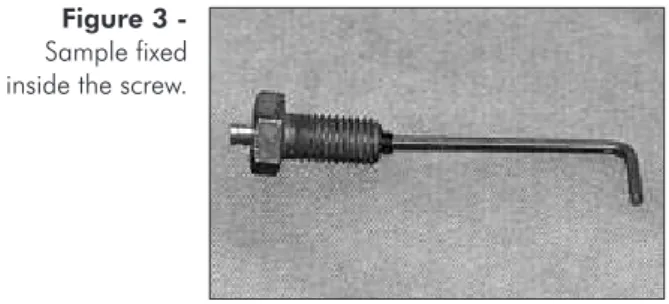
After 15 days, the test specimens were submitted to shear strength tests in a universal test machine (EMIC, São José dos Pinhais, PR, Brazil) at a stan-dard speed of 0.5 mm/min and a 200 kgf load cell. To perform the tests, a device was constructed so that no artifact was welded to the copings and ana-logs. For this purpose a 12 mm screw with the re-quired measurement was turned internally, so that the portion of the tin hexagon abutment analog would pass through the middle of the screw. In its original conformation, the titanium coping, made as previously described, had a cervical shoulder external to the titanium cylinder whose diameter was 0.5 mm larger than that of the remainder of the cylinder. This shoulder was used as retention by mechanical misalignment at the moment of the ten-sile test, as it remained internally ixed to the screw (Figures 2A, 2B and 3). Another device was made by hollowing a steel cylinder so that the groove in the apical portion of the hexagonal abutment ana-log would it and remain ixed. Thus, traction was applied without the aid of any device welded to or cast on the coping and the analog abutment (Fig-ure 4). After the tensile test, the data obtained in kgf were submitted to the analysis of variance (p < 0.05) for comparison of the experimental groups, and the
B A
Figure 1 - Tin analogs and titanium copings. In the detail: Markings identifying the groups (without a mark, TempBond NE; one
mark, Zinc Phosphate;
two marks, ZOE; and
three marks, RelyX luting).
Tukey-Kramer test was used for multiple compari-son of the means.
Results
By means of one way analysis of variance, it was observed that there was statistically signiicant dif-ference among the types of cements used. Table 2 and Graph 1 demonstrate the result of the Tukey test (p < 0.05) for the different types of cement.
In Table 2 and in Graph 1, it can be seen that the
mer cement and zinc oxide-eugenol cement. The zinc oxide cement without eugenol presented the lowest mean tensile strength. It could be observed that the brands commercially known as being per-manent demonstrated greater tensile strength when compared with the temporary cements.
Discussion
The success of a cement-retained dental prosthe-sis depends on the it of the part after casting, the properties of the type of cement selected, handling and the conditions inherent to the oral environment itself.3 With regard to the cementation technique, lit-erature shows that not only the pressure used, but also whether it is static or dynamic, may interfere in the thickness of the ilm. Koyano et al.11 (1978) and Silva et al.12 (1998) found that dynamic pres-sures produced better seating than static prespres-sures, in which the smallest thickness was obtained under static pressure followed by dynamic pressure, and that the thickness of the ilm was slightly smaller with vertical vibration than with horizontal vibration. In this study, the results were obtained with the use of a static pressure device of 5 kgf for 10 minutes on all the samples, with the four cements used.3,8,12,13
In the study of Akashia et al.14 (2002), to aid the tensile test, rods were laser-welded to the cylinders/ gold copings, consequently the gold cylinder did not heat and there was reduced alteration to the cervical margin. In other studies, the copies went through a waxing, embedding and casting process in order to be adapted to the respective abutments after-wards.2,3,7-10,12,13,15,16 In the present study, machined prosthetic components were used, thus a device was developed to adapt the copings to the tensile device.
Figure 4
-Sample coupled to the traction device.
Figure 3 -
Sample fixed inside the screw.
Table 2 - Mean (kgf) and standard deviation of tensile strength of the abutment as a result of the cement.
Cement Mean (kgf) Standard
Deviation Tukey test
Zinc Phosphate 33.6 7.0 A
Rely X 20.5 8.2 B
Zoe 8.4 1.9 C
Temp Bond 3.1 1.5 D
Means followed by different letters in the vertical differ by the Tukey test (p < 0.05).
33.6
20.5
8.4
3.1
0 5 10 15 20 25 30 35 40
Zinc Phosphate® Rely X luting® Cements
Zoe®
Tens
ile
Strength
(kgf
)
Temp Bond®
ricated for performing the tensile test. The goal of this process was idelity with regard to the samples, meaning greater precision in the inal results.
With regard to the materials assessed, zinc phos-phate has small particles that inluence strength and setting time, its solubility in water is relatively low, and bonding occurs mainly by mechanical misalign-ment between the interfaces, and not by means of chemical interactions.17 Bresciano et al.16 (2005) proved these characteristics in their tests, obtaining a resistance of 61 kgf with this cement. In the same study, zinc phosphate cement presented the highest tensile strength mean value.
Glass ionomer cement is obtained by the reac-tion of silicate glass powder and polyacrylic acid. Replacing part of the polyacrylic acid with hydro-philic monomers resulted in a light- or chemically-activated hybrid material denominated resin-modi-ied glass ionomer cement. The susceptibility of this material to humidity and the slow acid-base setting reaction allow syneresis and imbibition processes that diminish the immediate strength of the mate-rial.17 In this study, the hybrid glass ionomer cement obtained intermediate tensile strength values lower than those of zinc phosphate and higher than those of zinc oxide based cements.
In this study, the zinc oxide-eugenol cement pre-sented lower tensile strength than the permanent ce-menting agents, but higher than that obtained with the temporary zinc oxide-based cement without eu-genol. It is known that the presence of free eugenol in the temporary cement can interfere in the appro-priate polymerization of the composites, therefore, acids such as polyorganic acid (Temp Bond) can be used to replace eugenol and produce a cement similar to zinc oxide-eugenol cement.17 The differ-ence in shear bond strength between the two zinc oxide-based cements is probably because of the size of the particles in each cement. The large size of the particles negatively affects the strength of the two zinc oxide-based cements and increases the materi-als’ shrinking coeficient, thus diminishing cement retention and producing greater solubility when compared with that of other cements.17
This study, like those conducted by Kent et al.18 (1996), Clayton et al.2 (1997), Covey et al.19 (2000),
conirmed that CeraOne abutments cemented with permanent cement produced greater retentive strength than temporary cement. Clayton et al.2 (1997) related that zinc phosphate cement presented approximately six times higher strength than the zinc oxide-eugenol cement. However, in the present study, the strength of the former was four times greater than that of the lat-ter, probably due to structures such as the abutment and coping being completely polished by the process of obtaining samples. This result is justiied, since the zinc phosphate cement has a higher modulus of elas-ticity and better mechanical properties because it has smaller particles in its composition.17 Consequently, the tensile strength is increased when compared with that of zinc oxide cements, which have larger parti-cles in their composition.
Bresciano et al.16 (2005) found higher axial ten-sile strength values for zinc phosphate cement in comparison with zinc oxide when using CeraOne abutments without the use of thermal cycling. These results are comparable with the values obtained by Kent et al.18, (1996) who obtained 61.1 kgf for zinc phosphate and 11.3 kgf for zinc oxide. In the pres-ent study, higher strength was also obtained for zinc phosphate when compared with zinc oxide, using the thermal aging process.
It was also observed that zinc phosphate ob-tained 63.9% higher tensile strength than the resin-modiied glass ionomer cement. This difference can be justiied by the characteristics of the ionomeric component of the resin-modiied glass ionomer ce-ment. This cement has a lower modulus of elasticity in comparison with zinc phosphate cement and is, therefore, far more susceptible to elastic deforma-tion. Moreover, it can be inluenced by the imbibi-tion and syneresis processes that characterize gain and loss of water to the medium, thereby compro-mising the integrity of the material.17
loosen-ing of a gold screw of the CeraOne abutment.4 One should seek to associate adequate marginal it with the retentiveness of temporary cements to achieve success. For the clinician that works with implant-supported prostheses, it is extremely impor-tant to know the retentive ability of the temporary cement in cases when the intention is to assure re-versibility of the crowns.14
Conclusion
There were differences in the axial tensile strength values among all the cements used. It was found that the permanent cements presented high-er tensile strength and that the temporary cement could be used in situations that require reversibility and removal of cemented dental implant-supported prostheses.
References
1. Jemt T. Modified single and short-span restorations supported by osseointegrated fixtures in the partially edentulous jaw. J Prosthet Dent. 1986;55(2):243-7.
2. Clayton GH, Driscoll CF, Hondrum SO. The effect of lut-ing agents on the retention and marginal adaptation of the CeraOne implant system. Int J Oral Maxillofac Implants. 1997;12(5):660-5.
3. Michalakis KX, Pissiotis AL, Hirayama H. Cement failure loads of 4 provisional luting agents used for the cementation of implant-supported fixed partial dentures. Int J Oral Maxil-lofac Implants. 2000;15(4):545-9.
4. Carter GM, Hunter KM, Herbison P. Factors influencing the retention of cemented implant-supported crowns. N Z Dent J. 1997;93(412):36-8.
5. Hebel KS, Gajjar RC. Cement-retained versus screw-retained implant restorations: Achieving optimal occlusion and esthet-ics in implant dentistry. J Prosthet Dent. 1997;77(1):28-35. 6. Breeding LC, Dixon DL, Bogacki MT, Tietgi JD. Use of
lut-ing agents with an implant system: Part I. J Prosthet Dent. 1992;68(5):737-41.
7. Ramp MH, Dixon DL, Ramp LC, Breeding LC, Barber LL. Tensile bond strengths of provisional luting agents used with an implant system. J Prosthet Dent. 1999;81(5):510-4. 8. Mansour A, Ercoli C, Graser G, Tallents R, Moss M.
Comparative evaluation of casting retention using the ITI solid abutment with six cements. J Clin Oral Implants Res. 2002;13(4):343-8.
9. Akca K, Iplikcioglu H, Cehreli MC. Comparison of uniaxial resistance forces of cements used with implant-supported crowns. Int J Oral Maxillofac Implants. 2002;17(4):536-42. 10. Squier RS, Agar JR, Duncan JP, Taylor TD. Retentiveness of
dental cements used with metallic implant components. Int J Oral Maxillofac Implants. 2001;16(6):793-8.
11. Koyano E, Iwaku M, Fusayama T. Pressuring techniques and cement thickness for cast restorations. J Prosthet Dent. 1978;40(5):544-8.
12. Silva EG, Moraes JV, Araújo MAM, Ushiwata O. [A compara-tive in vitro study of the effect of thermocycling on the tensile bond strength of metal copings cemented over human teeth using two different luting agents] [Article in Portuguese]. Rev Odontol UNESP 1998;27(2):537-51.
13. Alfaro MA, Papazoglou E, McGlumphy EA, Holloway JA. Short-Term retention properties of cements for retrievable implant-supported prostheses. Eur J Prosthodont Restor Dent. 2004;12(1):33-7.
14. Akashia AE, Franciscone CE, Tokutsune E, da Silva W Jr. Effects of different types of temporary cements on the tensile strength and marginal adaptation of crowns on implants. J Adhes Dent. 2002;4(4):309-15.
15. Bernal G, Okamura M, Muñoz CA. The effects of abutment taper, length and cement type on resistance to dislodgement of cement-retained, implant-supported restorations. J Prostho-dont. 2003;12(3):111-5.
16. Bresciano M, Schierano G, Manzella C, Screti A, Bignar-di C, Preti G. Retention of luting agents on implant abut-ments of different height and taper. Clin Oral Implants Res. 2005;16(5):594-8.
17. Shen C. [Dental Cements]. In: Anusavice KJ. Phillips Dental Materials. 11th ed. Rio de Janeiro: Elsevier; 2005. p. 419-68
[in Portuguese].
18. Kent DK, Koka S, Banks SB, Beatty MW. Factors influenc-ing retention of a CeraOne gold cylinder. Implant Dent. 1996;5(2):96-9.