www.scielo.br/rbg
STRUCTURAL DECOMPOSITION OF THE WAVE FIELD IN THE SOLUTION
OF INVERSE SEISMIC PROBLEMS
Georgy Mitrofanov
1and Viatcheslav Ivanovich Priimenko
2Recebido em 1 agosto, 2010 / Aceito em 21 janeiro, 2011 Received on August 1, 2010 / Accepted on January 21, 2011
ABSTRACT. This article discusses aspects of practical application of the solution to inverse seismic problems based on 1D elastic models of the medium. In order to better fit the 1D models to real observations we propose using a structural decomposition. It allows us to transform the wave field, corresponding to a 3D model, to the wave field, corresponding to a set of local 1D models with “ideal” conditions of seismic oscillations excitation and registration. As a result, a new system of observations in the form of “pseudo” seismograms, which are used during the transition into spectral domain for the solution of the corresponding inverse problem, can be available. In addition, the decomposition of waveforms corresponding to the target object is carried out in the spectral domain. This decomposition allows to eliminate variations in the waveform associated with the changes in the conditions of seismic oscillations excitation and registration, as well with the passage through the overlying medium. In particular, it takes into account the change in the waveform due to differences in the radiation patterns of the real source for different angles of arrival to the target object.
Keywords: seismic observations, seismic data transformation, 3D and 1D models, spectral domain, structural decomposition.
RESUMO.Este artigo discute aspectos da aplicac¸˜ao pr´atica da soluc¸˜ao de problemas inversos s´ısmicos, baseados em modelos el´asticos 1D de meio. A fim de melhor ajustar os modelos a observac¸˜oes reais, propomos utilizar uma decomposic¸˜ao estrutural, que permite transformar o campo de onda, correspondente a um modelo 3D, ao conjunto de dados, correspondentes a modelos 1D locais, com condic¸˜oes “ideais” de excitac¸˜ao e registro das oscilac¸˜oes s´ısmicas. Formando novos dados na forma de “pseudo” sismogramas, que s˜ao usados durante a transic¸˜ao no dom´ınio espectral para a construc¸˜ao da soluc¸˜ao do problema inverso correspondente. Al´em disso, a decomposic¸˜ao de formas de ondas correspondentes ao objeto alvo ´e realizada no dom´ınio espectral. Esta decomposic¸˜ao permite eliminar as variac¸˜oes na forma de onda, associadas a mudanc¸as nas condic¸˜oes de excitac¸˜ao e registro das oscilac¸˜oes s´ısmicas, bem como com a passagem pela parte superior da sec¸˜ao geol´ogica. Em particular, esta decomposic¸˜ao leva em conta a mudanc¸a na forma de onda, devido a diferenc¸as nas caracter´ısticas de orientac¸˜ao da fonte real para diferentes ˆangulos de chegada ao objeto alvo.
Palavras-chave: observac¸˜oes s´ısmicas, transformac¸˜ao de dados s´ısmicos, modelos 3D e 1D, dom´ınio espectral, decomposic¸˜ao estrutural.
1Institute of Geology and Geophysics, Siberian Branch of the Russian Academy of Sciences, pr. Koptyuga, 4, Akademgorodok, 630090, Novosibirsk, Russia. Phone: (73832) 333909 – E-mail: [email protected]
INTRODUCTION
In our previous articles (see Mitrofanov et al., 2009b, 2009c) we have dealt with combination of spectra, based on the theoretical solution of the direct problem, with the spectra calculated from the observed seismograms. These issues are the fundamentals for implementation of the proposed algorithms in practice. However, there is another serious issue, resulting in a considerable diffe-rence between the real experiment and the theoretical solutions. In the theoretical solution of the direct problem we have assu-med homogeneity of the overlying assu-medium and the invariability of the conditions of excitation and registration of seismic signals. All these characteristics are not entirely feasible in a real expe-riment. In addition, the real medium is not horizontally layered, as it is assumed in the theoretical model. Therefore, a pre-pro-cessing of seismograms, which eliminates these differences, is necessary. Such treatments may be based on different procedu-res, the simplest one of them is the stacking procedure. In pre-vious articles we have tried to note the major problem features associated with the existing dynamic processing of seismic data, and also indicated why not use the simplified scheme of seismic data processing when working with multi-component observati-ons, when we need to consider the elastic models. In this article we propose a general scheme, which allows improving the dyna-mic processing of actually observed seisdyna-mic data reflected from thin-layer target objects. It also allows to guarantee the solution of inverse dynamic problems for such objects in the spectral domain of the required input information within the horizontally layered elastic models.
This scheme is based on procedures for structural decompo-sition of the wave field, which can distinguish from the general structure of the registered wave field of reflected waves of requi-red type (for example, P P and P S). They also take into ac-count changes in the form of available signals associated with the heterogeneity, as regions of excitation and registration, and areas of propagation of the signals to thin-layer reflective object. These decomposition procedures give an opportunity to approach a model of the medium for the local target to a one-dimensional theoretical model. In a sense, this decomposition corresponds to the transformation of the initial wave field, corresponding to the elastic complex 3D models, to a set of local 1D models with ideal conditions of seismic oscillations excitation and registra-tion. Such a transformation can be regarded as the development of ideas for changing the structure of observation system and pro-cessing of multi-component seismic data. The simplest example of such transformations is the transition from the ordinary data
with common-shot gather to the data with common-middle gather. Such a transition is the basis of all the seismic data processing tools. The structural decomposition provides a transition to the data, corresponding to the reflection point from the local area of the medium and to a set of angles of arrival of reflected waves for the same area.
STRUCTURAL DECOMPOSITION OF THE SEISMIC WAVE FIELD
Examples of inverse problems and combination (similarity) of spectra, considered in previous works, were examined for syn-thetic seismograms, constructed in the framework of idealized models. In the examples we assumed one-dimensionality of the models, knowledge of the signal and the absent of any variation in its form, which is not related to the parameters of the target object. Therefore, studies have exceptional significance, but only in relation to the solution of the inverse problem on the algorith-mic level, and only under the stated assumptions which have still to be provided. At the same time, we know that the real seis-mic experiment is fundamentally different from them. There are a number of reasons. It suffices to point on the impossibility of carrying out controlled field experiments, which would maintain the form of input seismic signal. In addition, real media differs greatly from one-dimensional models, even in such “ideal” geo-logical basins, as the West-Siberian platform. The presence of such inadequacy of theoretical models for real media makes a serious instability in solving the inverse problem in the complete statement using the real data.
One possible way to overcome these difficulties is to depose the medium model and the observed wave field into com-ponents corresponding to contrasting local features in the struc-ture of the medium. This approach is associated with the heu-ristic argument, connected with the principle of locality, that the contrasting elements of the medium provide the most signifi-cant contribution to the wave field, and therefore their structure can be studied by selecting associated components in the wave field. Note that this argument is the basis of almost all methods of seismic data processing, aimed at the separation of certain re-flections. All the methods of kinematic interpretation and the so-lution of inverse kinematic problems are based on it.
Under this approach, the inverse dynamic problem for the tar-get local objects can be reduced to the following multi-level pro-cess in relation to the real observations and more realistic models.
target objects. It includes the construction of frame macro model, based on availablea priori geological and seismic information. This allows using the ray tracing method to identify and allocate the required wave objects. At the same time it guarantees to take into account the geometry of rays in the area between the object being studied, as well as the key dynamic characteristics associ-ated with a change of seismic energy in the process of propaga-tion of selected waves as a funcpropaga-tion of the front divergence, the curvatures of borders, etc.
The second level is the decomposition of the form of seis-mic signals in multiplicative components corresponding to the influence of surface irregularities, as well as the area of signal propagation and the local reflecting object. As a result, a form of the incident seismic pulse and the spectral characteristics of the reflecting target object are estimated. It can be built as an ope-rator, characterizing the influence of the upper part of geological section, which includes special features related to the heteroge-neity of the conditions of seismic oscillations excitation and regis-tration and to the area of signal propagation. It can be considered as a correction operator with respect to the form of signals for the isolated waves.
The third level is an immediate solution of the local inverse dynamic problem for a given structure of the reflecting object, including elastic models too. In this case, we can already use a locally one-dimensional description for the target object and the corresponding inverse problem in linearized or complete state-ment, which was considered in our previous article, see Mitrofa-nov et al. (2009b).
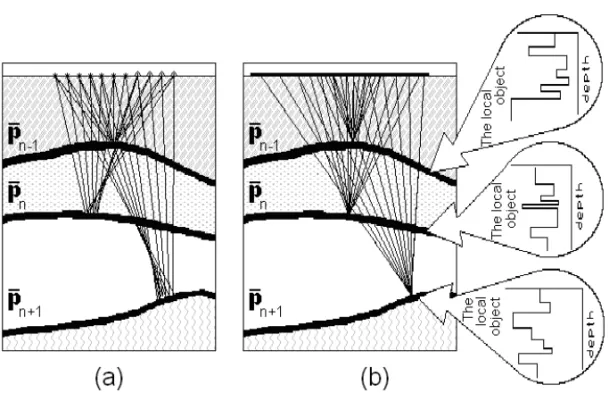
The general idea regarding proposed multi-level process for the solution of inverse dynamic problems for local targets using the real seismic data is presented in Figure 1. It can be seen that the use of structural macro model of the medium that defi-nes a common “skeleton” model, and ray schemes constructed on the basis of this model for given types of waves and availa-ble systems of observations, reduces the general inverse proavaila-blem to several inverse problems in relation to the target local objects. It is possible to transform the wave propagation in complex mo-del for the individual observations (see Fig. 1(a)) in the process of wave propagation in locally one-dimensional models by selec-ting the appropriate observations, corresponded to the required angles of incidence and reflection points (see Fig. 1(b)). We use simultaneously with this approach effectively all the information that was obtained in the previous stages of processing and inter-pretation of multi-component data. In addition, this provides the separation and addition of two main approaches in the seismic research methods: kinematic and dynamic.
Let us consider the main points of this process. The kine-matic interpretation the one among the main methods has been used for the construction of structural frame models of the me-dium. Therefore, during the processing of any real seismic data in modern processing tools there is always enough information to specify the structure of the model in some approximation. At this stage, the important point is the description and the cons-truction of block models of media with the capability to automa-tically generate rays for different kind of waves and to analyze of loop situations, arising in ray tracing in models of this type. We earlier have solved these problems. Corresponding algorithms and programs in determining appropriate models and carrying out ray tracing for different types of waves had been created.
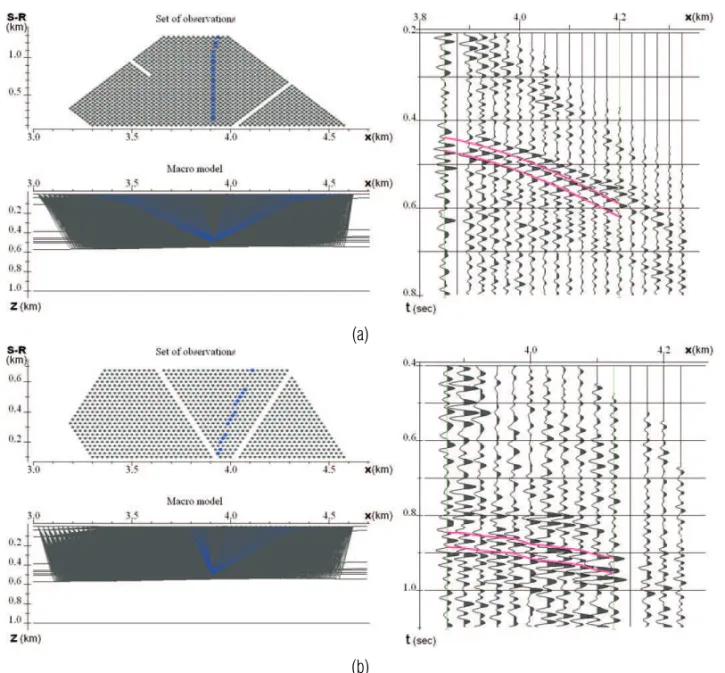
Figure 2 shows how to use these programs for the identifica-tion and selecidentifica-tion of waves,P P(Fig. 2(a)) andP S(Fig. 2(b)), in the processing of real seismograms. It clearly shows a signi-ficant difference in between the selection of these waves, as by the structure of initial observations and by the initial wave field, on the real seismograms. The selected traces were used for for-mation of a “pseudo” seismogram.
The term structural decomposition reflects the essence of the proposed transformation of initial data while using the local one-dimensional models in the process of solving inverse seis-mic problems; where the structures of the macro model and ob-servations to build the ray schemes have been used. Afterwards the ray schemes are used for the selection of observations that contain information about the local area of medium. Thus, the structure of the observations is modified in order to guarantee maximum focus on the local object. This can be represented as the decomposition of the observed wave field in the sum of waves corresponding to the fixed elements of the medium and ray parameter. The results of the decomposition, presented in the form of new sets of observations or the generalized seismo-grams, can be used to solve inverse problems. For example, using interpolation for the selected traces we can create “pseudo” seis-mograms, corresponded to the fixed zone of reflection and the normal ray. This allows us to pass on to the local one-dimen-sional problem in the time or spectral domain.
Figure 1– General scheme of structural decomposition of seismic wave field: (a) structural macro model of the medium, defined by the vector of elastic parametersp¯, and ray schemes corresponded to the given observations; (b) selection of obser-vations by the reflection point and angles. The structure of local objects, corresponded to the target horizons, is also shown.
This method also uses the relationship of variations of shape of the seismic signal to the structure of the observed wave field and the system of observations. The following issues can be stand out:
1. Accounting irregularities within the thick layers and con-trasting elements of the medium along the signal path;
2. The solution of overdetermined systems of linear equati-ons with a singular matrix;
3. Kind ofa priori information required to construct a unique solution for these systems.
Consideration of the first issue was carried out in a geo-metric (ray) approximation, including caustics and diffraction. The second problem is an indispensable feature of the decom-position problems, solved for a range of special problems. Any change in the decomposition model and (or) system of obser-vations provokes the need to restructure the algorithms for sol-ving the problem and to redefinea priori data, needed to ensure the uniqueness of the solution. This made the development of a fairly general algorithm for finding the solution for any decom-position problem by finding the vectors of kernel matrix of the corresponding linear system. It is based on the consideration of factor models, which are relevant to various seismic problems. By virtue of the fact that many solutions have been previously ob-tained and published in various articles, we will not dwell on the
details of the constructions carried out, but only give the basic concepts and results.
A representation, used in the spectral-statistical method for a part of the seismic traceyi j(t)containing the seismic signal or
wave of a given nature, can serve as an example of a multiplicative factor model (Goldin & Mitrofanov, 1973):
yi j(t)=si(t)×rj(t)×ui jM(t)+ξi j(t) (1)
wheresi(t),rj(t)are the impulse responses of excitation and
registration zones of the seismic signal at the appropriate points of the profile line, andξi j(t)is the noisy component. The
in-dicesi and j uniquely determine the coordinates of the source and receiver, similar to the problem of static correction, and ob-servationyi j(t)can be depicted in a generalized plane of
obser-vations. At the same time it is assumed that the impulse charac-teristicsui jM(t)satisfy some additional conditions related to as-sumptions about the model. So, if assumed that the upper part of geological section is homogeneous and has no significant effect on the shape of the propagating seismic signal, corresponding to the wave reflected from the fixed boundary, then the very sim-ple expressionGi+j(t)forui jM(t)can be used, but the whole
expression is rewritten as:
yi j(t)=si(t)×rj(t)×ui jM(t)+ξi j(t) (2)
(a)
(b)
Figure 2– Selection of the given types of waves: (a) P Pand (b)P Son the basis of the developed procedures, using the ray method and the structural macro model. The system of observations is shown with the selected traces, macro model with ray schemes and “pseudo” seismograms formed on the basis of the selected traces. Selected observations and rays corresponded to reflections from a fixed point are identified in blue.
multiplicative factors: source, receiver and impulse response of the reflecting boundary. The operator, eliminating the influence of the upper part of geological section, can be simply defined as
RU p−
1
i j (t)=s
−1
i (t)×r
−1
j (t)
after determiningsi(t), rj(t)by using the available
observa-tions yi j(t). The impact of this operator to the observation
yi j(t)provides us an information about the target object, which
can be used to solve the corresponding inverse problem. Obvi-ously, for the real media and corresponding inverse problems the structure of the multiplicative factor model will be significantly more difficult, so the operator, eliminating the influence of the up-per part of geological section, requires a more complex structure. A general scheme of decomposition of the observed wave field on the multiplicative components was carried out for
differ-ent description models ofui jM(t). These included:
• Model of the spectral-statistical method (Goldin &
Mitro-fanov, 1975),
ui jM(t)=Gi+j(t)×Li−j(t),
• Efficient dynamic model (Mitrofanov, 1980),
ui jM(t)=g
(0)
i+j(t)×g
(2)
i+j,i−j(t)×. . .×g
(2N)
i+j,i−j(t),
• Effective ray model (Madatov et al., 1991),
ui jM(t)= A(γi j, πi j)×T(γi j,t),
• Model of head waves (Mitrofanov & Sergeev, 1986),
ui jM(t)=H(1)
i (t)×H
(3)
j (t)×H
as well as models of target objects, including low-amplitude fault (Landa & Mitrofanov, 1979) and model of thin-layers objects, considered in our recent work, see Mitrofanov et al. (2009a).
An essential aspect of all the multiplicative factor models is their complete or partial linearization by passing to the loga-rithms of the spectral characteristics of intervals of tracesyi j(t)
containing selected waves. After linearization, any multiplicative model can be represented in conventional linear-algebraic form as:
¯
z(ω)=Aθ (ω)¯ + ¯ε(ω)
where¯z(ω)is a vector of initial data, which are the logarithms of the spectral characteristicsyi j(t),θ (ω)¯ is the vector of unknown
parameters, usually consisting of the logarithms of the spectral characteristics of multiplicative factors,ε(ω)¯ is noise vector,A
is frequency independent matrix, whose form is determined by the type of model and structure of the observation system. This allows using modern methods of linear algebra to study the pro-perties of these models and the construction of efficient algo-rithms for estimation of the parameters.
Such a transition is easily illustrated by a simple multiplica-tive factor model (2), which was used in the spectral-statistical method. After this transition, we obtain the expression:
zi j(ω) = αi(ω)+βj(ω)+γi+j(ω)
+λi−j(ω)+εi j(ω)
(3)
which represents a special case of the additive or linear factor model for each fixed frequencyω. Herezi j(ω),αi(ω),βj(ω),
γi+j(ω), λi−j(ω)are the logarithms of the spectral
charac-teristicsyi j(t),si(t),rj(t), Gi+j(t), Li−j(t), respectively,
and as well
εi j(ω)=ln
1+ξ
i j(ω)
(Si(ω)·Rj(ω)·Gi+j(ω)·Li−j(ω))
is a noise that has properties distinct from the original noisy componentξi j(t)in Eq. (1). The properties ofξi j(t)and the
effective ways of constructing estimates in the linearized models were studied in (Mitrofanov et al., 2009b). The above transition leads us to a fairly common way of constructing estimates of factor models. Existing methods of estimating the parameters of linear systems allow constructing an optimal operator for selec-tion of any of the components ofθ (ω)¯ or some combination of them. In general terms, any of the constructed operators will be linear, and obtained estimations can be represented as:
¯
θ∗(ω)=Hz¯(ω)
whereHis a matrix. Then the component of our interest of the linearized model (or a fixedk-th component ofθ (ω)) can be re-¯ presented as
θk∗(ω)=
N
X
l=1
hkl·zl(ω) (4)
wherehkl are the elements of the matrix H, and zi(ω) are
components of the vector ¯z(ω). This expression allows us to provide an estimate of the spectral characteristics of any multi-plicative factor, included in the model, in the form:
L∗k(ω)=eθ
∗ k(ω)=
N
Y
l=1
ehkl·zl(ω)=
N
Y
l=1
(Yl(ω))hkl (5)
wherek and l specify the corresponding components of the vectorsθ (ω)¯ and¯z(ω). Thus the estimate of the spectral com-ponent of the multiplicative model can be represented by an ex-ponent product of the spectra of the parts of the traces, containing a signal from the local target object, and the properties of this product is completely determined by the properties and ele-ments of the matrixH.
After linearization of the above models ofui jM(t), an ana-lysis was carried out of the structure of the zero variety of the linear systems arising in the estimation of multiplicative com-ponents, which include components related to the upper part of geological section. This provided an opportunity to analyze a priori information needed to obtain a unique solution of the pro-blem of separation of such components and construction of the operator taking into account the influence of the upper part of geological section. This analysis was conducted using procedu-res for the selection of vectors of zero variety of the corprocedu-respon- correspon-ding matrices, proposed in Mitrofanov & Rachkovskaia (1996).
multifac-tor models. We therefore used conventional approach based on
F-statistics (Reyment & Joreskog, 1996), only by taking into ac-count the probabilistic properties of the considered logarithms of the spectral characteristics of the linearized model.
The values of logarithms of spectra were used for linear esti-mation of the factors that determine the conditions of seismic os-cillations excitation and registration, as well as the transmission and reflection characteristics of the medium for each of the waves used. Later, on the basis of this scheme and the mentioned al-gorithms a complete program will be developed to generate data for the solution of inverse dynamic problems using real multi-component seismograms. Key elements of such a program and its prospects in the processing of multi-component seismograms, which correspond to more complicated than the one-dimensional model, are presented below in the framework of model experi-ments carried out for two-dimensional model of the medium.
RESULTS OF MODEL EXPERIMENTS FOR THIN-LAYER OBJECTS
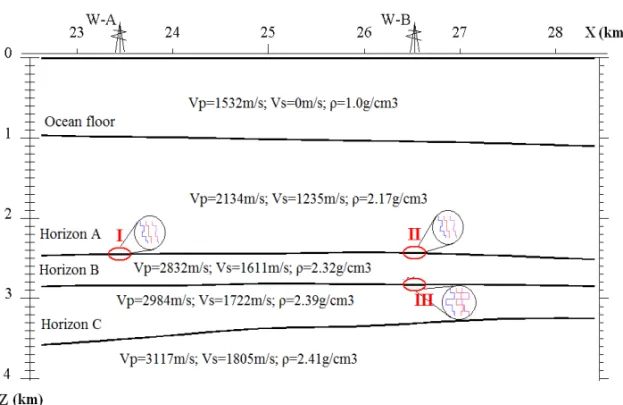
A series of experiments, performed on the synthetic data, shows the importance and necessity of structural decomposition in the process of solving the inverse dynamic problems. At the same time, a macro model, corresponded to real seismic observations, was used as the basic model. Part of the corresponding macro model is shown in Figure 3. It shows the main reflecting hori-zons, as well as the position of two exploration wells, which were used to select models of thin-layer objects related to the target horizons. The locations of the three objects are identified in the figure in red. It also shows the variation of elastic parametersVp,
Vs,ρ, which will be consistent with thin-layer objects (blue-color
variationVp, redVsand purpleρ). Models of objects in its
struc-ture correspond to two types of thin-layer models, and were used in our previous works (Mitrofanov et al., 2009b, 2009c). Also, the figure shows the values of elastic parameters for the thick layers of macro model.
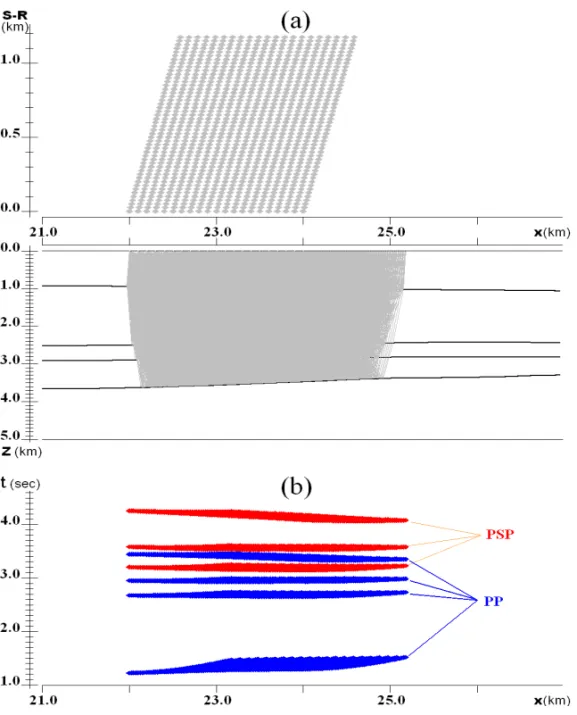
The presented macro model and the models of local objects were used to calculate the synthetic seismograms. We used an effective method of solving the direct problem described in the paper (Mitrofanov et al., 2009a). In order to make structural de-composition of the wave field on the basis of macro model, there rebuild ray schemes used in the subsequent for the identification and selection of the reflected waves corresponding to target ob-jects. An example of such schemes for the target object I, asso-ciated with the second boundary (horizon A) and located on the profile in the coordinatesx = 23.0–23.5 km, was utilized. The schemes were calculated for two types of waves (P P, P S P)
and corresponded to 48 multifold coverage for 21 sources. In this case the first source was located at a profile point with co-ordinatesx= 22.0 km and the distance between the sources was 100 m. The distance between the receivers was equal to 25 m. Thus, the observing system covers all possible area of the target object, see Figure 4(a).
Constructed ray schemes enable us to determine the time of arrival of the waves. The corresponding times are presented in Figure 4(b). They not only provide accurate identification of each type of wave, as shown in the figure, but also determine the possible intervals of data analysis of waves. They also allow to specify the velocity characteristics of these waves, which can be used on the stages of the selection of waves, in particular, with the optimalF-Kfiltering.
Another important application aspect of ray schemes cons-truction is the use of ray characteristics to calculate synthetic seismograms. These seismograms give us an opportunity to better understand the features of selected waves.
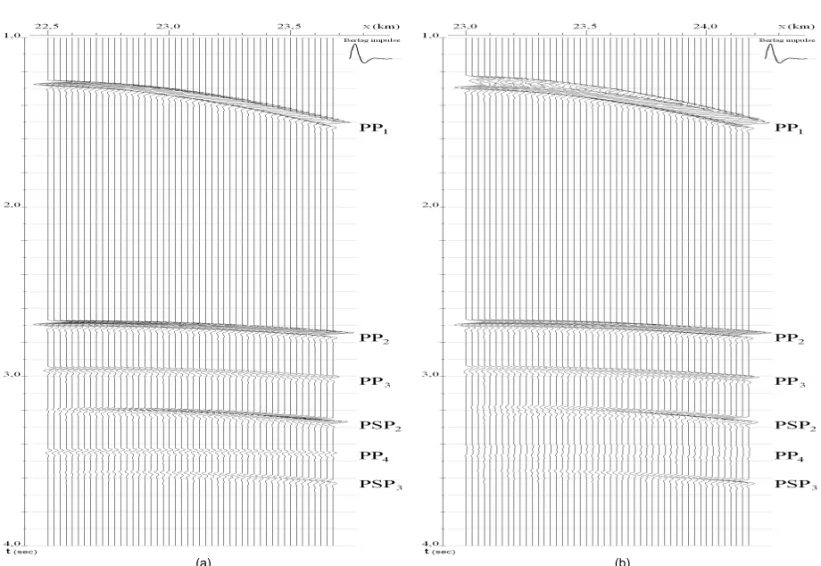
Figure 5 shows examples of the two calculated seismograms, corresponded to the specified system of observations. Using in-formation about time of arrival of waves allows us to accura-tely identify all the observed signals on these seismograms. In this case we can analyze the amplitude and the dynamic featu-res of these signals, in particular, the ratio of the amplitudes of different types of waves. For instance, the seismograms show when the signal amplitudes corresponded to the target converted wavesP S P2, would be comparable to the monotypic reflected waves, which have similar arrival times. This can have a signi-ficant impact on the selection of the initial seismic traces of the complete observations system.
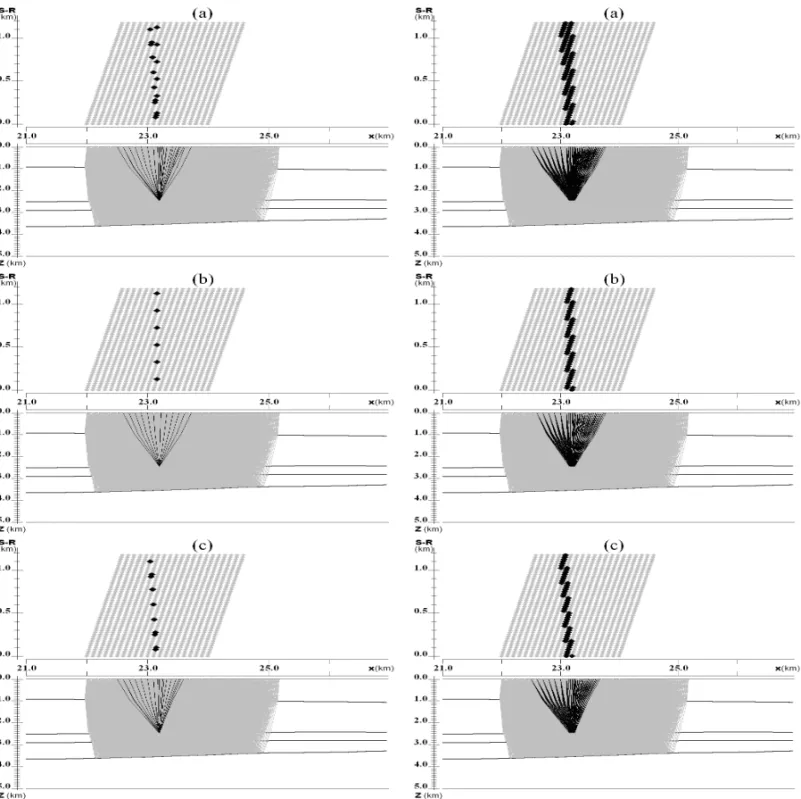
Ray schemes provide an opportunity to consider the peculi-arities of the target selected time intervals containing the reflec-ted signal from the object. For example, if the proposed object, corresponded to the second boundary, is located at the point of a profile with coordinatex= 23.2 km, then we can analyze the structure of the selected observations for a given type of wave.
sig-Figure 3– Part of the macro model with the selected three target thin-layer objects, corresponding to the investigated horizons and the positions of the exploratory wells.
nals related to the reflected P P-wave, see Figure 6(b), left co-lumn. For the converted P S P2-wave we can have a somewhat larger number of target signals, see Figure 6(c), left column. However, the small amplitude of converted waves at the near chan-nels most likely will not get a good quality of these signals for the real data. Therefore, for the converted wave the number of the actually used signals will also be very small. This feature the selective procedure can have a significant impact on the stability of the solution, as in the problem of decomposition of waveforms, and the inverse problem in general. An essential factor in the se-lection of the data may be an extension of the domain containing reflections from the target object, which may include correspon-ding rays. The right column of Figure 6 shows the structure of selected observations, when the corresponding region has a va-riation of±100 m from the exact coordinate of the object. In this case the number of selected signals for each type of wave (the total number of possible signals exceeds 100) increases substan-tially. This expansion of the domain can be justified according to Fresnel zone, affecting the formation of the reflected signal. However, in real situations, we may be limited bya priori informa-tion on possible changes in the properties of the horizon for the broad reflected area. Therefore, when such information is avai-lable, we can use the constructed ray schemes to find the opti-mum width of the selection of the reflected signals, which allows to guarantee the greatest number of observations for the possible variations of the spatial coordinates along the boundary.
Selected observations, together with the ray characteristics, can simplify the selection of the required time intervals, contain-ing the appropriate signals. Figure 7 shows examples of selec-ted intervals for a given model experiment, when used a broad area of analysis of the reflected rays to the target. It is clearly seen that for seismograms corresponding to the source with coordi-natex= 22.5 km (see Fig. 7(a)), the convertedP S P2-waves have high amplitude, which should provide the high signal-to-noise ratio for real traces. Therefore, they can be included in the in-put information. For the seismograms corresponding to a source with coordinatex= 23.0 km (see Fig. 7(b)), the situation is quite different. It makes sense to select only theP P-waves.
ANALYSIS OF INFLUENCE OF SOURCE RADIATION PATTERN
Figure 4– Ray schemes for the given macro model: (a) system of observations with ray schemes corresponding to the two types of waves:P P,P S P; (b) hodographs of these waves, calculated for the given observations on the basis of the constructed ray schemes.
problem in the spectral domain. This is primarily associated with a significant difference between theoretical and calculated spectra, which significantly affects the properties of the minimized objec-tive function (Mitrofanov et al., 2009b).
Experiments were carried out as follows: firstly, based on the model of the target object, model seismogram was calculated by using the complete solution of the direct dynamic problem in the spectral domain for a deepened source of the type of the center of expansion. Then constructed seismograms were used for the selection of signals corresponding to a specific target signals and the types of waves. Selected signals served as input data to de-termine the spectral characteristics. This approach fully
(a) (b)
Figure 5– Examples of synthetic seismograms, calculated for multiple system of observations based on the ray method and containing only two types of reflected wavesP PandP S P. The seismograms correspond to the sources located at the points of the profile with coordinatesx= 22.5 km (a) andx= 23 km (b).
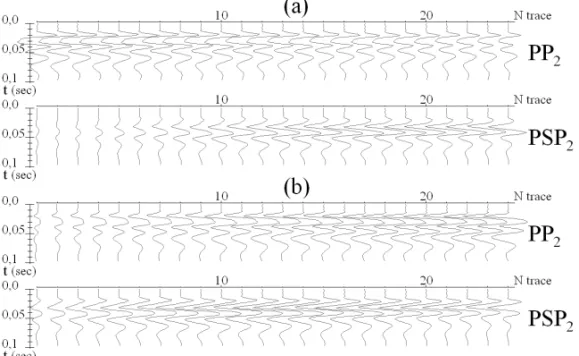
In constructing the model seismograms in all these experi-ments we used 24 channels array with the source position on the left side. In this, the first device is located directly above the source. The distance between geophones is 50 m; thus, the maximum distance is equal to 1150 m. The source signal was always the Berlage impulse that better corresponds to the sig-nals observed in the real seismograms. The shape of this pulse is shown in Figure 5. The selection of the required reflections of the multi-component synthetic seismograms, corresponding toZ andX component, was carried out using ray tracing algo-rithms. As a rule, the start point of the selected interval, con-tained the analyzed signal, had a somewhat smaller value than the time by traced ray, see Figure 7. Example of selected inter-vals containing of P Pand P S P waves reflected from the re-gion of the second object is shown in Figure 8. These intervals were used to calculate the spectra, which are then compared with theoretical values.
In calculating the spectra for selected intervals of traces that contain reflections of certain types, we used optimal smoothing windows, providing sufficient accuracy of the spectral
characteris-tics. Therefore, all the obtained deviations of the calculated spectra from the theoretical values could be attributed to inadequacies of model assumptions and the observed signals. It is important to note that according to the results of our previous studies (Mitro-fanov et al., 2009a) the constructed linearized representation of the spectral characteristics of thin-layers series for a given type of reflection gives an error of no more than 2-3% with relatively small angles of incidence on the object. In our experiments, the latter condition, because of the relatively small size of source-to-receiver distance, was certainly achieved.
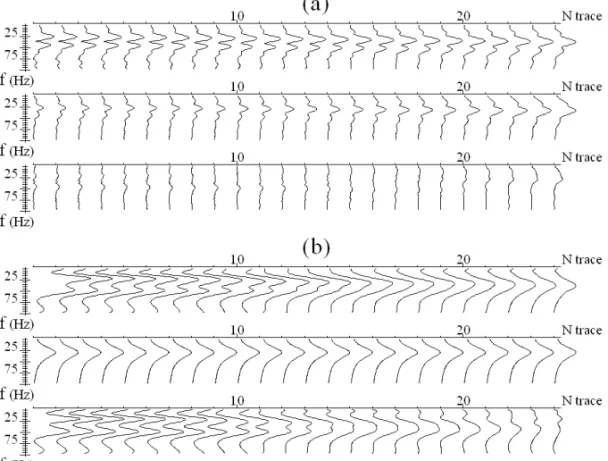
Figures 9-10 present some results of the analysis of the amplitude of the spectral characteristics of reflected signals for longitudinal waves. With the greatest simplicity, they provide a clear understanding of those features which may substantially affect the spectral characteristics of the observed signal in a real experiment.
Figure 6– Selection of the rays and observations, corresponding to the target object I at the point with coordinatex= 23.2 km (left column) and with an interval of 200 m from the center pointx= 23.2 km (right column) for the complex of reflection wavesP P+P S P(a) as well as separately for theP P(b) andP S P(c) waves.
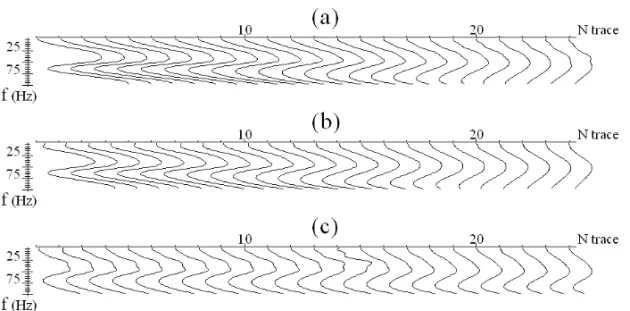
bottom in the figure) represents the theoretical spectral response of the thin-layer object, which was multiplied by the average spec-trum of the smoothed signal, which serves as an estimate of the initial pulse incident on the given object. Similar estimates of the initial pulse are usually used in the real data processing. The third series of spectra (the lowest on the image) represents the differ-ence between the first two spectra.
It is seen that the difference between the two spectra can re-ach significant values (in some cases, its value is 58%), and the
spec-(a) (b)
Figure 7– Examples of the selection of intervals corresponding to the target object I, using the domain of 200 m with the center pointx= 23.2 km for the complex of reflection wavesP P+P S Pon synthetic seismograms. The intervals are related to the seismograms with sources located at the points with coordinatesx= 22.5 km (a) andx= 23 km (b). Intervals with the reflected signals are shown in blue (forP P-wave) and in red (forP S P-wave).
Figure 8– Time intervals selected by the synthetic seismograms forZ-component (a) andX-component (b), which contained reflections from the region of the target object II.
tral characteristics for the given object. By definition, they must correspond to the spectral characteristics of the original pulse (it is shown in the middle part of the figure). But in practice, we have a significant difference between this ratio and the spectrum of the initial pulse. The size and structure of this difference is shown in the bottom of the figure.
The use of simplified decomposition procedures, specified the form of the initial pulse, which falls directly on the thin-layer object permits to improve the quality of the calculated
Figure 9– Comparison of the calculated and theoretical spectra (a) for the reflectedP P-waves in the case of the model for the target object II, as well as their relations with the spectrum of the initial pulse (b).
Figure 11– Residual components in the spectra of reflectedP P-waves in the case of models for objects: (a) I, (b) II, and (c) III.
The nature of these changes in shape and spectrum of the incident wave is related to the directional characteristics of a source, used in constructing the complete solution of the problem with a source of the type of the center of expansion, it is quite ob-vious from the physical point of view, and its manifestation in the synthetic data requires using more complex models of decompo-sition, which may take into account such changes. The model for the spectral-statistical method, in which the impulse characteris-ticsLi−j(t)(or factorsλi−j(ω)) permit to determine changes
in the waveform associated with different source-to-receiver dis-tance, were quite suitable in our experiments.
Figure 11 shows the changes that were manifested by the specified radiation pattern of the source, in different calculated seismograms. It is evident that for objects I and II, which were as-sociated with the same target horizon A and were located on near depths, these characteristics have a very similar structure. If we change the target horizon and its depth (that we have for the ob-ject model III) we observe a change in the corresponding radiation patterns. Thus, in a real experiment, when the characteristics of the source is unknown and may vary for different sources, its ac-counting is required in the procedures of decomposition. Taking into account this characteristic allowed us to provide near-perfect matching calculated and theoretical spectra, in addition to that, the value of the functional was equal to 0.01427.
CONCLUSIONS
In this paper, a structural decomposition of the observed wave fields and forms of seismic signals have been presented, which allows us to transform seismic data in the initial information for solving the inverse problem for a local target of a real medium.
This transformation is crucial for the practical realization of in-verse dynamic problems. It actually creates a certain methodo-logy of constructing a solution of these problems in the case of elastic models of the medium where it is impossible to construct inverse algorithms for the whole model and the full wave field. For these cases, it allows us to make the transformation of seis-mic observations, which were obtained in complex models to the observations corresponded to locally horizontally layered model with respect to the target objects. It is important that in this case we are successful to take into account the characteristics of a real experiment, associated with the heterogeneity of regions of seis-mic oscillations excitation and registration, and also determine the form of the signal incident on the target object. It should be noted that this transformation is carried out by reduction of the reflection features to the points of normal rays. So, it can be im-plemented using both ray schemes and migration procedures.
This transformation defines the method of solution of inverse dynamic problems for modern multi-component observations. In the first stage there are distinguished local elements of the wave field (seismic signals) that are present in the various observed components, but related to the same target. Then, based on those elements of the field (reflected signals), the inverse problem is solved for the target object. Thus, we achieved several goals: first, adjustment of various observed components; second, using an additional information about the shape of the signal for refinement of an existing model of the medium, in order to more complete description of the target objects.
ACKNOWLEDGEMENTS
This work was supported by the Petrobras Institute for Research and Development – CENPES, RJ, Brazil. The first author is es-pecially thankful to the North Fluminense State University Darcy Ribeiro, RJ, Brazil, for providing support as a visiting resear-cher in LENEP/CCT/UENF. We also are thankful to MSc. Keerti Sharma and the anonymous referees for helpful suggestions and comments.
REFERENCES
GOLDIN SV & MITROFANOV GM. 1973. Restoration of the signal form in the presence of near-surface heterogeneities. Reports of Ukrainian Academy of Sciences, issue 2, 125–131. (in Russian)
GOLDIN SV & MITROFANOV GM. 1975. Spectral-statistical method of allowing for surface heterogeneities in the systems of multiple tracing of reflected waves. Geology and Geophysics (Soviet), 16(6): 102–112.
LANDA EI & MITROFANOV GM. 1979. Estimates of parameters of small amplitude fault by CDP seismograms. Izv. AN SSSR, Ser. Physics of Earth, 7: 34–41.
MADATOV AG, MITROFANOV GM & SEREDA VAI. 1991. Approximation approach in dynamic analysis of multichannel seismograms. 1. Model conceptions. Geology and Geophysics (Soviet), 32(10): 97–106.
MITROFANOV GM. 1980. Effective presentation of the wave field in seismic exploration. Geology and Geophysics (Soviet), 21(4): 46–58.
MITROFANOV GM & RACHKOVSKAIA NA. 1996. A priori information forming for analyzing and correction of seismic data in reflection waves method: Geology and Geophysics (Soviet), 37(3): 74–84.
MITROFANOV GM & SERGEEV VN. 1986. Investigation of linearization model for the head waves in the connection with the CMRW data proces-sing. Geology and Geophysics (Soviet), 27(10): 98–108.
MITROFANOV GM, PRIIMENKO VI, MISS´AGIA RM & AMARAL LH. 2009a. Utilizac¸˜ao das transformadas de Laplace e Fourier-Bessel na modelagem de meios el´asticos delgados. Revista Brasileira de Geof´ı-sica, 27(2): 205–224.
MITROFANOV GM, PRIIMENKO VI, MISS´AGIA RM & AMARAL LH. 2009b. Transformada de Laplace na soluc¸˜ao de problemas inversos dinˆamicos da s´ısmica. Revista Brasileira de Geof´ısica, 27(4): 527–544.
MITROFANOV GM, PRIIMENKO VI & BUENO AD. 2009c. Comparac¸˜ao da soluc¸˜ao completa do sistema de Lam´e com espectro de sismogramas. Revista Brasileira de Geof´ısica, 27(4): 545–563.
REYMENT R & JORESKOG K. 1996. Applied Factor Analysis in the Na-tural Sciences. Cambridge University Press, 371 pp.
NOTES ABOUT THE AUTHORS
Georgy Mitrofanovgraduated in Geology and Geophysics, Novosibirsk State University (NSU), Akademgorodok, Novosibirsk, Russia, in 1972. He received his Ph.D. in Mathematical Physics in 1984. He is currently a visiting professor of LENEP/UENF. Areas of interest: seismic data processing, direct and inverse problems in geophysics, reservoir characterization.