ISSN 0101-8205 www.scielo.br/cam
Solving the dual subproblem of the Method of
Moving Asymptotes using a trust-region scheme
MÁRCIA A. GOMES-RUGGIERO, MAEL SACHINE* and SANDRA A. SANTOS
Department of Applied Mathematics, IMECC, UNICAMP, 13081-970, Campinas, SP, Brazil E-mails: [email protected] / [email protected] / [email protected]
Abstract. An alternative strategy to solve the subproblems of the Method of Moving Asymp-totes (MMA) is presented, based on a trust-region scheme applied to the dual of the MMA subproblem. At each iteration, the objective function of the dual problem is approximated by a regularized spectral model. A globally convergent modification to the MMA is also suggested, in which the conservative condition is relaxed by means of a summable controlled forcing sequence. Another modification to the MMA previously proposed by the authors [Optim. Methods Softw., 25 (2010), pp. 883–893] is recalled to be used in the numerical tests. This modification is based on the spectral parameter for updating the MMA models, so as to improve their quality. The per-formed numerical experiments confirm the efficiency of the indicated modifications, especially when jointly combined.
Mathematical subject classification: 49M37, 49M29, 65K05, 90C30.
Key words: nonlinear programming, Method of Moving Asymptotes, spectral parameter, global convergence, dual problem.
1 Introduction
This study proposes a new strategy for solving the subproblems of the Method of Moving Asymptotes (MMA) by means of its dual formulation, using a trust-region technique. The MMA is a very popular method within the structural
optimization community and applies to the inequality constrained nonlinear pro-gramming problem with simple bounds as follows:
minimize f0(x)
subject to fi(x)≤0, i =1, . . . ,m,
xminj ≤xj ≤ xmaxj , j =1, . . . ,n,
(1)
where x = (x1, . . . ,xn)T ∈ Rn is the vector of the variables, xminj and xmaxj are given real numbers for each j and f0, f1, . . . , fm are real-valued twice continuously differentiable functions.
The original version of the MMA [16] was introduced in 1987 by Svanberg, as a generalization of the convex linearization method (CONLIN) [9], with-out global convergence. In 1995, Svanberg [17] proposed a globally conver-gent version. Several other MMA versions have appeared since then, see for instance [5, 20, 22, 23] and references therein. In 1998, Svanberg [18] devel-oped a primal-dual interior-point method for solving the subproblems, in which a sequence of relaxed Karush-Kuhn-Tucker (KKT) conditions are solved by Newton’s method. In 2003, Ni [15] proposed a globally convergent algorithm that combines the method of moving asymptotes with a trust-region technique, in order to solve bound-constrained problems. In its more recent version [19], the MMA was merged into the Conservative Convex and Separable Approx-imation (CCSA) class of methods, which are globally convergent.
In the current work, the dual problem associated with the MMA subproblem is stated and analyzed. The explicit expression of the dual objective function is accessible due to the separability of the rational models of the MMA. The intrinsic features of such a function are highlighted, namely being concave and continuously differentiable. The discontinuities of the second-order derivatives are discussed as well. Motivated by such features, we have proposed a trust-region approach for solving the dual of the MMA subproblem by means of a quadratic model that has a spectral regularization term. The solution of the trust-region subproblem has a closed form.
on a summable controlled forcing sequence [13], so that the maintenance of global convergence of the MMA with this modification is proved. The modified MMA algorithm together with its convergence results are presented in [11].
In the numerical experiments, a third modification of the MMA previously proposed by the authors [10] is incorporated. This modification, also consid-ered in the algorithm and theoretical results of [11], is based on the spectral parameter for the updating of a key parameter of the method, that ensures strict convexity of the model functions. The second-order information provided by the spectral parameter is included in the model functions that define the ratio-nal approximations of both the objective function and the nonlinear constraints at the beginning of each iteration, so as to improve the quality of the models. The computational results corroborate the proposed modifications, especially when jointly combined.
The structure of this paper is as follows. In Section 2, the basic ideas of the MMA are presented, and the relaxed conservative condition is described. In Section 3, a discussion of the dual problem associated with the MMA sub-problem is provided together with details of our trust-region approach applied to the dual of the MMA subproblem. The numerical results are given in Sec-tion 4, and final remarks, in SecSec-tion 5, conclude the text.
2 The Method of Moving Asymptotes and our modifications
Following Svanberg’s approach [16], artificial variables y =(y1, . . . ,ym)T are introduced in problem (1), so that the following enlarged problem is addressed:
minimize f0(x)+ m
X
i=1
ciyi +12diyi2
subject to fi(x)−yi ≤0, i =1, . . . ,m,
x ∈ X, y ≥0,
(2)
where X = {x ∈ Rn;xmin
The 2002 version of MMA for solving problem (2) performs outer and inner iterations. The indices(k, ℓ)are used to denote the ℓ-th inner iteration within
thek-th outer iteration.
To start, it is necessary to choosex(1) ∈ X, and then to computey(1), obtaining
an initial feasible estimate(x(1),y(1))for problem (2).
Thus, given(x(k),y(k)), a subproblem is generated and solved. This
subprob-lem is obtained from (2), replacing the objective function and the functions that define the inequality constraints by separable strictly convex modelsg(k,ℓ)i .
Moreover, the original box is reduced, being defined around the current point with the aid of the parameterσ(k). This subproblem is given next
minimize g(k,ℓ)0 (x)+ m
X
i=1
ciyi+ 12diyi2
subject to gi(k,ℓ)(x)−yi ≤0, i =1, . . . ,m,
x ∈ X(k), y ≥0,
(3)
fork ∈ {1,2,3, . . .}andℓ∈ {0,1,2, . . .}, where
X(k) =x ∈ X |xj ∈
x(k)j −0.9σ(k)j , x(k)j +0.9σj(k), j =1, . . . ,n .
The vectorσ(k)=(σ1(k), . . . , σn(k))T contains strictly positive parameters and its
updating is done as in [19].
Denoting the optimal solution of subproblem (3) by(xˆ(k,ℓ),yˆ(k,ℓ)), at theℓ-th inner iteration, if theconservative conditionholds at xˆ(k,ℓ) for all functions of the problem, that is,
fi(xˆ(k,ℓ))≤ g(k,ℓ)i (xˆ
(k,ℓ)), ∀i ∈ {0,1, . . . ,m}, (4)
then we set(x(k+1),y(k+1))=(xˆ(k,ℓ),yˆ(k,ℓ)), and thek-th outer iteration is com-pleted, after ℓ inner iterations. Otherwise, if g(k,ℓ)i (xˆ(k,ℓ)) < fi(xˆ(k,ℓ)) for at least an index i ∈ {0,1, . . . ,m}, another inner iteration must be performed.
The model for the function fi is maintained the same for the index i such that the approximation is conservative in xˆ(k,ℓ), that is,gi(k,ℓ)(x) ≡ g(k,ℓi +1)(x).
For the indices for which the approximationg(k,ℓ)i does not fulfill the
conserva-tive condition (4) inxˆ(k,ℓ), the model is modified so that the new approximation
It is worth mentioning that the conservative condition is demanded for both the objective function and the constraints, producing, with regards to prob-lem (2), strict reduction of the objective function value and feasible iterates, respectively.
In the MMA, the approximating functions are stated as
g(k,ℓ)i (x)= n
X
j=1
p(k,ℓ)i j u(k)j −xj
+ q (k,ℓ) i j
xj −l (k) j
!
+ri(k,ℓ),
where the poles of the moving asymptotesl(k)j andu(k)j are
l(k)j =x(k)j −σ(k)j and u(k)j =x(k)j +σ(k)j ,
and the coefficientsp(k,ℓ)i j ,qi j(k,ℓ)andri(k,ℓ)are given by
pi j(k,ℓ) = (σ(k)j )2 max
0, ∂fi ∂xj
(x(k)) + ρ (k,ℓ) i σ (k) j 4 ,
qi j(k,ℓ) = (σ(k)j )2 max
0,−∂fi
∂xj
(x(k)) + ρ (k,ℓ) i σ (k) j 4 ,
ri(k,ℓ) = fi(x(k))− n
X
j=1
pi j(k,ℓ) + qi j(k,ℓ) σ(k)j
! .
Within an outer iteration k, the only difference between two inner iterations
are the values of the parametersρi(k,ℓ). These parameters are strictly positive, so
that all the approximating functionsgi(k,ℓ)are strictly convex and every
subprob-lem has a single global optimum. The updating of parametersρi(k,ℓ) is the one
suggested in [19].
The model functionsg(k,ℓ)i are first-order approximations to the original
func-tions fi at the current estimate, that is, conditions
gi(k,ℓ)(x(k))= fi(x(k)) and ∇gi(k,ℓ)(x(k))= ∇fi(x(k))
must hold for alli =0,1, . . . ,m. Another condition that must be satisfied by
the approximating functions is separability, that is,
gi(k,ℓ)(x)=g(k,ℓ)i0 + n
X
j=1
Such a property is crucial in practice, because the Hessian matrices of the ap-proximations are diagonal ones, allowing us to address large-scale problems. The model proposed in [19] satisfies such a condition withgi(k,ℓ)0 =ri(k,ℓ)and
gi j(k,ℓ)(xj)=
p(k,ℓ)i j u(k)j −xj
+ q (k,ℓ) i j
xj −l(k)j
! .
In [10], a modified version of the MMA is proposed based on the spectral parameter, used in the updating of the parametersρi(k,ℓ). The second-order
in-formation provided by the spectral parameter is included in the model functions
gi(k,ℓ)that define the rational approximations of the objective function and of the
nonlinear constraints at the beginning of each outer iteration. The motivation for proposing this idea came from the numerical observation that in many cases the algorithm with Svanberg’s original updating stops making significant progress in the solution of the sequence of solved subproblems. By improving the qual-ity of the approximations this drawback was overcome. Moreover, the idea preserves the global convergence property of the CCSA class, as proved in [11]. We have devised another modification for the MMA, based on relaxing the conservative condition, by means of a summable controlled forcing sequence. In this sense, we say that therelaxed conservative conditionholds at the iterate
ˆ
x(k,ℓ)if
fi(xˆ(k,ℓ)) ≤ g(k,ℓ)i (xˆ
(k,ℓ)) + μ k max
n
1,
gi(k,ℓ)(xˆ(k,ℓ))
o, (5)
for alli ∈ {0,1, . . . ,m}, where
∞
X
k=1
μk ≤μ <∞. (6)
Therefore, the conservative condition is more relaxed at the beginning of the generated sequence, and ultimately achieved in the end. The original conserva-tive condition is recovered ifμk ≡0,∀k.
Let the functionsFi be defined, forx ∈ X andy ∈Rm, by
F0(x,y)= f0(x)+ m
X
i=1
(ciyi+12diyi2),
and
Fi(x,y)= fi(x)−yi, for all i =1, . . . ,m.
The original conservative condition (4) provides strict reduction in the objec-tive function valueF0and feasible iterates for problem (2). In Lemma 5 of [11] we prove that, adopting the relaxed conservative condition (5), the outer iterates of problem (2) might be infeasible and the values F0 might increase. How-ever, the most important remark of Lemma 5 is that this occurs in a controlled way, i.e.: Fi(x(k),y(k)) ≤ ˉμk−1,i fori ≥ 1 andk ≥ 2 and F0(x(k+1),y(k+1)) <
F0(x(k),y(k)) + ˉμk,0 for k ≥ 1, where μˉk,i = μk max{1,|gi(k,ℓ)(xˆ(k,ℓ))|}. After this lemma we have also proved that
∞
X
k=1 ˉ
μk,i <∞, for all i =0,1, . . . ,m.
Due to these results, in Lemma 7 of [11], we prove that the sequence{F0(x(k),
y(k))}is convergent. This result is the same one stated by Lemma 7.8 of [19], in which the monotonicity had a crucial role on the proof. Considering this, the whole reasoning of [19] remains valid based on the fact thatμk →0 ask → ∞, so that the global convergence of the MMA modified algorithm is maintained. The actual choice for the sequence{μk}∞k=1is provided in Section 4, within the description of the numerical results.
In the section that follows, a brief analysis of the dual of the MMA sub-problem and its properties will motivate a new strategy for solving the MMA subproblems.
3 Solving the MMA subproblems: interior-point methodsversus a trust-region strategy
new strategy is an alternative for both approaches already devised by Svanberg: the dual and the primal-dual interior-point ones. The dual approach is based on Lagrangian relaxation duality and was implemented with a linesearch technique [16]. In the primal-dual interior-point approach, a sequence of relaxed KKT conditions are solved by Newton’s method [18]. We have devised a regularized quadratic model for the dual subproblem with the solution expressed in a closed form.
To simplify the notation, we omit the indices k andℓof the outer and inner
iterations, respectively. We denote the bounds of the variables by the values
αj andβj, i.e., αj =max{xminj , x (k)
j −0.9σ (k)
j } andβj = min{xmaxj , x (k) j + 0.9σ(k)j }, for j = 1, . . . ,n, so that the box constraints of the MMA
sub-problems are: αj ≤xj ≤βj for j =1, . . . ,nandyi ≥0 fori =1, . . . ,m. Initially, we show how to obtain an explicit expression of the dual objective function, thereby generating the dual problem corresponding to the MMA sub-problem. We highlight some properties associated with the dual function. Then, we propose a trust-region scheme and present the algorithm.
3.1 The dual problem associated with the MMA subproblem
Considering only the main constraints, since the simple box and the non-negat-ivity constraints will be incorporated in the minimization process, the Lagran-gian corresponding to subproblem (3) is given by:
L(x,y, λ) = g0(x)+
m
X
i=1
λigi(x)+ m
X
i=1
ciyi +12diyi2
− m
X
i=1
λiyi
= n
X
j=1
Lj(xj, λ)+r0+λTr + m
X
i=1
ciyi +12diyi2−λiyi
where
r =(r1, . . . ,rm)T, pj =(p1j, . . . ,pm j)T, qj =(q1j, . . . ,qm j)T,
Lj(xj, λ)= p0j +λ Tp
j
uj −xj
+q0j +λ Tq
j
xj −lj
,
The dual objective functionW is defined, forλ≥0, as follows:
W(λ) = minx,y L(x,y, λ); αj ≤xj ≤βj, yi ≥0, ∀i, ∀j
= r0+λTr + n
X
j=1
c Wj(λ)+
m
X
i=1
f
Wi(λ) (7)
where
c
Wj(λ) = min
xj
L
j(xj, λ); αj ≤xj ≤βj , j =1, . . . ,n, (8)
f
Wi(λ) = min yi
ciyi+21diyi2−λiyi; yi ≥0 , i =1, . . . ,m. (9) Note that the separability of the MMA primal approximations allows the Lagrangian functionL(x,y, λ) to be written as the sum of n+m individual
functions and therefore, the (n +m)-dimensional minimization problem (7)
can be split into then+mminimization problems (8) and (9). The use of the
minimum instead of the infimum in expressions (7)-(9) is justified by the exis-tence of the minimizers of (8) and (9). The expressions of these minimizers, which we denote byxj(λ)andyi(λi), respectively, are:
xj(λ)=max
αj,min
βj,x∗j(λ)
, for j =1, . . . ,n, (10)
where
x∗j(λ)= (p0j +λ Tp
j)1/2lj +(q0j +λTqj)1/2uj
(p0j+λTpj)1/2+(q0j +λTqj)1/2
(11)
and
yi(λi)=max
0,λi −ci di
, for i=1, . . . ,m. (12)
Note thatxj : Rm → Rand yi : R → Rare continuous functions of λ, but not differentiable at the pointsλsuch that xj(λ) = αj andxj(λ) = βj, for all
j = 1, . . . ,n, and λi = ci, for alli = 1, . . . ,m, respectively. Because there are explicit expressions for the minimizersxj(λ)of (8) and yi(λi)of (9), there is also an explicit expression for the dual objective function (7), which is:
W(λ) = r0 + λTr + n
X
j=1
p0j +λTpj
uj −xj(λ)
+q0j +λ Tq
j
xj(λ)−lj
+ m
X
i=1
ciyi(λi) + 12di yi2(λi) − λiyi(λi)
Thus, the dual problem corresponding to the MMA subproblem (3) is given by
maximize W(λ)
subject to λ≥0. (13)
Once the dual problem (13) is solved, the optimal solution of the MMA (pri-mal) subproblem (3) is obtained by replacing the dual optimal solution in the expressions ofxj(λ)andyi(λi).
3.2 Properties of the dual function
Before proposing our approach to solve the dual problem (13) corresponding to the MMA subproblem (3), we comment on some properties associated with the dual functionW.
First, note that the functionW :Rm →Ris concave, since it is the pointwise minimum of a collection of functions which are linear in λ. Moreover, it is
continuous becausexj(λ)and yi(λi)depend continuously onλandlj < αj ≤
xj(λ)≤βj <uj. More than that, the functionW is continuously differentiable and its first-order partial derivatives with respect to the dual variablesλiare given by the constraints of the primal subproblem evaluated atxj(λ)andyi(λi), i.e.,
∂W
∂λi
(λ) = gi(x(λ))−yi(λ)
= n
X
j=1
p
i j
uj−xj(λ)
+ qi j
xj(λ)−lj
+ri−yi(λi),
for alli = 1, . . . ,m andλ ∈ Rm, as stated in Proposition 6.1.1 of [2]. Note that, although y does not belong to a compact set, the existence of the
mini-mizer (12) justifies the usage of such a proposition.
Since the dual problem can be written explicitly, and the associated primal problem displays a relatively simple algebraic form, the second-order partial derivatives of the dual function can be written in a closed form:
∂2W ∂λi∂λk
(λ)=
n
X
j=1
p
i j
(uj −xj(λ))2
− qi j
(xj(λ)−lj)2
∂xj
∂λk
(λ)
−yi′(λi),
variablexj(λ), i.e., αj < xj(λ) < βj, may be different from the value of this derivative when the variablexj(λ)is fixed, i.e.,xj(λ)=αjorxj(λ)=βj, which is obviously zero. This means that the second derivatives of the dual function are discontinuous whenever a free primal variable becomes fixed, or vice versa. From the primal-dual relationships (10), we see that the dual space is partitioned in several regions separated by second-order hypersurfaces of discontinuity. These surfaces are defined by x∗j(λ) = αj and xj∗(λ) = βj, where x∗j(λ) is given by (11).
3.3 Trust-region method
In this subsection we present a strategy to solve the dual subproblems of the MMA, using a trust-region scheme. Consider then the dual problem corre-sponding to the MMA subproblem as the minimization of functionW(λ)subject
to no other constraints than non-negativity requirements on the dual variables:
minimize W(λ)
subject to λ≥0, (14)
whereW(λ) = −W(λ). The quadratic model for the function W, adopted at
each iterationkˉ of the trust-region algorithm is:
mkˉ(λ)=W(λ(k)ˉ )+ ∇W(λ(k)ˉ)T(λ−λ(k)ˉ )+ 12η(k)ˉ kλ−λ(k)ˉ k22, (15)
whereη(k)ˉ is the spectral parameter associated with the functionW at the cur-rent iterate, that is,
η(k)ˉ = (s
(k)ˉ)Tt(k)ˉ
(s(k)ˉ)Ts(k)ˉ (16)
with
s(k)ˉ =λ(k)ˉ −λ(kˉ−1) and t(k)ˉ = ∇W(λ(k)ˉ )− ∇W(λ(kˉ−1)).
The second-order term in the quadratic modelmkˉcan be interpreted as a
quad-ratic regularization term of a linear model of the function W in the proximal
similar to (15) have been considered, as in [1] where the quadratic term of the model includes the spectral parameter in order to speed up a procedure based on the projected gradient, and in [21] where spherical quadratic convex approxima-tions are employed in gradient-only optimization methods.
At each iterationkˉ, we should minimize the modelmˉ
ksubject to a trust region and to the nonnegativity of the dual variables. Any norm may be used to define the trust region, but since the feasible set of (14) is an orthant, the choice|| ∙ ||∞
fits better in the sense that the constraints of the trust-region subproblem are simple-bounded ones.
Therefore, we obtain the problem
minimize mkˉ(λ)
subject to λ(k)ˉ ≤λ≤λ(k)ˉ ,
(17)
where λ(ik)ˉ = max{0, λi(k)ˉ −1(k)ˉ}, λi(k)ˉ = λi(k)ˉ +1(k)ˉ and 1(k)ˉ > 0 is the
trust-region radius. The solutionλˆ ∈Rm of problem (17) is given by the closed form
ˆ
λ=min
λ(k)ˉ,max
λ(k)ˉ, λ(k)ˉ − 1
η(k)ˉ ∇W(λ (k)ˉ )
. (18)
A model algorithm based on the trust-region framework is given next for completeness.
Algorithm: A trust-region approach applied to the dual of the MMA sub-problem
Given λ(1), 1(1) > 0, 0 < υ < ω < 1, 0 < γ0 ≤ γ1 < 1 ≤ γ2, for ˉ
k=1,2, . . . until convergence
1. Computeη(k)ˉ using (16) andλˆ as in (18).
2. ComputeW(λ)ˆ and
θkˉ =
W(λ(k)ˉ )−W(λ)ˆ mkˉ(λ(k)ˉ )−mkˉ(λ)ˆ
.
3. Set
λ(kˉ+1) =
(
ˆ
λ, if θkˉ> υ
4. Set
1(kˉ+1)∈
[1(k)ˉ , γ21(k)ˉ ], if θkˉ ≥ω [very successful iteration]
1(k)ˉ, if υ < θkˉ < ω [successful iteration]
[γ01(k)ˉ , γ11(k)ˉ], otherwise. [unsuccessful iteration] In the first iteration of our algorithm, to compute the spectral parameter η(1),
we need another estimateλ(0)distinct from the initial estimateλ(1). This estimate λ(0)is computed by perturbingλ(1), i.e.,λ(0) =λ(1)+ε. In the numerical tests,
we have usedε =10−3.
We have stated a summary of the algorithm used in the numerical experiments. The choice adopted in this work for updating the trust-region radius is based on [6, 7]. For further algorithmic details, see [11].
Despite not being our primary motivation, it is worth mentioning that (18) coincides with the first Spectral Projected Gradient (SPG) trial point (cf. [3]) for problem (14) within the bound constraints of (17). For further details on the SPG, see also [4] and references therein. Instead of adopting the linesearch procedure of the SPG algorithm, we use a trust-region scheme. As usual in methods that employ spectral gradients, better practical results are obtained by not imposing sufficient functional decrease at every iteration. In this sense, the acceptance condition of the Step 3 provides a nonmonotone decrease for the functionW becauseθkˉ > υmay be seen as the relaxed Armijo-like condition
W(λ) <ˆ W(λ(k)ˉ)+υ∇W(λ(k)ˉ )T(λˆ −λ(k)ˉ )+ υ 2η
(k)ˉ||ˆλ−λ(k)ˉ ||2 2, whenevermkˉ(λ(k)ˉ) >mkˉ(λ)ˆ .
4 Numerical results
Two families of academic problems were addressed, parameterized by the number of variablesn > 1, and suggested in [19]. Their general structure
re-sembles that of topology optimization problems, namely nonconvex problems with a large number of variables, upper and lower bounds on all variables, and a relatively small number of general inequality constraints.
Problem 1 has a strictly convex objective function and nonlinear constraints defined by means of strictly concave functions, so that the feasible region is nonconvex. Problem 2, on the other hand, has a strictly concave objective func-tion and the funcfunc-tions that define the feasible region are strictly convex. They are stated as
Academic problem 1:
minimize xTSx
s.t. n
2 −x
TP x ≤0,
n
2 −x
TQx ≤0,
−1≤xj ≤1, ∀j,
Academic problem 2:
minimize −xTSx
s.t. xTP x−n 2 ≤0,
xTQx−n
2 ≤0,
−1≤xj ≤1, ∀j,
where the square matricesS,PandQof dimensionnare symmetric and positive
definite. Their elements are given by
Si j =
2+sen(4π αi j)
(1+ |i− j|)lnn, Pi j =
1+2αi j
(1+ |i− j|)lnn, Qi j =
3−2αi j
(1+ |i− j|)lnn,
where
αi j =
(i+ j−2)
(2n−2) ∈ [0,1]
for all i and j. The feasible starting points for Problems 1 and 2 are x(1) =
(0.5, . . . ,0.5)T ∈Rnandx(1)=(0.25, . . . ,0.25)T ∈
Rn, respectively.
The problem dimension n varied in {100,500,1000,2000} for both
prob-lems. Problems 1 and 2 are formulated as in (1), so they were initially written in the format (2) withdi =1 andci =1000, fori =1, . . . ,m. These choices have producedy ≡0 for each outer iterate.
anda−=max{0,−a}:
(1+xj)
∂f0
∂xj
(x)+λ1
∂f1
∂xj
(x)+λ2
∂f2
∂xj
(x) +
= 0, j =1, . . . ,n,
(1−xj)
∂f0
∂xj
(x)+λ1
∂f1
∂xj
(x)+λ2
∂f2
∂xj
(x) −
= 0, j =1, . . . ,n,
fi(x)+ = 0, i=1,2,
λi fi(x)− = 0, i=1,2,
λi ≥ 0, i=1,2,
−1 ≤ xj ≤ 1, j =1, . . . ,n.
The 2n+4 equalities displayed previously may be concisely stated asrϕ(x, λ)= 0, ϕ = 1, . . . ,2n+4. As a by-product of the strategies employed to solve the problems, the inequalities of the KKT system are always fulfilled by the primal and dual variables,xj andλi, respectively. The outer loop finishes successfully wheneverx andλare such that
1
n
2nX+4 ϕ=1
rϕ(x, λ)
2
≤10−10
.
The sequence {μk}∞k=1 used in (5) to relax the conservative condition was chosen as follows:
μk =
Nk
(k+1)1.1,
with
N1= ||rϕ(1)||2, N2=min
||rϕ(1)||2,||rϕ(2)||2 ,
and fork≥3
Nk =min
||rϕ(k−2)||2, ||rϕ(k−1)||2, ||rϕ(k)||2 ,
whererϕ(k) ≡rϕ(x(k), λ(k))is the residue of the KKT conditions of problem (2) at thek-th outer iteration. To ensure that the sequence Nk is bounded, we take
Three strategies were adopted to solve the problems: inStrategy 1the spec-tral parameter was used to update the parameters ρi(k,ℓ) at the beginning of
each outer iteration; inStrategy 2 the relaxed conservative condition (5) was employed as the acceptance criterion so that the solution of the MMA sub-problem becomes the next outer iterate; inStrategy 3both strategies 1 and 2 are combined.
We have compared eight distinct instances: Svanberg’s primal-dual approach (PD), our dual trust-region approach (TR), and the combination of these approaches with each of the three strategies described above.
From the whole set of comparative results involving all these combinations, and thoroughly described in [11], we have noticed that the strategies that used the dual trust-region approach are competitive in terms of the demanded num-ber of iterations, and more efficient when it comes to the CPU time spent, in comparison with those that rely upon the primal-dual approach.
Among the instances that used the dual trust-region approach, we have ob-served that in most of the cases Strategy 1 usually needs slightly more outer iterations to reach convergence than the pure algorithm without any modifica-tion. However, the amount of additional inner iterations decreases in a larger proportion, so that for both problems, the total number of solved subproblems is smaller for the spectral strategy than for the method without further modi-fications.
Analyzing Strategy 2, for Problem 1, we have noticed that despite the increase in the number of outer iterations, the additional inner iterations demanded were so few that the total number of solved subproblems is even smaller than in Strategy 1. For Problem 2, although the additional amount of inner iterations performed is not so small, all in all, the total effort decreases when compared with Strategy 1 and with the original algorithm.
Focusing now on Strategy 3, the results obtained were excellent. The number of both outer and additional inner iteration decreased by a large amount, and consequently the CPU time spent is the least among the four instances that used the dual trust-region approach for solving the MMA subproblem.
con-sideration. Thus, eighty tests were solved, forty for Problem 1 and forty for Problem 2. Each strategy was used for solving these tests, and the results cor-roborate the previous ones. It is important to note that for each test, including the aforementioned, with the initial point from the literature, all the strategies achieved the same optimal solution.
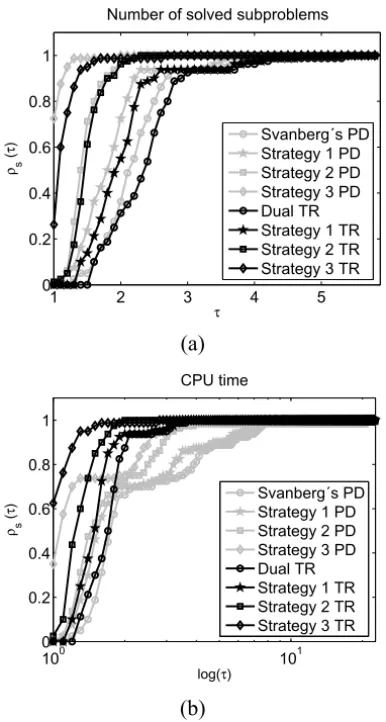
In Figure 1 we depict the performance profiles [8] of the results correspond-ing to the eighty generated tests. Figure 1(a) is concerned with the number of solved subproblems, whereas Figure 1(b), with the CPU time spent. In both profiles we notice that Strategies 3 PD and 3 TR are the most efficient. From Figure 1(a) it is evident that Svanberg’s PD is more efficient in terms of the number of solved subproblems. Nevertheless, both approaches (PD and TR) for solving the subproblems are competitive, when compared pairwise with each of the three strategies. When it comes to the CPU time spent, the strategies that rely upon the dual trust-region approach were more efficient, as can be seen in Figure 1(b).
5 Conclusions
We have proposed a new strategy for solving the MMA subproblems by means of its dual formulation, using a trust-region technique. This alternative approach deals with the dual problem associated with the MMA subproblem, that is a maximization problem of a concave function under nonnegativity constraints. We have taken advantage of the dual objective function properties, such as be-ing concave and continuously differentiable up to first-order, together with the existence of a closed form for the solution of the subproblem obtained with a regularized spectral model within a trust-region scheme. Such a globalization strategy was the key point in recasting, in a simpler way, the dual approach orig-inally adopted by Svanberg [16], and replaced by the primal-dual approach [18]. We have also presented a modification for the MMA, based on relaxing the con-servative condition by means of a summable controlled forcing sequence, so that the maintenance of global convergence is proved [11]. Another modification for the MMA, previously proposed by the authors, was recalled to be used in the numerical tests. It is based on the spectral parameter for updating the parameters
1 2 3 4 5 0
0.2 0.4 0.6 0.8 1
τ ρs
(
τ
)
Number of solved subproblems
Svanberg´s PD Strategy 1 PD Strategy 2 PD Strategy 3 PD Dual TR Strategy 1 TR Strategy 2 TR Strategy 3 TR
(a)
100 101
0 0.2 0.4 0.6 0.8 1
log(τ)
ρs
(
τ
)
CPU time
Svanberg´s PD Strategy 1 PD Strategy 2 PD Strategy 3 PD Dual TR Strategy 1 TR Strategy 2 TR Strategy 3 TR
(b)
Figure 1 – Performance profiles for Problems 1 and 2.
(Strat-egy 1), the relaxed conservative condition (Strat(Strat-egy 2) and the combination of these two ideas (Strategy 3), pointing out the potential contribution of such modifications for the original algorithm.
Acknowledgements. This work is partially supported by FAPESP (06/52846-7, 06/53768-0, 10/09773-4), CNPq (303465/2007-(06/52846-7, 306220/2009-1) and PRO-NEX-Optimization. The authors are grateful for the comments and suggestions of the anonymous referees, which helped to improve the presentation of the original manuscript.
REFERENCES
[1] A. Auslender, P.J.S. Silva and M. Teboulle, Nonmonotone projected gradient
methods based on barrier and Euclidean distances. Comput. Optim. Appl.,
38(2007), 305–327.
[2] D.P. Bertsekas, Nonlinear Programming: Second Edition. Athena Scientific, Belmont (2003). (Second Printing).
[3] E.G. Birgin, J.M. Martínez and M. Raydan, Nonmonotone spectral projected
gradient methods on convex sets. SIAM J. Optim.,10(2000), 1196–1211.
[4] E.G. Birgin, J.M. Martínez and M. Raydan,Spectral Projected Gradient Methods.
InEncyclopedia of Optimization, C.A. Floudas and P.M. Pardalos, editors. Second
Edition. Springer (2009), 3652–3659.
[5] M. Bruyneel, P. Duysinx and C. Fleury, A family of MMA approximations for
structural optimization. Struct. Multidiscip. Optim.,24(2002), 263–276.
[6] A R. Conn, N.I.M. Gould and Ph.L. Toint, LANCELOT: A Fortran Package for
Large-Scale Nonlinear Optimization (Release A). Springer-Verlag, Berlin,
Hei-delberg (1992).
[7] A.R. Conn, N.I.M. Gould and Ph.L. Toint, Trust-Region Methods. SIAM,
Philadelphia (2000).
[8] E.D. Dolan and J.J. Moré, Benchmarking optimization software with
perfor-mance profiles. Math. Program.,91(2002), 201–213.
[9] C. Fleury and V. Braibant, Structural optimization: A new dual method using
mixed variables. Internat. J. Numer. Methods Engrg.,23(1986), 409–428.
[10] M.A. Gomes-Ruggiero, M. Sachine and S.A. Santos,A spectral updating for the
[11] M.A. Gomes-Ruggiero, M. Sachine and S.A. Santos,Globally convergent modi-fications to the Method of Moving Asymptotes and the solution of the subproblems
using trust regions: theoretical and numerical results. Technical Report RP 15/10,
IMECC, Unicamp, revised in November (2010), 44 p. Available at http://www.ime.unicamp.br/rel_pesq/relatorio.html.
[12] O. Güler, New proximal point algorithms for convex minimization. SIAM J.
Op-tim.,2(4) (1992), 649–664.
[13] D.H. Li and M. Fukushima,A derivative-free line search and global convergence
of Broyden-like method for nonlinear equations. Optim. Methods Softw.,13(3)
(2000), 181–201.
[14] O.L. Mangasarian and S. Fromovitz, The Fritz John necessary optimality
condi-tions in the presence of equality and inequality constraints. J. Math. Anal. Appl.,
17(1967), 37–47.
[15] Q. Ni, A globally convergent method of moving asymptotes with trust region
technique. Optim. Methods Softw.,18(3) (2003), 283–297.
[16] K. Svanberg, The method of moving asymptotes – a new method for structural
optimization. Internat. J. Numer. Methods Engrg.,24(1987), 359–373.
[17] K. Svanberg, A Globally Convergent Version of MMA without Linesearch. In:
G.I.N. Rozvany and N. Olhoff (eds). Proceedings of the First World Congress of Structural and Multidisciplinary Optimization, (1995), 9–16.
[18] K. Svanberg,The Method of Moving Asymptotes – Modelling aspects and solution
schemes. Lecture Notes for the DCAMM course Advanced Topics in Structural
Optimization, (1998), 24 p.
[19] K. Svanberg, A class of globally convergent optimization methods based on
con-servative convex separable approximations. SIAM J. Optim.,12(2002), 555–573.
[20] H. Wang and Q. Ni, A new method of moving asymptotes for large-scale
uncon-strained optimization. Appl. Math. Comput.,203(2008), 62–71.
[21] D.N. Wilke, S. Kok and A.A. Groenwold, The application of gradient-only
op-timization methods for problems discretized using non-constant methods. Struct.
Multidiscip. Optim.,40(2010), 433–451.
[22] W.H. Zhang and C. Fleury, A modification of convex approximation methods for
structural optimization. Comput. & Structures,64(1997), 89–95.
[23] C. Zillober, Global convergence of a nonlinear programming method using