Satisfaction of Elderly Hearing Aid Users
Lorena Kozlowski
1Angela Ribas
2Gleide Almeida
2Idalina Luz
31Department of Phonoaudiology, Centro de Audição e Linguagem–
CEAL, Curitiba, PR, Brazil
2Department of Communication Disorders, Universdidade Tuiuti do
Paraná, Curitiba, PR, Brazil
3Universidade Tuiuti do Paraná, Fonoaudiologia, Curitiba,
Paraná, Brazil
Int Arch Otorhinolaryngol 2017;21:92–96.
Address for correspondence Angela Ribas, PhD, Universidade Tuiuti do Paraná - Programa de Mestrado e doutorado em Distúrbios da Comunicação da Universdidade Tuiuti do Paraná, Rua Jose Isidoro Biazetto 845 Curitiba, PR, Brazil 81200240
(e-mail: [email protected]).
Introduction
The impact of auditory sensory deprivation in the life of an individual is enormous because it not only affects one’s ability to properly understand auditory information, but also the way people relate to their environment and their culture. In addition, this sensory deprivation causes biological, psycho-logical, and social consequences.1
The monitoring of adult and elderly subjects with hearing loss is intended to minimize the difficulties and handicaps that occur as a consequence of this pathology. An important component of such monitoring is a recommendation to wear one or two hearing aids.
The hearing aid is a very important device in the (re) habilitation of hearing impairments. This miniaturized electronic device amplifies sounds so as to allow for the stimulation of residual hearing.
The services offered in this area are configured in different ways, but always contain elements associated with the tech-nical performance of hearing aids and how the device helps the listener to overcome the deficits and disadvantages experienced in their daily lives.2
In the past, research in thefield of health was focused on physiological change. On the one hand, those are important aspects to study; however, it is also necessary to address important questions about the effects of medical treatment Keywords
►
patient satisfaction
►
quality of life
►
hearing aids
►
hearing Loss
Abstract
Introduction
The impact of auditory sensory deprivation in the life of an individual is
enormous because it not only affects one
’
s ability to properly understand auditory
information, but also the way people relate to their environment and their culture. The
monitoring of adult and elderly subjects with hearing loss is intended to minimize the
dif
fi
culties and handicaps that occur as a consequence of this pathology.
Objective
To evaluate the level of user satisfaction with hearing aids.
Methods
A clinical and experimental study involving 91 elderly hearing aid users. We
used the questionnaire Satisfaction with Ampli
fi
cation in Daily Life to determine the
degree of the satisfaction provided by hearing aids. We evaluated mean global score,
subscales, as well as the variables time to use, age, and degree of hearing loss.
Results
Mean global score was 4.73, the score for Positive Effects 5.45, Negative
Factors 3.2, demonstrating that they were satis
fi
ed; Services and Costs 5.98: very
satis
fi
ed ; 3.65 Personal Image: dissatis
fi
ed. We observed statistically signi
fi
cant
difference for the time of hearing aid use, age, and degree of hearing loss.
Conclusion
The SADL is a tool, simple and easy to apply and in this study we can
demonstrate the high degree of satisfaction with the hearing aids by the majority of the
sample collected, increasing with time of use and a greater degree of hearing loss.
received
November 11, 2015
accepted
January 12, 2016
published online
March 9, 2016
DOI http://dx.doi.org/ 10.1055/s-0036-1579744.
ISSN 1809-9777.
Copyright © 2017 by Thieme-Revinter Publicações Ltda, Rio de Janeiro, Brazil
on the functional status and quality of life of the individual concerned.3,4
Gatehouse5described that we should not limit ourselves only to the audiogram. According to the author, we should have access to the individual experiences of each hearing impaired patient, their descriptions of the problems experi-enced and the impact this has on them, as well as their ability to deal with such issues.
In recent years, clinical practice has been very concerned in assessing the handicap, benefit, and satisfaction of hearing aid users and documenting them. Despite the fact that the available tools vary in their approaches, all assess the user’s self-perception and the impact of a hearing aid in their daily lives. To evaluate these effects, some tools in form of ques-tionnaires are available.
User satisfaction can be defined as one of the areas of self-assessment, and can be measured based on any physical, social, psychological, andfinancial changes resulting from the acquisition and use of hearing aids.6
To investigate the satisfaction of hearing aid users, several researchers developed and validated measuring instruments. Among the most known and used is the questionnaire, Satisfaction with Amplification in Daily Life (SADL). The SADL was developed by Cox and Alexander7and gives an overall score of satisfaction with hearing aids and specific scores to assess satisfaction in the following subscales: posi-tive effects, services and costs, negaposi-tive factors, and personal image. This instrument was developed to quantify the degree of satisfaction with the use of a hearing aid, and allow for the identification of adverse aspects of adaptation of hearing aids.6
The questionnaire was translated into Brazilian Portu-guese with the titleSatisfação com o Aparelho Auditivo em sua Vida Diária(Satisfaction with a Hearing Aid in your Daily Life),8,9and adapted versions of SADL have also been used in other studies in Brazil.10–12
Depending on what one wishes to evaluate, and according to the purpose of each instrument, one can choose which questionnaire to use.
The aim of this study is to evaluate the degree of satisfac-tion for elderly hearing aid users, using the SADL self-assess-ment questionnaire, translated into Portuguese, as a tool.
Methods
This is a clinical and experimental study performed in con-junction with the health service that selects and recommends devices through the Brazilian Unified Health System (SUS).
This project was approved by the Research Ethics Com-mittee for studies with humans under the registration code CEP 27/2008.
The population studied was made up of 91 elderly hearing aid users with sensorineural, mixed, and/ or conductive hearing loss. The sample of this study was formed on a probabilistic voluntary basis from the criteria listed below:
The inclusion criteria were: be more than 60 years old by the date of the tests, have acquired, post-lingual sensorineu-ral, mixed, and/ or conductive hearing loss, wear a hearing
aid, fill out and sign the consent form, have no health or physical problems that would prevent participation in the study.
The exclusion criteria consisted of: not meet the inclusion criteria, or have health or physical problems that prevent participation in the study.
For the project in question, the research tools used were an identification sheet and questionnaire. The identification sheet was used to determine basic information about the individual, characterizing the type and degree of hearing loss, age, type of adaptation (monaural or binaural), gender, employment status, and device usage time. The SADL trans-lated into Portuguese was applied to hearing aid users and assessed the degree of satisfaction with the use of the amplification devise. The overall score, subscales and the variables for time of use, age and degree of hearing loss were all analyzed.
The SADL questionnaire consists of 15 closed questions, divided into four categories, namely:
– Positive effects: includes issues related to communicative ability, sound localization, sound quality, and addressing psychological issues. It consists of six items (questions 1, 3, 5, 6, 9, 10);
– Service and cost: evaluates the competence of the audiol-ogist and the value of hearing aids, in three items (ques-tions 12, 14, 15). Since this research was conducted with subjects who received their hearing aids without cost, we treated “cost” as only the price of the batteries and the transportation costs for visits to make adjustments, which is the same calculation used in another study.13
– Negative factors: covers three items that investigate per-formance in noisy environments, feedback noise, and telephone use (questions 2, 7, 11);
– Personal image: consists of three items researching the hearing aid user’s self-image and the stigma of wearing a hearing aid (questions 4, 8, 13).
The questionnaire has closed questions, with seven response options: not at all, a little, somewhat, medium, considerably, greatly, and tremendously. The answers are equivalent to a seven-point scale, in which the lowest score is 1, corresponding to the answer “not at all.” The highest score is 7 and corresponds to the answer “tremendously,” indicating respectively the lowest and the highest degrees of satisfaction. Question numbers 2, 4, 7, and 13 correspond to items called“reversals,”in that a score of 7 corresponds to the answer“not at all,”while a score of 1 corresponds to the reply “tremendously.”
Individuals were asked to assign a score from one to seven for each question. For the analysis of satisfaction, the pro-posed standards were used by the authors of the question-naire.7Dissatisfaction was indicated by scores below the 20th percentile, scores between the 20thand the 80thpercentile suggested that the users are satisfied, and scores higher than the 80th percentile indicated that the subjects are very satisfied with the use of their amplification device.
result is the mathematical average of the four categories. For analysis, we used the total score and subscales, and examined the variables time of use, age, and degree of hearing loss.
Data collection was performed between June and November 2013, when the subjects returned to the clinic to carry out follow-up visits and a maintenance review for the hearing aid.
The SADL questionnaire was administered orally, in indi-vidual interviews conducted by the researchers and the hearing aid wearer. Having the subject respond to the ques-tions as read by the examiner, face to face, is clinically preferable, since the answers are more reliable when com-pared with having the subject respond in writing.14
Because the entire research team was knowledgeable in data collection tools, all of them were able to apply the questionnaires orally.
All subjects in the sample signed the consent form for voluntary participation in this study.
The authors performed statistical analysis using descrip-tive and inferential statistical techniques, with a 0.05 signifi -cance level (5%). The inferential methods used were the Student’st-test and the Spearman rank correlation.
The authors applied the Spearman rank correlation to evaluate the behavior of the SADL questionnaire variables (total score and subscales) during the time of use, age, and degree of hearing loss. Data were analyzed using Statistica brand software version 7.0.
The SADL was employed as it is a form of measurement that is quick, comprehensive, and accessible to different cultural and social factors for diverse uses and comparisons.
Results
Most hearing loss (60.35%) were sensorineural, 20.8% were mixed, and 18.75% were conductive. Regarding the degree of loss, most (50.25%) were moderate, with 28.15% at a severe degree, 16.85% were mild, and the smallest percentage (4.55%) had profound hearing loss.
Of these, 73.3% wore hearing aids in both ears and 26.6% wore a single hearing aid.
Age ranged between 60 and 96 years (mean 66.65 years), while 57% were male and 43% female.
Regarding employment status, most were retired (71.2%).
In terms of the time wearing their hearing aids, the majority (28.8%) had been wearing them for over six years, 20.7% between 1 and 3 years, 20.7% less than 6 months, 18% 6 months to 1 year and 11.7% for 3 to 4 years.
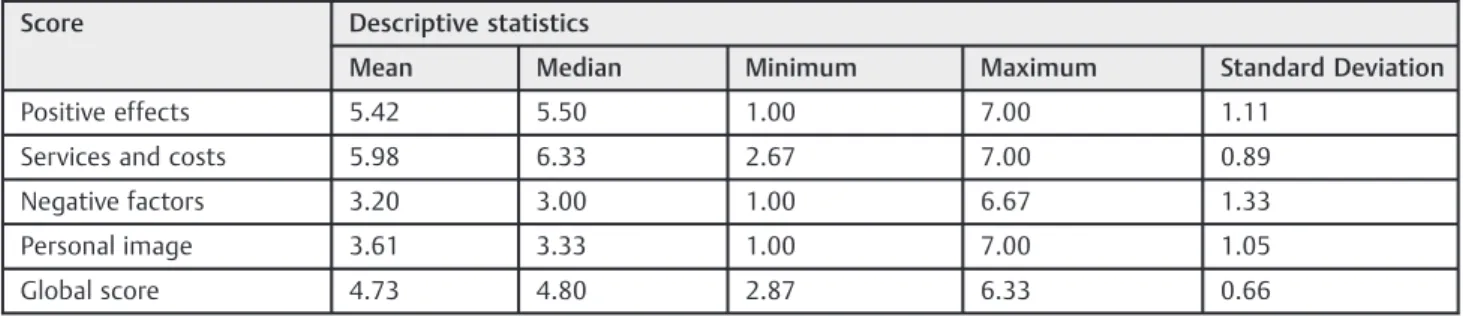
The averages in the overall score and subscales can be found in►Table 1.
The degree of overall satisfaction for the individuals, according to thefigures for the global score (4.73) Positive Effects (5.42) and Negative Factors (3.20), showed that the subjects were satisfied because the averages were between the 20thand 80thpercentiles of the original study7(
►Table 1). Regarding the Service and Cost subscale (5.98, above the 80thpercentile), individuals were found to be very satisfied. Personal Image (3.61) came in below the 20thpercentile, demonstrating that individuals were dissatisfied in that regard.
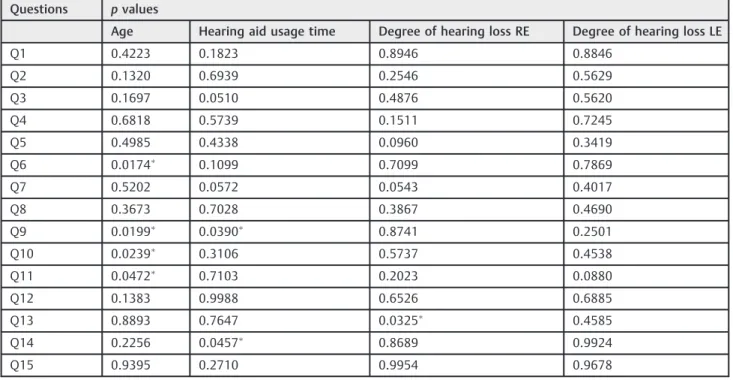
With respect to correlations between the questions and age, hearing aid time of use, and degree of hearing loss (►Table 2), with a significance level of 0.05 (5%) in the Spearman rank correlation, there is significant positive cor-relation between age and questions 6, 9, 10, and 11. For those questions, increasing age provides improved results. There is a significant positive correlation between the hearing aid time of use and questions 9 and 14. For these questions, the subjects with greater hearing aid time of use report better results. Regarding the degree of hearing loss, there was a significant positive correlation between the degree of loss in the right ear (RE) and question 13. In other words, the higher the degree of hearing loss, the greater satisfaction with hearing aids.
Discussion
According to the American Speech-Language-Hearing Asso-ciation (ASHA),15the validation process, which reviews the impact of the intervention in the perception of disability and handicap, should be part of the hearing aidfitting process. Therefore, at this stage, the application of self-assessment questionnaires is extremely important, as user satisfaction is closely related to the success of rehabilitation.16
Speech perception is only one aspect of the evaluation for comprehension, but other measures such as perception of sound quality and user satisfaction are also important.17
Table 1 Descriptive statistics for the overall score and subscales of the SADL
Score Descriptive statistics
Mean Median Minimum Maximum Standard Deviation
Positive effects 5.42 5.50 1.00 7.00 1.11
Services and costs 5.98 6.33 2.67 7.00 0.89
Negative factors 3.20 3.00 1.00 6.67 1.33
Personal image 3.61 3.33 1.00 7.00 1.05
Global score 4.73 4.80 2.87 6.33 0.66
Abbreviation: SADL, Satisfaction with Amplification in Daily Life.
Statistically significant results (p
The subjects of this study demonstrated a satisfaction score of 4.73, which means that they were satisfied with the sound amplification and these results are similar to the score obtained in the questionnaire standardization study,7which is 4.3.
Authors who have chosen to use the SADL questionnaire found higher satisfaction in individuals who received their hearing aids through concessions18–22when compared with results in our study.
The score given by individuals for the Positive Effects scale was 5.42, demonstrating that users were satisfied. The importance of this subscale is confirmed by the subjects’ stating their improvement in communication and sound quality, which have a strong influence in building satisfaction.12,21
Regarding the subscale of Services and Costs, the score (5.98) was higher than the 80thpercentile from the original study, indicating that the hearing aid users in this study were very satisfied. This result is similar to those from other studies,12,21 showing that there were no complaints about acoustic issues or the competence of the audiologist respon-sible forfitting. The subjects of this study had their hearing aids given to them by SUS, which probably raised the average for this subscale.
The Negative Factors subscale had a score of 3.2, demon-strating that individuals in the survey were satisfied. These results are similar to those found in other studies.12 This subscale investigated user performance in noisy environ-ments, feedback noise, and telephone use, demonstrating that there were no adaptation problems.
For the subscale that measures Personal Image, the score was 3.61, below the 20thpercentile, demonstrating that the participants in this study were dissatisfied with the
self-image and esteem of hearing aids. Some studies12 demon-strated that, for some individuals, the appearance of the hearing aid and the impression that this caused in others is extremely significant, although many users do not worry about such aspects.
Several studies emphasize the noticeable improvement in speech skills or subjective benefits after continuous use of sound amplification,12,13 yet there is no agreement on the ideal period to observe a significant change for improvement in language skills.23
In a study of 3,000 hearing aid wearers, it was found that only 59% reported being satisfied with the performance of their prosthesis,24with a strong association in patients who perceive sounds clearly, resocialization in leisure activities, effectiveness in noisy places or in difficult listening situations, among others.25
According to WHO, considering elderly people above 60 years, this study shows a sample consisting predominantly of elderly individuals with an average age of 66.65 years. Among the consequences of the natural aging process, hearing disorders deserve mention, as they occur mainly due to disorders that affect the inner ear, affecting the hearing organ.26
In a study that evaluated the post-adaptation quality of life in adults and elderly subjects, authors27observed that after wearing hearing aids there was an improvement in the quality of life as a whole, showing the importance of hearing aid use and referral of users to adaptation and training strategies in communication programs. In addition, the authors stressed the need to create programs aimed at bringing the individual back into society, such as the referral of individuals to community groups, which is focused on improving social relationships.
Table 2 Spearman correlations between the questions and the age of hearing aids use of time and degree of hearing loss
Questions pvalues
Age Hearing aid usage time Degree of hearing loss RE Degree of hearing loss LE
Q1 0.4223 0.1823 0.8946 0.8846
Q2 0.1320 0.6939 0.2546 0.5629
Q3 0.1697 0.0510 0.4876 0.5620
Q4 0.6818 0.5739 0.1511 0.7245
Q5 0.4985 0.4338 0.0960 0.3419
Q6 0.0174 0.1099 0.7099 0.7869
Q7 0.5202 0.0572 0.0543 0.4017
Q8 0.3673 0.7028 0.3867 0.4690
Q9 0.0199 0.0390 0.8741 0.2501
Q10 0.0239 0.3106 0.5737 0.4538
Q11 0.0472 0.7103 0.2023 0.0880
Q12 0.1383 0.9988 0.6526 0.6885
Q13 0.8893 0.7647 0.0325 0.4585
Q14 0.2256 0.0457 0.8689 0.9924
Q15 0.9395 0.2710 0.9954 0.9678
Abbreviations: LE, left ear; RE, right ear.
Thus, in all cases, monitoring is essential because such guidance and monitoring are the keys to success in the effective use of hearing aids, showing their importance in the adaptation process.28–30
With this study we can attest to the high degree of satisfaction with the use of hearing aids presented by the collected sample. The protocol was efficient for use in SUS, where the demand for elderly care by ENT is high.31
Conclusion
The results of this study demonstrate that the use of a protocol for evaluating the degree of user satisfaction was a simple and easy tool to apply to register the performance of the device. The group studied showed satisfaction with the use of their hearing aids, which has the direct consequence of improved quality of life for these patients.
References
1 Silman S, Iorio MCM, Mizhahi MM, et al. Próteses auditivas: um
estudo sobre seu benefício na qualidade de vida de indivíduos portadores de perda auditiva neurossensorial. Distúrb Comun 2004;16(2):153–165
2 Kozlowski L, Almeida G, Ribas A. Level of user satisfaction with
hearing AIDS and environment: the international outcome inven-tory for hearing AIDS. Int Arch Otorhinolaryngol 2014;18(3): 229–234
3 Curtis JR. The“patient-centered”outcomes of critical care: what are they and how should they be used? New Horiz 1998;6(1):26–32 4 Gatehouse S; National Institute for Clinical Excellence. Some
reflections on the NICE appraisal of hearing aid technology. Br J Audiol 2001;35(5):267–270
5 Gatehouse S. Rehabilitation: identification of needs, priorities and
expectations, and the evaluation of benefit. Int J Audiol 2003;42 (Suppl 2):S77–S83
6 Cox RM, Alexander GC. The International Outcome Inventory for
Hearing Aids (IOI-HA): psychometric properties of the English version. Int J Audiol 2002;41(1):30–35
7 Cox RM, Alexander GC. Measuring Satisfaction with Amplification in Daily Life: the SADL scale. Ear Hear 1999;20(4):306–320
8 Penteado SP, Bento RF, Battistella LR, Silva SM, Sooful P. Use of the
satisfaction with amplification in daily life questionnaire to assess patient satisfaction following remote hearing aid adjustments (telefitting). JMIR Med Inform 2014;2(2):e18
9 Danieli F, Castiquini EPT, de Freitas ZambonattoTC, Bevilacqua MC.
Avaliação do nível de satisfação de usuários de aparelhos de amplificação sonora individuais dispensados pelo Sistema Único de Saúde. Rev Soc Bras Fonoaudiol. 2011;16(2):15–29
10 Veiga LR, Merlo ARC, Mengue SS. Satisfaction with hearing aid in
daily life in users of the Army health system. Braz J Otorhinolar-yngol. 2005;71(1):67–73
11 Farias RB, Russo ICP. Saúde auditiva: estudo do grau de satisfação
de usuários de aparelho de amplificação sonora individual. Rev Soc Bras Fonoaudiol. 2010;15(1):26–31
12 Lopes AS, Costa MJ, Aurélio NHS, dos Santos SN, Vaucher AV.
A satisfação e o desempenho de usuários de próteses auditiva
atendidos em um programa de atenção à saúde auditiva. Rev CEFAC 2011;13(4):698–709
13 Laperuta EB, Fiorini AC. Satisfaction of elderly individuals with
hearing aids in thefirst six months of use. J Soc Bras Fonoaudiol.
2012;24(4): 316–321
14 Weinstein BE, Spitzer JB, Ventry IM. Test-retest reliability of the
hearing handicap inventory for the elderly. Ear Hear 1986;7(5): 295–299
15 Dell ASF, Ikino CMY, Carreirão FW. Degree of satisfaction of
patientsfitted hearing aids at a high complexity service. Braz J Otorhinolaringol. 2013;79(5):555–563
16 Silva DPCB, Silva VB, Aurélio FS. Auditory satisfaction of patients fitted with hearing aids in the Brazilian Public Health Service and benefits offered by the hearing aids. Braz J Otorhinolaryngol 2013; 79(5):538–545
17 Gresele ADP, Lessa AH, Alves LC, et al. Survey and data analysis of
patients treated in a hearing aids grant program. CoDAS 2013; 25(3):195–201
18 Matas CG, Iório MCM. Verificação e Validação do Processo de Seleção e Adaptação de Próteses Auditivas. In: Almeida K, Iório MCM. Próteses Auditivas; Fundamentos Teóricos e Aplicações Clínicas. São Paulo: Lovise; 2003
19 Arakawa AM, Picolini MM, Sitta EI, et al. A Avaliação da Satisfação
dos Usuários de AASI na Região Amazônica. Int Arch Otorhinolar-yngol. 2010;14(1):38–44
20 Marques AC, Kozlowski L, Mendes J. Reabilitação auditiva no idoso.
Rev Bras Otorrinolaringol (Engl Ed) 2004;70(1):806–811
21 Rodrigues FL. Doação de aparelho de amplificação sonora: grau de satisfação do usuário adulto [dissertação]. São Paulo: Pontífica Universidade Católica de São Paulo; 2002
22 Aurélio FS, Silva SP, Rodrigues LB, Kuniyoshi IC, Botelho MSN.
Satisfação dos usuários de próteses auditivas em seu dia-a-dia. Acta Otorrinaringol. 2007;25(4):225325
23 Mondelli MFCG, Magalhães FF, Lauris JRP. Cultural adaptation of
the SADL (satisfaction with amplification in daily life) questionaire for Brazilian Portuguese. Braz J Otorhinolaryngol 2011;77(5): 563–572
24 Magni C, Freilberger F, Tonn K. Avaliação do grau de satisfação
entre os usuários de amplificação de tecnologia analógica e digital.
Rev Bras Otorrinolaringol (Engl Ed) 2005;71(5):650–657
25 Prates LPCS, Iório MCM. Acclimatization: speech recognition in
hearing aid users. Pro Fono 2006;18(3):259–266
26 Almeida MR, Guarinello AC. Reabilitação audiológica em pacientes
idosos. Rev Soc Bras Fonoaudiol. 2009;14(2):247–255
27 Teixeira AR, Almeida LG, Jotz GP, De Barba MC. Qualidade de vida
de adultos e idosos pós adaptação de próteses auditivas. Rev Soc Bras Fonoaudiol. 2008;13(4):357–361
28 Aurélio FS, Silva SP, Rodrigues LB, Kuniyoshi IC, Botelho MS.
Satisfaction of patientsfit with a hearing aid in a high complexity clinic. Braz J Otorhinolaryngol 2012;78(5):69–77
29 Fialho IM, Bortoil D, Mendonça GG, Pagnosim DF, Scholze AS.
Percepção de idosos sobre o uso de AASI concedido pelo Sistema Único de Saúde. Rev CEFAC 2009;11(2):338–344
30 Freitas CD, Costa MJ. Processo de adaptação de próteses auditivas
em usuários atendidos em uma instituição pública federal–Parte
I: resultados e implicações com o uso da amplificação. Rev Bras Otorrinolaringol (Engl Ed) 2007;73(5):744–751
31 Ribas A, Serratto MRF, Bento KA, Vieira M, Lourenço H, Costa TL.