Genetic polymorphisms of Interleukin-18 are not associated with allograft
function in kidney transplant recipients
Wenna Gleyce Araújo do Nascimento
1, Daiani Alves Cilião
2, Julieta Genre
3, Dikson Dibe Gondim
1,
Renata Gomes Alves
4, Neife Deghaide Hassan
2, Francisco Pignataro Lima
5, Maurício Galvão Pereira
6,
Eduardo Antônio Donadi
2and Janaina Cristiana de Oliveira Crispim
11
Departamento de Análises Clínicas e Toxicológicas, Universidade Federal do Rio Grande do Norte,
Natal, RN, Brazil.
2
Departamento de Medicina Clínica, Faculdade de Medicina de Ribeirão Preto, Universidade de São Paulo,
Ribeirão Preto, SP, Brazil.
3
Programa de Pós-Graduação em Ciências Farmacêuticas, Universidade Federal do Rio Grande do Norte,
Natal, RN, Brazil.
4
Hemocentro do Rio Grande do Norte, Natal, RN, Brazil.
5
Departamento de Patologia, Universidade Federal do Rio Grande do Norte, Natal, RN, Brazil.
6
Departamento de Medicina Integrativa, Universidade Federal do Rio Grande do Norte, Natal, RN, Brazil.
Abstract
Interleukin 18 (IL-18) is a proinflammatory cytokine that plays a role in host defense by upregulating both innate and acquired immune responses. Analysis ofIL18 polymorphisms may be clinically important since their roles have been recognized in a variety of inflammatory and autoimmune disorders. However, the role of this cytokine polymorphisms in kidney transplant still remains unclear. In this study, we evaluated the associations betweenIL18 polymorphisms and graft function assessed by creatinine clearance in kidney transplant recipients. A total of 82 kidney transplant re-cipients and 183 healthy controls were enrolled, and frequencies of alleles, genotypes and haplotypes forIL18 polymorphisms were determined and compared with creatinine clearance. The -607C/A (rs1946518) and -137C/G (rs187238) variant alleles in theIL18 gene were determined by polymerase chain reaction. In our study, no signifi-cant association was found between theIL18 variants and creatinine clearance (p > 0.05). Nonetheless, polymor-phism analysis revealed an increase in the frequency of theIL18 major haplotype -607C/-137G in kidney transplant patients (odds ratio 2.57, 95% confidence interval 1.45-4.55, p = 0.0014). Finally, we found thatIL18 polymorphisms did not influence the renal function and thatIL18 haplotype -607C/-137G seems to be associated with kidney trans-plant recipients.
Keywords: IL-18, -607C/A, -137C/G, kidney transplant.
Received: November 18, 2013; Accepted: February 25, 2014.
Introduction
Kidney transplantation is a widely accepted treatment for end-stage renal failure, improving life quality and ex-tending patients survival time. In Brazil, the number of pa-tients on waiting lists for kidney transplantation was about 21,686 in the second semester of 2012, corresponding to 24% of a total of nearly 90,000 patients in dialysis treat-ment (Solezet al., 2008). Despite all advances in the devel-opment of immunosuppressive drugs and the introduction of supportive therapies aimed to decrease acute rejection
incidence, several poorly elucidated factors still affect the success of a kidney transplant, leading to a progressive de-terioration of the renal function and graft loss.
In synergy with IL-12, IL-18 stimulates the release of IFN-gby T and B cells, increasing the cytolytic activity of NK cells (Nakamuraet al., 1989; Okamuraet al., 1995; Micallefet al., 1996; Yoshimotoet al., 1998) and inducing Th1 or Th2 responses, depending on the underlying immu-nological milieu (Reddy, 2004). IL-18 levels have been re-ported to be abnormal in some inflammatory and autoimmune diseases (Haas et al., 2005; Novak et al., 2005; Imboden et al., 2006; Thompson and Huphries, 2007). In a murine model of kidney rejection, IL-18 in-duces several pathways of inflammation whenIL18 and
IL18Rgene expression are upregulated in allografts
(Wy-www.sbg.org.br
Send correspondence to Janaina Cristiana de Oliveira Crispim. Departamento de Análises Clínicas e Toxicológicas, Universidade Federal do Rio Grande do Norte, Rua Gal. Gustavo Cordeiro de Farias s/n, 59012-570 Natal, RN, Brazil. E-mail: [email protected].
burnet al., 2006). Furthermore, increased levels of IL-18 produced by intra-graft macrophages were observed during acute rejection in a rat model (Wyburnet al., 2005). In hu-mans, IL-18 is upregulated in patients during kidney allograft rejection, is expressed in the allograft micro-environment and increased IL-18 serum levels are detected in these patients (Striz et al., 2005). As a corollary, de-creased IL-18 levels have been associated with dede-creased serum creatinine levels in kidney transplant recipients (Parikhet al., 2004).
TheIL18gene has at least two functional polymor-phisms affecting the cytokine production and only few studies have evaluated the association ofIL18 polymor-phisms with kidney allotransplantation (Kolesar et al., 2007; Kimet al., 2008; Mittalet al., 2011). In this study, we hypothesized that the genetic variability at theIL18gene was associated with kidney allograft function. Considering that creatinine clearance (CrCl) is considered to be a gold standard marker for renal function, we evaluated the associ-ation between IL18 -607C/A (rs1946518) and -137C/G (rs187238) single nucleotide polymorphisms (SNPs) and graft function as assessed by CrCl in kidney transplant re-cipients.
Material and Methods
Patients and controls
A total of 82 kidney transplant recipients (54 men and 28 women, mean age 38.40±13.21 years) were enrolled from 2010 to 2011 at the Hospital Universitário Onofre Lopes in Natal, in northeastern Brazil. All patients who were attended at the hospital due to disorders in creatinine serum were enrolled, being that 23 of the recruited patients were found in rejection episode during the analysis whereas 59 had no rejection.
Diagnosis of kidney rejection in transplanted patients was realized by histopathological analyses of graft biopsy according to Banff 07 classification (Solezet al., 2008). Bi-opsies were done on the basis of renal dysfunction, whether worsening or not improving in creatinine levels, i.e. no creatinine stabilization. In the absence of biopsy indication, only laboratory tests were collected to monitor the graft function.
As controls of our study, 183 healthy sex- and age-matched individuals (123 men and 60 women, mean age 30.33 ± 8.19 years) were enrolled. These subjects were bone marrow donors at the Hospital Universitário Onofre Lopes and had no known infectious, chronic or autoim-mune disorders and neither had kidney diseases and/or un-dergone transplantation.
This study was approved by the ethical committee of Hospital Universitário Onofre Lopes, Universidade Fed-eral do Rio Grande do Norte, and signed informed consent forms were obtained from all participants.
Creatinine Clearance (CrCl) determination
We evaluated the kidney graft function during a fol-low-up period of 1 month, 3 months and 6 months after transplantation. The renal function was assessed by deter-mining creatinine clearance levels using the Cockroft-Gault formula calculated as ((140 - age) x weight)/72 x (se-rum creatinine in mg/dL) x (0.85 if female) (Cockcroft and Gault, 1976).
DNA isolation and amplification ofIL18promoter polymorphisms
DNA was extracted from peripheral blood leukocytes by Miller’s salting out procedure (Milleret al., 1988).IL18
promoter polymorphisms were evaluated by the polymer-ase chain reaction (PCR). PCR was done in a final volume of 10mL containing 100 ng of genomic DNA, 3 pmol of two primers (a common one and the allele-specific one), 2 pmol of each control primer, 0.25 mM dNTP (Pharmacia Biotech, Paris, France), 1.5 mM MgCl2, 0.75 U of Taq
DNA polymerase (Invitrogen, Carlsbad, CA) and 1x PCR buffer (0.2 M Tris-HCl, pH 8.5, 0.5 M KCl). The cycling conditions were 3 min at 94 °C, followed by seven cycles of 20 s at 94 °C, 40 s at 64 °C for IL18-607 or 60 s at 68 °C for IL18-137 and 40 s at 72 °C and 25 cycles of 20 s at 94 °C, 40 s at 57 °C for IL18-607 or 20 s at 62 °C for IL18-137 and 40 s at 72 °C, and a final elongation step of 5 min at 72 °C. The amplified products were analyzed by 1% agarose gel electrophoresis and stained with ethidium bromide.
Statistical analyses
Comparisons of clinical and descriptive data of the patients were performed with GraphPad Prism 5.0 soft-ware, using non-parametric tests, such as the Mann-Whitney test, two-sided Fisher exact test for 2 x 2 contin-gency tables. An exact test that uses the Metropolis algo-rithm was done to obtain an unbiased estimate of the exact p-value and its standard error using the RXC software (http://www.marksgeneticsoftware.net/rxc.htm). Allele and genotype frequencies were computed using the direct counting method. Hardy-Weinberg equilibrium was tested by an exact test using GENEPOP 3.4 software (Raymond and Rousset, 1995). The haplotype diversity, as well as the standard derivations, was estimated by the ARLEQUIN 3.11 program (Excoffier and Lischer, 2010). Comparisons of allele, haplotype and genotype frequencies were per-formed by means of the two-sided Fisher’s exact test. In all statistical tests, p-values below 0.05 were considered statis-tically significant.
Results
Characteristics of the studied population
were stratified into rejection and non-rejection groups. To evaluate the differential impact of risk factors on graft func-tion we performed univariate analyses encompassing
non-immunological (gender, patient age at transplantation, ne-phropathy leading to renal failure, type of transplantation, donor age and cold ischemia time) and immunological
(an-Table 1- Demographic, clinical, laboratorial and histopathological features of kidney transplant patients.
With rejection n = 23 Without rejection n = 59 p value
Gender 0.1960 (FET)
Male/ Female 18/05 36/23
Age at transplantation (years) 0.0211 (MW)
Mean 33.09±12.44 40.53±13.01
Range 27.57-38.601 37.01-44.05
Nephropathy leading to renal failure 0.8419 (FET)
Hypertension 6 17
Glomerulosclerosis 0 2
Glomerulonephritis 5 17
Other 5 11
Undetermined 7 12
Antibody reactivity panel (%) 0.6967 (MW)
0 21 55
1 to 10 0 0
10 to 20 0 0
20 to 30 0 1
30 to 40 0 1
40 to 50 1 0
50 to 60 1 1
Mean 3.29±7.825 8.29±20.665
Type of transplantation 0.1499 (FET)
Deceased / living organ donation 13/08 45/12
Donor age (years) 0.0624 (MW)
Mean 43.75±14.257 33.91±13.83
Range 36.154 - 51.346 31.701 - 40.117
Cold ischemia time (h) 0.7623 (MW)
Mean 13.4±6.021 12.93±8.675
Range 9.093-17.707 9.265-16.593
Immunossupression
Mycophenolate 19/1 53/1 0.470 (FET)
Azathioprine 1/19 2/51 1.000 (FET)
Cyclosporine 6/14 11/42 0.535 (FET)
Tacrolimus 14/6 42/12 0.547 (FET)
Sirolimus 0/20 1/53 1.000 (FET)
Prednisone 19/1 50/1 0.487 (FET)
Basiliximab 7/13 16/36 0.782 (FET)
Thymoglobulin 0/21 1/53 1.000 (FET)
HLA-mismatch 0.3±0.6 2.0±1.0 0.126 (MW)
DR HLA-mismatch 0.3±0.6 1.2±0.4 0.214 (MW)
Pre-transplant cross-match
Negative / positive 20/1 54/0 0.280 (FET)
tibody reactivity panel, immunosuppressive treatment, HLA-mismatch and pre-transplant cross-match) factors.
Overall, the comparisons between rejection and non-rejection groups revealed non-significant differences, ex-cept for the findings that non-rejection patients were older than rejection ones. However, comparisons regarding IL-18 alleles, genotypes and haplotypes between patients with and without transplant rejection showed no statistical dif-ferences regarding age at transplantation (data not shown).
Creatinine clearance levels andIL18polymorphism
The Creatinine values utilized were reached by the calculation of creatinine clearance (CrCl). The kidney transplant patients showed a progressive increase in renal function during the six months follow up of our study, with the most significant increase occurring in patients who had no rejection. The rejection group showed a discrete renal function improvement as shown in Table 2. The CrCl val-ues when compared with theIL18genotypes showed no as-sociation.
Genotype and allele frequencies ofIL18promoter polymorphisms
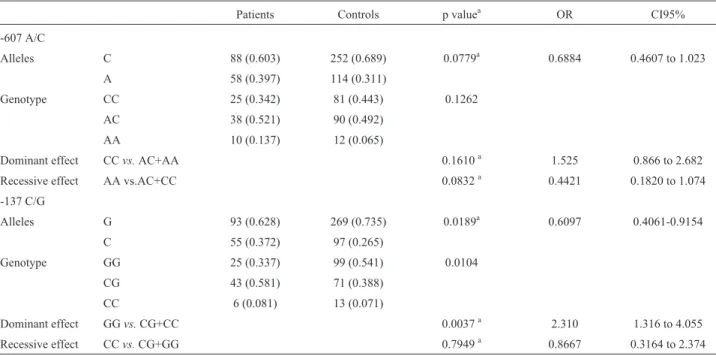
Genotype distribution of both polymorphisms in healthy controls and patients were in Hardy-Weinberg equilibrium (healthy controls: -607 p = 0.7822, -137 p = 1.0000; Non rejection Group: -607 p = 0.6108, -137 p = 0.6421; Rejection Group: -607 p = 0.0584, -137 p = 0.0831). Allele frequencies and genotype distribution ofIL18polymorphisms -607A/C and -137C/G in healthy controls and transplant patients are show in Table 3.
Haplo-type analysis demonstrated an increased frequency of the major haplotype -607C/-137G in kidney transplant patients (odds ratio 2.57, 95% confidence interval 1.45-4.55, p = 0.0014) while the minor haplotype -607A/-137C was more frequent in healthy controls (odds ratio 0.47, 95% confidence interval 0.24-0.92, p = 0.0294) (Table 4).
Histopathological analyses
A total of 49 biopsies were obtained from the 82 kid-ney transplant recipients. Allograft rejection was present in 23 subjects (28.05%) whereas 26 (31.71%) showed no sign of rejection but presented other histological features of re-nal transplant pathology,i.e.fibrosis, acute tubular
necro-Table 3- Allele frequencies and genotype distribution (%) ofIL18polymorphisms -607A/C and -137C/G in healthy controls and transplant patients.
Patients Controls p valuea OR CI95%
-607 A/C
Alleles C 88 (0.603) 252 (0.689) 0.0779a 0.6884 0.4607 to 1.023
A 58 (0.397) 114 (0.311)
Genotype CC 25 (0.342) 81 (0.443) 0.1262
AC 38 (0.521) 90 (0.492)
AA 10 (0.137) 12 (0.065)
Dominant effect CCvs.AC+AA 0.1610a 1.525 0.866 to 2.682
Recessive effect AA vs.AC+CC 0.0832a 0.4421 0.1820 to 1.074
-137 C/G
Alleles G 93 (0.628) 269 (0.735) 0.0189a 0.6097 0.4061-0.9154
C 55 (0.372) 97 (0.265)
Genotype GG 25 (0.337) 99 (0.541) 0.0104
CG 43 (0.581) 71 (0.388)
CC 6 (0.081) 13 (0.071)
Dominant effect GGvs.CG+CC 0.0037a 2.310 1.316 to 4.055
Recessive effect CCvs.CG+GG 0.7949a 0.8667 0.3164 to 2.374
a
two-sided Fisher exact test.
Table 2- Kidney function by creatinine clearance (mL/min)a of the allograft kidney patients.
RG (n = 19) NRG (n = 42) p value
1 month
Mean 43.77±23.53 53.35±29.78 0.2589b
Range 32.43-55.11 44.07-62.63
3 months
Mean 51.53±19.69 66.65±19.32 0.0092b
Range 41.74-61.33 59.90-73.39
6 months
Mean 52.84±12.26 73.79±20.74 0.0007b
Range 45.43-60.25 66.04-81.53
sis, nephritis, interstitial inflammation, glomerulonephritis and relapses of the recipient’s underlying kidney disease. Fifteen out of 23 patients exhibited acute rejection (18.3%) and 8 exhibited chronic rejection (9.8%). Graft biopsies are not routinely performed in these renal transplanted patients. Prior to biopsy indication, only non-invasive laboratory tests are performed to monitor the graft function. There-fore, this was done only in these 49 patients that presented clinical and/or laboratorial evidence of renal dysfunction.
Discussion
It is well known that IL-18 has a critical role on in-flammation and on the immune responses, enhancing IL-12 driven Th1 immune response and, in synergy with IL-4, stimulating the Th2 cell differentiation profile (Nakanishi
et al., 2001). The role of IL-18 has recently been demon-strated in a variety of renal disease processes, including ischemia/reperfusion, autoimmune conditions, infections and malignancies (Leslie and Meldrum, 2008). In addition, IL-18 also has an important role on experimental and hu-man renal transplantation (Parikhet al., 2004; Strizet al., 2005; Wyburnet al., 2005, 2006). Therefore, the analysis of IL18 genetic polymorphisms may improve the under-standing of the contribution of this gene to renal transplan-tation.
The allele variants of theIL18gene evaluated in this study may affect protein production, since a change from C to A at position -607 and a change from G to C at position -137 have been associated with differentialIL18 transcrip-tion (Giedraitiset al., 2001). Analysis of theIL18gene pro-moter suggested that two single nucleotide variants could cause differences in transcription factor binding. A change from C to A at position -607 disrupts a potential binding site for cAMP-responsive element binding protein. A change at position -137 from G to C changes the H4TF-1 nuclear fac-tor binding site to a binding site for an unknown facfac-tor found in the GM-CSF promoter (Giedraitiset al., 2001).
The functional significance of these two SNPs has not been elucidated; however, the -607C and -137G alleles have been associated with higher IL-18 production. In our study, we observed that the frequency of the -607C allele was closely similar in kidney transplant patients and in healthy controls, whereas the -137G allele at single or dou-ble doses was underrepresented in renal transplant patients when compared to controls. On the other hand, the
-607C/-137G haplotype was overrepresented in kidney transplant patients when compared to controls, whereas the -607A/-137C haplotype was underrepresented in patients, indicating that the ensemble of both polymorphic sites may be important for the control ofIL18expression.
It is interesting to note that the transcription factors that regulate IL-18 production may differentially act at the promoter region; for instance, the HTF4-1 transcription factor presents a differential action when targeting the -137G/C polymorphic site (Giedraitiset al., 2001). In addi-tion, multiple sclerosis patients exhibiting the -607C/-137G haplotype had higher levels of IL18 mRNA, while the -607A/-137C haplotype was associated with reduced pro-moter activity (Giedraitiset al., 2001). Therefore, the study of linkage disequilibrium between -607A/C, -137G/C and eventually other understudied polymorphic sites at theIL18
promoter region, together with the identification of differ-entially expressed transcription factors in renal trans-planted patients may contribute to the understanding of the role of this gene in transplantation and rejection episodes.
Although we observed no significant differences in terms ofIL18 polymorphic sites when rejection patients were compared to non-rejection ones, and when these poly-morphic sites were evaluated according to renal function (ClCr), literature studies reported increased frequency of the -607C allele in Czech kidney transplant patients who presented delayed onset of graft function (Kolesaret al., 2007) and increased frequency of the -137 GG genotype in Korean patients exhibiting acute kidney rejection (Kimet al., 2008).
In our study, we observed that the -137GG genotype was higher in the control group rather than in transplanted patients. However, we strongly believe that this discrep-ancy regarding -137GG genotype distribution between Kim’s study and ours may be due to racial differences in ge-notype constitution of the two studied population. Further-more, the frequency of -137 GG, GC and CC genotypes in other Brazilian cohorts of healthy subjects are similar to those shown in our study, suggesting that the distribution of -137GG genotype in our control group is representative of the Brazilian population (Segatet al., 2006, Castelaret al., 2010, Rocha-Júnioret al., 2012). Importantly, this observa-tion gives support to the idea that, although the Brazilian population is genetically heterogeneous when compared to other population, such as the Korean studied by Kim and Table 4- Haplotype frequencies (%) ofIL18promoter in healthy controls and kidney transplant patients.
Transplant patients Healthy controls p valuea OR IC 95%
-607C/ -137G 40 (0.588) 65 (0.357) 0.0014 2.571 1.454 to 4.549
-607C/ -137C 7 (0.103) 19 (0.104) 1 0.9845 0.3941 to 2.459
-607A/ -137G 8 (0.118) 37 (0.203) 0.1401 0.5225 0.2298 to 1.188
-607A /-137C 13 (0.191) 61 (0.335) 0.0294 0.4689 0.2379 to 0.9240
a
collaborators, it seems to be homogeneous when intra-population comparisons are done.
In addition, the combinatorial analysis of alleles at -137 and -607 positions in the context of different clinical conditions, may present different outcomes regarding be-ing a risk factor or presentbe-ing a protective function. In sup-port of this hypothesis an increased frequency of -137G/-607A haplotype has been observed in chronic HBV patients (Hirankarnet al., 2007). Similarly, this haplotype was higher in patients with HTLV-1 infection than in healthy subjects, indicating this haplotype as a risk factor for the HTLV-1 infection. On the other hand, protection against HTLV-1 infection was conferred by the -137C/-607C haplotype, since it was increased in healthy controls (Rocha-Júnioret al., 2012). Furthermore, it was shown in studies involving HIV-1 infection that the haplo-type -137G/-607C was related to susceptibility to this virus (Segatet al., 2006), and the same genotype was associated with protection against lipodystrophy syndrome develop-ment in HIV-1 infection (Castelaret al., 2010).
Ideally, the study of the role ofIL18promoter region polymorphisms should include the evaluation of the entire promoter segment to unveil the linkage disequilibrium be-tween all polymorphic sites observed in the segment. In ad-dition, the evaluation of IL-18 serum levels,IL18 expres-sion at the kidney environment, as well as the differential expression profile of the allograft may help to establish re-lationships among all these factors. In this context, major limitations of this study included the evaluation of only two
IL18promoter region polymorphic sites and lack of con-comitant evaluation of IL-18 levels.
Concluding, although no association between IL18
polymorphisms with renal function was observed, the in-creased frequency of the IL18 -607C/-137G haplotype (containing both alleles associated with high production of IL-18) in kidney recipients deserves further and larger stud-ies to discern whether or not such association may be due to the underlying kidney disorder or to rejection.
Acknowledgments
This study was supported by Conselho Nacional de Desenvolvimento Científico e Tecnológico - Brazil.
References
Castelar L, Silva MM, Castelli EC, Deghaide NH, Mendes-Junior CT, Machado AA, Donadi EA and Fernandes AP (2010) Interleukin-18 and interferon-gamma polymorphisms in Brazilian human immunodeficiency virus-1-infected pa-tients presenting with lipodystrophy syndrome. Tissue Anti-gens 76:126-30.
Cockcroft DW and Gault MH (1976) Prediction of creatinine clearance from serum creatinine. Nephron 16:31-41. Excoffier L and Lischer HEL (2010) Arlequin suite ver 3.5: A
new series of programs to perform population genetics anal-yses under Linux and Windows. Mol Eco Res 10:564-567.
Giedraitis V, He B, Huang WX and Hillert J (2001) Cloning and mutation analysis of the human IL-18 promoter: A possible role of polymorphisms in expression regulation. J Neuro-immunol 112:146-152.
Haas SL, Andreas Koch W, Schreiber S, Reinhard I, Koyama N, Singer MV and Böcker U (2005) -137 (G/C) IL-18 promoter polymorphism in patients with inflammatory bowel disease. Scand J Gastroenterol 40:1438-1443.
Hirankarn N, Manonom C, Tangkijvanich P and Poovorawan Y (2007) Association of interleukin-18 gene polymorphism (-607A/A genotype) with susceptibility to chronic hepatitis B virus infection. Tissue Antigens 70:160-163.
Imboden M, Nicod L, Nieters A, Glaus E, Matyas G, Bircher AJ, Ackermann-Liebrich U, Berger W, Probst-Hensch NM and SAPALDIA Team (2006) The common G-allele of inter-leukin-18 single-nucleotide polymorphism is a genetic risk factor for atopic asthma. The SAPALDIA Cohort Study. Clin Exp Allergy 36:211-218.
Kim CD, Ryu HM, Choi JY, Choi HJ, Choi HJ, Cho JH, Park SH, Won DI and Kim YL (2008) Association of G-137C IL-18 Promoter polymorphism with acute allograft rejection in re-nal transplant recipients. Transplantation 86:1610-1614. Kolesar L, Novota P, Krasna E, Slavcev A, Viklicky O, Honsova
E and Striz I (2007) Polymorphism of interleukin-18 pro-moter influences the onset of kidney graft function after transplantation. Tissue Antigens 70:363-368.
Leslie JA and Meldrum KK (2008) The role of interleukin-18 in renal injury. J Surg Res 145:170-175.
Micallef MJ, Ohtsuki T, Kohno K, Tanabe F, Ushio S, Namba M, Tanimoto T, Torigoe K, Fujii M, Ikeda M,et al.(1996) In-terferon-g-inducing factor enhances T helper 1 cytokine pro-duction by stimulated human T cells: Synergism with inter-leukin-12 for interferon-g production. Eur J Immunol 26:1647-1651.
Miller SA, Dykes DD and Polesky HF (1988) A simple salting out procedure for extracting DNA from human nucleated cells. Nucleic Acids Res 16:1215.
Mittal RD, Srivastava P, Singh V, Jaiswal P and Kapoor R (2011) Association of common variants of Vascular Endothelial Growth Factor and Interleukin-18 genes with allograft sur-vival in renal transplant recipients of North India. DNA Cell Biol 30:309-315.
Nakamura K, Okamura H, Wada M, Nagata K and Tamura T (1989) Endotoxin-induced serum factor that stimulates gamma interferon production. Infect Immun 57:590-595. Nakanishi K, Yoshimoto T, Tsutsui H and Okamura H (2001)
Interleukin-18 regulates both Th1 and Th2 responses. Annu Rev Immunol 19:423-474.
Novak N, Kruse S, Potreck J, Maintz L, Jenneck C, Weidinger S, Fimmers R and Bieber T (2005) Single nucleotide poly-morphisms of the IL18 gene are associated with atopic ec-zema. J Allergy Clin Immunol 115:828-833.
Okamura H, Tsutsi H, Komatsu T, Yutsudo M, Hakura A, Tani-moto T, Torigoe K, Okura T, Nukada Y, Hattori K,et al. (1995) Coning of a new cytokine that induces IFN-Gamma production by T cells. Nature 378:88-91.
Raymond M and Rousset F (1995) Genepop 3.4 software - an up-dated version of genepop 1.2 - Population-genetics software for exact tests and ecumenicism. J Hered 86:248-249. Reddy P (2004) Interleukin-18: Recent advances. Curr Opin
He-matol 11:405-410.
Rocha-Júnior MC, Haddad R, Cilião Alves DC, de Deus Wagatsuma VM, Mendes-Junior CT, Deghaide NH, Takayanagui OM, Covas DT, Donadi EA and Kashima S (2012) Interleukin-18 and interferon-gamma polymor-phisms are implicated on proviral load and susceptibility to human T-lymphotropic virus type 1 infection.Tissue Anti-gens 80:143-150.
Segat L, Bevilacqua D, Boniotto M, Arraes LC, de Souza PR, de Lima Filho JL and Crovella S (2006) IL-18 gene promoter polymorphism is involved in HIV-1 infection in a Brazilian pediatric population. Immunogenetics 58:471-473. Solez K, Colvin RB, Racusen LC, Haas M, Sis B, Mengel M,
Halloran PF, Baldwin W, Banfi G and Collins AB (2008) Banff 07 classification of renal allograft pathology: Updates and future directions. Am J Transplant 8:753-760.
Striz I, Krasna E, Honsova E, Lacha J, Petrickova K, Jaresova M, Lodererova A, Bohmova R, Valhova S and Slavcev A and
Vitko S (2005) A Interleukin 18 (IL-18) upregulation in acute rejection of kidney allograft. Immunol Lett 99:30-35. Thompson SR and Humphries SE (2007) Interleukin-18 genetics and inflammatory disease susceptibility. Genes Immun 8:91-99.
Wyburn K, Wu H, Yin J, Jose M, Eris J and Chadban S (2005) Macrophage-derived interleukin-18 in experimental renal allograft rejection. Nephrol Dial Transplant 20:699-706. Wyburn K, Wu H, Chen G, Yin J, Eris J and Chadban S (2006)
Interleukin-18 affects local cytokine expression but does not impact on the development of kidney allograft rejection. Am J Transplant 6:2612-2621.
Yoshimoto T, Takeda K, Tanaka T, Ohkusu K, Kashiwamura S, Okamura H, Akira S and Nakanishi K (1998) IL-12 up-regulates IL-18 receptor expression on T cells, Th1 cells, and B cells: Synergism with IL-18 for IFN-gproduction. J Immunol 161:3400-3407.
Associate Editor: Mara H. Hutz