683 683 683 683 683 Mem Inst Oswaldo Cruz, Rio de Janeiro, Vol. 92(5): 683-687, Sep./Oct. 1997
Role of Immune Complexes from Pacients with Different
Clinical Forms of Schistosomiasis in the Modulation of
In
Vitro
Granuloma Reaction
Simone A Rezende, José R Lambertucci
*, Alfredo M Goes/
+Departamento de Bioquímica e Imunologia, Instituto de Ciências Biológicas *Departamento de Clínica Médica, Faculdade de Medicina, Universidade Federal de Minas Gerais, Caixa Postal 486, 30161-970 Belo Horizonte,
MG, Brasil
Schistosomiasis is a disease whose pathology is strongly related to the granulomatous reaction formed around parasite eggs trapped in host tissues. Studies have shown that the chronic intestinal form (INT) of this infection is associated with a variety of immunoregulatory mechanisms which lead to a dimin-ished granulomatous reaction. Using an in vitro model of granuloma reaction, we show that immune complexes (IC) isolated from sera of INT patients are able to reduce granulomatous reaction developed by peripheral blood mononuclear cells (PBMC) from acute (AC), INT and hepatosplenic (HE) patients to soluble egg antigen (SEA)-conjugated polyacrylamide beads (PB-SEA). This inhibitory activity is also observed in cell proliferation assay of PBMC from INT and HE patients stimulated with SEA and adult worm antigen (SWAP). Furthermore, IC isolated from sera of patients with different clinical forms of the disease are also able to suppress INT patients PBMC reactivity. Therefore, our results show that circulating IC present in sera of patients with different clinical forms of schistosomiasis may down-regulate PBMC reactivity to parasite antigens resulting in a diminished granuloma reaction to parasite eggs.
Key words:Schistosoma mansoni - granuloma - immune complexes - clinical forms
Schistosomiasis mansoni is a chronic disease
caused by a parasitic helminth, Schistosoma
mansoni. The disease-related pathology is charac-terized by a granulomatous hypersensitivity reac-tion against eggs trapped in the liver and intestines of the infected host (Boros 1989). The anti-egg inflammatory response has been shown to be highly regulated by suppressive mechanisms in long term chronic infections in which is observed a decline in soluble egg antigen (SEA)-induced response, spontaneous regression of the granuloma size, and a decrease of pathology (Colley 1981). This regu-lation has been associated to many factors such as cytokines, idiotype anti-idiotype interactions, supressor T cells, macrophages and immune
com-plexes (IC) (Montesano et al. 1989, Goes et al. 1991, 1994, Joseph & Boros 1993, Rezende et al. 1993, Flores-Villanueva et al. 1994).
Using an in vitro model of granuloma
reac-tion we have shown that IC isolated from sera of chronic intestinal form (INT-IC) patients are able to regulate the granulomatous hypersensitivity de-veloped by chronic intestinal patients peripheral blood mononuclear cells (PBMC) to
polyacryla-mide beads conjugated to S. mansoni egg
anti-gens (PB-SEA) (Goes et al. 1991). This suppres-sive effect was also observed in cell proliferation assay where INT-IC induced a significant sup-pression of PBMC proliferative response to para-site antigens from eggs and adult worm (SWAP) (Rezende et al. 1993).
In this study we were interested to know if IC-induced suppression was dependent on the clini-cal form from which IC and/or PBMC were ob-tained. To accomplish this question we determined the ability of INT-IC to affect the reactivity of PBMC obtained from patients with different clini-cal forms of schistosomiasis, i.e., acute, chronic intestinal and hepatosplenic patients. Furthermore, we studied the effect of IC obtained from patients with different clinical forms of schistosomiasis in the reactivity of PBMC obtained from INT patients.
This investigation received financial assistance from Coordenação de Aperfeiçoamento de Pessoal de Nível Superior (CAPES), Conselho Nacional de Pesquisa (CNPq), Pró-Reitoria de Pesquisa da Universidade Fed-eral de Minas Gerais (PRPp-UFMG) and Fundação de Amparo à Pesquisa de Minas Gerais (FAPEMIG).
+Corresponding author. Fax: +55-31-441. 5963. E-mail:
684 684 684 684
684 Immune Complexes in Modulation of Schistosomiasis SA Rezende et al.
MATERIALS AND METHODS
Study population - Schistosomiasis patients
were selected in Ambulatório Orestes Diniz and Fundação Nacional da Saúde based on clinical and parasitological stool examination for the presence of S. mansoni egg antigens by the quantitative Kato-Katz procedure (Katz et al. 1972).
Isolation of IC - A pool of schistosomiasis se-rum from patients with different clinical forms
(N=10) was inactivated at 56oC for 30 min and
IC were precipitated using polyethylene glicol 6000 (PEG, Sigma P-2139) at a final concentra-tion of 4% (Goes et al. 1991). PEG-induced pre-cipitates were ressuspended in PBS to the origi-nal sera volume and the quantity of protein was determined by Bradford Method (Bradford 1976). In the following assays, PBMC were treated with
125 mg/ml of IC.
In vitro granuloma reaction -PBMC were iso-lated from heparinized blood by Ficoll-diatrizoate density gradient centrifugation as previously de-scribed (Goes et al. 1991) and cultured in RPMI medium containing 10% heat inactivated AB+ human serum (RPMI 10% AB). Antigen-conju-gated polyacrylamide beads, ressuspended in cul-ture medium, were distributed at 200 beads/well in 96 well flat-bottomed tissue culture plates
to-gether with 3 x 10⁵ PBMC. In vitro granuloma
re-action was evaluated on day 5 of culture by quantitation of cellular reactivity around the beads using a phase contrast inverted tissue culture mi-croscope, as previously described (Doughty et al. 1987, Hirsch & Goes 1996). Three hundred sepa-rated determinations of cellular reactivity were made for each experimental group. The total score was then summed and the resultant mean expressed as granuloma index (GI) ± standard deviation (SD). Granulomatous reactivity to PB-SEA was com-pared to the nonspecific binding of PBMC to poly-acrylamide beads not conjugated to antigen (PB). Cell proliferation assay - 3 x 10⁵ PBMC from schistosomiasis patients were cultured in 96 well flat-bottomed plates in RPMI 10% AB. These cul-tures were done in medium alone (MED) and with
25 mg/ml of SEA or SWAP. As positive control
cells were stimulated with 10 mg/ml of
phytohemaglutinin A (PHA-P). For the last 18 hr
of incubation, cells were pulsed with 0.5 mCi/well
of tritiated thymidine (ICN Biomedicals Inc., Irvine, CA). On day 5 of culture, cells were har-vested onto glass fiber paper and beta scintillation counting was determined. Data are expressed as the mean of cpm values of triplicate cultures ± stan-dard deviation (SD).
Statistics - Statistical significance was
deter-mined using Student’s t-test and significance was
determined with the use of P values < 0.05.
RESULTS
Effect of IC in the reactivity of PBMC obtained from patients with different clinical forms of schis-tosomiasis -Previous data have shown that IC ob-tained from INT patients are able to reduce the re-activity of PBMC from INT patients to parasite antigens (Goes et al. 1991, 1994, Rezende et al. 1993). In this work we were interested in studying if this suppression depends on the clinical form of the patients from which IC and/or PBMC were iso-lated. Toward this end, PBMC from patients with different clinical forms of schistosomiasis were obtained and we tested the ability of IC isolated
from INT patients (INT-IC) to suppress in vitro
granuloma reaction and cell proliferation to
para-site antigens. On in vitro granuloma reaction, all
patients presented a significant reaction to PB-SEA when compared to PB. As previously observed, INT-IC provoked marked inhibition of INT-PBMC granulomatous hypersensitivity to PB-SEA (35%).
Furthermore, significant suppression of in vitro
granuloma reaction was observed when PBMC obtained from AC or HE patients were incubated in the presence of IC (25% and 31%, respectively) (Fig. 1).
AC INT HE
1 2 3 4 5 6
G
R
ANUL
OM
A INDE
X
PBMC PB PB + IC PB-SEA PB-SEA + IC
Fig. 1: 3 x 10⁵ peripheral blood mononuclear cells (PBMC) from acute (AC), chronic intestinal (INT) or hepatosplenic (HE) patients were incubated in 96 well-flat-bottomed plates with no treatment or with 125 mg/ml of IC from INT patients (IC). These
685 685685 685685 Mem Inst Oswaldo Cruz, Rio de Janeiro, Vol. 92(5), Sep./Oct. 1997
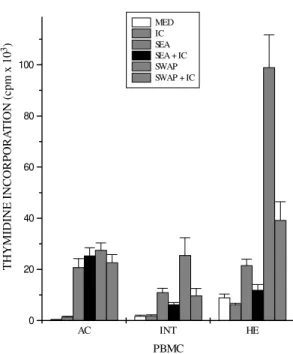
Upon examination of the proliferative response of PBMC obtained from INT and HE patients to parasite antigens, we observed that IC isolated from INT patients provoked marked suppression of cell proliferation to both SEA and SWAP. The suppres-sive effect of IC was 42% on INT cells and 45% on HE cells when these cells were stimulated with SEA besides a suppression of 62% on INT cells and 60% on HE cells stimulated with SWAP (Fig. 2).
A different pattern of response was observed in acute patients PBMC as compared to that ob-served in INT and HE patients. In these patients INT-IC were not able to induce significant sup-pression on proliferative response of PBMC stimu-lated with SWAP or SEA (Fig. 2).
Effect of IC obtained from patients with differ-ent clinical forms of schistosomiasis in the reactiv-ity of PBMC from chronic intestinal patients -In this assay we tested the effect of IC obtained from sera of patients with different clinical forms of
schis-tosomiasis on in vitro granuloma reaction developed
AC INT HE
0 20 40 60 80 100
T
H
Y
M
ID
IN
E
IN
C
OR
P
OR
A
T
ION
(
c
p
m
x
1
0
-3)
PBMC MED IC SEA SEA + IC SWAP SWAP + IC
Fig. 2: 3 x 10⁵ peripheral blood mononuclear cells(PBMC) from acute (AC), chronic intestinal (INT) or hepatosplenic patients (HE) were incubated in 96 well-flat-bottomed plates with no treatment or with 125 mg/ml of IC from INT patients (IC). These
cells were co-cultured for 5 days with medium (MED), 25 mg/
ml of Schistosoma mansoni antigens from eggs (SEA) or adult worm (SWAP), 10 mg/ml of PHA (positive control) in cell
pro-liferation assay. Then, PBMC were pulsed for the final 18 hr with 0.5 mCi of tritiated thymidine and incorporated
radioac-tivity was determined. Data are reported as mean of cpm ± ED. N = 4 (for each experimental group). PHA= 12.345.
AC HE
1 2 3 4 5 6
G
R
A
NUL
O
M
A IN
DE
X
IMMUNE COMPLEX
PB PB + IC PB-SEA PB-SEA + IC
Fig. 3: 3 x 10⁵ peripheral blood mononuclear cells (PBMC) from schistosomiasis patients were incubated in 96 well-flat-bottomed plates with no treatment or with 125 mg/ml of IC
ob-tained from acute (AC) or hepatosplenic (HE) patients. These cells were co-cultured for 5 days with egg antigens conjugated to polyacrylamide beads (PB-SEA) or beads alone (PB). The granuloma index (GI) was evaluated by cellular reactivity around the beads. Data are reported as mean granuloma index ± ED for N = 4.
by PBMC from INT patients to PB-SEA. These IC
were able to suppress in vitro granuloma reaction
independent of the clinical form of the patient from which they were obtained. A suppression of 27% was observed in the granuloma reaction to PB-SEA when cells were incubated with IC obtained of AC patients and of 19% when cells were treated with IC obtained from HE patients (Fig. 3).
Furthermore we tested the effect of these IC in the proliferation of PBMC from INT patients and also detected a significant suppression in the pro-liferative response of PBMC to parasite antigens. The treatment of cells with IC obtained from AC patients caused a suppression of 19% in the re-sponse to SEA and of 43% to SWAP. Furthermore we observed that HE-IC induced a suppression of 31% and 59% in the proliferative response to SEA and SWAP, respectively (Fig. 4).
THYMIDINE
INCORPORA
TION (cpm x 10
686 686 686 686
686 Immune Complexes in Modulation of Schistosomiasis SA Rezende et al.
DISCUSSION
Granulomatous reaction around parasite eggs trapped in host tissues is a prominent pathologic lesion in schistosomiasis. In the chronic phase, regulation of this lesion occurs, resulting in smaller anti-egg granulomas. Recent studies have demon-strated that several immunoregulatory mechanisms may be operative in human schistosomiasis. The possible interference of IC with cellular defense
mechanisms against S. mansoni has been suggested
by others (Butterworth et al. 1977, Kamal &
Higashi 1982). Afterwards, studies on in vitro
granuloma reaction have shown that IC obtained from sera of INT patients are able to suppress INT patients PBMC reactivity to SEA and PB-SWAP (Goes et al. 1991, 1994, Rezende et al. 1993). This suppressive effect was also observed in the proliferative response of PBMC to parasite antigens (Rezende et al. 1993).
In this work we studied if IC-induced suppres-sion was related to the clinical form of the schisto-somiasis patients from which IC and/or PBMC were isolated. Our results demonstrated that IC
obtained from sera of INT patients (INT-IC) were
able to suppress in vitro granuloma reaction
de-veloped by PBMC from AC, INT and HE patients to S. mansoni egg antigens conjugated to polyacry-lamide beads. A decrease in cell proliferation to SEA and SWAP was also observed when PBMC from INT and HE patients were incubated with INT-IC. Studies on patients with different clinical forms of schistosomiasis have shown that most acute patients are high responders to SEA and moderate responders to SWAP. Meanwhile, HE and INT patients are, in general, less responsive to both antigens (Colley et al. 1986). Therefore, the inabil-ity of IC to suppress cell proliferation to SEA and SWAP may be related to the ineffectiveness of immunoregulatory mechanisms to egg antigens in acute patients. Studies on the cytokine pattern of PBMC obtained from patients with different clini-cal forms of schistosomiasis upon IC stimulation are in progress in our laboratory and may be use-ful to the understanding of these processes (un-published observations).
The mechanism by which IC down-modulates
cell reactivity to S. mansoni antigens still awaits
further elucidation. In this study, we demonstrated that IC obtained from patients with different clini-cal forms of schistosomiasis are able to suppress
INT PBMC reactivity both on in vitro granuloma
reaction and cell proliferation assay. Goes et al.
(1991) have shown that the suppression of in vitro
granuloma reaction is dependent on macrophages and IC composed of intact immunoglobulin (Ig).
In that system, IC formed with F(ab’2) IgG
pre-sented no regulatory activity, showing that the in-teraction of IC with macrophages depends on the Fc portion of the antibody molecule. We believe that IC-induced suppression of cell proliferative response may function in a different way, since
these systems work differently. Studies on in vitro
granuloma reaction have shown that this reaction
is dependent on CD4+ cells and macrophages, and
independent of B cells (Doughty et al. 1987). Oth-erwise, B cells are involved in processing and pre-sentation of antigens in proliferative responses (Vidard et al. 1996) and may have their processing capability changed by the binding of Igs that form part of IC (Watts & Lanzavecchia 1993). There-fore, we believe that, in cell proliferation assay, the binding of IC to Fc receptors on antigen-spe-cific B cells might alter the presentation capability of these cells, causing a different pattern of re-sponse to different antigens. Then, the composi-tion of IC may interfere in the response of specific B cells and be responsible for the antigen-specific effect observed in acute patients.
Recent data from our laboratory indicate that IC have the capacity to induce prostaglandin E pro-Fig. 4: 3 x 10⁵ peripheral blood mononuclear cells (PBMC)
from chronic intestinal patients (INT) were incubated in 96 well-flat-bottomed plates with no treatment or with 125 mg/ml
of IC from acute (AC) or hepatosplenic (HE) patients. These cells were co-cultured for 5 days with medium (MED), 25 mg/
ml of Schistosoma mansoni antigens from eggs (SEA) or adult worm (SWAP), 10 mg/ml of PHA (positive control) in cell
pro-liferation assay. Then, PBMC were pulsed for the final 18 hr of culture with 0.5 mCi of tritiated thymidine and incorporated
ra-dioactivity was determined. Data are reported as mean of cpm ± ED for N = 4. PHA= 15.300.
AC HE
0 20 40 60 80
T
H
Y
M
ID
IN
E
IN
C
O
R
P
OR
A
T
ION
(
c
p
m
x
1
0
-3)
IMMUNE COMPLEX MED IC SEA SEA + IC SWAP SWAP + IC
THYMIDINE
INCORPORA
TION (cpm x 10
687 687687 687687 Mem Inst Oswaldo Cruz, Rio de Janeiro, Vol. 92(5), Sep./Oct. 1997
duction by macrophages and thus inhibit the ini-tial events involved in granuloma formation (Goes et al. 1991, 1994). However, the characterization of immunoregulatory events and cytokines induced by IC is incomplete. Studies performed in our labo-ratory have demonstrated the involvement of cytokines in this system (unpublished observa-tions). This suppression seems to be related to an increase in IL-10 production and a decrease in
TNF-a production by mononuclear cells from
schistosomiasis patients. This pattern of cytokines may influence the expression of adhesion mol-ecules, cellular recruitment and lymphocyte acti-vation, leading to the suppression of granuloma-tous reaction.
Taken together, our data suggest that IC ob-tained from patients with different clinical forms of schistosomiasis are able to modulate PBMC
re-activity to S. mansoni eggs. Other suppressive
mechanisms have been described in acute and HE patients but the fact that INT patients show a de-creased granuloma reaction led us to suppose that these mechanisms, including IC-induced suppres-sion, are more pronounced in these patients.
REFERENCES
Boros DL 1989. Immunopathology of Schistosoma mansoni infection. Clin Microbiol Rev2: 250-280. Bradford MM 1976. A rapid and sensitive method for
the quantification of microgram quantities of pro-tein utilizing the principle of propro-tein-dye binding.
Ann Biochem 72: 327-331.
Butterworth AE, Remold VH, David JR, Franks D, David PH, Sturrock RF 1977. Antibody-dependent eosi-nophil-mediated damage to 51Cr-labeled schistoso-mula of Schistosoma mansoni: mediation by IgG, and inhibition by antigen-antibody complexes. J Immunol3: 2230-2236.
Colley DG 1981. Immune responses and immunoregu-lation in experimental and clinical schistosomiasis, p. 1-83. In JM Mansfild, Parasitic Diseases. Marcel Decker Inc., New York.
Colley DG, Garcia AA, Lambertucci JR, Parra JC, Katz N, Rocha RS, Gazzinelli G 1986. Immune responses during human schistosomiasis. XII. Differential re-sponsiveness in patients with hepatosplenic disease.
Am J Trop Med Hyg 35:793-802.
Doughty BL, Goes AM, Parra JC, Rocha RS, Katz N, Colley DG, Gazzinelli G 1987. Granulomatous hy-persensitivity to Schistosoma mansoni egg antigen
in human schistosomiasis. I. Granuloma formation and modulation around polyacrylamide antigen-con-jugated beads. Mem Inst Oswaldo Cruz82: 47-54. Flores-Villanueva PO, Harris TLS, Ricklan DE,
Stadecker MJ 1994. Acessory cell signals regulate Th-cell responses: from basic immunology to a model of helminthic disease. J Immunol152: 571-574.
Goes AM, Gazzinelli G, Rocha R, Katz N, Doughty BL 1991. Granulomatous hypersensitivity to Schisto-soma mansoni egg antigens in human schistosomia-sis. III. In vitro granuloma modulation induced by immune complexes. Am J Trop Med Hyg4: 434-443.
Goes AM, Rezende SA, Gazzinelli G, Doughty BL 1994. Granulomatous hypersensitivity to Schistosoma mansoni egg antigens in human schistosomiasisIV. A role for prostaglandin induced inhibition of in vitro granuloma formation. Parasite Immunol 16:
11-18.
Hirsch C, Goes AM 1996. Characterization of fraction-ated Schistosoma mansoni soluble adult worm anti-gens that elicit human cell proliferation and granu-loma formation in vitro.Parasitol112: 529-535. Joseph AL, Boros DL 1993. Tumor necrosis factor plays
a role in Schistosoma mansoni egg-induced granu-lomatous inflammation. J Immunol151:5461-5471. Kamal KA, Higashi GI 1982. Suppression of mitogen-induced lymphocyte transformation by plasma from patients with hepatosplenic schistosomiais mansoni: role of immune complexes. Parasite Immunol4: 283-298.
Katz N, Chaves A, Pellegrino J 1972. A simple device for quantitative stool thick-smear technique in schistosomiais mansoni. Rev Inst Med Trop São Paulo14: 397-400.
Montesano MA, Lima MS, Correa-Oliveira R, Gazzinelli G, Colley DG 1989. Immune responses during hu-man schistosomiasis hu-mansoni. Idiotypic differences in antibody preparations from patients with differ-ent clinical forms of infection. J Immunol 142: 2501-2505.
Rezende SA, Miranda TCL, Ferreira MG, Goes AM 1993. In vitro granuloma modulation induced by immune complexes in human schistosomiasis mansoni. Braz J Med Biol Res 26: 207-211. Vidard L, Kovacsovics-Bankowski M, Kraeft S, Chen
LB, Benacerraf B, Rock KL 1996. Analysis of MHC class II presentation of particulate antigens by B lym-phocytes. J Immunol 156:2809-2818.