Ce llular and m atrix inte ractio ns during
the de ve lo pm e nt o f T lym pho cyte s
Department of Anatomy, Medical School, The University of Birmingham, Edgbaston, Birmingham, UK
J.J.T. O wen, D.E. McLoughlin, R.K. Suniara and E.J. Jenkinson
Abstract
The thymus contains an extensive extracellular matrix. Although thymocytes express integrins capable of binding to matrix molecules, the functional significance of the matrix for T cell development is uncertain. We have shown that the matrix is associated with thymic fibroblasts which are required for the CD44+ CD25+ stage of double negative (CD4-8-) thymocyte development. The survival of cells at this stage is dependent on IL-7 and we propose that the role of fibroblasts is to present, via the matrix, IL-7 to developing T cells.
Co rre spo nde nce
J.J.T. O wen
Department of Anatomy Medical School
The University of Birmingham Edgbaston
Birmingham B15 2TT UK
Fax: + 44-(0)121-414-6815 E-mail: d.jones.1@ bham.ac.uk
Presented at the 5th Brazilian Symposium on Extracellular Matrix - SIMEC, Angra dos Reis, RJ,Brasil, September 7-10, 1998.
Received O ctober 19, 1998 Accepted November 4, 1998
Ke y wo rds
·Extracellular matrix ·Epithelial cells ·Fibroblasts ·Integrins ·Interleukin-7 ·Thymus
Intro ductio n
The thymus is a major site of T cell development, although there are extrathymic pathways especially in the gastrointestinal tract. Within the thymus, T cells are derived from blood-borne stem cells which migrate from sites of haemopoiesis into the thymic microenvironment. The nature of these stem cells, i.e., whether they are multipotential with respect to haemopoietic development or whether they are already restricted to the T cell lineage, has been debated for some time without a definitive outcome. Simi-larly, although the development of stem cells into T lymphocytes is known to depend upon interactions with cells of the thymic stroma, the nature of these interactions has remained elusive (1).
In fact, the thymic stroma is complex and consists of epithelial cells derived from the pharynx as well as macrophages and den-dritic cells derived from haemopoietic
pre-cursors. Savino et al. (2) also pointed out that the thymus contains a prominent extracellu-lar matrix (ECM) which is present from the earliest phases of ontogeny and these au-thors suggested that it played an important role in T cell development. The potential functional significance of the ECM is strengthened by the fact that developing T cells express integrins which are capable of binding to matrix molecules.
Developing T cells pass through two im-portant checkpoints during their maturation within the thymus. The first occurs when cells are passing through the immature, double negative (DN; CD4-8-) stage of de-velopment and depends on expression of the T cell receptor (TCR) ß chain. This check-point controls the maturation of DN cells to the double positive (DP; CD4+
8+
regu-U U U
U
U U
U U
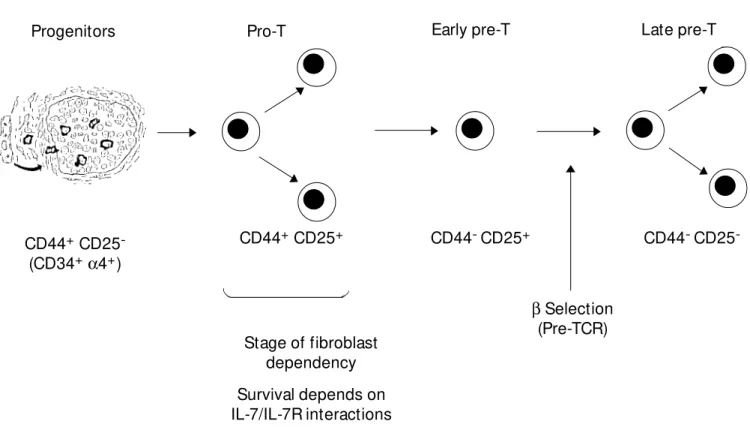
CD4-8- (double negative) stages of ab T cell development
Progenitors Pro-T Early pre-T Late pre-T
CD44+ CD25 -(CD34+a4+)
CD44+ CD25+ CD44- CD25+
b Selection (Pre-TCR)
CD44- CD25
-Stage of fibroblast dependency
Survival depends on IL-7/IL-7R interactions
Figure 1 - Stages of double negative (CD4-8-) aß T cell development. The CD44+ stage requires both fibroblast/ECM interactions w ith
developing thymocytes as w ell as IL-7/IL-7R interactions.
lated by the aß TCR complex expressed on DP cells which, following interaction with peptide/MHC complexes on thymic epithe-lial cells, drives their maturation into single positive (SP; CD4+
and CD8+
) T cells in a process known as positive selection (4). It is important to note that thymocytes removed from the thymic stroma fail to develop in vitro even in the presence of cytokines. Hence
it is likely that stromal cells provide signals for most phases of thymocyte development. Moreover, the three-dimensional structure of the stroma is important because only lim-ited T cell development is obtained on stro-mal monolayers, perhaps because strostro-mal cells undergo a number of functional changes in monolayers (5).
In this paper, we will focus on studies in which the thymic microenvironment has been
reconstructed in three dimensions using a reaggregation technique whereby purified populations of stromal cells are associated with thymocytes at defined stages of devel-opment. These studies point to the impor-tance of a fibroblast associated ECM during the earliest DN phases of T cell develop-ment.
The thym us co ntains an ECM asso ciate d with fibro blasts
epithelial cell lines are known to make the constituents of the ECM, thymic fibroblasts but not thymic epithelial cells express the a5 ß1 integrin which is known to be involved in matrix deposition. Also, in short-term pri-mary cultures of thymic epithelial cells and fibroblasts, we have found that an ECM is associated with fibroblasts but not with epi-thelial cells (7). Hence we have concluded that the thymic stroma contains a prominent fibroblast-associated ECM as well as the more widely recognised network of inter-connecting epithelial cells.
Fibro blasts are re quire d fo r e arly T ce ll de ve lo pme nt
In order to analyse the importance of the various cell types that make up the stroma, we have used a technique in which purified stromal cell populations are prepared by immunomagnetic selection from trypsinised thymic lobes. Prior to trypsinisation, embry-onic thymic lobes are cultured in the pres-ence of 2-deoxyguanosine which is toxic for lymphoid cells but not for stromal cells. Purified stromal cells are reaggregated with defined T cell precursors to reform lobes which can be maintained in organ culture. Using this approach, we have shown that DN thymocytes but not DP thymocytes require fibroblasts as well as epithelial cells for their development (7). The DN stage has been sub-divided into 4 distinct developmental compartments based on expression of CD44 and CD25 (Figure 1). During the first phases (thymic progenitors and pro-T cells), thy-mocytes express high levels of CD44 whereas in the second two phases (early and late pre-T cells) CD44 is down-regulated. By purify-ing CD44+
and CD44- DN cells and reaggre-gating them with purified stromal cells, we have shown that fibroblast dependency is confined to the CD44+
stage of T cell devel-opment. Hence these studies suggest that a fibroblast associated ECM might be most important at the CD44+
stage.
Inte ractio ns be twe e n de ve lo ping T ce lls and the ECM
As mentioned earlier, a number of stud-ies have identified integrins on developing thymocytes with the potential of binding to ECM molecules. In particular, a4ß1, a5ß1 and a6ß1 are known to be expressed on thymocytes and are present at highest levels during the DN phase of T cell development (8). Moreover, immature T cells have been shown to be capable of binding to matrix constituents indicating that their integrin re-ceptors are active. The potential functional importance of such interactions is also strengthened by evidence that antibodies to CD44 and a4 interfere with the develop-ment of immature CD44+
thymocytes in re-aggregate organ cultures (7). Recent mo-lecular genetic approaches have also pointed to the importance of integrins during T cell development. Thus, in mutant mice lacking ß1 integrins, lymphoid stem cells are blocked in their ability to produce T lymphocytes (9) and also mice lacking a4 integrin have im-paired T cell development after birth (10). In the latter case, the defect is at the level of development of DN cells into DP cells and so again focuses on the DN stage of develop-ment as important in integrin/matrix interac-tions.
Gro wth facto rs, the ECM and T ce ll de ve lo pm e nt
Thymocytes express a number of cytokine receptors and respond to cytokines in vitro.
However, gene knockout studies have failed to reveal essential functions for many of the cytokines with the exception of IL-7
mice, in which there is a greatly reduced level of thymopoiesis (11). Similarly, mutant mice lacking expression of the IL-7 receptor a chain have defective thymocyte development (12). An initial effect due to the lack of IL-7 is a reduced number of DN CD44+
CD25+
transgenic bcl-2 molecule into these mice restores normal T cell development (13). Since bcl-2 is known to be important in enhancing cell survival, these results suggest that IL-7 might provide a survival signal for thymocytes which are at a stage of develop-ment where we have shown there is a need for fibroblasts.
In a previous study, using a semi-quanti-tative PCR technique, we have shown that IL-7 is a product of thymic epithelial cells but not of other thymic stromal cells (14). However, IL-7 is known to bind to sulphated glycosaminoglycans in the ECM (15). In a recent study on early pre-B cell development it was shown that direct contact between bone marrow stromal cells and pre-B cells is required for IL-7 to function (16). These authors showed that there is an impaired ability of bone marrow stromal cells to present IL-7 during B-lymphopoiesis with age. Hence, in the thymus, IL-7 might be pre-sented to CD44+
DN cells on fibroblast asso-ciated ECM. In addition, the interaction be-tween thymocytes and the ECM via CD44 and integrins might be important in focusing IL-7 onto T cell precursors. In fact it has been suggested that IL-7 itself might further potentiate such interactions (17).
Hence in this scheme, IL-7, although pro-duced by thymic epithelial cells, would need to be presented by the ECM during a close interaction between immature thymocytes and their integrin receptors with molecules of the ECM. IL-7 presented in this way would promote pro-T cell survival at the CD44+
stage and allow progression to later stages.
It is interesting to note that in at least two situations, i.e., in mutants lacking expres-sion of a4 and mutants lacking expression of the IL-7 receptor a chain defects of thymo-poiesis, are more evident in the postnatal thymus than during foetal life (10,12). The reasons for these differences are unclear but it should be remembered that the kinetics of
T cell development are likely to be different in the foetus than in the adult. Thus, in the foetus, stem cells enter the thymus in waves with the initial wave occurring at the 12th to 13th day of gestation and hence develop-mental events are synchronized during foe-tal development with major populations of cells passing through each developmental stage. Perhaps under these circumstances it is more likely that some cells may survive the CD44+
stage, even in the absence of integrin and IL-7 interactions, than in the adult where precursor populations are likely to be more limiting.
Final co nside ratio ns
We have discussed evidence that the known importance of fibroblasts in the early development of DN thymocytes might de-pend upon the presentation of IL-7 through matrix molecules which are associated with fibroblasts but not with thymic epithelial cells. We are carrying out experiments to test this hypothesis by associated IL-7-depen-dent pre-B cell lines with either purified thymic epithelial cells or with epithelial cells and fibroblasts. Given the total dependence of these lines on IL-7 presentation, it should be possible to determine the importance of fibroblasts as presenters of IL-7 in the sur-vival and growth of these lines. It might also follow that the necessity for fibroblasts dur-ing early T cell development can be over-come if sufficient recombinant IL-7 is added to reaggregate cultures of purified epithelial cells and CD44+
Re fe re nce s
1. Anderson G, M oore NC, Ow en JJT & Jenkinson EJ (1996). Cellular interactions in thymocyte development. Annual
Re-view of Immunology, 14: 73-99.
2. Savino W, Villa-Verde DM S & Lannes-Vieira J (1993). Extracellular matrix pro-teins in intrathymic T cell migration and differentiation. Immunology Today, 14: 158-161.
3. von Boehmer H & Fehling HJ (1997). Structure and function of the pre-T cell receptor. Annual Review of Immunology,
15: 433-452.
4. M arrack P & Kappler J (1997). Positive selection of thymocytes bearing aß T cell receptors. Current Opinion in Immunol-ogy, 9: 250-255.
5. Anderson K, M oore NC, M cLoughlin DE, Jenkinson EJ & Ow en JJT (1998). Studies on thymic epithelial cells in vitro. Devel-opmental and Comparative Immunology,
22: 367-377.
6. Lannes-Vieira J, Dardenne M & Savino W (1991). Extracellular matrix components of the mouse thymus microenvironment: ontogenetic studies and modulation by glucocorticoid hormones. Journal of
His-tochemistry and CyHis-tochemistry, 39:
1539-1546.
7. Anderson G, Anderson KL, Tchilian EZ, Ow en JJT & Jenkinson EJ (1997). Fibro-blast dependency during early thymocyte development maps to the CD25+ CD44+
stage and involves interactions w ith
fibro-blast matrix molecules. European Journal
of Immunology, 27: 1200-1206.
8. Ut sum i K, Saw ada M , Narum iya S, Nagamine J, Sakata T, Iw agami S, Kita Y, Teraoka H, Hirano H, Ogata M , Hamaoka T & Fujiw ara H (1991). Adhesion of imma-ture thymocytes to thymic stromal cells through fibronectin molecules and its sig-nificance for the induction of thymocyte differentiation. Proceedings of the
Na-tional Academy of Sciences, USA, 88:
5685-5689.
9. Hirsch E, Iglesias A, Pot ocnik AJ, Hartmann U & Fassler R (1996). Impaired migration but not differentiation of haem-atopoietic stem cells in the absence of ß1 integrins. Nature, 380: 171-175. 10. Arroyo AG, Yang JT, Rayburn H & Hynes
RO (1996). Differential requirements for
a4 integrins during fetal and adult hemato-poiesis. Cell, 85: 997-1008.
11. M oore TA, von Freeden-Jeffry U, M urray R & Zlotnik A (1996). Inhibitor of gd T cell development and early thymocyte matu-ration in IL-7-/- mice. Journal of Immunol-ogy, 157: 2366-2377.
12. Crompton T, Outram SV, Buckland J & Ow en M J (1998). Distinct roles of the interleukin-7 receptor a chain in fetal and adult thymocyte development revealed by an analysis of interleukin-7 receptor a -deficient mice. European Journal of
Im-munology, 28: 1859-1866.
13. M araskovsky E, O’Reilly LA, Teepe M ,
Corcoran LM , Peschon JJ & Strasser A (1997). Bcl-2 can rescue T lymphocyte development in interleukin-7 receptor de-ficient mice but not in mutant rag-1
-/-mice. Cell, 89: 1011-1019.
14. M oore N, Anderson G, Smith CA, Ow en JJT & Jenkinson EJ (1993). Analyses of cytokine gene expression in subpopula-tions of isolate thymocytes and thymic stromal cells using semiquantitative poly-merase chain reaction. European Journal
of Immunology, 23: 922-924.
15. Clarke D, Katoh O, Gibbs RV, Griffiths SD & Gordon M Y (1995). Interaction of IL-7 w ith glycosaminoglycans and its biologi-cal relevance. Cytokine, 7: 325-327. 16. Stephan RP, Reilly CR & Witte PL (1998).
Impaired ability of bone marrow stromal cells to support B-lymphopoiesis w ith age. Blood, 91: 75-88.
17. Kitazaw a H, M uegge K, Badolata R, Wang JM , Fogler W E, Ferris DK, Lee CK, Candeias S, Smith M R, Oppenheim JJ & Durum SK (1997). IL-7 activates a4ß1 integrin in murine thymocytes. Journal of
Immunology, 159: 2259-2264.