
Changes in cell shape, cytoskeletal
proteins and adhesion sites of cultured
cells after extracellular Ca
2+
chelation
Departamento de Histologia e Embriologia, Instituto de Ciências Biomédicas, Universidade Federal do Rio de Janeiro, Rio de Janeiro, RJ, Brasil
C.S. Mermelstein, M.I.L. Rebello, L.M. Amaral and M.L. Costa
Abstract
Although much is known about the molecules involved in extracellu-lar Ca2+ regulation, the relationship of the ion with overall cell
morphology is not understood. The objective of the present study was to determine the effect of the Ca2+ chelator EGTA on the major
cytoskeleton components, at integrin-containing adhesion sites, and their consequences on cell shape. Control mouse cell line C2C12 has a well-spread morphology with long stress fibers running in many different directions, as detected by fluorescence microscopy using rhodamine-phalloidin. In contrast, cells treated with EGTA (1.75 mM in culture medium) for 24 h became bipolar and showed less stress fibers running in one major direction. The adhesion plaque protein α5
-integrin was detected by immunofluorescence microscopy at fibrillar adhesion sites in both control and treated cells, whereas a dense labeling was seen only inside treated cells. Microtubules shifted from a radial arrangement in control cells to a longitudinal distribution in EGTA-treated cells, as analyzed by immunofluorescence microscopy. Desmin intermediate filaments were detected by immunofluorescence microscopy in a fragmented network dispersed within the entire cytoplasm in EGTA-treated cells, whereas a dense network was seen in the whole cytoplasm of control cells. The present results suggest that the role of extracellular Ca2+ in the regulation of C2C12 cell shape
can be mediated by actin-containing stress fibers and microtubules and by intermediate filament reorganization, which may involve integrin adhesion sites.
Correspondence
C.S. Mermelstein
Departamento de Histologia e Embriologia, ICB, UFRJ Ilha do Fundão
21941-590 Rio de Janeiro, RJ Brasil
Fax: +55-21-2562-6483 E-mail: [email protected]
Presented at SIMEC 2002 (International Symposium on Extracellular Matrix), Angra dos Reis, RJ, Brazil, October 7-10, 2002.
Research supported by CNPq, FAPERJ and FUJB/UFRJ, Brasil.
Received December 2, 2002 Accepted May 5, 2003
Key words
•Cytoskeleton
•Extracellular Ca2+ •Cell shape •Microfilaments
•Microtubules
•Integrin
Probably one of the most studied and yet less understood processes in cell biology is the generation and maintenance of cell shape. Cell shape changes are mediated by proteins of the cytoskeleton (microfilaments, micro-tubules and intermediate filaments), cell sur-face receptors and molecules of the
extracel-lular matrix. Many extracelextracel-lular factors, such as extracellular Ca2+, can initiate a cascade of events that will lead to changes in the membrane-cytoskeleton interface.
mainly of long bundles of filamentous actin, which often extend the length of a cultured cell, giving it tension and modifying its shape (1). These fibers interact at focal adhesion contact, sites of cell attachment to the extra-cellular matrix (2) via specific cell surface receptors, most of which belong to the inte-grin family of glycoproteins (3).
Although the involvement of microfila-ments in the connections between cytoskel-eton and extracellular matrix has been inten-sively studied, microtubules are also impli-cated in the process of cell adhesion to a substrate and in the maintenance of cell shape (4). The organization of microtubules in cells varies with cell type, but they are usually radially distributed from a microtubule-or-ganizing center localized near the nucleus. Microtubules support cell elongation and the formation and maintenance of long pro-cesses from the cell surface (5).
Intermediate filaments are the main struc-tural element of the cytoskeleton (6), there-fore involved in the generation and mainte-nance of the overall cell shape. Intermediate filaments of different cell types are com-posed of distinct proteins, e.g., desmin fila-ments are found predominantly in all types of muscle cells.
Most of the studies about extracellular Ca2+ have focused on the regulation of Ca2+ -dependent adhesion proteins such as cadher-ins, and their role in the development and maintenance of tissues. There is a lack of data concerning the relation between extra-cellular Ca2+-dependent systems and cell shape determination, particularly the cross-talk between membrane components and the cytoskeleton.
In the present study we examined the ef-fects of extracellular Ca2+ withdrawal on the generation and maintenance of cell shape and on cytoskeletal and adhesion site organization in the cell line C2C12 grown in culture. We analyzed the distribution of microfilaments, microtubules, intermediate filaments and inte-grin-containing adhesion sites using
immuno-fluorescence microscopy, and the overall cell shape using phase contrast microscopy.
The mouse skeletal muscle cell line C2C12 was obtained from the Rio de Janeiro Cell Bank (PABCAM, Federal University of Rio de Janeiro, Rio de Janeiro, RJ, Brazil). Cells were routinely maintained in Dulbec-co’s modified Eagle’s medium with 20% fetal calf serum, 1% L-glutamine and 1% penicillin-streptomycin (all from Sigma, St. Louis, MO, USA), under a humidified 5% CO2 atmosphere at 37ºC. Cells were grown at a low density of 5 x 10⁵ cells/35 mm culture dish (Nunc, Copenhagen, Denmark) onto rat collagen-coated Aclar coverslips (Pro-Plastics Inc., Linden, NJ, USA). EGTA (Sigma) was added to the medium of sub-confluent cultures at a final concentration of 1.75 mM (7). Both control and EGTA-treated cultures received fresh medium with or with-out EGTA daily. After 24 h of EGTA expo-sure, cultures were observed by phase con-trast microscopy or submitted to fluores-cence microscopy.
For immunofluorescence microscopy, cultures were fixed with 4% formaldehyde in PBS for 3 min at room temperature and permeabilized with 0.5% Triton X-100 (Sigma) in PBS (8). For some experiments, cells were simultaneously incubated with a mouse
anti-α-tubulin monoclonal antibody and a rabbit
polyclonal antibody against desmin (both from Sigma). Cells were then washed and incubated with fluorescein isothiocyanate (FITC)-goat anti-mouse IgG antibody and a tetramethylrhodamine isothiocyanate-goat anti-rabbit IgG antibody (both from Jackson Immunoresearch Labs., West Grove, PA, USA). In other experiments, cells were incu-bated with a rat anti-α5-integrin monoclonal
rhodamine-phalloi-din. The nuclei were stained with DAPI (4,6-diamidino-2-phenylindole dihydrochloride; Molecular Probes Inc.) at 0.1 µg/ml in 0.9% NaCl. Cells were mounted in glycerol con-taining, by weight, 5% n-propyl gallate (Sigma), 0.25% 1,4-diazabicyclo (2,2,2) oc-tane (Sigma), and 0.0025% para-phenylene-diamine (Sigma). Cells were examined with an epifluorescence Axiovert 100 light mi-croscope (Carl Zeiss, Oberkochen, Ger-many), using appropriate filter sets. Images were acquired with a C2400i integrated CCD camera (Hamamatsu Photonics, Shizuoka, Japan) using an Argus 20 image processor (Hamamatsu Photonics). Digitalized images were transferred to a Dell OptiPlex GL 575 computer (Dell Corporate, Round Rock, TX, USA) and plates were mounted using Adobe
Photoshop software (Adobe Systems Incor-porated, San Jose, CA, USA).
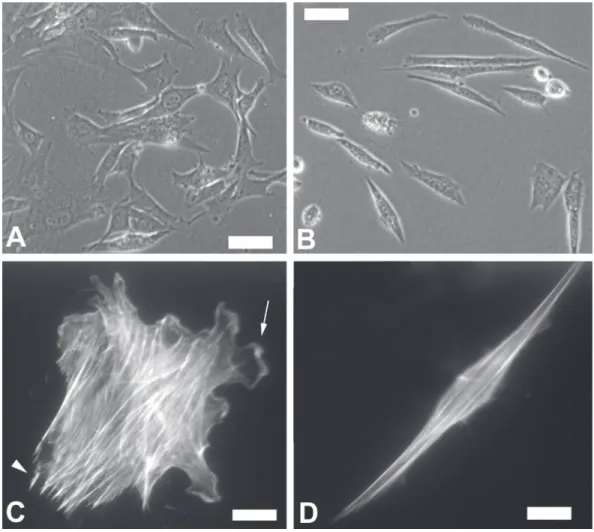
Control experiments with no primary an-tibody showed only a faint background stain-ing (data not shown). Live C2C12 cells grown on collagen-coated Aclar coverslips were examined and images were acquired by phase contrast microscopy using the same micro-scope and digital system as described above. C2C12 cells grown in normal medium without EGTA (control cells) were well spread and showed many contacts with the substrate (Figure 1A). In contrast, most of the cells grown in the presence of EGTA for 24 h changed to a bipolar morphology, pre-sumably with fewer contacts with the sub-strate (Figure 1B).
Control C2C12 cells stained with the
Figure 1. Phase contrast mi-croscopy of C2C12 cells grown in the absence (A) of EGTA (control cells) or in the presence (B) of 1.75 mM EGTA for 24 h. Fluores-cence microscopy of C2C12 cells grown in the absence of EGTA (control cells, C) or in the presence of 1.75 mM EGTA for 24 h (D) and stained with rhodamine-phalloidin. Arrow in C points to ruffled membrane and ar-rowhead in C points to ad-hesion sites. Bars in A and
B = 50 µm. Bars in C and D
Figure 2. Immunofluo-rescence microscopy of C2C12 cells grown in the absence (A,B,C) of EGTA (control cells) or in the presence (D,E,F) of 1.75 mM EGTA for 24 h and an anti-α-tubulin
mono-clonal antibody (A,D), with an anti-desmin polyclonal antibody (B,E) and with the nuclear stain DAPI (C,F). Arrows in A and
D point to microtubule-organizing centers. Bars = 10 µm for all panels.
Figure 3. Immunofluo-rescence microscopy of C2C12 cells grown in the absence (A,B,C) of EGTA (control cells) or in the presence (D,E,F) of 1.75 mM EGTA for 24 h and stained with rhodami-ne-phalloidin (A,D), with an anti-α5-integrin
monoclonal antibody (B,E) and with the nuclear stain DAPI (C,F). Arrows in B and
filamentous actin-specific probe rhodami-ne-phalloidin showed characteristic long stress fibers running in many different direc-tions (Figure 1C), focal adhesions at the termination of stress fibers close to the cell membrane (Figure 1C, arrowhead) and cor-tical actin in ruffled membranes (Figure 1C, arrow). Treated cells showed a smaller num-ber of stress finum-bers within the cells, running mainly in the longitudinal direction of the cell, and no focal adhesions or ruffle mem-branes were visualized (Figure 1D).
Tubulin staining showed a radial arrange-ment of microtubules in control C2C12 cells (Figure 2A), in contrast with a longitudinal distribution of microtubules in cells treated with EGTA (Figure 2D). In addition, a single and distinctive microtubule-organizing cen-ter was observed close to the nuclear mem-brane in both control and EGTA-treated C2C12 cells (arrows in Figure 2A,D). The desmin staining showed a filament network dispersed within the whole cytoplasm, and especially concentrated in the perinuclear re-gion of both control and treated cells (Figure 2B,E, respectively), correlated with the micro-tubule network. EGTA-treated cells appeared to have a more fragmented desmin network compared to control cells (Figure 2E,B, re-spectively). Nuclear staining with DAPI showed a normal nuclear pattern, with no nuclear fragmentation in both control cells (Figures 2C and 3C) and in cells treated with EGTA (Figures 2F and 3F), suggesting that treated cells were still viable.
Both control and EGTA-treated C2C12 cells, double-stained with phalloidin and
anti-α5-integrin antibody, showed
integrin-con-taining fibrillar adhesions (Figure 3B and E, arrows) at the termination of stress fibers (Figure 3A and D). Besides, a dense α5
-integrin labeling was seen inside most treated cells, which does not correspond to the stress
fiber distribution (Figure 3E).
The change in cell shape observed after extracellular Ca2+ withdrawal was correlated with the change in the number and distribu-tion of stress fibers, and with the change in the organization of α5-integrin fibrillar
ad-hesions (2). It is possible that the dense intracellular α5-integrin staining observed in
EGTA-treated cells corresponds to the inter-nalization of the protein, as described by others (9). Furthermore, the elongation of EGTA-treated cells may be microtubule de-pendent (10) since microtubules shifted from the radial arrangement they display in round and well-spread cells to a longitudinal distri-bution, which is unique for bipolar cells (11). The fragmented desmin filaments ob-served in EGTA-treated cells could be re-lated to the activation of the calpain protease system, which has been reported to cause a rapid cleavage of desmin (12). Changes in the distribution of intermediate filament net-works have been described in several cell types that undergo differentiation and cell shape changes (13).
It has been proposed that extracellular Ca2+ -binding proteins could regulate the availability of free Ca2+ outside the cell, influencing sev-eral cellular functions, such as cell adhesion and migration (14). We showed here that ex-tracellular Ca2+ withdrawal caused changes in cell shape and in the organization of cytoskel-eton and adhesion sites. Although such major changes in the cell could be attributed to changes in isolated molecules only, it is more reasonable that such changes are complex events that involve cytoskeletal structures and their membrane connections.
Acknowledgments
References
1. Costa KD, Hucker WJ & Yin FC (2002). Buckling of actin stress fibers: A new wrinkle in the cytoskeletal tapestry. Cell Motility and the Cytoskeleton, 52: 266-274.
2. Jockusch BM, Bubeck P, Giehl K, Kroemker M, Moschner J, Rotkegel M, Schiller K, Stanke G & Winkler J (1995). The molecular architecture of focal adhesions. Annual Review of Cell and Develop-mental Biology, 11: 379-416.
3. Hynes RO (1992). Integrins: versatility, modulation, and signaling in cell adhesion. Cell, 69: 11-25.
4. Elbaum M, Chausovsky A, Levy ET, Shtutman M & Bershadsky AD (1999). Microtubule involvement in regulating cell contractility and adhesion-dependent signalling: a possible mechanism for polariza-tion of cell motility. Biochemical Society Symposia, 65: 147-172. 5. Warren RH (1974). Microtubular organization in elongating
myo-genic cells. Journal of Cell Biology, 63: 550-566.
6. Herrmann H & Aebi U (2000). Intermediate filaments and their associates: multi-talented structural elements specifying cytoarchi-tecture and cytodynamics. Current Opinion in Cell Biology, 12: 79-90.
7. Cho WJ, Kim EJ, Lee SJ, Kim HD, Shin HJ & Lim WK (2000). Involvement of SPARC in in vitro differentiation of skeletal myo-blasts. Biochemical and Biophysical Research Communications, 271: 630-634.
8. Mermelstein CS, Costa ML, Chagas C & Moura Neto V (1996). Intermediate filaments in TPA-treated skeletal muscle cells in
cul-ture. Journal of Muscle Research and Cell Motility, 17: 199-206. 9. Kawakami K, Tatsumi H & Sokabe M (2001). Dynamics of integrin
clustering at focal contacts of endothelial cells studied by multi-mode imaging microscopy. Journal of Cell Science, 114: 3125-3135.
10. Holtzer H, Croop J, Dienstman S, Ishikawa H & Somlyo AP (1975). The effects of cytochalasin B and colcemid on myogenic cultures.
Proceedings of the National Academy of Sciences, USA, 72: 513-517.
11. Holtzer H, Dilullo C, Costa ML, Lu M, Choi J, Mermelstein CS, Schultheiss T & Holtzer S (1991). Striated myoblasts and multi-nucleated myotubes induced in non-muscle cells by MyoD are similar to normal in vivo and in vitro counterparts. In: Ozawa E, Masaki T & Nabeshima Y (Editors), Frontiers in Muscle Research.
Elsevier Science Publishers, New York, 187-207.
12. Goll DE, Thompson VF, Taylor RG & Ouali A (1998). The calpain system and skeletal muscle growth. Canadian Journal of Animal Science, 78: 503-512.
13. Costa ML, Escaleira RC, Rodrigues VB, Manasfi M & Mermelstein CS (2002). Some distinctive features of zebrafish myogenesis based on unexpected distributions of muscle cytoskeletal proteins actin, myosin, desmin, alpha-actinin, troponin and titin. Mechanisms of Development, 116: 95-104.

![In vitro recapitulation of functional microvessels for the study of endothelial shear response, nitric oxide and [Ca2+]i.](data:image/gif;base64,R0lGODlhAQABAIAAAP///wAAACH5BAEAAAAALAAAAAABAAEAAAICRAEAOw==)