276e
Rev Bras M ed Esporte _ Vol. 11, Nº 5 – Set/Out, 2005 1. M astership in Human M otricity Science – PROCIM H (UCB-RJ).2. Laboratory of Bioscience of the Human M otricity – LABIM H (UCB-RJ). 3. Gama Filho University (CEPAC).
4. Petropolis Catholic University. 5. Funadesp’s Scholarship.
6. Rio de Janeiro Federal University – UFRJ.
Received in 26/7/04. 2nd version received in 9/12/04. Approved in 10/7/05.
Correspondence to: Roberto Simão, Universidade Gama Filho – CEPAC, Rua M anoel Vitorino, 553, Piedade, Prédio M R Térreo – 20748-900 – Rio de Janeiro, RJ. E-mail: [email protected]
Analysis on the cardiac rate, blood pressure
and doubled-product in different body
positions in resisted exercises
Humberto M iranda1,2, Roberto Simão3,4, Adriana Lemos1,2,4, Bernardo Henrique Alexander Dantas1,2,
Luiz Alberto Baptista1,2 and Jefferson Novaes1,2,5,6
O
RIGINALA
RTICLEKeyw ords: Hemo-dynamic responses. Body position. Strength training.
ENGLISH VERSION
ABSTRACT
Presently, resisted exercises (RE) have suffered several investi-gations due to the importance they attained to the development of the cardiorespiratory and neuromuscular fitness. To prescribe the RE, some variables such as cardiac rate (CR), and blood pressure (BP) shall be monitored. The association betw een the CR and BP supply data to allow the obtainment of the doubled-product (DP). These tw o variables w ere used to analyze and compare the hemo-dynamic responses of the straight seat supine (SRS) and straight slying supine (SRD) and ten repetitions at 65% of a maximum rep-etition (1 RM ) w ere performed. The sampling w as composed by 14 individuals (10 female and 4 male) w ith mean ages of 23 years (± 4 years), body w eight of 61 kg (± 7 kg), and height of 168 cm (± 5 cm). As material to the collection, it w as used a Polar M Z1 fre-quencymeter (Finland), a Vasquez-Lubry sphygmomanometer (Ger-many), and a Littman stethoscope (USA). It w as used the coupled t-Student test to make a comparison betw een values found among physiological variables. The statistical analysis had as significance criterion p < .05. Every variable presented a mean higher value in the SRS related to the SRD. It w as considered the pre- and post-exercise’s CR, the BP, SBP and DBP. It is understood that the ab-solute value of the BP measured by the auscultatory method trends to be low er than the value recorded inside the artery, but in test situations using different intensity exercises, the percentage of the BP variation presents the same trend than the invasive meth-od. Thus, it can be concluded that the SRS and SRD exercises did not present significant differences in none of the physiological pa-rameters studied, but it w as noted a small decreased response of that parameter in the SRD exercise. So, it is necessary to accom-plish further studies analyzing different body positions to establish a conduct as to these exercises through comparisons.
INTRODUCTION
It is recognized that the improvement of the physical aptitude can contribute in a significant w ay to the health, raising the quality of life level(1). Among physical activities that may improve the health,
to practice resisted exercises (RE) has been recommended by the major normative agencies of physical activity, such as the Ameri-can College of Sports M edicine (ACSM )(2,3), and the American Heart
Association(4), due to its relative safety, even among the so-called
special populations.
As RE acquires importance, the number of published studies aiming to analyze intervenient factors (extrinsic and intrinsic) to the training trend to increase. As consequence, the training is indi-vidualized, as to answ er more specifically each individual’s needs, w hen it is considered aspects such as age(5), and cardiovascular
diseases(6).
Despite of this, it is necessary to be surely surrounded by every precaution in order to increase as much as possible the safety of such practice. The position assumed by the individual to perform the exercise may interfere in some physiological variables. Simão et al.(7) show ed that for the squat exercise in the low er limbs, the
doubled-product w as higher w hen performed in the stand up posi-tion in relaposi-tion to the seat posiposi-tion. The quantificaposi-tion of the cardio-vascular overload associated to the exercise is one of the strate-gies used to assure the safety of such practice(8). How ever, some
physiological variables shall be monitored to prescribe the RE, such as the cardiac rate (CR), and the blood pressure (BP). The isolated observation of these tw o variables does not assure a significant level of safety, but the association betw een them may supply data correlated to the oxygen consumption in the myocardium, and this is usually called the doubled-product (DP), w hich is calculated by multiplying the systolic blood pressure (SBP) by the CR.
The DP is a variable w hose correlation to the oxygen consump-tion of the myocardium (MVO2) makes it to be considered the most reliable indicator of the heart w ork during continuous physical strength of aerobic nature(10). This does not impede the DP to have
value on the evaluation of the overload imposed to the cardiac muscle(8). The appropriate occasion to measure the BP by the
aus-cultatory method is fundamental to minimize possible errors con-tained in such technique(11).
Due to the importance of these physiological parameters (CR, BP, and DP) as to the prescription and controlling of the RE’s inten-sity, having in mind the great scarcity of studies investigating these different body positions, this study has the purpose to analyze and compare the hemodynamic responses of the horizontal aduction of the shoulders w ith extension of the elbow s in the straight su-pine in tw o different positions: the straight seat susu-pine (SRS) us-ing the equipment, and the laid dow n straight supine (SRD), per-forming ten repetitions at 65% of the w orkload of one repetition maximum (1 RM ).
M ATERIALS AND M ETHODS
per-Rev Bras M ed Esporte _ Vol. 11, Nº 5 – Set/Out , 2005
277e
form the exercises, drugs that w ould affect the BP and the CR, consumption of caffeine or alcohol, and physical activity during the data collection period. All individuals w ere volunteers, and they w ere submitted to a PAR-Q(12) questionnaire and signed a consent
term according to the Resolution 196/96 of the National Council of Health in Brazil.
Aiming to reduce the possibility of any occurrence of errors dur-ing the one tests of maximum repetition (1 RM )(13), the follow ing
strategies(14) w ere adopted: a) instructions related to every test
routine w ere previously supplied to every component of the sam-pling; b) the individual being evaluated w as instructed on the exe-cution’s technique; c) the researcher w as thoughtful on every mo-ment of the exercises’ execution w ith the purpose to impede that any mistake performed by the individuals could interfere in the data collection; d) tests w ere previously set, and they w ere alw ays performed in a same time for each of the individuals.
It w as analyzed the SRD and SRS exercises, due to the fact they are composed by the same muscles and technical formats (posi-tioning and adjustment of individuals in the equipments). Having in mind to assure a pattern on the performance of the exercises dur-ing the tests, it w as set the follow dur-ing steps:
Laid dow n straight supine:
The individual w as in dorsal decubitus on the straight bench w ith his feet on one step, having his height adjusted in order to have his knees at a 90o angle. The implement w here the individual’s hands
w ere supported w as in the starting position, aligned just below the axillary line. This w as the initial and final positions of the move-ment w here the cycle w as completed, and from there starting a new repetition.
Seat straight supine:
The bench of the equipment w as adjusted as to allow that the implement w here the individual w as supporting his hands w as aligned just below the axillary line w hen the individual w as posi-tioned to perform the movement. Seat on the equipment, the indi-vidual’s hands w ere supported on the implement, as to have his elbow at a 90o angle just below his shoulders’ line.
His feet w ere supported on the ground or step, allow ing their knees to be at a 90o angle (depending on his height). This w as the
initial and final positions of the movement w here the cycle w as completed, and from there starting a new repetition.
In both executions of the concentric phase the articulations per-formed the simultaneous horizontal flexion of the shoulders in the w hole extension of the elbow s.
The trial w as conducted in three alternate days. In the first day, a test w as performed to determine the maximal w orkload in 1 RM in the SRD. In the second day (48 hours after the first evaluation), the same procedure w as performed to the SRS. In the third day (72 hours after the second day), the individuals w ere submitted to the tests in ten repetitions at 65% of the 1 RM w orkload in both exercises, in order to measure the DP (BP x CR). After the w ork-load test in the first day, all individuals w ere instructed to perform no physical activities using their upper limbs during the interval period betw een sessions, and they should come back to the site of the trial to be submitted to the second and third data collection. Such information w as added to the research, in order to allow that the data collected w ould not suffer any alteration due to muscular stress on the upper limbs. In case the upper limbs w ould had been w orked out during the period betw een tests, this could compro-mise the individual w hen performing the movement due to mus-cular fatigue.
When reaching the site of the tests, the individual w as seat on a chair w here he w ould be for five minutes to rest, and then he had his BP and CR measured. Then, the individual w as positioned in the first equipment, w hich w as randomly chosen, and ten repeti-tions w ere performed w ith a w orkload equivalent to 30% of the 1
RM as w arming exercise. After five minutes, 10 repetitions w ere performed at 65% of the w orkload.
The CR and BP values w ere simultaneously measured, just be-fore the beginning of the movement, and betw een the last but one and the last repetition, having the individual still in the equipment. This procedure w as used taking into account that the higher val-ues of the BP and CR responses probably occur during the tw o last repetitions of all series(15). To the BP measurement, it w as
con-sidered the systolic value of the first phase upon hearing the Ko-rotkoff sound, and the fourth phase of the diastolic value. To the CR, it w as used the higher value recorded w hen performing the exercise, or just after its completion, due to the time necessary to the monitor to attain the right measurement. Then, it w as allow ed a five minutes interval, w hen the individual repeated the same pro-cedure to the other exercise. The individuals w ere requested to avoid the Valsalva maneuver w hen performing the exercises.
The CR measurements w ere made through a Polar M Z1 fre-quencymeter (Finland). The BP measurements w ere made using a Vasquez-Lubry aneroid sphygmomanometer (Germany) alw ays lo-cated on the left arm, and a Littman stethoscope (USA), w here it w as considered a 2-2 mmHg interval.
It w as used the coupled t-Student test to perform a comparison betw een values found in the physiological variables. The statistical analysis had as significance criterion p < 0.05.
RESULTS
Related to the CR of the pre-SRS exercise, the mean value found w as of 86 bpm, and to the SRD it w as of 81 bpm. In the post-exercise CR, the values to the SRS w as of 99 bpm, and to SRD, it w as of 96 bpm (figure 1). The significance betw een exercises re-lated to the CR (p = 0.285) did not show any significant difference betw een values.
Taking into account that the auscultatory method can cause un-derestimated values for the SBP during the RE(16), the DP w ill not
correspond to the real value as w ell. How ever, regardless the w ay used to perform the measurement, the BP variation can inform the demand’s magnitude imposed by the exercise. The pre-exer-cise SBP presented a mean value of 116 mmHg for the SRS, and 113 mmHg for the SRD. The post-exercise SBP presented mean values of 128 and 127 mmHg for SRS and SRD, respectively. The pre-exercise diastolic blood pressure (DBP) w as of 76 mmHg in the SRS, and 69 mmHg in the SRD. The post-exercise DBP w as of 72 mmHg in the SRS, and 65 mmHg in the SRD. The significant SBP betw een exercises w as of p = 0.692, and for the DBP it w as of p = 0.511, thus not show ing any significant difference for both values in the tw o variables (figure 2).
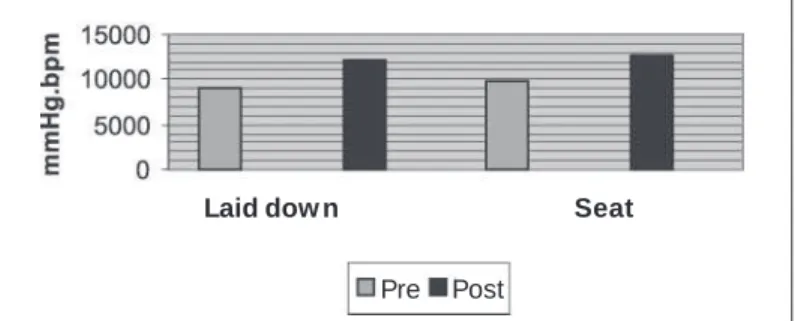
The pre-exercise DP w as of 9,931 in the SRS, and 9,125 in the SRD. The post-exercise values w ere 12,554 in the SRS, and 12,151 in the SRD (figure 3). The significance betw een exercises w as of p = 0.112.
Fig. 1 – CR responses to the laid dow n and seat supine exercises
Laid dow n Seat
278e
Rev Bras M ed Esporte _ Vol. 11, Nº 5 – Set/Out, 2005DISCUSSION
There is scarcity of information concerning to cardiovascular re-sponses and the adaptation to the RE(7). It can be identified in the
literature a predominance of studies searching the correlation of the cardiovascular safety to the type of contraction involved in the exercise (static or dynamic), mainly on individuals pertaining to the risk groups or athletes(17).
Before starting the discussion on the data obtained, some com-ments related to the materials and methods shall be clarified. The first observation is related to the BP measurement through the auscultatory method.
According to Leite and Farinatti(8), one of the obvious critiques
w hich arises is the possibility to underestimate the pressure, con-sidering the accuracy of the invasive methods, such as the intra-arterial catheterism. It is obvious that the absolute values of the BP supplied by the invasive techniques have major validity and reliability. How ever, such evaluation w as performed in healthy in-dividuals – and since catheterism is an invasive method, it implies considerable risks (such as pain, arterial spasm, thrombosis, steno-sis, vasovagal syncope, hemorrhage, etc.). Due to its invasive na-ture, considered a gold standard, to promote risks through the use of such application w ould surpass ethical limits having in mind the scientific investigation(19). Some authors(8,11,20-24), argue on the
ap-plicability of invasive methods to quantify the systemic pressure, once they are extremely sensitive to the pulse pressure w hile per-forming the activity, and less to the flow detection(18). It is
recog-nized that the measurement made through the auscultatory meth-od trends to underestimate the absolute values of the BP during the exercises. How ever, in more intense exercises, compared to those values obtained through auscultatory methods, the relation-ship betw een both of them trends to be kept, as it w as described in some studies(7,8,20-22). Considering the bias that the BP’s
under-estimation happens in a systemic w ay, the association of an activ-ity w ith the highest or low est BP values can be detected. There-fore, due to the nature of the demand proposed in this study, this seems to be sufficient.
In the literature, there are several studies on the acute cardio-vascular responses during physical exercises. They show that REs present a low er DP than the aerobic exercises(17). Farinatti and
Assis(17) evaluated 18 individuals in counter-resistance exercises in
1, 6, and 20 maximum repetitions (RM ), and a continuous aerobic training in the cycloergometer for 20 minutes at 75-80% of the reserve CR. In the RE, the highest DP w as recorded in 20 RM , follow ed by the 6 RM , and finally, the 1 RM , recording the low er value for DP.
Thus, in the RE, the increase in the DP w as more associated to the number of repetitions than to the w orkload, and in the aerobic w orkload it w as recorded a highest DP compared to the RE. It can be concluded that regardless their intensity, the RE imposes a low er cardiac demand than the aerobic activity. These findings confirm other studies analyzing the DP in aerobic w orks(23,24).
In our study, the CR did not present significant differences be-tw een the be-tw o positions, despite it had show n highest values in the seat straight supine. The systolic and diastolic blood pressures did not present significant difference betw een them as w ell, but in both exercises the SBP raised during the exercise, w hile the DBP reached low est values in both. Several studies(7,8,11,17,18,25,26)
con-firm our findings, once they show a higher CR, BP and DP during the RE, as it occurred in our study. But there is a major lack of w orks investigating such physiological parameter concerning dif-ferent body positions. In a recent study, the influence of the body position in the hemodynamic responses w as verified through the comparison of the squat exercise to different positions (dorsal de-cubitus in the equipment or stand up) presented the highest DP value w hen performed in the stand up position(7). It is not evidenced
the same occurrence in the knees’ flexion, and therefore, it w as found no significant differences compared to the flexor table (dor-sal decubitus), and the flexor chair (in the seat position) in 10 RM(26).
Evidences has show n that the RE may be safely applied even in those cases of individuals bearers of cardiovascular onsets(4). Our
study confirms the fact that w hen the individual is not allow ed to have an excessive raise in the DP, it is preferable to perform the exercise in dorsal decubitus, since in our study the SRD presented a mean DP of 12,151, and SRS of 12,554, show ing that the exer-cises in dorsal decubitus w ould be a safety factor for individuals bearers of any cardiovascular disease.
The reduced resting BP and during the sub-maximal exercise w ould be considered a positive adaptation, particularly in individu-als w ith ischemic disease. Therefore, it w ould be required a higher w orkload to attain the same DP as a consequence of the training. The result of such adaptation w ould be that it probably w ould re-duce the probability for an occurrence of an event of cardiac is-chemia during the physical activity.
As it w as previously seen in other studies(7,8,26), it also can be
evidenced that the low er the muscular mass demanded, the low -est w ill be the DP in its absolute form. How ever, as there is scarci-ty of studies related to the DP, it can not be asserted that there w ill alw ays be a significant difference betw een exercises of the low er limbs under different body positions, once several factors are in-volved, such as the body angle grade, and even the size and quan-tity of the muscular groups. Thus, the results attained in this study could not be attained if one of the supines w ould be performed in an inclined equipment, or if the muscular groups involved in the movement w ere low er.
It can be concluded that the straight supine exercises, laid dow n or seat did not present significant difference in none of the physi-ological parameters studied. But in the straight laid dow n supine it w as observed that every physiological response (CR, SBP, DBP and DP) w ere a little more low er than in the straight seat supine. Thus, it is necessary to accomplish further studies analyzing differ-ent body positions in other exercises to set through comparisons the adequate conduct as to the prescription of such exercises.
All the authors declared there is not any potential conflict of inter-ests regarding this article.
Fig. 2 – BP responses to the laid dow n and seat supine exercises
Laid dow n Seat
SBP Pre SBP Post DBP Pre DBP Post
Fig. 3 – DP responses to the laid dow n and seat supine exercises
Laid dow n Seat
Rev Bras M ed Esporte _ Vol. 11, Nº 5 – Set/Out , 2005
279e
REFERENCES
1. Pafenbarger RS. Contributions of epidemiology to exercise science and cardio-vascular health. M ed Sci Sports Exerc 1998;20:426-38.
2. American College of Sports M edicine. Exercise and physical activity for older adults. M ed Sci Sports Exerc 1998;30:992-1008.
3. American College of Sports M edicine. Progression models in resistance training for healthy adults. M ed Sci Sports Exerc 2002;34:364-80.
4. Pollock M , Franklin B, Balady G, Chaitman B, Fleg J, Fletcher B, et al. Resis-tance exercise in individuals w ith and w ithout cardiovascular disease. Circula-tion 2000;101:828-33.
5. Fiatarone M A, M arks EC, Ryan ND, M eredith CN, Lipsitz LA, Evans WJ. High intensity strength training in nonagenarians. Effect on skeletal muscle. JAM A 1990;263:3029-34.
6. M artel GF, Hurlbut DE, Lott M E, Lemmer JT, Ivey FM , Roth SM , et al. Strength training normalizes resting blood pressure in 65- to 73 year-old men and w omen w ith high normal blood pressure. J Am Geriatr Soc 1999;47:1215-21. 7. Simão R, Polito M D, Lemos A. Duplo-produto em exercícios contra-resistidos.
Fit Perfor J 2003;2:279-84.
8. Leite T, Farinatti P. Estudo da freqüência cardíaca, pressão arterial e duplo-pro-duto em exercícios resistidos diversos para grupamentos musculares semelhan-tes. Rev Bras Fisiol Exerc 2003;2:68-88.
9. M cCartney N. Acute responses to resistance training and safety. M ed Sci Sports Exerc 1999;31:31-7.
10. Gobel FL, Norstrom LA, Nelson RR, Jorgensen CR, Wang Y. The rate-pressure product as an index of myocardial oxygen consumption during exercise in pa-tients w ith angina pectoris. Circulation 1999;57:549-56.
11. Polito M D, Farinatti PTV. Considerações sobre a medida da pressão arterial em exercícios contra-resistência. Rev Bras M ed Esporte 2003;9:25-33.
12. Shepard RJ. PAR-Q, Canadian home fitness test and exercise screening alterna-tives. Sports M edicine 1988;5:185-95.
13. M oura JAR, Borher T, Prestes M T, Zinn JL. Influência de diferentes ângulos articulares obtidos na posição inicial do exercício pressão de pernas e final do exercício puxada frontal sobre os valores de 1RM . Rev Bras M ed Esporte 2004; 4:269-74.
14. M onteiro WD. M edida da força muscular: aspectos metodológicos e aplicações. Rev Treinamento Desp 1997;3:38-51.
15. Sale DG, M oroz DE, M cKelvig, RS, M acDougall, JD, M cCartney, N. Effect of training on the blood to w eight lifting. Can J Appl Phisiol 1994;19:60-74. 16. Wiecek EM , M cCartney N, M cKelvie RS. Comparison of direct and indirect
mea-sures of systemic arterial pressure during w eightlifting in coronary artery dis-ease. Am J Cardiol 1990;66:1065-9.
17. Farinatti PTV, Assis BFCB. Estudo da freqüência cardíaca, pressão arterial e du-plo-produto em exercícios contra-resistência e aeróbico contínuo. Rev Bras Ativ Física Saúde 2000;5:5-16.
18. M acDougall JD, M cKelvie RS, M oroz DE, Sale DG, M cCartney N. Factors affect-ing blood pressure duraffect-ing heavy w eight liftaffect-ing and static contractions. J Appl Physiol 1992;73:1590-7.
19. Perloff D, Grim C, Flack J, Frohlich E, Hill M , M cDonald M . Human blood pres-sure determination by sphygmomanometry. Circulation 1993;88:2460-7. 20. M urray WB, Gorven AM . Invasive vs non invasive blood pressure measurements
– the influence of the pressure contour. S Afr M ed J 1991;79:134-9.
21. Raftery EB. Direct versus indirect measurement of blood pressure. J Hipertens 1991;9:S10-S12.
22. Jürimäe T, Jürimäe J, Pihl E. Circulatory response to single circuit w eight and w alking training session of similar energy cost in middle-age overw eight females. Clin Physiol 2000;20:143-9.
23. Gould BA, Hornung RS, Altman DG, Casman PM , Raftery EB. Indirect measure-ment of blood pressure response during exercise testing can be misleading. Br Heart J 1985;53:611-5.
24. Rasmussen PH, Staats BA, Driscoll DJ, Beck KC, Bonekat HW, Wilcox WD. Direct and indirect blood pressure during exercise. Chest 1985;87:743-8. 25. Cerqueira M , M iranda H, Calado S, Almeida M , Novaes J. Comparação das
res-postas hemodinâmicas do supino reto sentado em 6 e 10 repetições. Simpósio Internacional de Ciências do Esporte 2003;26:159.