The influence of distal-end heat treatment on
deflection of nickel-titanium archwire
Marcelo Faria da Silva1, Célia Regina Maia Pinzan-Vercelino2, Júlio de Araújo Gurgel2
Objective: The aim of this in vitro study was to evaluate the deflection-force behavior of nickel-titanium (NiTi) orth-odontic wires adjacent to the portion submitted to heat treatment. Material and Methods: A total of 106 segments of NiTi wires (0.019 x 0.025-in) and heat-activated NiTi wires (0.016 x 0.022-in) from four commercial brands were tested. The segments were obtained from 80 archwires. For the experimental group, the distal portion of each segmented archwire was subjected to heat treatment (n = 40), while the other distal portion of the same archwire was used as a heat-ing-free control group (n = 40). Deflection tests were performed in a temperature-controlled universal testing machine. Unpaired Student’s t-tests were applied to determine if there were differences between the experimental and control groups for each commercial brand and size of wire. Statistical significance was set at p < 0.05. Results: There were no statistically significant differences between the tested groups with the same size and brand of wire. Conclusions: Heat treatment applied to the distal ends of rectangular NiTi archwires does not permanently change the elastic properties of the adjacent portions.
Keywords: Orthodontic wires. Heat treatment. Mechanical properties.
1 Private practice, Palmas, Tocantins, Brazil.
2 Assistant Professor, Universidade Ceuma, Department of Orthodontics, São
Luís, Maranhão, Brazil.
DOI: http://dx.doi.org/10.1590/2177-6709.21.1.083-088.oar
How to cite this article: Silva MF, Pinzan-Vercelino CRM, Gurgel JA. The influence of distal-end heat treatment on deflection of nickel-titanium archwire. Dental Press J Orthod. 2016 Jan-Feb;21(1):83-8.
DOI: http://dx.doi.org/10.1590/2177-6709.21.1.083-088.oar
Submitted: February 05, 2015 - Revised and accepted: April 10, 2015
» The authors report no commercial, proprietary or financial interest in the products or companies described in this article.
Contact address: Júlio de Araújo Gurgel E-mail: [email protected]
Objetivo: o objetivo dessa pesquisa in vitro foi avaliar a deflexão na porção adjacente à área do tratamento térmico rea-lizado no extremo distal de fios ortodônticos de níquel-titânio (NiTi). Métodos: foram testados 160 segmentos de fios de NiTi (0,019” x 0,025”) e NiTi termoativado (0,016” x 0,022”) de quatro marcas comerciais; obtidos de 80 arcos. No grupo experimental (n = 40), realizou-se o tratamento térmico no extremo distal; enquanto no grupo controle (n = 40), o extremo distal foi mantido isento de tratamento térmico. Os testes de deflexão foram realizados em máquina universal de ensaios, com controle de temperatura. Foi aplicado o teste t de Student não-pareado, visando observar a diferença entre os grupos experimental e controle, em cada espessura e marca. A significância estatística foi fixada com valor de p < 0,05. Resultados: não foram encontradas diferenças estatisticamente significativas entre os grupos testados, de mesma espessu-ra e marca comercial. Conclusão: conclui-se que o tespessu-ratamento térmico não influenciou na deflexão da região adjacente à extremidade de fios de NiTi submetidos ao tratamento térmico.
INTRODUCTION
Nickel-titanium (NiTi) wires are commonly used in the early stages of orthodontic treatment because they release light constant forces that are appropriate for alignment and leveling. Among the types of NiTi wires, heat-activated NiTi wires stand out because
their action is inluenced by temperature.1 These types
of wire exhibit crystallographic transformation under
controlled temperatures.However, the austenite
in-ish temperature (Af) of heat-activated NiTi wires has
shown variability among commercial brands.2
NiTi archwires are used for the initial leveling phase of orthodontic treatment performed with
con-ventional or self-ligating brackets.Self-ligating
sys-tems reduce friction, thereby allowing shifting,
espe-cially of thin or rectangular wires.3 This may result in
incisor protrusion and/or in protruding wire in the
distal portion of molar tubes. This last fact may cause impingement of the oral tissue surrounding the dis-tal portion of molar tubes. To minimize this injury, crimpable stops are recommended, as they are placed over the archwire in any interbracket spaces so as to
limit the shift of archwires.3 Another clinical
proce-dure to limit archwire shifting is to heat the ends of archwire, allowing it to become formable. At room temperature, heat treatment causes reduction in stiff-ness of metal alloys. Excessive heating of the wire leads to loss of tempering of the alloy and facilitates bending as a consequence of changes caused to the mechanical properties of the wire. Clinical orthodon-tists usually carry out heat treatment with a blowtorch or a conventional cigarette lighter. For NiTi wires, heat treatment at ± 650 °C causes loss of mechanical
properties.4
Following heat treatment in the distal ends, the wires are cinched back to the lingual or gingival sides. However, this effective and easy-to-perform tech-nique requires scientific validation due to influences caused to the mechanical properties of the adjacent segment of the treated archwire.
Studies have shown that exposure of NiTi wires to temperatures of 500 °C and 600 °C alters their mechanical properties, reducing the force released
in deflection tests.4,5,6 Because metal alloys are good
thermal conductors, it is understood that tempering orthodontic wires leads to heat dissipation at other portions of the archwire. Thus, heat treatment of the
distal end of NiTi wires is a matter of concern be-cause it may negatively affect deflection of the area adjacent to heat treatment, which might include mo-lar and premomo-lar regions.
This in vitro study analyzed the force present in
different commercial brands of NiTi wires in a de-flection test. The null hypothesis was that heat treat-ment of the distal ends of NiTi orthodontic archwires does not alter deflection in the adjacent area.
MATERIAL AND METHODS
Sample size was calculated using GpowerTM
, ver-sion 3.1 software (University of Düsseldorf, Düssel-dorf, Germany). The parameters adopted were the
following: significance level α of 5%; test power of
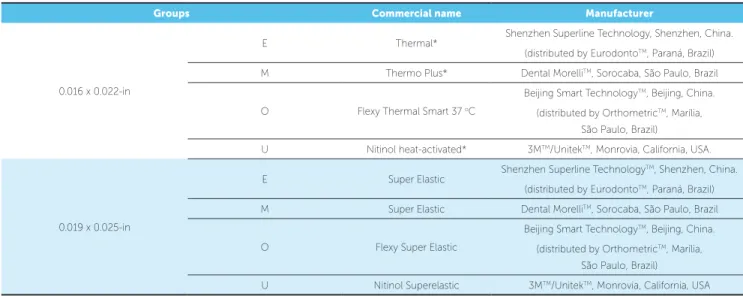
70%; and effect size equal to 1. A sample size (n) of 10 specimens in each group was determined. The fol-lowing archwires were used in this study: 40 NiTi heat-activated archwires from the same lot with cross sections of 0.016 x 0.022-in and 40 NiTi arches from the same lot with cross sections of 0.019 x 0.025-in (Table 1). Thus, four brands were selected for evalua-tion, with one rectangular cross section evaluated for each type of NiTi archwire.
from the control group and 80 specimens from the experimental group were generated.
A three-point bending test was carried out for the specimen wires (n = 10). All samples were loaded under the same protocol and according to
ISO/CD 15841.7 A metallic device consisting of two
5-mm diameter pins welded vertically 14 mm apart was used. A maxillary premolar metallic bracket was attached to one of the pins, and a simple tube spe-cifically designed for maxillary molars was attached to the other pin. Both attachments had a 0.22 slot
without torque and angulation (MorelliTM,
Soroca-ba, São Paulo, Brazil).
Each specimen was placed under the bracket and the attachment so that the distance between the distal end of each bracket and the wire was the same on both sides. The experimental wires were attached to the bracket by gray elastic ligature in modules
(Mo-relliTM, Sorocaba, São Paulo, Brazil). Then, the test
device was adapted to a universal testing machine
in-side a thermal chamber (EMICTM, São José dos
Pin-hais, Paraná, Brazil) at a temperature of 36 °C.
Each wire was first loaded to a deflection of 3.1 mm (activation) and then unloaded (deactivation) at a
rate of 1 mm/min with a load cell of 50 N (EMICTM,
Model DL 2000, São José dos Pinhais, Brazil). Both force and deflection (activation and deactivation at 1.0 mm) were compared.
Statistical analysis was performed by Statistica ver-sion 5.1 software (StatSoft Inc., Tulsa, USA) to ex-amine the effect of heat treatment on the specimens of the same wire type. Data were examined for normal-ity with the Kolmogorov-Smirnov test. The mean values for activation and deactivation were analyzed by t-test to test for a significant difference after heat treatment (p < 0.05).
RESULTS
The values achieved by the 0.019 x 0.025-in wires during activation and deactivation were higher than those for the smaller-diameter (0.016 x 0.022-in) wires. This effect was due to differences in cross-sec-tion and stiffness.
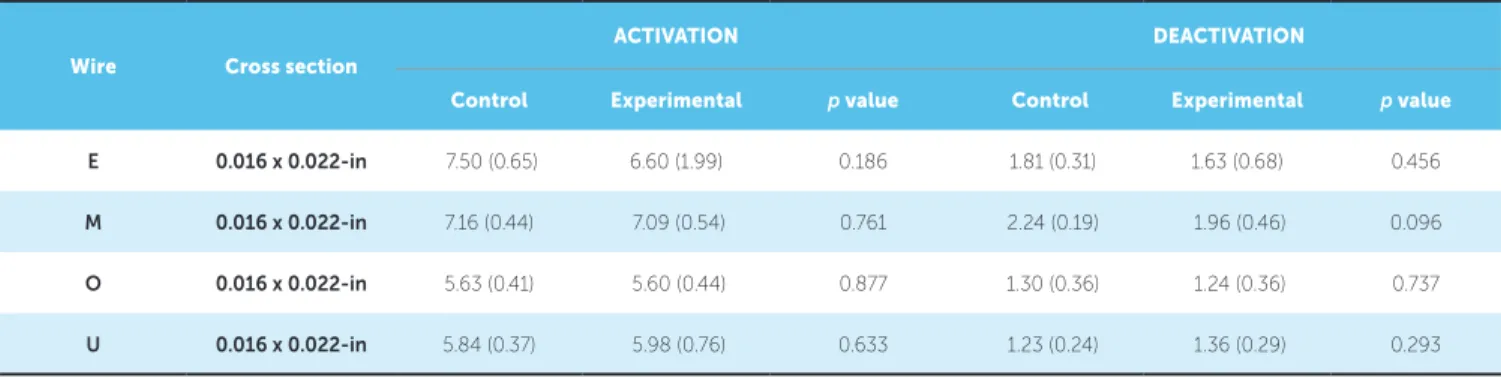
Deflection force at activation and deactivation of 1 mm did not show significant difference among wires, with similar cross-sections for either the ex-perimental or control groups (p > 0.05) (Table 2).
The four commercial wire brands showed mean deactivation forces of 1.6 N for the 0.016 x 0.022- in wires and 6.2 N for the 0.019 x 0.025-in wires.
Table 1 - Complete description of specifications of the nickel-titanium (NiTi) wires tested.
*No information about the transformation temperature is disclosed on the package.
Groups Commercial name Manufacturer
0.016 x 0.022-in
E Thermal* Shenzhen Superline Technology, Shenzhen, China. (distributed by EurodontoTM, Paraná, Brazil)
M Thermo Plus* Dental MorelliTM, Sorocaba, São Paulo, Brazil
O Flexy Thermal Smart 37 oC
Beijing Smart TechnologyTM, Beijing, China.
(distributed by OrthometricTM, Marília,
São Paulo, Brazil)
U Nitinol heat-activated* 3MTM/UnitekTM, Monrovia, California, USA.
0.019 x 0.025-in
E Super Elastic Shenzhen Superline Technology
TM, Shenzhen, China.
(distributed by EurodontoTM, Paraná, Brazil)
M Super Elastic Dental MorelliTM, Sorocaba, São Paulo, Brazil
O Flexy Super Elastic
Beijing Smart TechnologyTM, Beijing, China.
(distributed by OrthometricTM, Marília,
São Paulo, Brazil)
In general, for the 0.016 x 0.022-in wires, it was observed that both activation and deactivation values were lower in the experimental group than in the control group (Table 2). An exception to this rule was observed for the “U” wires which showed high-er mean values in the exphigh-erimental group (5.98 N) compared to the control group (5.84 N). Addition-ally, during deactivation, the means for the experi-mental group (1.36 N) tended to be higher than in the control group (1.23 N). No significant difference was observed in these values between the control and experimental groups (p > 0.05) (Table 2).
Regarding 0.019 x 0.025-in wires (Table 2), dur-ing activation, only the “O” brand wires had higher mean values in the experimental group (13.64 N) compared to the control group (12.83 N). However, a similar result was not found for deactivation. For the experimental group, the “U” and “M” wires
achieved values of 7.60 N and 6.43 N, respective-ly, and the control group achieved values of 7.44 N and 6.24 N, respectively. No significant difference was observed between the control and experimental groups (p > 0.05) (Table 2).
DISCUSSION
The results of this study showed that heat treatment of the tested NiTi wires ends did not alter the delection of the adjacent portions of orthodontic archwires. There-fore, there was no change in the delection of NiTi wires in the region adjacent to where heat treatment had been used to cinch back the wire at the molar tube. These data reveal that heat treatment applied to the distal end of rect-angular NiTi wires does not compromise the delection force in the second premolar region.
According to the methods used in the present study, heat treatment should be performed at the inal 5 mm
Table 2 - Force (Newton) for activation and deactivation measured at 1 mm deflection for control and experimental samples (0.016 x 0.022-in heat-activated NiTi).
*Significance set at 5%.
Wire Cross section
ACTIVATION DEACTIVATION
Control Experimental p value Control Experimental p value
E 0.016 x 0.022-in 7.50 (0.65) 6.60 (1.99) 0.186 1.81 (0.31) 1.63 (0.68) 0.456
M 0.016 x 0.022-in 7.16 (0.44) 7.09 (0.54) 0.761 2.24 (0.19) 1.96 (0.46) 0.096
O 0.016 x 0.022-in 5.63 (0.41) 5.60 (0.44) 0.877 1.30 (0.36) 1.24 (0.36) 0.737
U 0.016 x 0.022-in 5.84 (0.37) 5.98 (0.76) 0.633 1.23 (0.24) 1.36 (0.29) 0.293
Table 3 - Force (Newton) for activation and deactivation measured at 1 mm deflection for control and experimental samples (0.019 x 0.025-in NiTi).
*Significance set at 5%.
Wire Cross section
ACTIVATION DEACTIVATION
Control Experimental p value Control Experimental p value
E 0.019 x 0.025-in 14.31 (0.46) 14.09 (0.81) 0.457 5.62 (0.32) 5.49 (0.31) 0.361
M 0.019 x 0.025-in 15.18 (0.92) 15.14 (0.80) 0.920 7.44 (0.44) 7.60 (0.51) 0.470
O 0.019 x 0.025-in 12.83 (1.71) 13.64 (0.65) 0.175 5.44 (0.49) 5.27 (0.18) 0.306
of NiTi wires, whether conventional or heat-activated. In clinical practice, performing heat treatment in the distal end of a wire is usually a simple procedure for every orthodontist. To eliminate measurement bias in our study, we used a miniature orthodontic gas blow-torch that had been previously calibrated under con-trolled temperatures.
The NiTi orthodontic wires exposed to tempera-tures of 500 °C showed changes in some of their me-chanical properties. However, when wires are exposed to temperatures of 600 °C, the properties are completely
lost.4 In this study, heat treatment was performed at a
temperature of 650 °C until the wire became red-hot. The same procedure is used by orthodontists who wish to easily bend an orthodontic wire of a diferent alloy.
The objective of the present study was not to compare commercial brands, but to compare the efects of heat treatment on diferent cross-section and brands of wires.
However, for UnitekTM/3MTM 0.016 x 0.022-in wires, an
insigniicant increase in stifness was observed in the ex-perimental group. This change did not appear to be sui-cient to hinder tooth movement. For the 0.016 x 0.022-in
wires (EurodontoTM, MorelliTM, OrthometricTM),
activa-tion and deactivaactiva-tion values were lower in the experimental group compared to the control group, indicating that heat treatment caused no signiicant changes in adjacent regions (Table 2). Because these diferences between groups were not statistically signiicant, it should be understood that the reduction in force necessary for delection was not signii-cant to orthodontic movement.
Only during activation Orthometric 0.019 x 0.025-in NiTi wires exhibited higher mean values for the experi-mental group compared to the control group. Similar results were not observed for deactivation.
Neverthe-less, for UnitekTM/3MTM and MorelliTM wires, the
ex-perimental group showed higher values than those of the control group for deactivation. This diference would indicate that heat treatment causes a slight increase in stifness for some NiTi wires (Table 2).
In this study, heat treatment in the distal portion of NiTi wires did not inluence delection for various tested brands. Thus, it seems clear that orthodontists can select the NiTi wire of their choice and anneal any desired spot (cinched back) to the archwire. Clinicians should prevent sot-tissue irritation caused by swiveling of the archwire; this should be the standard of care during severe anterior crowding correction. Crowding correction with NiTi
wires is eiciently performed between appointments when wire excess is common in the distal region of molar tubes. For rectangular archwires, correct leveling and alignment allowed shiting of the archwire, leading not only to sot tissue irritation, but also to arch distortion and asymmetry. Although crimpable stops are the most commonly indicat-ed methods to avoid archwire shiting, they partially retain the archwire due to interbracket distance, thus allow free space for shiting. Heating the distal ends of NiTi arch-wires is advantageous due to being an inexpensive, rapid and simple procedure. This fact is particularly important for treatment performed with self-ligating systems because
low friction allows archwire shiting.3,8,9
Although there are many studies in the literature
on the delection of NiTi wires,1,4,10,11 to the best of our
knowledge, no previous study has determined the in-luence of thermal treatment in NiTi wires or in heat-activated NiTi wires. In the future, laboratory and clini-cal research can examine the aspects highlighted in this study in greater detail.
Although values obtained for in vitro experiments do not always coincide with clinical reality, they provide a means of comparison with other studies and guide the selection of the best material for a given stage of
treat-ment.12,13 The present study demonstrated that heat
treat-ment of distal ends can be performed with heat-activated and conventional rectangular NiTi wires without any risk of detrimentally afecting alignment or leveling of teeth ad-jacent to the area chosen for heat treatment.
CONCLUSIONS
1. Gurgel JA, Kerr S, Powers JM, LeCrone V. Force-delection properties of superelastic nickel-titanium archwires. Am J Orthod Dentofacial Orthop. 2001 Oct;120(4):378-82.
2. Lombardo L, Toni G, Stefanoni F, Mollica F, Guarneri MP, Siciliani G. The efect of temperature on the mechanical behavior of nickel-titanium orthodontic initial archwires. Angle Orthod. 2013 Mar;83(2):298-305.
3. Ludwig B, Gasl B, Lietz T. Auxiliary equipment and techniques. In: Ludwig B, Bister D, Baumgaertel S. Self-ligating brackets in orthodontics. Vicenza: Thieme; 2012. p. 173-205.
4. Khier SE, Brantley WA, Fournelle RA. Bending properties of superelastic and nonsuperelastic nickel-titanium orthodontic wires. Am J Orthod Dentofacial Orthop. 1991 Apr;99(4):310-8.
5. Yoneyama T, Doi H, Kobayashi E, Hamanaka H. Super-elastic property of Ti-Ni alloy for use in dentistry. Front Med Biol Eng. 2000;10(2):97-103.
6. Berger J, Waram T. Force levels of nickel titanium initial archwires. J Clin Orthod. 2007 May;41(5):286-92.
REFERENCES
7. International Organization for Standardization. Wires for use in orthodontics. ISO 15841. UNE-EN ISO; 2007. p. 1-12.
8. Damon DH. The rationale, evolution and clinical application of the self-ligating bracket. Clin Orthod Res. 1998 Aug;1(1):52-61.
9. Nakano H, Satoh K, Norris R, Jin T, Kamegai T, Ishikawa F, et al. Mechanical properties of several nickel-titanium alloy wires in three-point bending tests. Am J Orthod Dentofacial Orthop. 1999 Apr;115(4):390-5.
10. Ong E, Ho C, Miles P. Alignment eiciency and discomfort of three orthodontic archwire sequences: a randomized clinical trial. J Orthod. 2011 Mar;38(1):32-9. 11. Bartzela TN, Senn C, Wichelhaus A. Load-delection characteristics of
superelastic nickel-titanium wires. Angle Orthod. 2007 Nov;77(6):991-8. 12. Burstone CJ. Variable-modulus orthodontics. Am J Orthod. 1981 Jul;80(1):1-16. 13. Hayashi K, Araki Y, Mizoguchi I. Nonlinear large-delection analysis of orthodontic