Arq Neuropsiquiatr 2009;67(2-B):523-526
523
Clinical / Scientiic note
Superior ophthalmiC vein punCture
An alternative approach to treat complex cavernous sinus istulae
Eduardo Wajnberg
1, Gabriela Z. Spilberg
2, Emerson L. Gasparetto
3punção da veia oftálmiCa Superior: uma via alternativa para tratamento de fíStulaS Carótido-CavernoSaS ComplexaS
Departamento de Radiologia da Universidade Federal do Rio de Janeiro (UFRJ), Rio de Janeiro RJ, Brasil: 1Médico Neuroradiologista Intervencionista
do Departamento de Radiologia da UFRJ; 2Residente do Segundo Ano do Departamento de Radiologia da UFRJ; 3Professor Adjunto do Departamento
de Radiologia da UFRJ.
Received 6 November 2008, received in inal form 25 January 2009. Accepted 29 April 2009.
Dr. Eduardo Wajnberg – Rua Lopes Quintas 100 / 602 - 22460-010 Rio de Janeiro RJ - Brasil. E-mail: [email protected]
Complex cavernous sinus fistulae (CCF) are a tech-nical challenge to neuro-vascular specialists. Their clin-ical symptoms are usually a triad of chemosis, ptosis and exophthalmia1,2. Among the most serious symptoms are
visual loss, and consequences of brain hemorrhage. The most commonly performed endovascular treatment con-sists in embolization through a venous approach by the in-ferior petrosal sinus and occlusion of the cavernous sinus with coils. Not always a conventional route is feasible, im-posing alternative routes. We describe two cases of CCF treated with technical success using the superior ophthal-mic vein (SOV) as a route to reach the cavernous sinus.
CaSeS
Case 1
A 73 year-old male presented with acute-onset right perio-cular pain, diplopia, operio-cular injection, progressive proptosis, and periocular swelling after an episode of trauma. His past medi-cal history was unremarkable.
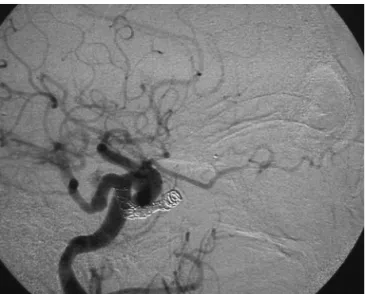
The CT scan of the brain demonstrated enlargement of the right SOV posterior to the eye globe. A cerebral angiogra-phy demonstrated a direct carotid cavernous dural sinus istu-la. The right internal carotid artery supplied the istula, but al-so the posterior circulation, due to the presence of a persistent trigeminal artery. The istula drained only to the anterior com-partment of the cavernous sinus, through the superior ophthal-mic vein. There was no suitable alternative access to the istula: the inferior petrosal sinus was occluded and the angular and fa-cial veins were tortuous, such that accessing the istula through these routes would be dificult (Fig 1). Direct balloon emboliza-tion was discarded because of the risk of occluding the persis-tent trigeminal artery, which was calibrous. An endovascular at-tempt to recanalize the inferior petrous sinus was unsuccessful. Conventional surgery with direct occlusion of the cavernous si-nus was attempted, but also not successful, as the patient re-mained symptomatic and control angiograms done in the
post-Fig 1. Patient 1. Left carotid angiography despicting a carotid-cavern-ous direct istula, with exclusive vencarotid-cavern-ous drainge by a dilated SOV and a proeminant persistent trigeminal artery.
Arq Neuropsiquiatr 2009;67(2-B)
524
Superior ophthalmic vein puncture Wajnberg et al.
operative period showed partial occlusion of the cavernous sinus and persistence of the istula. At this point it was decided to access the cavernous sinus via direct puncture of the SOV.
The patient was placed under general anesthesia. After the arterial anatomy of the lesion was studied through a complete 4 vessels angiography, a 5 French catheter was placed in the ca-rotid artery for observation of the shunt, angiographic control and road mapping. After surgical dissection of the right SOV, the puncture was done with 20G-Telon intravenous type-cath-eter, and a microcatheter (Tracker Excel 14- Boston Scientiic, Freemont, CA) was placed directly through it. The correct posi-tion of the microcatheter was conirmed with both transvenous and transarterial angiography. Embolization was performed us-ing Guglielmi detachable platinum coils (Boston Scientiic/Tar-get, Fremont, CA) and Hidrogel 14 coils (MicroVention, Inc., Al-iso Viejo, CA). With progressive packing of the istulous pouch, transarterial angiography was repeated sequentially until no ev-idence of istulous drainage was visible. The patient recovered well, remaining with a residual diplopia.
Case 2
A 65 year-old woman presented with a 15 year-history of proptosis, low visual acuity and a pulsatile supraorbital mass. There was no history of trauma. Her past medical history was remarkable for Chagas disease, with cardiomyopathy.
The CT scan of the brain demonstrated a giant SOV and ex-uberant venous collateral circulation in the supraorbital region and forehead. A cerebral angiography was done, which demon-strated a direct carotid cavernous dural sinus istula. Both inter-nal carotids were occluded at origin, and recainter-nalization of the distal segments through anastomotic branches of the external carotid arteries was observed. The istula was fed mainly by the posterior circulation. The direct puncture of the SOV was cho-sen as the via to access the cavernous sinus.
After the arterial anatomy of the lesion was studied through a complete 4 vessels angiography, a 5 French catheter was placed in the left vertebral artery for observation of the shunt and an-giographic control. Road-map images of the venous phase were obtained through transarterial injections from the carotid ar-tery catheter, to guide the venous puncture and microcatheter navigation. The puncture of a collateral enlarged supra-orbit-ary vein was done with 20G-Telon intravenous type-catheter, and a microcatheter (Tracker Excel 14- Boston Scientiic, Free-mont, CA) was placed directly through it. There was no surgical exposure of the vein, as in Case 1. The puncture was done un-der direct road map visualization. The correct position of the microcatheter was conirmed with both transvenous and tran-sarterial angiography. Embolization was achieved using DCS 18 (Cook, Bloomington, IN, USA). With progressive packing of the istulous pouch, transarterial angiography was repeated
sequen-Fig 3. Patient 2. Lateral vertebral angiography showing microcathe-ter navigation throw a large and tortuous SOV.
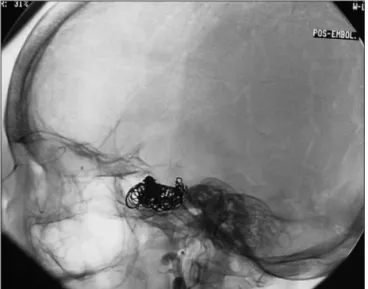
Fig 4. Patient 2. Post-embolization aspect, with a dense coil cast in-side the cavernous sinus.
Arq Neuropsiquiatr 2009;67(2-B)
525 Superior ophthalmic vein puncture Wajnberg et al.
tially until no evidence of istulous drainage was visible. There was immediate closure of the istula, with shrinkage of the su-praorbital pulsatile mass (Figs 2,3,4,5). Six months after the pro-cedure, the patient remained with mild proptosis.
diSCuSSion
Intracranial dural arteriovenous istulae are acquired arteriovenous shunts located inside the dura-mater. They account for 10–15% of all intracranial arteriovenous le-sions3. Their arterial supply arises from meningeal
branch-es of the internal or external carotid arteribranch-es, and rarely from cortical branches. The clinical presentation of dur-al istulae is due to arteridur-alization of the venous system. CCF usually presents with neuro-ophtalmologic symp-toms secondary to ophthalmic veins arterialization4,5, such
as chemosis (88%), exoftalmos (70%), III cranial nerve pal-sy (35%), VI nerve palpal-sy (64%) and bruit (47%) in a series presented by Klisch et al.6. Acute-onset istulae or high
low istulae may also be associated with periocular swell-ing. Patients with visual deterioration require early inter-vention to preserve their sight. Once visual loss is com-plete, even with treatment, optic nerve function is hardly recovered7,8. When cortical drainage is present, there is a
major risk factor to intra-parenchymal hemorrhage3. The
clinical presentation of our patients was periocular pain, diplopia, ocular injection, proptosis, periocular swelling, low visual acuity and a pulsatile mass.
The CT scans in patients with dural vascular malfor-mations are often normal. Sometimes enlargement of a dural sinus or a dilated draining vein can be identiied. In carotid cavernous istulae an enlarged cavernous sinus is seen in half of cases, and a dilated superior ophthalmic vein can be identiied on most contrast-enhanced scans. On magnetic resonance studies, the inding of dilated cor-tical veins without an identiiable parenchymal nidus sug-gests the presence of a dural shunt. Routine T1 and T2, spin echo weighted MR images can demonstrate compli-cations of dural istula, such as infarction and hemorrhage. Conventional MRI is less successful at direct visualization of the exact istula site, although dural engorgement can sometimes be seen on post-contrast studies. Enlarged su-perior ophthalmic vein are readily identiiable9. In our
cas-es, the pre-treatment CT scan indings were enlargement of the SOV and collateral circulation.
Manual carotid-jugular or ocular compression was a classically proposed therapeutic method for CCF8,10, not
frequently used today. It may precipitate vaso-vagal at-tack or even isquemic stroke. Hamby and Gardner in 1933 described the irst successful intracranial ligation of the carotid artery for treatment of this disease11.
Endovascu-lar treatment of direct CCFs has evolved since the intro-duction of detachable balloons12 and is now the
deini-tive treatment of high-low traumatic lesions because of
its safety and eficacy13. However, indirect CCFs are rarely,
if ever, curable with balloon occlusion or particulate em-bolization, because the complex arterial supply from mul-tiple ECA and/or cavernous ICA branches13.
Trans-arterial treatment may be performed2,14;
partic-ulate arterial embolization may result in angiographic im-mediate cure of the istulae in up to 50% of cases, but de-layed recanalization, or change in drainage pattern usually is observed. It may specially be effective when the patient is oligosymptomatic3 and the istula is fed only by
menin-geal branches of the external carotid artery.
Arterial embolization with glue also can be per-formed3, but only in cases of simple istulae with a single
pedicle, or few dilated pedicles. Injection should be done only if distal catheterization allows good low control, en-abling glue to reach the venous side. In these cases, com-plete cure of the istulae may be achieved.
Transvenous embolization has become the treatment of choice for such lesions15 after the introduction of this
method by Ulacker et al. in 198616. Generally, an approach
may be performed trough the femoral vein and inferior petrosal sinus. When the inferior petrosal sinus is not opaciied, an attempt to catheterize or recanalize it must be made17,18. It may be impossible because of thrombosis
or anatomic variation, such as cases of plexiform inferi-or petrosal sinus inferi-or absence of connection with the jug-ular vein8. An alternative to these cases is catheterization
of the facial and angular veins6,8. This may be technically
very dificult owing to the tortuosity of the vein. In these cases, direct puncture of the SOV, percutaneously or after surgical exposure, may be a good alternative19,20.
The complications of this approach include risk of damage to the trochlea or other orbital structures, caus-ing retro-ocular hemorrhage and infection. Other poten-tial complications include injury of the supra-orbital nerve or elevator palpebrae muscle21. Goldberg et al.
conclud-ed that, if the SOV is not dilatconclud-ed, or if it is locatconclud-ed deep in the orbit, then trasorbital venous approach may not be possible22. Miller et al. reported severe visual loss and
neurovascular glaucoma complicating the SOV approach23.
Devoto et al. described acute exophtalmus occurring dur-ing treatment of a carotid-cavernous istula via the SOV24.
Aihara et al. reported worsening of ocular symptoms oc-curring after occlusion of the cavernous sinus25. Fukami et
al. described late central retin vein occlusion after trans-venous embolization of a DAVF26.
di-Arq Neuropsiquiatr 2009;67(2-B)
526
Superior ophthalmic vein puncture Wajnberg et al.
rect puncture of the SOV. In Patient 2 both internal ca-rotids were occluded at origin, and there was an exuber-ant SOV and collateral circulation, making it a good and easy approach.
There weren’t any technical dificulties or complica-tions in our cases with the direct transvenous approach of the SOV. It can be reached either with surgical expo-sure or catheterization trough a collateral vein. When oth-er routes are not available, the supoth-erior ophtalmic vein puncture is a feasible approach and carries a low risk of complications.
referenCeS
1. Kim MS HD, Kwon OK, Oh CW, Han MH. Clinical
characteris-tics of dural arteriovenous istula. J Clin Neurosci 2002;9:147-155. 2. Michels KS NJ, Falardeau J, Roberts WG, Petersen B, Nesbit
GM, Barnwell SL. Transvenous embolization of a dural ca
-rotid-cavernous sinus istula via the inferior ophthalmic vein. Ophthalmic Plastic Reconstructive Surgery 2007;23:480-482.
3. Kiyosue H HY, Okahara M, Tanoue S, et al. Treatment of in
-tracranial dural arteriovenous istulas: current strategies based on location and hemodynamics, and alternative techniques of transcatheter embolization. Radiographics 2004;24:1637-1653. 4. Lasjaunias P CM, ter Brugge K, Tolia A, Hurth M, Bernstein
M. Neurological manifestations of intracranial dural arterio
-venous malformations. J Neurosurgery 1986;64:724-730. 5. Stiebel-Kalish H SA, Nimii Y, Kalish Y, et al. Cavernous sinus
dural arteriovenous malformations: patterns of venous drain
-age are related to clinical signs and symptoms. Ophthalmology 2002;109:1685-1691.
6. Klisch JMDH, Juergen H, Spestzger U, Hetzel A, Wolfgang S, Schumach M. Transvenous treatment of carotid cavernous and dural arteriovenous istulae: results for 31 patients and review of the literature. Neurosurgery 2003;53:836-857.
7. Albuquerque FC, McDougall CG. Reversal of blindness after transvenous embolization of a carotid-cavernous istula: case report. Neurosurgery 2003;52:233-237.
8. Yu SC CH, Wong GK, Chan CM, Cheung JY, Poon WS. Trans
-venous embolization of dural carotid-cavernous istulae with transfacial catheterization through the superior ophthalmic vein. Neurosurgery 2007;60:1032-1037.
9. Tsai MYF, Chen LK, Su CT, Lu TN, Wu CC, Kuo CJ. Utility of
source images of three-dimensional time-of-light magnetic res
-onance angiography in the diagnosis of indirect carotid–cav
-ernous sinus istulas. J Neuro-Ophthalmology 2004;24:285- 289.
10. Higashida RT HG, Halbach VV, Bentson JR, Goto K. Clo
-sure of carotid cavernous sinus istulae by external compres
-sion of the carotid artery and jugular vein. Acta Radiol 1986; 369(Suppl):S580-S583.
11. Hamby WBGW. Treatment of pulsating exophtalmus: report of 2 cases. Arch Surg Chicago 1933;27:676-678.
12. Liang MW, Xiaofeng Y, Weiguo L, et al. . Bilateral traumatic ca
-rotid cavernous istula: the manifestations, transvascular em
-bolization and prevention of the vascular complications af
-ter therapeutic embolization. J Craniofacial Surgery 2007;18: 74-77.
13. Koebbe CJ, Jungreis C, Levy E, Pless M. Alcohol embolization of carotid-cavernous indirect istulae. Neurosurgery 2003;52: 1111-1116.
14. Satomi J, Satoh K, Matsubara S, Nakajima N, Nagahiro S. An
-giographic changes in venous drainage of cavernous sinus du
-ral arteriovenous istulae after palliative transarterial embo
-lization or observational manangement: a proposed stage clas
-siication. Neurosurgery 2005;56:494-502.
15. Hara T, Hamada JI, Kai Y, Ushio Y. Surgical transvenous embo
-lization of a carotid-cavernous dural istula with cortical drain
-age via a petrosal vein: two technical case reports. Neurosurgery 2002;50:1380-1384.
16. Ulacker R LS, Ribas GC, Piske RL. Carotid-cavernous istulas: embolization through the superior ophthalmic vein approach. Radiology 1986;159:175-179.
17. Cheng CMC, Cheung YL. Transvenous embolisation of dural carotid-cavernous istulas by multiple venous routes: a series of 27 cases. Acta Neurochirurgica 2003;145:17-29.
18. Benndorf G BA, Lehmann R, Lanksch W. Transvenous occlu
-sion of dural cavernous sinus istulas through the thrombosed inferior petrosal sinus: report of four cases and review of the literature. Surg Neurol 2000;54:42-54.
19. Miller PS. Cook detachable coil embolization of a symptom
-atic, isolated orbital arteriovenous istula via a superior oph
-thalmic vein approach. Intervent Neuroradiol 2005;47:62-65.
20. Quiñones D DG, Gobin PY, Goldberg RA, Viñuela F. Emboliza
-tion of dural cavernous istulas via superior ophthalmic vein approach. AJNR Am J Neuroradiol 1997;18:921-928.
21. Oishi H AH, Sato K, Iizuka Y. Complications associated with transvenous embolisation of cavernous dural arteriovenous istula. Acta Neurochir (Wien) 1999;141:1265-1271.
22. Goldberg RA GS, Duckwiler G, Vinuela F. Management of cavernous sinus-dural istulas. Indications and techniques for primary embolization via the superior ophthalmic vein. Arch Ophthalmol 1996;114:707-714.
23. Miller NR ML, Debrun GM, Tamargo RJ, Nauta HJ. Treatment
of carotid-cavernous sinus istulas using a superior ophthal
-mic vein approach. J Neurosurg 1995;83:838-842.
24. Devoto MH EJ, Tomsick TA, Kulwin DR. Acute exophthalmos during treatment of a cavernous sinus-dural istula through the superior ophthalmic vein. Arch Ophthalmol 1997;115:823-824. 25. Aihara N MM, Yamada K, Banno T, Watanabe K, Kamiya K,
Takagi T. Deterioration of ocular motor dysfunction after trans
-venous embolization of dural arterio-venous istula involving the cavernous sinus. Acta Neurochir (Wien). 1999;141:707-709.
26. Fukami T IT, Shiino A, Nakazawa T, Matsuda M, Handa J. Cen
-tral retinal vein occlusion after embolization for spontaneous ca