376
Eifer DA et al. Unilateral pulmonary veins atresia: evaluation by CT
Radiol Bras. 2013 Nov/Dez;46(6):376–378
Unilateral pulmonary veins atresia: evaluation by computed
tomography
*
Atresia unilateral das veias pulmonares: avaliação por tomografia computadorizada
Diego André Eifer1, Felipe Veras Arsego1, Felipe Soares Torres2
Unilateral pulmonary vein atresia is a rare congenital condition. In addition to cardiac malformations or pulmonary hyper-tension, patients may present with recurrent pulmonary infections or hemoptysis in childhood or adolescence. The authors report a case where the typical findings of such condition were observed at computed tomography in an adult patient.
Keywords: Pulmonary veins; Unilateral pulmonary veins atresia; Computed tomography.
A atresia unilateral das veias pulmonares é uma condição congênita rara. Os pacientes podem apresentar infecções recorrentes ou hemoptise na infância ou adolescência, além de malformações cardíacas ou hipertensão pulmonar. Relatamos caso em que os achados característicos dessa alteração foram demonstrados pela tomografia computado-rizada em um paciente adulto.
Unitermos: Veias pulmonares; Atresia unilateral de veias pulmonares; Tomografia computadorizada.
Abstract
Resumo
* Study developed in the Unit of Radiology at Hospital de Clínicas de Porto Alegre (HCPA), Porto Alegre, RS, Brazil.
1. MDs, Residents, Unit of Radiology, Hospital de Clínicas de Porto Alegre (HCPA), Porto Alegre, RS, Brazil.
2. MD, Radiologist, Unit of Radiology Hospital de Clínicas
Eifer DA, Arsego FV, Torres FS. Unilateral pulmonary veins atresia: evaluation by computed tomography. Radiol Bras. 2013 Nov/Dez; 46(6):376–378.
0100-3984 © Colégio Brasileiro de Radiologia e Diagnóstico por Imagem CASE REPORT
pnea during stress, without recurrent infec-tion. Computed tomography study was per-formed in a multidetector Philips Brilliance 16 equipment, with 2.0 mm collimation, 1.0 mm thick slices and intravenous non-ionic iodinated contrast agent (80 ml at a mality in laboratory tests. Chest
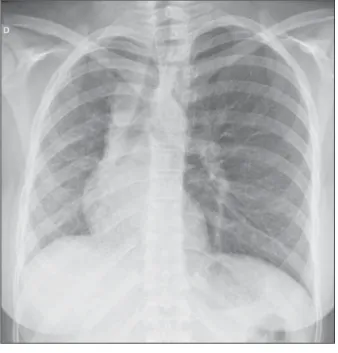
radiogra-phy did not demonstrate signs of pulmo-nary infection, but demonstrated right lung and pulmonary artery with reduced dimen-sions and mediastinal shift to the right (Fig-ure 1). The patient presented history of dys-INTRODUCTION
Venous abnormalities of the thorax may involve either systemic or pulmonary veins, ranging from incidental findings to compo-nents of more complex abnormalities, most frequently congenital heart disease(1). How-ever, complete absence of pulmonary venous drainage into the left atrium is a rare condition and may affect a whole lung, without associated anomalous drainage(2). Atresia may be divided into common, in-dividual or unilateral(3); the latter is a rare condition corresponding to the absence of pulmonary veins in one of the lungs.
In the present report, the authors de-scribe the case of an adult patient with uni-lateral pulmonary veins atresia, with em-phasis on computed tomography findings.
CASE REPORT
A female, 18-year-old patient attended the emergency service with history of he-moptysis. At pulmonary auscultation, the patient presented decreased vesicular mur-mur in the right lung base, with no
abnor-de Porto Alegre (HCPA), Program of Post-Graduation in Cardiol-ogy – School of Medicine, Universidade Federal do Rio Grande do Sul (UFRGS), Porto Alegre, RS, Brazil.
Mailing Address: Dr. Felipe S. Torres. Serviço de Radiolo-gia, Hospital de Clínicas de Porto Alegre. Rua Ramiro Barcelos,
2350, Santana. Porto Alegre, RS, Brazil, 90035-903. E-mail: [email protected].
Received September 28, 2012. Accepted after revision April 30, 2013.
377
Eifer DA et al. Unilateral pulmonary veins atresia: evaluation by CT
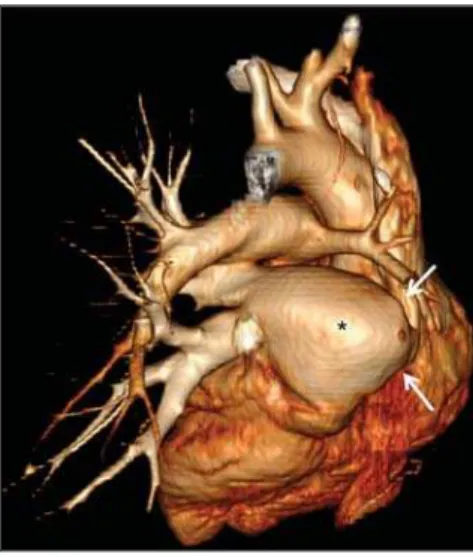
Radiol Bras. 2013 Nov/Dez;46(6):376–378 rate of 4.5 ml/s) and demonstrated absence of right pulmonary arteries (Figure 2), right pulmonary artery hypoplasia with ipsilat-eral prominence of bronchial arteries (Fig-ure 3), besides reduction of pulmonary volume at the right lung, allowing the di-agnosis. The analysis of the lung paren-chyma demonstrated ground glass opacities and peribronchovascular thickening and interlobular septa thickening at the right lung (Figure 4). No other pleuropulmonary
or mediastinal changes were identified at computed tomography. Fibrobronchoscopy demonstrated diffuse hypervascularization of the right respiratory tree and mucosal edema with bleeding spots. Scintigraphy was also performed, demonstrating ab-sence of 99mTc-MAA uptake in the right lung. Superselective embolization of hem-orrhagic vessels was successfully per-formed. Currently, the patient remains un-der follow-up on an outpatient basis, with no new episode of hemoptysis.
DISCUSSION
Unilateral pulmonary veins atresia is a rare condition, with less than 40 cases re-ported in the literature until 2010(4). Such
a condition is characterized by the absence of pulmonary veins on the affected side and presents high morbimortality(2). Its etiology
is unknown, but it is suspected that there may be a congenital failure in the incorpo-ration of the common pulmonary vein into the left atrium, with equal involvement ei-ther at right or at left(5). The condition may
become clinically noticeable in the child-hood or adolescence, with progressive dys-pnea caused, at least partially, by pulmo-nary artery hypertension, recurrent episodes of pneumonia and/or hemoptysis in the af-fected lung. Cyanosis is not frequently ob-served in this condition, and one should
raise the hypothesis of the presence of a concomitant congenital heart defect, which occurs in 32% to 50% of cases(2,5,6).
Physiopathological changes in the af-fected lung involve hypertrophy and fibro-sis of the remaining veins, with fibrofibro-sis of the intima and reduction of the vascular lu-men(2). Consequently, collateral
extrapul-monary vessels develop to partially drain the affected lung. Discontinued (or focal) interstitial fibrosis and interlobular septa thickening secondary to recurrent infec-tions or infarction are observed. Because of inappropriate gaseous exchanges caused by alterations between ventilation and perfu-sion, there is a progressive reduction in the caliber of the pulmonary artery of the af-fected lung which, eventually, presents flow reversal toward the contralateral artery.
The diagnosis is generally made at the first years of life(5), and the symptoms are
extremely variable, ranging from no symp-tom(7,8) to recurrent pulmonary
infec-tions(5,9), hemoptysis(9), and even death(2,4).
Death was the outcome in ten of the 25 pediatric cases reported until 2003(2) and
also in a recently reported case where the patient presented associated heart de-fects(10). Since 2011, nine cases have been
reported(4,7–12). Out of such cases, four were
asymptomatic and the others presented cy-anosis(10,12), dyspnea(10–12), hemoptysis(9) or
recurrent infections(9).
Figure 3. Axial reconstruction of contrast-enhanced chest computed tomog-raphy with maximum intensity projection (MIP), demonstrating reduction of right pulmonary artery caliber (black arrow) and prominence of bronchial arteries (white arrow).
Figure 4. Axial section of chest computed tomography demonstrating inter-lobular septa thickening and ground glass opacities in the right lower lobe. Figure 2. Posterior view of three-dimensional
378
Eifer DA et al. Unilateral pulmonary veins atresia: evaluation by CT
Radiol Bras. 2013 Nov/Dez;46(6):376–378 In the present case, the patient had
re-mained asymptomatic for a long period of time. Similarly, Kim et al. have reported two cases of adult patients (23 and 37 years) who were asymptomatic at the diag-nosis(4). The time for development of
symp-toms or pulmonary arterial hypertension seems to be dependent on the balance be-tween the systemic vessels which supply and those vessels which drain the affected lung(2,4), in association with the lymphatic
system drainage capacity. In the present case, pulmonary scintigraphy did not dem-onstrate contrast uptake in the affected lung, indicating a significant decrease in the organ perfusion without detecting of anomalous venous return. Although the CT evaluation of the participation of bronchial veins in the pulmonary drainage is limited, smooth interlobular septal thickening and nodular thickening of interlobular fissures and pleura suggest the presence of a signifi-cant lymphatic engorgement.
A series of recent studies published in Brazil have highlighted the relevant role of imaging methods in the assessment of the chest(13–17). Chest radiography findings may
reveal reduced hemithorax, with ipsilateral mediastinal deviation and parenchymal opacities. Computed tomography demon-strates pulmonary artery with a reduced caliber and absence of pulmonary venous drainage into the left atrium in the affected lung, besides pulmonary alterations such as interlobular septal thickening, peribron-chovascular thickening, interstitial fibrosis and ground glass opacities(5,9,18).
Ventila-tion perfusion scintigraphy demonstrates absence of contrast uptake in the affected lung, despite the normal ventilation for the reduced pulmonary volume(6).
The therapeutic options include follow-up of patients with few or none symp-toms(4,11), selective embolization of
sys-temic collaterals in cases of hemoptysis(5),
and pneumonectomy in the presentations with progressive dyspnea, recurrent infec-tions and to prevent pulmonary hyperten-sion without significant left to right
shunt(2,4). Although Pourmoghadam et al.
indicate surgery as a first therapeutic op-tion(2), Kim et al. understand that such
ap-proach may be delayed in adult symptom-atic patients provided they are followed-up for development of pulmonary arterial hy-pertension(4). This was the therapeutic
ap-proach adopted in the present case, consid-ering that the superselective embolization of the hemorrhagic vessels was sufficient to control symptoms. Recent publications report four cases where the patients were clinically followed-up, with no complica-tion(4,7,8,11). Two out of such patients
under-went follow-up for up to five years(4,8).
Surgical repair of anomalous venous re-turn may be performed in cases where there is no significant left to right shunt. But, considering that the diagnosis is many times made after the development of such complication, pneumonectomy of the af-fected side could reduce the hemodynamic effects of the shunt and reduce the dead space, with reflection on the tolerance to exercises and on the occurrence of repeated infections(2,11).
In the present case report, the authors demonstrate the capacity of computed to-mography to reveal characteristic findings of unilateral pulmonary veins atresia, re-inforcing recent data in the literature indi-cating the utilization of contrast-enhanced CT as a definitive diagnostic method for this disease and also for other thoracic venous abnormalities(4,9,10,19), reducing the
necessity of invasive diagnostic proce-dures and facilitating the surgical plan-ning(9,18).
REFERENCES
1. Demos TC, Posniak HV, Pierce KL, et al. Venous anomalies of the thorax. AJR Am J Roentgenol. 2004;182:1139–50.
2. Pourmoghadam KK, Moore JW, Khan M, et al. Congenital unilateral pulmonary vein atresia: definitive diagnosis and treatment. Pediatr Cardiol. 2003;24:73–9.
3. Lee HN, Kim YT, Cho SS. Individual pulmonary vein atresia in adults: report of two cases. Korean J Radiol. 2011;12:395–9.
4. Kim Y, Yoo IR, Ahn MI, et al. Asymptomatic adults with isolated, unilateral right pulmonary
vein atresia: multidetector CT findings. Br J Radiol. 2011;84:e109–13.
5. Heyneman LE, Nolan RL, Harrison JK, et al. Congenital unilateral pulmonary vein atresia: ra-diologic findings in three adult patients. AJR Am J Roentgenol. 2001;177:681–5.
6. Tissot C, Corbelli R, Aggoun Y, et al. Broncho-scopic diagnosis of asymptomatic unilateral pul-monary vein atresia in an infant. Pediatr Cardiol. 2008;29:976–9.
7. Wang Y, Ma Y, Li B, et al. Unilateral left pulmo-nary vein atresia: radiologic findings in an adult case. Quant Imaging Med Surg. 2012;2:296. 8. Gasparetto TD, Daltro P, Marchiori E. Imaging
findings of an asymptomatic child with pulmo-nary vein atresia. Pediatr Radiol. 2010;40:1458– 9.
9. Dixit R, Kumar J, Chowdhury V, et al. Case re-port: Isolated unilateral pulmonary vein atresia diagnosed on 128-slice multidetector CT. Indian J Radiol Imaging. 2011;21:253–6.
10. Vergales JE, West SC, Hoyer AW. Pulmonary vein atresia with severe contralateral pulmonary vein stenosis in a child. Pediatr Cardiol. 2012;33:663– 5.
11. SavaÕ BozbaÕÔ, Varan B, Akçay Ô. Right pulmo-nary venous atresia: a case report and review of literature. Tuberk Toraks. 2012;60:254–7. 12. Kozak MF, Kozak AC, Souza AS, et al. Left
pul-monary vein atresia: the contribution of multislice computed tomography. Pediatr Cardiol. 2011; 32:108–10.
13. Canellas R, Kanaan D, Martins PHR, et al. Re-gressão espontânea de proteinose alveolar pulmo-nar: relato de caso. Radiol Bras. 2012;45:294–6.
14. Chojniak R, Pinto PNV, Ting CJ, et al. Biópsia transtorácica de nódulos e massas pulmonares dirigida por tomografia computadorizada. Radiol Bras. 2011;44:315–20.
15. Koenigkam-Santos M, Barreto ARF, Chagas Neto FA, et al. Tumores neuroendócrinos do pulmão: principais achados radiológicos em uma série de 22 casos com confirmação anatomopatológica. Radiol Bras. 2012;45:191–7.
16. Cerci JJ, Takagaki TY, Trindade E, et al. A tomo-grafia por emissão de pósitrons com 2-[18
F]-fluo-ro-2-desoxi-D-glicose é custo-efetiva em pacien-tes com câncer de pulmão não pequenas células no Brasil. Radiol Bras. 2012;45:198–204.
17. Bozi LCF, Melo ASA, Marchiori E. Calcificação pulmonar metastática: relato de caso. Radiol Bras. 2012;45:297–9.
18. Mataciunas M, Gumbiene L, Cibiras S, et al. CT angiography of mildly symptomatic, isolated, unilateral right pulmonary vein atresia. Pediatr Radiol. 2009;39:1087–90.