ABSTRACT
http://dx.doi.org/10.1590/1679-775720130026
Long-term degradation of resin-based cements
in substances present in the oral environment:
Eduardo Moreira da SILVA1, Jaime Dutra NORONHA-FILHO2, Cristiane Mariote AMARAL3, Laiza Tatiana POSKUS3, José Guilherme Antunes GUIMARÃES1
1- DDS, MSc, PhD, Associate Professor, Analytical Laboratory of Restorative Biomaterials - LABiom-R, School of Dentistry, Federal Fluminense University, Niterói, RJ, Brazil.
2- MSc, PhD student, Analytical Laboratory of Restorative Biomaterials - LABiom-R, School of Dentistry, Federal Fluminense University, Niterói, RJ, Brazil. 3- DDS, MSc, PhD, Assistant Professor, Analytical Laboratory of Restorative Biomaterials - LABiom-R, School of Dentistry, Federal Fluminense University, Niterói, RJ, Brazil.
Corresponding address: Eduardo Moreira da Silva - Faculdade de Odontologia, Universidade Federal Fluminense - Rua Mário Santos Braga, nº 30 - Campus Valonguinho, Centro - Niterói - RJ - Brasil - 24020-140 - Phone: 55 21 2629-9832 - Fax: 55 21 2622-5739 - e-mail: [email protected]
I
ndirect restorations in contact with free gingival margins or principally within the gingival present faster degradation of the resin-based cement pellicle. Objectives: To investigate the degradation of four resin-based cements: Rely X ARC (R), Variolink II (V), Enforce !"# $ % &' and Methods: Two activation modes were evaluated: chemical (Ch) and dual (D). In the dual activation, a two-millimeter thick ceramic disk (IPS Empress System) was interposed between the specimen and light-curing unit tip. Specimens were desiccated, immersed in *&+'/01 +2* 0+34+425*+2*&$ 673) were calculated based on ISO 4049. The data were submitted to multifactor analysis of variance (MANOVA) and Tukey's HSD test for media comparisons >?*&*@& BF $ # G*&*@ G*&*@&$ FJ! (p<0.05). The lowest solubility was presented by R (p<0.05). Conclusions: Lactic acid increased the degradation of resin-based cements. Moreover, the physical component of activation, i.e., light-activation, contributed to a low degradation of resin-based cements.Key words: Resin cements. Sorption. Solubility. Degradation. Lactic acid.
INTRODUCTION
In state-of-the-art restorative dentistry, there has
use of ceramic materials for esthetic restorations. The clinical longevity of this type of restoration is related to the operator skill, mechanical properties of the ceramic material and, principally, to the performance of the tooth-restoration adhesive interface2,4,5. For esthetic reasons, particularly in indirect restorations in anterior teeth, the cervical margins of ceramic restorations are often located
close to the free gingival margin or even within the gingival sulcus3. Consequently, the resin-based
is a high concentration of organic acids produced by and formic acid)6,9.
It is well known that the greater the degree of && ? dimethacrylate monomers broken during this polymerization reaction, the lower the solubility and the sorption suffered by the material.
The use of sorption and solubility parameters as a method to analyze the degradation of resin-based materials is well established in the literature16,22,30. Sorption is a diffusion-controlled penetrates materials when they are immersed in _ &` by two main factors: dimethacrylate monomer capable of forming hydrogen bonds with water (-OH in the Bis-GMA, -O- in TEGDMA and -NH- in UDMA), and the polymer network structure formed after polymerization23. The amount of non-reacted dimethacrylate monomers that undergoes lixiviation in an aqueous media determines the material solubility. The degree of conversion strongly & { | based material with a low degree of conversion has more non-reacted monomers and is more prone to solubility10.
In recent years, published studies have shown that lactic, propionic and acetic acid increased the degradation of restorative resin composites and adhesive systems25,26. Thus, considering that resin-based cements are composed of methacrylate monomers, and so are restorative resin composites, it seems reasonable to imagine that the same phenomenon may occur with these cements. Therefore, the aim of this study was to investigate the degradation of four resin-based cements immersed in substances present in the mode on this response. The test hypotheses were: 1) immersion in lactic acid would increase the degradation (sorption and solubility) of resin-based cements; 2) dual activation would lead to a lower degradation than chemical activation.
MATERIAL AND METHODS
The composition of resin-based cements is presented in Figure 1. All the specimens in the dual activation mode group were light-activated with a quartz-tungsten-halogen unit (Optilux 501, Demetron Inc. Danbury, USA) using an irradiance of 650 mW/cm2 for 40 s.
Sorption and solubility
!| aluminum mold (1 mm thick and 6 mm in diameter). For the specimens subjected to chemical activation, was then covered with a polyester strip and a black mask, and compressed with a device (500 g) for 20 s to avoid porosities. After reaching a rigid stage (15 min) the specimens were placed in light-proof containers. For the dual-activation, after the same procedure as for the chemical-activation (except for placement of a black mask), a ceramic disk 12 mm in diameter and 2.0 mm thick, consisting of a 1 mm thick framework made of a castable pressed ceramic, (whose surface was etched with +* 4* /* and air dried) and a 1 mm thick layering ceramic (IPS-Empress 2 system, Ivoclar Vivadent, Schaan, Liechtenstein) was placed between the mixed resin-based cement and the light unit, and the specimens were light activated.
For each activation mode, the specimens were individually stored in plastic vials, placed in a desiccator containing freshly dried silica gel, and transferred to an oven at 37°C. After 24 h, the discs were repeatedly weighed on an analytical balance (AUW 220D/0.01 mg, Shimadzu, Tokyo, Japan) until a constant mass (m1) was attained, i.e., disc mass variation was less than ±0.1 mg in any 24 h period. The thickness and the diameter of the discs were measured at four points, using a digital caliper (MPI/E-101, Mitutoyo, Tokyo, Japan),
Material Manufacturer Composition Filler (wt%)
All Cem FGM Dental Products (Joinville, SC, Brazil)
Bis-GMA, Bis-EMA, TEGDMA, Ba–Al-silicate glass, silane treated silica, benzoyl peroxide, co-initiators and
camphorquinone.
68
Variolink II Ivoclar Vivadent, Schaan, Liechenstein
Bis-GMA, UDMA, TEGDMA, barium glass, ytterbium benzoyl peroxide, initiators, stabilizers and pigments.
71
Enforce Dentsply BisGMA, TEGDMA, BHT, EDAB, fumed silica, silanized barium, aluminum borosilicate glass.
66
Rely-X ARC 3M-ESPE, St. Paul, MN, USA
! " peroxide, amine and photoinitiator.
67.5
and the volume (V) was calculated in mm3. After this, for each activation mode, the specimens were ?@ F +* saliva (KCl, NaCl, MgCl, CaCl, Nipagin, CNC, Sorbitol, and deionized water - neutral pH) or lactic acid 0.1 ' ?3/0+&$_ then after time intervals of 14, 21, 28, 90, and 180 days (m2). Before being weighed, the specimens were blotted dry with absorbent paper. After 180 days, the specimens were placed in a desiccator and weighed daily until the mass variation was less
than ±0.1 mg (m3). The sorption (Sp) at each time interval and the solubility (Sl) during the course of the 180 days of media immersion were obtained
673):
Statistical analysis
Statistical analysis was performed using the Statgraphics 5.1 Software (Manugistics, Rockville, MD, USA). The sorption and solubility data were
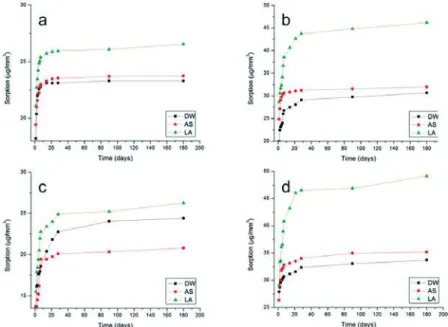
Figure 2- Increase in sorption as a function of time for dual-activation mode. In (a) All Cem; (b) Enforce; (c) Rely X ARC and (d) Variolink II
analyzed by multifactor analysis of variance - MANOVA (resin-based cement vs. activation mode vs. media immersion) and Tukey’s HSD test for multiple comparisons. The sorption and solubility data were also submitted to a simple regression analysis. The analyses were performed at a
α?*&*@&
RESULTS
For sorption, the MANOVA revealed statistically | activation mode and media immersion independent factors (p<0.05). All the interactions were also G*&*@& ` the Tukey’s HSD test are presented in Table 1. For all resin-based cements the sorption values were higher after immersion in lactic acid. Irrespective of the immersion media, E and V presented higher sorption than R and A. The lowest sorption was presented by R dual activated and after immersion
+0&@ 673). The highest
sorption was presented by V chemically activated and after immersion in lactic acid. Figures 2 and 3 present the curves of increase in sorption vs. immersion time for dual and chemical-activation mode, respectively: (a) A; (b) E; (c) R and (d) V. It can be noted that in general, the highest increase in sorption were reached close to 20 days.
With regard to solubility, the MANOVA detected |
(p<0.05) and media immersion (p<0.05) independent factors. Whereas, the activation mode
p?*&/+@@&
G*&*+&`4 of the Tukey’s HSD test. In all immersion media, R presented the lowest solubility values (p<0.05). For E and V and for R chemically activated, immersion in distilled water produced lower solubility values (p<0.05).
DISCUSSION
Many published studies have analyzed the mechanical behavior of resin-based cements1,4,14,19,29. However, until now, little information has been available about resin-based cement degradation in the substances present in the oral environment18. { that the durability of the bond between resin-based cements and dentin can be affected by water immersion and over the course of time7,13. According to Bagheri, et al.1 (2010) material degradation in the oral environment has two components; one is due to mechanical and the other to chemical degradation. Taking clinical practice into consideration, however, two aspects are noteworthy. Firstly, after restoration | &$ is immediately submitted to severe conditions such as pH cycling, temperature changes and exposure && % Resin-based
cement
Distilled water * &* Lactic acid
Chemical Dual Chemical Dual Chemical Dual
All Cem 23.3±0.4C,b 23.0±0.2B,b 23.7±0.6C,b 23.2±0.5B,b 26.6±0.3C,a 26.0±0.1B,a
Enforce 30.7±0.8B,d 30.6±0.5A,d 32.0±1.3B,c 34.4±0.5A,c 46.2±0.7B,a 41.4±0.6A,b
Rely X 24.4±1.4C,a,b 17.5±1.3C,d 20.8±1.7D,c 21.7±1.7B,c 26.3±1.6C,a 22.3±1.8C,b,c
Variolink II 33.7±0.4A,c,d 32.1±1.5A,d 35.2±0.9A,c 36.1±1.3A,c 49.2±0.5A,a 43.1±0.8A,b Table 1- Means ± standard deviations of sorption (µg/mm3)
In each column, values with identical capital letters are similar (Tukey HSD, p>0.05) In each row, values with identical lower case letters are similar (Tukey HSD, p>0.05)
Resin-based Distilled water * &* Lactic acid
Chemical Dual Chemical Dual Chemical Dual
All Cem 5.4±0.1A,a 5.4±0.1A,B,a 5.8±0.1A,a 5.5±0.1A,a 5.9±0.1A,a 5.8±0.1A,a
Enforce 5.2±0.1A,b 5.6±0.1A,a,b 5.8±0.1A,a 5.8±0.1A,a 6.1±0.1A,a 6.0±0.1A,a
Rely X 4.5±0.6B,b 5.3±0.2A,B,a 5.1±0.1B,a 5.1±0.1B,a 5.3±0.4B,a 5.3±0.5B,a
Variolink 5.2±0.1A,b 5.1±0.1B,b 6.0±0.1A,a 5.8±0.1A,a 6.2±0.1A,a 6.2±0.1A,a
Table 2- # $%!"&'3)
& seems reasonable to imagine that the chemical | degradation at a later time. Thus, investigations about the chemical degradation could be important to predict resin-based cement behavior in terms of the clinical serviceability of indirect ceramic & acids, lactic acid was chosen because Distler and Kröncke6 (1983) showed that lactic acid accounts for about 70% of the total acids present in the human dental plaque. Moreover, these authors found a steeper increase in lactic acid after sucrose rinsing, claiming that this was due to rapid sucrose degradation by lactate-producing bacteria, e.g., S.
mutans. Based on this, it is reasonable to speculate
that during carbohydrate ingestion, there would be a larger amount of lactic acid in the oral cavity than the other organic acids produced by human dental plaque, i.e., propionic and acetic acids. According to a previous study, 4 is the lowest pH within the 9. Based on this and in attempt to mimic the conditions present in the oral environment as closely as possible, the pH of lactic acid was adjusted to this value in the present study.
In order to withstand the mechanical stresses generated during the masticatory process in vivo, the minimum thickness of the occlusal surfaces of posterior all-ceramic onlays and crowns have to be around 1.5 to 2.0 mm17. Thus, in the present study the specimens polymerized by dual mode were activated through a 2 mm thick disk of IPS Empress ceramic system in an endeavor to mimic a clinical situation as closely as possible, and to analyze phenomenon.
The analysis provided in Table 1 shows that immersion in lactic acid produced the highest sorption values for all the resin-based cements analyzed. This result is in agreement with a previous study18. On the other hand, the solubility in this
(Table 2). However, considering the activation mode, it could be noted that for all resin-based cements the solubility values in lactic acid were always numerically higher than those after immersion in the other media. Thus, it seems reasonable to &` be interpreted as resin-based cements tending to be more prone to absorbing LA than AS and DW. ` $&26 (2011) could be used to explain this thought. When analyzing the sorption of some resin-based composites, these authors showed a higher rate of sorption after immersion in lactic acid and claimed that this was due to the
high level of hydrogen bonds promoted by the –OH and –COOH functional groups present in the lactic acid molecule with polar sites of dimethacrylate monomers, i.e., -OH- in Bis-GMA, -O- in TEGDMA and Bis-EMA and –NH- in UDMA, present in the organic matrixes of the analyzed materials. Since all resin-based cements analyzed in the present study had dimethacrylate monomers in their compositions, the same phenomenon may have taken place here.
In resin-based materials the solubility phenomenon reflects the release of residual and ions from their surfaces8. This results in material degradation. From the data shown in Table 4 of the independent factor media immersion was B and E after immersion in distilled water. However, the solubility values after immersion in lactic acid were numerically higher than those presented after immersion in the other media. Thus, it is possible that irrespective of the resin-based cement compositions, a common mechanism of action took place after immersion in this acid. Based on this, we speculate whether the solubility of a resin-based cement could increase after a long time of exposition to lactic acid. These explanations
$ &25 (2012)
who showed that some adhesive systems presented after immersion in propionic and lactic acid when
was due to a common degradative effect produced by these acids.
composites immersed in acidic drinks (pH of 7.0, 3.9 and 3.1), Rahim, et al.22 (2012) found that the solubility was higher after immersion in the low ?/&+& the release of unreacted monomers and inorganic &
Analyses of Tables 1 and 2 shows that with exception of the solubility values of R in distilled water, all the sorption and solubility values for the dual-activated mode group were lower than or equal to those presented by the chemically activated & support the second research hypothesis of the present study, from the clinical point of view, these results are important and mean that the physical component of activation, i.e., light-activation, is able to contribute with the conversion of a resin-based cement when activated through ceramic materials 2 mm thick, with translucence equal to or greater than that of the IPS Empress system.
Figures 2 and 3 show that irrespective of the media immersion and activation mode, all resin-based cements presented an increase in sorption +2* with the highest increase occurring within the & ` found in the literature21. Even considering that the present study was conducted in vitro, from the clinical viewpoint these results seem to be relevant because they suggest that the resin-based cement within the gingival sulcus, e.g, ceramic total crowns, may undergo fast degradation if exposed to organic present study).
In the present study, the solubility values 3&@ &4673. These values are in total agreement with the maximum solubility {$ 3*35 0&@ 673)12. On the contrary, four values of sorption (E: Chemical 46.2/Dual 41.4; and V: Chemical 49.2/Dual 43.1) exceeded the maximum sorption established by 3*673)12. Interestingly, all these values were reached after immersion in lactic &` that the degradation of resin-based cements could be more intense in areas where there is higher &
Under experimental conditions, R presented the lowest sorption and solubility values (Table 1 and 2). This behavior could be explained by the fact that R presented a higher degree of conversion than the other resin-based cements analyzed15,20,27. It has been well established that resin-based materials with a high degree of conversion and crosslink density may present limited pathways to water
diffusion into the polymeric matrix network8. The strong negative correlation between the sorption phenomenon and degree of conversion presented by other studies may reinforce this statement10,24.
CONCLUSIONS
In summary, the results of the present study suggest that the exposure to the organic acids && increase the degradation of resin-based cements. Moreover, the physical component of activation, i.e., light-activation, may contribute to a low degradation of the resin-based cements.
REFERENCES
1- Bagheri R, Mese A, Burrow MF, Tyas MJ. Comparison of the effect of storage media on shear punch strength of resin luting cements. J Dent. 2010;38:820-7.
2- Blatz MB. Long-term clinical success of all-ceramic posterior restorations. Quintessence Int. 2002;33:415-26.
3- Borges MA, Matos IC, Mendes LC, Gomes AS, Miranda MS. Degradation of polymeric restorative materials subjected to a high caries challenge. Dent Mater. 2011;27:244-52.
4- Braga RR, Cesar PF, Gonzaga CC. Mechanical properties of resin cements with different activation modes. J Oral Rehabil. 2002;29:257-62.
5- Della Bona A, Kelly JR. The clinical success of all-ceramic restorations. J Am Dent Assoc. 2008;139(Suppl):8S-13S. 6- Distler W, Kroncke A. The acid pattern in human dental plaque. J Dent Res. 1983;62:87-91.
7- Duarte RM, Goes MF, Montes MA. Effect of time on tensile bond strength of resin cement bonded to dentine and low-viscosity composite. J Dent. 2006;34:52-61.
8- Ferracane JL. Hygroscopic and hydrolytic effects in dental polymer networks. Dent Mater. 2006;22:211-22.
9- Geddes DA. Acids produced by human dental plaque metabolism
in situ. Caries Res. 1975;9:98-109.
10- Goncalves L, Filho JD, Guimaraes JG, Poskus LT, Silva EM. Solubility, salivary sorption and degree of conversion of dimethacrylate-based polymeric matrixes. J Biomed Mater Res Part B Appl Biomater. 2008;85:320-5.
11- Gopferich A. Mechanisms of polymer degradation and erosion. Biomaterials. 1996;17:103-14.
12- International Organization for Standardization. ISO 3*35F4**5F!| | luting materials. Geneva: ISO; 2009.
13- Kitasako Y, Burrow MF, Katahira N, Nikaido T, Tagami J. Shear bond strengths of three resin cements to dentine over 3 years in vitro. J Dent. 2001;29:139-44.
14- Knobloch LA, Kerby RE, Seghi R, Berlin JS, Lee JS. Fracture toughness of resin-based luting cements. J Prosthet Dent. 2000;83:204-9.
15- Kumbuloglu O, Lassila LV, User A, Vallittu PK. A study of the physical and chemical properties of four resin composite luting cements. Int J Prosthodont. 2004;17:357-63.
16- Liu Q, Meng X, Yoshida K, Luo X. Bond degradation behavior of self-adhesive cement and conventional resin cements bonded to silanized ceramic. J Prosthet Dent. 2011;105:177-84. 17- Marchack BW, Futatsuki Y, Marchack CB, White SN. Customization of milled zirconia copings for all-ceramic crowns: a clinical report. J Prosthet Dent. 2008;99:169-73.
19- Nakamura T, Wakabayashi K, Kinuta S, Nishida H, Miyamae M, Yatani H. Mechanical properties of new self-adhesive resin-based cement. J Prosthodont Res. 2010;54:59-64.
20- Noronha Filho JD, Brandao NL, Poskus LT, Guimaraes JG, Silva EM. A critical analysis of the degree of conversion of resin-based luting cements. J Appl Oral Sci. 2010;18:442-6.
21- Ortengren U, Andersson F, Elgh U, Terselius B, Karlsson S. { behaviour of three composite resin materials. J Dent. 2001;29:35-41.
22- Rahim TN, Mohamad D, Md Akil H, Ab Rahman I. Water sorption characteristics of restorative dental composites immersed in acidic drinks. Dent Mater. 2012;28:e63-70.
23- Sideridou I, Tserki V, Papanastasiou G. Study of water sorption, solubility and modulus of elasticity of light-cured dimethacrylate-based dental resins. Biomaterials. 2003;24:655-65.
24- Silva EM, Almeida GS, Poskus LT, Guimarães JG. Relationship between the degree of conversion, solubility and salivary sorption & $& 2008;16:161-6.
4@|$'$ #`&{ strength of adhesive systems to human dentin. J Biomed Mater Res Part B Appl Biomater. 2012;100:735-41.
26- Silva EM, Goncalves L, Guimaraes JG, Poskus LT, Fellows & ` acid. Clin Oral Investig. 2011;15:393-401.
27- Souza-Junior EJ, Prieto LT, Soares GP, Dias CT, Aguiar FH, Paulillo LA. The effect of curing light and chemical catalyst on the degree of conversion of two dual cured resin luting cements. Lasers Med Sci. 2012;27:145-51.
28- Spinell T, Schedle A, Watts DC. Polymerization shrinkage kinetics of dimethacrylate resin-cements. Dent Mater. 2009;25:1058-66. 29- Walker MP, Spencer P, David Eick J. Mechanical property characterization of resin cement after aqueous aging with and without cyclic loading. Dent Mater. 2003;19:645-52.