________________________________________________________________________
_____________________________
*)Corresponding author: [email protected],
doi:
10.2298/SOS1303363S
UDK 541.183
The Influence of Organic Modification on the Structural and
Adsorptive Properties of Bentonite Clay and Its Application for
the Removal of Lead
S. Stojiljkovic
1, M. Stamenkovic
1, D. Kostic
2, M. Miljkovic
2, B. Arsic
2*),
I. Savic
1, I. Savic
1, V. Miljkovic
11
Faculty of Technology, The University of Nis, Bulevar Oslobodjenja 124, Leskovac,
Republic of Serbia
2
Faculty of Sciences and Mathematics, The University of Nis, Visegradska 33, Nis,
Republic of Serbia
Abstract:
Organic modification of mineral clay using the monomer ethenyl acetate was performed. The exchange of inorganic interlayer clay cations was achieved using the cationic surfactant Genamine CTAC and Asepsol. Aiming to investigate the influence of organic modifications on adsorptive clay properties, dried composites of clay/ethenyl acetate, with different percentages of clay were soaked in distilled water. The influence of the temperature on the adsorptive properties of organoclays was also followed. The adsorptive properties of the obtained composites of organoclays with Luviskol, Carbopole and purine were investigated along with their capability for removing Pb2+ from water in charged systems.
Keywords: Ethenyl acetate, SEM, Adsorption, Waste water.
1. Introduction
Clays are two-dimensional structures as opposed to zeolites, which have three-dimensional structures [1]. Members of the smectite group include the dioctahedral minerals montmorillonite, beidellite, nontronite, bentonite, and the trioctahedral minerals hectorite (Li-rich), saponite (Mg-rich) and sanconite (Zn-rich) [2].
The structure of clay will be neutral if: 1) an octahedral structural element contains trivalent cations on two octahedral positions (usually Al(III) and Fe(III)) with the vacation in the third octahedral; 2) divalent cations (usually Fe(II), Mg(II), Mn(II)) occupy all octahedral positions; 3) tetrahedral structural elements contain a Si(IV) tetrahedral layer.
mainly Na and Ca bentonite are used [5].
There are numerous examples of clay modifications. For example, Wyoming montmorillonite was modified using ultrasonic and hydrothermal methods and cationic surfactant octadecyl trimethylammonium bromide (ODTMA). Characterization of the changes in the surfaces was performed using X-ray diffraction (XRD), thermal analysis (TG) and electron microscopy [6]. The effect of acid treatment on structural-phase transformations in bentonite was tracked by X-ray, FT-IR and BET (dehydroxylation and dehydratation of montmorillonite occurs) [7]. Rapid modification using dyes TBAC and CTAB was observed due to a higher cationic exchange capacity and ultrasound effect [8]. The physico-chemical characterization of bentonite and its application for the removal of Mn2+ from aqueous systems were studied and the efficiency of bentonite was determined using Langmuir, Freundlich and Dubinin-Radushkevich theory models [9]. A promising candidate for the removal of heavy metals is the magnetically modified bentonite [10]. Scanning electron microscopy (SEM) was proven to be the most useful for the characterization of modification of clay surfaces [11-14].
The therapeutic properties of clay come from its complex chemical composition which consists of: antitoxicity, antiseptic properties, bacteriocidity, anti-inflammatory properties, absorption, and demineralization [15].
The pollution of the environment with chemical substances is one of the most pronounced causes of ecosystem degradation; among ecosystems metals have special ecological, biological and health effects [16].
The content of toxic metals in natural waters is naturally low because of their low abundance in the lithosphere and pedosphere (except iron). Because intensive industrial development did not follow time appropriate measures for environmental protection, water pollution with toxic metals is present. If toxic metals reach the water, they accumulate in ecosystems and aqueous organisms (bacteria, algae, invertebrates and fish) and via diet cycles they reach plants, animals and humans [17].
Lead is a very toxic metal, which causes kidney damage, problems in the reproductive system, liver, brain, central nervous system, blood and blood vessels; it can even cause mental retardation of children. Lead poisoning (saturnism), even in mild doses, can lead to anemia. Its solubility and mobility is very low because it transforms into insoluble forms. It is mildly mobile and has a small chance of being absorbed by plants [17].
The aim of the work was the organic modification of mineral bentonite clay using the monomer ethenyl acetate, investigation of its properties in combinations with gel substances: Carbopol, Asepsol and soy isolate-purine, influence of temperature on its properties and checking adsorptive properties of the organoclay for the removal of Pb2+ ions from waste waters.
2. Experimental
The change of inorganic interlayer clay cations was achieved using cationic surfactant (Genamine CTAC). Aiming to investigate the influence of organic modification on the adsorptive properties of bentonite clays, samples with different percentages of clay (1, 2 and 5 %), placed in fixed volumes of distilled water at different temperatures (4, 25, and 40 0C) were investigated.
___________________________________________________________________________
2.1. Materials and instrumentation
In experiments, the following reagents were used: 1) surfactants: GENAMINE CTAC, CLARIANT GmbH Division Surfactants D-65926, Frankfurt am Main and Asepsol 1 %; 2) polymer: ethenyl acetate, monomer; 3) clay: bentonite (montmorillonite of the first quality); 4) gel substances: Carbopol 940, Luviskol K30, soy isolate-purine.
The equipment used in experiments included: 1) analytical scales; 2) FT-IR spectrophotometer, Bomem-Michelson, Herman & Braun, MB-Series; 3) fridge; 4) dryer; 5) microwave oven; 6) conductometer, Hanna HI 8020 (before use, conductometer was calibrated using HI-7031 standard solution at temperature 25 0C, with temperature coefficient β = 2 % 0C-1; 7) scanning electronic microscope, JSM-5300 (JEOL-Japan).
2.2. Preparation of samples of organic modified clay (organoclay)
The preparation of composite samples of organoclay was accomplished using hand mixing with different clay percents (0 %, 1 %, 2 %, 5 %) with the same volume of surfactant Genamine CTAC (6 mL). With an aim to achieve high homogeneity, the mixing was continued for 20 min. After that, in each obtained mixture, 6 mL of ethenyl acetate monomer was added. The obtained composites were dried for 3 h at 105 0C.
2.3. Adsorption of organoclay
Dry samples of organoclay, with different mass percentages of clay were soaked in 10 mL of distilled water at different temperatures (4, 25 and 40 0C). The adsorption experiment above room temperature was conducted using a microwave oven (Fisher Scientific Isotemp 500 Series), while for the adsorption experiments below room temperature the fridge-freezer Hotpoint No-Frost CTX 18P Refrigerator-Freezer was used. The samples were temporarily taken out, dried with Kimberly Clark lint-free paper, measured on scales and again soaked in the same volume of water (10 mL). Samples were measured after 60 min during the first 3 h, and then every 24 h till the end of the experiment.
2.4. Preparation of the organoclay composites dispersed in gel
Organoclay samples were prepared in the same way as described previously. Instead of surfactant Genamine CTAC, Asepsol was used and the mass percentage was 1 % and 2 %. Gel samples were prepared by dissolving 1 g of gel substance (Carbopol 940; Luviskol K30; soy isolate-purine) in 10 mL of distilled water. After gel preparation, the entire quantity of organoclay was dispersed into it, and afterwards dried for 3 h at temperature of 105 0C.
Removal of Pb2+ ions from aqueous systems by an organoclay composite 5 g of dried organoclay was added to a 100 mL 1 μg/mL aqueous solution of lead(II) ethanoate. The change of the Pb2+ content in the aqueous system after adsorption was monitored by following changes of the values of electrical conductivity.
2.5. Preparation of samples for FT-IR analysis
vacuum process leading to a pressure of 800 MPa in order to obtain pastilles. The reference pastille was prepared from pure KBr.
2.6. Preparation of the sample for SEM analysis
A scanning electron microscope JSM-5300 (JEOL, Japan) was used for the investigation of the structure of modified organoclay. The samples were placed on the basis of alumina with the aid of glue. The tool used for widening the conductive layer on the sample’s surface, was a JFC-1100 E ION SPUTTER (JEOL Co., Japan). The difference in the potential of electronic acceleration was 30 kV, and the sample was enlarged 350, 1500, 2000, 7500, and 10000 times.
3. Results and Discussions
3.1. Organic modification of bentonite clay with ethenyl acetate using Genamine
CTAC
Because of its prominent industrial application, bentonite clay was organically modified using the monomer ethenyl acetate.
Considering that the nanoclay is completely inorganic material and was made compatible with organic compounds during modification, it was necessary to modify its surface. To achieve this, compatibility tools are necessary, which usually consist of the group of cation active materials (alkylammonium derivatives). During the process of organically modifying bentonite clay with ethenyl acetate, the cationic surfactant Genamine CTAC was used as a compatibility tool. The reaction of cationic exchange was achieved by mixing the aqueous dispersion of mineral clay (with the mass percentages of 1, 2 and 5 % clay) and the surfactant solution.
The obtained product was isolated from the aqueous system by filtration and washed several times. During the reaction, an exchange of alkylammonium ions of surfactant with ions situated between clay plates most likely occurred, which caused a change of hydrophilic properties of the silicate surface. Additionally, the reaction of the cationic exchange indicates the likelihood that the distance between interlayers was increased by several nanometers, as a result of the vertical orientation of the chains of surfactant Genamine, where the available volume of clay for the adsorptions grew significantly. The increased width of interlayers between plates of clay enabled interlayer adsorption of the monomer ethenyl acetate by the mechanism of direct incorporation. Therefore, a good geometrical package of monomers into the interlayer of clay was achieved by the influence of Van der Waals interactions making hydrogen bonds between the oxymethylene group of the monomer and the clay surface, as well as by the effect of an ion-dipole interaction of the oxyetymethylene group and the interlayers’ cations.
3.2. Analysis of IR spectra of modified bentonite clay using ethenyl acetate
Infrared (IR) spectra of natural and modified bentonite (with the different percentages of clay 1, 2 and 5 %) (Fig. 1).
From each spectrum, IR bands were identified, taking into account that assignations were determined for each band [18, 19].
___________________________________________________________________________
group (around 1630 cm-1). Bands at around 1045 and 795 cm-1 are consequences of Si-O valence vibrations. Deformation vibrations Si-O-Al and Si-O-Si in the infrared spectrum appeared at around 523 and 467 cm-1, respectively.
a)
b)
c)
d)
With the addition of the monomer ethenyl acetate, absorption bands of increased intensity occurred (Fig. 1 (a) and (b)) at around 2930 and 2850 cm-1, which have their origin in the symmetrical and asymmetrical vibrations of the methylene group of ethenyl acetate, respectively. The change of the percentages of clay in the composite does not strongly affect the intensity of the remaining vibrational bands (Fig. 1).
Analysis of IR spectra confirmed that the monomer is strongly associated with bentonite when put in its interlayer space. The result of this is the formation of a new composite, which, because of the different structure relative to the clay and the monomer, will have different properties.
3.3. The influence of organic modification on the adsorptive properties of bentonite
clay
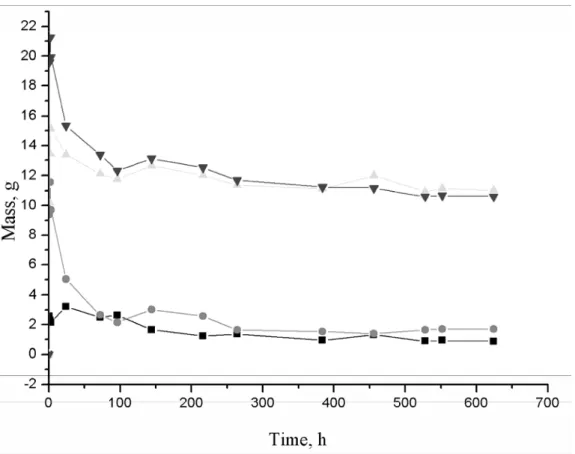
With the aim to investigate the influence of organic modification on adsorptive clay properties, dried clay composites/ethenyl acetate, with different mass percentages of clay, were soaked in 10 mL of distilled water. Additionally, the influence of temperature on the adsorptive properties of organoclay at temperatures of 4, 25 and 40 0C, was monitored. The adsorptive properties of organoclay were determined by measuring its mass at particular time intervals. The mass change of organoclay with the different mass percentages of clay at 4 0C in the particular time interval is represented in Fig. 2.
Fig. 2. Graph represents the mass change upon the adsorption of water using different weight percentages of clay at 4 °C (black line with 0 %, red line with 1 %, green line with 2 %, blue
line with 5 %)
___________________________________________________________________________
available to the clay surface. The higher water content in organoclay samples shows that modified organoclay is more hydrophilic than pure clay. The reason for this behavior is the formation of hydrogen bonds between the molecules of adsorbed water and present oxygen atoms in the monomer chain.
The time necessary to achieve equilibrium moisture content (Fig. 2) increases together with clay content. For example, a sample of pure clay (0 %) requires approximately 30 h to achieve equilibrium moisture content; meanwhile for the samples with 1, 2 and 5 % of clay, more than 250 h are required to achieve equilibrium moisture content. This means that clay plates do not allow adsorbed water molecules to penetrate. The adsorption of water molecules did not continue until the clay plates had become completely saturated with water. This explains why the time to achieve equilibrium moisture content increased with the increase of clay quantity in the samples of the composite with a higher clay quantity and higher number of plates.
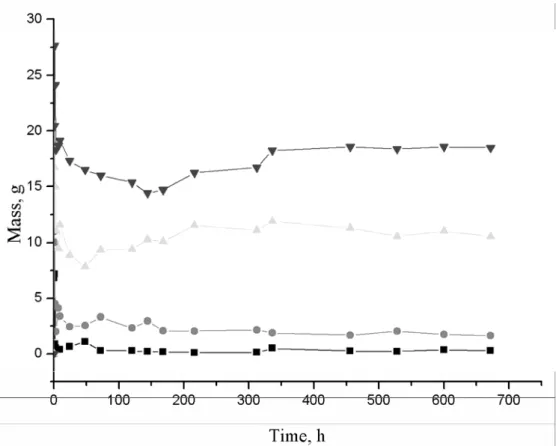
The influence of organic modification on the adsorptive properties of clay at room temperature was also determined (Fig. 3). As in the previous case, with an increase in the quantity of clay in the composite, water was adsorbed.
Fig. 3. Graphical representation of mass change upon the water adsorption with different weight percentages of clay at 25 °C (black line with 0 %, red line with 1 %, green line with
2 %, blue line with 5 %)
The time necessary to achieve equilibrium moisture content (Fig. 3) increased with an increase of the quantity of clay, except in the case of the composite with a 1 % mass percentage of clay, which behaved similarly to pure clay. It requires more time to achieve equilibrium moisture content at 25 0C (more than 300 h, for composites with a 2 and 5 % mass percentage of clay) than at 4 0C.
in the case of the composite with a 5 % mass percentage of clay.
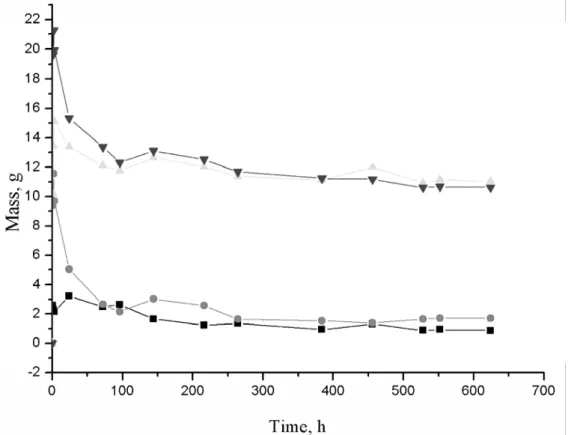
The adsorptive properties of organoclay were investigated at an elevated temperature (40 0C). As with the previous two temperatures (4 and 25 0C), with an increased quantity of clay in the composite (Fig. 4), comes an increase in water adsorption. Water adsorption from the composite, with a mass percentage of clay 1 and 2 % at a temperature of 40 0C, is approximately equal to the water adsorption at 25 0C. As in the case of the composite with a mass percentage of 5 % clay at 40 0C, the increase in mass is slightly less compared to the same composite which was set to a temperature of 4 and 25 0C. This shows the fact that the composite with a 5 % mass percentage at 40 0C is more hydrophobic compared to the rest of the composite samples.
Fig. 4. Graphical representation of mass change upon water adsorption with different weight percentages of clay at 40 °C (black line with 0 %, red line with 1 %, green line with 2 %, blue
line with 5 %)
The mass percentage of clay in the composite at 40 0C does not affect the time necessary to achieve the equilibrium moisture percentage (Fig. 4). In this case, for all investigated composite samples, it requires approximately 100 h, which are 2.5 i.e. 3 times lower than at 4 and 25 0C, respectively.
The results of the investigation of the effects of the organic modification of clay on adsorptive bentonite properties (Fig. 2, 3 and 4) show that clay modification produced organophilic clay properties (bentonite was converted into an effective water adsorbent).
3.4. Organic modification of bentonite clay using ethenyl acetate and Asepsol
___________________________________________________________________________
Genamine CTAC surfactant. In order to improve the adsorptive properties of organoclay, organoclay was incorporated into the gel of the following networked substances: Carbopol 940, Luviskol K30 and soy isolate-purine. The obtained composites’ structure was investigated applying FTIR spectroscopy, while the morphology of the composites was investigated using SEM.
3.5. Analysis of IR spectra
Infrared (IR) spectra of organoclay composites were incorporated into the gel of luviskole, carbopole and purine (1 and 2 %) (Fig. 5). IR Bands were identified from each spectrum and they were compared with the bands of natural bentonite.
a)
b)
d)
e)
f)
Fig. 5. IR spectra of organoclay composites with Luviskol of 1 % (A) i 2 % (B); with carbopole of 1 % (C) i 2 % (D); with purine of 1 % (E) i 2 % (F).
The addition of Luviskol K30 (1-ethenyl-2-pyrrolidone) into the obtained composite caused the appearance of new bands around 1662 cm-1, which is the result of stretching vibrations of the C=O bond. Also, new bands around 1480 cm-1 are visible from vibrations of the amide group. Significant differences in the absorption spectra between Luviskol K30 with a 1 % and 2 % weight percentage were not observed. Changes in the structure of the organoclay composite with Luviskole K30 compared to the natural bentonite show that this composite will have different properties as well, the demonstration of which is the objective of this work.
___________________________________________________________________________
with carbopole (Fig. 5), we can see that they are almost identical.
3.6. SEM analysis
For the investigation of the structure of the upper composite layers, a scanning electronic microscope JSM-5300 (Jeol, Japan) was used. In order to identify changes in composite structure, the sample of natural bentonite clay was recorded. From the obtained SEM record (Fig. 6), we can clearly see the layered clay structure and group of particles which vary in shape, magnitude and spatial abundance.
Fig. 6. SEM record of natural clay with the magnification 3500 times
The analysis of the SEM record of the dry organoclay composite (Fig. 6) shows the sample surfaces have a characteristic texture. However, it was confirmed that upon clay modification, inner damage did not occur, but rather its porosity increased, which can be observed using smaller magnification. Increased porosity is the result of an increase of the distances between clay layers, upon incorporation of the molecule surfactant and the monomer, which enables water molecules to more easily penetrate into the inner part of the composite. Using obtained SEM records with a higher magnification (10000 times) it can be observed that the organoclay composite has a compact and flat surface.
3.7. Removal of Pb2+ from the water systems using an organoclay composite
On the basis of an IR and SEM analysis, it was confirmed that after organic bentonite modification, the formation of composites, which were shown to be effective adsorbents, were produced.
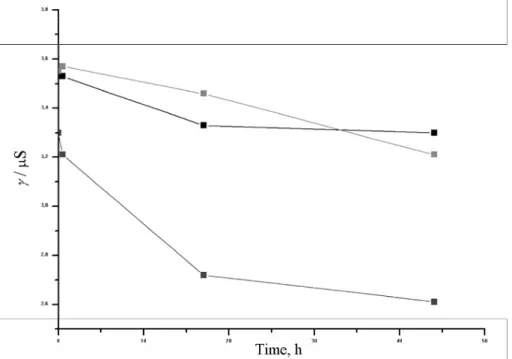
of the composite were analyzed on the basis of the value changes of the electrical conductivity of an aqueous solution of lead of a particular concentration, to which the appropriate content of the composite was added. At the beginning, the conductivity of the lead solution without the composite was measured, yielding a value of 3.54 μS. After the addition of the composite, a slight decrease of the value of electrical conductivity occurred in the first 15 h (Fig. 7), except in the case of the composite application with carbopole, when the value of the electrical conductivity drastically decreased. After this point till the end of the experiment (48 h), the value of the electrical conductivity decreased in all investigated cases. This change in conductivity was also confirmed by the application of a degree of turbidity to the aqueous system. After 1 h the turbidity of the sample with carbopole composite started to decrease slightly, but in the two other samples the decrease was observed after 18 h. After 48 h, the solutions had become almost transparent.
Fig. 7. Modified clay in the solution of lead(II) ethanoate (black line-modification with purine, red line-upon the addition of Luviksol, blue line-Carbopole modification)
The decrease of the value of the conductivity of the aqueous solution of lead shows that after some time, a decrease of Pb2+ concentration in an aqueous system, i.e. its adsorption in composite, occurs.
Because of its high specific mass, charge, the existance of a high number of macro, meso, micro and submicropores in its structure, and its high number of active surface centers, the composite material shows good adsorptive characteristics towards Pb2+ ions.
4. Conclusions
Bentonite clay was organically modified using the monomer ethenyl acetate. The exchange of inorganic intralayer cations of the clay was achieved using a cationic surfactant (Genamine CTAC).
An analysis of the IR spectra confirmed that the monomer was firmly associated with bentonite and put into its intralayer space.
___________________________________________________________________________
adsorptive properties of bentonite clay show that modification of the clay produces an organophilic clay surface. It was confirmed that by increasing the quantity of the clay in the composite, the adsorptive composite properties would also increase.
The comparison of the adsorption of organoclay at different temperatures drew us to the conclusion that the adsorption is significantly high at a temperature of 4 0C, except in the case of the composite with the 5 % clay weight.
After an analysis of IR spectra, it was confirmed that the addition of Luviskol K30 (1-ethenyl-2-pyrrolidone) into the obtained composite, caused the appearance of new bands around 1662 cm-1, which is the result of valence vibrations of the C=O bond. Also, new bands can be observed around 1480 cm-1 from valence vibrations of amide groups. Significant differences in the absorption spectra between Luviskol K30 with a 1 % and 2 % weight were not observed. The change in the structure of the composite of organoclay with Luviskol K30 in comparison with natural bentonite, show that this composite will have different properties as well.
Having compared the spectrum of organoclay with spectra of organoclay composites with carbopole and purine, we can conclude that they are almost identical.
An analysis of the SEM records of dry composites show that the sample surfaces have a characteristic texture. However, it was confirmed that by modifying the clay, inner damage did not occur, but rather its porosity increased, which can be observed upon slight magnification.
Using SEM records with higher amplification (10000 times) it was observed that the organoclay composite has a compact and flat surface.
Thanks to its high specific surface, charge, the existance of a high number of macro, micro and submicro pores in the structure of the composite, as well as a high number of active centers on its surface, the material shows good adsorptive characteristics towards Pb2+ ions, which was confirmed by the decrease of the value of the electrical conductivity.
Acknowledgements
Stanisa Stojiljkovic, Miodrag Stamenkovic, Milena Miljkovic, Ivana Savic and Ivan Savic were supported for this research with the project of Republic of Serbia (TR 34020), Danijela Kostic was funded with the project of Republic of Serbia (172047) and Biljana Arsic with the project of Ministry of Education and Science of Republic of Serbia (174007).
References
1. J.-Q. Jiang, C. Cooper, S. Quki, Chemosphere. 47 (2002) 711-716. 2. P. Liu, L. Zhang, Sep. Purif. Technol. 58 (2007) 32-39.
3. B. B. Basak, S. Pal, S. C. Datta, Curr. Sci. India. 102 (9) (2012) 1272-1278.
4. P. J. Flory, Principles of polymer chemistry, Cornell University Press, New York, NY, USA, 1967.
5. X. M. Ma, J. Elisseeff, Scaffolding in tissue engineering. CRC Press, Taylor and Francis, Boca Raton, FL, USA, 2006.
6. Y. Xi, R. L. Frost, H. He, Langmuir. 21 (2005) 8675-8680.
7. M. Vlasova, G. Dominguez-Patino, N. Kakozey, M. Dominguez-Patino, D. Juarez-Romero, Y. Enriquez-Mendez, Sci. Sinter. 35 (2003) 155-166.
8. S. Sonawane, P. Chaudhari, S. Ghodke, S. Phadtare, S. Meshram, J. Sci. Ind. Res. India. 68 (2009) 162-167.
10. A. Mockovciakova, Z. Orolinova, Chem. Technol. (Kaunas, Lith.). 1 (50) (2009) 47-50.
11. K. Cetin, W. D. Huff, Clay. Clay Miner. 43 (1995) 337-345. 12. S. Y. Lee, S. J. Kim, Colloids Surf. A. 211 (2002) 19-26. 13. S. Y. Lee, S. J. Kim, Clay. Clay Miner. 50 (2002) 435-445. 14. H. Vali, H. M. Koester, Clay Miner. 21 (1986) 827-859.
15. P. Fratzl, R. Weinkamer, Prog. Mater. Sci. 52 (2007) 1263-1334.
16. R. Radovic, M. Knezevic, Toxic metals in forest ecosystems of Serbia, Finegraf, Belgrade, 2002.
17. S. Goletic, Toxic metals in environment. University of Zenica, 2005.
18. J. Madejova, J. Bujadak, M. Janek, P. Komadel, Spectrochim. Acta, Part A. 54 (1998) 1397-1406.
19. J. Madejova, P. Komadel, B. Cicel, Clay Miner. 29 gold (1994) 319-326