Monitoring the physical processes
of sterilization in hospitals
in the state of Goiás*
O MONITORAMENTO DE PROCESSOS FÍSICOS DE ESTERILIZAÇÃO EM HOSPITAIS DO INTERIOR DO ESTADO DE GOIÁS
MONITOREO DE PROCESOS FÍSICOS DE ESTERILIZACIÓN EN HOSPITALES DEL INTERIOR DEL ESTADO DE GOIÁS
RESUMO
Estudo descritivo com o objetivo de iden-tificar a realização de controles físicos, quí-micos e biológicos dos processos de esteri-lização pelo vapor saturado sob pressão e em estufas de Pasteur em Centros de Ma-terial e Esterilização - CME. Os dados foram obtidos por meio de entrevista ao respon-sável pelo CME do maior hospital de todas as cidades do interior do Estado de Goiás, com número de habitantes igual ou superi-or a 20.000, no período de agosto de 2005 a junho de 2006. Participaram 44 municí-pios. Foi utilizado o programa SPSS, para análise. Em 31 (94,0%) hospitais não havia enfermeiros exclusivos no CME, os respon-sáveis eram técnicos e auxiliares de enfer-magem. A maioria não realizava os contro-les físicos, químicos e biológicos dos pro-cessos de esterilização e, em apenas um, esses eram realizados simultaneamente. O descumprimento da monitorização dos ci-clos de esterilização, impedindo a garantia da qualidade dos processos, representa ris-co à população assistida.
DESCRITORES Esterilização Infecção hospitalar Controle de qualidade
Almoxarifado Central Hospitalar Enfermagem
* Extracted from the thesis "Padrões arquitetônicos dos centros de material e esterilização de hospitais do interior do estado de Goiás e o processamento de artigos", Federal University of Goiás, Nursing School, Graduate Program, 2006. 1 RN. PhD in Nursing. Associated Professor, Federal University of Goiás,
Nursing School. Coordinator of the Center of Studies and Research in Health Care-Associated Infections. Goiânia, GO, Brazil. [email protected]
2 RN, Federal University of Goiás, Nursing School. Goiânia, GO, Brazil. [email protected] 3SSC in nursing, Federal University of Goiás, Nursing
School. Nurse at the Hospital das Clinicas at Federal , University of Goiás. Goiânia, GO, Brazil. [email protected] 4SSC in nursing, Federal
University of Goiás, Nursing School. Nurse at the Hospital das Clinicas at Federal University of Goiás. Professor, Federal University of Goiás, School of Nursing.
O
RIGINAL
A
R
TICLE
Anaclara Ferreira Veiga Tipple1, Francine Vieira Pires2, Simone Vieira Toledo Guadagnin3, Dulcelene de Sousa Melo4
ABSTRACT
The objective of this descriptive study was to identify the physical, chemical and bio-logical controls of the sterilization process by saturated steam in Pasteur autoclaves at Material and Sterilization Centers (MSC). The data was obtained by interviewing the worker responsible for the MSC of the larg-est hospital in every city in the interior of Goiás that had population of at least 20,000, in the period from August 2005 to June 2006. A total 44 municipalities partici-pated. The analysis was performed using SPSS software. In 31 (94.0%) hospitals there were no nurses exclusive to the MSC, the workers responsible for the center were nursing aides and technicians. Most did not perform any physical, chemical and biologi-cal control of the sterilization process, and, in one case only these controls were per-formed simultaneously. Failing to monitor the sterilization cycles, and thus not ensur-ing the quality of the processes, is a risk to the population being assisted.
DESCRIPTORS Sterilization Cross infection Quality control Central Supply, Hospital Nursing
RESUMEN
Estudio descriptivo que objetivó identificar la realización de controles físicos, químicos y biológicos de procesos de esterilización por vapor saturado bajo presión y en estu-fas de Pasteur en Centros de Material y Es-terilización - CME. Datos obtenidos median-te entrevistas a responsables de CME del mayor hospital de todas las ciudades del interior del estado de Goiás, con número de habitantes mayor a 20.000, en período de agosto 2005 a junio 2006. Participaron 44 municipios. Se utilizó el programa SPSS para el análisis. En 31 (94%) hospitales no había enfermeros exclusivos en el CME, los responsables eran técnicos y auxiliares de enfermería. La mayoría no realizaba contro-les físicos, químicos y biológicos de los pro-cesos de esterilización y, en apenas uno, estos eran realizados simultáneamente. El incumplimiento del monitoreo de los ciclos de esterilización, impidiendo la garantía de calidad de procesos, representa un riesgo para la población atendida.
DESCRIPTORES Esterilización Infección hospitalaria Control de calidad
INTRODUCTION
Infections related to health delivery are complications that arise from diagnostic and therapeutic procedures and represent one of the main problems in quality of care. These can be classified as endogenous when the causative agents are present in the individual him/herself and as exogenous when microorganisms come from the external environment(1).
Controlling exogenous infections related to health ser-vices depends on the prevention practice of professionals in the field in relation to a series of measures such as the reprocessing of dental-medical-hospital material, which is an important measure of anti-infectious protection and in-cludes validation and monitoring of all stages(1).
The validation of sterilization depends on a set of vari-ous stages called ‘qualification’, with certification of the suitability of these parameters. Among these is the vali-dation of the performance of the sterilizing device that is accomplished by physical, chemical and
biological controls, the purpose of which is to ensure that the probability of survival of microorganisms is below 10-6(2-3).
The survival of microorganisms after sterilization can result from human and/or mechanical failure. The regular monitoring of the process is an integral part of the fac-tors that avoid such failures that can inter-fere in sterilization efficiency(3).
All dental-medical-hospital material should be in a safe condition (be repro-cessed before the next use) and be free of viable microorganisms, minimizing the risk of infectious iatrogenies(1-3).
The type of reprocessing depends on the potential risk of transmission of microorganisms to the patient through the material used. Material considered critical is that which comes into direct contact by invasive procedures with sites considered sterile. Sterilization is recommended for criti-cal material(2-4).
Sterilization is the process by which all forms of mi-crobial life are destroyed such as fungus, viruses, and bac-teria in vegetative and spore forms and can be performed by physical, chemical and physical-chemical means. The physical processes include sterilization by saturated steam under pressure and dry heat – Pasteur’s oven(2-3).
Sterilization by saturated steam under pressure is per-formed in autoclaves and its principle of destroying micro-organisms includes the combined action of time, tempera-ture, pressure and humidity, which promotes thermo-co-agulation and denaturation of proteins from their cellular genetic structure. There are also gravity and pre-vacuum autoclaves(5).
Dry heat sterilization is performed by a gravity or me-chanical convection oven. An oven is an electrical appara-tus that propagates dry heat, has low penetrating power, where sterilization occurs in an irregular and slow manner. Destruction of microorganisms occurs through cellular oxi-dation and desiccation(2,4).
Ensuring safety while reprocessing dental-medical-hos-pital material is an important measure in controlling infec-tions associated with health care. The chain of transmis-sion of microorganisms can be interrupted through steril-ization. However, for sterilization to be effective one needs to have knowledge and properly perform each phase of this reprocessing: cleansing, drying, preparation, steriliza-tion itself and storage(6-8). From this perspective, efforts have
been made toward the construction of quality indicators concerning the structure, process and results of steriliza-tion, seeking to measure each of these stages(3,6).
Since the infectious process depends on various fac-tors, specifically identifying failures in the sterilization of material as the causal factor of infections is difficult, however, there are mechanisms to rule out this potential source through quality control of each stage from cleansing to ensuring the efficiency of the sterilization cycle(1-3,6).
Sterilization monitoring should encom-pass physical, chemical and biological evalu-ations of the sterilization process. Physical control includes the monitoring of critical parameters of each process through manual recording or by a printer connected to the sterilizer. Different indicators and integrators of chemical control are available on the market in different presentations. Biological indicators are characterized by a standard-ized preparation of bacterial spores designed to produce suspensions with 105 to 106 spores per unit of paper filter.
Bacterial species differ according to the sterilization pro-cess. There are first, second and third generations of indi-cators(1-3).
Considering the complexity and importance of controls to ensure the quality of the sterilization processes as well as its contribution to prevent and control infections, this study intends to provide a situational diagnosis concern-ing these indicators. Identifyconcern-ing the status of this context will ensure the quality of the processes both at an institu-tional level and in terms of health inspection.
OBJECTIVE
To identify the physical, chemical and biological con-trols performed in sterilization by saturated steam under pressure and dry heat (Pasteur’s oven) in the Sterilization and Supply Centers (SSC) of hospitals in the cities in the interior of Goias, Brazil.
for sterilization to be effective one needs to
have knowledge and properly perform each
phase of this reprocessing: cleansing, drying,
preparation, sterilization itself
METHOD
This descriptive study was carried out in all the cities in the interior of Goias, GO, Brazil with a population equal to or greater than 20,000 inhabitants. A total of 45 cities were considered eligible according to data provided by the Bra-zilian Institute of Geography and Statistics (IBGE)(9). One
hospital was selected in each city, the one with the great-est number of beds.
The project was approved by the Ethics Committee for Medical Human and Animal Research of the General Hos-pital of Goiania, protocol nº 110/05. The population was composed of the technical supervisors of the SSC of the hospitals registered in the DATASUS(10). Data were collected
through interviews following a structured script, which was held with the technical supervisors of each SSC from Au-gust 2005 to June 2006. The facilities’ directors and techni-cal supervisors signed free and informed consent forms according to Resolution 196/96(11). Data collection was
car-ried out by one of the researchers in each city.
The script contained data characterizing the institutions, technical supervisors and information on the physical meth-ods of sterilization and physical, chemical and biological tests for control quality used by the hospitals concerning types, periodicity and records forms.
The Statistical Package for Social Sciences (SPSS) ver-sion 16.0 was used for data analysis. Data were presented in tables and figures and descriptive statistics was used to present measures of simple frequency.
RESULTS AND DISCUSSION
Of the 45 eligible hospitals, 44 were included in the study. The hospital in one city was being re-built. No nurses were available in 11 (25.0%) facilities; 31 (94.0%) out of the 33 (75.0%) facilities that had nurses available, did not have exclusive nurses for the SSC and nursing technicians and auxiliaries were those responsible for the unit; only two (6.0%) facilities had nurses assigned exclusively to the SSC.
Reprocessing of material performed by non-qualified personnel may compromise its quality. The responsibility for the SSC, its maintenance, validation and control of the routine of sterilization methods should be designated to a properly qualified person(2). Hence, the presence of a nurse
exclusively dedicated to the SSC is extremely important(2).
It is worth noting that the SSC is essentially composed of the nursing team workforce, with the exception of workers for administrative support, hygiene and cleansing. There-fore, according to the Federal Council of Nursing, law Lei n° 7.498(12), nurses should supervise the staff.
A study performed in 74 public and private hospitals, from medium to large, in the city of São Paulo, SP, Brazil, identi-fied that there was a nurse responsible for the SSC(13) in 95.9%
of the cases. An inverse situation of that found in this study. The validation of sterilization methods also depends on the human element, which should be trained to properly per-form the stages of material reprocessing(2,4,14). Professionals
who graduated from high school are apt for the technical activities inherent to the process but it is recommended they be under the direct coordination and supervision of a nurse who should respond quality control issues(1,2).
The sterilization methods adopted in the hospitals are described in Table 1. Most (97.8%) used sterilization in autoclaves, the method of choice for critical material be-cause it fills in the operational requirements of suitability, time, cost and safety. However, Pasteur’s oven was also adopted in 15 hospitals and it is a method that tends to disappear given technical advancements and operational difficulties, aspects that should be observed since they in-terfere in the material’s final quality(2-4,).
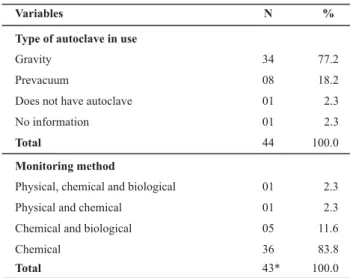
Table 2 shows the characterization of autoclaves and the monitoring methods used for this equipment.
Table 1 – Physical methods of sterilization used for reprocessing material in hospitals in the cities of the interior of Goias, GO, Brazil – 2006
Sterilization methods N %
Autoclave 29 66.0
Autoclave and oven 14 31.8
Oven 01 2.2
Total 44 100.0
Note: (n = 44)
*One hospital had no autoclave. Note: (n = 44)
Variables N %
Type of autoclave in use
Gravity 34 77.2
Prevacuum 08 18.2
Does not have autoclave 01 2.3
No information 01 2.3
Total 44 100.0
Monitoring method
Physical, chemical and biological 01 2.3
Physical and chemical 01 2.3
Chemical and biological 05 11.6
Chemical 36 83.8
Total 43* 100.0
Table 2 – Characterization of the sterilization process by saturated steam under pressure in hospitals in cities of the interior of Goias, Go, Brazil – 2006
in-formation was not reported in another. A gravity autoclave removes oxygen by gravity because the steam injection in the chamber forces cold air to exit through a valve located in its low portion. Time of sterilization is longer and there is a greater chance of the formation of bulbs inside the package, interfering with the quality of sterilization(1-2).
Pre-vacuum steam autoclaves have a vacuum pump that removes air from the chamber and from the material through one or three pulsating cycles, which better allows steam to penetrate into the packages. Time of exposure, sterilization and drying are reduced when compared to the gravity autoclave(2-4). The pre-steam system is recommended
given the improved conditions it offers for the sterilization cycles, and, consequently, for the final process.
In relation to monitoring, data found in this study are of concern, since only one (2.3%) hospital simultaneously performed physical, chemical and biological controls. Most (36/83.8%) used only chemical controls.
Physical, chemical and biological controls are part of the qualification and monitoring of performance, to check whether the conditions of a given sterilization process ac-tually ensure the method’s effectiveness and efficiency(1).
Isolated chemical control (different classes) is not satisfac-tory to ensure the sterilization process’s effectiveness. Simi-lar data were found in a study investigating Health Units in Goiania, GO, Brazil, which also found a predominance of a class 1 chemical indicator in the autoclaves of dental ser-vices(15). Another study showed that 96.0% of the hospitals
in the Southeast of São Paulo used biological indicators and 47.3% also used chemical indicators(13).
In relation to physical monitoring, only one (2.3%) ser-vice properly performed it; records were sent to the equipment’s printer (Table 3).
Records concerning the required parameters for the sterilizing method should be kept. Saturated steam under pressure includes temperature, time and pressure (prefer-ably automatically taken). If the sterilizer has no printer connected, this record should be manually noted every minute and is a document used for legal purposes(1-4). It is
worth keeping in mind that mechanical failures that pre-vent the process may occur during the cycle and these can be verified by simply systematically consulting these pa-rameters. The costs incurred for the hospital are linked to human resources, which reiterates the importance of moni-toring physical parameters during cycles.
Periodical preventive and/or corrective maintenance is also recommended and the problem and solution adopted should be recorded(2). Only 13 (30.3%) facilities performed
preventive and corrective maintenance and most (69.7%) performed only corrective maintenance, indicating that maintenance on equipment was only performed when the equipment was no longer working.
There are however different preventive procedures to be performed daily, weekly, and biweekly, varying accord-ing to the procedure. Preventive maintenance should oc-cur daily, weekly, and biweekly such as conoc-current clean-ing of the chamber, lubricatclean-ing the trim, cleanclean-ing the cham-ber with a product for rust removal, respectively, accord-ing to the manufacturer’s recommendations. These tasks can be performed by a nursing technician qualified for the task while monthly and annual procedures should be per-formed by a specific and able professional(4). Monthly
pre-ventive maintenance was reported by six (46.2%) hospitals.
Table 4 presents the chemical and biological indicators used in autoclaves and steam by the hospitals.
Table 3 – Physical indicators used in the reprocessing of material by saturated steam under pressure in hospitals of cities in the inte-rior of Goias, GO, Brazil – 2006
Note: (n = 43)
Variables N % Monitoring of physical parameters
Yes 01 2.3
No 42 97.7
Total 43 100.0
Autoclave maintenance
Corrective 30 69.7
Preventive and corrective 13 30.3
Total 43 100.0
Frequency of preventive maintenance
Monthly 06 46.2
Biannual 03 23.0
Biweekly 01 7.7
Bimonthly 01 7.7
Quarterly 01 7.7
Occasionally 01 7.7
Total 13 100.0
Table 4 – Chemical and biological indicators used by hospitals in the cities of the interior of Goiás to evaluate the saturated steam under pressure sterilization – Goiania, GO, Brazil - 2006
* Eight hospitals had prevacuum autoclave Note: (n = 43)
Chemical indicators
Class I – thermochromic tape 43 100.0
Class II – Bowie-Dick* test (n=8)
Yes 03 37.5
No 05 62.5
Biological Indicators
Yes 07 16.3
No 36 83.7
Frequency
Monthly 04 57.1
Weekly 01 14.3
4 to 6 months 01 14.3
Monthly and when there is a surgery with infection 01 14.3
Chemical monitoring should be performed by indica-tors and integraindica-tors that undergo chemical and physical changes when exposed to a sterilization process, evaluat-ing one or more parameters of the process, aimevaluat-ing to inter-nally and exterinter-nally control the package to be sterilized. These are essential to monitor failures and constitute an instrument to ensure the quality of the process(1-4).
Six classes of chemical indicators are currently available: Class I (process indicators) whose function is to identify and differentiate the material to be processed from those that were not processed (thermochromic tape); Class II – the Bowie & Dick test (indicator for use in a specific test) the purpose of which is to test the efficacy of the vacuum sys-tem in the pre-vacuum autoclave, detecting failures in the vacuum pump’s functioning and consequently the presence of residual air; Class III (single parameter indicators) is des-ignate to react to a specific parameter; Class IV (multipara-metric indicators) responds to one or more critical param-eters; Class V (integrator indicators) reacts to all critical pa-rameters in the sterilization process; Class VI (simulation/ emulator indicators) monitors all the critical parameters of the sterilization process, and does not react until approxi-mately 94% of the cycle is concluded. To use this integra-tor, the user has to associate the parameters of the steril-izer to the specifications of a given Class VI integrator(1-4).
The use of thermochronic tape (class I) was reported by all the services that had an autoclave. The tape’s function is to discriminate between reprocessed and non-reprocessed material, though its isolated use is inefficient to ensure the quality of saturated steam under pressure. The Bowie and Dick test (class II) was used in three hospitals, that is, less than half used pre-vacuum autoclaves. Of those using it, two adopted the daily frequency recommended by the Ministry of Health(4). This test presents a very positive cost-benefit
relation and is extremely important as an indicator in the steam sterilization process. The test, recommended to be used in the first load in the morning after the equipment is heated, shows the presence of residual air in the chamber. The equipment should not be used when the test indicates positive, because air is a barrier to steam(1-3).
Most (83.7%) of the hospitals did not use a biological indicator and among those (16.3%) that did, the second-generation test was used and only one hospital adopted the recommended minimum weekly frequency. The test should be performed with every load containing implant-able material(2-4).
The biological indicator consists of one standardized pre-paration of bacterial spores engineered to produce suspen-sions containing 106 spores per unit of filter paper. The method
ensures that the set of all sterilization critical parameters is appropriate, because the microorganisms are directly tested for growth after the application of the process(1-3). Thus, the
data found in this study are of concern, since a minority of hospitals performed biological monitoring
The Pasteur’s oven is not a first-choice piece of equip-ment for the physical sterilization of dental-medical-hospi-tal material(2-4). The parameters that determine the quality
of sterilization in this method are: relationship between time/temperature, use of adjunct thermometer, putting a small quantity of material inside the wrappers, not surpass-ing 2/3 of the chamber’s capacity, correctly dispossurpass-ing of boxes inside the chamber, keeping the door close during the entire cycle, performing chemical and biological moni-toring with Bacillus atrophaeus and, preventive mainte-nance(1-2,4,6). Data concerning the use of this equipment are
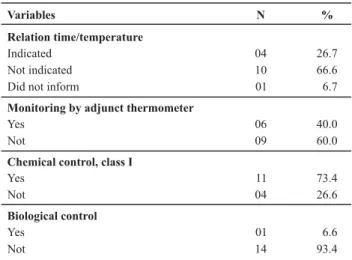
described in Table 5.
Table 5 – Variables of the sterilization process in ovens in hospitals in cities in the interior of Goias, GO, Brazil - 2006
Note: (n = 15)
Relation time/temperature
Indicated 04 26.7
Not indicated 10 66.6
Did not inform 01 6.7
Monitoring by adjunct thermometer
Yes 06 40.0
Not 09 60.0
Chemical control, class I
Yes 11 73.4
Not 04 26.6
Biological control
Yes 01 6.6
Not 14 93.4
Variables N %
Non-recommended practices predominated in relation to time/temperature. The values recommended by the Ministry of Health for dry heat sterilization are 170°C for one hour of exposure or 160°C for two hours(7). This
rela-tion is essential for ensuring efficacy of the cycle, noting that timing of exposure should begin only when a given temperature is reached; time spent to heat the equipment should not be taken into account(1,7). A study conducted in
101 dental offices in the central region of Goiania concluded that intervenient factors with greater significance related to sterilization failures were: not complying with the time/ temperature ratio recommended for the sterilization cycle and the absence of an adjunct thermometer to control the temperature of the cycles, aspects ratified in microbiologi-cal tests that were positive in 46 (45.5%) of the evaluated cycles(16). Similar data were found in other studies that
evalu-ated sterilization in Pasteur’s ovens in dental offices(17-18).
The use of an adjunct thermometer is essential to de-termine the temperature, which in this study was used only by a minority (40.0%). Temperatures taken from two differ-ent thermometers diverge because the thermometer in the device shows a temperature higher than that reached within the load; the reason is that the device’s thermometer is closer to the equipment’s electrical circuits(1,7). These
A study carried out in Canoas, RS, Brazil in 27 dental offices revealed that an adjunct thermometer was used in 24 (88.9%) offices, which shows better sterilization control when compared to data from this investigation(19).
Chemical indicators specific for monitoring the Pasteur’s oven are: Class I (thermo-chromic tape for external use) and class IV (tape indicating the internal use turning after five minutes after reaching temperature of 170°C). These indicators do not prove sterilization occurred but provide evidence as to functioning problems in the equipment(1-4).
The use of a chemical indicator (class I) predominates in the use of ovens.
Bacillus atrophaeus are used for monitoring the biologi-cal process of dry heat sterilization. These indicators should be used in ovens at the time they are installed, weekly and after each corrective and preventive maintenance task. The indicators check whether the materials were successfully sterilized, which is indicated by the death of all spores in the biological indicator used to test(1-4).
The biological indicators available in the market specific for Pasteur’s oven are paper strips inoculated with spores – first generation indicators with a definitive reading after seven days(1). In this study, only one service performed biological
monitoring in the ovens weekly. Studies show a low level of adherence to chemical and biological monitoring methods in the process of oven sterilization(16-17,20).
CONCLUSION
This study leads to the conclusion that most of the hos-pitals did not follow physical, chemical and biological con-trol of the sterilization cycles in autoclaves by saturated steam under pressure. Class I chemical indicators were pre-dominant in Pasteur’s ovens. Only one hospital performed physical, chemical and biological control simultaneously.
The low valorization of physical parameters draws one’s attention. Such parameters can be considered primary
for monitoring the equipment functioning both in relation to the maintenance of equipment and to parameters of ster-ilization cycles. Only one hospital recorded the physical monitoring (temperature, pressure, time) in all the cycles and verified the performance of only corrective mainte-nance of autoclaves. For the ovens, the monitoring condi-tions are even worse, since most hospitals adopted a non-recommended relation between time and temperature and there was a low level of use of adjunct thermometers to measure the temperature.
Despite all the technology available for quality control in reprocessing material, human resources are those respon-sible for appropriate compliance of all the operational stages. Some situations, such as performing physical con-trol by monitoring sterilization parameters, depend exclu-sively on human resources for successful completion, both at the managerial and care levels. Hence, the importance of having an exclusive nurse for the SSC who is responsible for monitoring reprocessing quality becomes apparent. A nurse assigned exclusively to the SSC, though, was found in only two hospitals. Moreover, it shows the need for nurses to be appropriately qualified to deal with the complexity of an SSC.
The absence of a nurse in 25% of the hospitals means that technical supervisors (nursing technicians and auxilia-ries) worked without even an indirect supervision of nurses. The lack of a qualified nurse to coordinate SSC is evidenced throughout this study when technical supervisors were not able to provide information requested, revealing a lack of knowledge, which actually became a limitation of this study. It is worth noting that failures in sterilization control can reflect on the quality of care delivery; these failures repre-sent a risk factor for infections.
The results of this study are expected to support edu-cational and surveillance actions for safe practice in repro-cessing materials, while the greatest recipients of such qual-ity are the clients and then, by extension, medical profes-sionals and facilities.
REFERENCES
1. Cunha AF, Miranda AMF, Rodrigues CT, Daú GL, Lech J, Possari JF, et al. Recomendações práticas para processos de esteriliza-ção em estabelecimentos de saúde: guia elaborado por enfer-meiros brasileiros. São Paulo: Komedi; 2000.
2. Sociedade Brasileira de Enfermeiros de Centro Cirúrgico, Recu-peração Anestésica e Centro de Material e Esterilização
(SOBECC). Manual de Práticas Recomendadas da SOBECC.5ª
ed. São Paulo; 2009.
3. Padoveze MC, Graziano KU, organizadoras. Limpeza, desinfec-ção e esterilizadesinfec-ção de artigos em unidades de saúde. São Pau-lo: APECIH; 2010.
4. Brasil. Ministério da Saúde. Secretaria de Assistência à Saúde. Coordenação Geral das Unidades Hospitalares Próprias do Rio de Janeiro. Orientações gerais para Central de Esterilização. Brasília; 2001.
6. Graziano MK, Lacerda RA, Turrini RNT, Bruna CQM, Silva CPR, Schmitt C, et al. Indicators for evaluation of processing dental-medical-hospital supplies: elaboration and validation. Rev Esc Enferm USP [Internet]. 2009 [cited 2009 Oct 10];43(n.esp 2):1174-80. Available from: http://www.scielo.br/pdf/reeusp/ v43nspe2/en_a04v43s2.pdf
7. Brasil. Ministério da Saúde. Coordenação de Controle de In-fecção Hospitalar. Processamento de artigos e superfícies em estabelecimentos de saúde. 2ª ed. Brasília; 1994.
8. Brito MFP, Galvão CM, Françolin L, Rotta CSG. Validação do pro-cesso de esterilização de artigos médico-hospitalares segundo diferentes embalagens. Rev Bras Enferm. 2002;55(4):414-9. 9. Instituto Brasileiro de Geografia e Estatística (IBGE). Cidades
[Internet]. Rio de Janeiro; 2005 [citado 2009 out. 10]. Disponí-vel em: http://www.ibge.gov.br/cidadesat/default.php
10. Brasil. Ministério da Saúde. DATASUS [Internet]. Brasília; 2009 [citado 2009 out. 10]. Disponível em: http://www.datasus.gov.br 11. Conselho Nacional de Saúde. Resolução n.196, de 10 de ou-tubro de 1996. Dispõe sobre diretrizes e normas regulamen-tadoras de pesquisas envolvendo seres humanos. Bioética. 1996;4(2 Supl):15-25.
12. Brasil. Lei n. 7.498, de 25 de junho de 1986. Dispõe sobre a regulamentação do exercício da enfermagem e dá outras pro-vidências. Diário Oficial da União, Brasília, 26 jun. 1986. Se-ção 1, p. 1.
13. Pinter MG. Validação do processo de esterilização a vapor saturado sob pressão em hospitais do Município de São Pau-lo [dissertação]. São PauPau-lo: Escola Paulista de Medicina, Uni-versidade Federal de São Paulo; 2001.
14. Oliveira TN. Esterilização com qualidade assegurada. Rev SOBECC. 1999;4(4):10-1.
15. Tipple AFV, Souza ACS, Nakatani AYK, Carvalho MVC, Faria RS, Paiva EMM. O processamento de artigos odontológicos em Centros de Saúde de Goiânia. Rev ROBRAC. 2005;14(37):15-20.
16. Tavares SSF, Sousa JT, Tipple AFV, Souza ACS, Pimenta FC, Anders PS. Eficácia da estufa de Pasteur como equipamento esterili-zante em consultórios odontológicos. Rev Esc Enferm USP. 2008;42(1):160-7. DOI: 10.1590/S0080-62342008000100021 17. Moreira AC, Rasquin OM. Controle de qualidade da
esterili-zação através do calor seco em estufas de consultórios odontológicos. Rev Fac Odontol Univ Fed Bahia. 2003;26(1):11-3.
18. Prado MEM, Santos SSF. Avaliação das condições de esterili-zação de materiais odontológicos em consultórios na cidade de Taubaté. Rev Biociênc. 2002;8(1):61-70.
19. Vier FV, Lopes AS, Sommer K, Oliveira EPM, Limongi O. Moni-toramento da temperatura de estufas odontológicas empre-gadas para a esterilização do instrumental. Odontologia Clín Científ. 2003;2(2):103-8.
20. Tipple AFV, Souza ACS, Paiva EMM, Pereira MS, Moriya TM. Processamento de artigos em uma instituição de ensino odontológico: discutindo a qualidade. Rev SOBECC. 2004;9 (3): 14-7.