ORIGINAL
RES
EAR
CH
Correspondence to: Célio Marcos dos Reis Ferreira – Clínica Escola de Fisioterapia, Campus JK, Universidade Federal dos Vales do Jequitinhonha e Mucuri, Rodovia MGT 367, km 583, 5000 – CEP: 39100-000 – Diamantina (MG), Brazil – E-mail: [email protected]
Presentation: Aug. 2013 – Accepted for publication: Aug. 2014 – Financing source: none – Conflict of interests: nothing to declare – Approval at the Animal Ethics Committee n. 08/2009.
ABSTRACT | Transcutaneous electric nerve stimulation
is a noninvasive method used in clinical Physiotherapy to control acute or chronic pain. Different theories have been proposed to explain the mechanism of the analgesic action of transcutaneous electric nerve stimulation, as the partici-pation of central and peripheral neurotransmitters. The aim of this study was to evaluate the involvement of noradren-ergic pathway and of the receptors alfa-2 and beta in the modulation of analgesia produced by transcutaneous elec-tric nerve stimulation of high and low frequency in Wistar rats after chronic treatment with propranolol or yohimbine intraperitoneally. Animals weighing 200 to 300 g were divided into 9 groups (n=8), which were obtained nocicep-tive thresholds through the Tail Flick before and after applica-tion of TENS for comparing the change of pain. The admin-istration of yohimbine or propranolol at a dose of 3 mg/kg was effective in antagonizing the analgesia induced by high
Evaluation of the noradrenergic pathway and
alpha-2 and beta-receptors in the modulation of the
analgesia induced by transcutaneous electric nerve
stimulation of high and low frequencies
Avaliação da via noradrenérgica e dos receptores alfa-2 e beta na modulação da
analgesia induzida pela estimulação elétrica nervosa transcutânea de alta
e de baixa frequência
Evaluación de la vía noradrenérgica y de los receptores alfa-2 y beta en la modulación
de analgesia inducida por la estimulación eléctrica nerviosa transcutánea con
alta y baja frecuencia
Thiago Henrique Ferreira Vasconcellos1, Patricia de Fátima Pantaleão1, Dulcinéa Gonçalves Teixeira1,
Ana Paula Santos2, Célio Marcos dos Reis Ferreira2
Study conducted at the Neuropsychopharmacology Laboratory of Centro Universitário de Patos de Minas (UNIPAM) – Patos de Minas (MG), Brazil.
1UNIPAM – Patos de Minas (MG), Brasil..
2Physical Therapy Department of Universidade Federal dos Vales do Jequitinhonha e Mucuri (UFVJM) – Diamantina (MG), Brasil.
(150 Hz) and low (10 Hz) frequency transcutaneous elec-tric nerve stimulation according to ANOVA test followed by Duncan post hoc test (p<0.05). Thus, it is suggested the involvement of alpha-2 and beta noradrenergic receptors in the modulation of transcutaneous electric nerve stimu-lation-induced analgesia.
Keywords | Pain; Yohimbine; Propranolol/therapeutic use; Transcutaneous Electric Nerve Stimulation; Rats, Wistar.
RESUMO | Estimulação elétrica nervosa transcutânea é um
INTRODUCTION
Pain is present in all the vital cycle of human beings. Lead by great scientiic curiosity, it spans psychic and somatic aspects. Although unpleasant and stressful1, it acts as a
protection for the organism2. However, when its vital
pro-tection functions are surpassed, it may seriously compro-mise quality of life, and bring damages to daily activities3.
Transmission of the painful stimulus as well as its inhibition involves multiple mechanisms4. Pain
sensa-tion may be modiied by pain inhibitory endogenous sys-tems, predominantly through the descending pathways of noradrenaline, serotonin, and endogenous opioids4,5. he locus coeruleus, an important nucleus of the noradrenergic brainstem, is involved in the descending control of noci-ceptive pathways6,7. Catecholamine receptors are
classi-cally divided into two main categories: alpha and beta adrenoceptors, and the nociceptive efect of noradrenaline is mainly mediated by alpha-2-adrenoceptors4,8.
Many techniques have been used, alone or in asso-ciation with medicine, to provide analgesia to the patient, such as the low-level laser therapy9,
acupunc-ture10, and transcutaneous electrical nerve stimulation
(TENS)11. TENS is a non-pharmacological,
noninva-sive, of easy use and relatively few counter-indications resource that is already known in the modulation of acute and chronic pain4,12,13.
Among the countless resources used, TENS and its chemical components of the human body like nor-adrenaline may be an important new mean to relieve very intense and frequent pains, providing an improve-ment in patients’ quality of life. Studies about the rela-tion between TENS and adrenergic receptors14-17 are
rare and contradictory.
he present paper aimed at assessing the participa-tion of the noradrenergic pathway and its respective receptors — alpha-2 and beta — in the modulation of analgesia induced by TENS in Wistar rats after treat-ment through the intraperitoneal pathway (IP) with yohimbine (alpha-2-receptor antagonist) and propanol (beta-receptor antagonist).
METHODOLOGY
Animals
Rats from the Wistar line that weighed 200 to 300 g, originated from the vivarium, were used. he animals were grouped in numbers of four inside the polypropyl-ene boxes, exposed to a 12-hour light-dark cycle with a mean temperature of 22 to 24oC; they also had free access to food (“Nuvilab” rat food) and water throughout
induzida pela estimulação elétrica nervosa transcutânea de alta e baixa frequência em ratos Wistar, após tratamento crônico com ioimbina ou propranolol por via intraperitoneal. Animais pesando entre 200 e 300 g foram divididos em 9 grupos (n=8), dos quais se obteve os limiares nociceptivos por meio do Tail Flick antes e após a aplicação da estimulação elétrica nervosa transcutânea para comparação de mudança do quadro álgico. A administração de ioimbina ou de propranolol na dose de 3 mg/kg foi efetiva em causar uma antagonização da analgesia induzida pela estimulação elétrica nervosa transcutânea de alta (150 Hz) e baixa frequência (10 Hz) segundo teste ANOVA seguido do teste post hoc Duncan (p<0,05). Dessa forma, sugere-se o envolvimento de receptores noradrenérgicos alfa-2 e beta na modulação da analgesia induzida pela estimulação elétrica nervosa transcutânea.
Descritores | Dor; Ioimbina; Propranolol/uso terapêutico; Estimulação Elétrica Nervosa Transcutânea; Ratos Wistar.
RESUMEN | La estimulación eléctrica nerviosa transcutánea es un método no invasivo utilizado en la clínica de Fisioterapia para controlar el dolor agudo y crónico. Diversas teorías son propuestas para expla-nar el mecanismo de acción analgésico de la estimulación eléctrica
nerviosa transcutánea, como la participación de neurotransmisores centrales y periféricos. El objetivo del presente estudio fue evaluar la participación de la vía noradrenérgica y de los receptores alfa-2 y beta en la modulación de analgesia inducida por la estimulación eléctrica nerviosa transcutánea con alta y baja frecuencia en ratos del tipo Wistar, después del tratamiento crónico con yohimbina o propranolol por la vía intraperitoneal. Animales que pesaban 200 y 300 g fueron divididos en nueve grupos (n=8), por los cuales fueron obtenidos los umbrales nociceptivos por medio del Tail Flick, antes y después de la aplicación de la estimulación eléctrica nerviosa transcutánea con el intuito de comparar la alteración del cuadro álgico. La administración de yohimbina o propranolol en el dosis de 3 mg/kg fue eficaz en resultar en una antagonización de anal-gesia inducida por la estimulación eléctrica nerviosa transcutánea con alta (150 Hz) y baja (10 Hz) frecuencia, de acuerdo al test de ANOVA seguido del test post-hoc de Duncan (p>0,05). Por lo tanto, se sugiere el envolvimiento de los receptores noradrenergicos alfa-2 y beta en la modulación de analgesia inducida por la estimulación eléctrica nerviosa transcutánea.
the experimental period. After the end of experiments, the animals were sacriiced with lethal injection of xyla-zine chloride and ketamine (100 and 375 mg/kg respec-tively). All experiments were performed following the ethical principles of the Ethics Commission in Animal Experimentation and following those adopted by the Brazilian College of Animal Experimentation – COBEA (approval protocol number 08/2009).
Animals were divided into nine groups (n=8). Control Groups (1) and (2) – treated with 0.9% physiological saline solution (NaCl), low and high frequency TENS respectively; Experimental Groups (3) and (4) – treated with alpha-2a antagonist medicine, concomi-tantly with low and high frequency TENS; Groups (5) and (6) – treated with beta antagonist, concomitantly low and high frequency TENS; Placebo Groups (7), (8) and (9) – treated with 0.9% physiological saline (NaCl) and antagonist drugs, both without TENS for purposes of intrinsic evaluation of the drug efects on the noradrenergic pathway.
Drugs used
Yohimbine (Tocris) and propranolol (Tocris) dissolved in physiological saline solution (NaCl at 0.9%) were used. Selective (yohimbine) and non-selective (propranolol) antagonists of noradrenergic receptors were administered through IP pathway in 3 mg/kg doses7,18,19.
TENS
For induction of the antinociceptive status, the TENS Vif 993 DUAL (QUARK) equipment was used at low (10 Hz) and high frequencies (150 Hz), with initial amplitude of 15 mA, varying every ive minutes (5 mA); and inal one of 40 mA, average of 30 minutes of electri-cal therapy and 1 ms pulse duration. A pair of adhesive electrodes was ixed in the distal and proximal regions of the animal’s tail, built specially for stimulation, and sized around 1 cm2. Animals were calm with the
elec-trodes ixed in their tails during TENS, which could not provide a muscular contraction or stressful stimulation that would provoke the animal’s scape.
Nociceptive test – Hyperalgesia Measuring
Animals of each group had their nociceptive thresholds measured with the use of tail removal test. Every animal
was put inside a contention cage with acrylic walls and their tails put on the sensor of a heating source (tail-lick – Analgesia Instrument; Stoelting), whose progres-sive raise was automatically interrupted as soon as the animal removed its tail from the equipment. A small adjustment of amplitude and current was performed whenever necessary, in the beginning of the experiment, with the aim of achieving three consecutive latencies of tail removal (LTR), between 2.5 to 3.5 seconds. hese adjustments were done to increase or decrease the level of resistance heat of Tail-lick so that the relex would be between 2.5 and 3.5 seconds.
Experimental protocol
Twenty-four hours after determination of baseline for the tail removal test, independent groups of Wistar rats had been previously treated with only one administration of physiological saline (Groups 1 and 2); alpha-2 norad-renergic antagonist (Groups 3 and 4) or beta (Groups 5 and 6) in the dose of 3 mg/kg through IP pathway for 15 consecutive days.
After 10 minutes of the last administration of nor-adrenergic antagonist or physiological saline that hap-pened in the 15th day, animals were treated with low or
high frequency TENS for 30 minutes, and analgesia test for LTR was performed at 0, 5, 10, 15, 20, 25, 30, 35, 40, 45, 50, 55, and 60 minutes.
With the aim of assessing drugs effect (yohim-bine and propranolol) on the nociceptive threshold, Groups 7, 8 and 9 took the same amount of physi-ological saline of noradrenergic antagonists for the same time period; however, they did not take part in the electric therapy, remained for 30 minutes only with the electrodes of TENS on the tail and device off (TENS OFF), right after their thresholds were measured in the same time mentioned.
Statistical analysis
RESULTS
Early treatment with yohimbine or propranolol through the IP pathway provided an antagonization of analge-sia induced by TENS, both of high and low frequencies. ANOVA of repeated measures showed a statistically signiicant efect between the yohimbine or propranolol treatments in the IP 3 mg/kg dose associated with 150 Hz TENS compared to the group treated with physiologi-cal saline at 0.9% 0.2 mL/kg IP associated with 150 Hz TENS [F(2,16)= 0.806 to 7.876; p<0.005]. he antinoci-ception seen after applying 150 Hz TENS in the group pre-treated with physiological saline remained from 0 to 60 minutes (Figure 1).
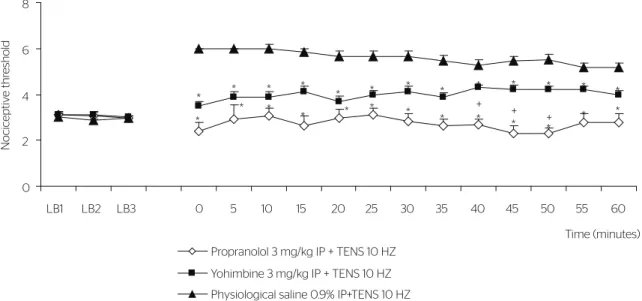
he same indings were seen with low frequency TENS. ANOVA showed statistical diference between the yohim-bine or propranolol treatments in the 3 mg/kg IP dose asso-ciated with 10 Hz TENS compared to the group treated with physiological saline at 0.9% 0.2 mL/kg IP associ-ated with 10 Hz TENS [F(2,16)=0.806 to 7.876; p<0.005]. Antinociception seen after using 10 Hz TENS in the group pre-treated with physiological saline also remained from 0 to 60 minutes (Figure 2).
Duncan post-hoc test showed a statistic diference between the group treated with yohimbine and the one treated with propranolol with 150 Hz TENS at 25, 30, 35, 45, 50, 55, and 60 minutes (p<0.05) (Figure 1).
Duncan post-hoc test showed a statistic diference between the group treated with yohimbine and the other
treated with propranolol with 10 Hz TENS at 40, 45 and 50 minutes (p<0.05) (Figure 2).
Figure 3 illustrates the absence of efects of the pre-treat-ment with yohimbine or propranolol in the 3.0 mg/kg dose on the nociceptive threshold. ANOVA of one pathway (one-way ANOVA) did not show a statistically sig-niicant efect [F(3,27)= 0.38; p<0.05]. Duncan post-hoc test showed absence of signiicance between the groups (p>0.05) (Figure 3).
DISCUSSION
his paper evaluated the noradrenergic participation in analgesia induced by TENS in laboratory animals. Several and diferent supraspinal descending inhibitory systems were identiied as able to modulate the spinal nociceptive transmission. With the ongoing investigation, places that were limited to structures of the mean line of mesencephalon and medulla increased. Recently, it is known that the solitary nucleus, locus coeruleus — sub-coeruleus and the lateral reticular nucleus have a role in the modulation of spinal nociceptive transmission6.
here are some evidences that injuries of an important origin of such pathways, the locus coeruleus, depress the persistent analgesia that follows tonic-clonic sei-zures, an efect that also seemed to depend on the par-ticipation of noradrenergic alpha- and beta-receptors7.
0 2 4 6
LB1 LB2 LB3 0 5 10 15 20 25 30 35 40 45 50 55 60
Time (minutes)
Nociceptiv
e thr
eshold
Propranolol 3 mg/kg IP + TENS 150 HZ Yohimbine 3 mg/kg IP + TENS 150 HZ Physiological saline 0,9% IP+TENS 150 HZ *
* *
* * *
* *
*
* *
* *
* *
*
* *
*
* *
*
* * * *
+ + +
+ + + +
Points represent the means of nociceptive thresholds measured in the diferent times; bars represent EPM. Nociceptive threshold, y axis, time (s). (*) Statistically significant efect (p<0.05) compared to the group pre-treated with physiological saline at 0.9% 0.2 mL/kg IP + TENS 150 Hz. (+) Statistically significant efect (p<0.05) compared to the groups pre-treated with yohimbine 3 mg/kg IP + TENS 150 Hz according to Duncan post-hoc test
Noradrenergic cells are highly distributed into the mes-encephalon and a substantial number of their neurons is in the locus coeruleus and has a signiicant descend-ing projection to the spinal medulla5,6,20. It might be a
possibility that the present results about antinocicep-tion induced by TENS have as their neural basis the noradrenergic pathway that was originated in the locus coeruleus, an important relay of the endogenous system of pain inhibition and of alpha-2 and beta noradrener-gic receptors. Results found support in recent indings,
which also suggest that alpha and beta-adrenergic receptors participate of the modulation of analgesia21-23.
Yohimbine, a drug that is commonly used for the antagonism of alpha-2 noradrenergic receptors7,8,17,24,25, is
a potent and selective alpha-2 adrenergic receptor antag-onist22. Yohimbine injections in the dorsal horn of the
spinal medulla resulted in antagonization of the antino-ciceptive efect of the stimulation applied in the periaq-ueductal gray substance26. his report suggests that not
only noradrenergic receptors of locus coeruleus, but also
Points represent the means of nociceptive thresholds measured in the diferent times; bars represent EPM. Nociceptive threshold, y axis, time (s). (*) Statistically significant efect (p<0.05) compared to the group pre-treated with physiological saline at 0.9% 0.2 mL/kg IP + TENS 10 Hz. (+) Statistically significant efect (p<0.05) compared to the groups pre-treated with yohimbine 3 mg/kg IP + TENS 10 Hz according to Duncan post-hoc test
Figure 2. Temporal course of the yohimbine and propranolol injection efect in the 3 mg/kg dose through intraperitoneal pathway (IP) on the nociceptive threshold, here represented by tail removal latency
0 2 4 6 8
LB1 LB2 LB3 0 5 10 15 20 25 30 35 40 45 50 55 60
Time (minutes)
Nociceptiv
e thr
eshold
Propranolol 3 mg/kg IP + TENS 10 HZ Yohimbine 3 mg/kg IP + TENS 10 HZ Physiological saline 0.9% IP+TENS 10 HZ
* * *
*
* * * * * * * * *
*
* *
* * * * * * *
*
* *
+ +
+
Points represent the means of nociceptive thresholds measured in diferent times; bars represent EPM. BL1, BL2 BL3 represent the three latency measures of tail removal from baseline (BL). Nociceptive threshold, y axis, time (s). Analysis of variance of a pathway showed absence of a statistically significant diference between the groups (p>0.05)
Figure 3. Temporal course of efect absence of yohimbine and propranolol antagonists administered at 3 mg/kg through intraperitoneal pathway (IP) on the nociceptive thresholds
0 2 4 6 8
BL1 BL2 BL3 0 5 10 15 20 25 30 35 40 45 50 55 60
Time (minutes)
Propranolol 3mg/kg IP + TENS (off)
Yohimbine 3mg/kg IP + TENS (off)
Physiological saline 0,9% IP + TENS (off)
Nociceptiv
e thr
of the dorsal horn of the spinal medulla may be involved in the antinociceptive processes.
It has been demonstrated that, depending on the dose, some alpha-noradrenergic receptor antagonists present local anesthetic efect27. Propranolol is the drug
chosen in several studies for the antagonism of beta noradrenergic receptors7,23,28,29. It is accepted that, in
addition to its classical non-selective antagonist action on beta-noradrenergic receptors, propranolol inhibits ionic currents of high and low tension activated by Ca2++ in low concentrations30 and, in higher
concen-trations, it moderately suppresses potassium currents31.
Nevertheless, in the present study, we considered that the propranolol efects happened due to their classi-cal antagonist action on beta-noradrenergic receptors, taking into consideration that propranolol manage-ment in the doses used in the present study did not change the basal nociceptive thresholds achieved by means of the tail removal test.
Some theories are proposed to explain TENS action mechanism4,17. In 1965, Melzack and Wall suggested the
existence of a kind of lood-gate in the medulla dorsal horn. According to this theory, some neurons would have the ability of suppressing the transmission of the painful signal of medulla dorsal horn, therefore clos-ing a hypothetical gate and inhibitclos-ing the passage of a painful impulse (Spinal Flood-gate heory)4,32. Spinal
and supraspinal mechanisms related to neurotransmit-ters and their receptors are involved in the mechanism of analgesia induced by TENS4,17. Recent data support
this theory, both for the low and for the high frequency of TENS33. Muscarinic and serotonergic receptors, and
opioids are activated by TENS in the spinal medulla and brainstem; peripherally, in the places of TENS applica-tion, alpha-2 noradrenergic receptors and opioids are involved in the analgesia induced by TENS14,34.
TENS efects of high and low frequency were seen in mutant rats that deprived alpha-2 adrenergic recep-tor. Analgesia induced by TENS both of high and low frequency was reduced in these animals compared to controls. Furthermore, a selective antagonist of the alpha-2 receptor (SK&F 86466) was intra-articularly administered, therefore analgesia induced by TENS was reversed; however, this result was not seen in intrathe-cal and intracerebroventricular administrations. Data suggest that alpha-2-receptor has some contribution for TENS antihyperalgesia. This result is in agree-ment with anatomic observations about the localiza-tion of alpha-2-receptors in primary aferent neurons
and macrophages next to the injured places14,15.
Non-involvement of spinal alpha-2 noradrenergic recep-tors in the analgesia of low and high frequency TENS was also veriied through intrathecal administration of yohimbine in Radhakrishnan et al.17 study. Spinal
sero-toninergic receptors participated of the antihyperalgic TENS process of low, but not of the high frequency one17. In the present study, involvement of alpha-2 and
beta noradrenergic receptors in the analgesia caused by TENS may have happened due to IP administration of antagonists. his method was chosen for allowing an initial and systemic veriication of the participation of alpha-2 and beta receptors in the modulation of noci-ceptive thresholds, since medicine used in this study are able to surpass the hematoencephalic obstruction, thus acting peripherally and centrally, and being used in studies on the antinociceptive process18,19,35.
Present results demonstrate involvement of alpha-2 and beta noradrenergic receptors after IP administra-tion of speciic antagonists in the antinociceptive process induced by TENS. hese indings allow us to suggest that electric therapy performed by TENS may be harmed due to the use of noradrenergic antagonists.
CONCLUSION
It might be possible that noradrenergic pathway and alpha-2 and beta-receptors participate of the analgesia modulation induced by TENS, since the administra-tion of yohimbine or propranolol through IP provided a reduction of the nociceptive thresholds with electrical stimulation in high or low frequency.
REFERENCES
1. Guimarães SS. Pelos meandros da dor. Mente e cérebro. 2008;16(188):36-55.
2. Novaes LHM. A dor: presença e papel no psiquismo humano. Rev Dor. 2007;8(2):981-2.
3. Dias S. A versão biológica da dor. Com Ciência [Revista Eletrônica de Jornalismo Científico] 2007 [citado 24 ago. 2012] Disponível em: http://www.comciencia.br/comciencia/?section=8&edicao=24&id=274
5. Yoshimura M, Furue H. Mechanisms for the anti-nociceptive actions of the descending noradrenergic and serotoninergic systems in the spinal cord. J Pharmacol Sci. 2006;101(2):107-17.
6. Jones SL. Descending noradrenergic influences on pain. Prog Brain Res. 1991;88:381-94.
7. Felippotti TT, dos Reis Ferreira CM, de Freitas RL, de Oliveira RC, de Oliveira R, Paschoalin-Maurin T, et al. Paradoxical efect of noradrenaline-mediated neurotransmission in the antinociceptive phenomenon that accompanies tonic-clonic seizures: role of locus coeruleus neurons and α(2)- and β-noradrenergic receptors. Epilepsy Behav. 2011;22(2):165-77.
8. Fairbanks CA, Wilcox GL. Moxonidine, a selective α2-adrenergic and imidazoline receptor agonist, produces spinal antinociception in mice. J Pharmacol Exp Ther. 1999;290(1):403-12.
9. Maher CG. Efective physical treatment for chronic low back pain. Orthop Clin North Am. 2004;35(1):57-64.
10. Kim DH, Cho SH, Song KH, Lee SE, Lee SH, Kwon GO, et al. Electroacupuncture analgesia for surgery in cattle. Am J Chin Med. 2004;32(1):131-40.
11. Kararmaz A, Kaya S, Karaman H, Turhanoglu S. Efect of the frequency of transcutaneous electrical nerve stimulation on analgesia during extracorporeal shock wave lithotripsy. Urol Res. 2004;32(6):411-5.
12. Morimoto HC, Yonekura MY, Liebano RE. Estimulação elétrica nervosa transcutânea nas modalidades convencional e acupuntura na dor induzida pelo frio. Fisioter Pesq. 2009;16(2): 148-54.
13. Sluka KA, Walsh D. Transcutaneous electrical nerve stimulation: basic science mechanisms and clinical efectiveness. J Pain. 2003;4(3):109-21.
14. DeSantana JM, Walsh DM, Vance C, Rakel BA, Sluka KA. Efectiveness of transcutaneous electrical nerve stimulation for treatment of hyperalgesia and pain. Curr Rheumatol Rep. 2008;10(6):492-9.
15. King EW, Audette K, Athman GA, Nguyen HO, Sluka KA, Fairbanks CA. Transcutaneous electrical nerve stimulation activates peripherally located alpha-2A adrenergic receptors. Pain 2005;115:364-73.
16. Sluka KA. The Neurobiology of pain and foundations for electrical stimulation. In: Robinson AJ; Snyder-Mackler L (eds). Clinical Electrophysiology. Philadelphia: Lippincott Williams & Wilkins; 2008:107-49.
17. Radhakrishnan R, King EW, Dickman JK, Herold CA, Natalie F. Johnston NF, et al. Spinal 5-HT2 and 5-HT3 receptors mediate low, but not high, frequency TENS-induced antihyperalgesia in rats. Pain. 2003;105(1-2):205-13.
18. Freitas RL, Ferreira CM, Ribeiro SJ, Carvalho AD, Elias-Filho DH, Garcia-Cairasco N, et al. Intrinsic neural circuits between dorsal midbrain neurons that control fear-induced responses and seizure activity and nuclei of the pain inhibitory system elaborating postictal antinociceptive processes: a functional neuroanatomical and neuropharmacological study. Exp Neurol. 2005;191(2):225-42.
19. Ferreira CMR. Estudo do envolvimento dos receptores noradrenérgicos alfa1, alfa2 e beta do sistema endógeno de inibição de dor nas alterações dos limiares nociceptivos induzidas por crises convulsivas isoladas e durante a fase silenciosa do status epilepticus e no modelo de kindling farmacológico [tese]. Minas Gerais: Faculdade de Medicina de Ribeirão Preto, Universidade de São Paulo, 2009.
20. Pertovaara A. Noradrenergic pain modulation. Progress in Neurobiology. 2006;80(2):53-83.
21. Kawasaki Y, Kumamoto E, Furue H, Yoshimura M. Alpha 2 adrenoceptor-mediated presynaptic inhibition of primary aferent glutamatergic transmission in rat substantia gelatinosa neurons. Anesthesiology. 2003;98(3):682-9.
22. Binder W, Mousa SA, Sitte N, Kaiser M, Stein C, Schäfer M. Sympathetic activation triggers endogenous opioid release and analgesia within peripheral inflamed tissue. Eur J Neurosci. 2004;20(1):92-100.
23. Saadé NE, Al Amin HA, Barchini J, Tchachaghian S, Shamaa F, Jabbur
SJ, et al. Brainstem injection of lidocaine releases the descending
pain-inhibitory mechanisms in a rat model of mononeuropathy. Exp Neurol. 2012;237(1):180-90.
24. Lalchandani SG, Lei L, Zheng W, Suni MM, Moore BM, Liggett SB, Miller DD, et al. Yohimbine dimers exhibiting selectivity for the human alpha 2C-adrenoceptor subtype. J Pharmacol Exp Ther. 2002;303(3):979-84.
25. Sahraei H, Ghazzaghi H, Zarrindast MR, Ghoshooni H, Sepehri H, Haeri-Rohan A. The role of alpha-adrenoceptor mechanism(s) in morphine-induced conditioned place preference in female mice. Pharmacol Biochem Behav. 2004;78(1):135-41.
26. Peng YB, Lin Q, Willis WD. Involvement of alpha-2 adrenoceptors in the periaqueductal gray-induced inhibition of dorsal horn cell activity in rats. J Pharmacol Exp Ther. 1996;278(1):125-35.
27. Morales Aguilera A, Vaughan Williams EM. The efects on cardiac muscle of beta-receptor antagonists in relation to their activity as local anaesthetics. Br J Pharmacol Chemother. 1965;24:332-8.
28. Tchivileva IE, Lim PF, Smith SB, Slade GD, Diatchenko L, McLean
SA, et al. Efect of catechol-O-methyltransferase polymorphism on
response to propranolol therapy in chronic musculoskeletal pain: a randomized, double-blind, placebo-controlled, crossover pilot study. Pharmacogenet Genomics. 2010;20(4):239-48.
29. Park DS, Seo BK, Baek YH. Analgesic efect of electroacupuncture on inflammatory pain in collagen-induced arthritis rats: mediation by alpha2- and beta-adrenoceptors. Rheumatol Int. 2013;33(2):309-14.
30. Akaike N, Ito H, Nishi K, Oyama Y. Further analysis of inhibitory efects of propranolol and local anaesthetics on the calcium current in Helix neurones. Br J Pharmacol. 1982;76(1):37-43.
31. Akaike N, Nishi K, Oyama Y. Inhibitory efects of propranolol on the calcium current of Helix neurones. Br J Pharmacol. 1981;73(2):431-4.
32. Melzack R, Wall PD. Pain mechanisms: a new theory. Science. 1965;19;150(3699):971-9.
33. Sluka KA, Walsh D. Trancutaneous Electrical Nerve Stimulation: Basic Science Mechanisms and Clinical Efectiveness. J Pain. 2003;4(3):109-21.
34. Sluka KA. The Neurobiology of pain and foundations for electrical stimulation. In: Robinson AJ; Snyder-Mackler L, editors. Clinical Electrophysiology. Philadelphia: Lippincott Williams & Wilkins; 2008:107-49.