Cop
yright
© ABE&M t
odos os dir
eit
os r
eser
vados
.
Normal values of serum
IGF-1 in adults: results from
a Brazilian population
Valores normais de IGF-1 sérico em adultos: resultados de uma população brasileira
Pedro Weslley Rosario1
ABSTRACT
Objective: To determine the normal values of serum IGF-1 (Immulite 2000) in a Brazilian adult (21-70 years) population. Subjects and methods: Healthy volunteers were divided into 10 groups according to age (5-year intervals), with 100 subjects (50 men and 50 women) per group. One-hundred participants were selected for repetition of the test after 12 weeks. Results: No difference in IGF-1 values was observed between men and women, but a progressive reduction of serum IGF-1 with age was seen. The reference values provided by the manufacturer of the assay, although discretely higher, were very close to the values found in this study. A second measurement of IGF-1 after 12 weeks revealed a variation ≤ 20% in 99% of subjects. Conclu-sions: This study established the reference range for IGF-1 determined with the Immulite 2000 assay for a large number of healthy Brazilian adults stratiied according to age, and suggests that variations > 20% in IGF-1 levels within an interval of 12 weeks cannot be attributed to inter-assay variability. Arq Bras Endocrinol Metab. 2010;54(5):477-81
Keywords
IGF-1; immulite assay; normal values; adults
RESUMO
Objetivo: Determinar os valores normais de IGF-1 sérico (Immulite 2000) em uma população adulta (21-70 anos) brasileira. Sujeitos e métodos: Voluntários saudáveis foram divididos em 10 grupos de acordo a idade (intervalos de 5 anos), com 100 indivíduos (50 homens e 50 mu-lheres) por grupo. Cem participantes foram selecionados para repetição do exame após 12 semanas. Resultados: Nenhuma diferença nos valores de IGF-1 foi observada entre homens e mulheres, mas uma redução progressiva do IGF-1 sérico com a idade foi vista. Os valores de referência fornecidos pelo fabricante do ensaio, embora discretamente maiores, foram muito próximos dos encontrados neste estudo. Uma segunda medida do IGF-1 após 12 semanas revelou uma variação ≤ 20% em 99% dos indivíduos. Conclusões: Este estudo estabeleceu os valores de referência para o IGF-1 com ensaio Immulite 2000 em um grande número de adultos brasileiros saudáveis e sugere que variações > 20% nos níveis de IGF-1 com intervalo de 12 se-manas não podem ser atribuídas à variabilidade interensaio. Arq Bras Endocrinol Metab. 2010;54(5):477-81
Descritores
IGF-1; ensaio immulite; valores normais; adultos
1 Programa de Pós-graduação,
Santa Casa de Belo Horizonte. Departamento de Neuroendocrinologia, Serviço de Endocrinologia, Santa Casa de Belo Horizonte, MG, Brazil
Correspondence to:
Pedro Weslley Rosario Programa de Pós-graduação, Santa Casa de Belo Horizonte Av. Francisco Sales, 1111, 9ºD 30150-221 − Belo Horizonte, MG, Brazil
Received on Jan/29/2010 Accepted on May/4/2010
InTRODUCTIOn
S
erum IGF-1 plays an important role in theevalua-tion of growth hormone (GH) deiciency and excess in adults. With respect to acromegaly, normal serum IGF-1 makes this diagnosis unlikely (1), whereas ele-vated IGF-1 is a suspicion of this condition, even when
provoca-Cop
yright
© ABE&M t
odos os dir
eit
os r
eser
vados
.
tive tests (4), deines severe GH deiciency [low IGF-1 (5)], and determines GH dose adjustments during therapy (4,5). In addition, epidemiological studies have associated serum IGF-1 levels with the risk of cardio-vascular disease and death and cancer (6).
Despite its importance, there is a lack of studies employing an adequate sample for the deinition of IGF-1 reference values using current assays. The only kit (Nichols Advantage) whose reference range was established in a large sample of different populations (7) is not longer available. To our knowledge, there is no study evaluating IGF-1 reference ranges in the Brazilian population. For example, in the case of the assay tested in the present study the reference values are derived from a German population (8).
Some recommendations need to be followed for the deinition of IGF-1 reference ranges. The values should be assay-speciic (9,10), should be reported according to age (7-16), and should preferentially be population-speciic (17). The sample from which these values are extracted should be of adequate size (7,9) and the subjects should be selected rigorously, exclud-ing conditions known to interfere with the levels of this hormone (6). It is also important to know which varia-tions in IGF-1 levels can be attributed to the treatment implemented or to progression of the disease and are not only due to interassay variability (18).
The objective of the present study was to determine the reference range for serum IGF-1 (Immulite 2000 kit) in a Brazilian adult (21-70 years) population and its intraindividual variability after an interval of 12 weeks.
SUBjECTS AnD METhODS
Volunteers of both genders (500 women and 500 men) from the metropolitan region of Belo Horizonte (Minas Gerais, Brazil), ranging in age from 21 to 70
years, with a BMI ≥ 18.5 and ≤ 30 kg/m2 (7) were
selected. The subjects were apparently healthy (with no diabetes mellitus, thyroid dysfunction, malignancy
or anemia, and no known or clinically suspected renal, hepatic or pituitary disease), eutrophic, and were not taking any potentially interfering medications (contra-ceptive drugs, estrogens, corticosteroids). The study was approved by the Ethics Committee of Santa Casa de Belo Horizonte.
In addition to clinical examination, all subjects were submitted to minimum laboratory assessment and only those presenting the following parameters
were included: fasting glycemia < 100 mg/dL, HbA1c ≤ 6%, hemoglobin ≥ 12 g/dL, serum albumin ≥ 3.5 g/dL, creatinine ≤ 1.2 mg/dL, TSH ranging from 0.5 to 4 mIU/L, ALT (alanine transaminase) and AST (aspartate transaminase) ≤ 40 U/L, and bilirubin ≤ 1.2 mg/dL.
Ten groups divided according to age [5-year intervals (7,8)] were pre-deined, with 100 subjects per group (6,17). Since the need of different reference values for men and women is not clear (6), each group was divided into two subgroups (50 men and 50 women). Each participant selected was allocated according to gender and age until completing the pre-deined number of subjects per subgroup.
For the evaluation of interassay variability, 100 participants (5/subgroup) were randomly selected for repetition of the test after 12 weeks. The absence of changes in health and nutritional status during this period was veriied and the selection criteria were reevaluated. This time period was deined based on the intervals recommended for the reassessment of IGF-1 after surgery and after the beginning or dose adjustment of medical therapy for acromegaly (19), and after the beginning or adjustments in the GH dose (4,5).
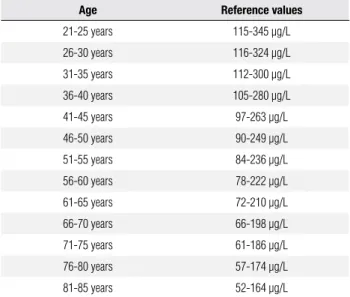
Serum samples were collected in the morning after a fast of approximately 10 h. The immunochemiluminescent assay (ICMA) used at various Neuroendocrinology Centers and Clinical Analysis Laboratories in Brazil was chosen [Immulite 2000, Diagnostic Products Corp., Los Angeles, CA; with an analytical sensitivity of 25 µg/L; intra- and interassay coeficient of variation < 8%; standards calibrated against the WHO IS 87/518 preparation (20); and the reference values provided by the manufacturer (8) are shown in Table 1]. The values obtained at our laboratory for 20 replicates of human serum containing 0 µg/L IGF-1 (standard zero
of the Immulite kit) presented ≤ 20 µg/L (analytical
sensitivity). For the analysis of imprecision, ive different samples (mean concentrations: 52, 128, 250, 516, and 901 µg/L) were processed in duplicate over the course of 20 days, two runs per day, for a total number of 40 runs and 80 replicates. Within-run coeficients of variation (CV) for the different levels were 5.1%, 4%, 3.2%, 4.1% and 4.8%. Total CV were 7%, 5.8%, 4.5%, 6% and 5.7%, respectively.
Cop
yright
© ABE&M t
odos os dir
eit
os r
eser
vados
.
Table 1. Reference values (mean ± 2 SD) provided by the Immulite kit
Age Reference values
21-25 years 115-345 µg/L
26-30 years 116-324 µg/L
31-35 years 112-300 µg/L
36-40 years 105-280 µg/L
41-45 years 97-263 µg/L
46-50 years 90-249 µg/L
51-55 years 84-236 µg/L
56-60 years 78-222 µg/L
61-65 years 72-210 µg/L
66-70 years 66-198 µg/L
71-75 years 61-186 µg/L
76-80 years 57-174 µg/L
81-85 years 52-164 µg/L
2) logarithmic transformation of the values obtained, calculation of the mean ± 2 SD of these values, and exponentiation to obtain the limits corresponding to the original scale (7-10,12). The Student t-test and Kruskal-Wallis test were used to determine differences between groups according to gender (10-12,14). The two-tailed Pearson correlation coeficient test was used to analyze the correlation between age and IGF-1 values in both genders (14) and between the irst and second measurement after 12 weeks (18). A p-value < 0.05 was considered to be statistically signiicant.
Table 2. Mean, median, lower (2.5th percentile, mean - 2 SD) and upper (97.5th percentile and mean + 2 SD) limit of IGF-1 (µg/L) according to age group
Age group percentile2.5th - 2 SD*Mean Mean Median percentile97.5th + 2 SD*Mean
21-25 years 111 110 195 197 334 336
26-30 years 109 108 187 190 310 312
31-35 years 106 106 178 178 287 290
36-40 years 102 100 168 169 265 267
41-45 years 95 95 165 163 250 253
46-50 years 87 86 145 145 240 243
51-55 years 81 80 137 137 220 222
56-60 years 75 75 129 127 207 210
61-65 years 68 68 120 121 197 201
66-70 years 65 65 110 110 185 188
* Of log-transformed values converted to the corresponding original value.
RESULTS
No signiicant difference in IGF-1 values was observed between men and women in any age group. The ma-ximum difference in the upper limit (97.5th percen-tile) was 7 µg/L (20 to 30 years) and the maximum difference in the lower limit (2.5th percentile) was 10 µg/L (21 to 25 years). Therefore, similar to pvious studies (7-14), the IGF-1 reference values are re-ported according to age group, without distinction be-tween genders (Table 2). The curves representing the 97.5th, 50th (median) and 2.5th percentiles of IGF-1 as a function of age are shown in igure 1. Pearson’s correlation coeficient (r) conirmed the negative cor-relation between age and IGF-1 levels both in the total sample of subjects [r = - 0.61 (p < 0.001)] and in the analysis by sex [r = - 0.65 in males (p < 0.001) and r = - 0.58 in females (p < 0.001)]. The upper and lower limits (mean ± 2 SD) provided by the manufacturer (Table 1), although discretely higher, were very close to those obtained in the present study.
0 50 100 150 200 250 300 350 400
20 25 30 35 40 45 50 55 60 65 70
Age (years)
Serum IGF-1 (ng/mL)
Figure 1. Curves representing the 97.5th, 50th (median) and 2.5th percentiles of IGF-1 as a function of age.
A second measurement of IGF-1 obtained after 12 weeks revealed a variation ≤ 20% in 99% of cases, ≤ 15% in 96%, and ≤ 10% in 75%. The correlation coeficient (r) was 0.91 (p < 0.001) despite this variability.
DISCUSSIOn
Cop
yright
© ABE&M t
odos os dir
eit
os r
eser
vados
.
antibodies, determine differences between assays. In fact, IGF-1 values obtained for the same sample with different assays can be highly discrepant (9,10). However, as long as the same commercial kit is used, the reference range, if adequately obtained, can be used by other laboratories. Next, we will discuss aspects regarding the establishment of IGF-1 reference values.
The size and selection criteria of the sample are important for the deinition of serum IGF-1 referen-ce range in adults. Massart and Poirier (9), studying treated acromegalic patients, found normal IGF-1 le-vels in only 31% (DiaSorin) and 36.5% (Immunotech) using the reference ranges provided by the kits. When adopting limits derived from a sample much larger than that used by the kit’s manufacturers for the deinition of reference values, the percentages increased to 54% (DiaSorin) and 61.5% (Immunotech) (9). Granada and cols. (10), evaluating adults with GH deiciency, obser-ved IGF-1 levels below the lower limit provided by the kits in 77.5% (Nichols) and 72.5% (Immulite) of the patients. However, when using limits derived from a signiicantly smaller sample than that used by the kit’s manufacturers to establish the normal reference range, these percentages decreased to 65% (Nichols) and 58% (Immulite) (10). These data show that sample size is fundamental for the reliability of the values suggested in the studies. Few studies have included such a large number of participants aged 20 to 70 years as has the present study (7). Furthermore, no other study has ap-plied the Immulite 2000 kit to such a large number of adults (8).
Different conditions can interfere with IGF-1 levels and exclusion of these conditions is an important step in the composition of the sample (6). Asymptomatic conditions such as subclinical thyroid dysfunction are not detected without appropriate laboratory investi-gation and can therefore inluence IGF-1 levels (22). Thus, in addition to clinical examination, laboratory criteria were adopted for inclusion in this investigation, an evaluation not routinely performed in previous stu-dies. The use of medications should also be investiga-ted carefully; for example, eventual differences between genders may in fact be due to the use of contraceptive drugs by women and not to true biological differences (7). Finally, extreme BMI values also inluence IGF-1 levels (23); thus, to establish normal reference values the sample should be restricted to subjects with a BMI
of approximately 20 to 32.5 kg/m2 (7,23) as was done
in the present study.
The progressive reduction in serum IGF-1 with in-creasing age in men and women seen in this study and reported in various other investigations (7-16) indica-tes the need for age-speciic reference ranges. Consen-sus exists regarding this aspect. However, inappropriate limits might be obtained when the subjects are divided into few and broad age groups since signiicant varia-tions in IGF-1 are observed within relatively short age intervals. We therefore adopted an interval of 5 years (7,8); nevertheless, differences > 20 µg/L in the upper limit between consecutive age groups were observed in the present study and have also been reported by other investigators (7,8,16).
In the present study, no difference in IGF-1 levels was observed between genders. Many other studies also failed to demonstrate such difference and their results were reported without distinction between genders (7-14). The hypothesis of a consistent and plausible di-fference between genders is also weakened by the fact that eventual small differences are not uniform, with some reporting higher IGF-1 levels in men or women depending on their age (10,15) or even on the assay used (10). In the largest study on this subject (7), sli-ghtly higher IGF-1 levels (without a signiicant diffe-rence) were observed in men, but the authors themsel-ves attributed this difference to the frequent use of oral contraceptives by the women participating in the study and suggested that there is no need for gender-speciic reference values. The exclusion of this interfering factor (use of contraceptive drugs) in the present study might have contributed to the closely similar IGF-1 values ob-served in men and women.
Cop
yright
© ABE&M t
odos os dir
eit
os r
eser
vados
.
found no difference between genders. These similarities support the adequacy of the reference range proposed here for the adult population when IGF-1 is measured by the Immulite 2000 assay. Nevertheless, a change of the current reference values (8) to those proposed in this study (discretely lower) will result in an increase in the number of patients with elevated IGF-1 and in a decrease in the number of those with low IGF-1, with an eventual change in the management of these cases whose IGF-1 values are reclassiied from normal to dis-cretely elevated or from low to normal.
Finally, reassessment of IGF-1 levels should be performed within 3 months after surgery and after the beginning or dose adjustment of medical therapy for acromegaly (19). A similar or shorter interval is recom-mended after the beginning of treatment of adult GH deiciency or adjustments in the GH dose (4,5). Thus, the period of 12 weeks used in this study for intrain-dividual measurements seems to be appropriate. The present results indicate that a variation > 20% cannot be attributed to assay variability alone. In contrast, Milani and cols. (18) reported variation > 20% in 12/84 sub-jects (14.3%) for measurements made within an interval of only 2 weeks, but no variation > 40% was observed.
In conclusion, this study has established the refe-rence range for serum IGF-1 determined with the Im-mulite 2000 assay in a large number of healthy Brazi-lian adult (21-70 years) subjects (n = 1,000) stratiied according to age (without distinction between genders due to similar values). The results also suggest that va-riations > 20% in IGF-1 levels within an interval of 12 weeks cannot be attributed to interassay variability.
Acknowledgements and disclosure: This study was supported by grants from Laboratórios Pizer Ltda.
REFEREnCES
1. Melmed S. Medical progress: acromegaly. N Engl J Med. 2006;355:2558-73.
2. Dimaraki EV, Jaffe CA, DeMott-Friberg R, Chandler WF, Barkan AL. Acromegaly with apparently normal GH secretion: impli-cations for diagnosis and follow-up. J Clin Endocrinol Metab. 2002;87:3537-42.
3. Freda PU, Reyes CM, Nuruzzaman AT, Sundeen RE, Bruce JN. Basal and glucose-suppressed GH levels less than 1 microg/L in newly diagnosed acromegaly. Pituitary. 2003;6:175-80.
4. Cook DM, Yuen KC, Biller BM, Kemp SF, Vance ML; American Asso-ciation of Clinical Endocrinologists. Medical guidelines for clinical practice for growth hormone use in growth hormone-deicient adults and transition patients. Endocr Pract. 2009;15(Suppl 2):1-29. 5. Molitch E, Clemmons DR, Malozowski S, Merriam GR, Shalet SM,
Vance ML, for The Endocrine Society’s Clinical Guidelines Sub-committee. Evaluation and treatment of adult growth hormone
deiciency: an Endocrine Society clinical practice guideline. J Clin Endocrinol Metab. 2006;91:1621-34.
6. Brabant G, Wallaschofski H. Normal levels of serum IGF-I: de-terminants and validity of current reference ranges. Pituitary. 2007;10:129-33.
7. Brabant G, von zur Mühlen A, Wüster C, Ranke MB, Kratzsch J, Kiess W, et al.; German KIMS Board. Serum insulin-like growth factor I reference values for an automated chemiluminescence immunoassay system: results from a multicenter study. Horm Res. 2003;60:53-60.
8. Elmlinger MW, Kühnel W, Weber MM, Ranke MB. Reference ran-ges for two automated chemiluminescent assays for serum insu-lin-like growth factor I (IGF-I) and IGF-binding protein 3 (IGFBP-3). Clin Chem Lab Med. 2004;42:654-64.
9. Massart C, Poirier JY. Serum insulin-like growth factor-I measure-ment in the follow-up of treated acromegaly: comparison of four immunoassays. Clin Chim Acta. 2006;373:176-9.
10. Granada ML, Ulied A, Casanueva FF, Pico A, Lucas T, Torres E, et al. Serum IGF-I measured by four different immunoassays in pa-tients with adult GH deiciency or acromegaly and in a control population. Clin Endocrinol (Oxf). 2008;68:942-50.
11. Ghigo E, Aimaretti G, Gianotti L, Bellone J, Arvat E, Camanni F. New approach to the diagnosis of growth hormone deiciency in adults. Eur J Endocrinol. 1996;134:352-6.
12. Hilding A, Hall K, Wivall-Helleryd IL, Saaf M, Melin AL, Thoren M. Serum levels of insulin-like growth factor-I in 152 patients with growth hormone deiciency, aged 19-82 years, in relation to those in healthy subjects. J Clin Endocrinol Metab. 1999;84:2013-9. 13. Nyström FH, Ohman PK, Ekman BA, Osterlund MK, Karlberg BE,
Arnqvist HJ. Population-based reference values for I and IGF-binding protein-1: relations with metabolic and anthropometric variables. Eur J Endocrinol. 1997;136:165-72.
14. Aimaretti G, Boschetti M, Corneli G, Gasco V, Valle D, Borsotti M, et al. Normal age-dependent values of serum insulin growth factor-I: results from a healthy Italian population. J Endocrinol In-vest. 2008;31:445-9.
15. Landin-Wilhelmsen K, Lundberg PA, Lappas G, Wilhelmsen L. Insulin-like growth factor I levels in healthy adults. Horm Res. 2004;62(Suppl 1):8-16.
16. Vierhapper H, Heinze G, Gessl A, Exner M, Bieglmayr C. Use of the oral glucose tolerance test to deine remission in acromegaly. Metabolism. 2003;52:181-5.
17. Donangelo I, Une K, Gadelha M. Diagnóstico e tratamento da acro-megalia no Brasil. Arq Bras Endocrinol Metab. 2003;47:331-46. 18. Milani D, Carmichael JD, Welkowitz J, Ferris S, Reitz RE, Danoff A,
et al. Variability and reliability of single serum IGF-I measure-ments: impact on determining predictability of risk ratios in dise-ase development. J Clin Endocrinol Metab. 2004;89:2271-4. 19. Growth Hormone Research Society; Pituitary Society.
Biochemi-cal assessment and long-term monitoring in patients with acro-megaly: statement from a joint consensus conference of the Gro-wth Hormone Research Society and the Pituitary Society. J Clin Endocrinol Metab. 2004;89:3099-102.
20. Bristow AF, Gooding RP, Das RE. The International Reference Rea-gent for insulin-like growth factor-I. J Endocrinol. 1990;125:191-7. 21. Ranke MB, Feldt-Rasmussen U, Bang P, Baxter RC, Camacho-Hübner
C, Clemmons DR, et al. How should insulin-like growth factor I be me-asured? A consensus statement. Horm Res. 2001;55(Suppl 2):106-9. 22. Akin F, Bastemir M, Yaylali GF, Alkis E, Kaptanoglu B. GH/IGF-1
axis in patients with subclinical hypothyroidism. Clin Endocrinol (Oxf). 2008;68:1009-10.